THE DOCTOR WHO RATINGS GUIDE: BY FANS, FOR FANS
| Story No. |
300 |
|
| Production Code |
Series 10, episode 11
|
| Dates |
June 24,
2017
|
With Peter Capaldi
Written by
Steven Moffat
Directed by
Rachel Talalay
Executive Producers: Steven Moffat, Brian Minchin.
|
|
Synopsis: The TARDIS lands on board a spaceship trying to escape a black hole.
|
Reviews
A Positive Attitude Will Help with the Horrors to Come by Niall Jones
19/7/25
One thing that we learn about the Twelfth Doctor in World Enough and Time is that he doesn't like bacon. When Bill raises Missy's predilection towards murder as a reason why she shouldn't be allowed to go on her own adventure in the TARDIS, he instructs her to 'go tell a pig about your moral high ground'. After all, your bacon sandwich had a mummy and a daddy too. It's the kind of unsentimental but fundamentally moral statement we've come to expect from Peter Capaldi's more alien Doctor. In the context, however, it is also unsettling. The Doctor's vegetarian sympathies might well show up Bill's hypocrisies as a meat eater, but does he really not care any more about a human's life than a pig's? Similarly, his refusal to guarantee that he won't get her killed may show a disarming level of honesty, but it provides cold comfort when things inevitably go wrong.
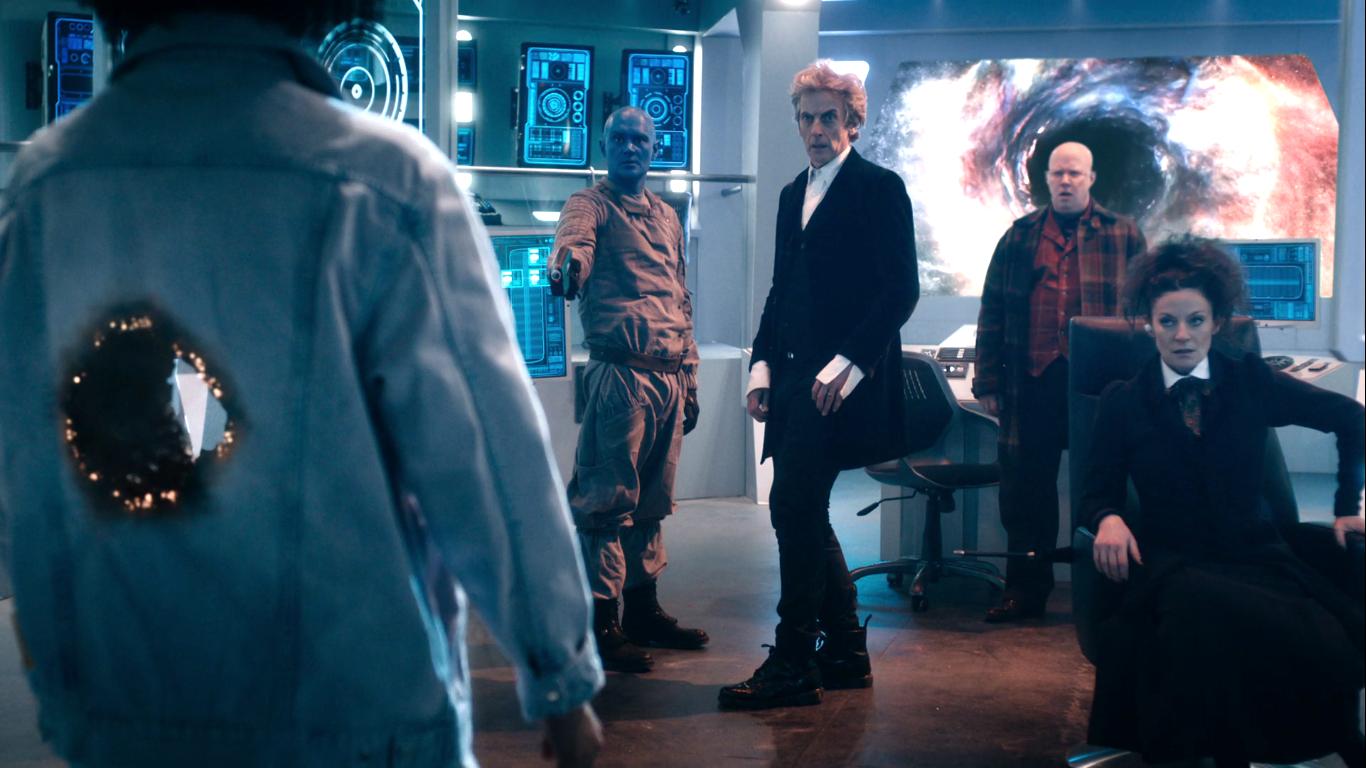
That this conversation appears as a kind of flashback immediately following Missy, Bill and Nardole's 'adventure' creates a horrible sense of irony. The scene in which Bill gets shot is one of the most shocking in Doctor Who's history. It's not just the speed with which it happens, occurring less than ten minutes into the episode, nor even that it is so gruesomely visceral. What ultimately makes this moment so chilling is the way it is directed. The initial focus is on Bill's face, capturing her shock, before moving to the Doctor. The camera zooms in on his eyes and he slowly turns towards Bill. The focus then switches to Bill's face and we see the disbelief and horror in her expression as she looks down and sees the gaping hole in her chest for the first time. It's an immensely powerful piece of filmmaking that seals Rachel Talalay's reputation as one of the show's all-time great directors. By focusing on the actor's faces, the camera captures the emotional significance of the scene. Bill's shooting represents a colossal failure of the Doctor's duty of care towards his companions, while the expression on Bill's face is not just disbelief at what has happened but also that the Doctor has allowed it to happen.
Part of what makes the Doctor's failure here interesting is that it is rooted in his status as a Time Lord. While this is in no way a new idea --- it's not for nothing that Russell T Davies had the Tenth Doctor refer to himself as 'The Time Lord Victorious' in The Waters of Mars --- the way in which Steven Moffat explores this theme in World Enough and Time is different. For Davies, the Doctor's status as a Time Lord has always been a source of mythic wonder and terror. For Moffat, however, the Doctor's alienness manifests itself in smaller, more personal ways.
In particular, it is his desire to rekindle an old friendship that brings everything crashing down. At St Luke's University, the Doctor tells Bill that Missy's 'the only person I've ever met who's even remotely like me'. For Bill, and likely many viewers, it may seem a strange thing to say. Beyond both being Time Lords, how can the man who saves people be anything like the self-professed 'queen of evil'? The brilliance of Missy's characterisation, and Michelle Gomez's gleeful performance, however, is that it is just about possible to see the truth in the Doctor's statement. Missy may be chaotic, violent and selfish, but she's also fiercely intelligent and witty. When called on to play the Doctor, she does a surprisingly good job, quickly identifying the nature of her predicament --- and managing not to kill anyone in the process. What makes Missy such a brilliant character --- and the best incarnation of the Master --- is that, for all her wickedness, she doesn't come across as evil, more amoral. As a result, the Master ceases to be the Doctor's archenemy and becomes instead his dark mirror, a vision of a conscienceless Doctor.
The Doctor's desire to rekindle their friendship by making Missy more like him also parallels Missy's plan in Death in Heaven, highlighting the extent to which World Enough and Time reiterates that earlier story. What makes the latter story different, however, is the possibility that, for once, the feeling might be mutual. Missy's comment that 'Time Lords are friends with each other', implicitly raises the possibility of friendship with the Doctor. Nevertheless, this statement has a sting in its tail, as she follows it up by adding that 'everything else is just cradle snatching'. This implies that there is an unstated 'only' in her first statement: Time Lord friendship is exclusive. Not only is there no space for humans, relationships with humans (or any other 'lesser' species) are inherently wrong.
This highlights one major difference between the Doctor and Missy: the way in which they treat their companions. For Missy, they are 'my disposables: exposition and comic relief', offering up a metafictional critique of companions as little more than functional devices --- a trap that Chris Chibnall would fall into during his time as head writer. Although World Enough and Time centres around the failure of the Doctor's duty of care towards Bill, it is clear throughout that he feels hugely responsible for her. When, back at St Luke's, the Doctor bemoans how breakable humans are, he's clearly teasing, but it's also clear that he cares deeply about her. Like Missy, he acknowledges that humans are not like Time Lords, but, for him, this makes them valuable, not disposable.
The parallels between World Enough and Time and Death in Heaven highlight an underdiscussed element of Steven Moffat's writing style. Despite his reputation for complex timey-wimey plotting, he's often not particularly original, stealing ideas from other writers, Doctor Who's past and his own back catalogue. To be clear, this is not intended as a criticism; after all, T.S. Eliot is often quoted as saying 'good writers borrow, great writers steal.' What matters most is how these ideas are used, and Moffat can be relied on to find new and interesting takes on old concepts.
Perhaps the most obvious similarity between the finales of Series 8 and 10, however, isn't Missy, but the triumphant return of the Cybermen. As with Dark Water, the Cybermen aren't properly revealed until the very end of the episode; instead, the story ratchets up a sense of dread through dramatic irony, as the audience works out what is going on before any of the characters. Holding back their reveal also helps to resolve a problem peculiar to the Cybermen: that, despite their iconic status within Doctor Who, they are incredibly hard to write well. They may be classic monsters, but there are relatively few classic Cybermen stories. The reason for this largely stems from a disconnect between the way the Cybermen were initially envisioned and the way in which they have too often been realised. Kit Pedler may have intended them as a cautionary tale about medicine going too far and creating humans purged of their humanity, but they have too often been presented as just another set of stompy robots.
By reverting back to the original Mondasian design from 1966's The Tenth Planet, World Enough and Time not only signals its intention to explore the ideas behind the Cybermen but also provides them with an origin story. In fact, the episode spends as much time exploring the circumstances that created the Cybermen as it does the Cybermen themselves. The world in which Bill finds herself after being separated from the Doctor is a dying world, one in which the only means of survival is conversion, while the hospital setting further emphasises the Cybermen's medical origins. For most of the story, however, there are no Cybermen, only 'special patients'. These 'special patients' --- partly converted humans --- are a source of horror, but also of pity. The scene in which Bill turns the volume up on one of the patient's speaking devices, only to find it repeating the word 'pain' over and over again and reacts by apologising and turning it down again is particularly disturbing, as it reflects the human instinct to look away from suffering and pointedly avoids offering simple solutions.
By separating the Doctor and Bill and having much of the plot revolve around her, the episode highlights the extent to which World Enough and Time is Bill's story. It may be about the Doctor's failures, but the focus is on their painful consequences for Bill. She acts as the soul of the story, seemingly vindicated in her scepticism towards the Doctor's plan.
The fact that the Doctor fails his companion at the very beginning of the episode is at the heart of what makes World Enough and Time so powerful. It's a tragedy in which the central event happens first, meaning that the rest of the episode --- as well The Doctor Falls --- is spent exploring its consequences. In Doctor Who terms, it's the opposite of an episode like Doomsday or Journey's End, in which a late tragedy is the price of victory.
By foregrounding Bill's shocking fate, the episode also emphasises that its focus is very much on its central characters, which is further emphasised by its limited setting and small cast. Like the other Twelfth Doctor season finales, World Enough and Time is a personal epic, its stakes drawn from the pressure that events exert on the Doctor and his companion's relationship, rather than on the scale of the threat posed to the Earth/the universe/time itself.
While the return of the Mondasian Cybermen may be the main draw for viewers, it is the relationship between the Doctor and Bill that lies at the heart of the story. Although The Doctor Falls will ultimately soften the blow, the fact that Bill's tragic fate comes as a direct result of his hubris shatters the illusion of security that travelling with the Doctor brings. Moffat's script may take the story to some incredibly dark places, but it does so with humour and a lightness of touch that prevent it from feeling unrelentingly grim. Typically strong performances from Peter Capaldi, Pearl Mackie and Michelle Gomez also help to make the episode as good as it is. Add in Rachel Talalay's astonishing direction and a cliffhanger that provides a double gut-punch, and you undoubtedly have one of the greatest Doctor Who episodes of all time.