THE DOCTOR WHO RATINGS GUIDE: BY FANS, FOR FANS

|
BBC
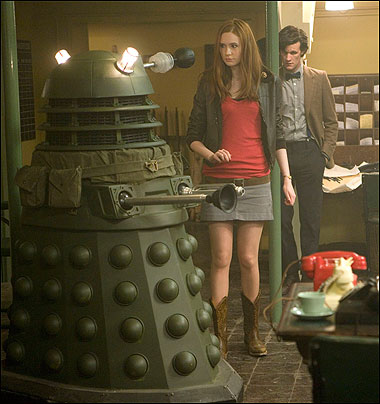
Victory of the Daleks
|

|
| Story No. |
222 |
|
| Production Code |
Series 5, Episode 3
|
| Dates |
April 17
2010
|
With Matt Smith,
Karen Gillan
Written by
Mark Gatiss
Directed by
Andrew Gunn
Executive Producers: Steven Moffat, Piers Wenger, Beth Willis.
|
|
Synopsis: Winston Churchill summons the Doctor, because the
Daleks have offered to help win the war.
|
Reviews
A Review by Gavin Smith
20/4/10
Like the other scripts by Mark Gatiss, Victory of the Daleks
seems to be more about style than about substance. But that doesn't mean I
didn't enjoy it.
Ok, I have a problem with the Daleks. They've turned up... again. As
the Doctor's number one enemy, the Daleks are only really effective when
they creep in on him and the audience. Admittedly, I liked the bit at the
start where one says "I am your soldier"; an allusion to the end of
episode two of Power of the Daleks? Nevertheless,
here they are, perhaps the fifth "lone" Dalek ship to have escaped their
mishmash of final defeats by "falling through time". That is seriously
starting to annoy me. If the Daleks are going to be the adversary, they
need substance! Also, their plan is rubbish. It is inherently clear from
the start what they are trying to do. Daleks in
Manhattan, for all its flaws, was a story worthy of the great space
dust bins because it featured them trying something relatively new; not
completely new, as similar things had been tried in Evil
of the Daleks and Revelation of the Daleks.
Here, they are one step away from regenerating their race through some
sci-fi, dues ex machina idea that was probably borrowed from Russell T.
Davies. Also, the Cult of Skaro stand-ins look like bath toys.
Now for everything else...
The TARDIS crew are on form. Matt Smith reminds me of Patrick
Troughton, not just in appearances but also through his mannerisms. He is
not, to my delight, completely above being outwitted by those around
him. Neither is
he completely above being bailed out by his friends; he and Amy have to
work from either side of the same problem before finally working directly
together to solve it. I like those episodes where the Doctor clearly would
not have survived had it not been for his companion: Rose, Turn Left. Whereas David
Tennant often seemed like a one-man show that quickly got annoying but
just wouldn't stop, here we have a couple of more believable - and in my
opinion more likeable - adventurers who complement each other well. It was
also good to see Matt Smith get a personnal confrontation with the Daleks.
I liked the concept behind Professor Bracewell. Ok, it got a bit hammy
when they were defusing the bomb but that was one thing about the Daleks
that was quite fresh.
Now, this is a negligible point, but it has captured my attention. The
revived series is very proud to establish itself as a British show. If
there was one thing I learned from The Idiot's
Lantern, it is that Mark Gatiss loves his Union Jacks - or Union Flags
as he has Billie point out. More interesting, however, is the show's
efforts to encompass the wider United Kingdom, though it seems to have
forgotten Northern Ireland and Cornwall. Winston Churchill very much
embodies this identity, well portrayed by the guy who played Baron
Harkonnen in Dune. Churchill's legacy is an interesting one; these days
it's really quite partisan: Gallipoli, Dresden, eh Winston? The British
stuff I'm fine with, though I imagine it may become annoying for other
viewers, particularly those in other countries.
In conclusion, despite a lack of depth - compared to the last two
episodes at least - Victory of the Daleks provides a sweet burst of
adrenaline early in the series, hopefully upping the overall pace.
A Review by Paul Mackie
15/5/10
It's time to put the Daleks to bed for a good long time. Victory of
the Daleks makes this abundantly clear. Like The
Stolen Earth/Journey's End and Daleks in
Manhattan/Evolution of the Daleks before it, Victory is another
plot-hole-riddled outing for the pepperpots. You've seen this plot before
and you've seen it done better, and I for one don't want to see the Daleks
back unless they come with an original and satisfying plot.
What's particularly annoying about Victory is that, for the
first 15 minutes or so, it really is a different kind of Dalek story. We
share the Doctor's curiosity and irritation with the "Ironsides", whose
ruse is consistently amusing for as long as it lasts. Ian McNeice is
entertainingly hammy as Churchill, enunciating every line as though
posterity is watching. The Doctor is so bothered that it seems the Daleks'
plan is just to get him to lose his cool, which it is, and he does.
Smith's more physical performance, as opposed to Tennant's wild-eyed line
readings, makes for a tremendously funny freakout scene.
But then it all breaks down, and quickly at that. The Doctor walks
straight into the Daleks' trap, which makes very little sense in the first
place; is that really the only way the "corrupted" Daleks could identify
themselves? Far be it for me to question Dalek racial science, but
couldn't there be some other phrenological test that didn't involve the
Daleks' worst nemesis and most dangerous threat?
Of course, the Daleks haven't always made sense, and the story could
easily have been redeemed if the proceedings from then on hadn't been such
trash. The Doctor exposits while holding the Skittle Daleks at bay; Smith plays the reveal beautifully, but otherwise this is the
same old scene we've seen in each and every Dalek episode of the new
series. Spitfires in Space; well, it looked great in the trailers, anyway,
but it comes off as unnecessary and has too much distracting illogic to
work, even on Doctor Who.
Worst of all is the oblivion bomb: specifically, how it's defused. For
the second week in a row, wonderful companion Amy Pond saves the day. But
talking to a living bomb; I mean, what good could that possibly do? Why
would the Daleks, the most cruel and sadistic of Who villains, give
their bomb the ability to defuse at all? Why even bother with the whole
London business when they could have just as easily set off
the oblivion bomb in the first place; to get the Spitfire setpiece in? Why
bother with Bracewell at all? Why not just trap the Doctor some other way? Why would an
intelligent, calculating race like the Daleks have so many moving parts in
such a simple plan?
Season 5 has been better than this, for the most part, but boy, this is
the kind of wall-banging script that I hoped had gone out of style with
Davies' departure. The Doctor and Amy remain likable enough to carry even
this pile of crap and make it fun while you're watching it, but it's just
not worth the logic hangover. The only real redemption here is the brief
notes of foreboding about Amy. Undoubtedly
this will play into the finale. Too bad the other 2/3rds of Victory
is straight garbage.
A Review by William Adam Sinclair
2/8/10
I am honestly incredibly sad that my first negative review must be of a
story from the Matt Smith era, an era that, so far, has managed to deliver
imaginative stories full of energy and wit every week and that the episode
was also written by my second favorite (to Moffat) Who writer, Mark
Gatiss. If you look at my review of The Stolen
Earth/Journey's End, you will know that I enjoyed it. However, I did
notice that the Daleks were beginning to become a bit pathetic in the way
they could be beaten by the flick of a few buttons. This story looked like
it could have revamped the Daleks and made them scary again. Sadly, it
didn't.
The episode starts extremely well with the Doctor and Amy landing in
the cabinet war rooms. They are greeted by Winston Churchill who takes
them to see his new weapon. I would like to note that in making it that
Winston and the Doctor know each other already Mark Gatiss has managed to
save a lot of time, no "who is this intruder?!" or psychic paper they
merely have some delightful banter in which we find out that Winston and
the Doctor are very close friends indeed! We then meet Criswell, the
"creator" of the new weapon. As you may have guessed by now the new weapon
is of course a Dalek.
The Daleks are tricking Winston into believing they are called
"Ironsides" and were invented by Criswell to win the war. The Doctor is
obviously annoyed about this and warns Churchill that they are Daleks and
are deadly. This is where the episode is at it's best, it really does feel
like this should have gone on for a lot longer but alas this is only 15
minutes of the episode before we are launched into a cartoonish romp with
absolutely no redeeming factors.
When no one believes the Doctor, he complete and utterly loses it and
starts pummeling the Dalek with a comically oversized spanner. This scene
is incredibly well done and is rather unsettling to watch. Then the Daleks
show they're true nature and exterminate two red shirts/soldiers (with no
concern from any of the main characters except for Chriswell) and promptly
reveal that Criswell is in fact an android before teleporting back to
their ship. And here we have it! After 15 minutes of careful plotting and
tension building, we suddenly have this cartoon of an episode that does
nothing but cement the fact the Daleks are no longer scary at all.
After some rather shit exposition about some random plot device (yeah I
know "progenitor" but the writers obviously didn't put any thought into it
at all so why the hell should I care?!) the new merchandise emerges! Six
new, rubbish-looking Daleks! When I saw this scene, I felt like I was
watching an incredibly high-budget toy commercial! I could just imagine
someone saying "now in new colors, buy them now!!!" Me and my friends have
had many a laugh at how rubbish the new Daleks look. Some of us say
"Teletubbies", others say "power rangers". Now, to be fair, they don't
look half as bad as most people say but they are just a huge step down
from the masterfully designed bronze Daleks we have had for the past few
seasons.
There is an attempt to make us care about Chriswell but we don't really
care seeing as how we've only known him for around 17 minutes! I really
think this should have been a two parter. It would have given the episode
time to flesh out the characters (and also the awesome concept of the
Daleks infiltrating the cabinet war rooms); as it is, however, it really
doesn't work. I am not even going to start talking about the sheer
stupidity of the spitfires in space sequence. It would've been awesome if
they had given us a proper explanation as to how the hell they were built!
I know I'm a nerd for nitpicking like that but it just really annoys me!
And so it all gets rounded up in the most idiotic way possible and
we're done. Thank God that's over! Now I would like to stress that for the
most part I have loved season five of New Who (and New Who
on the whole) but this episode just seems like wasted potential. I really
do feel bad for bashing the new series like this, seeing as how I normally
get annoyed by people who do that. Therefore, I promise that my next
review of the new series will be good! Hmm, perhaps I might review The Eleventh Hour?
Failure of the Daleks by Richard Evans
12/10/10
What does anger actually feel like? According to Davros' Dalek Supreme
(Journey's End), "anger, sorrow, despair" is
experienced by the Doctor after an apparently catastrophic setback. The
truth of the matter is that "anger" equates to having suffered the
insulting Victory of the Daleks.
My Time Lord instinct (it's in my guts, so I know what I'm talking
about) immediately indicates if I feel good or not at any particular time.
After watching the credits roll on the Eleventh Doctor's ridiculously
early Dalek encounter, I was truly fuming as, for every little thing the
story did right, it erred at least twice.
The initial set-up, concerning the Cabinet War Rooms and a prematurely
confident Churchill, is promising enough; the historian in me had to
admire the apt set pieces, even if what I have seen in the actual War
Rooms is incredibly dissimilar. We finally get a look inside a Dalek
saucer - and that comes across incredibly strongly, not to mention as a
welcome contrast to the motherships of The Parting
of the Ways and Journey's End. Mark
Gatiss slips in at least one thoughtful throwback to The Power of the Daleks, furthering the parallels
between the Eleventh and Second Doctors, but these are rather irritating,
because it is too clear that Victory of the Daleks as a whole has
been engineered around these referential one-liners.
This has a temporary side-effect of regressing the Daleks to the
sympathetic beings they were in the Hartnell era, with a highly
compromised sense of menace and believability. The Doctor is
understandably frustrated at their uncharacteristic ways, because I
definitely was (these are the same monsters that attempted to destroy
absolutely all alien life in their previous appearance). On the plus
side, the conversation between the Time Lord and Prime Minister, in which
the former addresses his loathing for the Daleks, gives Matt Smith an
instantaneous moment of brilliance: shutting his companion up when she has
reasonable grounds to doubt him. Despite David Tennant's exit, the
Doctor's long-standing arrogance is sustained, and that can only be
commended.
Such is only an instantaneous blip in a dismally conceived,
inconsistent misfire. The whole plot structure is illogical and messy,
with the latter half of the episode completely failing to ignite my
appreciation of the Daleks. Following the activation of their unusual
plan of attack, nothing much happens, with both the villains and the
supposed superhero standing still and watching too many inadequacies
materialising in the story. Smith is not a convincing enemy for the
monsters from Skaro, partly due to his embarrassing tendency to pelt them
with empty threats at the top of his voice. In a sci-fi cliche which, by
now, has become unbearably predictable, one sequence sees a respected
named character and two unknowns going off to do some good work, only for
the unknowns to perish between long pauses and the named man to make it
out alive. Even while this is going on, the Daleks don't seem to know what
they are trying to achieve, making everything awfully aimless. Eventually,
the climax arises and Gatiss throws in an over-familiar ultimatum -
another instance of a plot point being thrown in at the last minute with
no evident consideration - the realisation of which does not gel with what
has gone before it. The net result is the wimpiest ending I can think of,
as well as the least stirring and satisfying, and one that cemented my
fury.
Victory of the Daleks not only contains too many spoken and
visual elements that Doctor Who has seen already in recent years,
but many components of the whole thing make no sense at all. If there
exists a test for logic that works much like an IQ test, the people
responsible for this episode have just failed it. What's with the planes
flying over London in broad daylight? If these aircraft are British, why
is Churchill organising their destruction? Were there really zeppelins
overlooking the city in the months of the Blitz, or is their presence a
rotten attempt to remake Rise of the
Cybermen? How have two Daleks managed to change their colour to khaki
since we last saw them? Above all, I cannot and will never stop feeling
violently dejected thinking of Matt Smith's false mood swing in the
closing minutes (he is told by one of his fellows, "but you [did something
very good just now]" and sheds his shame ridiculously). The very presence
of these Daleks contradicts a comment made by Dalek Caan two years
earlier, and the explanation of how they made it to London in 1941 is
beyond lazy.
Perhaps the final nail in the coffin for Victory of the Daleks
is a pointless, ill-advised jest from Amy Pond to Churchill, who proves
herself to be pleasingly resourceful in every other scene: "Oi,
Churchill!" The same line is heard in a large number of Churchill
Insurance adverts, which (thanks to their brutish bulldog mascot)
petrified me to death when they were aired. Accordingly, its use in
Victory of the Daleks strikes all the wrong notes. To this day, I
am mesmerised that nobody else seems to have made this link; or maybe it
was utterly unintentional. If the latter is the case, Mark Gatiss is
acquitted on this charge, but this does not relieve him of the remaining
shameful sins committed by the episode.
I haven't even mentioned the one major thing about Victory of the
Daleks that sets it so lowly in the appreciation of myself and
everyone else. There's no point in doing so; I would prefer to leave this
infuriating error to burn, along with nothing else but The Two Doctors, in the archive of the most utterly
pointless Doctor Who stories.
Tin Soldiers by Mike Morris
29/1/11
Now, it wouldn't be fair or right to say that I resent Mark Gatiss'
success. I don't, not in the way that I get infuriated by the continued
career of Chris sodding Chibnall. After all, Gatiss was part of the League
of Gentlemen, and the League of Gentlemen was a wonderful piece of work
that understood narrative and grotesquery. Plus he was involved with the
new remake of Sherlock, which turned out to be quite good, even if Gatiss
himself wasn't very good in it.
Ah. There's the rub; much of what Gatiss does can, truth be told, be
filed under the "not very good" category. There's always been a nostalgia
to his Who work, which gave him a decent fan base back in the days
of the Rad vs Trad fan-wars, and culminated in the curiously over-the-top
acclaim given to The Unquiet Dead. Turns out that
fandom's as enamoured with Victoriana as Gatiss is, then.
Say it quietly, but The Unquiet Dead was never
really that good, and it looks worse now than it did on release. The
script has some sharp moments, and I still maintain that the prettified
production is more of a problem than the rather witless conclusion to the
story (I called the script godawful lately, which probably wasn't fair),
but it's not much of a story once you get past the "ooh, it looks a bit
like Talons" factor. The Idiot's
Lantern was less acclaimed but possibly better, although the last ten
or fifteen minutes badly lets down the creepy moments in the first
half-hour. And then, two not-very-good stories under his belt, Gatiss gets
to write a Dalek story. With Winston Churchill in it. How the hell did he
wangle that?
(Okay, I so maybe I do resent his success a bit.)
And, like every other story Mark Gatiss has written, this one isn't
very good. It pootles along at the level of ordinariness for some time,
and then descends into awfulness for the last fifteen minutes or so. This
isn't a new phenomenon for a Gatiss story; he seems unable to come up with
plots that end themselves, or to work them sufficiently through so that
they have a natural resolution, and so the conclusions always seem
tacked-on. So in The Unquiet Dead, the Gelth are
revealed to be evil and numerous, pretty much invalidating the preceding
half-hour; in The Idiot's Lantern, a bloke ends up
climbing an aerial with Maureen Lipman for no readily discernible reason.
Here, the Daleks have pretty much done what they have to do after half an
hour, and the rest is taken up with Spitfires-in-space that are nowhere
near as thrilling as they ought to be.
Ah yes, Daleks. The premise here is rather wonderful; the Daleks and
Churchill form an alliance! The Daleks get to say "would you like some
tea?"! Some absent-minded professor claims he invented them! The Doctor,
and only the Doctor, knows that something's wrong!
Does it work? Well, partly, although the bits that do work are a blend
of Evil of the Daleks and the clockwork Daleks from
Rob Shearman's audio drama, Jubilee. The Daleks
themselves are suitably menacing, and their wartime paint-job looks great.
And while Karen Gillen is doing a bit too much of her pouting-and-flirting
act with the soldier lads to engage interest, Smith is as great as always.
In fact, it's Churchill who disappoints most. He smokes cigars and
spouts wartime rhetoric. That's... it. There's a couple of hints of a
slightly ambivalent relationship between him and the Doctor - his grab for
the TARDIS key, say - but this is a cartoon of a character, with none of
the depth of the real historical figure. Mark Gatiss said in interview
that he'd decided that "Doctor Who isn't the place for that kind of
conversation" and forgive me if my response is predictable, but... why the
hell not? If Doctor Who has done anything in its long history of
the celebrity historical, it's humanise its subjects. Ultimately it's
about entertainment over education, but who's a more entertaining
character; an alcoholic, imperialistic egotist with brilliant oratory
skills and surprising passions (Churchill painted quite well, for example)
whose qualities were exactly what were needed in extremis, or a
cigar-chomping caricature who never once comes close to being a believable
human being? Dammit, when he wrote a wearying Charles Dickens at death's
door, at least Gatiss was trying.
As for the Daleks themselves... once you get past the initial joy of
the premise... what exactly are they doing, anyway? They need what appears
to be a tape-recording of the Doctor's voice, but why not get someone else
to say the same words? It's not like they've ever met Matt Smith's Doctor
before, so they won't recognise his voice. Plus, the talk about them being
hybridised suggests they're the Daleks of Eccleston season, but other
events contradict this, and besides... hey ho. The premise of Daleks in
WWII is a wonderful one, but there seems to have been no attempt to
develop this into anything interesting or even plausible.
The most suggestively silly scene, however, remains the scene where the
Daleks turn on the lights in London. For pity's sake... why? There's some
sort of unfathomable idea that they want to destroy London out of sheer
bastardy Dalekness, but... all they'll actually achieve is a
worse-than-usual bombing of London. It betrays the story's comic-book
aesthetic, where history is reduced to truisms; World War Two saved
civilisation, the Battle of Britain stopped the Nazis winning, therefore
surviving the Blitz saved the world. It wasn't like this, obviously, and I
could give all sorts of counter-examples; however, just watch The Empty Child or The Curse of
Fenric. The broadbrush Boys' Own strokes in which this story is
painted are killingly obvious. There's even a bally English RAF boy who
says tally-ho, for crying out loud.
I'll skip over the twin plot devices of new Daleks and the Bracewell
character, except to say that the new Daleks look a bit rubbish; and also,
since the story's finale depends on it, it's worth asking how the shiny
iDaleks even know who Bracewell is.
Still, it's not as bad as it could be. It ambles along uneventfully,
and gives the new Doctor his first real taste of failure, and only really
collapses at the could-have-been-amazing dogfight scenes at the end. Like
all of Gatiss' scripts, it mixes workaday plotting with a view of history
that seems grounded in a festering nostalgia, and unlike the previous
efforts, it's about an important point of history where the nostalgia
becomes offensive. This is a view of World War II with heroes but no
deaths, apart from offscreen ones of background characters that are only
there to make the heroism more textured. In short, it's moronic... and yet
it's not entirely unlikeable. It's one of the weaker stories of the
season, and it's worse than either of Gatiss' two previous offerings, but
it's not completely without merit. More faint praise, but it's the only
kind of praise I can manage, sadly.
The Worst of Series 5 by Kaan Vural
17/4/11
Steven Moffat's acquired a reputation for being a sort of magical
Scottish gremlin with a Midas touch. I'm a fan of his ideas, and a big fan
of his writing - he clearly has talent - but obviously the man's going to
be handed a crap script once in a while. Victory of the Daleks was
the low point of Series 5, and the reason should be obvious: the writing.
It's atrocious. The logical gaps in the story are down there with any of
Davies's work.
First and foremost, the Daleks' plan is patently ridiculous. Why does
the Progenitor need an excuse to produce Daleks? And even if there were a
good reason for this, why on Earth would the Progenitor rely on
voice-recognition when the Doctor's voice is unrecognizable from previous
incarnations? Don't tell me it's that the Daleks can always recognize the
Doctor; that in and of itself is never given a full explanation in the
series, and it's equivalent to trading one plot hole for another. How did
the Daleks know the Doctor would visit them specifically? If a simple
voice recording would have worked, couldn't they have used a recording
from some earlier encounter - and they must have had them, if they could
recognize the Doctor - or simply faked his voice? I mean, the Progenitor's
going off an mp3 or something, isn't it? It's not hearing the Doctor for
itself?
Moreover, why would these Daleks even want to use original Dalek DNA?
Shouldn't they consider themselves superior, the way each side in the
Dalek Civil War did; it's not like Davros was going to program them with
self-loathing, is he? Couldn't they just build a new Progenitor and use
their own DNA to create new Daleks? And how is it that the Dalek ship
doesn't have the energy to do this - or even defend itself against fighter
planes from the forties - and yet it does have the energy to travel vast
distances across space and time, maintain a force-field, power all of
London, teleport a couple of Daleks back and forth, build a
fully-functional android, and instantly synthesize five new Daleks? And if
it can do all of this, why can't it stop the TARDIS from materializing on
the ship? Surely a ship that fought in the Time War should be able to do
at least that! And how, for the love of God, can a single ray light up
London? Believe it or not, lightbulbs don't work because of rays! A
spotlight of some kind would have worked better; frankly, the image of
lighting up London to destroy it is nice, but is more consistent with some
kind of high fantasy than it is with what is ostensibly science fiction.
Then there's Churchill. Churchill trusts the Doctor's experience and
technology enough that he asks the Doctor to help them win the war, but
when the Doctor tells him that these murderous mechanical beings are his
lifelong, mortal enemy who are essentially Nazis in space, he shrugs this
off. I mean, what on Earth is going on in Winston's head? Does he think
the Doctor is so delusional that he made up centuries' worth of Dalek
memories? That the Doctor is just lying for some unexplained reason? Why
does Churchill feel no guilt when he realizes he was party to the
resurgence of a genocidal cosmic superpower?
Bracewell isn't stupid in and of himself, but the idea behind him
certainly is. Why did the Daleks program him with real scientific
knowledge that could be used against them if Bracewell turned rogue or
were reprogrammed? Why didn't they just deactivate Bracewell after they
left or, more to the point, detonate him if they had no more business on
Earth? In fact, when the Daleks were in the room, why didn't they
exterminate the Doctor before teleporting away, when they had no reason
not to do so and the Doctor was defenseless? And how can Bracewell make
three fighter planes fit for spaceflight - and capable of destroying a
Dalek vessel - and send them up into space in less than ten minutes? And
how is it that convincing him he's human defuses the bomb inside him? The
closest I could get to an explanation for this was that this would give
him autonomy and therefore the ability to stop his own self-destruct.
Couldn't the story have spared two sentences to explain that?
Finally, and most unforgivably, the Doctor. Instead of taking the
subtle course of action and waiting the Daleks out, watching them for
clues, he instantly goes into "shout-away-the-problem" mode. He somehow
fails to impress upon Churchill the fact that he has been fighting these
creatures across space and time, and that they pose a much greater threat
to Britain that Hitler ever would. He honestly believes Daleks are stupid
enough to be held at bay with a biscuit; it's not something the Doctor
wouldn't try, but he'd do it out of desperation, not as a first option.
Think about the Fourth Doctor threatening Davros with real dynamite, then
think about this joker waving baked goods around it. You can't take it
seriously. It defuses any tension instantly. But that's not even the half
of it. The Doctor doesn't realize that if he leaves the Dalek ship,
they'll just detonate Bracewell anyway; he doesn't realize that destroyed
Daleks wouldn't be able to detonate Bracewell, and that destroying the
Dalek ship basically makes no difference to his chances of being able to
defuse Bracewell. He punches Bracewell for no reason. And in spite of
being able to lower the Dalek ship's shields without remotely putting
himself in danger, he can't disable its communications so they won't
detonate Bracewell and he can't track it when it escapes through a time
corridor.
Every single one of these problems boils down to Gatiss having logic
operate at the convenience of what he wants to see. Tension has to be
maintained, so Churchill has to make idiotic judgments; he wants fighter
planes in space, so Bracewell has to have ridiculous amounts of technical
knowledge; he wants the Doctor to have a moral dilemma, so Bracewell has
to detonate as fast or as slow as the script requires.
But even writing this boneheaded usually has at least a consistent tone
to back it up. This story, though, is the creative equivalent of building
a Porsche by ramming two Vauxhalls into one another: all you have is an
automobile accident on your hands. The initial idea of the Daleks'
deception (which, as The Power of the Daleks
proved, is a workable idea) aborts halfway through, without having time to
build, develop, or relate in any way to the setting, to make way for the
exposition and ending. This is a story that is just not about anything,
which is especially insulting when you consider that a) the episode turns
a real conflict and real human concerns into a caricature to support
freaking pepperpots from space and b) the setting doesn't even relate to
the story! For God's sake, putting the Daleks and the Nazis together
should give you storytelling gold - and Gatiss still manages to run the
concept into the ground!
The point of having a Dalek story this early on was obviously to help
cement the idea that Smith really was the Doctor, and also to give him his
first "big villain" encounter. This just reeks of a kind of insecurity I
can neither stand nor understand. Matt Smith is a great actor with a great
take on the Doctor, and if you want him to impress people what you need to
give people is good writing, not shoddy attempts at big villains. Daleks
or not, Smith is going to make this part his own. If people stop watching
Doctor Who because they didn't see Daleks all season, screw 'em;
they probably weren't real fans anyway.
About the Dalek redesigns... they were apparently inspired by the
Technicolor movies, and I'm still confused as to why they would draw
inspiration from them. I mean, we're talking about space Nazis here; they
shouldn't be big on colors and variety. Totally aside from their
appearance, even the idea of Dalek castes feels off when you remember that
especially in their early appearances the Daleks were interchangeable and
uniform. They do have a height and weight to them that is suitably
menacing, but if it were up to me I'd have gone for the classic Baker-era
look: imagine combining their dark coloring and monochromatic eyes with
the size of the current model. I'm certain the result would have been a
deeply intimidating design, especially with the Supreme Dalek's deep,
grating boom of a voice. But honestly, I could care less what they look
like as long as they don't appear in schlock like this story. Every time I
see the Daleks given rehashed, simplistic storylines, it only further
tempts me to think that the Daleks should be written out of the show once
and for all.
A look at the positive. The acting is pretty solid all-round. Matt
Smith continues to impress; he's got a Bakeresque talent for expanding his
personality to fit any vessel. Gillan delivers a passable Pond, but this
story isn't really about her and she takes a back seat. Bill Paterson
renders Bracewell as absent-minded (appropriate for his artificial
identity) but also sympathetic. Ian McNeice also does a good job, though
admittedly he is working with flat and nuance-free writing; the decision
to have Churchill and the Doctor be old friends was a nice touch. The
female assistant and the warden are utterly pointless in terms of writing,
but Susannah Fielding does imbue the paper-thin character of Lillian with
genuine emotion, and Colin Prockter imbues the warden with... well,
annoyance. The music is good, especially when the Supreme Dalek reveals
its ace in the hole; the scene where the Doctor and Pond are trying to
strengthen Bracewell's humanity is wonderfully acted and sweetly written,
if fundamentally stupid. And a lot of the images - fighter planes vs.
aliens, Daleks in WWII, and the Daleks enacting a plan of deception rather
than all-out war - are pretty good, if poorly realized here.
It's abundantly clear to me that this is the worst story of the season,
but a few points bear consideration. First is that Smith can work even
with writing like this to convince as the Doctor, a testament to his
acting abilities. Second is that this was an early episode; I get the
feeling that Moffat knew this was going to be a dud, and figured he'd get
it out of the way early on. I like that decision: it teaches rabid Moffat
fans that Doctor Who's not going to be perfect every time under his
watch, but lets us raise our expectations as the season continues.
Finally, I hope this will contribute to the track record that gets Gatiss
kicked off the writers' team. I do have a hunch that this was originally
intended to be a two-parter but was condensed for scheduling reasons; if
so, I'll forgive Gatiss as cutting a two-parter in half is a Herculean
task for the best of writers. Otherwise, Mark, I love you like a brother,
and your work on Sherlock is terrific, but take a back seat or get a
co-writer to lend you some balance.
So there you have it. It's not a total loss, and there are some great
creative seeds involved, but it's certainly not need-to-watch material and
you could skip it without much incident.
"Tally-Ho!" by Hugh Sturgess
30/6/12
I have a theory about Moffat as a script editor. Basically, he's not
very good at it. Fandom seems a lot less willing to roll out the old
Moffat-is-a-genius cliche now that it's seen a whole series done by the
Grand Moff. The Moffat-written episodes tend to be good-to-very-good (with
even something like The Beast Below, which is
effectively a collection of cool ideas, showing that Moffat-on-autopilot
is better than most other writers on manual), with middling and faintly
embarrassing non-Moffat episodes by B-list returnees. Of Series 5, I'd
only select Amy's Choice as a genuinely great
"more please" non-Moffat story, and by a Doctor Who newbie to boot.
Series 6 seems to have fared a little better (but let us pause to remember
The Curse of the Black Spot...). It gives a renewed appreciation of Russell T's level of control across five years at the helm seeing the quality of Series 5 plunge between The Beast
Below and Victory of the Daleks. Russell was actually doing
something incredibly difficult, and the fact that we all shouted at him
and called him lazy when he failed just shows how easy he made it look.
Moffat, for all his qualities as a writer in his own right, just isn't up
to the same standard.
At the time, I genuinely thought this episode was some kind of
dangerous ploy on Moffat's part to make his own work look better by
comparison to this turd of a story. Even the production values seem higher
in The Time of Angels, coming straight after
this. You can also watch the episodes on either side of this without
feeling embarrassed, which is how I felt throughout this story.
To Britain: This is coming from a perfectly neutral Australian.
Australia stood beside you during your darkest hour in 1940/41, along with
a quarter of the world's population (but no one's supposed to know that,
shh!), so you can believe that it isn't European envy of your opposition
to Hitler that makes me say this: we're all getting a little bit tired of
hearing about the fucking Battle of Britain. Yeah, OK, the RAF is awesome.
We get the message. We'd rather not have simplified and trite
propaganda-as-history-lessons thrust down our throat every time we veer
too close to the first half of the twentieth century. The world thanks you
for standing up to Hitler, but do you want to know what's real heroism?
1.5 million people died during the siege of Leningrad, that is three times
the total British deaths in the war. In other words: suck it, Gatiss.
Mike Morris has, as always, already hit on the primary
problem with this episode's depiction of history: it's a kid's story. It's
a Boys' Own adventure version of the Second World War, with comedy
working-class air-raid wardens, tally-ho! public-school RAF fighter pilots
and Churchill as a cigar-chomping one-man war-machine. Jesus, how can you
be so proud of all the stuff you did in World War II and also venerate
Churchill as though he was the only one in the country actually fighting?
Ian McNiece's Churchill (well, to be fair, the script's) is a
chin-wobbling, bombastic caricature, a wind-up Winston, and this story
continues Gatiss's previous tendencies towards sheer flag-waving
uncomfortableness. Remember back in 2005, when we all shuffled in our
chairs in the face of the Doctor's "one tiny damp little island" speech?
At least that story showed that the Blitz wasn't a great time of national
solidarity or that the 1940s were some kind of food-stamp golden age.
Victory of the Daleks repeats all the simplistic nostrums of the
Greatest Generation with smug self-satisfaction.
(Orwell had the right of it, but then he often did. Speaking of
nationalism, he noted that bombastic British jingoism had flourished in
the era before the First World War, and he predicted that it might again,
particularly if Britain emerged from the Second World War greatly
weakened. That didn't come to pass, with Britain instead beginning a long
tradition of what might be called anti-nationalism. But today, with this
episode, The Empty Child's "one tiny damp
little island", The Idiot's Lantern's worship of
"the Union Flag" and the mob-feeding anti-Americanism of The Christmas Invasion and Last of the Time Lords, you sense he may have had
the right idea.)
Mark Gatiss sort-of-defended the good-day-out depiction of the
bloodiest conflict in human history with the suggestion that "Doctor
Who isn't the place to have those discussions". Mike
Morris's response was a high-minded "why not?", while mine is a purely
pragmatic "then why do it?". If you're not prepared to have that
"discussion", why set your story in World War II and star Winston
Churchill? That's almost perverse. Gatiss then undermined his own point by
saying on Confidential that the episode was a salute to the "the bravery
of all those young men" who laid down their lives for freedom. Judging
from the episode as transmitted, he forgot to add: "And then I've gone and
trivialised it all by putting it in a daft story about robots whose ears
flash when they talk." Then again, you can't say Victory is the
only episode of Series 5 to make that mistake. I imagine that Doctor
Who is also the wrong place for a character who is clinically
depressed, who hacked off his own ear as a ghoulish present for his
unrequited love, spent the last years of his life living with and trying
to "redeem" a prostitute and ultimately killed himself - and yet this
series also produced Vincent and the Doctor.
This episode isn't merely avoiding the discussion, it's almost
satirising it by approaching the topic in such a juvenile way. The plot of
this story is so functional, so simplistic, so totally unadorned. The
first half of the story is the Doctor in Winston's office telling him that
the Daleks aren't as nice as they seem, the second half is the Doctor in
the Dalek spaceship telling them that his jammy dodger isn't as nice as it
seems. The halves are connected by a scene in which the Doctor tells the
Daleks that he knows they aren't as nice as they seem. The closest the
episode has to an intriguing, semi-original idea is that of the Daleks as
Churchill's secret weapon. There's a really good story to be had in that.
Harry Turtledove, a writer of alternate history fiction, wrote a series
called "Worldwar", in which aliens invade the Earth during World War II.
The warring human powers turn from their struggle to combat the invaders,
but the Allies have to face the morality of allying with Hitler and Tojo,
however reluctantly. That's obviously a bit beyond Doctor Who, but
you can see what I mean.
There have been stories more offensive, there have been stories more
trite, there have been stories more pointless. What there hasn't been is a
story that's more obviously there to do a job, that is to reintroduce the
Daleks as recurring villains, in a bright new shiny casing. Everything
else in the story - the setting, the plot, the characters, everything that
reviewers are normally interested in - is superfluous. This is the closest
the New Series has come to Ewen Campion-Clarke's
description of Resurrection of the Daleks as "bored" rather than
boring: the story could be about the Daleks as Churchill's secret weapon,
or the rebirth of the Daleks, or about how awesome Britain is and how it
won the war, even if the Americans did turn up somewhere towards the end
and the Russians were in Berlin first. But it isn't. The story picks up
each and every potentially interesting element, shakes it a bit to see if
it's working, and then puts it down again.
Perhaps because of that, the performances aren't that great either. I
have a theory about Matt Smith as the Doctor. In good stories, he's
between quite good and very good. In poor stories, he's poor too. Compare
(for instance) The Curse of the Black Spot to The Doctor's Wife. Or, more appropriately,
Victory of the Daleks to the two episodes before and the two
episodes after it. Somehow, his curious line-delivery, which when it works
manages to be unexpected and suggestive of a being that's just pretending
to be like a human and getting it very slightly wrong, doesn't come off
here, and just looks stilted. There's still something slightly off about
it, but not in a good way. Meanwhile, the rest of the cast is populated by
caricatures. Churchill is a cartoon and Amy does nothing beyond pouting
and flirting (which isn't so much Karen Gillan's fault as the script's for
giving her nothing to do). Bill Paterson gets some material as Bracewell,
but if not even the writer (or, knowing Mark Gatiss's morbid cheerfulness,
the script editor) seems to care about the plot/characters/setting, I
can't really drum up enthusiasm either.
I'm making it sound as though I hated this episode, which I didn't. I
loathe its comically tasteless flag-waving and its near-drooling
fetishisation of British nationalism (there's even a triumphant shot of a
Union Jack - and it is a Union Jack, Gatiss, the term "Union Flag" was a
later invention - romantically flapping in the wind), but beyond that it
is so lightweight that it almost feels cruel to actively despise it. This
is a problem with a lot of the non-Moffat episodes of this season. I think
a lot of their authors are lured in to write for the series by the weight
of Moffat as a writer, without having much familiarity with Doctor
Who or science fiction. Sometimes that throws up Amy's Choice, but mostly it produces bland,
shallow stories based on the author's vague idea of what the programme is
like. Episodes like Vincent and the Doctor,
The Vampires of Venice and The Curse of the Black Spot are "generic Doctor Who": an alien in an historical setting. Gatiss knows his Doctor Who, but he's always enjoyed nostalgia, generic plots and non-ironic kitsch, so he fits in well here. In this tragic sub-genre, nothing is going on beyond the simple,
one-note plots. Even as Moffat makes the show "darker" (by literally
turning off the lights) and more "adult" (Torchwood-style: Day of the Moon is clearly not aimed at children),
his guest writers like those of the episodes I've mentioned above write
for children AND NO ONE ELSE. Disney cartoons have broader appeal than
episodes like Black Spot and Victory of the Daleks.
Victory is purely a vehicle for the introduction of the New
Dalek Paradigm. Imagine giving those three words "New Dalek Paradigm" to a
writer with an imagination. Rob Shearman, Marc Platt, Moffat himself, even
Mad Larry Miles. I'm salivating at the very idea of being asked to write
such a story. But Mark Gatiss's Doctor Who work abjures change and
innovation on moral grounds, so he's bound to be a bit amateurish when
asked to actually do it. The New Paradigm Daleks are introduced in the
swiftest, most unimaginative way possible. It's just dull as a concept;
the production expects that its shiny new Dalek designs will carry the
weight shrugged by imagination.
Even on that level, judging it by its own standards, I think it fails.
There's been a lot of bile generated over the Crap Daleks, some of it
justified. I personally don't mind the designs themselves (though in
low-angle shots it looks as though they've hired Michael Kilgarriff as an
operator), it's the colour scheme. The Supreme in fact looks quite
effective in just white - it lets us see the chunky, imposing physicality
of the design - but its red, blue and yellow brothers look... Well, no
nice way to say it: stupid. Call them Teletubbies, call them dodgem cars,
call them M&Ms (other multi-coloured chocolates are available), they look
stupid. It's difficult to reconcile them with Steven Moffat's description
of the Daleks as "the vilest thing in creation", "the ultimate in ethnic
cleansing" trying to destroy all life in the universe that isn't their
own. The Daleks from the Cushing movies, which apparently inspired this
design, were more effective than these ones. I won't go into the
philosophical arguments for why a genocidal galaxy-conquering force of
darkness should not come in primary colours, and just say that the "New
Paradigm" doesn't work. Sorry.
In any previous series of New Who, Victory of the Daleks would
probably be the worst episode of the season (though the middle trough of
Series 4 would give it a run for its money). Here, I think there are
probably at least two episodes even worse. Vincent and the Doctor is insultingly smaltzy
crap and The Vampires of Venice is a piece
of sub-imaginative hackwork. It's strangely hard for me to summon up the
outrage necessary for anything approaching hate. Victory has a
childishness, an honesty in its dumbness, that manages to be endearing, in
a slightly brain-damaged sort of way.
And incidentally, I wish to answer one of Richard Evans's
pressing questions in his review above, namely "Were there really
zeppelins overlooking London during the Blitz, or was it just a rotten
attempt to remake Rise of the Cybermen?" I
have no idea why you would suspect the latter, but the answer is yes there
were, except they weren't zeppelins, they were called barrage balloons.
They were flown over London to force German bombers to fly higher on their
raids, thus reducing their accuracy. Obviously, one plays a very big role
in The Empty Child. I hope this has improved
the episode for you.
A Rushed Victory? by Matthew Kresal
4/9/12
Victory of the Daleks: One of the most anticipated episodes of
the 2010 series. This episode, penned by Mark Gattis, would see the first
showdown between new Doctor Matt Smith and the series oldest villains: the
Daleks. Yet, while anticipated, Victory of the Daleks would receive
a mixed reaction upon its broadcast. So now we fans are left to ask the
question: was this episode a rushed "Victory"? Certainly, Victory of
the Daleks covers a lot of ground. Not only is it the first showdown
between the eleventh Doctor and the Daleks, it also features an outer
space battle between Spitfires and a Dalek saucer not to mention homages
to classic series Dalek stories and introduces the radically redesigned
Paradigm Daleks. Sound like a lot of ground to cover in 45 minutes? In
short: yes it is and that's a bit of a problem.
Victory of the Daleks has the distinct feeling of a two-parter
being crammed into a single episode. It's easy to imagine the reveal of
the Paradigm Daleks and the old Daleks chanting "Hail the return of the
master race!" as the cliffhanger of part one so to speak. Sequences such
as the battle between the Spitfires and the Dalek saucer, spectacular as
it is, push believability as they are set up in with just a few lines
about gravity bubbles instead of a proper set-up where things are
explained just a bit more (maybe a scene showing Bracewell readying the
devices for example). Things never seem to get properly explained as the
script rushes from point to point, as if to sacrifice plot for spectacle.
Perhaps the biggest side effect of this crammed feeling is the lack of
depth out of the supporting characters. While both Winston Churchill and
Professor Bracewell are both well-written and well portrayed, by Ian
McNeice and Bill Paterson respectively, other characters seem to fall by
the way side into being nearly one dimensional. A prime example is Blanche
Breen, the WREN in the Cabinet War Room whose boyfriend is a RAF pilot,
whose depth seems down more to the performance of actress Nina De Cosimo
than down to the script. Considering the depth that Gattis brought to his
supporting characters in his previous TV stories The
Unquiet Dead and The Idiot's Lantern, this
lack of depth seems rather surprising to say the least. Once again, it
seems almost as if the spectacle of the Daleks return overrode everything
else in the episode.
Which isn't to say that the episode is bad, mind you. While the script
might feel as though it is rushing from point to point, the performances
certainly don't. In fact, if there is a single big redeeming aspect to
Victory of the Daleks it is that this episode gives Matt Smith the
chance to show off his range as the new Doctor. Whenever Smith and the
Daleks are on-screen together, sparks fly as Smith shows off a dark side
to this new Doctor. Moments such as beating the Dalek in an attempt to get
it to reveal its true self show that this Doctor, who just two episodes
earlier was sitting at a table with fish fingers and custard, is a man
still haunted by his enemies and maybe even the memories of the Time War
itself. Yet Smith's best moments may well be when he is just simply
reacting to the Daleks such as the horrified reactions he gives when the
Ironside Dalek is revealed or the big reveal of the Paradigm Daleks. With
all this darkness though, Smith gets to show off his lighter side as well
such as in his moments both at the beginning and end with Winston
Churchill for example. It's Smith at the top of his game and it very much
sets up the performances that were to come in the rest of Series Five.
So where does that leave Victory of the Daleks then? It has some
fine performances from its cast (especially Matt Smith's still-new Doctor)
and some fine sequences as well such as the reveal of the Paradigm Daleks
or the Spitfire vs Dalek Saucer battle. The script by Mark Gattis though
feels rushed as it uses those spectacular sequences, rather than its
characters, to keep the story moving. The result is that, being so full of
those sequences, that this is an episode that feels, whether it was
created as such to begin with, as two episodes crammed into one.
A rushed "Victory"? Indeed it is...
It's a Jammie Dodger, but I was promised tea! by Evan Weston
16/3/17
Oof. This is a rough one. After The Beast Below, my faith in Steven Moffat as showrunner was shaken a bit. But after Victory of the Daleks, it was officially code red. This is a stinky little episode written by the remarkably talented yet consistently frustrating Mark Gatiss, who is so good in so many other places but can't seem to get Doctor Who right. He and Moffat are best buds, so naturally Gatiss gets to write a Dalek story, but boy, did he jump the shark on those characters.
The Daleks experienced a sharp and steady decline following their extraordinarily successful stint as Series 1's Big Bad. It started as the relative high point in the otherwise awful Doomsday, moved through the turgid and useless Daleks in Manhattan/Evolution of the Daleks, tumbled down to the mind-numbingly heinous The Stolen Earth/Journey's End and culminated here, stuck in a filler-week episode serving tea. At least in prior crappy stories they'd been given importance, and the script repeatedly told us - often far too desperately - to fear them. In Victory of the Daleks, they spend a large chunk of the episode fooled by a small cookie. Gatiss finishes what Russell T Davies and Helen Raynor started, reducing the Daleks to a punchline. They are dreadful, annoying and pointless, and I should never have to say that. Fortunately, they've come back to at least some semblance of the stature they enjoyed back in the Eccleston era, but until they start mercilessly picking off hopeless game-station control workers again, I'll mourn their loss heartily.
Matt Smith is faced with this atrocity and immediately gives me a reason to think he'll be better than David Tennant: he doesn't play along with the bad script. Smith injects a serious, heartfelt darkness into his lines about the Daleks, and we constantly feel the Doctor's anguish in bringing them back to the universe. The material isn't nearly good enough for even a Herculean performance to make it work, but Smith does a terrific job with what he's given, and he's easily the episode's MVP. Karen Gillan, on the other hand, turns in her first subpar performance as Amy Pond, not really doing much except looking gorgeous and inexplicably saving the day.
Ah, yes, the ridiculous Moffat endings mount. The idea that Bracewell, a robot created by the Daleks who has no real human history, can feel love for a woman that legitimately does not exist is stupid enough. The idea that this would stop him from doing what he's naturally programmed to do is insipid and insulting. With The Beast Below, I at least knew what the story was trying to do, but Bracewell is a plot device to begin with, and to put him at the center of the action and then throw in some tacked-on easy message about love conquering all is just silly. Bill Paterson tries valiantly, but to no avail. His whole character is moronic: the Daleks had the power to build a perfect human look-alike but they couldn't start their device?
The whole story has questions like this. There are leaps and stretches everywhere, most notoriously the script's decision to let us know that Bracewell is a bomb two-thirds of the way through. No central character does much of anything, either. The Daleks just complete their plan, the Doctor sends some planes in to blow them up, then we get the ending, and it's over. In between is a ton of talking with some admittedly good dialogue - as I said, Gatiss is talented - but there's nothing going on of any substance or import here, which is shocking for a Dalek story. Again with the decline.
It's not even like the production values are that great, with one huge exception that I'll get to in a minute. Most of the episode is spent wandering the corridors of Churchill's bunker, which strongly resembles... basically any other set of BBC hallways I've seen a million times. The Dalek episode got shortchanged in the budget! The New Paradigm Daleks look silly as all get out, color coated to match their apparent jobs, though only two of them actually do anything. Bracewell's metal chest is adorned with something that looks like the spinner that comes with a Chutes and Ladders board game. The exception is the Dalek-RAF dogfight in space, which looks like something straight out of Star Wars, and is straight-up awesome. Apparently all the money went to those three minutes, but I'll go as far as to say the scene is cool enough that it's justified.
If I have to go out of my way to raise up a Star Wars rip-off as Victory of the Daleks' best moment, though, then I'm writing about a pretty bad episode. Here's the thing, though: even with bad Moffat, you're still getting real dramatic television made by serious professionals. The worst of the Davies series had a tendency to lapse into amateur hour, and Moffat's show almost never does that. While I've spent almost all of this review ripping into Victory of the Daleks, the fundamentals are there. It's well-directed by Andrew Gunn, it looks fine (and at one point significantly better than that), everyone in it is at least competent, and we get attempts at real development for two characters. There's continuity and arc-plot - that nasty crack in the wall pops up again - and a sense that this is leading up to something better. The grade I'll give Victory of the Daleks is likely to be better than this review says it should be, but there's something to be said for somebody who gets television, and Moffat clearly does.
GRADE: C-
Doctor Who against the Power Rangers by Noe Geric
20/12/19
Churchill against the Daleks seems to be an interesting idea for a Doctor Who episode. But it can't work if you give the script to the man who wrote some of the worst TV episode (Idiot's Lantern, and Sleep No More is yet to come): Mark Gatiss. Even if some of his books and audios are good, most of the episodes he wrote for the TV show are dull. His sketches (The Kidnappers, The Pitch of Death...) are excellent, but when he is serious, Gatiss does a lot of rubbish. And Victory of the Daleks is the ultimate expression of that. He turns what could be a big episode into a little pile of errors.
First, everything feels rushed. For some reason, nothing is set nicely, and the Daleks, the most evil creatures in the universe, are beaten in record time. Are they the weakest monster of the show? Beaten so often they don't do anything new and retreat immediately once the Doctor appears? The Doctor and Amy too look useless, their characterization don't go further than some clever lines, and every other character of the episode is even more forgettable. McNiece does what he can with the character of Churchill, probably written in Gatiss' sleep. Bracewell is just dull, and the other supporting characters are blank. There's some drama trying to be created with a woman losing her husband, but nothing is done with that. And the worst character of the Matt Smith era turns up: Colin Procket as some old guy shouting at the sky in the most unconvincing way possible. Perhaps that's because he has some of the worst lines ever written for an historical character, but his acting is just ridiculous. His three scenes are the most uncomfortable I've ever seen.
And the Daleks get a redesign! Now they are the Power Rangers, lots of colours that damaged my retina for ever! And even Moffat saw that it was a bad idea, that's why this is their first and also last episode before they get back to the bronze colouring (after a little cameo in The Big Bang). They're so ridiculous... Their plan is just basic, a big bomb hidden in Bracewell. Everything is flat; I don't know why Gatiss come back each year because each episode is a big mess of cliches and bleak characters (except for Robot of Sherwood and Empress of Mars, which are okay). But writing something where WW2 soldiers fly into space without even frowning at the situation isn't what a professional writer would do.
And finally, the worst scene of the episode: Amy and Bracewell stopping the menace while talking about the girl he loved. Terrible, just terrible. Are the Daleks stupid enough to forget that a simple memory could stop the bomb? It's terribly written, something so cliched that even a good actor couldn't save that scene. Victory of the Daleks is a missed opportunity, thanks to Gatiss's poor writing. Chruchill is saved by McNiece's performance (who's born to play the role), but everything falls on its face. The plot is so thin that the episode is only 30 minutes long, with ten more minutes of pure filling: 4/10 just for some acting, and because the idea was interesting before it get spoilt.
Sorry Mark Gatiss, but Doctor Who on TV isn't for you; paying homage to your favorites episodes don't make your episode a good one. Phantasmagoria was a lot better, and your comic sketches were incredibly funny. But Victory of the Daleks is crap...