|
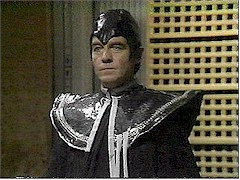
The Valeyard |
Reviews
|
|
The Valeyard |
Whither Valeyard? by Carl West 23/2/02
So, who is the Valeyard? "The amalgamation of the Doctor’s darker side, between his twelfth and final regeration." Ah, that explains everything...
Taking this at face value (if it's actually possible to do so), one would assume that the Valeyard isn’t actually flesh and blood -- how could an "amalgamation" of evil actually be? And, he’s out to steal the Sixth Doctor’s remaining regenerations -- this would perhaps allow him to attain corporeal existence? Would he be taking over the Doctor’s body a la the-Master-takes over-Tremas’-body? The truth of the Valeyard is a very vague, confusing concept, presented at the end of a very messy 14 part story.
I have often wondered what would have been a better explanation of who this Valeyard is. I have thought of an Inferno-type of theory: the Valeyard could have been a POSSIBLE future incarnation of the Doctor (twelfth, thirteenth, eleventh, whatever you like) from an alternative universe -- a universe in which the possibility of the Doctor regenerating into an evil personality is played out. The obvious flaw with this concept would be that, in Inferno, the Doctor vehemently warns against the danger of identical individuals from alternate universes coming into contact with one another (indeed, he is unwilling to save the Brigade Leader, Section Leader Liz, etc. from disaster because of this). True, it sometimes appears that ANYTHING is possible for the Time Lords; but given the Doctor’s and the Time Lords’ extreme paranoia of anti-matter in The Three Doctors and Arc of Infinity, I don’t think that such a Valeyard from an alternative universe could in fact come into ours. (I am aware that the Brigade Leader and company weren’t actually anti-matter, but it appears that their presence in our universe would have a very similar effect).
Then, of course, there is the Pyramids of Mars approach (I am obviously indebted to Andrew Wixon’s recent article for most of my ideas here!). If the Doctor and Sarah fail to stop the progress of events taking place in Pyramids, the earth in 1980 will be a lifeless wasteland. So, perhaps the Valeyard is a 1980’s-earth type of future incarnation of the Doctor -- unless the Doctor treads carefully, one of his future incarnations will be the Valeyard (we see similar concepts in The Space Museum).
However, the explanation we are given from the series -- and therefore the explanation that we must accept -- is that the Valeyard is a being who is the combination of all that is evil in the Doctor, and that he is a Doctor who was created (and perhaps was only meant to exist momentarily) in the process of the Twelfth Doctor regenerating into the Thirteenth. A very ambiguous explanation, perhaps, but maybe it was intended as the sort of rich ambiguity that would keep the fans debating sixteen years on.
Evil self or someone else? by Antony Tomlinson 20/4/05
I feel a bit silly writing this review of the Valeyard, given that I haven't actually heard what is probably the most important contribution to his myth in years - the Unbound audio story He Jests at Scars. However, as the Doctor seemingly speeds towards his 12th regeneration, it seems a good time to look back (or forwards?) at this evil cast-off from that process.
The idea of the Valeyard itself is terrific. I think the moment when it is revealed that he is the Doctor in Trial of a Time Lord is wonderfully done. And after three seasons of the Sixth Doctor's struggles with his own brutality (particularly in The Twin Dilemma and Mindwarp) this battle with a physical manifestation of his cruelty is very timely (and would have been more so, had Colin Baker remained in the role).
Furthermore, the idea of the Valeyard and the Master struggling across time - two well-matched villains battling to outdo each other - is also lovely (and it is amusing to think that the Master might know more about the Doctor's future than he does himself). And while it may be a bit of a cop-out to say that the Valeyard is some kind of side-affect of a future regeneration (like the Watcher) rather than a Doctor himself, I suppose it would have been a continuity headache for producers to have had an evil incarnation of the Doctor due in a few years time.
Nevertheless, I have one real problem with the Valeyard. My problem is that, as far as his character goes, he seems to have virtually nothing in common with our Doctor. However, it seems to me that the only fun in having an evil version of any character is that you get to see the best bits of your hero perverted and turned into something unpleasant - the good humour turns to cruel mocking, the brave ingenuity turns to cunning, the loyalty turns to fanaticism, the entertaining flair turns to malevolent charm etc..
But this is not what the Valeyard is like. Look at him. Is he the Doctor? Does he have the academic, fun-loving interest in the universe that the Doctor has? No, he seems a rather close-minded villain with his eye on Time Lord politics (unlike the Monk or Master who are as much connoisseurs of the cosmos as their nemesis). Is he charming or funny? Not really - he's something of a grumpy bureaucrat throughout (unlike the devilishly smooth Master or the treacherously affable Monk). Is he incredibly intelligent and ingenious? Not really, he just seems to want to blow people up and use surreal traps. Does he even have an eccentric dress sense. No (OK, - maybe the Doctor has taken to wearing leather jackets recently, but he still has more inspiring sartorial tastes than this funny-hatted lawyer).
There is an explanation of this in Trial of a Time Lord. In the story, as the two incarnations stand on a beach, the Valeyard starts reciting Shakespeare and then curses himself for sharing the Doctor's frivolous, academic attitudes. His whole aim is to become purely evil and pragmatic. Everything in him that is Doctorish must therefore die. However, all this then means is that the Valeyard becomes a rather dull villain. And the viewer is left wondering why they would want to watch such a hard-nosed bore. I would rather the writers had chosen to turn the Valeyard into someone recognisably "the Doctor". Otherwise this whole "evil self" thing becomes a bit irrelevant.
Of course, the idea of the Valeyard was a treat for the writers of Doctor Who novels. Their Seventh Doctor was a dark and ruthlessly pragmatic person himself - even if he believed that good ends justified his actions. The Seventh Doctor could thus be portrayed as a clear step towards the genesis of the Valeyard. Indeed, we could see the logic of a whole process across three incarnations. The Fifth Doctor was straightforwardly moral, but weak and unable to bring about the best results (Earthshock, Resurrection of the Daleks). A more ruthless self needed to come into being to overcome the Fifth Doctor's scruples (Cold Fusion). And so, after the instability of the Sixth Doctor, the Machiavellian Seventh Doctor came into being (by a deliberate choice, if Love and War is to be believed). But did the Doctor take a step too far in the wrong direction? The existence of the Valeyard hints that he may have.
In Millennial Rights the Sixth Doctor faces his evil self once again - albeit in a symbolic way, in a story that seems to point towards a future as the less ethically scrupulous Seventh Doctor. Matrix then sees a morose Seventh Doctor face the shoutiest, most straightforwardly nasty version of the Valeyard yet (aka, "Jack the Ripper"). However, he sees this cruel character very much as part of himself.
And so the Valeyard is a convenient device that Doctor Who writers can keep at the back of our minds - "This," they warn, "is what the Doctor might become."
Still, this does not excuse what I think is the mistake of having an evil self that is absolutely nothing like the good self. Furthermore, the logic of the Doctor moving from scrupulous loser to pragmatist, and eventually to morally dead villain has been ruined somewhat in recent years by the introduction of perhaps the two cheeriest, most impulsive incarnations of the Doctor yet - the Eighth and Ninth (although the latest Doctor clearly has a very dark side - see The End of the World).
Perhaps, however, it was the exhausting experience of being these later incarnations, with their ceaseless smiling, excitement and charm that eventually drove the Valeyard to come into existence. Perhaps all that grinning turned our hero into someone who could barely raise a smile. Still, I don't think that the Valeyard really lived up to his potential as the "Evil Doctor" - nice idea as it was. Never mind - bemoaning unfulfilled potential is the lot of the Doctor Who fan...
The Graveyard, the undiscovered country by Luke Hewitt 4/4/12
Inquisitor: "Doctor, the charges against you are grave indeed"
Sixth Doctor: "I only have to look at the Graveyard to see that, ma'am"
(an exchange that still makes me smile).
The Trial of a Time Lord has always been one of my favourite who adventures. I am much more a fan of long stories than short, still more when they have multiple threads and locations giving the feeling of going on a journey. Even though most of the current action of Trial happens in that court room, the evidence you see and the slowly building idea that there is more at stake even than the Doctor's life definitely give this feeling, right up to the revelations in the conclusion, murky Gallifreyan politics and the increasingly worrying warping of reality leading to the final climactic duel.
Central to this story is of course the trial itself. The stern, but seemingly fair Inquisitor sits as judge, while the Doctor defends his own actions. Against him, however, is the Valeyard, at first introduced simply as another Gallifreyan functionary like the Inquisitor. It becomes increasingly obvious though that his roll of prosecutor is far more than just a job, and he bears some personal animosity towards the Doctor, and has been the one to, well, doctor the evidence from the matrix to support a guilty verdict.
At the final revelation of who the Valeyard was I was frankly stunned. I've since watched Trial several times, watching the sparring between the Valeyard and the Doctor with his identity fully in mind.
So, who is the Valeyard?
As Carl West says above, we are told very little, simply that the Valeyard is a distillation of the Doctor's evil up until his twelfth and final incarnation. Like the simple statement in The Lord of the Rings that Sauron is the Dark Lord, this is a tantalizing bit of information that really is set to make us wonder.
It is always what we don't know that scares us most, a principle that the monsters of many Doctor Who episodes use well to their advantage, and I see the Valeyard as no different. If the Master had laid out a detailed plan of just who the Valeyard was, I doubt very much people would be writing articles on him now, or that he'd be half so interesting a character, or as effective a villain as he undoubtedly is.
What we do know however is that the Valeyard is in some way akin to the Doctor, but exactly how? I totally agree with Antony Tomlinson's above points. The Valeyard is almost entirely unlike the Doctor. Where the Doctor (especially his sixth self), is eccentric, brash and colourful, the Valeyard is cold and sardonic. Where the Doctor is cheerful, even indulging in wordplay when his life is on the line, the Goodsyard has no truck with such frivolities. Where the Doctor is a maverick and his own man, the Valeyard plays up to authority to get what he wants. Even in their mode of dress, the two are diametric opposites, the 6th doctor's coat of many colours contrasting starkly with the Valeyard's plain robes.
I'd therefore suggest that, rather than thinking of the Valeyard as some sort of evil version of the Doctor, the Valeyard is simply the Doctor's opposite. He represents everything the Doctor is not; a fact born out extremely by the way he violently distances himself from anything to do with the Doctor's character. If playing psychologist, it could be suggested then that the Valeyard corresponds to the Thanatos, or self-destructive drive of the Doctor, part of his id, that part which (under many schemes of psychoanalysis), makes us perform actions that are directly against our own best interest. Though of course such an idea is pure speculation and probably reading far too much into the character.
We see this opposite reaction in He Jests at Scars, the Big Finish audio featuring the Valeyard. Whereas the Doctor accepts his mistakes and treads carefully around the web of time, the Valeyard casually goes back to right wrongs every minute to the point the universe nearly collapses. Whereas the Doctor travels alone with a companion, the Valeyard becomes head of a universal empire, and whereas the Doctor always tries to preserve life and usually uses violence as a last resort, the Valeyard threatens his companion with death repeatedly and finally carries out that threat with cold brutality. Obviously, the Valeyard is out to do mischief and the Doctor is out to (as the Master says to David Tennant), make people better, but they seem far more opposites than that, in manner, in dress, even in use of language which certainly suggests some significant relation.
Evil versions of a main character are not a new idea. Even in Doctor Who before trial, we've had the Master for years, who, right from his conception in Terror of the Autons, was intended as the Moriarty to the Doctor's Holmes. This is also not to speak of Meglos, the android Doctor in The Chase, or indeed a good many other appearances (including the portrayal of a cowardly, self-serving sixth Doctor in the twisted evidence from Mindwarp).
I fully agree with Antony Tomlinson that evil versions are rather fun to see. They let us take another look at our heroes in a different light, and seeing a trait such as the Doctor's ingenuity and love of eccentricity turned to whim and cunning is always satisfying; indeed the Big Finish story The Curse of Davros had a distinctly different take on this idea. It strikes me though that with the Valeyard we are not simply seeing another Master, especially since the Master himself puts in an appearance in Trial. We are seeing something far more dark and primal, something far more mysterious about the Doctor; in its own way, almost a precursor to Zagreus from the Big finish audios and therefore something far more disturbing to us than just "what if our hero were a villain?"
Is the Valeyard actually a dark and bitter future Doctor, unlikely as that would seem? Is the Valeyard perhaps the Doctor from an alternate, opposite type universe like that of Inferno. Is the Valeyard perhaps some sort of residual distillation of all those things the Doctor hates, the Doctors shadow or thanatos, given form by the Time Lords from his biodata in the matrix and promised a real existence?
I don't have a clear answer, though I personally think the last is most likely; however, it's the very mystery of the character, the darkness behind the backyard (sorry, can't resist), that gives the Valeyard such an affective presence, whether he's bandying insults with the Doctor, threatening the High Council, swanning around the universe causing chaos and confusion, or in control of his own world.
As a basic villain, even if you take away this mystery angle, the Valeyard works extremely well, not the least due to some exceptional character acting by Michael Jayston. It would've been far too easy for the Valeyard to turn into a caricature villain, with evil rants, psychotic looks and manic plans (and there are already plenty of those in Who). Jayston's take, however, is exceptional for its lack of emotion. The Valeyard comes across as cold, but not because he is emotionless, simply because he holds his emotions rigidly in check other than when he decides to let them out for his own purposes; again, a major contrast to the at-times slightly irritable sixth Doctor. Even when making his evil speeches, he is cold and to the point, but with a suppressed aura of violence and menace, and a layer of quiet, sinister charisma that would silence a room full of people with a cool word of implied threat. Indeed, watching Trial now, other than the voice and emaciation, I see not a few parallels between the Valeyard and Lord Voldemort (a shame Jayston wasn't available to play him on screen).
For all these reasons, I'd love to see the Valeyard make a return to the TV series, though I would worry how he'd be handled given the way current episodes seem to focus more on visuals, action and one-liners than dialogue, plot and character mystery, which were, after all, the Valeyard's strengths.
He's already shown up in one audio story and I'd definitely welcome him appearing in others, still more in the main monthly series opposite the Doctor. Indeed, it'd be interesting to see how the 7th or 8th Doctors would deal with him.
Either way, I can firmly say that the Valeyard remains one of my all-time favourite Who villains and we can be assured that if we ever do run across the railyard again, we'll be in for a fantastic journey to dark and mysterious parts unknown.