THE DOCTOR WHO RATINGS GUIDE: BY FANS, FOR FANS
| Episodes |
4 |
 |
| Story No# |
96 |
| Production Code |
4Y |
| Season |
15 |
| Dates |
Jan. 7, 1978 -
Jan. 28, 1978 |
With Tom Baker, Louise Jameson,
and John Leeson as the voice of "K9".
Written by Bob Baker and Dave Martin.
Script-edited
by Anthony Read. Directed by Norman Stewart.
Produced by Graham Williams.
|
|
Synopsis: The Doctor reluctantly allies himself with a people once wronged
by the Time Lords to recover their race banks after a tortuous journey.
|
Reviews
Tom Baker's missing story? by James Schiaffino
7/7/97
Underworld... Tom Baker's forgotten episode. Or at least it
seems that way. No one ever seems to mention it anywhere, and it
consistently fails to receive any votes for release on video in Doctor
Who Magazine's surveys. Why is this? Certainly there can be no doubt
that Underworld has its share of ugly moments. The infamous
Who budget makes quite a showing here, with some of the most
laughable special effects the Tom Baker years have seen. These go hand in
hand with some pitiful plot devices, like the unimaginably unreal
"pacifier" device used on Leela, who clearly is so good at acting like a
savage that she doesn't remember how not to be violent. Tala's
regeneration sequence is probably the only interesting visual in the whole
story arc. (This was, in fact the only time in all the years of Doctor
Who episodes that a female's regeneration was actually seen on camera
-- Romana's was offscreen. Just a neat bit of trivia.)
However, certain elements of Underworld have particular merit.
This is the only appearance of the Minyans in Doctor Who that I know of, a
race that figures rather importantly in Time Lord history, as is explained
in the episode. That alone lends some credibility to the story. The
storyline itself also has some unique implications. What would it be like
to have lived for 100,000 years in pursuit of a single objective, as
Jackson and his crew have done? What would it feel like to have been
alive for seemingly an eternity, for only one goal - the survival of your
race? How would it feel to have finished, to have finally accomplished
the task?
Clearly, Underworld has its share of embarrassing moments that
are often cited as among the worst moments of Doctor Who.
However, it does at least pose some intriguing philosophical implications,
which make the story at least worth a look.
A Review by Stuart Gutteridge
30/6/99
It is fair to say that Underworld is not the most memorable
Doctor Who story. Although it isn`t as bad as its reputation might
suggest. The plot is perhaps Underworld`s greatest asset. Its roots
lie in Greek mythology, this is most obvious from the similarities between
names such as Herrick/Hercules and Jackson/Jason. The quest theme, whilst
perhaps being a little too obvious, is none the less cleverly written.
The acting is also variable, with only Tom Baker, (particularly when
confronting the Oracle) and James Maxwell really standing out. It is
fortunate that Imogen Bickford-Smith, as Tala, was not cast as the next
companion, as she ably proved here to be wooden at best.
Underworld also contains some nice ideas, using a pacifier on
Leela, perhaps a precursor to her settling down in The Invasion Of Time, and Tala`s regeneration are
effective. As is the first episode, the best of the four, with some
passable effects. It is the effects also for which Underworld is
best remembered; here the CSO kicks in and unfortunately it shows, all too
often. Underworld isn`t a bad story, just an underrated one.
A Review by Nicholas Sims
11/3/02
Having just seen the video of Underworld, it has left me
wondering why has this story obtained such a bad reputation. OK, the
effects are a bit ropey, but quite a few effects are like that in most of
the Dr Who episodes. The two robed guys in episode three with tin
heads look quite amusing, but so does the "Dobbin" the fluffy rat in Talons, as well as the action man figures in Deadly and the gormless Magma-beast in Caves, plus not to mention the inflatable "pink" snake
in Kinda. What is note-worthy about Underworld
is the plot build up centred around the construction of planets in space
for episode one and two – the asteroid's gravitational pull around
the space ship is great. The spaceship is not quite on the level as the
one in Trial but let's face it very few spaceship
scenes have matched that one – if any. The "pacifier" was not half
as horrendous as fans have been making out – I thought Louise's
acting made it convincing, plus it came across as classic light humour.
It is a shame that there wasn't more budget to enable more imaginative
concepts and visuals to be developed for the Underworld system; yet again
it was a shame that the Wirrn grub didn't appear or act like the one in
Ian Marter's book! However, for me the budget is a minor flaw in a plot
that is far removed from the usual "lets invade Earth again!" or "I'm mad
Doctor, stop me, or the jelly baby gets it!"
My main point is that none of the Dr Who episodes have been
absolutely perfect – if you haven’t already seen
Underworld or haven't seen it for a long time, view it again
because I reckon you will be pleasantly surprised!
Some More Mr Nice Guy by Matthew Harris
1/5/02
Either I am the most forgiving Doctor Who fan in the seven
galaxies, or I'm missing something. Terminus:
detested by 80% of the community... except me. Revenge
Of The Cybermen: reviled by 90% of the community... except me. Warriors Of The Deep: practically a swearword, but it
has pride of place in my collection. And Underworld.
What a great idea was Underworld. And what a nearly-great serial
it turned out to be. An episode setting Jason And The Argonauts in deep
space, to the tiniest detail, with neat little anagrams and plays on words
(P7E\Persephone, Jackson\Jason, Idmon\Idmon and so on). Instead of the
tree at the end of the world, we have a planet with a tree-shaped cavern
system at the end of the universe, with the P7E in place of the golden
fleece.
Shame, then, that Mr Williams and Mr Read ran out of money well before
making it and had to settle for CS (bloody) O instead of real caverns. Or
that Imogen Bickford-Smith's older Tala looks like her younger Tala with
polystyrene on her head. Or that you can't hear a blind word the Oracle
says. Or that it doesn't quite, though it tries very hard, make a cohesive
whole somehow. Still it's exciting, and incredibly watchable, and worth
the wasted hour and a half or so.
In summary then (and not before time): Underworld is a neat
piece of action unfortunately let down by the fact that the BBC couldn't
even afford a hole in the ground. 7.5/10.
Over ambitious and weak by Tim Roll-Pickering
4/10/02
Underworld is a good example of how weak ideas can be dragged
out far beyond their natural life and then further sunk by poor production
values. The story has at its heart the quest for the Minyan race banks but
the reasons for the quest are never made clear enough to justify the
story. The story's roots in Greek mythology are all too clear, even before
the Doctor compares Jackson to Jason, whilst the attempt to establish the
Minyans as the Time Lords' great failure and thus a potential source of
guilt completely fails since it makes little impact upon a roving wanderer
such as the Doctor. The result is a mess of a story that quickly
degenerates into an over-padded runabout that drags towards a lacklustre
climax.
On the acting side there are few performances that stand out at all,
with both the crew of the R1C and the Minyan survivors on the planet all
giving performances that are at best forgettable and thus adding to the
poor characterisation of the scripts. Even Tom Baker and Louise Jameson
give less than their usual effort, perhaps indicating a weariness with
the script. The one character that is used at all well is K9, since his
creators are writing for him. The result is that K9 is actually used as
a character and computer rather than as the mere mobile blaster he is
reduced to in other stories such as The Sunmakers.
Production wise Underworld features cheap looking sets similar
to several of its contemporaries, but what really scuppers the story is
the excess use of CSO. Although the CSO backgrounds look a lot more
convincing than many studio cave systems, the poor co-ordination that
results in many actors being superimposed at the wrong level whilst the
general CSO problems of lines around the edges of moving images and shadow
being picked up all contribute to some very unconvincing scenes. Even the
close-ups of characters look bad and the result is a major failing of the
story. With today's digital technology it would be possible to produce far
more convincing effects but even when compared to contemporary BBC efforts
such as the other Doctor Who stories from this period or the early
episodes of Blakes' 7, Underworld suffers immensely. Norman
Stewart's direction is highly pedestrian at times and this merely adds to
the disaster of the story. The script itself is poor, but the direction,
design and effects all drag the story down even further. Ambition is fine
but this story is far, far too ambitious and it shows. 1/10
Underwhelmed by Andrew Wixon
12/12/02
About 14 years ago DWM published an (for its time) unusual article
entitled 25 Years of Turkeys, a cheerful rundown of the 10 worst TV
stories up until that point. From memory, I seem to remember it featured
The Chase, The Underwater
Menace, The Horns of Nimon, a few others (none of
which, I'm sure, were any worse than strange omissions such as The Time Monster, The Seeds of
Death, Warriors of the Deep, Attack of the Cybermen, etc)... and Underworld.
This fact returned to me when I recently watched Underworld for
the first time in nearly 25 years. When I buy a new tape, I prefer not to
binge but to partake of its pleasures as nature intended, 25 minutes at a
time (closer to 20 in this case), spread over a few days. And after
episode 1 I thought, 'well, that wasn't great, but it's certainly not one
of the all-time stinkers'. Famous last words - but episode 1 of
Underworld has a lot going for it. The revelations of the past
relationship between Gallifrey and Minyos promises the prospect of an
entirely new perspective on the Time Lords and the Doctor. The unusual
edge-of-the-universe setting and the eternal quest suggest a bleakly
mythic tale is about to unfold. And the direction shows flashes of
brilliance - especially in Jackson's weary speech as we see Tala placed in
the regenerator.
It takes about ten minutes of episode 2 for this to all be forgotten
and for this to turn into one of the most wretched fiascos in DW
history. The main symptom is, of course, the CSO sets. Why, given the fact
real sets weren't available, couldn't they have CSO'd the characters into
more interesting backgrounds? The real crime here is not shortage of money
but shortage of imagination. As it is the CSO prevents any suspension of
disbelief, and severely hampers the director's options regarding camera
angles and shot choices.
But this isn't a great script either. The Gallifrey-Minyos thing gets
one - one! - mention after episode 1 and the Minyan argonauts - sorry,
astronauts - are flatly written and performed. Only Herrick has any
personality, mainly due to Alan Lake's Brian Blessed-ish performance. And
the plot is so thin - capture. Escape. Run around caves. Lame plot device.
Etc etc. And it has the worst lift music in the history of everything
ever.
The concept of this as a knowing pastiche of Greek myths seems to be
held up by the production as some kind of fig leaf, a defence that this
isn't just a cheap, misconceived runaround, but a story with aspirations
to be greater than that. Well, it just comes across as a pathetic excuse.
The good stuff in the opening part must be some kind of fluke. 25 years
on, this is still a terrible, terrible turkey.
The quest is the quest by Michael Hickerson
30/5/03
One of the good things about bad Who is that is really makes you
appreciate good Who. And Underworld is one of those stories
that, in most fans assessments, falls into the category of bad Who.
I'll admit that Underworld isn't even close to my top ten of
all-time great Who. In fact, it's one of the last Tom Baker
stories I saw (my PBS station skipped it in my first rotation through the
Tom Baker years). To make up for missing it in my first run-through of
Who, I read the novelization, which while not Earth shattering,
painting some strong pictures in my head of how the story look, feel and
sound once I finally got to see it on-screen. So, the first time I saw
it, I was sort of looking forward to Underworld.
And to be honest, I've not really watched it much since that time I
first saw it all those years ago. I've had it on tape for years, but it
was more out of a sense of being an obsessive Who completist than
an actual love of the story. There was very little danger of my wearing
out the tape re-watching this one, as I would do with, let's say Curse of Fenric or Pyramids of
Mars.
And so, Underworld languished in my memory as a rather
pedestrian Who story. But something nagged at me -- perhaps I
hadn't given it a fair shot. Maybe I should give it another chance.
Then, the VHS release came along and, again, being a completist I snapped
it up. Now, given that ever since WB took over the distribution of the
videos, I've got at least half of my newly purchased Who vids that
won't work, I came home, tore off the wrapper and put Underworld
into the VCR. Thankfully, it worked and I didn't have to exchange it
three times like I have some other Who vids I've got in the past
couple of years. And since it worked, it was running and I wasn't feeling
particularly well, I decided to give Underworld another viewing.
And for a few moments, I had some hope that maybe, just maybe it might
impress me this time. Maybe this time it would rocket up my list from bad
Who to good Who. Maybe time would help it out and make it a
better story in my estimation.
Sadly, it didn't happen.
I'll go so far to say that Underworld isn't necessarily in the
same realm that I consider The Gunfighters or The Web Planet. But neither is it in the realm of great
Who like Pyramids of Mars.
For one thing, the visuals are a huge let down. There is never more
apparent than when you view the story in the better quality VHS release.
The overuse of CSO makes the entire thing looks so incredibly fake that it
takes us out of whatever progress the story is trying to make on screen.
Honestly, I know that Who has a limited budget, but I far prefer
them actually building a cave set and trying to film it in new ways as was
done in Caves of Androzani, than trying to convince
us that this is actually a huge cave with lots of unique caverns done on
CSO where it obviously looks extremely fake.
Also, you have to add to this a cast that is taking underacting to new
depths. Everyone here seems bored -- especially Tom Baker, who seems to
alternate between bored and embarrassed by the whole thing. The scene
with the Doctor waving his scarf to dissipate the thick gas in the cave is
just bad and you can tell that Tom thinks so during the scene. Seeing
this story, it's easy to see why Louise Jameson got fed up with Leela and
decided to leave. She is nothing more than a two-dimensional savage here,
meant to be the butt of jokes when she's not being neutralized by the
Minyans' "don't worry, be happy" gun. Add to it that the Minyans are all
largely forgettable and that Imogen Bickford-Smith is in there to be
eye-candy and little else (does she even have a line after episode one?)
and you've got some pretty bad elements for a Who story.
And then, there's the script from the writing duo of Bob Baker and Dave
Martin. When it comes to Baker and Martin, less is definitely more. And
by this, I mean, the fewer episodes you ask them to write, the better it
seems to be. Exhibit A: The Sontaran Experiment --
two episodes that are tightly written and may be their best Who
offering. Exhibit B: The Mutants -- six episodes
stuffed to the gills with padding and plot redundancy. Luckily
Underworld is only four episodes, so the padding isn't too bad
here. But the story isn't really that great. Cribbing the story of Jason
and the Argonauts is not necessarily a good thing -- unless you tell it
well. And they don't tell it well. Also, putting in the intentional
winks at the audience in episode four as if to say -- golly, look at how
clever we are! are a bit much. Baker and Martin have clearly run out of
gas at this point and probably should have retired while they were ahead.
But for all that's wrong with the story, there are one or two things
that are right. The concept of seeing why the Time Lords adopted their
policy of non-intervention was a good idea, even if it's only brought up
at convenient times. Then, the idea of a group of people who spend
thousands of years in an obsessive quest (sort of like how I feel
sometimes about trying to find lost Who episodes) is a good one.
But the problem becomes that they get too content once the quest is done.
I found myself wishing that we'd see what happens afterwards -- we spent a
1000 years looking for this thing and now we've got it. So, now what? Do
we all go to DisneyWorld?
So, I've got to say that after viewing Underworld this time out,
it's probably going to go back to where it was in my collection --
collecting dust for a few years until my memory of it fades a bit and I
give it yet another chance. Until then, I think I'll work on wearing out
my copy of Pyramids of Mars... at least until the
Beeb sees fit to release that one on DVD, that is.
A Review by Brett Walther
14/1/04
Forget the notion that Underworld was based on a brilliant
premise, spoiled only by inappropriate production... Forget adjusting the
colour on your TV in the belief that it looks better in black and white...
Don't bother looking for any subtext or subtle nuances that you feel you
may have missed as you dozed off the first time you watched it...
Ladies and gentlemen, Underworld is really and truly as bad as
it seems.
The peg upon which Underworld apologists build their case in
defense of this drivel is invariably the backdrop to the story, involving
the Time Lords' interference on the planet Minyos. Although by this point
in the series we're already well-aware that the Time Lords aren't the
omnipotent beings that can do no wrong, Underworld takes this
portrayal further with the Minyan storyline, and although it pains me to
say it, the premise actually works.
However -- and this is a big however -- this premise is revealed within
the first ten minutes of the serial courtesy of some incredibly boring
exposition from the Doctor. Instead of meeting the crew of the R1C and
having their full origins emerge tantalizingly piece by piece, thus
keeping the Minyan/Time Lord back-story a mystery that unravels over the
course of the four episodes, Bob Baker and Dave Martin give it away right
off the bat, and the enormous potential of Underworld's single
redeeming feature goes up like a pair of fission grenades.
Strangely, other concepts that could easily have been elaborated upon
are completely ignored. What exactly are the Race Banks that the Minyans
are so desperate to retrieve? We find out that the Trogs -- who are
descendants of the Minyans themselves -- have the ability to reproduce, so
the Race Bank can't be vitally important to the continuation of the Minyan
race. Seeing as how Baker and Martin seem to have found dialogue
particularly difficult to create for Underworld (even the Doctor
doesn't get much to say, which has got to be a first for the Baker era!),
the omission of even the most basic explanations for plot elements like
these are unforgivable.
Speaking of which, what the heck was the Oracle? It had a pretty
decent voice, reminiscent of the creepy Animus in The Web
Planet, but as a villain, we don't ever get a hint of why it even
exists. Is it the P7E's ship computer gone mad? If so, why not introduce
us to a ship computer on board the R1C to counterpoint? Why is it insane
in the first place? Why does it have spare copies of the Race Banks, come
to think of it, when there was really no reason for the Oracle to expect
any other being in the universe to know of their existance? And who (or
what) are the Seers? (Maybe the Seers themselves explained their origins
at some point or other and I missed it -- their dialogue is largely
unintelligible!)
Not only does Underworld fail to make sense in many ways, it's
also unbearably dull. Part Two of Underworld is probably the
single most boring episode of Doctor Who I've ever seen.
Absolutely nothing happens for twenty minutes -- it's thankfully that
short of an episode, I might add. People wander about aimlessly through
unconvincing tunnels for those twenty minutes, rarely speaking and
certainly not getting any closer to advancing the storyline. The
cliffhanger evoked a smile, however. Actually, it was more of a grimace.
It's bizarre, isn't it? Here's the Doctor twirling about the smoke-filled
caves, coming to rest at what's presumably a control box for the
fumigation system. (We don't know, because this is one of the many
sequences that are directed as though it's a silent film.) Then, the
Doctor appears to fiddle about with the control box, but we're not allowed
to see what he's up to, because for some reason the director has employed
a long shot. And then, as the Doctor's standing there stooped over
working on the controls... the episode ends! I was stunned at the
monumental incompetence of this "cliffhanger". The lack of tension at
this moment makes the sudden appearance of the closing credits truly
surreal...
It doesn't help things that the season fifteen pairing of the Fourth
Doctor and Leela is pretty disastrous. It's obvious that Tom Baker
positively loathed the character of Leela, as he's fairly venomous in his
treatment of her, telling her to "shut up" and introducing her to the
Minyans as a "savage primitive". Although the line about Leela being a
savage was no doubt in the script, the "shut up" comment sounds more like
Baker improvising, 'cos it's quite out of character for the Doctor to have
such little patience with his travelling companions. Frankly, it jars.
The characterization of the Minyan space crew is equally disappointing.
Apart from Tala's regeneration scene and a few cobwebs in the storeroom in
which the TARDIS materializes, there's very little to suggest that this
Quest was begun 100,000 years ago. Both the performances and the dialogue
fail to convey the sense of weariness among the Minyans that would be
inevitable after such an insanely long voyage. Jackson, Orfe, Tala and
Herrick have been on the same ship for 100,000 years for heaven's sake --
I would have expected them to be borderline insane (or at least insanely
sick of each other's company) by the time the Doctor and Leela arrive.
Instead, they're just bland. The only one who isn't bland is Imogen
Bickford-Smith as Tala, who is completely atrocious. I broke down at her
complete non-reaction to the scene in which Herrick triumphantly declares
"The Quest is over!" while brandishing the Race Bank cylinders. This
woman just stands there as impassive as a plank, despite the fact that
this Quest has been her raison d'etre for 100,000 years! Can you imagine
the nightmare scenario of this woman taking over as Leela's replacement on
board the TARDIS as the production team was considering at the time? Now
that's scary.
If there's anything nice to say about Underworld, it would have
to be the costume design. The grey pantsuits worn by the Guards are
pretty cool (aside from the executioner's hoods with the eyelets serving
as mouth holes, nose holes and eye holes!), and the wide pantleg design
ensures that the Guards are the only ones whose legs don't disappear
during the interminable chase scenes through the CSO tunnels.
(Skinny-legged Idas in particular loses his legs below the knee throughout
the adventure.) Come to think of it, the shield guns used by the Minyans
are smashing too, aided by the interesting burbling sound effect they make
when fired.
You can tell I'm digging for something positive to say about a
Doctor Who story when I mention the sound effects...
1/10
A Review by Brian May
8/3/04
Underworld has some terrific space models, and the plot has an
interesting premise, based on various tales of Greek mythology.
Unfortunately, that's all I can say that's good about this story. So,
if this is your all-time favourite Doctor Who adventure, stop
reading now. I know it has received a critical pasting from the bulk of
fandom, so upon watching it I'm always a little more willing to give it
the benefit of the doubt. Perhaps, underneath the obvious flaws, this
actually is a decent yarn.
Alas, no.
I can't even say it's a case of a good script let down by poor
realisation because, while the idea of a science-fiction adventure based
on various Greek myths is sound, the actual realisation of
Underworld as a story fails. It's badly written and does no justice
to its source material. I know it's not intended to be an authoritative
text on the subject, but nevertheless it's pretty flat.
I suppose I should accentuate the positives, as the song goes. The
opening shot of the Minyan vessel flying through space is excellent - as
are all the model shots. They are superb, bringing to mind the high
standards of modelwork that graced The Space
Pirates, The Ambassadors of Death and Frontier in Space. The interior of the Minyan ship
is quite well realised also; it's given an authentically dilapidated look,
although the lounge chairs situated at the flight controls seem rather too
impractical (and, unfortunately, a bit too seventies).
But the entire story just feels inconsequential, not helped by the
uninspired casting. Apart from James Maxwell as Jackson, who convincingly
brings to life the Minyan commander's determination and
universe-weariness, and the underused character of Orfe (Jonathan Newth),
the acting is all a bit amateur and rather hammy. The scene where Idmon is
speaking to his fellow Trogs after the skyfall is one such case: he sounds
more like one of those loonies you find at Speaker's Corner. The guards
and Seers are totally bland (the voices of the latter carry no conviction
or menace whatsoever). Even Tom Baker is less than impressive, gliding
along in cruise control for the majority of this adventure.
The treatment of Leela is another detrimental factor, but this is not
the fault of Louise Jameson. She gives her best, but the writing lets her
down enormously. She is made out to be stupid and childish. Her
pacification, which makes her practically fall in love with Orfe, and her
sulking reaction when she realises what's been done to her is demeaning.
This isn't Leela! Tom Baker's distaste for the character is evident here -
note how he snaps at her while attending to Idas's foot; and how he
practically orders her to accompany him to confront the Oracle after she
says she will stay and fight. Given her character, helping the Minyans and
the enslaved Trogs is the best thing she could do. She certainly doesn't
play any significant part as the Doctor faces off with the mad computer.
Now for the direction. I was surprised, in fact, to learn that there
actually was somebody credited as director for this story! Norman Stewart
is the alleged man's name. Was he ever present? Perhaps not, given how
this tale sprawls and idles. Hey, wasn't this guy just a production
assistant a few stories ago (The Invisible Enemy)?
Surely that's a giant leap in such a short time?!? Part one is completely
unrivetting - nothing happens! Look at the cliffhangers. Three potentially
exciting, nail-biting scenarios become boring, flat non-moments, with no
sense of drama or tension. Watch the climax to part one, with the
meteorites surrounding the ship. Although it's an impressive model, we've
just seen the same shot about four times. Wouldn't it have been better to
make the ending when the ship plunges into the surface of the planet? It's
just as visually stunning, but a lot more exciting. Why not just cut out
Leela's sulking and pouting and being everything a few minutes back? For
episode two, the audience has been overcome by boredom long before the
Doctor is overcome by the gas. From a visual and timing perspective,
episode three's rock crusher incident is virtually incomprehensible.
Overall, the story looks cheap and tacky. From the bulldog clips that
link K9 to the ship, to the weird and somewhat ridiculous jumping bean
heads of the Seers. The awful shots of the Doctor, Leela and Idas floating
down the shaft, accompanied by ridiculous muzak (it's not Dudley Simpson's
finest hour, either). And of course, the CSO. I know the story went
over-budget on the spaceship sets, and the superimposed caves are not as
poor as their reputation suggests, but it's pretty embarrassing seeing it
in every underground scene. I wouldn't have minded slightly
crappier ships if we could have seen at least a few semi-realistic cave
walls. Revenge of the Cybermen is another Tom Baker
tale highly reviled by Who fans, but at least it has real caves.
I'd rather watch that than this any day of the week!
The tackiness is also evident in the script. "Made in Minyos" on an
item in the spaceship? The guards search for the Doctor and Leela, who are
hiding inside the mining cart, not three feet away from them. Do they look
under the cover? No, they just say "They must have doubled back!" (This
incident is slightly more forgivable - it's no different from other
"bumbling guards in pursuit" incidents, but this story needs all the help
it can get!) The name Jackson is rather human for someone who belongs to a
race that's a hundred thousand years old. The Oracle itself is
unimpressive. It instils no awe, no fear; it's built up so much and the
confrontation with it is rather an anticlimax. The Face
of Evil treated the megalomaniac computer so much better. Finally,
apart from one wonderful line - Leela's "Do not worry, he has saved many
fathers!" - the dialogue is totally forgettable. Tom Baker's penchant for
flippancy over genuine humour is also beginning to show.
Not the best piece of Who I've seen. 2/10
A Review by Laurence Manning
26/8/05
Underworld... not really a classic, is it? I only saw it
recently, but I'd heard rumors of crappy CSO work, bad scripts, poor
acting and an idiotic plot. It's fair to say I wasn't looking forward to
it, yet it far exceeded my expectations. Underworld, while not a
great story, isn't nearly as bad as it's made out to be. It's a
reasonable, enjoyable story with only one bad episode.
So let's start at the root of the problem - the CSO. Episodes 2, 3 and
4 all have extensive scenes set in caves and due to the fact that the
budget had run out, they had to use models and superimpose the actors,
rocks... well, everything but dirt and mud into the picture. I won't
delude you here; it looks like crap, but let's remember an important
point: we're Doctor Who fans. Since when have we wanted excellent,
convincing special effects?
Now when I say they're crap effects, I'm not saying they are the worst
ever. The Green Death has far worse CSO (although
admittedly, less of it). The main problem with the Underworld CSO
is the actor's interaction with it. They hover above the ground; they walk
through rocks, etc. It all ends up looking artificial and messy. But
that's enough about CSO - we can look past that. Onto the plot - which
isn't bad at all. It involves the last survivors of the Minyan race - a
race once (effectively) destroyed by the Time Lords - searching for their
lost race bank, which in turn leads them to a newly formed planet. It's a
good, solid, sci-fi plot (with silly science, but I care not). The only
letdown is the villain, The Oracle. You mean ANOTHER megalomaniacal
computer? That's WOTAN, BOSS, Xoanon and more that have slipped my mind.
Anyhow, the first episode of this story is brilliant - it's entirely
set on the decaying, run down Minyan spacecraft. This ship, and crew, has
survived for thousands of years through artificial regeneration and they
are worn down to the point of breaking, even to the point where one member
of the crew tries to kill herself (and interestingly enough leads to the
only onscreen female regeneration of the entire series). They are hostile
towards the Doctor and Leela when they identify him as a Time Lord, but he
eventually helps them to find the general location of the race banks - in
fact a planet that has formed around the ship carrying them.
The first episode is great, and the best of the story. Unfortunately,
episode two is stupid, as absolutely nothing happens save walking around
and getting confused. Episodes three and four, luckily, improve matters,
even if four is a bit dodgy. The sacrifice scenes are well done, as well
as a few battles, but there are very lame bits thrown in too - that bloody
muzak on the elevator!
The Doctor and Leela are great together in this story, and there are
some great moments - especially the recurring theme of Leela backing up
whatever the Doctor says. K9 also works well here, even though he is
hovering over the corridors in a humorous way.
But add all of this together and you have an enjoyable story. Sure, the
scientific principles behind it are complete bollocks, but that hardly
matters. Underworld isn't a great story, but it surely doesn't
deserve the flack it receives.
A Review by Harry O'Driscoll
1/6/09
Underworld is usually regarded as one of Tom Baker's worst and
it not difficult to see why. A measly budget, drab plot and rubbish
villain does not a good episode make unfortunately.
The whole story is essentially based upon the Greek myth of Jason and
the Argonauts. Not a bad idea, but sadly it fails to grab your enthusiasm.
After a good first episode, it all just goes dull and I found myself
losing track of the plot.
The Oracle as well is one of its major flaws. Of all the megalomaniac
computers the Doctor has faced, this one is the worst. It fails to come
across as anything other than another mad computer (the Doctor even says
this himself!), and sadly the seers are not much better. There is nothing
different or interesting about the Oracle and sadly it makes little
impact.
The acting is satisfactory but not exceptional, the sets are good and
convincing... which brings me to the CSO. The use of CSO is bold, but it
just all looks dark and flat, not that it is unconvincing.
But Underworld is not all bad. The idea of a planet forming
around a spaceship is clever (but the idea of zero gravity in the centre
is just tripe). The first episode is good and sets the layout well. The
plot, although boring, is consistent and solid.
All in all, Underworld despite having a decent script fails to
grab any attention, but it not nearly as bad as its reputation.
A Review by Jose Sentmanat
3/2/11
Underworld is one of those Doctor Who serials that has
generated a lot of bashers amongst fandom over the years, while
simultaneously garnering a small number of defenders. Count me among that
latter.
First and foremost, the story is patterned after the ancient Greek myth
about Jason and the Argonauts seeking the Golden Fleece. We must remember
that Doctor Who was a children's show, which also happened appealed
to a wider, adult audience. The educational elements, transparent as they
may be at times, bring a certain charm to the story, in my view. A certain
suspension of disbelief is called for. This isn’t gritty, realistic
science fiction, in the spirit of Ridley Scott's Alien or Blade Runner.
But then again, Doctor Who never aspired to such qualities, with
the exception perhaps of Season 7.
Second, and speaking of suspension of disbelief, the CSO is often
flagged as a major reason to condemn the story. The BBC was running out of
funding for the show during the period this serial was shot and could not
afford location shooting in caves (as was done, for example, at Wookey
Hole for Revenge of the Cybermen). Consequently,
director Norman Stewart and his production team had to use CSO to create
the desired effects. Given the level of technology in the late 1970s, the
result, far from being inept, deserves respect and admiration. We must
judge the efforts in Underworld not against modern CGI standards,
but against the standards of the day in which those efforts were mounted.
By those lights, what Stewart and his crew were able to accomplish is
nothing short of remarkable. Just use your imagination a bit, as was
intended, and the effects work just fine.
Third, the acting of the guest stars (particularly Imogen
Bickford-Smith) is often criticized for being wooden, placid, and
lifeless. Here, one must remember the details of the story. The Minyan
crew has been searching for the lost P7E starship containing their race
banks for tens of thousands of years, regenerating over and over again
without rest. The weariness of the quest has gotten to some of them, to
the point that, by the time the Doctor and Leela arrive, only four of the
original crew are left. So the acting is consistent with what is supposed
to be the state of mind of the characters.
I recommend the story because the plot is entertaining and moves along
nicely, with little padding. Baker and Jameson are wonderful, and K9
doesn't get in the way too much. Those who like the way the Doctor is
always looking to right wrongs and help the less fortunate will appreciate
this story a great deal, as he not only tries to make amends to the
Minyans for a wrong the Time Lords long ago inflicted on them, but also
tries to free some enslaved Minyans. I like seeing the Doctor fight for
justice, and I think a lot of other fans do, too. And along the way you'll
learn the reason for the Time Lord policy on non-intervention.
Those with a love of Greek myth will have fun spotting the references
and allusions, and those without such an affinity can simply enjoy the
story on its own merits. Either way, what you have in Underworld is
an under-appreciated, entertaining story. It's by no means a classic, but
it works well nonetheless.
Going Deeper Underground by Joe Briggs-Ritchie
22/3/11
Last night I watched Underworld for the first time in about four
years. Such a long period of not having seen it combined with the fact
that I was not hugely familiar with it to begin with made for something of
a sense of anticipation. One thing that I could remember from the last
time I watched it was that it wasn't actually as bad as the vast majority
of fandom make it out to be. I'm perfectly aware that it's not what one
would call a great story but it's certainly not the turkey that it's
constantly made out to be. I wasn't exactly enthralled by it but it kept
me entertained for all four episodes. The first episode is definitely the
most enjoyable and intriguing of the four with some eerie music from
Dudley Simpson.
The Minyans are something of a bland bunch. Apart from Herrick they
seem to be fairly subdued although this kind of makes sense if you think
about it. They've been stuck on their ship for 100,000 years, constantly
regenerating their bodies so it follows that they're somewhat tired and
jaded. Jackson actually seems quite haunted. I suppose it all depends on
how favourably you view this story in general. Their costumes are quite
silly though. Of course having a bunch of guest characters who are
somewhat underpowered only serves to highlight just how good Tom Baker and
Louise Jameson are. They have great chemistry - especially in the opening
ten minutes or so - and Louise Jameson really manages to create a charming
dynamic between her and the K9 prop. We also get an interesting insight
into her character. She isn't afraid of monsters or dying in battle but
she can't stand the thought that she is being laughed at, something which
almost reduces her to tears. Tom Baker is also brilliant throughout,
infinitely knowledgeable and with a somewhat scathing manner which
although rather sharp never tips over into the morbidity of Horror of Fang Rock.
The most infamous aspect of Underworld is the CSO caves. To be
honest it isn't actually that bad. Okay, so it's obvious that it's CSO but
most of the time it's quite serviceable although you do have to pity the
actors with all that blue screen work they must have had to do. The effect
for the Minyan weapons is quite nice and the exterior shots of the Minyan
ship are really quite impressive at times. This business of planets
forming around spaceships is somewhat dodgy and the whole concept is
bandied around a little too casually for my liking. I know it's a
necessary part of the story but it just doesn't seem very realistic. The
Doctor confronting the Oracle is rather effective: he doesn't give it the
time of the day and regards it as little more than a dishwasher with ideas
above its station. I also liked the cybernetic Seers. It's a very
effective moment when they remove their masks to reveal their tin bonces
underneath. The elevator scene is also rather nice. Okay, so it's a bit
silly but it's too charming to truly dislike it and Dudley Simpson
provides a lovely bit of muzak to accompany it. The Greek myth allegory
isn't exactly subtle but it provides a nice little extra layer to the
story, even if the writers felt it was necessary to have the Doctor
explain it to us. You know, just in case we weren't intelligent enough to
work it out for ourselves. Also Jackson is Human name. These aren't
Humans. They are Minyans. Doesn't really make a lot of sense does it?
The first episode is the best and even if the remaining three don't
quite match it they're still enjoyable enough. Most Doctor Who fans
don't like this story. Some of them think it's the worst story ever. I
don't agree. I don't even think it's the worst story of the Tom Baker era.
It's a fairly enjoyable little runaround and a nice enough way to spend an
hour and a half.
"Whatever blows can be sucked!" by Hugh Sturgess
12/9/12
Oh, come on! The Doctor actually said that?! It's so brazen it's
practically a single entendre.
Anyway, onto the story. It's awful. Absolutely dire. I watched this
hoping to enjoy it on some level, but it's impossible. My mind feels
hollow. Warriors of the Deep and its ilk at least
are engagingly bad; Underworld flatlines almost instantly, but,
like a zombie, lurches along at that (I guess appropriately) subterranean
level of tedium for the rest of the four trudging episodes.
At this point in Season Fourteen, The Robots of
Death was being shown. My God, how the mighty are fallen! This isn't
even the worst story of Season Fifteen, when one remembers The Invisible Enemy (also by Bob Baker and David Martin)
and The Invasion of Time. Ladies and
gentlemen, that is a reign of evil. True, Season Fifteen was made under
horrendous financial pressure: inflation was above 20%, economic growth
was sluggish and Underworld suffered as a result. But what's
present here is a dearth of imagination, not money. In fact, you won't
hear any mention of the CSO caves after this paragraph. To be honest,
they're not bad. Characters even cast shadows on them! Their main problems
are the resulting lack of atmosphere and the occasional doubling up of
backdrops, which makes it impossible to work out the geography of the
story. But if you're watching Underworld for the effects, you're
doing it wrong.
Underworld both sucks and blows for one basic reason that has
nothing to do with filthy lucre: it's boring. Like the Quest itself, it
goes on and on, without remembering why. The audience endures endless,
dreary scenes filled with charmless, wooden characters. The boredom
infects everything: the acting is boring, the plot is boring, the design
is boring, the direction is boring. Music is nearly absent, and when it
isn't it's some of Dudley Simpson's work that makes you agree with JNT's
decision to get rid of him come Season Eighteen. There's a good story
buried in here somewhere: the Golden Fleece is a timeless story first told
over two-thousand years ago and still told today. Underworld is
timeless, in that it drags so much that time seems to stand still.
Even in moments where there is plot, it's still boring. The flatness of
the whole enterprise sucks whatever draw-factor the story has out of it.
The fault isn't just the direction, but its responsibility is huge. Norman
Stewart had no training as a director before this story, but got promoted
because he found a way to afford the spaceship set. Very commendable, but
that makes him more to blame for this sucking nexus of anti-excitement
than just his director's credit would suggest. However, there remains the
hideous thought that Graham Williams considered this a success, since he
hired Stewart to make The Power of Kroll next year,
despite the man protesting that he wasn't fit to be a director.
Stewart can't be blamed for the quality of the script, but what he's
done is make a poor story poorer. He has no idea about editing
multi-camera video into a coherent whole, so the actors are delivering
their lines in a vacuum. The set-up is entirely static, interspersed with
occasional cuts for no reason; the cut to the Doctor's "physics is about
facts" homily in Part Two is amateurish, and the nearby scene in which
Herrick leaves a marker and goes on a reconnoitre is so poorly shot it's
actually incomprehensible. Set-pieces are drained of drama and in the
battle scenes the players mill about aimlessly without any urgency: the
examples are endless, but the cliffhanger to Part Three and its resolution
are pretty good ones; later in the story, Leela shoots one guard and the
other just stands there for the rest of the scene as though invisible. Odd
shots are repeated, usually of people running along cave tunnels (the
three white-clad guards running along, and one of them half-slipping, is a
favourite).
The acting is atrocious. The characters listlessly deliver their lines
in a stately monotone. The crew of the R1C is plain beyond imagination,
with James Maxwell taking every opportunity to underwhelm and Alan Lake
providing the obligatory hot-headed idiot to spice up the wall-to-wall
cardboard, but the most prominent offender is Tom Baker. He stalks through
this story like a somnambulist, and seems to be in a permanent bad mood.
He looks bored and his performance doesn't even qualify as phoning it in.
Witness his terribly-acted shock and delivery of "2,000 megatons!!!", or
the crap handling of the aforementioned "physics is about facts" dialogue.
The Doctor is just a crushing bore in this story, with even the lighter
moments flapping around aimlessly, and his less-than-hilarious schtick
(the "makes a noise and shushes Leela" thing in particular) goes over like
a lead balloon. He doesn't even bother putting emphasis into his dialogue,
though that's something shared by everyone in the story. Half the cast
constantly deliver their lines in a restrained murmur, while the other
half (the villains) shout everything.
There's an exciting story lurking somewhere in the basic outline. This
is the story of a hundred-thousand-year quest to the edge of the universe
and to the centre of a planet, and yet nothing of any interest is found
there. Every millisecond is predictable. There are the human slaves... who
live under the evil guards... who answer to a priestly caste... who
conduct sacrifices and worship a megalomaniac computer... Zzz... The Trogs
and the guards are losers who don't do anything. I didn't actively wish
them harm, but it never occurred to me that they presented a genuine
threat to even the R1C crew on their own. They might be a nuisance, but
that's it. The Doctor even points out the limpness of the "the Oracle is a
mad computer" cliche! The main character has passed judgement on the
story. Case closed.
And then K9 declares the story's conceit - Jason and the Argonauts in
space - to be essentially crap. "What do you think K9?" "Negative." This
review writes itself.
The entire story is a nested series of disappointments. The Minyans
have spent a thousand centuries searching... for some canisters of DNA;
100,000 years of reproduction in a high-radiation environment has turned
the inhabitants of the P7E into drippy losers with characters so thin and
unmemorable that Jackson and his troupe become almost charismatic; the
guards have a cool costume (I'm a-frightened of masks, so a masked villain
is always a plus), but underneath that they're fat security guards who
shout things like "Treachery! Heresy!" and, about three minutes into Part
Four, one leaves a pause before speaking that is so long that it makes him
look like a complete dolt, courtesy of Norman Stewart's shithouse dubbing.
They're also dumb as dogshit: the two running the fumigation don't
realise that the gas has been pumped into their own control room, even as
their minions cough and fall over. They have advance warning of the
Doctor, Leela and Bland Young Native entering the P7E, but they are
somehow still surprised and overwhelmed, despite facing only one armed
opponent. Then the Seers take off their hoods and things look up for a
moment. OK, they look like steampunk Bananas in Pajamas, or man-sized
dildos designed by Satan, but I like them. They're crazy, but in a classic
Doctor Who sort of way. They look like robots, though they clearly
have emotions and speak as though they have been "enhanced" by the Oracle
- but they turn out to be dolts as well. Even the Oracle is stupid:
handing out planet-cracking "grenades" that even you can't deactivate is a
bad move on every level.
(Though, that said, I liked that little hopeless reproach from the Seer
just before they all get blown up: "Why not?" "You made it so." That's a
man who's realised he's invested blind faith in a god that's frankly
rubbish, that is.)
A observation: the Seers' sacrifice (yes, it's another Graham Williams
story with a ridiculously complicated sacrifice in it) is called "the
Question of the Sword", as - symbolically - the question of how and when
we will meet our deaths is hanging over all of us, which weirdly reminded
me of the Silence. "Silence will fall when the Question is asked." And the
Minyans used to worship the Time Lords as gods...
The Graham Williams house style is "lots of ideas, shame about the
execution". Sometimes, the Williams era produces something awesome - City of Death, The Ribos Operation,
etc. - but more often you'll lament its inability to get its concepts on
screen. The Pirate Planet is botched by "comedy"
acting and drippy characters, while The Invasion
of Time, written in a hurry, has plenty of ideas with huge potential,
just squandered by crap on every level. Underworld is different.
I'm not sure there ARE lots of ideas here. The classic Bob Baker and Dave
Martin idea-explosion is absent. What we have here: shield guns,
pacifiers, the civilisation inside a planet... Yeah, not much.
Then there is the Unique Selling Point: this may come as a shock to
you, but SOME REVIEWERS have found a lot of similarities between
Underworld and the myth of Jason and the Argonauts. No, seriously.
Anthony Read gave Baker and Martin this idea, I believe, and he'd use it
himself with the minotaur in The Horns of Nimon.
...But why? Like The Horns of Nimon,
Underworld transcribes the myth to outer space in a suitably lame
fashion, having ripped out anything of any worth or weight first. The crew
of the R1C aren't heroic adventurers and pioneers (the Argonauts, let's
remember, were sort of a cross between the Dirty Dozen and the League of
Extraordinary Gentlemen), they're pen-pushing careerists. The Golden
Fleece becomes DNA canisters. And replacing the dragons protecting it with
crackling lines of electricity is so crass it's almost insulting.
The story copies the myth, step-by-step, with clunking SF literalism,
and is so pleased with itself that it insists on constantly pointing out
the translation with smug self-satisfaction. There isn't the slightest
effort to make this all seem magical or mythic; it seems to be enough that
it's a copy of Jason and the Argonauts, rather than something of similar
power. This needed to be more operatic. This needed to be more epic. But
the show didn't have enough money for that, and anyway the Williams era
does not do operatic and it does not do epic. Fantasy is meant to make
stories bigger, not smaller.
I've used the word "boring" a lot, but that's because that was my
overwhelming response. Underworld simply bores from beginning to
end. Even the first episode, which other reviews have judged to be either
goodish or at least tolerable, sapped my will to live right from the
start. Terms such as "entertainment", "excitement" and "adventure" simply
did not exist for me in those 100 crawling minutes. Truly terrible. To
raise my spirits, I think I may watch a comparatively towering titan of
quality, like The Unicorn and the Wasp or Timelash, perhaps.
"Doctor Who and Leela's Bogus Journey" by Thomas Cookson
31/12/17
If there's one thing that's recently helped me temper my feelings about Classic Who's eccentric decline, it's learning to play chess. A game I once thought was beyond me, before I had a recent learning curve, and which I now find quite therapeutic to play. It's a game that teaches patience, the humility to accept defeat and the need to make sacrifices.
Doctor Who has long appealed to my fannish, unhealthy hoarding instinct, and I'm finally setting myself about personally overcoming that. What that means to my hoarded Doctor Who collection is perhaps it's time to make sacrifices and redefine for myself which parts of Classic Who are worth hoarding and which aren't. I've long claimed the latter should be everything post-1981. But maybe I've been failing to put my words into practice, or maybe there's an overall wider reason that's not been working.
Previously, I've always championed the Williams' era for the many things it did right that JNT did wrong. But maybe it's precisely my being precious about the former that's always prevented me from fully letting go my issues with the latter. As though my brain is still fussing over momentary gems and wanting to see glimpses of merit in what was actually all one long decline.
An Unearthly Child to The Talons of Weng-Chiang was perhaps an uphill journey to heights the show could only reach once. Talons was perhaps the ne plus ultra that they were never going to top. Perhaps there was no point making the show anymore afterwards.
What's sad about Season 15 is the show was still suffering to Hinchcliffe's scorched-earth policy with the budget. This left the show's yearly budget reduced by 40%. In that light, Graham Williams did superbly well on the first four stories of his debut season, which begs the question why it wasn't decided by the BBC that it'd be only fair to reduce the show's output by 40% too.
A mini season of four serials running from Horror of Fang Rock to The Sunmakers would've been a leaner, meaner run that'd ultimately satisfy and leave viewers eager for more. The Sunmakers is probably one of the last stories to possess real teeth. Sadly, afterwards the season becomes severely dragged down by its last two stories, Underworld and The Invasion of Time, where, all too quickly, the show begins looking like it's being built on sand and the days this was a respectable, high-quality show suddenly feel like a distant memory.
The Key to Time quest likewise could've felt far tighter had it been composed of just the first four or five stories, with possibly The Pirate Planet being relocated to act as the season finale.
Ideally, with a shortened workload and reduced periods of tumultuous work stress, and far better results to show for his efforts, Graham Williams might've stayed on far longer, and at least wouldn't have been drinking from such a poisoned chalice of a show.
And so we come to Underworld. A story that's not quite as regrettable as The Invasion of Time but still a weak comedown from the solid run the show's enjoyed of late. Ironically, it very nearly became Season 15's finale when Head of Serials Graeme McDonald suggested abandoning The Invasion of Time and reusing its Gallifreyan sets the next season instead. Maybe Underworld would've been a better season finale than The Invasion of Time (and certainly a less morally troubling one) but it'd still be a weak one.
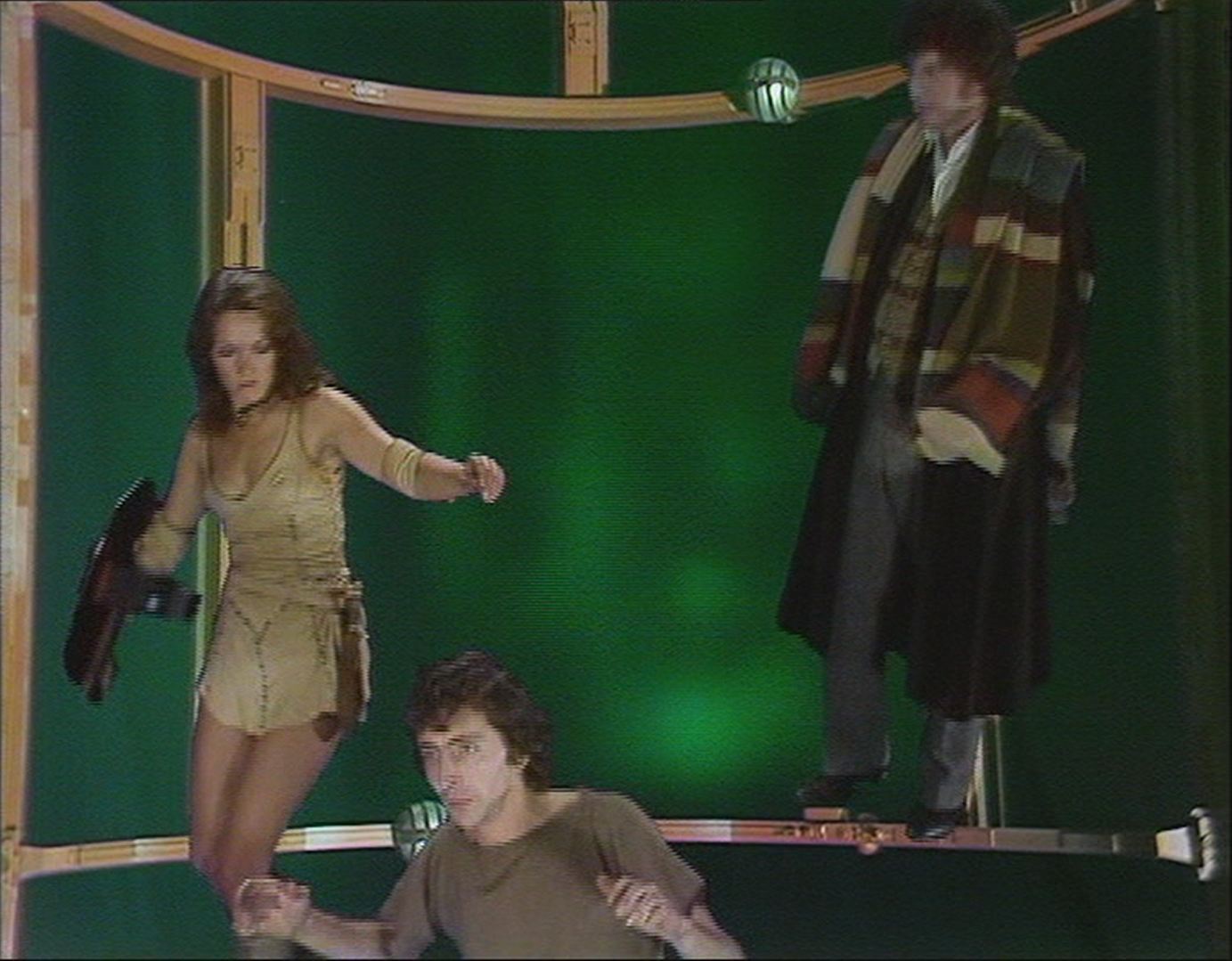
Rather tragically, Underworld's first episode is pretty solid. Whilst it's been criticised for its languid guest performances, for me the actors convey the monotony and meaningless void in their near-immortal lives. It's remarkably well directed too and places us firmly within the ship's cockpit, making the cosmos feel like its spinning around us. It's almost as cinematic as anything in Warriors' Gate and the cropping of viewscreen effects and the bridge set lines up perfectly smoothly and harmoniously in a way that, say, Revenge of the Cybermen's climax didn't.
The idea of a civilisation that all but destroyed itself because of the Time Lords being too generous with their technology is also an interesting premise.
There is, however, one moment where Louise Jameson as Leela is required to throw a contrived, forced tantrum and threaten to slice people up for patronising and trying to pacify her, where not only does Louise herself struggle with the scene, but one can almost tell she's started to become fed up with how her character's being written. Leela's probably the most interesting, challenging companion the show featured, and Jameson herself one of the show's best actresses, yet she's rather wasted this story.
In part two, we finally venture into the CSO caves, and the editing gets ridiculously choppy. Something happens, and suddenly the good will enfostered by part one quickly starts to die. We've reached the destination, and it turned out far less interesting than the journey promised.
Ironically, with the CSO background allowing the production team to film nearly everything localised and make it still look dynamic, the result is an incoherent tedious jumble that conveys the feeling that the story keeps leaving bits of its plot behind and forgetting about them. It becomes too easy to lose interest and patience with this story very quickly. It almost makes Moffat's story arcs seem simple and coherent by comparison.
In truth, the basic overall story is simple enough, with a population of slaves being liberated from their cruel oppressors, and it being quickly established who we're meant to be rooting for. From then on, the action should commence in uncomplicated fashion.
To give credit where it's due, the chase scenes are filmed and directed well, and, whilst they occasionally join up ruggedly, they're neatly done enough to convey the vast sense of open exposed space these characters are being hunted in.
The problem is, the production is set up in such a way that all the things the makers strive to achieve here are amongst the most banal aspects of visual storytelling, so there's never really a sense of grand triumph against the odds, and most of the time it doesn't feel like the cast are striving at all. And unfortunately the story doesn't let up in bombarding the viewer with this nightmarishly relentless incoherent plot chaos.
As with much of the Williams era, there are enough story ideas and homages to classic narratives about the tested, robust nobility of pioneering heroes to intrigue and reassure the viewer and almost make them feel rewarded by the little things. But inevitably the accumulation of longeur periods of dead air, tediously stalling humour and anecdotes and general running out of the clock leaves the viewer instead frustrating impatiently over where the show's been going so horribly wrong.
This has been a recurring feeling of the Williams era stories for me, and I used to think that Williams' stories were a frustrating viewing simply because I was being reminded how well the show's romantic storytelling was being done before JNT/Saward took over and deaded all that. That it was all the things the Williams stories were doing right that made me dwell on where the show would ultimately go wrong.
Now I think I was mistaken and that if the Williams stories were honestly that good, then the question of what went wrong after shouldn't even be entering into my head when watching, because I should be engrossed by the story.
I'm perhaps coming to acknowledge that maybe it's not so much that the JNT era's bad work acts as a retroactive corrosive critical mass to the show, as that too much of Williams' era is frankly easy to corrode, and a long, morbid viewing of the show's production falling apart already.
The worst Williams-era stories are ones that conceptually and aesthetically feel built on sand, and Underworld's arguably the worst offender of them all. At the point the plot should be in third gear, it's still working behind schedule to fit itself sequentially together.
Frankly, it seems to define how the majority of the Williams era feels composed of what might as well be a string of harmless, inconsequential dream sequences rather than actual solid adventures. Underworld being a particularly disorienting dream you feel desperate to wake from.
Certainly, watching Underworld gives stark insight into how the Williams era looks to its unforgiving detractors. One of the oddest scenes concerns the Doctor explaining to Leela about the people of Aberdeen being exposed to radiation by the local rock granite, and then declaring this is 'good for them'.
I suspect something was lost in the edit and that the call and response got muddled. But, at this point, the show indulging Tom Baker's irreverent idea of humour looks like a bleak prospect indeed. One where the dominating humour isn't necessarily witty or clever, nor does it even make sense, given this prize example of incoherently stupid, borderline-irresponsible gobbledegook that frankly makes it appear the show's severely malfunctioning on a scripting level.
I now see where fandom got sick of Tom Baker and wish he'd left sooner on a high during his prime. I would struggle to imagine City of Death working without Tom. But equally I can see myself watching The Invasion of Time on broadcast and being left sick of his Doctor for good. Hell, maybe Davison would've been better suited to the Key to Time quest.
However I do instinctively get behind the story's slave-liberation angle and the refreshing absence of trite moralising about maintaining a moral high ground in what's presented clearly as a kill or be killed scenario for our heroes. That part feels authentic and engages my spirit. The details are thin, of course, but a story of heroes that speaks to our romantic sense of morality and justice can be told any number of ways, even in the simplest form of narration or pocket synopsis, and still engage the listener.
Lawrence Miles once claimed that Doctor Who frequently had a stronger moral sense and conscience than the best of us. So maybe that applies here, where it doesn't matter how little we know about these nameless slaves, we're still assumed to care about and champion them.
We've gone from understanding the hollow lives of homeless space-faring immortals we met at the beginning, to seeing them rediscover their purpose when they find their far worse off brethren living only to serve and die. It all points to an emotionally satisfying conclusion, one made even more poignant by the many lives the Doctor couldn't save in Genesis of the Daleks or Horror of Fang Rock. That on the corner of a universe plagued by Daleks, the Doctor saved a last mass exodus from extinction. It could've even made a better capstone to the series than Survival. I dwell on this because it's the part of the story that almost makes it a keeper for me, and certainly moreso than nearly anything in the soulless, morally repugnant JNT era.
The problem is, the story of slave liberation is told with efficient brevity if we're being polite and is barely sketched in if we're being less so. But it leaves the story as a whole rather dragging itself out to fill a 90 minute runtime and it feels like the story doesn't know when to bloody end.
The insane computer is one of the most scarily voiced in the show, augmented by sinister lighting, yet the lack of motivation given it betrays a creative laziness, as does K9 quickly detecting the golden cannisters are grenades in disguise, and Tom easily returning them to sender before the story can milk further suspense. Besides, similar stories of liberation have been told more accessibly within Terry Nation's many stories.
The depressing tragedy about Underworld is that watching it is to see where, having ridden high so long, this once-magical show suddenly and completely loses its vitality and turns stale. In short, it's something you'd just rather not have to see.
Underrated? by Jason A. Miller
28/8/21
Season 15 was a pretty fraught time for Doctor Who, after eight straight seasons of expert leadership under Letts/Dicks, and then Hinchcliffe/Holmes. The troubled production behind Graham Williams' first four serials as producer betrayed a loss of leadership behind the scenes, and, with this story, Anthony Read fully replaces Robert Holmes, who'd been the last holdover from the first eight glory years of 1970s Doctor Who. If Season 13 under Hinchcliffe/Holmes was all about gothic horror, and if Season 14 neatly pivoted to a succession of hard sci-fi stories, then Season 15 was... adrift, mostly fixing its sights on space opera, but also, at times, losing its grip on logical writing, and with Tom Baker using the unexpected void from upstairs to make a power grab by rewriting every script to suit himself.
In spite of that background, Part One of Underworld is actually really good. There are some decent visuals (the opening pan of the stars) and model work (the R1C spaceship, and the cliffhanger effect of a planet forming around the R1C). The acting is variable, a bit wooden in spots among the guest cast, but the dialogue and storytelling is mostly intriguing. The idea of a Flying Dutchman ship on a 100,000-year-old quest and the idea of spaceships turning into new planets at the edge of creation are good storytelling devices. Following on from The Hand of Fear, this is the second straight season with a Bob Baker & Dave Martin story showing how other races, not just the Time Lords, can regenerate, here stressing that there's a dark side to the endless changing. Mawdryn Undead shares a lot of concepts with Underworld, and I mean that as a compliment.
But there are also some warning signs, even in Part One. Leela's little temper tantrum at the end -- as she's first pacified by Orfe, and then hypnotized by the Doctor into shucking off the effects of the pacifier -- is pretty badly written, a kind of pointless moment in an episode that was already under-running.
And then we come to the main story, as the R1C crash-lands into the baby planet, at the center of which is its lost Minyan cousin, the P7E. This where the story implodes.
I'm going to give a pass to the poorly realized CSO caves. It's late 1977, the show was operating on a negative budget. That's not the problem. I'm also going to give a pass to the fact that Part Two underruns by four minutes and still has to recycle like six minutes' worth of footage from elsewhere in the story.
No, the problem begins with the first shots of those Trog extras prancing around the rockfall, with the women extras wearing, some of them, fancy perms. Underground cave-dwelling slaves with hair salons? And where's all the light coming from? As with the same authors' The Invisible Enemy earlier in the season, with the inside of the Doctor's brain having a hidden light source, there's no plot reason for the caves to be well lit with no external source; it just happens out of plot necessity.
Speaking of the plot happening because it needs to happen, rather than because a good story is being told, considering that this is a story based largely on Greek mythology, set in the Underworld, with a character literally named Orfe (as in Orpheus)... and Orfe gets nothing to do in the caves, no subplot at all. Where's his Eurydice? Why name him Orfe at all? Herrick (Heracles) gets to be the strong and brave one. Orfe is... just there. Orfe gets to say exactly sixteen words in Part Two, and zero in Part Three. That's... a pretty annoying missed opportunity.
While the story is poorly made and grossly padded, even though it underruns by a total of about ten minutes compared to most four-parters, it still has a lot of isolated moments of charm. The last TARDIS scene is wonderful. The importance of K-9 to the TARDIS crew cannot be understated. Alone, the 4th Doctor and Leela had a somewhat toxic relationship, with the Doctor verbally abusing her at almost every opportunity, but K-9 gives Leela a foil and an ally; her kissing the K-9 prop on the nose at the very end (after K-9 shoots down one of the Doctor's whimsical but nonsensical theories) is just adorable. And it's one of only two Classic Doctor Who stories to name-check Jason, so, of course, I love that.
There are a few other nice moments. The Doctor outwitting the Oracle in a too-short scene in Part Four is one of his only positive contributions to solving the story's plot. The Oracle voice is excellent, too, sibilant and arrogant. I like the 1930s art-deco-design robot heads on Ankh and Lakh, revealed towards the Part Three cliffhanger. I also like the scene with the Doctor carrying the little Minyan girl -- a scene, per the DVD info text, that Tom Baker wrote and basically directed himself.
As for Dudley Simpson's whimsical elevator music/shopping-mall-at-Christmas sounds as the Doctor and Leela and Idas descend the shaft into the P7E (a scene played twice, to pad out the running time), this is... well, not his most majestic Doctor Who scoring, but it does fit the story. Most of Underworld is an unintentional comedy, and that music sure matches the action.
Although Underworld is bad, it at least crosses the line from awful into unintentional comedy. It has good moments, and even the bad moments are so bad that you have to kind of admire the writers and script editor and director and producer who let all this happen under their watch. In fact, the director even got invited back to try another story... and gave us The Power of Kroll. I mean, wow. Think about that, the guy who ruined Underworld actually got invited back... and managed to do even worse his second time.
You gotta salute that, you really do.
A Review by Thomas Tiley
1/10/25
Often considered to be one of the worst Doctor Who stories ever or at the very least coming close to the bottom in lists of the best episodes voted for by fans, so when it came time for me to watch this story I had already come in with certain expectations.
There are some interesting ideas: chasing after a ship only to see a newly-formed planet has encased it, a race of people affected by the Doctor's race's interference and the Doctor's own guilt/sense of responsibly driving him to help these people. Inspired by Greek mythology, the story plays with the idea that future history sort of echoes and spreads backwards to inspire myths and legends from the past is an interesting idea, but the rest of the episode is just standard evil computer who is bad just because it is (although there is a nice moment when the Oracle realizes its own trick has backfired and it has a almost human moment of regret, but as it comes almost right before the end, it's too little too late) and downtrodden extras (there are some good interaction/moments with them) and evil guards (who are revealed as robots or cyborgs after a while to no real end). I suppose the thousands of years spent on the quest could explain the subdued acting (or lack of) of the crew, but that is being generous. The only moment that stuck out with them was the renewal/regeneration tech they use, the pacifier gun that turns Leela all sweet for a few moments and Alan Lake's reaction when he thought the Quest was over (whether in character or just the actor glad it was nearly over, I don't know). The look of the sets of the spaceship are all right and cool looking, and the Laser/Shield weapons are a good-looking design, so it is very surprising how bland the story ends up. Not helped by the colour scheme of beiges, browns and other earthy colours.
The greenscreen effects are another thing people talk about, but they aren't that bad. They aren't great either, especially when scenes feature them and actors running/marching by are used again and again as padding to fit the running time. That being said, it's not as if the story would be better had they filmed it in a real cave or a proper cave set, as there would still be the same boring locations/reused footage problem.
The Doctor, Leela and K9 try their best, but save for a few moments are sort of on autopilot for this story and who can blame them.
Not exactly the worst Doctor Who story ever made, just bland and dull and slightly boring with no real interesting bits of action or acting, despite one or two interesting bits. Below average so I think 4/10.