THE DOCTOR WHO RATINGS GUIDE: BY FANS, FOR FANS
| Episodes |
3
45 minutes each |
 |
| Story No# |
141 |
| Production Code |
6W |
| Season |
22 |
| Dates |
Feb. 16, 1985 -
Mar. 2, 1985 |
With Colin Baker, Patrick Troughton,
Nicola Bryant, Frazier Hines.
Written by
Robert Holmes. Script-edited by Eric Saward.
Directed by Peter Moffatt. Produced by John Nathan-Turner.
|
|
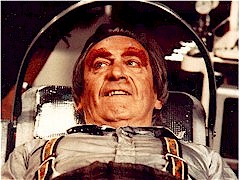
Synopsis: The paths of the second and sixth Doctor cross as alien omnivores plan to steal a secret of the Time Lords with the help of the Sontarans.
|
Back to page one (the first twenty
reviews)
Reviews
Doctor Who versus the Iron Chef by Jason A. Miller
20/11/03
If memory serves me right, the TARDIS never materialized in Kitchen
Stadium. However, by the time the 2nd Doctor rattles off a list of
unusual Earth recipes in Part Three of The Two Doctors, and
mentions Brillat-Savarin, and when Shockeye wonders if shepherd's pie
contains actual shepherds... then it's surely no coincidence that the
story's villain, Chessene, is wearing a metallic silver gown of the type
often worn by Chairman Kaga.
The Two Doctors is the best story of Colin Baker's abbreviated
tenure as the Sixth Doctor. The episode was written by Robert Holmes, one
of DW's top scribes, and therefore contains literally pages of
quotable dialogue -- and that's just in Part One. The story contains the
superfecta of Doctor Who tradition: the over-the-top villainness
(Chessene), the quotable henchman (Shockeye), the duped human stooge (Dr.
Dastari), and the prolonged gory death, complete with green ooze (Stike).
Not only that, but, being the longest DW story completed in the
1980s (not counting The Trial of a Time Lord),
there's a multi-layered plot which improves with age. Consider that I'd
always thought the reappearance of Holmes's own Sontaran enemies in The
Two Doctors to be a bit of a time-waster. With this viewing, however,
I realized that both Sontarans are well-acted, with witty dialogue -- and,
more importantly, their shaky alliance with Chessene allows for, as the
Doctor observes, "a double-double-cross". They don't waste time at all.
Indeed, by story's end, of the seven major guest characters, all but one
are dead. Similar to Holmes's previous script, The Caves
of Androzani, only a woman survives.
To call this the best Sixth Doctor TV story may come as faint praise,
but it's impossible to overstate Patrick Troughton's importance to the
affair, in his Second Doctor swan-song. Strapped to a table for most of
Part Two, Troughton still gets about 9 memorable quotes off in the first 9
minutes of Part One, and has a terrific turn as an Androgum gourmand in
Part Three. Also notable is that the story's climax is interrupted so
that the 2nd Doctor and Shockeye can drive into Seville (Spain) for a
lunch that costs, in 1984 terms, $233 US. No-one pays the tab.
Also welcome is the return of old companion Jamie (Fraser Hines), who
picks up the part after 15 years as if he hadn't missed a day. Teamed up
with the vintage cast, both the 6th Doctor and Peri (Nicola Bryant) are at
their most appealling. The best facet of Baker's tenure as the Doctor was
his line delivery, and Holmes feeds him several zingers which he reads
with obvious relish (pardon the pun). Some great clowning, also, as the
2nd Doctor defends himself against Shockeye with a cucumber, and the 6th
Doctor later brandishes a banana.
The addition to Time Lord mythology is interesting (and sets up the
Time Lords as the selfish villains they'd become in later TV shows and
books). Less welcome for me was the 6th Doctor's sudden embrace of the
"healthy vegetarian diet", although this part of the character would
thrive for another 15 years; and his unsubtle dig at Christopher Columbus
(who, if memory serves me right, is interred in Seville). You can also
tell that the Seville restaurant scenes were originally scripted for more
food-friendly New Orleans, before budget concerns intervened -- witness
how the 6th Doctor stages a mock arrest of his earlier self, by reading
the Miranda warnings. To quote the 2nd Doctor in Part Three... "Oh, my
giddy aunt. Oh, crumbs!"
A Review by Stuart Gutteridge
4/7/04
Of all the multi Doctor stories, The Two Doctors is the one that
stands up best. This is largely because there is something of a plot
within the story as opposed to a runaround. It is also the best multi
Doctor story for Patrick Troughton laregely because he is given something
to do within the story as opposed to bickering with Jon Pertwee.
Thankfully his interplay with both Colin Baker`s Doctor and Frazer Hines
is a joy to behold. Colin Baker is actually rather good here too, his
Doctor is still egotistical and arguing with Peri, but he is also more
commanding in the role too.
However the story does have its flaws, the Second Doctor is virtually
absent from the first episode once hes been captured, the Sontaran`s
costumes do them no favours, rubbery masks and loose collars don`t make
for a great returning villain. Similarly some of the other performances
are variable, Laurence Payne as Dastari is particularly wooden and
Jacqueline Pearce is simply going through the motions as Chessene
(virtually playing Servalan in all but name, without any of the flirting.)
By contrast however John Stratton`s Shockeye is great fun largely because
the character is so well motivated by a desire for food.
If you can ignore the flat direction, Peter Moffat`s introduction of
the Sontarans being a case in point, and tolerate some of the acting, then
what you are left with isn`t necessarily a classic but is certainly
watchable enough in its own right.
A Review by Finn Clark
4/11/06
Just like The Power of Kroll, The Two
Doctors starts well but goes downhill. However, in fairness, neither
story was written under ideal circumstances for poor Robert Holmes. The Power of Kroll was a last-minute replacement for an
abandoned story, while this one had to be wrenched from its original
setting of New Orleans. Furthermore it's an old-fashioned six-parter, to
date the last since The Armageddon Factor in 1979.
It's a mark of Robert Holmes's success on this count that people
criticising this story never seem to take that into account.
Personally I think it's fascinating! Part one has a thematic depth and
richness that's almost unparalleled throughout Doctor Who. It
repays attention in a way one doesn't normally see. Stories like Pyramids of Mars or Tomb of the
Cybermen are cracking yarns, but no more. They're just good tales
well told. This however has two different extensively explored themes.
It's a cliche that six-parters should in some sense be two stories in one,
although even a glance at Troughton-era six-parters will show that you
violate that rule at your peril. The Two Doctors however has two
TARDIS crews with two interweaving plot threads, two sets of villains, two
settings and two themes. I was particularly impressed by the latter, most
stories not even managing one.
The first theme is about hunting and killing lesser beings, usually for
food. The first Doctor-Peri scene is all about fishing, although the
Doctor ends up saying, "Did you see the one that got away? The
magnificent gumblejack that was trying to eat this poor little fellow?"
Naturally he throws back the minnow. Back in 1985 I never took seriously
the punchline about "a healthy vegetarian diet", despite the nut rolls in
Revelation of the Daleks, but in fact it's the
culmination of the story's themes. Robert Holmes was a vegetarian and had
strong feelings on these issues, but fortunately he didn't write some
"holier than thou" sermon. On the contrary, he dashed off a riot of sick
gags and tastelessness. "They don't feel pain the same way we do."
That's one theme. The other concerns your innate nature and what
happens when you try to change it, as summed up in the beautiful line:
"Give a monkey control of its environment, it'll fill the world with
bananas." (a) There's Chessene's double identity as shown in her
relationships with Dastari and Shockeye. Dastari thought he could change
her, but in fact he created a monster that made horrific plans with the
Sontarans. (b) Then there's the Doctor. Colin Baker has mysterious
mindlinks with Troughton, after the first of which incidentally it's
interesting how quickly he decides to visit Dastari. More importantly,
this is a 6th Doctor shortly after his regeneration, meeting an embodiment
of his own instability and shapeshifting. He gets affected by his former
self being kidnapped and/or Androgummed, although the temporal physics of
this is counter-intuitive. "Celery, that's what you need." Jelly babies.
There's also the minor detail of Time Lord genetic inheritance!
Normally the Doctor's just a hero who appears and solves your problems,
but here Robert Holmes explored his nature more deeply than any other
story. What's more, it's no identikit anniversary get-together. These
specific Doctors are important to the story: the 2nd's innocence and the
6th's instability. And all that in a JNT laundry list commission of a
multi-Doctor story. I think it's wonderful. (Holmes would soon take
these ideas somewhere even darker with the Valeyard.)
We have Troughton being pitched into the Saward universe, with all its
brutality and Time Lord obsessions. Much went wrong with Doctor
Who in the mid-eighties, but for precisely that reason Colin Baker's
era makes an even more complete thematic whole than Eccleston's. It's the
rotting fruit of Eric Saward's scary vision: a universe collapsing in upon
itself, full of old monsters and continuity. Time Lords are everywhere.
We start with a villainous but sympathetic one in The
Twin Dilemma and finish with Trial of a Time Lord
and the Ravalox conspiracy. In the end even the Doctor will be evil.
Somehow the retcon of a shockingly old Troughton working for Gallifrey
feels oddly fitting.
Thus his meeting with Dastari ends with a massacre and Jamie abandoned,
after which we get the 6th Doctor charging full steam ahead into a killer
space station controlled by a homicidal computer. As in Attack of the Cybermen, we get this Doctor's appalling
lyricism about death. "Fruit-soft flesh peeling from white bones. The
unholy unburiable smell of armageddon. Nothing quite so evocative as
one's sense of smell." Peri's response is simple. "I feel sick."
Suddenly this unlikeable TARDIS crew works. Troughton's era was about
joyful escapism. You wanted to be there, to travel with him. Not so with
Colin Baker. Peri whines, complains and doesn't want to be there, but
that's understandable since her adventures are so horrible. This is the
Sawardiverse, which pours petrol over wish-fulfilment and lights a match.
Robert Holmes even tries to make us wonder if the Time Lords
perpetrated this massacre. I never believed that in 1985, but today it's
more credible. This is the age of Time Wars and Lawrence Miles's sinister
Gallifreyans. "What kind of monster would want to stop the brilliant work
that was being done here?" asks the Doctor. Bearing in mind developments
in just the Colin Baker era, perhaps we were wrong to be so dismissive of
Holmes's suggestions. As an aside, The Two Doctors is almost a
prototype for Lawrence Miles's Interference: a
multi-Doctor story that puts a classic TARDIS crew from a more innocent
age into the grimmer, nastier universe of the then-current era. Both star
the worst TARDIS crew ever seen in that medium. Both stories are also
riddled with continuity, Time Lords and weird bio-technology, with a
Doctor imprisoned for a stretch in the middle.
So I like the script's ideas. What about the production? It's
directed by Peter Moffatt, which isn't a good sign, although he's far from
my least-favourite director. At least he gives a shit, unlike Pennant
Roberts, and he usually elicits decent performances. You can't blame him
for the twins in The Twin Dilemma. He's not the best
judge of tone, as shown by The Visitation's Richard
Mace and here Oscar Botcherby, but on the other hand his shows tend to
look pretty. State of Decay, The
Visitation and Mawdryn Undead are all easy on the
eye. The imagery in The Two Doctors is similarly attractive, with
a space station as good-looking as Seville and the Spanish countryside.
The Sontarans look unconvincing but no more than usual, while their eyes
in that mask can be surprisingly expressive.
Regarding the space station: returning to it in an abandoned state is
such a neat visual trick that I'm surprised it wasn't used more often.
Doctor Who's best take on that idea to date is actually the Destiny of the Doctors computer game, which took the
Graak to all kinds of different time zones, including one that was flooded
and underwater. Here of course we have the further twist of wondering
what the hell happened, although we have some idea.
The production's worst misstep is Oscar Botcherby. In the script he's
great, being basically Henry Jago from The Talons of
Weng-Chiang. Unfortunately, on-screen he's a loser. Yes, he's
basically ineffectual and a failure as an actor, but the production
undermines his comic moments with inappropriate music and never really has
fun with the character. John Stratton has enormous fun with Shockeye
(e.g. the rat) and that's why the character is so vivid onscreen. Oscar
just seems like a waste of space, which is why his death in episode three
feels so wrong. He hasn't been given enough weight to justify it. The
production never took him seriously. I don't blame Holmes one jot. The
final Oscar's too nerdy and tentative, which undercuts the comedy as well
as the drama. He should have been more theatrical, a larger-than-life
presence on a par with Shockeye et al. James Saxon achieves a kind of
baffled sweetness in the role, but basically he's awful.
Mind you, about Oscar's death everything is misjudged. The guitar
music is especially wrong, but that whole sequence is painful.
Personally I suspect that Robert Holmes would have played it as comedy so
black as to be barely detectable as comedy, if that makes sense.
Incidentally, one could almost regard Oscar as a surrogate 6th Doctor,
with Anita his pretty companion. Colin caught fish and Oscar caught
moths. Both are slightly pompous characters who love theatricality and
language. The difference is that Oscar is squeamish, killing moths but
hating the sight of blood. The 6th Doctor on the other hand is
practically scary in part three as he sets up Chessene and the Sontarans
to murder each other and then sits back merrily to watch the carnage.
Oscar aside however, the cast's fun to watch. Obviously I was
delighted to see Patrick Troughton and Frazer Hines again. They've always
been one of Doctor Who's most sparkling combinations, even if they
don't get enough to do here. Frazer is great even when getting almost no
lines, while Troughton is obviously having the time of his life. He even
gets to be bad! I was disappointed that his 'Doctrogum' wasn't evil
enough to be scary, but he's still relishing every moment. Jacqueline
Pearce is fun too, but the obvious standout in the guest cast is John
Stratton. He's enjoying himself almost as much as Patrick Troughton,
although it's interesting that they didn't try to make him particularly
scary. Imagine some huge ex-convict stalking Jamie through the space
station or Peri through Seville. That could have been terrifying.
In Season 22 it's curious that Peri has heard of Jamie and Jo, but
knows nothing of Cybermen, Sontarans and Daleks. Uh, Doctor?
Priorities? On a related topic, it's lucky for Robert Holmes that Pertwee
had already known about Sontarans before The Time
Warrior.
The Two Doctors is slightly awkward to watch and gets a bit
runaroundy in its later episodes, but I don't blame Robert Holmes for
that. It's a six-parter! More than anything else, this story needed a
director in sympathy with Holmes's gleeful delight in gore and
theatricality. Hell, reshooting Oscar Botcherby's scenes would fix 90% of
this story's problems. Read the novelisation. It's even more gruesome
than the TV version, but it's also hilarious. It's a shame that Holmes
never wrote another. This story is full of good stuff, but I like its
richness best. Those themes come through loud and clear. I'm coming to
realise that Season 22 made some dreadful mistakes, but thematically it's
one of the show's richest eras. "There cannot be a creature on the planet
that humans do not kill and eat. Many beasts are bred especially for
table." Even the Sontarans tie into the theme of using technology to
overcome your own nature. They're a clone race, remember?
The multi-Doctor stories seem to rub up many fans the wrong way, but
personally I like them all. If you can see past the self-congratulation,
there's much to admire. If nothing else, reflect on this. Patrick
Troughton appeared in all three multi-Doctor stories, yet only six
complete stories have survived from his own era. The Two Doctors may not
be another The War Games, but I think it's one of
Troughton's most fascinating stories.
A Review by Brian May
27/11/07
The Two Doctors is flashy, glossy, and driven by concepts rather
than storytelling: thus it's an ideal representation of Doctor Who
in the 1980s. The concepts it relies on - multiple Doctors; the return of
the Sontarans; another visit to an overseas locale - are simply dumped
into the mix without the foundation of a proper story. If you like, there
are too many ingredients and no recipe.
With Robert Holmes as the writer, you'd be forgiven for thinking he'd
provide a worthy follow-up to the previous season's stunning Caves of Androzani. Alas, poor viewer, this was not to
be. He's never been preachy before, but his anti-meat message is so
didactic it belongs in Star Trek. There's little of his usual sparkling
dialogue and, Oscar aside, no memorable characters. The aforementioned
concepts were thrust upon him by John Nathan-Turner, who script-edited
most of this, and Holmes doesn't seem very happy, whipping up a very
tired, bored and boring mess. The plot is vague, motivations are unclear
(Chessene suddenly changes her plan midway through) and it goes on
seemingly forever.
The length was another Nathan-Turner imposition - and rather a
hypocritical one. After all, it was he who did away with six parters,
ironically when the last few finally got the pacing right! But this sees a
return to the horrid padding of old. Most of part one is tedious, as we
follow the Doctor and Peri through the deserted space station. There's
only one good moment, when the computer suddenly says "They threatened the
Time Lords". It's a nice jolt, and I remember it quite vividly as it was
the cliffhanger for the story's Australian transmission, in which it was
shown as six episodes (oddly enough, it was edited this way for the VHS
release too!) The second episode also drags and only the last section of
part three provides anything in the way of movement. The slowness isn't
helped in any way by Peter Moffat's lifeless direction. Static images
added to a stagnant script don't make for good fare, and this is before
you factor in the horrid 80s costumes and design.
The Sontarans are completely wasted. Their return was publicised before
airing, therefore denying us any Earthshock-style
surprise, but their appearances are still clumsily handled. Their ships
are sighted and they are identified as they approach the station, yet the
monsters remain unseen as they capture the second Doctor. Why? We know who
they are, so there's no real point for this. They then vanish for a while
and re-appear in Spain - but they're just walking round and doing nothing,
procrastinating, prevaricating and making macho threats. Then they're
dispatched when the script has no further need for them, and on top of
this the masks are crap; they're extremely ill-fitting, and as they're a
clone species one of them shouldn't be more than a foot taller than the
other!
Patrick Troughton is also wasted as the second Doctor. His performance
is very good, but he's under-used and comes across as nothing more than a
boast for the production team. They're showing him off rather than
allowing him to be constructive. While there are moments of Troughton
magic - the first ten minutes and his wonderful culinary escapade with
Shockeye stand out - for the most part he's displayed like a trophy guest
star. As much as I like Frazer Hines, he's not very good here. As with
Troughton, the actor's enthusiasm is evident, but a 40-something man
trying to re-create his youthful verve from two decades ago just doesn't
work. Nicola Bryant gives one of her worst performances as Peri, but she's
not helped by having her character so badly written. There's zero
chemistry between her and Colin Baker, and she still can't say "glass" in
a convincing American accent! (cf. The Caves of
Androzani). Jacqueline Pearce is a fine actor, but she's stepped
straight back into Servalan mode, only a few years after the end of
Blake's 7, offering nothing new.
Colin Baker comes out best from all this. He's excellent, and by now
has cemented his own interpretation of the Doctor. While he still can be
an annoying git, the more unbalanced, disturbing aspects have gone -
thankfully. Him killing Shockeye at the end shouldn't be as controversial
as it's often been - there's no difference between this and his disposing
of the Cyberleader in Earthshock - although the
subsequent pun is very tasteless and should have been left out. On the
subject of Shockeye, John Stratton gives a fantastic performance, sharing
the best acting honours with Baker, although I also like Laurence Payne as
Dastari, and James Saxon gives a memorable turn as Oscar. As I said, he's
the best example of a Robert Holmes creation, reminiscent of Henry Gordon
Jago from The Talons of Weng-Chiang.
While I'm being nice, I must admit the location photography in and
around Seville is rather good, and I really like Malcolm Clarke's Sontaran
march theme; it's a pity it wasn't used more.
But overall The Two Doctors is a sprawling and uninteresting
mess, penned by a writer who seems to want no part of it. It's what you
get when those in charge obsessed over gimmicks, image and continuity
rather than solid stories. What's more sad is that it's Patrick
Troughton's last appearance in the show that so rightly endeared him to
countless viewers. He didn't deserve to bow out this way. 2.5/10
A Review by John Reid
5/4/10
The idea of previous Doctors meeting each other had been around since
the seventies story The Three Doctors. Producer Barry
Letts had treated the idea as a humorous tribute to the memory of the show
by having the current (third) Doctor reunited with the second Doctor only
for them to argue. They used the obvious plot device of having a powerful
body (in this case the Time lords) taking older Doctors from their part of
their time stream. An idea that Terrance Dicks would use ten years later
for The Five Doctors.
The roots of this story go back to Robert Holmes being asked to submit
an idea for the twentieth anniversary with the second, third and fourth
Doctors returning to meet the fifth Doctor. In this plot, the Cybermen
were after the Doctors DNA and wanted to extract the symbiosis of the Time
Lord that gives him the ability to time travel. Holmes' story fell by the
wayside but ideas from that story forms the basis of The Two
Doctors, with the notable change from Cybermen to the Sontarans.
Writer Robert Holmes' original idea of the Sontarans in their first
story, The Time Warrior was of a race of soldiers
who were so incredibly pompous Colonel Blimp characters that, when
arriving on earth, they found Earthlings to be more violent than they
were. By the time of The Two Doctors, the Sontarans are not too far
removed from Graham Chapman's officer from Monty Python's Flying Circus.
Holmes in The Two Doctors goes against the grain of how a story
involving the same person could meet themselves without trying to come
across himself. In this case, the second Doctor and Jamie are on a mission
from the Time Lords to visit an old friend Dastari, as they have noticed
he is responsible for disturbances in the time field. However, as the Time
Lords have a policy of non interference, but want to make sure that
Dastari doesn't rip a hole in the space time fabric, they send the second
Doctor to ask Dastari to stop. It won't interfere with their policy of non
intervention as the Doctor is a renegade.
When I first saw this story, I believed it was too long. Peter Moffat's
direction, while lacking in places, is his finest hour and Patrick
Troughton falls back into the role even though it had been 19 years since
he started. Unfortunaltey, this isn't Peri's finest hour and the sixth
Doctor was still finding his feet. However, the real star is Shockeye, as
the idea of a cannibal race was one that Robert Holmes had been working on
since his time as script editor. This story has been criticised for
violence, but I don't consider it any different from previous years and
justified as it would be in other Colin Baker gems Vengeance on Varos and The Trial of a
Time Lord. The real strength of this story is Pat Troughton playing
off Colin Baker's Doctor in what would be the second Doctor's last story.
9/10
Great, but not the best.
A Review by Yeaton Clifton
17/3/11
This classic episode featuring Patrick Troughton alongside Colin Baker
is very entertaining if viewed as a satire and piece of black comedy.
Troughton's performance is excellent, particularly the part of the story
where he is transformed into a cannibalistic alien who goes with a similar
alien to a restaurant in Seville. Unlike many Doctor Who serials,
the story can be said to have a solid plot. The reality of cannibalism
creates a conflict in the mind of the sixth Doctor about the business of
eating meat. The conflict is resolved when he becomes a vegetarian. I am
writing this review, my first review, to address two major complaints
about The Two Doctors. There is a charge that it is illogical; it
is logical as any story, given the absurd universe of Doctor Who.
There is also a charge that the story is too violent; it would not be a
black comedy if it were excessive and, given that violence is the subject
of the plot, a certain amount of violence is understandable. If there
something very wrong with this story, it is that the story is sexist, but
I would like to explain the positive before I explain the problem. I do
not consider it one of the ten best Doctor Who stories, and it did
not work with me so well that I gave up meat. I am recommending this story
to people who are in a mood for something absurd and funny.
There is something very violent about the cannibalistic race the
Androgums. The Androgums believe they are far superior to the human race
and view humans essentially as food. Androgums believe their gourmet taste
makes them superior, although Androgum is conspicuously an acronym for
gourmand: a word for a person who loves food although his or her taste is
not very refined. It also conspicuous that the Doctor, when discussing a
Androgum whose intellect was augmented, suggests that she cannot really be
changed. It is a disturbing to suggest there is an irredeemable race and
it would be inexcusable if the suggestion were taken literally. I
interpret the statement as a comment about arrogance. It suggests the
groups most certain of their own superiority might be the most inferior.
The most arrogant people in asserting their superiority are the ones who
cannot be redeemed. I believe that it is intended to call into question
the human belief we are superior to the animals we eat. The analogy is
completely over the top and offensive, but that seems to be the idea. The
references to cannibalism are also very offensive and seem lustful, but
that seems to be how the author wants to present our carnivorous nature.
This not something that I agree with, but I think it is interesting to
examine the scriptwriter's point of view. I would also point out that a
great deal of what is on TV is more violent than any Doctor Who
episode and most of these violent shows have no sane reason for being
violent.
There is an interesting question that has been posed about whether the
sixth Doctor would remember the events in a direct way. The story is that
the sixth Doctor does not remember because his past is being actively
altered as the story goes on. The sixth Doctor gets sudden encounters with
his past changing. The sixth Doctor's timeline was altered because the
Time Lords decided to use the second Doctor as their agent, thus
disrupting the reality of the sixth Doctor. The proof of this is that when
the second Doctor changes into an Androgum, the sixth Doctor starts to
change, implying that is being rewritten so that he was an Androgum during
all of the time in between when he was the second Doctor and the present.
The second Doctor changes back into a Time Lord and the past of the sixth
Doctor is restored. The logic is that of a TV series where it is possible
to travel through time in a police box. In such a series, explanations
tend to be odd, but The Two Doctors is not particularly odd in
terms of the explanation it gives.
The biggest problem with the story is that, for a plot that claims to
have an enlightened message, the way Peri is presented is fairly
demeaning. Peri is the longtime companion of the sixth Doctor. She is
underdressed, continually abused by the Doctor and seems to function
mainly as defenseless victim for the Doctor to rescue. Her defenselessness
is highlighted when she is placed on a butcher's table and an Androgum is
waving a knife over her, planning to torture her before he chops her to
bits. I am well aware that the show evolved into a vehicle in which the
Doctor was the main hero and that some of his companions serve as
decorations; for example, Leela and Amy are fairly decorative. The main
hero is supposed to be the one rescuing the supporting case, but often the
companions are given a certain amount of ability to defend themselves;
even if we are to see Peri as not able to defend herself against monsters,
there is the question of why she puts up with the Doctor's abuse. A sane
woman would walk out of the TARDIS if treated that way and it gives the
impression that attractive women are natural victims. Sexism is something
of a problem with the entire twenty-first season, but presenting Peri as
an object of cannibalism makes the problem worse.
I think The Two Doctors is one of the higher points of the Colin
Baker era. It is funny, it moves fast and it gives you something to think
about. There are a lot of chases that are fun, but do not keep the story
from having a solid plot. Recommended for fans who are willing to look at
something that is disturbing, so that they can get something to think
about. Not for the faint of heart.
A Review by Richard Conway
22/8/12
Forever linked in the subconcious of Who fans with the
cancellation/hiatus of 85. More than a quater of a century later seems
like more than enough time has past to look afresh at The Two
Doctors. The first thing that stikes you (sorry strikes you...
couldn't resist) is that Robert Holmes (the writer) has written a black
comedy for the programme. The one and only time he did so. I genuienly
found myself laughing out loud throughout and for all the right reasons.
The problem the story has - if it has one - is that the production team
in charge of making it seem blissfully unaware of this and seem content in
making a standard action adventure. The only ones on the production who
have seeminly latched onto the way the story has been written are the two
leads, Colin Baker and Troughton. They both relish the sparkling dialogue
throughout and bring out the black humour present. If ever there was a
story in the mid 80s that showcased the breakdown between the two
powerhouses of production, namely producer/director and script
editor/writer, then it's this one.
The story itself is glossy and well-produced. With the Spanish locale
not being neccessary for the story, it is at least pleasing on the eye and
gives the story some high production values. The sets and the costumes are
all of their time and that is not a criticism but merely stating a fact
and all of the acting is of a good order also. With the main plaudits
going to John Stratton's Shockeye. Between writer and actor, they come up
with a wonderful creation, that is a grotesque in the extreme, and it's
all the better for it. The only thing that lets down the character are the
visualisations of the orange eyebrows and the silver warts; however, this
was the mid 80's after all.
There is no denying that had this story kept it's original location of
New Orleans and been tightened to a pacier 2 parter, that's to say 2x45
mins episodes, it would have been a more involving and exciting story but
it didn't and wasn't and it is a fruitless task criticising a story for
what it wasn't rather than what it was. The director of this story was
Peter Moffat who, on his last work on the program, is as easy on the eye
as ever. If he lacked a little behind the camera, it was when it came to
action. He never cut enough or moved the camera enough to sell it and make
it work, and his style of directing in this kind of genre did at times
seem a little pedestrian.
In conclusion, what we get from this melting pot of ideas and talent is
a story that ultimately falls a little between two stools. It runs from
action adventure to black farce, many a time in the same scene, and this
is possibly why even now, after all this time and free from the black
cloud of the cancellation/hiatus, it's not held in higher esteem. The
story is being pulled from a production perspective from both sides and
therefore doesn't quite know what it wants to be.
The best example to demonstate this is in the death of one of the main
characters. No, not one of the usual suspects that are used to illustrate
where this story went wrong, but in Stike the lead Sontaran. His death is
really grand farce and black comedy to a tee. He is killed three times in
quick succession in three different ways by three different protagonists.
The last time of course by his own orders! It's not only the funniest
death in the whole series, it's probably one of the funniest moments as
well. It just doesn't play out like that though because the production
team are just playing it straight. Even when Shockeye caps of the gag by
plonking down what remains of the character (half a leg), it's still
played straight and so what comes out of these scenes is just seen as
gruesome and misguided, rather than the clever black farce that it really
is.
A misunderstood classic then. No, there's not enough excitment,
tension or pure drama in the finished program for that. Neither does it
deserve its tarnished reputation as the gory and over-violent misstep that
brought the roof down on Who. Like the story itself, it falls
somewhere in the middle. 3/5
"Licence to Kill" by Thomas Cookson
12/10/14
This is one last 80's story I must reckon with, but not necessarily to
bury it.
Tom May has nailed how this was likely a vague
attempt to make a 'classic' story. Unfortunately JNT by now defined
'classic' as The Twin Dilemma. But JNT knew what
fandom apparently wanted, which was Robert Holmes and continuity.
There was no particular occasion for a multi-Doctor story here, only
two years after the last one. I think it came about because Patrick
Troughton was still keen on playing the character again. On those grounds,
there's no reason it should've been out the question. And I doubt many
fans would hand on heart say we should have been denied this story, given
it was Pat's last performance in the role. Even I have trouble maintaining
my 'it should have ended on Logopolis/Castrovalva' stance when I think of that.
So we have a conflict between fandom's self-loathing compulsion to bash
continuity fanservice against their respect for one of the show's most
beloved lead actor's last performances before he died. Sure Jon Pertwee's
last performance hardly makes Dimensions in
Time a keeper. But this is different.
As a continuity exercise, it makes more sense than Arc
of Infinity or Warriors of the Deep did. The
Sontarans are pretty self-explanatory to non-fans, and a multi-Doctor
story would make sense to viewers who freshly remembered The Five Doctors and Davison's regeneration.
Bringing back the Sontarans might've been redundant if The Invasion of Time had been their finest hour.
But it wasn't. So there was more you could still do with the Sontarans. In
fact, this could have done for the Sontarans what Earthshock did for the Cybermen. After all, Season 22 is
less a natural successor or continuation to Season 21 and more a Season 19
redux.
JNT's concern over recasting the Doctor after Tom Baker was whether
audiences would accept the new guy, or even see this as the same show. The
solution was to focus on continuity, surrounding Davison with familiar
foes to corroborate his credentials by having his enemies still recognize
him as the Doctor. Asserting that the show's past was bigger than Tom
Baker. So after Tom Baker's departure to dismal ratings, Season 19 saved
the show, yet simultaneously damned it.
This continuity fixation should have ended in 1983 with Resurrection of the Daleks and The Five
Doctors at the latest. Unfortunately, the former was postponed a year.
But Season 21 felt like the endgame, hopefully bringing the continuity to
completion, before passing the torch to a new incumbent with more distance
from Tom Baker's shadow.
But rather than letting this new Doctor carry the show without the
crutch of continuity, they chickened out. Maybe JNT had an inflated
opinion of how beloved Davison was, thinking Colin now had Davison's
shadow to overcome. Sure JNT knew that some convention-goers, and even his
own bitchy boyfriend considered Davison 'bland'. But he'd been beside
Davison when promoting the show on chatshows, and knew Davison was, for
many, the face of the Doctor.
So Season 22 gets heavy flack for its gratuitous continuity, not for
being any more offensive or nonsensical about it than Davison's era was,
but because it wasn't the fresh start we were unspokenly promised.
What do I think of The Two Doctors? Well, when I watching this
story during an online marathon, I realized it really was a cut above
Season 22's usual crop. Plenty of fans who hate Colin's era would consider
this one story they'd gladly keep. Many other fans claim it put the
biggest stake through the show's heart, precisely because all hopes rested
on this combo of Holmes and Troughton. After all, if they couldn't save
this era, nothing could.
My own view goes back and forth. I hate how this story valorises
fandom's view that some lost-cause 80's stories were actually salvageable
if only the production and directing had been up to scratch. It's actually
true here, but I think this and Terminus are the only
times where it is. No Hollywood production values could save Time-Flight or Warriors of the
Deep from being rotten through and through. This script is different.
It's very promising and should have been nothing if not satisfying. It's
actually lavishly produced, but the director isn't in synch with the tone.
Or rather, a really good director could pull its problematic tone
together, but Peter Moffatt ain't the man for the job.
On paper, Peter Moffatt should have been a good choice. When directing
State of Decay, he'd aggressively fought against
Bidmead for the integrity of Terrance Dicks' vision. So equally he should
have been in touch with what macabre tone Holmes was aiming for here.
Peter Moffatt was rather the unsung hero behind the scenes of State of Decay, even taking time to sympathetically work
through Tom and Lalla's issues. I'll probably go to my grave cursing how,
in a perfect world, he'd have gotten the producer's job in 1980 instead.
He'd done a fairly sturdy job on The Five Doctors,
so he was the natural choice for the next multi-Doctor story. He'd not
only worked with Patrick Troughton before, but he'd demonstrated a good
flair for maintaining the momentum of adventures split between separate
parties on different routes to the same quest. But this story feels merely
gimmicky, like a typical Doctor Who story that's been split in two.
It doesn't feel like a proper multi-Doctor special.
So what works about this story, and what doesn't?
Well compared to stories preceding it, it shows a rapid curve of
improvement in certain areas. It suffers from similar pacing problems as
Mark of the Rani, but what fills its stretched
runtime is far more substantial and engaging. Also, at its stretched
length, you'd have time to really notice if it was as sloppy or
half-finished an effort as Attack of the Cybermen or
Vengeance on Varos was. And it clearly isn't. It
holds together narratively very well, and in some ways pre-empts some of
the timey-wimey business of Moffat's era. In fact, the scenes where the
Sixth Doctor undergoes self-hypnosis to find his abducted second
incarnation or begins succumbing to the Androgum conditioning of his
earlier self seem like a forerunner to A
Christmas Carol and The Girl Who Waited.
Where it is sloppy of course is in terms of canon continuity. So sloppy
in fact that it birthed the Season 6B theory. This leads me to the
conclusion that the JNT era wasn't really more accurate with continuity
than the show had been before. It simply adopted that pretext as a
propaganda tool that many fans swallowed, having wearied of the more
flippant way continuity was handled under Douglas Adams. It wasn't so much
about getting the facts right as feigning newly defined facts that are
suddenly made out to be how they've always been. Which is in keeping with
JNT's tabloid sensibilities. The focus on solidity of production value
complemented the sense of watching a block universe with a set timeline.
What the story really has going for it though are its characters. See,
in Attack of the Cybermen, I thought Lytton's gang
were fairly witty characters, but then I realized that, beyond this,
there's nothing to them. Even despite Terry Molloy bringing a lot to
Russell's character, he's actually only there to deliver exposition about
Lytton, then get killed off. Vengeance on Varos like
I said feels half-finished: whilst Sil and the Governor are brilliantly
drawn, it's a story in which the ciphers far outnumber genuine characters.
Shockeye feels authentically real and driven by animal instincts in a
way that gives him a genuine visceral presence and danger. The man is
volatile. Chessene, likewise, has a dark nature all her own that breeds
inner turmoil within her. Oscar and Donna are a sweet and awkward but
likeable couple. So it genuinely hurts when death strikes them. Even minor
victims like the blind woman become people because of Chessene's
telepathic reading of who she was and what thoughts and beliefs dominated
her mind. Dastari is a bit on the limp side, but even his arc from
turncoat to redeemed figure feels organic and believable. The Sontarans
are wasted though. Yet again, under Saward, the Doctor needn't do much to
overcome adversity when the villains are already destroying each other
anyway.
It might mean this is a cut above Season 22 because our points of
character interest aren't solely on the toxic Sixth Doctor and Peri
relationship. But overall the character decisions are real and engaging
and lead to genuine predicaments and sharp danger, and visceral
sensations. Making this much more involving and rewarding to watch.
But the afterviewing does leave a nasty aftertaste.
From first watching this, I've always had problems with the fascistic
assertion that Androgums can't be enlightened or redeemed because savagery
is in their blood. Now I can enjoy the Planet of the Apes films without
being bothered by its portrayal of a racially segregated caste system,
with the gorillas being good-for-nothing thugs of the military who are
considered stupid savages by the more enlightened higher up chimpanzees
and orangutans. Maybe because we expect that kind of hierarchy of
intelligence to the animal kingdom. But this is different, and far uglier,
because it actually rules out the idea that intelligence can redeem the
lower castes. The idea of arbitrarily cutting off someone's humanity and
consigning them to a sub-human level just because of their race. No wonder
Lawrence Miles was going to praise it in About Time
6.
It's not quite Warriors of the Deep where the
Doctor outright tells the human victims of ethnic cleansing that we're a
lesser species who have it coming just for existing. But it's close. It's
about rendering the Androgums defenceless and powerless and ascribing how
their lives carry less value.
Perhaps this is a continuation of Holmes' evisceration of criminal
culture in The Caves of Androzani. That there exists
a violent lumpen proletariat who can't be rehabilitated. That's a common
view for a cynical ex-policeman. Is he wrong? I certainly believe some
violent criminals or sex offenders can never be rehabilitated, and that
their intellect only makes them more manipulative and dangerous. But
framed in species terms, it comes off as racist and fascistic. Although a
part of me suspects Robert Holmes intended the Androgums as more a
universal metaphor for the human psyche and our darker, greedy, malicious
desires that we repress. But typical of JNT's era, it comes off as too
literal-minded to work.
As for Shockeye's death? I doubt anyone can seriously argue that a
dangerous beast like Shockeye didn't need putting down after killing
Oscar, without sounding idiotic. What choice did the Doctor have?
James Bond or Indiana Jones films feature plenty of cartoonish 'happy
kills' of bad guys. Robert Holmes often specialized in them. See Terror of the Autons and The
Sunmakers. I was somewhat glad we got away from this in the Davison
era, where everything became a serious matter, until I realized that what
replaced it was actually far worse. Dwelling on villains' screaming,
corroding, dying moments. Going for forced, ugly repulsion to emotionally
bully our sympathies for reprehensible scumbags. 'Happy kills' are slick
and dealt with quickly. But an upsetting villain's death that provokes
sympathy only works if you're technically exemplary at it. Good examples
being Blade Runner and Das Boot.
Holmes is going for the former, but Moffatt films it as the latter,
lingeringly, horribly. Producing an ugly mix. Like Cassandra's death,
except in reverse. In terms of the Doctor's Van Helsing role of
vanquishing evil by any means, there's no symbolism here. No potions. No
alchemy. Just cyanide. A real-life murder weapon. Too easy. Too close to
home.
Overall, it's Holmes writing the best Chibnall story that Chibnall
never wrote. It's Countrycide with wit and
imagination, and Pat and Frazer's double act. From that, you can gauge why
it's a cut above Season 22, yet far less than we'd expect or want from
Holmes.