THE DOCTOR WHO RATINGS GUIDE: BY FANS, FOR FANS
| Story No. |
302 |
|
| Production Code |
Series 10, Christmas episode
|
| Dates |
December 25,
2017
|
With Peter Capaldi, Pearl Mackie, Matt Lucas
Written by
Steven Moffat
Directed by
Rachel Talalay
Executive Producers: Steven Moffat, Brian Minchin.
|
|
Synopsis: Two Doctors find themselves facing their impending regenerations.
|
Reviews
"It's the end, but the moment has been prepared for" by Matthew Kresal
16/6/19
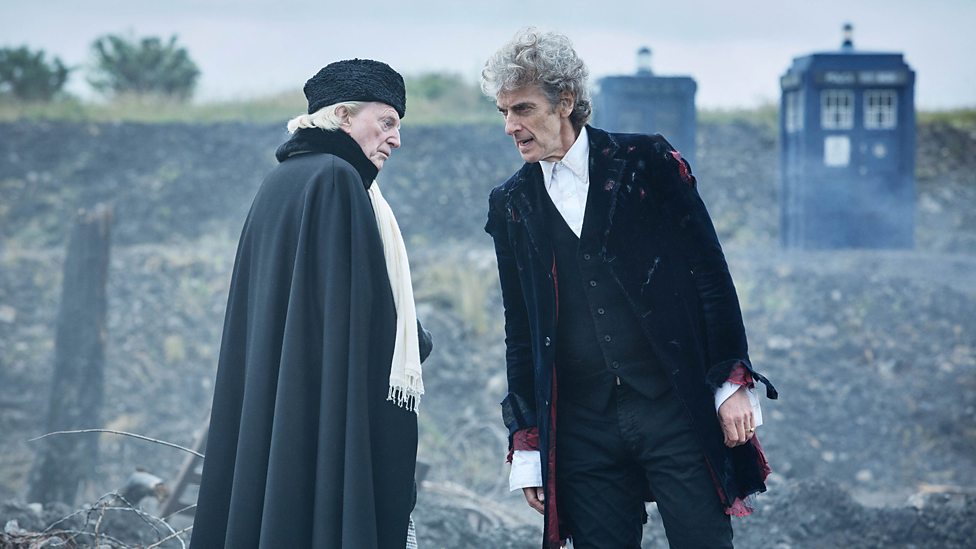
Those words, spoken by Tom Baker's Fourth Doctor on the brink of his regeneration nearly forty years ago, could also be applied to the 2017 Christmas special. It's safe to say that expectations were high, thanks to the announcement of Peter Capaldi exiting the series alongside showrunner Steven Moffat, Jodie Whittaker taking over as the first canonical (for lack of a better phrase) female Doctor, and then the return of David Bradley playing the role of the First Doctor (Bradley having previously played actor William Hartnell, who originated the role, in 2013's An Adventure In Space And Time). So did Twice Upon a Time live up to those expectations or did it crash and burn?
Given the sheer amount of elements on its plate, Moffat certainly had a lot to play with given the hour of screen time. Perhaps it's not a surprise then that the special's plot is relatively straightforward. Picking up both from the end of Series Ten finale and between scenes in the First Doctor's regeneration story, The Tenth Planet, Twice Upon a Time finds the First and Twelfth Doctors dealing with moments of frozen time with a group of glass-like creatures snatching people out of time at the moment of their deaths. Two of those they encounter are a First World War British army captain (played by Moffat's Sherlock co-creator Mark Gatiss, whose previous Who screen appearances include the title role in The Lazarus Experiment and numerous scripts) and former companion Bill Potts. The special then is a bit of a runaround but one that packs a punch.
A punch that is driven home by the characters and performances. Moffat uses all of the aforementioned characters to explore how we face death, something appropriate given that Twice Upon a Time marks the end of an era. It's something that Capaldi, Bradley and even Gatiss play wonderfully in their own ways at different times throughout the hour. Indeed, some of the best moments are having the two Doctors together from very different ends of their lives looking at each other as two old men raging against the dying of the light. And yet, the end of the special is also a life-affirming one, filled with hope for the future after spending nearly an hour looking so much to the past.
It's the looking to the past that will also help this special stand out. The special begins with footage from The Tenth Planet which morphs seamlessly from black and white with William Hartnell into newly shot color footage featuring Bradley, which offers snatches of scenes long lost due to a BBC archive purge in the 1970s. As a long-time fan, it's wonderful to see those moments recreated, and it is perhaps fans who will appreciate those touches and another major reference that comes late in the special more than the average viewer. At times though, it might be a bit much such as the return of a character (for lack of a better phrase) from a very early Capaldi episode or the over-played sexism of the First Doctor (something that was there back in the 1960s as part of the era but to a far lesser extent in the character himself). For long-time fans, it's much fun, a chance for the Doctor and viewer alike to look backward and forwards all at once.
What Twice Upon a Time will be remembered for more than anything else is its closing two minutes or so. Regenerations have not been a forte of 21st-century Who, it must be said. David Tennant's exit in The End of Time was spread across more than two hours and turned into a sloppy, poorly plotted and over-sentimental mess with him moaning "I don't want to go!" to the heartbreak of some and the heavy cringing of others. Matt Smith's 2013 exit was tonally all over the place, due to trying to cram so much into sixty minutes, though The Time Of The Doctor was redeemed somewhat by an excellent final scene for Smith. Indeed, only Christopher Eccelston's exit in Bad Wolf/Parting of the Ways can be said to have really worked. Here though, Moffat gets it right with a scene that lets Capaldi say goodbye not just in character as the Doctor but to the role that he, as a life-long fan, had clearly always wanted to play. Moffat keeps it from being too self-indulgent before it gives way to Jodie Whittaker's much-anticipated entrance, which left appetites whetted for her run (at least among those not already putting the proverbial nails into the coffin of the show following her casting).
For all of those reasons, Twice Upon a Time was and remains a joy to watch. It might well be the best Christmas special Doctor Who has yet aired and is the best regeneration story we've had in more than a decade. More than that, it's the end of an era and the beginning of a new one, something that everyone involved, from Moffat to Capaldi, are intent on making clear. It's a look back and a look ahead with nostalgia on one hand and hope on the other.
As the Third Doctor said to Sarah: "Where there's life there's..."
Sexist, Misogynist Dinosaurs by Jason A. Miller
27/6/23
I knew from the opening teaser to World Enough and Time that Something Special Was Happening. I'd managed to avoid all spoilers for the end of Series 10 (well, most of them), but the TARDIS landing at the South Pole at the beginning of a season-ending Cyberman two-parter, told me all I needed to know. When David Bradley walked out of the mist at the end of The Doctor Falls, the following week, I had a complete fangasm. I'd guessed it! The First Doctor was back! We were getting another multi-Doctor story! Matching up to Episode 4 of The Tenth Planet... to air on Christmas Day, months and months away.
I had super-high expectations for Twice Upon a Time. I love the First Doctor. Love him. Love, love, love him. William Hartnell doesn't get much credit for everything he brought to the role, for how diverse and protean his performance was. And for the first five minutes of the 2017 Christmas Special, with David Bradley playing the First Doctor in a remount of The Tenth Planet, I was in absolute fanboy heaven. Oh, and then Mark Gatiss stumbles into the scene, playing a mystery character whose identity Fandom had guessed long before he finally names himself.
Twice Upon a Time, then, is Bradley (good) playing the First Doctor (awesome) in a continuity-heavy coda to The Tenth Planet (superb)... but, unfortunately, in a script written by Steven Moffat (uh-oh), who always seemed to be somewhat contemptuous of the First Doctor (as is made clear in his Series 3 DVD audio commentary to Blink).
Which means that Twice Upon a Time has some problems. Peter Capaldi's final story, pairing up with the very Doctor that he emulated in his announcement special way back in August 2013, and in a lighter-hearted Christmas special, should have been a victory lap. Should have been an hour of pure joy and delight.
So why wasn't it?
The First Doctor is all wrong. Wrong wrong wrong. And I don't mean Bradley. Bradley is wonderful, clutching his lapels and inspecting the 12th Doctor's electric guitar and giving orders to the in-shock Gatiss. Bradley has never done a full-on Hartnell impersonation -- not in An Adventure in Space and Time, not in his several Big Finish series. But I'm totally fine with that.
But the script here sees the First Doctor as an anachronistic buffoon whose arrogance, to quote what the First Doctor once accused of Ian, is nearly as great as his ignorance. He makes a string of misogynist comments. A long string. About male nurses. About Polly obviously not being around anymore cause everything's covered in dust. And about the 12th Doctor needing Bill in order to get rid of all that dust. He takes forever to realize that the TARDIS flight deck can change architecture, or that, even though he's in mid-regeneration, Capaldi could possibly be his future self. He interrupts the 12th Doctor's reunion with Bill to ask what a sonic screwdriver is.
None of this captures anything of Hartnell's endearing warmth. Yeah, you could pluck out a few isolated moments of the First Doctor being a sexist dinosaur, but that just wasn't the character. Hartnell was pleasingly violent, spending his first two seasons bonking everybody on the head with his club. He was wickedly funny, particularly in the historicals. He was endearingly absent-minded at the same time that he was always two steps ahead of everyone else in figuring out the plot. He was feisty with the men and endearing with the women. And he wasn't afraid to let Jacqueline Hill order him around. But Bradley is given lines that allow him to exhibit very little of that charm.
As for the plot, typically for a Moffat script, there are several great ideas strung out in successive scenes, but never quite connected together. A profoundly eerie moment, Gatiss' World War I captain asking, tremulously, "What do you mean, World War... One?", is left to dangle with no follow-up. More interested, is Moffat, in explaining why Bradley doesn't look like Hartnell, or why the TARDIS prop is larger than the Innes Lloyd version. Unnecessary Moff-splaining. The Astral Map is rebuilt and given practical flashing lights but doesn't get used. There's a too-long sequence to visit the Dalek from Into the Dalek (millions of years into its future), and that subplot fizzles out, with no proper farewell to "Rusty".
I think Twice Upon a Time is a mashup of two stories, two stories that two different people wanted to tell, for two different reasons. Capaldi wanted to go out on a multi-Doctor adventure against the Hartnell Doctor, but Moffat didn't like the Hartnell Doctor, so he wrote a script where Hartnell says something ignorant or misogynist every two pages. And it takes Bill Potts to deliver to the Hartnell Doctor the message that Moffat wanted to deliver: that evil should defeat good every time, but that good wins for only one reason: because one bloke (some Doctor guy) is wandering around putting everything right. So once again in a Moffat story, the Doctor is subordinated to his companion. This is Bradley's only in-series TV episode, and he arguably needs to have a bigger hero moment. Instead, he's mostly the companion -- someone to get things wrong so that Capaldi can explain the plot to him, and, by extension, us at home.
Now, Bradley is mesmerizing in the moment where he tells us, finally, after 54 years, just why the Doctor left Gallifrey in the first place. Bill Potts hugs him and he gives a dazzling smile at the camera. And Testimony also works as a psychotherapist -- she learns why the First Doctor left Gallifrey, and then she's able to explain to the 12th Doctor why he's needed still: he's not a Doctor of War, he's a Doctor who fixes wars. This enables Capaldi to save Gatiss' character's life in time for the 1914 Christmas Armistice, and learn his true place in the Universe. All this material is good for the soul on Christmas Day.
Rachel Talalay's direction is, as always, wonderful. When the First Doctor peers out through his pince-nez, the camera goes slightly out of focus. That's a gorgeous moment, even though I didn't pick up on it until my third viewing. The remounted scenes from Tenth Planet are a delight to look at -- and there more of them, cut for timing to fit Twice Upon a Time at 60 minutes. Talalay had even recast Barclay with a black actor, something I wish had been left in.
The ending, the last ten minutes or so, are really what Moffat does best. Grand emotional moments. The 1914 Christmas armistice, the realization that the Doctor really will fulfill Gatiss's promises to check in on his family, the Lethbridge-Stewart family, "from time to time". The parade of old companions is touching. The Doctor finally regains his memories of Clara and gets to insult Nardole one last time. The Hartnell Doctor, after seeing his future self play with the timelines in order to save Gatiss' life, embraces his death and regeneration. The Capaldi Doctor gives up on his idea of being the Last Doctor and also embraces his regeneration.
I'm a little less sold on the 12th Doctor's final speech to himself, which I saw one internet commentator describe as the Doctor "mansplaining himself to death". Murray Gold exits the series with one last burst of overly-loud music, attempting to drown out Jodie Whittaker's two hard-to-discern words as the 13th Doctor. And then it's over, the TARDIS console room is apparently destroyed by the release of Capaldi's long-pent up regeneration energy, and Whittaker falls from the TARDIS, to become the Woman Who Fell to Earth.
That's it. We're denied having Bradley turn to the camera and wish a Happy Christmas to all of us at home. We're denied other fan-pleasing moments that Testimony could have enabled, such as Carole Ann Ford or Anneke Wills walking on camera to say goodbye to the Hartnell Doctor. All that would have been preferable to the on-screen explanations of Bradley looking different or the TARDIS prop being the wrong size. We're left with a multi-Doctor story that, sadly, kind of misuses David Bradley and the First Doctor. And, with that, Steven Moffat is gone as show-runner, leaving on something less than a pure high note than most of us wanted.
Auld Lang Syne by Niall Jones
29/9/25
Perhaps the first thing to note about Twice Upon a Time is that it almost didn't happen. Steven Moffat had been all set to leave Doctor Who with the Series 10 finale when he discovered that his successor as showrunner, Chris Chibnall, didn't want to start with a Christmas Special. Not wanting Doctor Who to lose its coveted festive slot, he agreed to step in and write Twice Upon a Time. Given that The Doctor Falls had already wrapped up the series' various plot threads, with only the Doctor's regeneration left to run its course, Twice Upon a Time has a slightly insubstantial feel. The episode acts as a coda or epilogue, rather than as a grand finale. Despite this, the story brings one period of the show's history to a bittersweet end, while also acting as a launching pad for a whole new era.
If Twice Upon a Time doesn't have much of a plot, it is at least based around an eye-catching conceit: the Twelfth Doctor, refusing to regenerate after being fatally wounded by a Cyberman, finds himself at the South Pole, where he comes across his oldest predecessor, in much the same predicament.
The story opens not with the Twelfth Doctor, but with the First, beginning with the events of The Tenth Planet. While this initially means grainy black-and-white footage, it soon switches to colour, featuring a recreation of scenes from the 1966 story specially shot by director Rachel Talalay. Whereas the original black-and-white footage acts as a reminder of the depth of Doctor Who's history, emphasised by a subtitle that cheekily refers to events as taking place '709 episodes ago', the switch to colour collapses this sense of distance. A gap of more than 50 years is erased by cinematography, emphasising that, for both Doctors, the events of the episode take place in the present.
With William Hartnell sadly long-since deceased, it's up to David Bradley, who had previously played Hartnell in the docudrama An Adventure in Space and Time, to take on the role of the First Doctor. In his performance, Bradley avoids simply mimicking Hartnell's mannerisms. His Doctor seems older and doesn't have the same twinkle in his eye that Hartnell's did. Nevertheless, he is compelling in his own right and, crucially, recognisable as the same character. It's a new take on an old favourite, like a Shakespearean actor taking on a classic role. Shannon Patrick Sullivan highlights this on his website, A Brief History of Time (Travel), which aims to give a comprehensive account of Doctor Who's production history. He notes that, 'Although Hartnell's character had softened considerably during his years in the role, Moffat nonetheless wanted to reflect the received wisdom that he was a crotchety, irascible old man', suggesting that the reappearance of the First Doctor is significant primarily because of what he represents. He exists more as an idea than as a summation of past performance and characterisation. As a result, there are, inevitably, differences between the two versions of the character.
Perhaps the most commented on is Bradley's Doctor's tendency for sexist comments, which has been criticised as an inaccuracy which unfairly slanders the First Doctor's character --- not least by Jason A. Miller in his review for this website. It is true that, while you can cherry-pick sexist moments from Hartnell's Doctor --- perhaps surprisingly, the line about 'a smacked bottom' in Twice Upon a Time is lifted directly from The Dalek Invasion of Earth --- sexism was never a major part of his character, and his attitude to women was far more progressive than you would expect from watching this episode.
Part of the reason for the inclusion of these comments may be simply because Moffat can't resist a joke --- and the First Doctor's sexism in Twice Upon a Time is frequently very funny --- not, to be clear, because sexism itself is funny, but because of the justifiably horrified reactions of the Twelfth Doctor and Bill. The main reason, though, is that the contrast between the two Doctors is used to reflect differences in society over time. Sexist attitudes were commonplace in the 1960s and inevitably seeped into Doctor Who. In fact, they weren't limited to that era --- you only need to look at the sexual objectification of Peri to see that the 1980s could be just as bad, if not worse. It makes perfect sense for an episode so focused on the relationship between Doctor Who's past and present to address its own historical failings, especially given that it ends with the arrival of the first female Doctor.
It is unfair to pin the show's history of sexism solely on the First Doctor, but the fact that the character is used in such a way suggests that his appearance is, at least partly, symbolic. He acts as a metonym for Doctor Who's origins more generally. As such, it's not surprising that the question of why the Doctor left Gallifrey is raised. In all honesty, I don't quite buy the First Doctor's answer, that he wanted to know 'Why does good prevail? What keeps the balance between good and evil in this appalling universe?' It just feels a bit too academic, although it is in keeping with Bradley's portrayal of the Doctor as something of a philosopher. Despite this, the scene in which Bill asks the question is rather lovely. I also like the fact that she asks not what he was running from, but what he was running to. Moffat is smart enough to know that, while he can tease grand revelations as much as he likes, he can never give conclusive answers. Nevertheless, he can ask new questions.
Similarly, the appearance of the Daleks --- and specifically the return of Rusty from Into the Dalek --- might seem a little random in plot terms, but it makes sense from a symbolic point of view. Encountering the Daleks was what made the Doctor into a hero. By juxtaposing the Twelfth Doctor's meeting with Rusty with the First Doctor and Bill's conversation, Moffat ties together the Doctor's past and present, while also hinting at what led him to become the answer to his own question.
In the end, more answers are found on the battlefield. Since its apparent appearance in The War Games, Doctor Who has largely avoided setting stories during the First World War. This isn't especially surprising. Historical episodes have often been based around the look or feel of an era, presenting it almost as a genre --- gas-lit Victoriana or country-house crime --- and the impression of the First World War --- pointless slaughter and suffering --- is far too dark to base an episode around. In fact, the Doctor Who story most about the War, Human Nature/The Family of Blood, largely avoids representing it on screen. By choosing to focus on the Christmas truce at Ypres in 1914, however, Twice Upon a Time locates a moment of hope amid the suffering --- a brief window in which the universe just might be a fairytale.
With its two regenerations, Twice Upon a Time is all about being on the cusp of change, about having the courage to look to the future, while also keeping one eye on the past. This becomes especially apparent in its final scenes, as the Twelfth Doctor says his goodbyes. His final moments with Bill and Nardole enable him to say farewell properly, while the brief appearance of Clara, hitherto wiped from his memory, is especially poignant. When the Doctor waves to the Captain, however, he's not just saying goodbye to a one-off supporting character. The casting of Moffat's friend and frequent collaborator Mark Gatiss in the role makes visible another set of goodbyes, as one set of creatives gives way to another. Additionally, School Reunion and The God Complex writer Toby Whithouse appears as a German soldier. At any other time, these casting choices might have felt self-indulgent, but here they feel deserved, bittersweet reminders of an era coming to an end.
Twice Upon a Time may well be all about the First and Twelfth Doctors, but the final word has to go to the Thirteenth. The regeneration scene at the end of the episode is one of the best in Doctor Who's history, and Jodie Whittaker makes a strong impression. Her only line, 'Ah, brilliant', delivered with a smile and the hint of a laugh, immediately marks her as the Doctor, as she revels in both chaos and wonder. The whole regeneration sequence is powerfully directed and full of inspired visual choices, such as the decision to have the physical transition from Capaldi to Whittaker be focused on their eyes. Despite all its explosive energy, the actual moment of regeneration is both simple and subtle. The scene also contains a small but beautiful moment, in which the TARDIS interior is seen reflected in the Doctor's eye, before we shift from third to first-person perspective and see it literally through her eyes, effortlessly capturing her disorientation and sense of wonder. That the Thirteenth Doctor's era did not work out as well as those of her predecessors is unfortunate, but this scene shows that Whittaker had great potential and that her casting was not responsible for its weaknesses.
There's a simple way to sum up Twice Upon a Time. When he first meets the First Doctor, the Twelfth Doctor tells him that, 'either we change and go on or we die as we are'. It's a statement that applies equally to Doctor Who as a series as to its lead character.