
The War Games
The Timewyrm Series
Just War
Players
Timewyrm: Exodus
Timewyrm Part Two

|
The War Games The Timewyrm Series Just War Players |
Virgin Books Timewyrm: Exodus Timewyrm Part Two |
|
| Author | Terrance Dicks | 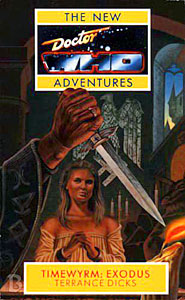 |
| ISBN# | 0 426 20357 7 | |
| Published | 1991 | |
| Cover | Andrew Skilleter |
| Synopsis: The Doctor and Ace land in London, 1951 to discover the Nazi's won the second World War and have occupied England. The Doctor impersonates an inspector in order to discover the truth, but is discovered by the evil Lt Hemmings of the Britisher Freikorps. The Doctor and Ace then travel back to the divergence to discover the Timewyrm has both possessed and become trapped in Hitler's mind. But things get even worse when they discover a very old enemy lurking in the same time zone... |
A Review by Keith Bennett 11/4/98
The most prolific Doctor Who novelist of all has produced a high quality follow-up to John Peel's Genesys. Terrance Dicks has often been critisized for producing lightweight books based on the programme, although they were usually quite good, if not very good, if only for the fact that the stories they were based on were often of high quality.
The Doctor and Ace land in London in the year 1951, believing the evil Timewyrm to be dwelling there, and find it to be German-dominated - the Second World War has not gone the way it should have. The first half of the novel is set at this time, while the second is set before the war, with the Doctor acting as personal advisor to Adolf Hitler so as to find out what is happening and put history back on course. Someone is controlling the Fuehrer, but is it the Timewyrm, or an old enemy of the Doctor...
This is, as expected, a typically easy-to-read book from Dicks, tamer than Genesys, but still most intriguing, amusing and enjoyable, quite a fascinating insight into the Reich, and thankfully, the Timewyrm is given very little to do, just appearing to rant and rave briefly at the end. The only major negative is with the whirlwind changing of scenes from buildings to buildings. All the tree-lined streets and giant offices begin to seem the same after a while. Also, the first two stories of this series have been completely earthbound, and the Coda suggests Nigel Robinson's Apocalypse might be the same. It would be nice to see the TARDIS in space again soon.
But a really good story overall, fast moving and fun.
Terrance Dicks' Best Story by Tom May 2/6/98
The second NA is certainly one of the finest and well plotted of any in the 50+ range. The style helps to set the tone for future NA's, while keeping a foot firmly in Doctor Who's past. When reading the opening chapters I had the feeling I was reading an addition to the wonderful Season 26. Terrance Dicks' plot is gripping, oddly amusing and deeper than any of his previous scripts for Doctor Who.
The plot concerns history, and tampering with it. Dicks, after beginning the book in a Nazi occupied London of 1951, gives major depth to the charcters and situations of Nazi Germany. There's much use of the TARDIS in this book, and it really seems as if the Doctor's plan is as intricate and dangerous of any he's ever faced. The Doctor's role as mentor to Hitler is treated superbly, as are the characters (and rivalry) of Himmler and Goering. Perhaps the best thing about the book is the Doctor's part in it. He pretends to be "Herr Doktor," a leading Nazi with precision, mixing and plotting with and against the Nazis in a subtle way. I was reminded of the Second Doctor's impersonation of an authority figure in Part 2 of The War Games, and I'd love to see McCoy in that leather jacket.
The book sustains interest throughout, and the ending is fittingly magical and ingenious. This story could've been a television masterpiece, yet we'll have to settle for a novel that is adult, intillegent and magical in the Doctor Who tradition. Dicks treats the major Nazi players with subtlty, making them seem human, although we know this is only because of The Doctor's popular presence. It's good that this isn't a simple morality play -- Dicks must've had a good idea of the NA's prospective audience, unlike he did with BBC range opener The Eight Doctors, which was targetted at JNT/continuity fans and kids. The horrors of Nazism aren't truly dwelled upon in this novel, as we know all about them. Timewryn: Exodus is an undeniably superb book that would serve as a great introduction to the NA range for the uninitiated. 10/10
The 10 Commandments, as featured in the book of Exodus by Matt Haasch 7/6/00
Here we are. Fresh off of Genesys, which I haven't read due to lack of good reviews on John Peel. Here we get a taste of War Games, which this is practically a sequel to. This is also tied into Players very well with many characters remaining in both books. Here we see not necessarily a manipulative Doctor, but one which can adapt to anything. He also seems to get along very well with the Nazis, which is fun, do to all the duping he does just by rasing his voice. Explanations as to why he didn't stop Hitler in the first place are pretty good. The action is well written and keeps the reader immersed. I read this one in about 4 days. The Nazi group are well characterized, with Hitler being infected with the timewyrm. Von Ribbentrop plays a smaller part in this book as apposed to Players, but there are plenty of fighting between Hitler's right hand men, to the point where the Doctor has them chasing each other's tails -- Nazi forces against the SS. All of this, the action, plot, and everything seem perfect, as well as the interpretation of the Doctor and Ace, who seem just as they do in the show. There's even a moment where the Doctor shows a kind of fatherly love toward her which is extremely touching. A good buy in the field of NA's. Recommended for an enjoyable tale.
A Review by Rob Matthews 24/9/01
One of this site's reviews of the novel Damaged Goods makes a good point about the discomfort it causes when it invokes the subject of AIDS. It's a potent criticism, partly because the author's use of it comes across as an aside or afterthought, but mostly because its incredibly crass to use a subject so serious and current in what is essentially light entertainment (no matter how high-quality).
The problem is that Doctor Who's time-travel format occasionally asks us to compromise our respect for history, and potentially our sense of the reality around us. Suspension of disbelief is one thing, but some things are too huge to play games with. Doctor Who rarely encroaches upon real-life tragedy and injustice, except through allegory and parallels. By this, I mean we're not offended by Tom Baker acting silly or making flippant remarks if he's up against an oppressive and murderous regime on the planet Pluto, but we would scarcely expect the same lightness of tone if we were asked to imagine him materialising in Afghanistan and opposing the Taliban. The notion of the Doctor and his companions accidentally giving the world a cure for AIDS is no more destructive to our worldview than the idea of the Fendahl influencing the development of our ids, Scaroth advancing our civilisation or the Osirans inspiring the Egyptian gods. Real lives were involved in all those things too (well, except in any specific way the Fendahl one). But these things are too far out of living memory for anyone to be too offended by them, and they intrigue rather than annoy us because its all plainly daft.
Those examples come from a few disparate stories, but if you start to add them up it builds a view of the world which quite thoroughly negates human civilisation and creativity. Of course, the show's creators ever intended us to add all these stories together - Doctor Who the TV series never meant to offer us a coherent and consistent view of its universe -, and as ingenious as we might often find these ideas, we can't take them seriously because it's just entertainment. We can suspend our disbelief and believe for the purposes of a story that the Cybermen accidentally wiped out the dinosaurs, because real though the dinsosaurs were, it's all academic; it's all history; all backstory. Something terrible which is happening now is not.
Which brings me to Timewyrm: Exodus. I don't believe World War II happened long enough ago for this historical gameplaying to be tasteful. It worked in The Curse of Fenric because the details of the war were not dealt with too directly - it dealt with the Allies' antagonism toward the Russians rather than the Germans, and the plot did not actually impact upon the war itself. WWII was evoked for atmosphere, a perfect correlative for a story dealing with the release of Evil, but was not nudged for effect. Millington reminded you of Hitler, but it wasn't overemphasised. The story played on inference and association rather than direct rewriting of horrendous factual occurences.
Unlike Timewyrm: Exodus, which goes too far. Hitler did not rise to power because of a rogue Time Lord and a telepath-entity telescoping his charisma. He did it because his country was in a bad economic state, because human beings have a terrible appalling tendency to scapegoat and demonise, and because of a widespread and insidious antisemitism that can be found, for example, in Edgar Allen Poe and Henry James as easily as in the Third Reich.
The image of the Doctor chummying up to Hitler is not treated carefully enough. It should be horrifying, but is made merely temporarily disturbing.
But what really appalled me in this book was the attitude of the Doctor and Ace. In one scene, the Doctor - posing as a high-ranking Nazi - chucks a couple of fascists out of their box overlooking Hitler's rally and says to Ace something along the lines of "Oh look, they've left some champagne and chocolates'. In another scene, the Doctor and Ace discuss the injustice of the luxuries of the Nazis and the deprivation of those they subjugate, only for Ace to finally shrug, "Oh well, it's hard work but somebody's got to do it. More caviar, Professor?"
Now, my usual attitude to Doctor Who is that anything goes, but this is wrong, wrong, wrong. The Doctor is not someone who travels through time and space righting wrongs and, if he's lucky, feasting on luxury chocolates. The seventh Doctor, in particular, would not care about chocolates, would not be remotely interested. Colin Baker's Doctor, who everyone derides as a porky pig, would most likely say, "We've got more to worry about than chocolates, Peri". No-one as sensitive to misery and tyranny as the Doctor is supposed to be would so smugly and thoughtlessly feed on death and suffering. But it seems that as far as Terrance Dicks is concerned, any pretext for an orgy of gluttony will do - look at the way he has the sixth Doctor and Peri swanning around in fancy hotels and going on expensive shopping sprees in Players. Doctor Who is about many things, but not about travelling through time so you can accumulate interest on a bank account and then paint the town red. And especially not when your story is about one of the worst atrocities of the twentieth century.
Of course - moving on to lesser matters -, with a Terrance Dicks novel it's pointless to comment on whether he's being true to the characer of the Doctor in question. He is perennially writing for Jon Pertwee, still writing for seasons seven thru eleven. Witness the Doctor referring to his companion as "My dear Ace" and advising her that if she pays attention she 'might learn something'. Has Terrance Dicks even seen any of McCoy's era?
Ace, meanwhile, gets beaten up by a misogynist and later offered as a sacrificial virgin. Oh yes, the rationale that gave us Jo Grant over Liz Shaw 'triumphs' again. I'm afraid it's too easy to imagine someone getting their jollies over these scenes.
Anyway, this is in fact a well-structured and clearly well-researched story with the surprise return of an old villain handled interestingly. But it's too badly misguided for any of that to matter.
A short, spoiler-free, mindless review by Andrew McCaffrey 30/10/01
"What we're seeing here are the effects of interference."It sounds strange to say this about something that is primarily set during the Second World War, but Timewyrm: Exodus is an amazingly fun book to read. Of course, it's difficult to find anything in here that relates to the more disturbing elements of that war; this is the WWII of simplistic war films and novels, but it feels right at home with Terrance Dicks' writing style.
As usual with Uncle Terry's books, the characterization of the regulars is excellent. His Doctor is spot on; Dicks makes it look easy. The Doctor gets all the best lines and all the best scenes. He even gets the best costume, shedding his regular coat for a creepy black leather jacket. Ace also gets some good scenes though there are one or two moments when she appears weaker than in past.
The plot runs at quite a pace and contains some of Dicks' best writing to date. The whole if-Hitler-won scenario is handled quite well. The view of what England would be like if it had lost the Second World War is interesting, but it is wisely kept to a short section before it can fall into one of the numerous science-fiction parallel universe cliches.
There are a few places where the author's Target television novelization experience comes back to haunt him. A few characters give away elements of the plot by having them explain things to each other that surely they would already know. But, thankfully, this is kept to a bare minimum.
The thought of the Doctor working his way behind the scenes in Nazi Germany is quite a disturbing concept. Although I usually dislike the stories in which the Doctor hangs out with historical persons, Dicks manages to successfully portray Adolf Hitler as a historical figure by showing him at several points along his life (Dicks would use this method even more successfully in his later book, Players, in his depiction of Winston Churchill). Having the Doctor meeting a real-life evil such as Hitler could have been an enormous disaster. Fortunately the events are handled with just the right amount of needed sensitivity.
There really isn't all that much to say about this book. It almost defies discussion. It's really good and that's all one needs to know.
A Review by Finn Clark 6/2/02
Initial reaction: wow, actual prose! In a Terrance Dicks pamphlet! The poor chap has acquired a reputation for shallow runarounds - but for his Virgin debut, nose met grindstone. This is a novel.
Second reaction: how odd, an NA taking its reference points from the TV stories (Curse of Fenric in this instance, and perhaps a subtle Remembrance of the Daleks ref on page 69). It feels strange, a mismatch of influences. I don't mean to imply that the Virgin books ignored the TV episodes, but by and large they used them as a source of fanwank references rather than the latest bit o' story.
It's genuinely spooky. Setting a big chunk of the book in an altered timeline of occupied Britain was a masterstroke, making the Nazis unpredictable and scary rather than Indiana Jones villains. Terrance trademarks are already making themselves felt, but they're generally to the story's advantage. As with Players we have a Doctor who dresses well, lives the high life and allies himself with the authorities... but since these authorities are high-ranking Nazis, I was constantly on the edge of my seat. It's scary watching the Doctor befriending evil people! You're constantly waiting for betrayal and discovery.
The Doctor is very good - but in a way that today might be criticised. We've become more sensitive to Doctors being specifically characterised as that incarnation rather than any other, and the Doctor of Timewyrm: Exodus is perhaps more Dicksish than McCoyish. But having said that, there's some great material that Sylvester would have loved and I never had trouble imagining the Season 26 crew. [There's a great line on page 51, too.]
Terrance-isms... there's lots of surprising references, such as to Gallifrey or to books Terrance hadn't yet written. Reread today, Exodus feels like a sequel to Players! (The two books form a trilogy with The Shadow in the Glass which I recommend highly, though you might want to rewatch The War Games before embarking upon it.)
However I have two niggles. Suggesting that aliens influenced our development is generally a mistake, here implying that Hitler's evil was partly down to people from outer space - an amazingly tasteless idea and one that incidentally hurts Shadow in the Glass. Having said that, I bought it here. I also don't like the Doctor's amazing never-before-seen ability to summon the TARDIS telepathically, a catch-all Get Out Of Jail Free card that puts the TVM's temporal orbit to shame.
This is a great book - chilling and nowhere near the comic book Nazi runaround I'd been half-expecting. The history is interesting, the TARDIS crew are charming and the writing's really good. Terrance worked hard on this one. You can tell.
A Review by Clive Walker 1/4/02
Virgin was playing it safe and sticking with established writers at this early stage in the life of the New Adventures. The second part of the Timewyrm series fell to Terrance Dicks, that stalwart of the Target range, and what a wise choice this turned out to be.
There are few people with a better understanding than Dicks of what makes good Doctor Who. Here he produces an exciting and engaging tale of Nazis and alternate time streams that draws the reader in from page 1 and never lets go. The scenes where the Doctor poses as a high ranking Nazi official and proceeds to run rings around the enemy are a joy to read and one can almost hear Sylvester McCoy speaking the lines. Indeed, one of the great successes of this book is its recreation of the Doctor and Ace and their relationship just as they were in their final TV season.
It should come as no surprise to anyone that Dicks can tell a good tale but he also displays in this novel an unexpected (for those brought up on his Target novelisations) talent for description and characterisation. In the first part of the book he evokes wonderfully a vision of a grey and downtrodden London. Later he brings to life the terrifying theatre of the Nuremburg rallies and the grandiosity of Hitler's Berlin. Best of all though is his depiction of the paranoid, back-stabbing freak show that made up the senior ranks of the Nazi hierarchy. Dicks's portrayal of these men may, or may not, be accurate but it is chillingly believable.
The only significant element of this book that I found disappointing was the inclusion of the War Chief and his allies. This is a strong novel in its own right that simply did not need the clumsy addition of continuity elements from the TV show to appeal to its readership. The eponymous Timewyrm is a more than adequate protagonist and re-introducing an old enemy that just happens to be simultaneously interfering in Earth's history stretches credibility and feels like a gimmick.
My other gripes are minor. The Doctor, unwilling as ever to shoot people, at one point hands a gun to Ace so that she can do so instead. This incident seems jarringly out of character in a novel that is, as noted above, for the most part true to the TV series. It might be seen in retrospect as the first foreshadowing of Ace as the killing machine she becomes in later novels. Oh, and two novels into the series I'm already getting sick of her use of Nitro 9 as the get-out clause in every sticky situation.
In summary this novel is highly recommended - a great read marred only slightly by the needless inclusion of elements from the TV show's past. I give it 9/10.
Highly Readable by Tim Roll-Pickering 20/6/02
Terrance Dicks' first original novel is one of the fastest moving and entertaining of all the New Adventures. Moving rapidly between an alternate Festival of Britain in 1951 to Munich in 1923 to Nuremberg, Berlin and Drachensberg in 1939 to Felsennest in 1940 to the real Festival of Britain in 1951 it never once lets up but at the same time tells an extremely strong and memorable story. What makes it work especially well is the way that the story could so easily have been told without the addition of the Timewyrm linking theme but at the same time it feels like it is an integral part of the novel.
The story is notable for being the first time an 'official' Doctor Who story has directly featured the Third Reich and key Nazis (Silver Nemesis only featured latter day Nazis in exile) and as such there is the difficulty as to how to present the Nazi hierarchy and Nazi Germany. Terrance Dicks manages to convey a strong sense of the horror of the Nazi's crimes whilst at the same time not letting the plot become bogged down by the moral arguments. The question of whether or not it is morally right for a time traveller to kill Hitler is addressed and answered only through reference to the case in hand and the book's core premise that the Second World War was only lost by Germany due to Hitler's incompetence. Terrance Dicks' knowledge of the period is strong and we get to see an up close examination of the state of Germany at the outbreak of the Second World War. The third part of the novel is perhaps the strongest, showing the scheming and jostling for influence amongst the key Nazis whilst also showing them for what they were, most obviously Goering (who is almost the heroic support character for the story) and Himmler, a loyal little monster. Hitler himself is only seen for brief periods, but is shown very clearly as a driven insane individual. The story also enhances the Doctor's detachment from the situation and his values through the way that Ace is routinely horrified by what she sees him do, yet later in the castle he demonstrates how he feels about her in a very moving brief scene.
The alternate 1951 sequence is more clich? and could easily have been shortened but at the same time it allows for some enjoyable scenes such as the Doctor's impersonation of the Reichinspektor General and his general demolition of the military. This is very much an action adventure and there is a lot of this throughout the book, whilst at the same time we get to see some of the less well publicised parts of Nazi Germany and the parallels between Nazism and religion are paralleled. And in only the second of the New Adventures we get to see the return of an old enemy, in this case the War Chief and the 'Aliens' from The War Games. Since Dicks co-wrote that story it is appropriate that he should be the one to revive the characters and their new plan is noticeably different. This is a surprising resurrection but all the necessary details about the Doctor's previous encounter with them are given so it doesn't matter if a reader is familiar with the events of that story or not.
Terrance Dicks' prose style has been accused of being over simplistic and traditional but it does flow exceptionally well, making it easy to read the book in a few hours without ever feeling the need for a break from the book, which is something that not every New Adventure can boast. The result is a good strong traditional story that breaks new ground and remains highly readable again and again. 9/10
A Review by Brian May 22/10/04
The first of the New Adventures was written by a name familiar to Doctor Who fans. John Peel - the author of various anthologies and the Target novelisations of several Hartnell and Troughton Dalek stories in the late 1980s; so in 1991 readers had a name they were acquainted with. For the second book, there was an even more familiar name to assure readers this new series was in capable hands. Terrance Dicks. Uncle Terrance. Script editor of the programme for five years. Script writer. The ultimate Target author - he wrote countless adaptations, which ranged from quality efforts through to unimaginative, churned-out rubbish. But when Dicks was good, he was very good! Timewyrm: Exodus, is Uncle Terry at his best.
It's well written, easily readable and is at times a tense and nail-biting piece of escapist adventure. It's hardly what you would call original - most of Doctor Who is similarly derivative - but it's a stylish take on the well worn "what if the Nazis won?" alternate history scenario. The oppressive, gloomy atmosphere of Nazi occupied London is wonderfully realised, echoing The Dalek Invasion of Earth, but instead of alien Nazi metaphors, here we have the real thing. The interference in human history and the imperative to go back and prevent this timeline are also successfully conveyed, complete with the proper sense of urgency.
The various stages of German history, from the Munich putsch of 1923 to Hitler's absolute power of 1939 are also well done, with a good sense of historical mood and feel. The way Hitler is written emphasises what a megalomaniac he really was, with or without the influence of the Timewyrm. The Doctor and Ace are pretty good renditions of their televised selves, especially the former. His interactions with the Nazis are interesting - he rightly loathes and despises them and everything they stand for, but he knows he must ally himself with such people. His promise to Hitler in 1923 that he will rule Germany one day, along with his "All I ask is that you remember me" request, are great dramatic moments; you can tell he doesn't want a bar of him, yet he must maintain a link in order to restore the proper course of history. Ace's attempt to kill Hitler is problematic - it's well within her aggressive character, but I think even she would have the intelligence to realise he must live (for the time being).
During the 1939 sections, the scenes between the Doctor and Hitler, especially during the latter's fits of possession, are truly creepy. The build-up to the climax and the revelation of the War Chief are well done, although the sacrificial rites of the Black Coven and the final battle in Drachensberg are somewhat flat, too dependent on action and seem like padding. Also, the Doctor summoning the TARDIS from its "parking spot" in the space-time continuum is a cop-out. It appears out of nowhere to save him and Ace from a nasty scrape - if he can do this, why doesn't he simply do it every adventure? Exodus is better when it's in slow burn mode; the better parts are made up of conversation, dialogue and moments when the Doctor and Ace venture into the unknown. The action scenes earlier in the novel are better - their attempts to escape from their captors and reach the TARDIS in Nazi Britain are quite engaging, because of the aforementioned need to travel back in time.
Also mentioned above is the return of the War Chief - the villain from Terrance Dicks and Malcolm Hulke's The War Games. This book is very early in the Who fiction scene - the constant references to the programme's past and continuity would in time lead to the creation of the dreaded "f"-word. This story's immediate predecessor, Genesys, went slightly overboard, including dreadful usage of the third and fourth Doctors. Exodus is a different matter - Dicks is setting out to write a sequel to the televised Troughton adventure, so references to it - and the use of characters - are more justifiable than the simple recitation of stories/characters/monsters in the attempt to show off knowledge of the show. (But that mention of Dr Solon's Special Morbius Lotion? Hmmmmm, maybe an overstep there...) And Dicks expands on his characters - the War Chief is fleshed out extremely well; he leaves plenty of clues as to his identity (including the blatantly obvious title of Kriegslieter). The aborted regeneration and the description of his deformed body are quite gruesome.
Dicks also keeps him in the shadows for a while, letting on to the reader there's an old enemy present, but they're going to have to keep reading to find out who it is (or work it out for themselves). There's one small section he should have left out - when the War Chief attempts to kill the Doctor in 1923 Munich, his yelling out "No, Doctor, you lose!" This is rather silly. He alerts the Doctor to his presence - and allows Ace to throw a canister of nitro-nine-a at him. He could have just attempted to shoot him - Dicks could have thought up a way to make him miss - and vanished. The Doctor still would have been aware of an alien presence. There's another small problem: The War Chief is working with the son of the War Lord - who was dematerialised at the end of The War Games. Effectively he never existed, so therefore wouldn't his son never have existed as well?
The use of the Timewyrm is extremely good. She's kept in the background for much of the adventure, under the (quite clever) idea of her being trapped in Hitler's mind. The rampaging, omnipresent character of Ishtar in Genesys couldn't have been convincingly repeated so soon - so good on Uncle Terry for this move. However, this leads to another disappointing factor at the end - the Doctor disposes of her (for this story at least) too quickly and easily. Like the disappointing runaround in Drachensberg, it lacks a dramatic edge.
However, Exodus is for the most part a satisfying, enjoyable story. The plotting is excellent; the presence of two different alien influences - the Timewyrm and the War Chief - working separately, could have cluttered things up, but Dicks avoids this, allowing for some effort and guesswork on the part of the reader - and some red herrings. He also keeps things interesting, what with the sudden disappearance of Hemmings into the TARDIS (apparently) midway through the story, setting up a cryptic and sequel-anticipating coda. A few overlong action sequences and a rather lukewarm conclusion aside, Exodus is gripping, page turning and highly recommended. One of the best of the early NAs. 8.5/10
Herr Doktor in Nazi Land by Andrew Feryok 26/7/10
[Ma Barker] looked at Ace. 'You're quite right, ducks.' 'What about?' Ma Barker beamed. 'About your little mate, here. He's got the cheek of the devil...'I injured my leg recently and had a lot of time to kill while I was recovering, so I decided to finish reading Timewyrm: Exodus at last. Okay, I admit I just read the first chapter, got turned off by the whole idea of an alternate future ruled by Nazis and the book sat on my shelf for over a year unfinished. But since I had the time to read at the moment, I decided to push through a perserver.
- Ma Barker to Ace, Timewyrm: Exodus, Part 1, Chapter 9, page 83
By chapter 3 I was absolutely hooked on the story and finished book in two evenings.
This is hands down the best book Terrance Dicks has ever written for Doctor Who, at least amongst the ones I have read so far (Blood Harvest and Players). This book is a thrilling yarn, although it surprsingly has very little to do with the Timewyrm story arc. I get the impression that Terrance Dicks wasn't terribly interested in the concept of the Timewyrm and decided to relegate her to the side so that he could get on with telling the story he wanted to tell. But the book he turned out was so good that the editor didn't want to cancel it and so here we get a story in the Timewyrm series with very little Timewyrm.
Or do we?
Actually, the interesting thing about the Timewyrm is the way Terrance Dicks has written her: although we don't see her, we always feel her presence. Dicks always keeps us guessing if she is the source of the interference in history or whether a time meddler from the Doctor's past is responsible. He weaves these two suspicions through the story masterfully and then pulls the ultimate trick of revealing that there are actually two parties interfering in history working totally independently of each other! Compare this to John Peel in Timewyrm: Genesys who not only introduced the Timewyrm in the very first chapter of the book, but completely dispelled any mystery about her by explaining everything we ever needed to know about her and presenting her as a cliched, ranting madwoman. Only in the last few chapters of Peel's book do we feel the true power of the Timewyrm. But Dicks takes a completely different approach. By keeping her an ethereal, elemental force who is never quite seen, she actually gets a sense of forboding around her. Only in the very last pages of the book do we get the ranting megalomaniac again but it is so brief that we don't notice and are actually quite frightened of her as a raw force of evil. And of course the Coda is marvelous, setting up the next conflict and enticing readers to move on to the next instalment in the saga.
And that's just the start. Dicks does a marvelous job with the characters in this story, especially the regulars. Dicks is often criticized for writing generic Doctors with no discernable personality traits or identity. But here he manages to capture the manipulative and cunning Doctor of Season 26 in all his glory. Not once did I think this was anyone other than Sylvester McCoy's Doctor and he actually even takes the character to a level that I don't think MCoy's acting abilities could ever have taken the characer on screen (no offense to Sylvester McCoy or McCoy fans out there). This Doctor has an aura of power about him, a natural authority that makes the people of the totalitarian Nazi regime in any time period respect and fear him. It's actually quite amusing watching him run rings around the Nazis, seeing right through their interrogation techniques, sleeping in the Gestapo HQ while he's supposed to be waiting for a feared meeting with the SS, and gaining the supreme trust of the highest Nazi officials and enjoying the best luxuries they can possibly provide. Ace is also well portrayed as a very capable and independent character. Terrance Dicks plays down her rebellious nature a bit, but in turn gives Ace a rare vulnerability that makes her more human instead of the walking teenage cliche calling everyone "bird brain".
My absolute favorite chapter in the entire book is Chapter 3 in Part 1. In this chapter, the Doctor and Ace are captured by the Nazis and placed in prison where they proceed to try and interrogate them using a variety of psychological techniques to break them down and even attempting to fool them into signing false confessions. But the Doctor knows every single one of their techniques and proceeds to make the whole situation into an absurd history lecture for Ace, almost as if he is watching historical re-enactors giving the performance of their life. He even gives his interrogators feedback on how well they are performing, which only serves to frustrate the Nazis who are used to people crumbling in fear before them and not giving them feedback like it's some kind of American Idol contest. And of course, when the Doctor has had enough of these games, he swiftly ennacts a means of escape that is clever, effective and highly Doctor-ly in style.
I was a bit worried about how Terrance Dicks would treat the character of Hitler, especially since he is so central to the book. Dicks manages to show us the human side of Hitler without ignoring the fact that he was a mad dictator and a monster who caused enormous suffering, horror and death throughout Europe during World War II, not to mention the years of torture he put his own country through. Dicks walks a fine line and manages not stray from it at all. We both sympathize with Hitler and despise him at the same time as we watch him get manipulated by the Timewyrm. I think the final moment when the Doctor talks to Hitler at the end of the book sums it all up. Hitler asks what is to become of him and the Doctor tells him that he is going to meet his destiny. On the surface, he appears to be comforting Hitler, but he's really telling him that he's about to get what he deserves for causing all the suffering from his mad ambitions.
I also have to note that, despite all the reveling in Nazi luxury that Terrance Dicks has the Doctor and Ace enjoying, he also tempers this by showing the nasty underbelly of Nazi society as well. While the Doctor and Ace may be enjoying a luxurious dinner in a Nazi-run hotel in the alternate 1951, we also see the British Museum looted, a Jewish tea shop owner brutalized and extorted by local Nazi thugs, and a resistance living in utter paranoia and squaller. In 1939, the Doctor and Ace tour the streets of Berlin which, despite the banners, looks like a very pleasant city on the surface. But then they see the "no Jews" signs and watch as an SS parade goes by and proceed to beat a man in the street for failing to salute the flag as it goes by. In fact, one of the most beautiful moments in the entire book is in the epilogue when the Doctor and Ace return to 1951 after history is corrected and they visit all the places and people they met before and realize just how wonderful it is to live in a free society. Something as simple as tea rations, a local carnival, or friendly police officer are seen as things of exquisite beauty to be treasured and protected dearly.
And what of the War Lords? Oh yeah, we can't have a Terrance Dicks book without him reliving old glories. I've actually noticed a trend in Terrance Dicks' original novels. He likes having mysterious black covens manipulating time, he loves referencing The Five Doctors, and he loves referencing The War Games. All three elements have appeared in some form in Blood Harvest and Players, and I have no doubt that I would find them in his other original novels as well. Here, he retreads old ground by bringing back the War Chief and the War Lords from the Troughton epic The War Games. Despite the fact that they make a lot of sense for this story, they are completely unnecessary to bring back. Their story was over and the Time Lords had wiped them from existence. When I learned they were in here, I was beginning to wonder how Terrance Dicks was going to dance around that piece of continuity. He actually does manage to come up with a solution that makes sense without altering established history, but it still all seems rather unnecessary. Though I have to admit that the War Chief is pretty frightening here. I especially loved the gross moment when we saw the result of his "aborted regeneration".
On the whole, this book is absolutely magnificent. It is beautifully written by Terrance Dicks who keeps us engaged with the characters and hanging on every plot twist until the end. I actually felt like I was learning a bit of history too along the way. Dicks also manages to pull off the trick of introducing elements that are clearly going to be important later, make us forget about them, and then pull them out at the appropriate moment for a surprise. That takes great writing and Dicks pulls it off brilliantly here. If you haven't read it yet, do it now! 10/10
Oh and sneaky Terrance Dicks managed to slip the Daleks in a very minor cameo in the book right under Virgin's nose. See if you can spot it on page 49...
Skip Genesys and Go Straight To Exodus! by Matthew Kresal 12/9/10
Having read my way through the wooden beginning that was Timewyrm: Genesys, I turned my attention to this novel, the second in the opening Timewyrm arc of the New Adventures and the first New Adventure by Terrence Dicks. Having been disappointed by Genesys, I was hoping for a much better novel this time around. That was exactly what I got and more.
For starters, Dicks has a much better grasp on the characterization of the seventh Doctor and Ace than John Peel did. From their first appearance in chapter one all the way to the epilogue, I never once got the feeling I was reading anyone but the Doctor and Ace I have come to enjoy so much from the TV and audio stories. There's a moment in chapter seven of the first part of the novel (or pages 61-63 to be more precise) that stands out as a moment where Dicks perfectly captured the personality and (quite possibly) the inner workings of the seventh Doctor. Then there's the final chapter before the epilogue as well which, to my mind at least, perfectly captures the relationship between the Doctor and Ace. My only real qualm with the characterization is that - given the Doctor's comment about Hitler in The Curse Of Fenric - it seems odd to see him socializing and becoming chummy to a degree with some of the Nazis he becomes involved with in the course of the novel. Otherwise, Dicks gives on the best novel sketches of a TV TARDIS team.
The supporting characters are well drawn out as well. From those who occupy the alternate 1951 London to the leaders of Nazi government to the return of old foes of the Doctors and right down to one of the worst madmen of the last century, Adolf Hitler, Dicks fleshes out intriguing little portraits of those surrounding the Doctor and Ace. As someone who has read quite a bit on World War II and the Nazis, I was surprised by the detail that Dicks put into the personalities of those in the Nazi leadership with some pretty accurate portraits especially of Himmler. Even more intriguing is Dicks' use of the villains from The War Games and how Dicks manages to show how those characters have progressed since we last saw them. He even adds some much needed background to the lead villain of that story. All in all, it's a nice cast of characters.
To understate a fact, Dicks does a lot of things better then Peel did. He uses continuity references sparingly and when they feel generally needed, like the background of a character as listed above. In fact, he mostly avoids them and uses them really only to reintroduce elements from The War Games. After all the needless references in Genesys, this comes as a pleasant surprise. Dicks trades this fact off by creating a convincing atmosphere of not only Nazi-occupied Britain but of Nazi Germany itself. And into all this, Dicks brings sci-fi elements into the mix in a much more convincing (if not better handled) way than the wooden elements of Genesys. In fact, judging from the prologue at the beginning, Dicks has a better handle on Genesys than Peel himself!
There is one thing that both Genesys and Exodus share. Despite having the Timewyrm in the title, both have it mentioned in the beginning and suddenly has it appear at the end. Yet, believe it or not, Dicks manages to actually put this weakness to good use. Because the Timewyrm appears in the last place you'd expect it to and, unlike Genesys, it doesn't feel like a cheat. That said, it's still a weakness.
I was once asked an interesting question by a friend. It was that if Genesys wasn't a good place to start fro someone wanting to get into the New Adventures where would be? Well with this novels excellent characterization, nice use of continuity form the TV series and a much better science fiction plot I think I have that answer. Skip Genesys and go straight to Exodus! It's one of the best New Adventures I've read and one of the best Doctor Who adventure stories I've read, period.
A Review by Jason A. Miller 17/4/11
Here it remains, the shining moment of Terrance Dicks' career, his first and still best-received full-length Doctor Who novel. Coming up on its 20th anniversary, this book is just never going to get old for me. Timewyrm: Exodus may not be a literary masterwork, it may not be subtle or lyrical, but it is a clinic on storytelling and pacing, and as such it's still a must-read.
Like thousands of other aspiring pre-teen novelists, I took my writing cues from Dicks' Target novelizations, from his economical and precise word choices, not to mention his razor-sharp and brief asides. For example, in his novelization of An Unearthly Child, a semi-conscious Doctor still has time to observe of a speech-prone caveman: "Even in the stone age, there were still politicians to deal with." Apart from the abbreviated page count, there was almost nothing to dislike about a Terrance Dicks Target book. By the late 1980s, though, under the stewardship of Nigel Robinson and then Peter Darvill-Evans, the novellizations got longer in page count and more nuanced in craft. Dicks started to look weak in comparison to the newer writers, who had an extra 20 to 40 pages to work with (and, in novelizing Seasons 25 and 26, better scripts than the late-1970s source material). When I first bought Timewyrm: Exodus (from the same store where I'd first bought the wonderful Doctor Who and the Invasion of Time seven years earlier), I saw the name Terrance Dicks on the spine and had low expectations. Fortunately I was wrong.
Exodus is the first New Adventure to play with alternate history. Who fiction played the alternative universes conservatively in its early days; as Darvill-Evans later explained, the NAs worked from the theory that there was only one Universe. That meant it would take a Herculean effort to change the timelines. When Dicks lands the TARDIS in Nazi-controlled Great Britain in 1951, with Britischer Freikorps thugs roaming the banks of the Thames, and Wallis Simpson as Queen, there's not just one villain responsible for this change in history, but two. This leads us on a merry chase through time: back to the 1920s as the Doctor insinuates himself into the infamous beer-hall Putsch, and then back to 1939 as an advisor to Hitler, where he learns what's really been driving the Nazis into Poland.
Dicks' writing charges forward, from time zone to time zone and from one encounter with historical figure to another. Along the way, there are pitched battles, mob scenes, medieval castles, spies and counter-spies. This may not be too deep for the small screen but it is certainly too broad. While later NAs would achieve far greater literary heights, Who fiction does not get much better than when it is said, of an SS lieutenant, "his jackboots gleamed evilly". There is no part of Dicks' storytelling that is not awesome, as he deftly sends up both Who and spy movie conventions, while mocking Nazi espionage techniques: "This is stage four, Ace: the good old beaten-up fellow prisoner trick." We even get the return of an old friend: "There was such authority in his [The Doctor's] voice that Bormann automatically holstered his revolver." However, when regeneration is described as a "little death", we're reminded that we never, ever want Uncle Terry to hit us with double entendres.
As it turned out, this was Dicks' first opportunity to write for the Seventh Doctor, as all but one of the 12 McCoy-era novelizations were penned by the stories' original authors (with Marc Platt guest-novelizing Battlefield, presumably when Ben Aaronovitch's 1991-era IBM Selectric typewriter had a ribbon malfunction). This is how Dicks described McCoy: a "smallish dark-haired man" with "shabby borwn checked trousers" and "keen grey eyes". I'm pretty sure this is how he described Patrick Troughton, too, but we'll let that pass because he also nails McCoy's "garish fair-isle pullover" and "jaunty straw hat". While the 7th Doctor's vegetarianism later became a highly-stressed character trait (and a plot point in Human Nature), the Doctor's seen to eat lots of meat in this one; I guess that means Hitler is the only vegetarian in Exodus. There's also an early and somewhat-clumsy example of the Seventh Doctor's manipulative streak, as he fires an anti-aircraft shell into a Nazi convoy to provoke a shooting war between two military factions. Late in the book, the Doctor utters what would become a prophetic line: "Maybe I'm being corrupted," although the NAs' "Dark Doctor" is otherwise not much on display yet through two books.
Dicks is at his best when the Doctor hobnobs with the high and mighty and tosses off mildly biting political satire. Looking at a photograph of Edward the 8th and Queen Wallis, the Doctor scowls and murmurs "I never trusted those Windsors!". Similarly, while at first I chalked up the appearance of a Nazi named Strasser to more of Dicks' famed ability to work every element from the movie Casablanca into his Who fiction, it turns out that the Strasser in question actually was a Nazi apparatchik. I'll never doubt Dicks' historical research again.
Unfortunately, two books away from Timewyrm:
Revelation, we're still stuck with middle-aged white authors who don't
quite know what to do with Ace. In Of course, you can't get through a Dicks novel, even his first
full-length Who novel, without liberal quoting from his own earlier
scripts. The first of many returning villains from the TV series shows up
as a secondary bad guy here; while the titular Timewyrm possesses Hitler's
brain, it is really the War Lords, led by a semi-regenerated War Chief,
who are interfering with human history. There is also another example of
many hiding-in-plain-sight Who villain acronyms and anagrams;
fortunately this is long before we got the Master translating his name
into Esperanto, so it's done creatively here. Dicks, as is typical, also
has fun at his own expense, with the Doctor describing the plot of The War Games as "to say the least, a little
over-complex." There is also a big shout out to The Brain
of Morbius, a story that I guess Terry has come to accept as his own,
decades after pulling his name from the final script.
Dicks would write several more Who novels for the Virgin and BBC
ranges, although Exodus remains the best of them. Before the NAs
really put their own distinct mark on the 7th Doctor, Dicks reminded us
all why we'd followed the character through so many years of the TV show.
By the time Dicks returned to the NAs three years later, his work seemed
pale in comparison to the newer authors, but in 1991 he momentarily
recaptured his place as Who's pre-eminent writer, and even on
reread nearly 20 years later, Exodus has lost little of its
original charm.
Heil Doctor! by Jacob Licklider
19/1/16
Timewyrm: Exodus sees the return of Terrance Dicks to the world
of Doctor Who, writing a story asking the question "What if Hitler
won World War II?" with the Doctor and Ace arriving in an alternate 1951
Britain where the Nazis won the war. While Dicks is most known for his
Target novelizations of countless stories, his style from those translates
better than it really should as the book is such an easy read. Take note
that I say easy, but the novel is far from childish. The story is
extremely adult, with the Doctor actually having to side with the Nazis
and help Adolf Hitler while keeping the timeline intact. It is much unlike
Timewyrm: Genesys, which elected to use sex as a way
to be adult while here it is just pure adult themes. There are also
sacrificial cults reminiscent of The Stones of Blood,
and the villain is even from a certain classic Dicks script from 1969. The
twist is well done on who is behind the interference as the Doctor says
several times that it couldn't be the Timewyrm because it is too subtle
for her tastes.
On the topic of the Timewyrm, for the few scenes she's in, you get to
see her vulnerable and in fear, as well as prideful. This is in stark
contrast to Timewyrm: Genesys, where she was much
more cool, calculating and manipulative. The real villains of the piece
aren't revealed until the final act of the novel, where we see the scope
of their plans.
The characterization of the Doctor and Ace are great again here. We see
Ace push her limits after actually killing Nazi soldiers and being a bit
cold as they shouldn't have been alive. The Doctor is also great as he is
being the chessmaster but has to keep changing up his strategy as the
situation keeps spinning out of his control. The Timewyrm seems to be a
great villain for the Seventh Doctor because of how much she knows and
because she is connected to the Doctor and knows what he is going to do.
The stakes are raised here: if the Timewyrm dies, the Doctor and the
TARDIS will die as well. What also is great is that there aren't any
negatives I can find in this novel as it feels like it could be an audio
drama like The Chimes of Midnight or Spare Parts. So, all in all, I give Timewyrm:
Exodus 100/100 for being a great read that raises the stakes and gets
ready for a climax in Timewyrm: Apocalypse and Timewyrm: Revelation.
A Review by John Miller
17/8/16
Timewyrm: Exodus has taken a place in organsied fandom as a classic novel, and many would argue that it is the finest book that Terrance Dicks has ever written. I am not one of those people. Exodus is a cartoonish, poorly written piece of work and a definite misstep.
The novel attempts to ask the question: "What is Germany had won the Second World War?" It then dives into a Hollywood idea of what that means. Nowhere does one feel that there is anything real about any of this. These are not real characters, real men who really lived, they are one-dimensional comic book versions of these characters. Worse, the idea that it was only because of alien interference that the Nazis did what they did left me speechless. What the Nazis did in the 30's and 40's should stand as a lesson to all mankind, as to what human beings can and will do. By blaming it all on the Timewyrm or the War Lords (more on them soon) controlling a bunch of paranoid incompetents and madmen comes across as insulting to all the real people who suffered greatly because of what were very human actions by men who knew exactly what they themselves were doing. The Classic Series deliberately steered clear of World War II, apart from skirting around it. By diving headfirst into it with Exodus, Dicks shows exactly WHY it was a subject that the television series never touched. It's not "Adult" or "deep", especially not Dicks' hamfisted attempt to paint a picture that manages to get just about everything wrong.
The characterisation of the main characters is also off. The Doctor here never comes across as being the Seventh Doctor. It's really Generic Doctor time, and not even a particularly good one at that. Ace meanwhile ends up repeatedly screaming and fainting. The fact that she comments on that doesn't change the fact that Dicks was clearly writing the companion as 'damsel in distress', but then added in the "I'm not usually like that" as a way to try and give some semblance of the actual Ace to this character, whoever she may really have been intended to be.
And then, as we are told, this is a sequel to The War Games. Except of course that it really isn't at all. In The War Games, the Doctor runs into an old friend, an intelligent, charming renegade Time Lord who had used time-travel technology to hypnotise humans to do his bidding. All while allying himself with a powerful alien ally whom he always intended to betray in order to take full power for himself. He also tempted the Doctor by offering him a partnership in control of the universe. It's not a stretch to see why The War Games co-writer Malcolm Hulke and Terror of the Autons author Robert Holmes stated that this is the same character that would later be more famously played by Roger Delgado. However, Dicks here seems determined to rewrite the entire history of the War Chief, and by doing so makes a complete mess of everything.
The War Games established that the Doctor and the War Chief knew each other from before The War Games. Timewyrm: Exodus says that that was their first encounter. The War Chief in The War Games was a shrewd, intelligent, charming villain. Kriegslieter in Timewyrm: Exodus is an incompetent, deformed monstrosity, even more a one-dimensional nonentity that Dicks' portrayal of the Nazis. The War Lords in The War Games were a highly intelligent and well-organised race. The War Lords in Timewyrm: Exodus are tacked-on extras, a way to say "This is the same race as from The War Games!" The War Games saw a massive, intricate organisation and execution. Timewyrm: Exodus has a simplistic, stupid plan that was always destined to fail, even when piggybacking on the Timewyrm's actions. Kriegslieter tells the Doctor that he left Gallifrey because his rapid rise through the Time Lord ranks meant that Borusa viewed him as a threat. Shortly afterwards, we find out that Kriegslieter wants the Doctor's TARDIS to learn the secrets of TARDISes. This from the high-ranking Time Lord who has already organised The War Games and managed to escape the Time Lords' punishment at the end of that story. Speaking of which, if the War Lord was erased from ever having existed, how does he now have a son, who is very much alive and remembers the events of The War Games, even though he himself was never involved with them? It makes no sense, it's totally discontinuous with the very story it intends to act as a sequel to, and it actually takes away from the classic original story by tacking this absurdity onto it. In that way then, it is indeed a template for many future New and Missing Adventures.
All in all, Terrance Dicks wanted to do a Doctor Who story with Nazis. Not the real, flesh-and-blood Nazis who were motivated by very human feelings and showed what humanity is truly capable of. Comic-book Nazis, ones who are controlled by alien forces, thereby taking away from real events that real people went through. Terrance Dicks wanted a generic female companion who screams and faints. Terrance Dicks, for whatever reason, decided that he wanted to 'prove' that Edward Brayshaw and Roger Delgado were playing two entirely separate Time Lord characters. So he gave the world Timewyrm: Exodus. A story written not because it was a good, strong story that needed to be told, but because there were elements and ideas that the author wanted to make, and he needed something vaguely resembling a story to hang them on. It's a Nazi story that blames everything on the Timewyrm and uses comic-book versions of Nazis. It's a Seventh Doctor and Ace story, where the characters virtually never come across as being anything like the actual Seventh Doctor and Ace. And it's a sequel to The War Games that appears to have been written by somebody who knows nothing whatsoever about the original television serial or what made it work so well. All the more bizarre as Dicks himself co-wrote The War Games. In short, speaking plainly, it's total rubbish. And we can see why, for 26 years of a quality television show, this sort of story was never produced for the BBC. It's not too "deep" or "broad" or "adult" for the small screen. It's just nowhere near good enough.