
Time Works

|
|
Big Finish Productions Time Works |
|
| Written by | Steve Lyons | 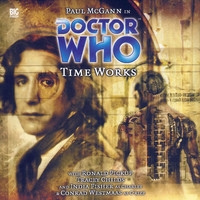 |
| Format | Compact Disc | |
| Released | 2006 | |
| Continuity | After The TV Movie |
| Starring Paul McGann, India Fisher and Conrad Westmaas |
| Synopsis: The TARDIS lands in between times, in a time where this is no time. A time in which nothing can possibly be. But something is... |
The Passing of Time by Stephen Maslin 26/1/17
Melancholy is built into fandom. Something special has gone, or will go, or is not the same as it was. This is usually associated with the passing of childhood, of that innocent time of constant discovery, before sex and fashion and earning a living got in the way; when one's love of an imagined future had not yet been beaten to death by one's fear of the real future.
For a Doctor Who fan, this sense of loss is not necessarily limited to childhood's ending, for the show has a knack for re-invention, so much so that one might end up enduring multiple traumas: Peter Davison regenerating into Colin Baker; the show that you no longer admitted watching being finally taken off air a few years later (coinciding with the uncomfortable realization that, contrary to all your former prejudices, Star Trek TNG, Season 3 vintage, was suddenly worth watching); the passing of The New Adventures range; Christopher Eccleston's last story... Perhaps you might even feel nostalgia for an era that had no right to exist.
Take Time Works as an example from the latter. It's an Eighth and Charley story from 2006: long after the childhood of the vast majority of 'Classic Who' fans but also just after the Eighth Doctor had stopped being THE Doctor. No other actor who had played the part had ever carried on appearing in stories so soon after it was clear they'd regenerated elsewhere. Those who had come back from the post-regeneration wilderness at least had the good manners to wait a couple of decades. Yet this after-the-fact tale should not be side-lined as mere apochrypha. For a start, it ranks alongside The Fires of Vulcan as Steve Lyons' finest script for Big Finish and (along with The Kingmaker, School Reunion, Year of the Pig, The Girl in the Fireplace and Memory Lane) is one of the stand-out Doctor Who stories of 2006. The ingredients?
Melancholy? Perhaps not. Tragedy, more like.
8.5/10.
You Will Die in Five Hours by Jacob Licklider 26/4/21
This is just one of those stories that really feels like it belongs in the middle of the Divergent Universe Arc. It's a story that takes place on a planet where everything is regulated by the concept of time. Everyone is forced to work in a specific shift and live until their assets to society are determined no longer useful, which is when the clockwork men come. Steve Lyons does a great job at making this planet just feel alien, very much in the same vein as Conundrum and Head Games, which of course just gets you wrapped up in the setting and the characters of Time Works and just how the mechanics of this world works. What really becomes striking concerns the way Lyons writes the story. It isn't done in the traditional plot point A to point B to point C, but mixed up scene by scene as time on this planet isn't working as a line from cause to effect, but almost events running parallel with Tracey Childs' magnificent Figurehead manipulating the events from behind the scenes, which actually makes it feel a lot like a spiritual successor to Head Games in that it comments a bit on the Seventh Doctor. Paul McGann is great as the Eighth Doctor, but there are points in this story that Lyons goes out of his way to show the Doctor has changed from the manipulative man that was the Seventh Doctor was, but of course his time came and he died.
Lyons is great at crafting the supporting cast of this story; they are all really interesting and have fleshed out characters, but this actually causes Charley and C'rizz to suffer. Now, India Fisher and Conrad Westmass are both doing their very best in this story to be engaging, but they don't really have much to do except explore. They're both doing a lot of enjoyable things in the story, but it almost feels like their parts were meant for Chris Cwej and Roz Forrester from the novels, not because they are out of character, but they just have things that feel more like those characters. The story's style also causes the pacing to suffer early on, as Part One is pretty much divided into little snippets of story before it actually allows us to go on.
Time Works is just an extremely difficult story to talk about, even more so than The Natural History of Fear and Creatures of Beauty, as it does a lot of the same style of storytelling in the nonlinear fashion. It is done for a really good story that wouldn't feel out of place in a lot of different ranges, especially the Divergent Universe Arc, which was sadly cut severely short, or the Virgin New Adventures. 87/100