THE DOCTOR WHO RATINGS GUIDE: BY FANS, FOR FANS

|
BBC
The Time of the Doctor
|

|
| Story No. |
262 |
|
| Production Code |
Series 7, Christmas episode
|
| Dates |
December 25,
2013
|
With Matt Smith,
Jenna Coleman
Written by
Steven Moffat
Directed by
Jamie Payne
Executive Producers: Steven Moffat, Brian Minchin.
|
|
Synopsis: The Doctor lives out his last days in a town
called Christmas.
|
Reviews
A Review by Jacob Licklider
3/9/14
After watching The Day of the Doctor, I was
really expecting something just as good, if not better, but that would
have been very unlikely. Upon viewing it, of course it wasn't as good as
Day and still some fans I know simply said it
was good because it was a Christmas Special and for whatever reason I find
people give all Special episodes a free pass on quality although most of
them if regular episodes wouldn't work and this is the case for quite a
bit of Time.
Before I get into the bad, let's get the good out of the way. Matt
Smith gives a great performance throughout, especially near the beginning
when he finds out the name of the planet, when he has to stay behind
without the TARDIS and ages, and the closing scenes in the TARDIS before
the regeneration and his final speech about change (but I'll get into that
later). The direction by Jamie Payne did give the episode a nice feel,
reminiscent of his other story, Hide. The rest of the
cast also gave good performances with the material that they were given.
Also the music by Murray Gold worked well during the closing TARDIS
scenes, with some of the melody being lifted from The
Rings of Akhaten.
What didn't really work was the whole Church of the Papal
Mainframe/Tasha Lem portions of the plot, because Lem as a character
didn't get any time to explain who she was except for the Doctor's
explanation of her being the Mother Superius of the Church. Also the
Silence and almost all of the other villains were underused; most of them
were there for a scene or two, especially the Sontarans who are there for
a throwaway gag. Really they could have just made it a Dalek story and it
would have worked well. The portions on Earth with Clara's family didn't
work very well, showing how lackluster the humor of the episode was. The
only person to make me laugh was Clara's grandmother (but that might be
because I had recently seen Vengeance on Varos).
Calling the town Christmas seemed unnecessary considering that portions
of the story on Earth took place at Christmas and should have been enough
to tie the story to Christmas.
All in all, The Time of the Doctor is just an ok story that is
brought up by its regeneration scene. 50/100
A Review by Elliott Rowe
25/12/14
So this is it. Three years of plotlines and stories all wrapped up in
one 60 minute episode... Can it be done?
Well, yes and no.
Let me start by saying that I tried to defend this story to friends and
family and managed to do a reasonable job. However, in my review below it
may appear I'm being more negative than positive.
Ironically, the one thing The Time of the Doctor suffered from
was time. The Time of the Doctor was 60 minutes, compared to the
135 minutes that The End of Time (David's last
episode) got.
The story didn't quite know what to do. Moffat seemed confused whether
he was writing an epic war/battle over hundreds of years or the story of
'that Christmas when Clara pretended she needed a boyfriend'. Clearly the
former provides a better story, so why he decided to tell the latter is
beyond me.
This story for me seemed to suffer from Russell T Davies syndrome.
Russell seemed to feel that an episode had to include modern day earth at
least once to make the audience feel comfortable. This was never an issue
for Moffat until now.
A perfect example of this is the series one finale Bad Wolf/Parting of the Ways, because Time of the
Doctor borrows from this story quite heavily. Parting of the Ways is my favourite of Russell's
epic invasion stories, so this doesn't bother me, other than the fact that
he stole the wrong part. The Earth part.
In Parting of the Ways, the Doctor, faced
with a choice of Rose dying in battle or saving her, opts for the safer
option and sends her home. This is fine, other than the fact that Russell
then proceeds to set a 1/3 of the next episode set on Earth, with Rose
crying in a chip shop.
Moffat uses this trope twice in one episode, once where it's
unsuccessful and once where it is. When Clara is sent back home with her
Christmas Turkey, she proceeds to sit with her family who are there to
represent the monotony of her everyday life in comparison to that of her
life with the Doctor. This has no real bearing on the storyline, and in
fact distracts viewers and takes away precious minutes that the story
needed.
The story did need an earth presence, it needed Clara, as we've seen
throughout series 7B she's a part-time companion so picking her up at home
made sense. What it didn't need however was the "naked at dinner"
sequence.
The whole idea of the holographic clothes was utterly stupid, and I
can't find a way to defend it so I'll be blunt; it's the stupidest thing
Moffat has ever written. The point of the 'joke' seemed to be so that: A)
Clara saw the Doctor naked B) so that her family saw him naked and C) so
that when they trip and fall, they land on each other... naked.
The only redeemable part of the opening sequence seems to be the actual
Turkey jokes. Clara not cooking the Turkey early enough and the Doctor
remarking she'd "need a time machine" was quite nice, though not enough to
redeem the sequence.
Then comes the problem of River Song 2.0 Tasha Lem. It's not unusual
for writers (not just Moffat) to introduce characters who the Doctor has
said to have known in the past that we don't know. However, when the
character in question is a rewrite of Moffat's most infamous creation it
becomes a problem. The flirty character that obviously has had a
relationship with the Doctor but also wants to kill him was done (to death
some feel) with River. So introducing the same character again feels lazy.
On to the positives for a moment. As always, Matt Smith gives a
momentous performance, reminding us all of why he was and is a perfect
choice for the Doctor. The core of the story is actually very good.
Anyone who has seen Lost will know that the show was famous for its
many, many story arcs. However, when the writers were told the show only
had one more series, they had to wrap 5 series worth of story in one
series. (The jury is still out on whether they managed it; I personally
liked it.)
To me, that's what Time feels like. Matt leaving seemed to come
out of the blue (certainly to the fans) and perhaps even to Moffat. If so,
it's easy to believe that the entire plot/story arc of Time would have
been spread over one, or maybe even two series in Moffat's plan, when all
of a sudden he has to compress it into one episode.
I mentioned The End of Time, which was an
extended double episode of 60 and 75 minutes respectively. This seems
unfair as the plot of The End of Time could have
been condensed into 60 minutes losing nothing but some Grandmas groping
Ten and some scenes of Ten crying in a cafe. Time of the Doctor
could have used the extra 75 minutes to properly show us the siege of
Trenzalore, rather than the Sunday morning highlights.
This isn't an excuse for lazy writing, just the opposite in fact, given
the reduced length of the episode; Moffat should have been more focused on
telling us the main story.
One thing many people were worried about was the regeneration limit and
how it would be handled. Since it was introduced in The
Deadly Assassin, it's been known to fans that the Doctor is running
out of regenerations. Even more so when Russell wasted a regeneration on
10.5 (or handy Doc) and Moffat introduced us to the "Not Doctor" of John
Hurt. So Matt Smith was the 13th incarnation of the Doctor, but only the
11th Doctor (as neither Handy nor Hurt called themselves Doctor).
The resolution to this could have seemingly made a full story arc;
however, given Matt's departure, it had to be ticked off the list. Whilst
Moffat's solution of magical gold dust from a crack worked, it felt a
little rushed and contrived, as did Clara's "if you love him" speech.
With the regeneration limit now sorted, it's time for the conclusion.
The point of the whole episode. The regeneration. Whist I'll give Moffat
credit for making it a hell of a lot more dignified than Ten's and that
the speech he gives was lovely and poignant, I still felt it was lacking.
The sneeze-flash regeneration into Capaldi is quite jarring against the
build-up, and against what we've seen previously.The cameo of Amy was
lovely and Matt, Karen and Jenna all played the scene wonderfully, as did
Capaldi on his debut, but it still left me slightly cold.
This episode brought home a truth for me I'd tried to deny. It's time
for Moffat to go. He's written some wonderful stories under Russell, and
series 5 and 7 are my favourite series of New Who (I do hate this
phrase...) but Time of the Doctor tied up his stories and perhaps
Moffat and Smith should have stepped away together and let someone like
Mark Gatiss take the reins for series 8. This would mean someone who has
fresh ideas and mean that Moffat left on a high note, rather than doing
what Russell did, which was outstay his welcome.
The Regeneration Limit Resolution: The Deus Ex Machina
Way by Kory Stephens
9/2/15
You know, it's hard to believe it's been over 6 years since Matt Smith
took on the role of the 11th Doctor. Reactions to his casting from January
2009 up to the premiere of The Eleventh Hour in the spring of 2010 ranged
from severely negative to open-minded approval; taking a wait and see
outlook to how good he'd be. Now five years later, we bid adieu to our
Raggedy Man, our Mad Man in a Box. So how does his last Chirstmas Special
measure up to the previous ones and does 11th go out on a coherent high?
Well... let's cut to the good this time:
Good:
The intro with 11th and the Daleks (and "Handles") early on was strong;
leaving you to believe this will be a very strong send-off.
The performances from Smith, Coleman and guest star Orla Brady were on
the ball. Plus the scenes in Trenzalore showcased why I like the 11th
Doctor. Going toe-to-toe with the wooden Cybermen whilst rapidly aging
through 900 years (rivaling 8th's 600 years on Orbis). The aging 11th was
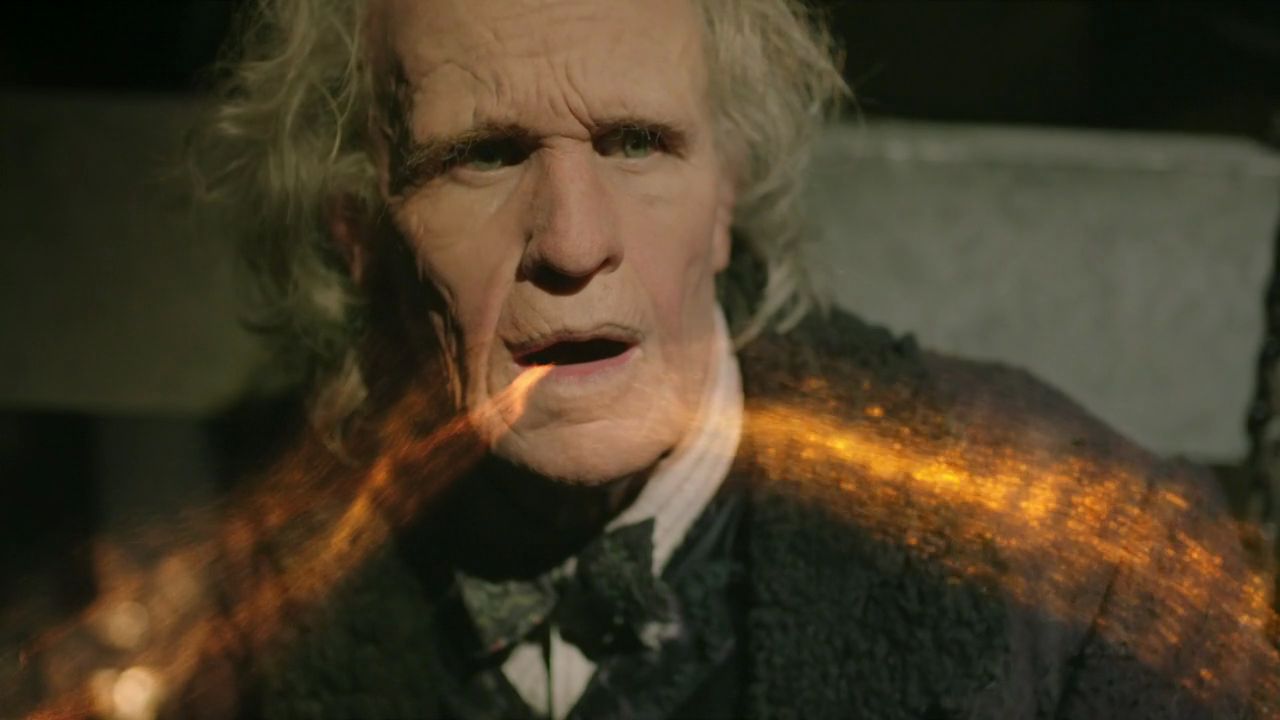
very amusing. By the time we got to the grand finale, Smith's elderly
make-up makes him look nearly Hartnell-esque, right down to the wig and
walking stick.
The cameo from from Karen Gillan was one many a fan won't forget. It
serves as a right little bookend to the 11th Doctor's lengthy life. He met
Amy in his beginning as her imaginary friend, now she's became his just
before he went.
Wooden Cyberman....Wooden. Cyberman! That is all.
The explanation as to who blew the TARDIS up, but not the why (why is
disappointing), apart from the destiny trap the church mapped out for the
Doctor.
Dat final speech! Now this (while second to Paul McGann's Physcian,
heal thyself line) is strong dialogue for Matt Smith to go out on.
As for the bad...
The sexism is quite evident here just as it was in The Day of the Doctor and even moreso 2011's Let's Kill Hitler. Normally I don't have a dog in that
race, but it's quite alarming when the showrunner's sexual politic issues
run the gammut from mild to flat-out hamfisted. Case in point, the
unneeded mysogynist line or two being foisted on Smith to say which feels
more at home from a Terrance Dicks-penned Doctor Who novel of old
than on TV.
The Daleks were not in best use here. One forum comment was on point
about there not being a single extermination from them since Steven
Moffat's reign began. They're now as neutered (on TV, anyway) as Saturday
Morning cartoons were when parents forced TV programmes to be the parent
while the actual one just continue their passive parenting without a
single-- (Kory. Rambling!) Bottom line, they've ceased being scary and
it's a damn shame in their 50th year in pop culture. Plus, I can see now
we'll never see a proper Dalek agent or a Roboman at this point or ever.
Thank the gods for Big Finish to allow the Skaro-born menace to do what
they do best.
The plot, when it comes to the previous baddies used throughout the
Smith era, made the entire special feel like a Greatest Hits complilation
but with no bonus bits or new material to shine through to round it off.
The late Craig Hinton would've crapped out a better form of fanwank
without blatantly gushing about what a genius he is.
Clara, Clara, Clara... I can't help but think her lack of character
development is more in tune with how Susan was written the fifty years
before. Only in 2013, sprained ankles and cry spells have been replaced
with quips, flirtation and her saving the day a lot whether its a leaf or
her appealing to the Time Lords via a crack to give the Doctor a new
regeneration. Speaking of that...
Yay for Moffat's latest Kanye moment! Rubbing salt on an old wound by
bringing up the Eccleston stand-in (that's all John Hurt will always be to
me) and Handy to remind us that the 11th Doctor was the last one with
complete disregard for the Valeyard angle to tackle which could've been
the best opportunity to exploit it. Thus the entire final scene where the
11th Docotr regenerates (and the energy being shot towards the Daleks) as
the biggest dues ex machina that makes Last of the
Time Lords look like a true masterpiece....
Will someone please tell Murray Gold to turn down the friggin' volume
when adding music to every episode?! It wasn't cute during the RTD era and
it's not cute now.
Feels Different This Time:
The regeneration was a lot shorter this time around; as quick as the
Pertwee-Tom Baker regeneration in Planet of the
Spiders and more or less the infamous 6th regeneration in the intro to
Time and the Rani. Still, the 30 odd seconds with
the now-incumbent Doctor Peter Capaldi was a real treat. So, it's good to
say that everyone has a good reason to look forward to Series 8. Whether
Moffat will continue the uneven Joe Quesada-esque trait with Capaldi
remains to be seen at this time.
Overall, The Time of the Doctor is uneven, messy and often slow
in certain parts. It really shoud have been a stronger send off for Matt
Smith rather than the net result. Compared to the cruel joke that was The Day of the Doctor, The Time of the
Doctor is more stable even if it's disjointed in its own Moffaty way.
On the bright side, Smith didn't go out like whiny child like his
pinstriped predecessor. Just saying!
"The Unreliable Narrator" by Thomas Cookson
7/3/16
The 50th Anniversary event had left me feeling deflated and convinced
Moffat had played all his cards long ago. But I saw the trailers and
photos for this story and was suckered by its epic heavenly fanwank
ultimate showdown to end all showdowns.
But the problem is it's so clearly a Pandorica Opens redux, teasing us again with
the threat of all the gathered foes revving for an almighty ruck.
Horror of Fang Rock made similar bold insinuations
of unseen mighty galactic war-fleets but was resolved in a very low key
way, which felt fine. But Moffat really promises the almighty clash of
titans here, the ante-upping from last time, in ways that leave me
disappointed and feeling cheated.
I'd wanted to like it, but when time came to explain my feelings it
just came out of me that this was more like being told a great story by
someone than experiencing it myself. It's like the story flew completely
over any plot development, skipping right to the climax's end.
I wanted to savour the story's goods but kept getting sidetracked or
bamboozled by irrelevance. No explanation how Smith obtained 'Handles',
making the opener somewhat baffling. Clara's family domestics were awful,
possibly the worst comedy material Moffat's written, ever. And
frustratingly taking up runtime that'd be better served elsewhere.
Whatever happened to Moffat's gift of using limited runtimes to maximum
effect and leaving not a moment wasted in a way rivalled only by Barbara
Clegg? Since Series 6, he's been either going too fast or wasting our
time. Sadly, the atrociously misjudged naked-Smith moment leaves me
thinking he's succumbed to some inferiority complex about Russell's
vaunted 'genius' populism and quirky humour delivered with the subtlety of
a teabagging.
Oh and then there's the bum slap. I get the sense that, much like Queen
Lizzy's horrid characterisation in Day, Moffat
just put this in to annoy his more uptight feminists detractors on
purpose.
I get feminism's argument about sexual bullies groping their victim in
concert with humour to leave the abused victim feeling their protests will
be perceived as too touchy and humourless, as though they should accept
their 'good humour' and deny their own screaming, brutalised feelings. But
it doesn't apply here as far as I'm concerned. This is simply mutually
understood horseplay humour without sinister intention between close,
trusting friends with less need for personal boundaries. While feminist
critics show the typical worrying tendencies to assume the worst offended
feelings of any man-to-woman contact or interaction, promoting a culture
where men must always feel guilty for something they don't understand and
can't do right for being wrong.
But it doesn't make sense the Doctor would ever be so stupid to make
such a reckless faux pas at a Christmas family lunch, let alone to turn up
stark naked. What actually was the point of the hologramatic clothes? Was
that important to the ending in an earlier draft that got scrapped?
Moffat also led me to expect that the repeated significance given to
the underbaked family lunch turkey was a clue for something important or
crucial, but no significance to it transpires, beyond being an unwitting
metaphor for the script, which again leaves me wondering why it didn't end
up on the cutting room floor. Likewise, the scene where Clara's being
menaced by Silents outside Tasha's bedroom seemed like it was going
somewhere, but instead the Silents might as well not be here at all for
all the use they are. These aren't just red herrings, they're red plot
herrings that serve only to disappoint and irritate.
What was the point of the truth field? Potentially, it could've been
fascinating to have the Doctor and Daleks share dialogue where sneaking
around each other or empty hyperbole is no longer optional, or even have
them say things to one another they'd never said before. But the story
abandons the concept as soon as introduces it.
I do want to be positive about some things though. The Weeping Angels
climbing out the ice was exceedingly thrilling, whilst being an acceptable
enough non sequitor. The revelation that the Daleks had off-screen already
massacred and converted Tasha and her clergymen also made me hold my
breath. Her slapping Eleven before incinerating all three Daleks was
fantastic, but this also seemed to disappear from the plot too soon. The
story lacked showing a satisfying fight of it. And all it needed was more
Silents/Dalek converts on snowy Trenzalore blasting the shit out of Dalek
ground forces.
By the same token, the story doesn't even seem to bother exploring the
implications that the Doctor might've ensured an everlasting peaceful
stalemate had he stayed out of the whole conflict.
Incidentally, Tasha Lem has been much derided as a blatant River Song
substitute. But frankly she works much better as a character than River
because she shows a resigned maturity and distinction, and Moffat hasn't
yet gotten a chance to lose all focus and handle on the character and
drown her in excesses. So I'm more in favour of her returning than most
fans are.
Now in the past Moffat has introduced a sacrificial female lamb in the
Christmas specials, and it's always felt somewhat ugly how it's handled
each time. There seemed no reason why Abigail had to be thawed out on her
doomed last day. We were told her superior focused singing voice's
resonance with the ice crystals was largely down to her existence in ice.
So why couldn't they have thawed out someone else, less doomed, to do the
singing? Likewise, Clara's death in The Snowmen
left a nasty aftertaste largely because of it happening because of the
Doctor's prior sulky impotence.
But here things just feel a bit sanitised. We're told about the hard
and costly fights to defend the town from superior might, but we never
really see it. The point that really lost me was when in the last quarter
the Dalek incursions were allegedly intensifying but were merely narrated
and rushed through.
That's not something the story can afford to leave ambiguous when it's
depicting a small village of innocent, primitive luddites surviving
against the greatest military power in the universe. What happened to the
words "Saltlake City, population all dead!" from just one Dalek? I need to
believe in that implausible story of victory against all odds, but I can't
if it's just neglected.
This I think is the problem. Taking, for example, The Dark Knight
Rises, there's the grossly irrelevant question of how, once Bruce escaped
from the prison well, he managed to get into Gotham City. The lazy answer
is 'because he's Batman' but the truer answer is because, frankly once
we'd seen him conquer the most impossible obstacle, anything after can be
taken as a small feat by comparison, and therefore unnecessarily
cumbersome to show. To bring things closer to home, Family of Blood's conclusion worked whereby the
true dilemma was about John Smith's courage to finally sacrifice himself
to bring back the Doctor. Once that happened we could probably skip the
usual victories and come-uppances the re-awoken Doctor was guaranteed to
deliver.
Unfortunately, Moffat is clearly assuming the lazy answer of 'because
he's the Doctor' to wish-wash any and all problematics here. Resultantly,
we're presented with the worst terrifying big bads of Doctor Who,
whilst taking it for granted that they're all on a hiding to nothing
against Smith. The story's undone by Moffat's attitude filtering in that
the viewer need not even see this story, because they already know it.
It's clear that this story wants to, belatedly, be The
Five Doctors of the Matt Smith era. But it almost never takes the time
to make something of each incidental threat or the Doctor's ingenious
solution to them before cutting away several years on. Asylum of the Daleks did those kind of moments right
with an ease suggesting Moffat could write this kind of thing in his
sleep, i.e. "I'm not looking for an override dear. I'm looking for
reverse."
Then of course was the scene in Day of the
Doctor where the TARDIS smashed through the walls and totalled a dozen
Daleks. That worked because it was like a classic 80's practical effect
with model minatures, where timing was crucial, leading to a greater air
of anticipation and the payoff was more satisfying. It milked the one
set-piece for all its worth. Time of the Doctor frankly seems
rushed and like it can't be bothered.
Before long, the Doctor's old. We get him giving false hope to a young
lad, in blatant contradiction of the 'truth field', which frustratingly
suggests Moffat hasn't read his script through properly. With no plan or
way out, he gets a great, furious, nothing-to-lose speech to deliver to
the Daleks, whilst Clara gives a brief but touching cry and prayer for
help. Having been largely left disengaged from the story, this was the
kind of re-engagement I wanted. But it's rather too late.
The means of him getting a new regeneration cycle was done neatly
enough to go unspoken. Though destroying the Dalek fleet with it was...
stupid. Perhaps had that been Matt's final scene I'd have been happy
enough with it. Instead, the extended scene in the TARDIS with Matt now
de-aged undermines the sense of all that's taken place.
The sad goodbye to Clara is nice. The bowtie removal and the Doctor's
summation that all people change in terms of who they are through their
lives is eloquently poignant.
But it visually contradicts what should be our instinctive sense of the
why the Doctor's dying. Just imagine if he was elderly and frail all
through. It would've given extra poignance to the wigged cameo of Amy
wishing him a sweet "Goodnight", and made the clearly obscured child
actress who obviously isn't Caitlin Blackwood forgivable, if there was
that crushing temporal vertigo sense of an old man's distant dreams and
memories and dying final cathartic hallucinations and having those bits be
the only parts where Smith looks young anew.
Yet, for all Matt's last scene was too long, it was paradoxically too
abrupt, to the point of 'blink and you'll miss it'. The result is that the
departure of my favourite New Series Doctor ends up barely even
registering or having impact.
The story was mainly about resolving the many dangling threads
concerning the cracks, who blew up the TARDIS and why the Silents hate
him. It does so succinctly enough, though hardly in a way I can bring
myself to call neat.
Hurt's Doctor is still a lasting problem. I hate myself for saying so
because Hurt's very Doctorish performance was so amazingly good. But it's
produced a situation where no sooner has Eleven undergone serious
renumbering than he's leaving and we're suddenly force-fed how this makes
him the 'last' Doctor, because suddenly The Stolen
Earth's almost-regeneration counts too. So Smith's regeneration
becomes emergency retconned into a bigger deal than usual. It's clear
Moffat's making this up as he goes along. Worse, he's making the retcon up
as he goes along. We're sold this idea too late to believe it was now or
ever inherent in the character's make-up. Resultantly, the story barely
decides what kind of final story it is, but does it so blatantly and
unsubtly it's all see-through cliches.
Perhaps New Who regeneration stories are doomed to fail. Given
how short Eccleston's reign was, and his swift replacement, and how from
2007 onwards we've practically seen a regeneration per season. Nowadays,
no one doubts Dalek weapons will do anything to the Doctor but change his
face. It's become a carelessly handled trivial thing in ways it never was
allowed to in Classic Who. Ultimately this feels less a story and
more a scorched-Earth solution to Moffat's own mis-numbered Doctors mess.
Raggedy man, good night by Evan Weston
8/3/21
The first two New Series Doctors both received endings that fit both the quality of their reigns and the tone of their takes on the classic character. Christopher Eccleston's Bad Wolf/Parting of the Ways started off with some bland Russell T Davies satire but quickly got over it to tell a dark, frightening tale filled with morality crises and thrilling showdowns. And at the end of it all, Eccleston went out with a smile, perhaps finally achieving some small amount of peace. David Tennant's The End of Time was a big, overstuffed epic with just the right amount of Davies' absurd sense of scale, capped off by an incredibly moving (if over-indulgent) trip through the Tenth Doctor's companions. Both gave their Doctors an appropriate sense of closure.
The Time of the Doctor both meets and fails this criterion. The episode is a nice encapsulation of what was good and bad about Matt Smith's era, sure, but it is not good enough to serve as his finale. While Smith's era doesn't have an ambitious television landmark like Dalek, Blink or Midnight to its name (though The Day of the Doctor has an argument), it can claim at least a dozen tremendously strong episodes, some of which carried a huge amount of pressure on their shoulders. What a shame, then, that The Time of the Doctor falters under perhaps the greatest amount of pressure heaped on an episode since The Eleventh Hour, all the way back in April 2010.
This episode, due to mismanagement of previous arcs by Steven Moffat, is responsible for tying up all the loose ends from Smith's era. This includes the perpetrators behind the TARDIS's explosion in The Pandorica Opens/The Big Bang, the origins of the Silence and why they went to the lengths they did to destroy the Doctor, the way in which the Doctor comes to die at Trenzalore, and most recently, the whereabouts of the Time Lords. The Time of the Doctor attempts to accomplish all of this exposition while telling a Christmas-themed war story that spans nearly a thousand years.
It doesn't end all that well. Moffat, in his quest to keep his viewers' minds scrambling, left way too much unanswered at the conclusion of the nebulous and overwrought Series 6 and then ignored it for the duration of the enjoyable yet incomplete Series 7, leaving all of it for this grand finale. Most of the questions I detailed above are answered in brief statements from Tasha Lem: the Silence of Series 6 was just a branch of the futuristic Church; they broke away in an extreme attempt to prevent the events of this very episode; they were responsible for the TARDIS exploding; and their stalemate with the Doctor over the Time Lords is what forces our hero to live out his years defending the planet Trenzalore at its central town, obnoxiously named Christmas. This is the bad of the Smith era. All of the silly details and circular questions come back to haunt The Time of the Doctor in the worst way possible.
This has the effect of making the episode feel more like a highlight reel and less like a full story. We see only snippets of the conflict, for Moffat has only 60 minutes to tell a story that probably requires at least 135 (what Davies had for The End of Time). The set-up is done well - all the way through the revelation of the planet as Trenzalore, things are paced nicely, and the moment the Doctor realizes that the Time Lords have been behind the crack in the wall the whole time is very powerful. But once the conflict is established, we zip forward 300 years, a bit more nonsense happens, some exposition is delivered, and we're forward another god knows how many years until the Doctor is a sullen husk of a man. Yet all this time, he never changes or develops meaningfully at all. The Eleventh Doctor has always been an aged soul, and while I appreciate the poetry of that age finally bubbling to the surface, Moffat doubles an iconic character's much-discussed lifespan in half an hour and shows no interest in giving that any significance beyond further mythologizing the Doctor.
Thankfully, sprinkled amongst the chaos are many moments that remind us of the good of Series 5-7. Smith is just absolutely tremendous, and, as you'd expect, he gets better as more poorly applied age makeup is caked onto his face. He's as whimsical as ever, but Smith is asked to do loss, regret, flirting (weirdly enough) and a frank acceptance of death within the hour, and he pulls it all off brilliantly. I hold the unpopular opinion that Smith is a better actor than Tennant, but I stand by it. David's range just isn't this wide. There are so many somber, quiet moments into which Smith injects so much soul that Tennant would just play angry. I don't intend to bash Tennant, but Smith's Doctor is just more interesting.
There's less humor than you'd expect: Clara's family is surprisingly dull, and the main naked joke that carries the beginning of the episode never really catches on. But the Doctor's interactions with Cyber-head Handles are terrific, and I only wish that Moffat would have developed the idea of Handles earlier. His death halfway through is a potent moment that would have been made all the more tragic had he been around for a series or two. The supporting cast is a mixed bag, but Jenna Coleman is as delightful and mournful as ever, though her character is still a pointless cypher. Orla Brady is frustratingly bad as Tasha Lem, who seems at one moment like a future version of River Song and the next just a lazy device that lets Moffat dodge several plot corners. Brady herself is way over-the-top in the part.
The Time of the Doctor is gorgeous, like the recent set of episodes and like most Moffat Christmas specials. It isn't quite as dark blue and purple as the past three, but there's certainly a lot of that, and director Jamie Payne is smart to balance the Christmas special needs with the episode's grave importance to the series, as The End of Time did. The cavalcade of villains is great, and they all get their due, particularly the Daleks. Moffat has worked valiantly to revive the creatures, and while you get the sense that he doesn't take them as seriously as Davies did, they're fairly menacing in their takeover of the Papal Mainframe and their taunts to the Doctor near the end. It also makes sense for them to be here, considering the Time Lords are involved in the plot and the Daleks have a vested interest in making sure the bait-and-switch that nearly extinguished (exterminated?) them at the end of the Time War doesn't happen again.
This wouldn't be enough to save the episode from a middling grade, and, to be honest, most of it isn't really worth a rewatch. It's just too haphazardly thrown together, too obviously trying to clean everything up while only brushing over details, a child flipping through a long, carefully written fairy tale. But the final ten minutes are masterfully done and bring the episode to a level that I can accept, if not be pleased with. Clara's speech is just the right amount of Doctor-love mixed with a real pathos that Coleman nails, and the resulting action scene in which Grandpa Matt blows up the Daleks with his regeneration energy is really freaking cool.
It improves further when Clara steps back into the TARDIS. Smith, brought back to his regular look for the final scene (as Tennant was; there is continuity to support it), is all sad eyes and big heart. The last lines he delivers, again as it was for Tennant, are clearly Smith breaking the fourth wall and talking through the character, explaining his decision to leave the show while genuinely expressing how much the experience meant and will always mean to him. What really takes the sequence over the top is the Karen Gillan's cameo as Amy Pond. Sorry Clara, but Amy is always going to be inextricably linked to the Eleventh Doctor as his real companion, and her return is beautifully done to ensure that not a dry eye remains in the house. All that's left is for Smith is remove his bowtie and change. Peter Capaldi, for his part, is madly energetic in his first scene, leaving you sad but excited to see what's next.
So we say farewell to Matt Smith, and we do so with an episode that lets down the trilogy it is intended to conclude, but does enough with its final moments to at least stand semi-proudly on the DVD shelf. The Time of the Doctor slowly devolves into a mess that would slot in perfectly with Series 6, but Moffat has learned enough to begin and end on a high note. Smith came onto the scene with Moffat back in 2010 armed with low expectations and a goofy haircut, but somehow managed to transcend his alienating look with wonderful performance after wonderful performance, and he retires as, at worst, the third most popular Doctor of all time. His ability to look young and feel old is unique and drove most of his greatest moments, and that will always be the defining characteristic of his Doctor. Goodbye, Raggedy Man. See you around.
GRADE: B
Ranking the Stories - Series 7
- The Day of the Doctor (A)
- The Name of the Doctor (A-)
- Asylum of the Daleks (A-)
- The Angels Take Manhattan (B+)
- The Rings of Akhaten (B+)
- The Crimson Horror (B+)
- The Bells of Saint John (B+)
- Dinosaurs on a Spaceship (B+)
- The Snowmen (B)
- A Town Called Mercy (B)
- Journey to the Centre of the TARDIS (B)
- The Time of the Doctor (B)
- Hide (B-)
- Nightmare in Silver (B-)
- The Doctor, the Widow and the Wardrobe (B-)
- Cold War (C+)
- The Power of Three (C)
Ranking the Supporting Characters - Series 7
- The War Doctor - The Day of the Doctor
- The Tenth Doctor - The Day of the Doctor
- River Song - The Angels Take Manhattan
- Victorian Clara - The Snowmen
- Oswin Oswald - Asylum of the Daleks
- Jenny - The Crimson Horror
- Merry Gillel - The Rings of Akhaten
- Brian Williams - Dinosaurs on a Spaceship
- Strax - The Snowmen
- The Moment - The Day of the Doctor
Ranking the Villains - Series 7
- The Weeping Angels - The Angels Take Manhattan
- Mr. Clever - Nightmare in Silver
- Mrs. Gillyflower - The Crimson Horror
- Miss Kizlet - The Bells of Saint John
- Solomon - Dinosaurs on a Spaceship
- The Daleks - The Time of the Doctor
- The Great Intelligence - The Name of the Doctor
- Grand Marshall Skaldak - Cold War
- The Zygons - The Day of the Doctor
- The Vigil - The Rings of Akhaten
SERIES GRADE: B