
This Town Will Never Let Us Go

|
|
Faction Paradox This Town Will Never Let Us Go |
|
| Author | Lawrence Miles | 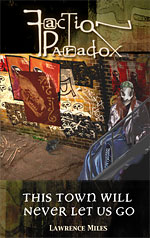 |
| Published | 2003 | |
| ISBN | 0 97259 592 9 | |
| Publisher | Mad Norwegian Press |
| Synopsis: This book features the 19-year-old Inangela, a city-dweller who's under observation by Faction Paradox's elders and archons. Before this story's done, Inangela's going to encounter the Great Urban Horror -- an unidentified force seeking to tunnel its way out of the ground and feed on the surface world. |
A Review by Sean Gaffney 5/12/03
Well, it's another Lawrence Miles book, boys and girls. And this one is probably not going to change anyone's mind one way or the other about him. I think fans will enjoy it, though there are a few things I found frustrating.
The plot is excellent, and has a very high re-read factor to it. Even after I've finished the book, I'm still going over what happened in my head, connecting the metaphorical dots. There's very little going on here that's unnecessary, and even things I thought were Lawrence being cute and making fun of pop culture turned out to be huge points of reference.
There's only a few major characters to keep track of, thankfully, as the book is already rather overloaded with its own culture and identity. Inangela is written very well, and for most of the book I didn't particularly like her. Not because she was written badly, but I think because I was meant to be doubting her and trying to cut her down. The narrative in the book really drives your thinking towards what it wants you to think; more on that later.
Valentine was OK, but probably my 'weak link' in the narrative. He reminded me a lot of Fitz, perhaps because of the events of Revolution Man. Valentine is, like the reader, led where he is needed to be by unknown events. He also stays bewildered and confused most of the book, which doesn't help him on the 'likeability' scale.
Tiffany, on the other hand, was a very likeable character, which I found quite amusing, as she's meant to be a 'Britney Spears' type, the sort many readers of Lawrence Miles books wouldn't be caught dead liking. But I empathised with her struggle to find out what she's become and how to see it all, even after she starts to control it and gets just a little bit scary. There's also a fundamental question of just how much of Tiffany is Tiffany, and how much is the novel in its entirety.
And we also have Horror. Horror, also one of my favorite characters. Inangela and the narrative spend most of the book putting her down and mocking her intelligence, which made me like her all the more. She's the 'voice of reason' that was desperately needed to balance Inangela and Valentine's conspiracy theories and ritual doubletalk. She's also one of the big 'a ha!' revelations at the end, which I found highly amusing.
And then there's the narrative. The 5th main character. Normally I don't really notice a narrative voice, but this book makes you notice it. The narrative has opinions, it cracks jokes, and it lectures. Often this is refreshing, and I did enjoy the breaks in tension when they were provided. Sometimes, however, Lawrence wants to Tell Us Something. And when he does, about every 10 pages or so, it hits with all the subtlety of a ball pen hammer to the skull. The lectures in the narrative were the weakest part of the book. (And the textual mangling in section 5:37 was done better in Vrs).
It should also be noted that this is the first in a series of books about Faction Paradox, and by extension, The War. Strangely, though the Faction are seen in little and big ways throughout the book, they don't make as much of an impact as I'd thought. They're almost a red herring. This is more a book about The War, and about the mindset that a War might produce in the innocent bystanders. If indeed a War like this can have any such thing. I find it interesting that Lawrence, from all the myriad things in The Book in the War that could stand to be fleshed out, went for a psychological examination of it on a very small scale.
I had a lot of fun reading this book. The characters were intriguing, the plot diabolical, and I'm still picking it apart in my mind. Yes, occasionally I muttered to myself about Lawrence being irritating, but let's be honest - we all want to do that a bit, surely? ^_-
A Review by John Seavey 12/12/03
First, before I begin, a caveat. Since I don't want to keep qualifying my statements with the phrase "if you like Lawrence Miles", I will say once at the beginning and once at the end that This Town Will Never Let Us Go is a further evolution of Lawrence Miles' distinctive style of writing, a further step along the path from his previous novels. So if you've found yourself liking his work less and less as he went along from Alien Bodies to Dead Romance to Interference to The Adventuress of Henrietta Street, well... you'll probably not like This Town Will Never Let Us Go. There. Disclaimer over, now I shall proceed to gush.
This Town Will Never Let Us Go is gorgeous. It's about... well, it's about two people, Valentine and Inangela, and their respective attempts to change the world on a single strange night in a town that's like somewhere on Earth at some point in time but is just different enough that you feel sure it's somewhere in the future but you're not sure how much... but it's not really about what it's about. It's about the ways it's about what it's about. It's a series of short essays on culture and the effects rituals and wars have on cultures (both personal cultures and general cultures) using Valentine, Inangela, and Tiffany Korta (a Britney Spears analogue undergoing her own personal transformation) as examples, all of which connect together to form a plot, and it's absolutely engrossing.
Miles' writing here is all stream-of-consciousness -- not necessarily always his consciousness, but at least someone's. There's very little actual dialogue. The story really takes place inside the heads of the people living in it, and one of the definite subtexts of the novel is that this is the way the world really works. We all really live inside our minds, and it's that thought, perception -- information -- that's the important thing. Inangela is attempting to change the world by changing the information in it; Valentine is attempting to make a grand gesture the world can't ignore. Somewhere in all that is a discussion of 9/11, the state of permanent near-war we've existed since then with no real opponents, and the way that the powers that be have maintained power by suggesting dissent is an "inappropriate" response to the tragedy.
Of course, all this could come across as extremely dull and worse, insane... it could wind up feeling like Miles is writing because the alternative is to hole up under an overpass and talk about the voices in his head. But Miles deflates his own pomposity just enough with humor to make it all palatable; his depiction of George Orwell's guest appearance on the Muppet Show, complete with Miss Piggy doing an 'Animal Farm' skit, is worth the price of the book in and of itself.
Of course, anyone coming from The Book of the War to this will be a bit surprised that this is how the founder of the Faction Paradox book line decided to kick things off. This isn't a big, mythos-oriented novel that features the War King, Compassion, and all the "main" characters of the War... this is a ground-level view, in which Faction Paradox is mostly a myth and nobody even knows how the War is fought, much less what it's about. It's concerned with the victims of the War, not the soldiers or leaders.
Nonetheless, it's an amazing book, and a tough act for Philip Purser-Hallard to follow. To repeat the caveat at the end, if you're not a fan of Lawrence Miles, this novel won't convert you. But if you've liked what he's written before, this is an excellent, fascinating series of meditations on the world we live in.
A Review by Finn Clark 6/2/04
To start on the crudest imaginable level... that's one big book. The page count isn't the problem, since 281 pages is about the norm these days. No, it's the page size. This is a jumbo tome in the same format as The Book of the War, with oversized pages and a monstrous word count that sneaks up on you unawares. You start the book, not expecting anything extraordinary. You read all evening. The next morning, to your shock you're not even a hundred pages into the bloody thing.
In other words, it's another Interference. In length, anyway. Say what you like about Interference and The Adventuress of Henrietta Street, at least their stories felt big enough to warrant the added word count. This Town Will Never Let Us Go doesn't, but in a way that's almost a virtue. This feels like Mad Larry's most confident novel to date, in which he's completely abandoned all notions of 'How It Should Be Done' and is simply doing his own thing. He's hit his natural rhythm. This is like Lawrence's Goblet of Fire.
As a story, it's remarkably self-contained. The cast is small and their individual stories don't start connecting until we're halfway through. The setting is almost claustrophobic, being almost entirely confined within one semi-mythical, never-named town ("that will never let us go"... that title gets ever-spookier the further you read). Lawrence isn't particularly concerned with Faction Paradox, the War or anything else you might have seen in Alien Bodies and Interference. Instead he's suddenly become interested in the little people on the sidelines - which is a very un-Milesian attitude, compared to the cosmic scale and Big Ideas of his other novels.
No, none of the above is what powers this book. It's set in the Town, yes, but that's only literally true. This Town Will Never Let Us Go is really set inside Lawrence Miles's head... and it's a scary place. If you've ever read a Mad Larry interview, that's the voice of this novel. It's non-standard narrative, but less so than Henrietta Street or The Book of the War, being more like Dead Romance than anything else. It's 3rd person narrative rather than the 1st person diary of Christine Summerfield, but I could suggest other similarities. Sometimes this doesn't feel so much like a novel as an extended stand-up routine, except that the narrator's odd observations aren't being taken to their illogical conclusions for comic purposes. He's just describing the view from Planet Larry. You'll have to smack yourself in the head with lead piping a few times before you decide that this book does indeed take place on Earth.
I hasten to add that that's a good thing. Lawrence's worldview may be getting a little over-familiar from his various interviews, but it's still fun to see him spell it out in caustic, exaggerated detail. Mind you, if he writes another book along these lines he'll be in danger of becoming the next Dave Stone. [I'm a huge Stone fan, but even I'll admit that his books can feel a bit interchangeable.]
The characters are good, which is lucky since the cast is so small that even one dull protagonist could have wrecked things. Tiffany is a lot like Britney Spears, being an apparently empty-headed pop star of Britney-like status, but unfortunately this made my brain want to crawl out through my forehead during her early scenes. She's not Britney really, but the mental associations were strong enough for it to disconcert me when Tiffany turned out to come from Cuba. However my favourite character was Horror, who made me laugh - though one has to wonder about a girl who chooses a name with the short form of "Hor". Um, how do you pronounce that?
Inangela and Valentine are fine. It's the walk-on guest stars who really stick in the mind, like Miss Ruth and the Black Man with his canister. That last one in particular gets the book's most astonishing scene. Overall, this book combines high-concept characters with ordinary people of a kind Lawrence hasn't always seemed to be interested in before.
If this book is about any one thing, it's about celebrity. Tiffany's story is its real heart. The War features in an odd offstage fashion, as if Mad Larry has decided in the decade since Alien Bodies that war is rather silly, but for precisely that reason also rather interesting. There's much musing on what international conflict means these days, with parallels being drawn with both Western intervention and international terrorism. Lawrence's War has come into the 21st century and it's grown an attitude.
This book is almost more of a thesis on Mad Larryology than a narrative, but it's entertaining enough for me not to have a problem with that. There's even plenty of plot, though it takes its own sweet time. [For example I have a theory about the identity of the dying girl in the ambulance which works so much better as a possibility than it would have done as a spelled-out final twist.] You'll probably remember this book more for its Larry-isms than for its story, e.g. the naked videotape nightmares, or what pop stars have in common with chickens. However it looks very re-readable - and even on first exposure it's more fun than any Miles book since Alien Bodies. Lawrence certainly hasn't forgotten how to turn a witty sentence. This isn't a self-consciously 'big' story like much of his work... but I'm sure for many people that's a good thing.
A Review by Rob Matthews 17/2/04
In some parallel universe where it's possible to get a word in edgeways with Lawrence Miles, you'd commend him on his bravery. If I could describe this novel in just word, that word would be 'surprising'. No sooner has Mad Larry kicked off Faction Paradox as a book series in its own right than he's decided that Faction Paradox is, well, a bit daft.
The Faction's here alright, just about, but it's not necessarily the same organisation anymore that it was in the Doctor Who universe, and - as has been commented already -, it's a bit of a red herring. You want to read about Cousins and Houses and Cwejen and whatnot, forget it. Oh, there are bits of familiar lore in here alright. There's a figure-eight symbol cropping up here and there which Miles' readers will identify easily enough. There's a chamber containing a hexagonal altar with an illuminated central column. There's even a reference to Compassion as a Ship prototype. But such is Miles' dedication to writing each of his books as a Novel-Goddammit in its own right, such is his capacity for reinvention, you're left feeling that prior knowledge of these things is almost more a hindrance than a help. Faction Paradox has become an ongoing property, but the great thing about Miles is that even when he's writing a book as part of a series, it reads as standalone.
Faction Paradox are here as, if anything, representatives of Ritual. Their precise nature so far as this novel is concerned is never clear. Just how they've become a part of popular culture in the eponymous Town is never clear, though a hint of an explanation may well turn up on a second read. Quite what the War is to the inhabitants of this Town is, so far as I can tell, not clear either.
Sounds rather diffuse and airy doesn't it, but of course it isn't; this is Lawrence Miles. And This Town... is his first comprehensive foray into Faction Paradox-as-Fashion Paradox. It's about pop culture and how easily culture pops. He may not spell out the nature of the War in precise detail but, Finn Clark's pointed it out, this is the twenty-first century now, and we all know the new connotations taken on by that phrase 'the War'.?And certainly Miles doesn't use the phrase any more nebulously than, ooh, say the backward hick puppet-leaders of certain world superpowers. This is a book very much about the world, 'the Pit', as it is now, so probably we really shouldn't be surprised to see Miles also take on the world's current obsession, exponentially-booming and ever more tiresome; that of bloody Celebrity. And terrorism. And Buffy. Actually, the mix of terrorism, pop tarts, simulacra and surrealism reminded me of Bret Easton Ellis' depressingly prescient Glamorama, though Miles of course mixes these ingredients very differently. Though, I'm proud to say, no less literately! Which - depending on how much of a huckster you consider Ellis himself - is a rather wonderful thing to consider when you remember that is after all a spin-off novel from a spin-off range of books from an old kid's show. As I've mentioned, the very barest bones of Doctor Who are still there, but this is next-gen stuff, Kode as compared to Fitz. Appropriately enough, since as Miles Tells Us once again, only the bones ever remain.
A surprising book, yeah, but when you think about it an appropriate (haha, I'm intrinsically evil) way to follow up The Book of the War - namely, with restraint. In terms of focus, that is; one could never accuse Mad Larry's ranting authorial voice of anything remotely approaching restraint, any more than you could accuse me of not using ridiculously tangential run-on sentences. But the narrative itself is deceptively simple - three main protagonists, two of them teenage girls (there be the Buffy influence); the events taking place, minute-by-minute, all in six hours, all in one Town. Cutting back on all the massive scale stuff that ultimately made The Book of the War rather wearying is just the right thing to do, and Miles' universe reveals itself just as effectively in the minutae as in the broad sweeps.
Where and when and in what dimension this Town is, incidentally, is an intriguing question in itself. Some of the clues we get are red herrings. George Orwell seeming to turn up on The Muppet Show for example, was actually a bit of a blind. I kept getting the feeling this was America, but references to fish'n'chips and The Sun made that seem less likely. Things do start to unravel though, albeit in oblique fashion.
There's a consistent motif running though this book, a kind of thematic sequel to Interference. There the simile was Television; here - simplicity itself - it's the VCR (we can confidently expect Miles' next novel to orchestrate itself around the DVD player, though of course he's good at quoshing expectations). The termite-colony metaphor is superbly sustained, even though no matter how hard I tried after reading it, I just couldn't get freaked out by videotapes. Pass the roll-ups...
It's worth pointing out that characterisation-wise, no-one really appeals. Goodness knows what we're meant to think of Inangela and Horror, whether we're meant to like them or not. As I've said, their presence alerted me to a probable Buffy influence, given that Miles is a self-proclaimed admirer of that show. For myself, I'm just not sure I like reading novels with teenagers as protagonists. Old fart that I am, I'm not particularly well disposed towards that self-obsessed, know-it-all adolescent attitude and don't really have much wish to see it recreated on the page. Of course this might also be because, whippersnapper that I am, those years are still recent enough for me to be embarrassed by them. Possibly that's just my own prejudice.
Inangela's yer archetypal slacker-generation teen rebel. By which I mean she does her rebelling in slack fashion. Tiffany's yer archetypal teen conformist - in fact as a Cuban Britney-alike she's the very gold standard of everything the less imaginative teen girls try to conform to -
(it could be pointed out here that as with the VCR simile, Miles is just that bit out of step - yesterday's videos and Britneys are today's DVDs and Beyonces)
-, but whether we're mean to root for either of them, I don't know. I remember in the Menace interview Miles criticising Jack in Matthew Jones' Bad Therapy as a sickeningly calculated 'sympathetic' character, written to have a 'aah bless' little puppy-style appeal to the reader. It was a telling swipe, I think, because I doubt Miles really cares whether his characters are appealing to his audience. Matters such as 'likeability' just seem alien to his writing style - I don't think it's a big consideration for him. With his more cerebral approach, he probably considers such matters rather childish, the way an arch modernist would consider linear plot childish. The only time I can remember him making any such effort with his characters was Scarlette in Adventuress of Henrietta Street, and for me she rang hollow. Bluntly, I don't think he couldn manage it - likeability just wasn't in him.
Course, there's always the possibility that I'm misreading and Miles is wildly in love with these people... God help his loved ones if that's the case!
On a simple level, the name 'Inangela' appears to imply either 'inane', or 'inangelic', or both. Whereas anyone named Tiffany is so obviously a target for derision that really it'd just be cheap to deride her. So wisely Miles doesn't bother. I don't think she's as sympathetic a character as some readers have suggested, though, merely a cipher for a discussion of media, the way Valentine is just the latest conduit for Miles' seemingly neverending rant about moral relativism; 'A to B, B to C...' etc.
Ah, Larry Miles. The fourth and and inarguably biggest character. The most interesting too. And certainly the most annoying. In fact after careful consideration I'd say Miles has now completely surpassed Paul Magrs and Dave Stone as the Emperor of Completely Brilliant/Eye-Bogglingly Infuriating Who-Related Narrators. His worst tendency is to yell accusing questions at us like 'Do you want to know why they really do this?', 'Do you want to know what it's really all about?', to which I always find myself responding with mental sarcasm. Oh do tell us, o fount of all knowledge, don't let us be condemned to the eternal intellectual blindness that comes of not being - gasp! - Lawrence Miles!
And, hey, if I'm being stroppy with Miles as a writer it's certainly no less so than he is with us as readers.? When he gets a bee in his bonnet about bones ('Yes yes, I know we've all been here before'), when he starts talking about the Grandfather's Axe ('Oh god, it's such a cliche even to say it's a cliche is a cliche'), you sometimes get the feeling he'd like us to sod off and leave him alone talking to himself. That is, he's second-guessing the reader in an open and seemingly rather hostile way. And you kind of think, if you've got something to say, just say it Larry and stop getting so bloody defensive.
Still, fair play to him. The man's a genius in his way, and all the irritable prickly stuff is counterbalanced by flashes of real insight. I particularly love his passage about - appropriately enough - paradox: (out of context to avoid spoilers) 'Did you ever think that perhaps nothing would happen?' Another accusative question, yeah, but this time my answer was 'Um, no I didn't, but now you mention it...'. Which is a good reaction to a book, because it means that Larry needn't worry, he has surprised me. The thread best summarised as 'YESSSSS!!' was a daring and an honest one too - reminded me of yer standard tabloid schadenfraude about slebs for a start, but more specifically - because of the Britney analogue - of how some US radio station had a prank news item a while back about Britney Spears and Her Boyfriend Justin Timberlake dying in a car crash (this was in the days before a teeth-grindingly sexy butterfly emerged from that frizzy-haired Britney's-Boyfriend cocoon - fight ya for him, Joe!). I mean, just the notion that they thought it would be funny to pretend two people had died in a car crash gives Miles' bloodthirsty theorising some weight. And if you look at the sad rituals of shows like 'I'm a Celebrity: Completely Humiliate Me', well...
The book's a slow burner; it takes its time the way Interference took its time. I know some readers had a problem with that. But as with that book, there are events in the concluding chapters which are simply as good and as vivid as fiction gets, and they'll stick with you for a very long time. A sure sign IMO of success. It's a slow burning book, but what it's slowly burning is its way into is your brain. And you'll realise afterwards it doesn't shift that easily.
Not what you'd expect so early in the Faction Paradox range, but I think it'll be hard to surpass. Plus if the final paragraphs don't give you goosebumps, you'd best check for a pulse!
Lawrence Will Never Let This Go by Jamas Enright 22/3/06
The blurb describes this book as 'A study in ritual, politics, pop culture, time-travel and urban horror,' but one gets the feeling that they mean this in a positive way. What we get is nearly 300 pages of Mad Larry's ideas on all of the above, and the man has a lot of ideas. He is very much a symbologist, and he's finding symbols everywhere. (Makes me wonder what would happen if we put him and Mr. Deconstructualist Paul Magrs in the same place...)
The story is set in a town, between midnight and six a.m., and follows three different people and story threads as they have to deal with themselves and the War, and often the latter is easier than the former. The War is very much a background element to this story, as are Faction Paradox, neither element coming to the foreground, but both very much present.
The first of the three important people is Inangela Marrero, main ritualist, not-a-witch, and heroine. She's about the only truly interesting character in the whole book, which is a shame as she doesn't get that much screen time, but her appearances always make for entertaining reading. Valentine Bregman is the 'villain' of the piece (as much as the is a villain and not just someone who is doing something they think is right but society as a whole would view as wrong), but is such an irritating pratt for most of the time that you just want to slap him. Tiffany Korta, the 'poor little rich girl celebrity' wanders between likeable and irritating several times, and I was left with the impression that Lawrence Miles had a definition feeling in mind he wanted the audience to feel for her, but couldn't quite get it to happen.
This story reminded me a lot of Dead Romance, not so much for the obvious reasons that I had just read that book and this is the same author, but that every 'section' of this book is a minute of the town (literally, all the section headings range from '0.00' to '5.59' with appropriate titles), and there can be several minutes per page. As the small sections allowed Mad Larry to do in Dead Romance, here the minute sections allow him to jump all over the place, from thread to thread, and occasionally drop in essays on the nature of reality and ritual as perceived by whatever point Mad Larry is trying to make (given that I don't agree with much of what he says, I suspect the finer points he's trying to achieve will forever be beyond my grasp...assuming they are possible to be in anyone's grasp).
[I'm really not sure if we're supposed to feel for the girl in the mask in the ambulance, or recognise that we're supposed to feel for the girl in the mask in the ambulance and not do so because of that recognition. In the end, I decided not to care because we all know that she, like everyone else, will be resurrected in the City of the Saved.]
Some might consider this Lawrence Miles' greatest work, but it is merely 'Lawrence Miles Unleashed' with all the mental collapses and psychic shrapnel that implies. Yes, there are some valid ideas in here, but that doesn't justify this book.
A Review by Terrence Keenan 30/3/06
Lawrence Miles, man of controversy, a writer of notorious reputation for speaking opinions without regards to the consequences.
He's also a brilliant storyteller. Best ever on the Who Line.
And now he's launching into his own little microcosom of the Whoniverse he created, namely "The War in Heaven" between the Great Houses (Time Lords) and the Enemy, with a time travelling Voodoo Cult/criminal organization waiting on the sidelines like vultures called Faction Paradox.
Miles, our Universe-creating mad genius, has decidedly narrowed his focus for This Town... setting it in one place and over a six hour period. There are nods to previous Miles efforts, with the structure similar to Dead Romance: big chapters divided into smaller sections; and Interference: the whole idea of the Cold and the Remote being a way to dissect television.
And it's told mostly in the present tense, by a narrator who reminded me of the Narrator from Barry Lyndon, only with a darker sense of humor.
Our four main characters are Inangela: ritualist and FP wannabe who seems compelled to perform a ritual in order to wake up the town; Horror: Inangela's reluctant partner in crime; Valentine: a man on a mission; and finally, Tiffany Kortez, pop singer and global phenom who sold her soul for fame and fortune.
Over the course of the six hours, these characters come together and cross paths in a city that's been targeted by the warring factions for unknown reasons, as if to show that the war does exist.
Anyhoo, I won't discuss the plot all that much, because you should go into it as cold as possible. Suffice to say, it features Miles's most confident writing since Dead Romance, and features the normal mix of laugh-out-loud moments and utterly disturbing moments.
A Review by Matthew Clarke 13/4/13
On the very first page of this novel we get the most surreal idea imaginable; George Orwell apparently appearing as a celebrity guest on The Muppet Show. Only a mind like that of Lawrence Miles could have come up with something like this. It's such a gloriously colourful and bizarre notion that it just sucks you in and draws you into the rest of the novel.
Like every other Lawrence Miles novel, This Town Will Never Let Us Go is not blessed with a strong plot, so things start to get a bit frantic towards the end as the author tries to bring the book to some sort of resolution. I suspect most people who have heard of this novel know who Lawrence Miles is and will not be reading it in the hope of reading a tightly written , gripping adventure. That's just not the sort of book that he writes. If you don't care for Lawrence Miles' blend of surrealistic madness and intellectual analysis of everything, you may as well not bother reading this.
The most distinctive literary feature of This Town Will Never Let Us Go is the highly involved narration. The book is narrated almost conversationally, as though Lawrence Miles were sitting with you, telling you the story, along with his opinions on modern life. Miles has almost become the central character in his own novel. It is a feature which risks alienating the reader, as it is fair to say that Miles uses the novel as a platform to preach his particular take on society. Being a pro-free market conservative who supported the War on Terror, I inevitably find myself disagreeing with Miles most of the time, but I still find his views very interesting.
While This Town Will Never Let Us Go is the first novel in the Faction Paradox series, it is not really about Faction Paradox. The Faction are more of a background presence. This novel differs from other Miles books in the scale on which it operates. While his other novels deal with grand, sweeping cosmic events, this book is all about ordinary characters and how they are affected by the unseen cosmic War.
Bizarrely, Lawrence Miles continues the original educational agenda of early Doctor Who. The first companions of the Doctor were a science teacher to teach young viewers about science and a history teacher to teach them about history. Lawrence Miles' books are rather thin on school teachers, but, in his inimitable way, he educates fans about postmodernity, poststructuralist literary theory and cultural anthropology. This Town Will Never Let Us Go has the influence of the French postmodern philosopher Baudrillard written all over it. Baudrillard's theory of hyperreality is explored in depth and with it the notion that events like wars have a more substantial media existence than they do an actual spatio-temporal reality. Lawrence Miles also brings up some interesting anthropological ideas about the place of rituals and symbols and how magic has an important place even in modern society.
The novel is set in a world that looks very much like ours, but is not quite the same. The town in which the story unfolds is never named. At first, I wondered if the setting was meant to be Italy, but then it became apparent that this place was meant to resemble 21st century Britain. The most obvious difference from our world is that it is being affected by the mysterious War. This seems to be the same war explored and detailed in The Book of the War. This War is very obviously analogous to the War on Terror. In a postmodern spirit, it is not at all clear whether the events of the book are meant to be taken literally on their own narrative terms or whether they are intended to be treated purely on a metaphorical level. Given the highly didactic nature of the book, the latter seems rather more likely. The appearance of a literal 'Dog of War' is a nice play on metaphors.
The characters are an odd bunch. We have the ritual-obsessed Goth, Inangela. It's hard to really get a feel on her character. She comes across as very confident and having mysterious depths. Her friend Horror is very shallow best-friend type, who turns about to be rather more important to the plot than might be expected. Many reviewers have suggested that these characters have a very Buffy flavour. I found myself taking a massive dislike to Valentine, an ambulance driver who is also a fanatical revolutionary type. He shows a callous disregard to human life. As somebody who works in an accident and emergency department, I was unconvinced by the realism of his activity. There is absolutely no way an ambulance could go off on excursions with a dying girl in the back. Ambulance crews are just too closely monitored for that to happen.
The most engaging character was Tiffany Korta, one of those manufactured pop stars. It's remarkably disconcerting to see her discovery of the way her media image is being manipulating. One of the most terrifying scenes is when she is put on 'trial' by her record company executives who seem to almost wield absolute power over her very existence.
As in Alien Bodies, we get a character called the 'Black Man.' He appears remarkably similar to the one we met in that novel. He gets a very powerful and quite scary scene with Valentine. The comparison between the Black Man and the strange media witch, Miss Ruth is interesting.
I found This Town Will Never Let Us Go an immensely interesting and enjoyable read, but then I am a massive Lawrence Miles fan. It is certainly not his best novel and I suspect those who dislike his work will not be impressed.
Why Aren't We Shouting About This From The Rooftops? by Matthew Kresal 11/4/18
Nearly a decade ago, I attended a panel at the Chicago TARDIS convention on the topic of the novels of the wilderness years. On the panel were convention guests who had contributed to those books, including Jonathan Blum, Paul Cornell, Kate Orman, and Gary Russell. Perhaps it was inevitable that the topic of Lawrence Miles, that looming but an immensely controversial author of the era, came up as the proverbial "elephant in the room". Despite Miles attacking them all in interviews, all four had great things to say about his work, and it was Cornell who said that Miles, "should have been the next great British science fiction writer." In reading this, Miles' last published novel (which I bought at the same convention six years later), I can't help but feel he was right in that assessment.
Technically, This Town Will Never Let Us Go was meant to be the opening standalone novel in the Mad Norwegian Press Faction Paradox series of novels. Considering that, it feels like an odd book indeed. The faction hardly features in the novel at all, mainly through little references here and there. Indeed, all the things one would have expected from Miles' previous set-up in Doctor Who novels like Alien Bodies barely come into play at all. It's a strange way to kick-off a series to say the least.
Or at least one might think that. Instead of what the reader was likely expecting, Miles instead spends 281 pages following a trio of characters across six hours one morning. The novel presents us with a human-eye view of that conflict known simply as The War. We might Inangela, a goth girl living in a van determined to join the ranks of the Faction by engaging in a ritual across the titular town. There's Valentine, an ambulance driver who has decided to make his own way into The War. Last but not least is Tiffany, a Latina Britney Spears type who goes on a journey of self-discovery right into the heart of modern media. These three apparently disconnected protagonists eventually converge in the plot's last couple of hours, but that isn't what's most surprising about the novel.
That would be the fact that Miles does what all great science fiction does. He takes this human eye view of The War and engages in an almighty critique of British society and Western culture in the aftermath of 9/11. The War becomes a metaphor for the War on Terror, and Valentine's subplot becomes an all-too-familiar story of radicalization that wouldn't be out of place in headlines fifteen years or more after the novel was first published. Miles is also keen to take shots at the media, advertising and pop culture in general as he finds symbolism and banality side by side in places. Despite it being "the most 2003 book imaginable" (to paraphrase and indeed correct something Miles said in 2013 in the last interview I'm aware of that he did), it's also a remarkably prescient book, as he discusses the spread of information and ideas, kneejerk reactions and cults of personality around celebrities that doesn't feel at all out of place in the age of Twitter and social media. What's remarkable is that Miles does all that in what is really a novel meant to be aimed at a niche within a niche (Doctor Who fans who not only read his previous BBC novels but also wanted more of Faction Paradox in print) and tells a compelling story along the way.
It's compelling in large part because of how Miles chooses to tell his story. The novel unfolds minute by minute, hour by hour in the unnamed town that seems to have more than a few similarities with London. The novel is full of asides worthy of Douglas Adams and an almost obsessive eye towards the mythological dimensions underpinning behind ordinary things that would not be out of place in one of Neil Gaiman's novels from Neverwhere to American Gods. Indeed, reading this made me understand some of Miles' animosity towards Gaiman that he has expressed on his blog. They're both British writers (though Gaiman spends a lot of time in the US these days) who deal in similar territories at times. Miles is what Gaiman (and perhaps even the aforementioned late Mr. Adams) would be if they were cynical to the extreme. The cynicism and the at-times borderline pretentious literary style (along with the small print of the physical edition I read) makes reading the novel difficult at times. It's a novel overflowing with ideas and insights (as painful and difficult to swallow as they are at times) but well worth making it through.
Perhaps the biggest problem the novel has is that it is, ultimately, meant to be a Doctor Who spin-off novel. It's the fact that it is aimed at the aforementioned niche within a niche that made its audience so small. This Town Will Never Let Us Go is a remarkable, breathtaking, even uncomfortably-getting-under-your-skin piece of work. It should have been the start of something new, maybe a way of bringing Faction Paradox and its creator to a wider audience.
Instead, it's a footnote. One of many Doctor Who spin-off novels out there at the moment. Miles said in the aforementioned 2013 podcast interview that he has all but given up writing at this point. All of which makes me sad, because This Town Will Never Let Us Go ought to be screamed about from the rooftops and Miles ought to be winning prizes. Instead one is out of print (though still obtainable at reasonable prices) and the other has given up writing.
Neither of which feels right.