THE DOCTOR WHO RATINGS GUIDE: BY FANS, FOR FANS
| Episodes |
6 |
 |
| Story No# |
91 |
| Production Code |
4S |
| Season |
14 |
| Dates |
Feb. 26, 1977-
Apr. 2, 1977 |
With Tom Baker, Louise Jameson.
Written and script-edited by Robert Holmes
(based on an idea by Robert Banks Stewart).
Directed by David Maloney. Produced by Philip Hinchcliffe.
|
|
Synopsis: A Chinese magician in Victorian England searches
alongside a living, killer mannequin for the lost time machine of his
master, the god Weng-Chiang.
|
Back to page one (the first twenty
reviews)
Reviews
A Review by Finn Clark
6/5/06
What's left to say about The Talons of Weng-Chiang? It's not
the most intelligent Doctor Who story, or the most interesting, or
the funniest. It's simply the capstone of the Hinchcliffe era, in which
everyone's at the top of their game. The script, the production and the
acting are almost flawless... but I don't think that's enough to explain
this story's reputation.
Personally I see two reasons for its popularity. Firstly, it's
playful. Leaving aside the slight oddity that is Season Twelve, the
fan-favourite Hinchcliffe stories tend to be the ones that have the most
fun with the conventions of their chosen genre. Brain of
Morbius doesn't just dig up Frankenstein, but almost spoofs it. Pyramids of Mars positively wallows in its Egyptology.
However The Talons of Weng-Chiang goes further than any of them,
ransacking every Victorian pulp cliche Robert Holmes could think of and
milking them dry. It's gloriously overblown. It rips off Fu Manchu, the
Phantom of the Opera, Sherlock Holmes, the Island of Dr Moreau and
probably dozens more. In particular the dialogue is absurd but perfect.
Robert Holmes loved language and here he creates an intoxicating world of
words. Jago is the most obvious example, but even the Doctor's dialogue
has been touched by the same heightened reality. Nothing's naturalistic.
It's not even trying to recreate the real 19th century, but instead the
romance of Victorian fiction with its clip-clopping horses on foggy London
streets.
The results are vibrant and Dickensian. It's not just flat pastiche
and the soulless disinternment of dead language, but instead full of wit
and one-liners.
What's more, everyone's in on the act. It looks better than The Unquiet Dead, although that's not difficult. We
get lots of close-ups and a rich world of darkness, fog and theatricality.
It's claustrophobic, hammy and full of luscious detail. To be blunt,
David Maloney directs the arse off it. Its visual compositions suck you
in. The vibrancy of its theatre, the shabbiness of its "dun' like it
guvnah" lowlifes, the shamelessness of its Asian stereotypes... I know
Doctor Who isn't about sets and special effects, but I think in
this story for once the production quality was a huge part of its success.
The BBC understood period drama, having been doing classic adaptations of
Dickens and his ilk for so long that they could almost do it in their
sleep. The Talons of Weng-Chiang played to the BBC's strengths and
as a result evokes a world that you can happily lose yourself in even when
nothing much is happening.
It wouldn't even be the same with any other TARDIS crew. Tom Baker is
of course a god before whom we bow in awe, who incidentally would go on to
play Sherlock Holmes for real some years after doing this riff on him.
However Leela is arguably even more indispensible. She's Eliza Doolittle,
an endlessly entertaining fish out of water but in a way that augments the
Victoriana. Ace and Rose were modern girls, bringing the audience's
sensibilities into Ghost Light and The Unquiet Dead. However it's easy to imagine
Robert Louis Stevenson having a ball writing about Leela in Victorian
London. These episodes are worth watching just for the Leela-Litefoot
comedy.
It helps that Leela rules, though. Louise Jameson is fantastic, even
without her wet underwear scene. I raised my eyebrows at her grande dame
moment, though ("not a word").
The story has one big problem and I'm not talking about rodents. (I
only laughed once at the rat, when it was bouncing along with those cute
little ears.) Robert Holmes is soaring to a height of political
incorrectness that today's more delicate sensibilities probably wouldn't
allow. Sometimes it's simply misunderstood. I feel the Doctor's "Well,
they were Chinese ruffians" must be interpreted as akin to his "Well, the
others were all foreigners" in Robot, if only
because to read the line straight you've got to assume that both the
Doctor and a Robert Holmes script are being both racist and humourlessly
literal. Personally I think if you ignore this story's relationship to
its pulp roots and get affronted at, say, its villainous Asian
stereotypes, you're missing something important.
However not all of its problems are so easily justified. The lesser
charge is Tom Baker's laughable Chinese intonation in episode one. Even
my little brother can say "Ni hao" better than that. (However note that
the Chinese man doesn't respond and a modern counter-reading could be that
he hadn't understood Tom's accent!) That's unfortunate, but still more
regrettable is the casting of John Bennett as Li H'sen Chang, which led to
the story being banned by at least two American TV stations and drew
protests from Asian-American groups. The best we can say is that it's a
historical artefact. British stage and TV had long had a tradition of
"blacking-up" and cross-dressing, contributing to the strange and
unhealthy state of the industry in the seventies. Britain was a less
racially-sensitive society, both in the roles that got written and the
casting decisions that were considered acceptable. The result was an
industry that made things very hard for ethnic minority actors. These
things are a vicious circle. If the work isn't available, you won't
nurture the talent. For example, look at the performances of the two
actors of colour in the preceding story, The Robots of
Death. Tania Rogers and Tariq Yunis are bloody awful, while John
Bennett is superb.
It doesn't help that, like The Crusade, the story
draws attention to its Caucasian actors by deliberately tackling racial
themes. I will however point out that Robert Holmes subverts the racism
of his source material, making Li H'sen Chang a complicated, honourable
man with whom you sympathise even as he kidnaps girls to be devoured by
his master. The script doesn't laugh at him. On the contrary, despite
being dead he even gets the story's last word. "I'll venture the great Li
H'sen Chang himself would have appreciated that." It may only be a
theatrical poster, but it's still him.
Back on a more mundane plane, this is the most effortless six-parter in
all of Doctor Who. The only time I felt the strain showed was
during the theatre chase scene in part two. (The only competitor for the
title would be The Two Doctors, also by Robert
Holmes, which is essentially two interweaving stories that only come
together in the last episode.) Overall Talons is a triumphant romp
that could hardly fail to entertain if it tried. The Litefoot-Jago double
act, for instance, is so well-regarded that it nearly spawned a spin-off
TV series, yet they don't get together until episode five! Overall,
delicious.
A Review by Brian May
11/11/14
The Talons of Weng-Chiang is one of the most highly praised
Doctor Who stories, held up as one of the best ever. It has
appeared in countless top tens of countless polls throughout the ages,
often clinching the top spot. It is also one that non-fans or casual
viewers are usually able to recall ("The One with the Rats" or "The One
with the Chinese Doll"). And yes, these accolades are all deserved. Robert
Holmes was one of the programme's best ever writers, David Maloney one of
its best directors. Put them together and you know the result will be
something special, as we saw only a few stories ago with The Deadly Assassin (I am conveniently forgetting about
The Krotons, but if pressed to remember, would argue
it as early days for both).
Holmes takes Phantom of the Opera, Sherlock Holmes, Fu Manchu,
Pygmalion and The Good Old Days, blending them into an exceptionally
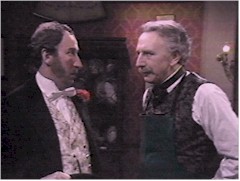
witty, highly quotable and always enjoyable tale. In Henry Gordon Jago and
Professor Litefoot, we have two of the writer's best and most fondly
remembered characters, certainly deserving of their own spin-off, an idea
mooted at the time but never coming to fruition until recently thanks to
Big Finish. Christopher Benjamin's ebullient performance as the theatre
manager ensures Jago is larger than life, but not over the top. While
certainly a comic-relief figure, he's never one of derision. Nevertheless,
he's the centre of the two moments I'd call laugh-out-loud funny: Casey
bluntly disabusing him of his true standing in the theatre ("But you don't
do anything, Mr Jago!") and his "corks" response to the Doctor's hilarious
"destiny" wind-up. On the other side of the spectrum, John Bennett's Chang
is sympathetic and tragic, while Michael Spice is an excellently nasty
Who villain, the actor's second in two years (and neither time do
we get to see his real face!). The Pygmalion-inspired strand of the story
sees a significant development in the Doctor-Leela relationship, bringing
out the best in Tom Baker and Louise Jameson. In fact, it's disappointing
and a little sad to be aware of the off-screen friction between the two.
It spoils the illusion, especially during their great scenes in Litefoot's
house in part five. Oh well, I suppose that's reason to praise the actors
even more.
Holmes's script is full of the Gothic atmosphere true to the
programme's signature at the time, which Maloney realises on screen with
consummate skill. The already sumptuous location footage is enhanced by
great use of shadow and fog, while it's just as impressive indoors. Every
moment inside the theatre, whether during the show or backstage, is a
treat to behold. In the fifth episode, there's a remarkable dolly shot as
the camera takes the point-of-view of Jago and Litefoot, slowly and
menacingly zooming towards their waiting captor, his gnarled hands
outstretched. This is also the only time I would say a pantomime horse's
head made me jump! But, for real scares, you're unlikely to go past Mr
Sin. His attacks on the cabbie and Leela are iconic moments, but the
dummy's eyes flicking open when Jago examines it frightened me more. The
design is wonderful, with the House of the Dragon possibly one of the best
Who sets ever, and, given the rich resources of the BBC costume
department, everyone is superbly attired.
I suppose I must mention the rat. Yes, it's pretty woeful. In several
close-ups you can see it for the furry suit it is. Not even a story of
this calibre can hide the crap monster! However, it's sparing in its
appearance, the surrounding scenes are tense to the hilt, and there are
alternative shots (the close-ups of real rats in the first episode) that
compensate.
However a much more serious criticism needs examining, that of racism.
The Talons of Weng-Chiang has copped a lot of flak for its
portrayal of the Chinese. So how grounded are these accusations? On one
side, I believe it's blown out of proportion. It obviously doesn't say
that all Chinese people are members of a secretive criminal organisation.
Do The Godfather or Goodfellas say that all Italians are mobsters? Of
course not. Does The Wire say that all African Americans are drug dealers?
Of course not. (Oh my gosh, the postmodern intertextuality of it all...
this is getting really heavy... ) If this story had been made today, there
would undoubtedly be a sympathetic Chinese character who would play
temporary ally and make the half-apology "Not all my people in this city
are like this." There are of course racist remarks, but they're made by
equally racist characters - the police sergeant, Teresa and Jago - meant
to ensure the speakers are the ignorant products of their era. Chang
himself makes the wry, sarcastic comment "I understand we all look the
same" and plays on racist attitudes in his stage act. In my opinion, the
most offensive line in the story comes from the Doctor himself, when he
explains to the constable that he and Leela were attacked by "this little
man and four other little men". Whether scripted by Holmes or ad-libbed by
Baker, it's pretty horrid.
The other contentious matter is the casting of John Bennett, a
Caucasian, as Chang. No, it wasn't the wisest thing to do. Television
wasn't politically correct back then, and the practice of "yellowface"
(and other colours) was pretty common. But Bennett is excellent in the
role; I've already mentioned he makes Chang sympathetic, but it is also a
sensitive performance. His affected accent is measured (except when the
character deliberately exaggerates it during his show, as per the
paragraph above) and actually stands up pretty well when you consider
other examples. The Wheel in Space also has a
character called Chang, also played by a Caucasian, whose accent is so
caricatured it's awful. But he only speaks in the missing fourth episode,
so tends to be forgotten. Away from Doctor Who and onto the big
screen, we have Peter Ustinov as Charlie Chan, Peter Sellers as Fu Manchu
(and also a Charlie Chan-styled character in Murder by Death) and of
course Mickey Rooney as a Japanese man in Breakfast at Tiffany's. Now
these are truly offensive! Watching Bennett doesn't make me cringe;
watching Mickey Rooney or Peter Sellers does. But still, best intentions
by Bennett aside, his casting does not sit well. The Tong subordinates and
extras were all played by Chinese actors, so why couldn't Chang have been?
(My own choice would have been Bert Kwouk, a well established
Chinese-British actor at the time.)
So does this affect the overall quality of The Talons of
Weng-Chiang? No, not a great deal, but it needs to be addressed. It's
a black mark, indicative of the time it was made, but not an indelible
stain. It shouldn't detract from acknowledging what is definitely one of
the best Doctor Who stories ever made. 9/10