
Harry Sullivan's War
Millennial Rites
Millennium Shock
System Shock

|
Harry Sullivan's War Millennial Rites Millennium Shock |
Virgin Publishing System Shock |
|
| Author | Justin Richards | 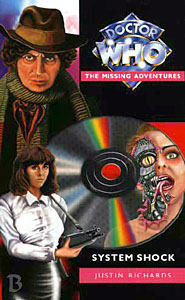 |
| ISBN# | 0 426 20445 X | |
| Published | 1995 | |
| Continuity | Between The Seeds of Doom
and The Masque of Mandragora |
| Synopsis: On 1998 Earth, the Doctor, Sarah, and Harry discover an alien invader that seeks to conquer Earth using an advanced computer network. |
A Review by Tammy Potash 22/7/00
It's probably a good thing that this was never aired as a TV episode, because it would have freaked people out worse than Terror of the Autons did. Will my telephone explode? Will my car start driving itself?
As with Option Lock, Justin Richards skitters dangerously close to writing Dr. Who as Tom Clancy. The techno-thriller is an unfamiliar direction for a Who novel to take, and it is done quite well, with enough action for a James Bond film and some neat little links to Millennial Rites and Business Unusual. When Millenium Shock came out, I was stunned as the possibility of a sequel to System Shock had not occurred to me. It's suggested very subtly by the epilogue, far more so than the ending for Grave Matter.
With System Shock and Option Lock, Grave Matter, Theatre of War and Dreams of Empire, Richards proves his ability to write well for any combination of Doctor and companions, a versatility matched only by Paul Cornell. Here we have the 4th Doctor and Sarah in a very unfamiliar setting; the high-tech world of 1998. Special care and attention are given to a twenty-years older (than the TV version) Harry Sullivan, who is given a much better treatment than he ever got on the telly. This is what the abysmally written Harry Sullivan's War ought to have been.
The Doctor is up against the Voracians, direct opposites of the Cybermen. Though it is thankfully not depicted, I found myself wondering how the squeamish aliens would be deal with the disgusting necessity of excretory functions, since they do eat, however reluctantly. Their business-jargon filled speech goes a long way to providing their characterization. They are like the Cybermen in one respect though; they are utterly unprepared for the illogical, creative, chaotic Doctor. Watch as he uses a yoyo as a weapon, and his defeat of Voractyll is a triumph and a delight. Other Doctors will face menacing software, (Seeing I, Transit, Sleepy) but none will delight you as this book will.
A Review by Stuart Gutteridge 27/10/00
This is definitely Doctor Who for the nineties. A techno-thriller borrowing heavily from the likes of James Bond, BUGS and The Invasion (in terms of using technology anyway). But is System Shock any good?
PLOT: A lot hinges on your understanding of modern technology, but nonetheless it's a great read, which sees The Doctor and company attempting to halt the plans of the Voracians.
THE DOCTOR: Justin Richards proves time after time that he can write for virtually any Doctor/Companion and this is no exception. He`s true to form, but nothing new is explored, although this is no bad thing given the pace of the novel.
COMPANIONS: Watching Sarah Jane cope with technology in 1998 is fascinating, and it also proves that shes a lot tougher; I had no problems with the cover, which showed her armed with a gun. Harry Sullivan is back and portrayed competently. He is a joy to read.
VILLAINS: Basing the Voracians on snakes, is a clever idea and the cover reinforces the fact that they are truly horrifying, yet clever with it. Their motivations are believable and they add greatly to the book.
OVERALL: Technophobia seems to be the ongoing theme, and it works well exploring the man versus machine ideas in a similair way to The Ice Warriors some years previously. This is easily one of the best MAs and is very hard to put down. 9/10.
A Review by Finn Clark 27/2/03
This was only Justin Richards's second Who novel (after Theatre of War) and I think it shows in the characterisation. Something's slightly off. There's some good material here, especially with the women - e.g. Eleanor Jenkins or the Duchess of Glastonbury - but it felt a little bolted on. This isn't a character-driven novel, but instead a macho techno-thriller (there's a character called Gibson) with hostages, gunfights and lots of slightly quaint jargon. Did we really once say "Information Superhighway"?
On that level, it's fine. There's plenty of ingenuity (I liked the Voracians' origins) and the characterisation level only really hurts the book when it comes to the Doctor. He gets a few funny moments, but Tom Baker he ain't. Ah well. Many authors have struggled with that particular challenge and we've seen far worse.
The book's real entertainment value comes with its bad guys. The Voracians are evil management consultants, clearly inspired by the real-life work experiences of its author. This is Doctor Who's equivalent of The Office. These people call a hat a "cranial accessory" and their jargon-laden dialogue provides the book's comedy highlights. (I particularly enjoyed seeing the Voracians handle a hostage situation.) Admittedly Lawrence Miles made a similar joke in Interference with the Remote, but it's good enough to stand repetition. And of course dear old Harry Sullivan can't understand one word of this management-babble.
And there's more! Endless meaningless meetings, lethal office equipment... you can tell Justin was getting something out of his system with this novel. It's like Spearhead from Space but with electronics instead of plastic. The moral of the story: don't trust that photocopier! (Or mobile phone, or fax machine...) I, Who also claims that the Voracian leader Stabfield's body language is similar to that of Bill Gates, but on that I couldn't possibly comment.
Much fun can be had by putting System Shock in the context of the other books. Page 229 is good for a cheap laugh... no, Harry, they're not likely to disbelieve your alien revelations. Not when the Ice Warriors invaded Britain last year in The Dying Days, caused worldwide panic and crowned their leader King of England. Harry isn't in his late forties (p61) but his fifties, according to Harry Sullivan's War. Oh, and weren't there lots of evil high-tech companies around now? As well as I2 (System Shock), we have Ashley Chapel Logistics (Millennial Rites), Silver Bullet Solutions (Millennial Shock), InterCom (King of Terror), the Butler Institute (Cat's Cradle: Warhead)...
Random observation: a few authors like setting their books in a common era (e.g. Steve Lyons) but Justin Richards has taken this to unprecedented levels. So far he has three favourite periods:
1st - contemporary (1996-2001)... The Sands of Time, System Shock, Option Lock, Millennium Shock, , The Shadow in the Glass, Time Zero.
2nd - Benny-contemporary, i.e. the 26th century... Demontage, Dragon's Wrath, The Medusa Effect, Tears of the Oracle, The Joy Device, The Doomsday Manuscript.
3rd - for no obvious reason, the 1890s... The Burning and Time Zero are both set in 1894, The Sands of Time in 1896 and The Banquo Legacy in 1898.
The cover's ugly, and I must have missed the scene where Sarah gains a couple of cup sizes. (Amazingly, an earlier version of the cover was even worse! It showed Sarah as an apron-wearing waitress, apparently looking like something out of 'Allo 'Allo.) System Shock isn't a great book, but it's a solidly acceptable one that will probably resonate with office slaves everywhere. One of the more action-based Who novels to date, and there's nothing wrong with that.
A Review by Brian May 6/4/09
System Shock is an entertaining techno-thriller, having everything you'd expect from Justin Richards: excellent writing, great plot and good characterisations.
Computers are the centrepiece of this novel. Richards looks at how rapidly technology advances and how our dependency on it increases in parallel - and how easily both could be compromised. There's a cautionary tone not unlike the 1960s tales The War Machines and The Ice Warriors, and films like Colossus: The Forbin Project and 2001: A Space Odyssey. Of course these stories' concerns look rather daft today - but so might System Shock's in thirty or forty years' time. Indeed, some of the terminology has dated already. "Information superhighway" and "InterNet" may have been zeitgeist buzzwords in 1995 but look incredibly archaic nowadays (they even did in 1998, the year of this book's setting!). But hopefully the accepted role of computers in today's society - whether the "today" of 1995, 1998 or 2009 - won't make too much of this novel look obsolete in years to come.
Richards has always been a great character author, although not without the occasional misstep. The Doctor and Sarah suffer at the very beginning; during their first scene in the pub, their words and actions are just very wrong. But after this they're fine; the former particularly as the novel progresses. Tom Baker's performances are always difficult to capture accurately, but I was more than convinced come the second half, especially the witticisms and one-liners. I've always adored Harry Sullivan, but there's something not quite right about him in these pages. Maybe it's because Ian Marter died at the young age of 42 that I cannot picture Harry as older and greying. The charming clueless duffer that made the television character so endearing is all here, but his bewilderment at modern day computers is too much like Sarah's understandable 1970s reaction. Surely he'd have a contemporary (i.e. nineties) grasp of computers in his job, even if it was rudimentary?
With other characters, Richards has given us his usual range of believable people, not with spectacular depth but always solidly realistic - Westwood, Lewis and Gibson I particularly liked for this, while Miss Jenson is one of those nominally inconsequential, one-scene people you're totally convinced by, given how endearing they're made in their miniscule page time. The continual mystery regarding the identity of the COBRA insider is excellently conveyed, keeping the reader hooked, but I found the revelation a letdown. There is, I think, a typical Richards clue on p.18 (I'll leave it to you to see if you can pick it up!), but the way the Doctor unmasks him is a bit of a cheat - identifying his face from the VR surgical sequence, something we readers weren't able to do!
Detail is another of the author's strengths, and that's well evident in the marvellous descriptions of various software and computing processes. Excessive technobabble is avoided, and the plot is allowed to unfold and gather momentum with a great tension building stealth. The three disasters that occur early on (in Chapter 06: System Crashes) and the gradual spread of Voractyll through the global networks are fine examples of this. Richards usually uses repetition to an advantage; here we get the different perspectives of the view of the Hubway grounds. They have no real bearing on the story. They're just there, but work to differentiate the characters. However, elsewhere things do get a bit samey: the Doctor's obstacle course through a number of homicidal electrical apparatus is both exciting and humorous, but Sarah's ordeal in later pages is too similar, cheapening the effect. This leads to one of System Shock's weakest points: its length. At over 300 pages it's too long. The last few chapters drag quite a bit; a few too many talkfests at the mobile control centre; a lot of capture, escape and running around; and a rather tacked on showdown aboard the mothership. Don't get me wrong, there's a lot of great stuff as well - the "face-off" between the two Voractylls is brilliant - but nevertheless there's a lot of to-ing and fro-ing that could have been trimmed.
For his second Doctor Who novel, Justin Richards maintains his skill at telling a good story and telling it well. It's an interesting contemporaneous concern about the dependence we place upon computers. It has great villains/aliens who carry out their plans in a simultaneously wry and hilarious poke at the corporate mentality. It's got a great sense of escalation, with a good mix of action and suspense; unfortunately, it outstays its welcome. It lacks the wow factor of his debut, Theatre of War and given The Sands of Time would follow it pales in comparison even more. But even if this is a lesser work than these, with such an author you're always guaranteed a good read. 7.5/10
A Virus is Like a Slippery Snake by Jacob Licklider 30/7/19
Harry Sullivan is an extremely underrated companion in my eyes. Only featuring from Robot to Terror of the Zygons, with a small role in The Android Invasion, fans often forget who Harry was, as his only purpose was to do the stronger tasks, as the Fourth Doctor was originally meant to be an older man. He features heavily in System Shock, and Justin Richards does a great job at evolving his character, as we meet up with him thirty years or so after the time he spent at UNIT.
Harry left, but he isn't forgotten, as the New Series and The Sarah Jane Adventures have mentioned him from time to time with the story that he is working for the MI5 on top secret projects. System Shock depicts one of those projects, seeing Harry in the 1990s reunite with the Doctor and Sarah Jane just after the events of The Seeds of Doom. They have to stop a race of giant snake cyborgs from taking over the world by controlling anything that uses electricity. That idea alone has horrifying implications, as the 1990s had the emergence of home computers and electronics. Justin Richards takes full advantage of this, as these Voracians take over everything and use it as a weapons. Appliances explode, printers shoot out paper, copiers give off flashes of light to blind you... No matter what Richards comes up with, there is a sense of danger that pervades many of the later scenes of the novel, even though, to someone looking in, the scenario would seem extremely silly, but paper cuts of course can be deadly.
Richards does some of his best work with Sarah Jane Smith, as the performances of Elisabeth Sladen along with her chemistry with the Fourth Doctor is written beautifully. It feels like the story is bridging the gap between Seasons 13 and 14 as Sarah Jane has been travelling and cannot believe she is seeing Harry who has grown old as time marched on. Richards also uses Sarah Jane as a journalist for portions of the story as she cashes in some favors to get a job at the company I2, which is the secret headquarters for the Voracians. Richards uses this to tell an espionage tale, which is great, as it's a genre Doctor Who excels at, as there is usually the idea there is a big bad to be defeated in espionage stories. This is similar to Doctor Who stories also having a larger-than-life villain behind the plots.
The Fourth Doctor is portrayed brilliantly by Richards as well, as Richards often uses the general character of the Doctor in his writing, which is pretty much just Tom Baker's Fourth Doctor. Richards has Tom Baker's mannerisms down to a tee, even with the forgetful nature of the Doctor and the idea that he doesn't get human beings. He gets some great moments where he has to talk a computer into seeing that humanity and organic life isn't illogical, which is hilarious as people are wildly illogical. The Doctor knows this, and he has no idea how to actually convince the computer to spare humanity.
The novel also has a lot of problems. First, the writing style of Justin Richards is really generic and kind of a slog to get through. He writes in a style of: this happened and then this happened, which breaks up the flow of the story greatly and just makes the pace seem pretty slow. This problem does disappear about halfway through when writing the hostage situation at the unveiling of the Hubway where Sarah Jane is kidnapped as hostage and has to work with the Doctor to find a solution to the titular System Shock, which is housed on a CD-ROM, without actually being able to communicate with the Doctor or Harry. It is really good until the eventual conclusion where Richards employs a Chekhov's gun with a throwaway character being brought back into the novel just so we can get an easy conclusion and move on with the novel. The Voracians, while an extremely interesting species with unusual speech patterns, really don't feel like much of a threat. They say they will kill the hostages, but they don't, and, while I'm not saying there should have been a bloodbath, at least one of them could have died so the story could continue with some sense of urgency.
To summarize, System Shock is a great example of a story capturing the feel of a period but not doing anything to stop any of the flaws of said period. The characterization is great for the regulars and the villains, but the supporting cast is extremely boring. The plot is an espionage thriller, except it has such a general writing style it becomes boring at times. Richards has made his story better than Theatre of War, but it isn't very special. 75/100
Who Dares Wins by Matthew Kresal 29/11/23
In hindsight, the 1990s were the Wild West years of Doctor Who. At a time when the series was off-air and living primarily on the printed page (the Big Finish audios not starting until the end of the decade), writers and editors experimented with the series and its format in the Virgin New Adventures. The Missing Adventures arrived to fill in that yearning for new stories with the first six Doctors, filling in holes in the show's continuity or offering traditional tales while allowing authors to put familiar characters into new situations. An example of a novel doing all three to varying degrees came with 1995's System Shock by Justin Richards.
Let's begin with "filling in holes in the show's continuity." Richards and System Shock are less guilty of this than, say, The Scales of Injustice (or most other things by Gary Russell, frankly). Indeed, it most does this to reunite the Season 12 TARDIS crew outside of that season by reuniting the Fourth Doctor and Sarah with an older Harry. It's a development that feels quite welcome, given how Harry got written out of the series in both Terror of the Zygons and The Android Invasion, and this coming out nearly a decade after Ian Marter's untimely passing. It helps that Richards knew how to write for Harry, giving a logical twenty-plus years later extension of the character, now a middle-aged (sorta) man of action with a touch of wry humor. It would have been easy to play the character for laughs as an imbecile, and it's to the author's credit that he didn't.
Moving on to "traditional tales," it's safe to say that System Shock is a thriller in the Robert Banks Stewart or even Terrance Dicks Robot mode. Like them, this is an Earthbound tale in familiar settings, including a climax set around a single location. In being so, it also captures their spirit with sizable action sequences and set pieces, including ones featuring Britain's SAS in action. It's almost no surprise that two decades after this novel, Roberts would co-author a series with former SAS member Andy McNab. The chemistry between the returning TV characters adds to that, as well, with Richards wonderfully capturing Tom Baker's mannerisms, even if the use of illogical logic comes across as owing more to the Douglas Adams era of Baker's tenure than Robert Holmes.
Last but not least, there are "familiar characters into new situations". In this case, while Richards wrote something in the vein of Stewart or Dicks (near) contemporary for their time's thrillers, he brought those sensibilities into a near-contemporary setting of his own. Reading the novel nearly thirty years after it was published, the depictions of what was then three years in the future felt closer to 2023 than 1998. Richards imagined technological developments like smart homes and our further reliance on the internet through a mid-1990s pair of digital spectacles (oh, how long it's been since I've come across the phrase "Information Superhighway!"). It's something that, despite some of those nineties imaginings and the odd dated reference to the technology of the time, made this feel surprisingly contemporary. There aren't many novels you can say that about after nearly three decades. Nor, even with Big Finish doing it in audio dramas in more recent times, has the appeal of bringing Classic Who characters into a latter-day setting lost any of its delightful appeal. There's something nice about reading Sarah, soon after leaving the 1970s (or is it the 1980s?) behind trying to make sense of pseudo-1990s computers that feels believable without being patronizing to either character or reader alike.
The "Doctor Who thriller" has become a sub-genre that Richards has often revisited in the decades since (including in a BBC Books sequel to this very novel). It isn't hard to understand why, having read System Shock and given how well he made it work even so early in his career. It might be on the traditional side of literary Doctor Who, but that doesn't make System Shock any less fun as a thriller.