THE DOCTOR WHO RATINGS GUIDE: BY FANS, FOR FANS

|
BBC
Survival
|

|
| Episodes |
3 |
 |
| Story No# |
159 |
| Production Code |
7P |
| Season |
26 |
| Dates |
Nov. 22, 1989 -
Dec. 6, 1989 |
With Sylvester McCoy, Sophie Aldred.
Written by Rona Munro. Script-edited by Andrew
Cartmel.
Directed by Alan Wareing. Produced by John Nathan-Turner.
|
|
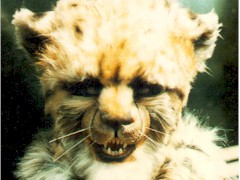
Synopsis: The galaxy roaming Cheetah people extend their claws to Earth,
catching the Doctor, Ace, and an old enemy.
|
Reviews
A Poignant Farewell by Kevin Guhl
9/1/97
Then came Survival the last story of Doctor Who's
original run. While not your traditional final episode fanfare,
Survival still ended on a poignant note, as those episodes are apt
to do. Cheetah people kidnap humans to their home planet, for hunting
purposes! Sounds like traditional Who? Don't be fooled. As the Doctor and
companions struggle against the cheetah planet's primitive drive, the
issue becomes "survival of the fittest". Are people restricted to the law
which guides all nature? The Doctor, Ace, the Master and all others are
put to this test. The maturity begun with Sylvester McCoy's second season
fully blossoms in Survival. Ace is forced to make a decision that
will affect the rest of her life, and the Doctor seems to have a true bond
with her. The plot, while intelligent, also manages to maintain the
excitement and humour essential to good Who. After Survival's
climax, we sigh, knowing the final lines are near. As the background score
bids a sad farewell, the Doctor and Ace walk off towards the sunset, he
telling of wondrous sites yet to behold. The sky then explodes into a
starscape and the closing credits. Next time we see the Doctor, he's about
to regenerate and Ace has departed for parts unknown. A meaningful close
to sci-fi's longest running TV series.
Pussy cat, pussy cat, where have you been? by Jason Fraser
9/1/97
The story opens with the mysterious - a man washing his car. A strange
looking cat watches him from a near by fence. The Doctor takes Ace back to
Perivale, the boredom capital of the universe where she hopes to meet up
with her old gang. But where are they? What is happening with the feline
population? Why don't they have houses in Perivale? and Why do the two
shopkeepers look so familiar? (cameo by Hale and Pace). All these
questions will be answered over the next 75 minutes. We are presented with
a story revolving around various Perivale inhabitants being teleported to
another planet, paying tribute to werewolf legends, an exploration of the
"tough guy" image, how the veneer of civilisation lurks a beast, PLUS we
get a special twist, the appearance of the Master who engages him in his
last encounter. Survival is multi-layered with an intelligent,
straight-forward plot, good use of it's immensely action-packed 3 episode
format and even a sprinkling of humour. Overall, the story is quite
enjoyable and very original. This is quite clearly not the end of
Doctor Who. 7.5/10
A Review by Matt Michael
23/4/98
Survival is, of course, the final screened Doctor Who
story prior to Enemy Within. It is also
the seventh Doctor and Ace's final pairing outside of the New Adventures.
It's place in Who history is thus assured.
Survival is actually a very good story in its own right,
although it tends to be overshadowed by the fact that it is the last. If
one approaches it as another McCoy serial then it is highly entertaining.
The themes of survival have been explored perhaps more successfully in The Caves of Androzani, but here they are
framed by an epic struggle between the seventh Doctor and the Master.
In his finest performance as the Master, Ainley succeeds in
recapturing Delgado's original portrayal. He is the very model of a
well-spoken gentleman, without a single "bwa-ha-ha" in sight. His
portrayal of the degenerating Master is both impressive and disturbing.
McCoy is also good, although he does tend to overact in parts.
However, although his performance here is less polished than those in The Curse of Fenric and (especially) Ghost Light, his interplay with the Master
is beautifully done, and I don't even mind the "if we fight like animals"
bit. Sophie Aldred again impresses as Ace, forced to return to her home.
The script is full of marvellous one liners ("I thought you'd died.
Or gone to Birmingham"), and the plot, though simple compared to the rest
of Season 26, is none the worse for it. The special effects are also good
- especially the Cheetah planet.
Unfortunately, this story was the last and so it had to be extra
special. It disappoints rather in this respect, although the final lines
almost make up for this as the Doctor and Ace discuss the wonders of the
universe-- never a dry eye in our house when that comes on. There is also
some sense of conclusion as the series ends where it began-- present day
London with the Doctor and a young female companion. Overall, a decent
story but a bit of an anti-climax. 8/10
"If we fight like animals, we'll die like animals!" by Will Jones
25/7/99
Survival - one of the most endlessly overanalysed stories of
the Seventh Doctor's era and indeed Doctor Who as a whole. Can
there really be anything new to say about it? Well, probably not, but
I'll try anyway.
Rarely in the series' history was a theme made just as important to
the basis of the story as the plot itself. Although a similar thing had
happened in Ghost Light, earlier in the season where
the theme of evolution was just as important, the strongly related theme
of survival of the fittest is explored in depth and to the benefit of the
tale.
This is excellent stuff from first-time Who writer Rona Munro.
It's insightful, adult and most of all acted in a dead serious way, even
when it comes to otherwise comical characters such as Julian Holloway's
survivalist Sergeant Paterson. It is a vivid demonstration of how today's
society has blunted the edges of true tooth-and-claw survival that
Holloway, who on SAS camp was "the only one who ate the worm stew", is one
of the least adept at surviving on the planet of the Cheetah People.
Aptly for a story about nature, the script is harsh and unfair, having
no compunction about killing off characters just when it seems they've
survived the story. In a traditional Doctor Who story, no more would have
been seen of Patterson after he returned to Earth, and Midge would have
gone free having had his humanity restored by the motorcycle crash. Here
the Master's hypnotised goons kill them both. Also of note are the
convincing shots of Kitlings feasting on some sort of animal carcass.
However 'convincing' is not normally a word I'd apply to the Kitlings.
It takes some kind of bravery to cut from a real black cat to an obviously
fake Kitling model and back again, and expect to get away with it. Other
than this, though, the special effects in the story are generally good.
Yes we are yet again presented with a quarry masquerading as an alien
world, but just for once it doesn't look like a pit just outside London
thanks to those excellent background vistas of a decaying planet.
We all know how good the three central performances are, and I won't
dwell on them overmuch except to say that it's a shame we never saw
Anthony Ainley be this good before. It is obvious not just in the false
teeth and false eyes but in his whole performance that the Master is
regressing to the level of an animal, believing he has control over the
planet when really it may well control him. Conversely he has only been
this evil before in Logopolis - only now, with desperation driving him,
can the Master be quite so callous about death.
Survival is brilliant, and wraps up the series wonderfully to
the extent that I often wish this was, to quote Troughton in The Evil of the Daleks, "The final end." It sort of
cheapens the memory of this tale, and particularly that beautiful final
monologue, to have The Enemy Within come afterwards.
Still this is great stuff, and occupies a highly deserved place in the
history of the programme. 9/10
A Review by Stuart Gutteridge
25/7/99
Like the recent movie The Phantom Menace, Survival took me back
to a time of endless, long summer holidays. After all, this is what
Survival is primarily about, growing up. It is easy to spot that it was
written by a woman and Rona Munro does a wonderful job in mixing the
normal with the alien and telling a great story along the way.
The scenes set in Perivale set the scene that something bad will
happen; the comforting reassurance of a sleepy town giving way to
something hostile. With Sophie Aldred taking centre stage as Ace, she
gives a great performance as a young girl, possessed by the creature
inside of her. There are magical scenes aplenty, when she reveals herself
(at the end of part two), complete with yellow eyes, being a case in
point. Sylvester McCoy is nothing less than enchanting as The Doctor,
although his struggle with The Master proved to be anticlimatic (and which
would be repeated in the TV Movie.) Anthony Ainley
is an absolute joy to behold in this story, he was never better than here,
and it is a shame that this was his last story.
There are minor flaws with Survival however, the cameos from
Hale and Pace seem superfluous, surely there would have been some of food
in the TARDIS to use as bait, the animatronic cat doesn`t work too well
and neither do the Cheetah costumes when seen up close. But on the whole
Survival is a wonderful example of what Doctor Who could be
when it was at its best. Pure nostalgia.
A Review by Mark Irvin
11/10/01
First of all I would like to make a bit of a confession. In my earlier
review of Silver Nemesis I condemned many of McCoy's
stories by insinuating that the majority were "rubbish". I have to admit
that this assessment was somewhat unfair and that this may have been an
over reaction due to the sour taste left in my mouth after watching The Happiness Patrol. I think that at least his last
couple of seasons, although nowhere near the class of Tom Baker's
offering, were far from "rubbish". When comparing them to some of the less
enjoyable outings that sometimes occurred during Pertwee and Davison's
reigns, I concluded that these stories could more accurately be defined as
"rubbish". (Although it's been years since I've seen McCoy's first season
- according to reports and my faint recollection it was probably less than
memorable)
Anyway, now that I've got that of my back, what did I think of
Survival?
Not bad, not bad at all - considering it had the unenviable task of
concluding the greatest science fiction show of all time! The first thing
I noticed about it was that appears to have an air of finality about it.
It also has the impression of a story that was tailor made for McCoy.
The theme behind Survival is an interesting one, being the
survival of the fittest, the weak die and the strong survive. I thought
the inclusion of Sergent Paterson was delightfully ironic, in that one of
the points here is that fighting and aggression will often do you no good.
His interaction with the Doctor is very amusing, showing slight shades of
resemblance of to that of the fourth Doctor and Duggan in City of Death.
The Cheetah people were fairly well realised, but not really anything
particularly special. I'm surprised by the fact that the unusually violent
scene where Midge stabs a Cheetah is not mentioned more often. If it had
happened in one of poor old Colin Baker's stories, you would probably have
never heard the end of it. The Kitlings worked effectively, building the
intrigue early when the viewer isn't sure exactly what's going on. (O.K, I
admit it, I love cats.)
To be honest I can't quite seem to fathom criticisms raised by Stuart
Gutteridge concerning the Hale and Pace cameo. Initially during it's
original broadcast I didn't know who they were (I'm Australian), thinking
that they were just a couple of hilariously realistic shopkeepers. And
rather well played I might add. Surely it doesn't matter who is selected
for a role, so long as it's done well and the intended purpose is
achieved.
Anthony Ainley impresses in one of his better performances as the
Master, superbly underplaying the ultimate villain in this case. The
Master has always worked best when portrayed as a more believable foe. Not
some ridiculously evil, megalomaniac madman that's hell bent on killing
the Doctor and ruling the universe - for seemingly no reason apparent.
Here he's reminiscent of Roger Delgardo in The
Frontier in Space, being considerably more suave and sophisticated.
This is in complete contrast to the idiotic performance given by Eric
Roberts who played him in The Telemovie. Way too
over the top.
Sophie Aldred continues her good work with yet another impressive
performance as Ace. Once again she plays a pivotal role in the plot -
avoiding usual companion folly of just being there to ask stupid questions
and scream. I especially enjoyed her comment following the Doctor's
description of the Master. "One of my oldest and deadliest of enemies". To
which Ace replied "Do you know any nice people?....You know.... ordinary
people, not power crazed nutters trying to take of the galaxy?"
McCoy does possibly overacts at times, but only slightly. I didn't
really mind the "If we fight like animals we die like animal" part. The
famous speech at the end was also very special and I honestly couldn't
think of better words to end the series. The motorbike stand-off game of
chicken has often been criticized, but personally I thought it was quite
good - very original and something the series had never really seen
before.
Survival does however lack a certain sense of magic that
prevents it from being put there with the truly great stories - I can't
really put my finger on it. At times it does feel a little rushed lacking
a certain amount of required plot development. It may have worked better
as a four-parter, perhaps including more of an explanation of how the
Master came to be the planet in the first place. Although the 26th season
is of a reasonably high standard, it is often hard to follow, sometimes
brushing over details which are vitally important - commanding a great
deal from the viewer. This is what tends to let these stories down to a
certain degree.
I think for once give this one a rough rating. Let's make it a
7/10 - but keep in mind like all Who fans - tomorrow I might
have changed my mind!
Whew! Ainley can act! by Joe Ford
4/8/02
Survival has a lot to live up to. After all it is the last
television outing for a show that is over twenty-six years old and that
show is Doctor Who at that. I believe this show comes in for too
much flack for that reason alone. To be fair to the Survival writer
she wasn't aiming to write the last story ever as she didn't know it was
going to be the last one, all she was trying to was write a stonking good
story, an aim she more than manages.
Survival is absolutely astonishing in it's maturity. That's
not the guns'n'politics maturity of the Pertwee era (fun as it was) but
getting in touch with the characters emotions and connecting with the
audience with very little dialouge. That takes not only a fantastic
director but good, solid actors too. Fortunately the director this time
around is Alan Wareing, who revealed his considerable talents with the
superlative Greatest Show and the moody Ghost Light. His work here is stunning. The camera never
stops... gripping chase scenes, panning smoothly around corners and
capturing all that emotion in the Dorset heat. All the scenes on the
Cheetah planet are not only gorgeous to look at but (and this is forgotten
about a whole lot in current SF) highly atmospheric too. Given the idea of
the planet and the people connecting emotionally Wareing reveals a planet
that is hostile, agressive and violent. Direction must be good when you
can give a planet a personality! His work on Earth is just as good,
revealing the gritty under class eighties in all it's grimy glory... god I
remember those days of flat blocks and youth wings... it makes me feel
nostalgic!
If people thought I was too harsh on McCoy in my
Curse of Fenric review then calm down, he is at his best here. Yes
okay he does overdo the "Don't move!" fight but generally I could make a
good case for his Doctor based on this story alone. After two stories of
throwing Ace's fears in her face he is finally rewarded as she runs off to
enjoy her dark side and McCoy's frightened look is just phenomenal. Also
the scene where he asks her to come back to him, throwing a look at Karra
is as gripping as it is fantastic pay off for this plot thread. I don't
even mind his larking around in episode one! Sophie Aldred is, of course,
better. Ace has come into for a lot of flack recently for her overuse in
all medias but let's not forget people how refreshing she was when she
first bolted onto our screens. Aside from struggling with that horrible
eighties slang I cannot think of a poor moment Ms Aldred gave us. You can
tell she is having a lot of fun with the role and she was a highly
engaging character. As a resolution for her character this is about as
perfect as closure gets! Her moments with Karra by the lake are dripping
with emotion and as she cries over her death I found myself tearing up
too. There is one scene, where she tells the Doctor she is excited by her
emerging wild side and it made me sit up in horror more than perhaps any
other scene in Doctor Who.
And what about The Master? What a revelation! It wasn't Ainley's
fault... all those dire performances during the Davison era I am convinced
from this story alone that he genuinely WAS told to dumb down his
performance. Here he is feral, violent, malevolant and pretty damn
terrifying. Ainley is so subdued and yet so good it makes me weep this was
the only chance he got to show his teeth.
The story is jammed full of memorable scenes be it due to brilliant
direction (Ace first materialising on the Cheetah planet and watching that
kid get mauled, the tense scenes as the Doctor uses Ace to chase The
Master) or acting (Ace resisting her dark side looking in the lake). And
there is one of the most devasting moments of the entire show with the
final Doctor/Master fight with the Doc finally giving in to his feral
nature and the Master's most revealing line ever ("We could escape"...
"No, not this time..."). Genius on every level.
Survival makes a great last story showing how much ground the
show has covered with the story being very similar to Unearthly Child (contempory Earth, characters in
conflict, kidnapped from their home). It epitomises everything that is
perfect about the JNT producership... quality writing, great music,
stylish direction, a cast of assured actors and bags of atmosphere. It
ends a five story run of excellence and makes me furious to think the show
was cancelled as it was practically flawless.
Panic on the streets of Perivale by Andrew Wixon
25/8/02
There's a terrible silence at the end of Survival, the end of my
off-air copy of it anyway. Not total silence, the theme tune is
bingly-bonging away as usual, but at the moment when the continuity
announcer should say 'Doctor Who will be back in the New Year'... well, as
we all know, that bit got omitted for a good reason.
Did any of us realise Survival was going to be the last proper
DW story at the time? I kind of had a suspicion we might be in for
a delay before Season 27, but no-one said 'That's it, that's the end' -
except perhaps the production team, by including the wonderfully evocative
closing narration by McCoy. In any case watching this story now is a
terribly bittersweet experience, simply because, well, It's The Last One.
But at least it's a pretty good one. It has the potential to be an
absolutely great one: the first part is as fine an example of urban gothic
as the series ever produced, the script, direction and music creating an
eeriely oppressive atmosphere for the streets and commons of Perivale. The
criticism of Thatcherism is fairly explicit too: both in terms of the
ruthlessly competitive ethics of the time, and also the mindset that
created a society where people can simply vanish without it being noticed.
The sequences on the Cheetah planet aren't quite so effective,
unfortunately. But the series hadn't produced a proper 'run around the
quarry' story in over two years so I suppose we must indulge it.
Thankfully it's back to Perivale for the finale but even here the story
has flaws (the sofa, the fact that Derek and Shreela both vanish from the
story rather arbitrarily). But the climax is fine, apart from McCoy's
operatic delivery of 'If we fight like animals...'
And it even manages to rehabilitate the Master, up to a point.
Obviously the best Master stories are the ones where he's in a hole and
needs the Doctor's help (willingly or not) to get out of it, and on these
terms it works well. But the Master is also less annoyingly written than
usual and apart from the occasional 'bwa-ha-ha' Tony Ainley does the
business too, it's certainly his best performance since Season 18. This is
probably because of the show being interested in theme and metaphor rather
than the crunching literalism of the Saward years.
So it's stylish, politically engaged, thoughtful and energetic. It's
also occasionally embarrassing, slightly wilfully oblique and has
light-entertainment guest stars. It's Survival (it's also a pretty
fair description of the McCoy era as a whole). It's (ironically, given the
title) The Last One. And oh, how I still wish it weren't.
A Review by Terrence Keenan
27/11/02
Doctor Who finally shows up in suburbia. About damn time too!
Black Cats and Cheetah People, Social Darwinism and an old enemy are
thrown into a three episode pot and simmered to perfection.
Not since An Unearthly Child has Doctor Who
really been in the "Present" (except for a brief stop in South Croyden).
There have been contemporary tales, but always at research centers,
military bases and whatnot. Ace wonders what's going back in Perivale and
the Seventh Doctor takes her there. Perivale may be West London, but it's
suburbia, where teens are desperate to find anything to do, where nothing
changes and everyone has dreams of escaping. Ace did -- by accident -- and
upon her return is not to happy to see that things have changed. She may
call it the "most boring place in the universe", but it's still Ace's
home, and her disappointment is borne out in the early segments of the
first episode. Audience identification at its simplest in DW.
Magic Realism has been brought up in terms of Doctor Who in
regards to certain novels -- Paul Magrs' offerings, to be specific -- but
Survival is probably the closest that the TV show has come in
presenting a Magic Realist story. Shopkeepers and self-defence instructors
mingle with Cheetah People on horseback and their black cat familiars. The
opening scene sets up this surreality. A man washing his car is menaced by
a kitling and then some monstrous apparition comes from nowhere and
attacks him, blasting him who knows where.
Episode two reminded me of Land of the Lost. All that was missing were
sleestaks. There are teens running around a desolate landscape aided by
their wits, and avoiding the cheetah people. The Doctor does what he can,
but he's dealing with adolescents with minds of their own, even his
apprentice, Ace.
The final episode drags us back to reality, where the final battle
between good and evil takes place. Ace learns a valuable lesson and is
willing to make the ultimate sacrifice for her friends, and especially the
Doctor.
The old enemy that returns is the Master. Anthony Ainley is allowed to
play the part with restraint, for once. It's a chilling portrayal, imbued
with a desperation and a seriousness of a man trying to prevent his slide
into a regressive animal state.
Syl and Sophie acquit themselves well, although the bit in episode
three where she starts crying does press the plausibility envelope.
Although Syl can't do angry, his "if we fight like animals, we die like
animals" is well done and more desperate than anger.
It's a proper ending to the show, although not in terms of story, but
in theme. It's about coming home and not letting anyone be left behind.
One of McCoy's best.
A Review by Owen A. Stinger
7/4/03
Survival is a frustrating story because it is very good in many
respects while simultaneously disappointing and many others. The story is
visually stunning, deals with a compelling central theme, has some of the
best background music ever, and it features the Master to boot!
However, it is let down in three principle areas: performance,
characterization, and script. Regarding performance, Survival
suffers from the same poor pantomime level of acting/directing (it's hard
to discern which is the cause) that all of the McCoy era stories seem to.
The worst instances of this are when the Doctor attempts to stop everyone
from running away from the Cheetah people (that tripping of a Cheetah and
tipping of the hat is cringe-inducing), and the Doctor's hammy beseeching
"If we fight like animals, we die like animals!" With the Doctor flinging
his arms high above is head in exaggerated pantomime while delivering this
line, the Master would have all the time in the world to run him through
with a barbed bone. Yes, unfortunately, Survival is another in the
long list of McCoy stories in which the viewer is never able to suspend
their disbelief. The players never fully become their parts, never rising
above the level of playhouse actors on a theatre stage, a shortcoming
exacerbated by...
...Characterization. Successful literature relies on a balanced blend
of characterization to the many archetypes inhabiting the narrative (the
protagonist, the antagonist, the sidekick, the wise guardian, the love
interest, etc. etc.) Unfortunately, the characters in Survival
never become anything more than archetypes, Sgt. Paterson being the worst
example, although Karra is also poor. As a result, the theme of survival
(which, to the story's credit, is intriguing and ambitious), loses the
subtlety required for effectiveness. Themes are essential to good story
telling, but they should be underlying, not smothering. The audience
should be only vaguely aware of the theme while they are viewing the story
so that is seeps into their subconscious, thereby leaving that special
"something" that makes the story thoroughly enjoyable. In the case of
Survival, the audience is constantly assaulted with the theme, thus
impairing its effectiveness. This is a shame, and could have been avoided
if the characters were fleshed out rather being mere archetypes.
Survival is also let down by the script, which, while generally
telling an interesting story, is deficient in several areas. Too often the
audience is required to make a leap of imagination that is too grand for
their belief to keep pace. The most glaring of these is the Master's
extremely brief explanation that the Cheetah planet is somehow "linked" to
its inhabitants and crumbles away when they fight. Uhm... huh? This is not
science fiction, but pure fairyland fantasy. This really requires some
scientific (or at least pseudo-scientific) explanation. For example: the
planet was formed when the mind essence of some deposed social Darwinist
despot, which was rocketed into space as a sentence passed by the people
he formerly ruled, collided with a life-forming mixture of gasses and
amino acids, with his essence disseminated throughout the resulting
planet. Hence, the planet's inhabitants are willed by their creator into
fighting to see who is the fittest for survival, and when they destroy
each other, portions of the integrally linked planet are also destroyed.
Such an explanation, or a similar one, would at least bridge the yawning
gap between the viewer's ability to suspend disbelief and the extreme
level of inexplicability they are asked to accept. Also required is an
explanation for the Cheetah people's seemingly magical (for complete lack
of any other reasoning) ability to teleport back and forth between the
Cheetah planet and Earth and why this ability seems limited to arrival in
Perivale (it would have made more sense had the Cheetah planet been an
alternate reality Earth, with the location where the characters arrive
being geographically the same as Perivale in our universe). Other
unanswered questions include: How did the Master wind up on the Cheetah
planet in the first place? Why does he need the Doctor's help, and why
couldn't he figure out for himself the very simple solution of lassoing a
hybrid and following it home?
It's too bad that Survival suffers from so many shortcomings,
since it really has so much potential. Perhaps if it were four
episodes...?
A show that can survive by Tim Roll-Pickering
17/8/03
The original BBC series began in a London suburb and so it returns to
another for its final story. Previously most stories set on contemporary
Earth have been set either in a rural environment or around public
buildings. Survival differs by taking the TARDIS to a London
suburb and materialising outside someone's front door - a dream of many
fans. Perivale has been run down by Ace throughout the previous two
seasons and we get to see just why she hates it so much. Like many
disaffected teenagers she comes from a place where there is little to
actually do and so gets caught in a cycle of boredom and despair. No
attempt at all is made to glamorise Perivale and so we get an environment
that many viewers can truly relate to. Rona Munro's script is fast and
packed, focusing heavily on the characters. The Master appears for the
first time in three years, but is a far cry from his usual schemes to
either conquer a planet or destroy the Doctor. Here he merely wishes to
escape from the planet of the Cheetah People before he is transformed into
one himself. Anthony Ainley gives a performance indicating that the Master
is much older and wearier than when he last appeared, making for a fine
contrast with the Doctor and adding to a sense of foreclosure.
The Cheetah People are not the most detailed race seen in the series
but everything sufficient is explained about them so that their true level
of threat becomes apparent, as do their origins. Karra gradually develops
so that when she appears to help Ace and gets killed by the Master there
is a real sense of loss as Ace sees her 'sister' die. The very concept of
the Master and Ace and even the Doctor succumbing to the influence of the
planet is strong and works as a metaphor for how easy it is to descend
into savagery. This subtle parody of William Golding's The Lord of the
Flies works and in the process challenges some of the ethics the series
has advocated in the past, such as the need to fight.
One of the key themes of the story is where 'home' is for Ace (and in
hindsight much can be read into the Doctor's 'home' from this as well). It
is telling that when she does take the others 'home' she arrives by the
TARDIS and at the end this is where she and the Doctor depart for, showing
how she has changed, not only in this story but throughout her time since
she first met him. The final monologue as the Doctor and Ace walk off into
the sunset makes for a wonderful pause for the series, promising more
things to come and making it clear that the show can go on.
This story predominantly revolves around the regular characters, with
McCoy, Aldred and Ainley all giving good performances. Most of the rest of
the cast are predominantly onlookers, though Julian Holoway (Paterson)
gives a tough performance, making the character seem rough and ready
despite being the story's symbol of authority. The production is strong as
well, with the Cheetah People's planet looking realistic due to the
excellent video effects and there are only a few shots where the trickery
becomes noticeable, something that would have been exceedingly difficult
to have sorted out back in 1989. Survival is a strong story that
works both on its own and as a 'last adventure' for the series as it
indeed was for some years and ensures that viewers are left wanting more.
9/10
I'm going to see a man about a cat... by Steve
Cassidy
12/8/06
Survival just works.
It's my favourite McCoy adventure and the reason is very simple. It's a
very good story. A story which reaches deep inside every one of us and
asks us to question our own civilised values. It's a story which is
actually very sophisticated. Telling an interesting tale coherently and
succinctly. Unlike many in season 26 there is no need to buy the DVD
sixteen years after the event so you can understand what is going on when
it is explained in the commentary.
OK, obligatory Andrew Cartmel jibe over with.
Thankfully the collaboration with writer Rona Munro pays off dividends
here. She crafts a story where mankind is laid bare. Where our feral roots
are exposed. This is set against the "civilised" Perivale with its
twitching curtains, Victorian terraces and the middleclass values. The
contrast between the savage Planet of the Cheetah people and cloying
West-London suburbia is sharply drawn. What this adventure has with all
the Who "greats" is atmosphere. A lot of this has to do with
Dominic Glynn's incidental music and Alan Wareing's direction. From the
first where he makes use of overhead cameras to show the looming terror of
the boy washing his car, you realise that this adventure is going to work
out fine. There are so many nice little camera touches in Survival:
the spinning of the roundabout, Ace running at full speed and the hordes
of Cheetah people/riders appearing over the horizon giving the viewer a
shiver.
For this one has what a lot of McCoys are missing: real danger. Not
everyone returns from the Planet of the Cheetah People (so obscure and
legendary - it isn't even given a proper name). The boy taken while
washing his car lies mangled and mauled in an obscure gulley, the milkman
panics and is instantly torn to pieces by the Cheetah people - and it's
certainly inferred by Midge, Shreela etc that they have lost friends -
hunted at night by the Cheetah people. Grafted on to this is the premise
that violence breeds violence. The Cheetah Planet itself is a stange
creation; there is no scientific rationale behind it. It seems to be put
together by feelings, real violent feelings, rather than strong science.
In a galaxy which contains the domain of The Mind
Robber and such fairytale planets such as Tara or Peladon, a planet
created by a human emotion and then torn apart by another human desire is
not out of proportion. Maybe the Planet of the Cheetah people is a simple
metaphor for human violence.
It certainly is an enjoyably fiendish planet: red skies, burning
deserts, rumbling volcanoes. It is a place where life is measured in days
rather then years, where creatures are brought here for others to hunt and
kill. I particularly like the "intergalacic vultures", the kitlings.
I've always found cats creepy; the way they look at you, their
independence and most of all the way they use their claws without
hesitation. If you are rather a felinophobe like me then the kitlings
hissing from the flowerbeds and prowling around suburban Perivale are
enjoyably creepy. The Cheetah people themselves are slightly less
realised. At close range the costumes look a little bit tatty but the
sight of them hunting people on horseback like they were mice is terrific.
The camp is impressive as well: it looks dusty, makeshift and littered
with bones. Whether it was there already, put up by previous survivalists
or by the Master I don't know.
Ah, yes - Anthony Ainley's final appearance as the Master. He is
finally given a script by JNT that he can, literally, sink his teeth into.
The base urges of the Master, just like Ace, are brought to the surface.
He is no longer an icily-cold calculating villain but simply a man who
wants to escape the vile Planet of the Cheetahs. His savagery, which was
always there under his civilised veneer, comes to the fore and he murders
his way through the adventure. There seems to be a theme in season 26: Ghost Light highlighted the monsters beneath the
Victorian veneer; Survival brings that to its ultimate conclusion.
The regulars do good work. McCoy will never be my favourite Doctor but
I am warming to him (a lot of that has to do with laughing my way through
Time and the Rani which I got on ebay for 1.50...
after that any performance by him is good). He does struggle to do anger
and the "If we fight like animals, we will die like animals" seems to be
seriously overcooked. Certainly Pertwee or Colin Baker would have put a
different spin on it. But where he is wonderfully effective is the first
superb episode in Perivale. Even the boredom of the place is affecting the
Doctor and there is a whimsical air about him as they wander around the
quiet suburban streets. He even made me laugh with the "Haven't you
forgotten something?" skit with Hale and Pace. Hale and Pace are the best
example, bar Ken Dodd, of JNT stuntcasting I can think of. And their
"joke" regarding lions almost brings the whole sequence to a grinding halt
- but the first episode set in Perivale is so enchanting and haunting I
really can't find it in my heart to damn them.
Sophie Aldred does very good work as Ace. She seems to succumb to the
Planets influence much quicker then the others. This is another terrific
character point: the planet latches onto the aggression and violence of
the Ace we know. I like the fact that she is nearly seduced by the life of
Karra, the urge to "run free like the wind" borders on cliche but it is
nicely played and her concern for her friends is genuine. Despite her
dysfunctionality, deep down Ace is a "people person" and tends to be loyal
to her friends. The three-dimensional writing of the character of sesaon
26 is strong here.
There are a couple of other good roles; the survival part of the story
is hammered home by Carry-On star Julian Holloway as gruff Sergeant
Paterson. I love the way he is "neighbourhood watch" as well as the local
"yoof club" trainer. And plaudits must also go to William Barton as Midge:
his acting as he becomes more and more feral is brilliant. And I wonder if
successive generations will get the Thatcherite references at the end as
quickly as others did back in 1989.
There is a bittersweet reputation to Survival. This was the last
Who adventure for sixteen years. And as others have pointed out it
does predate the RTD era with a story more grounded in reality with its
suburban streets and council estates. But at the same time there is strong
storytelling, excellent ideas and some genuinely creepy moments.
Who fans will argue whether Survival is the best story of
season 26, but for me it's my favourite of McCoy's entire run.
Bad Kitty by Greg Long
9/10/07
Survival is an awful lot better than the majority of stories
from the McCoy years and contains some interesting, ambitious and
promising ideas. However, to be brutally honest, it just isn't very good.
The biggest problem with the story is that elements are introduced
without any concern about whether they make sense. Why are the aliens
like cheetahs and domestic cats from Earth? Why do they ride Earth
horses? Why is their violence contagious and, above all, why does their
violence magically destroy their planet? For that matter, why does
everyone the Doctor bump into on Earth happen to be talking about survival
of the fittest? The arbitrariness of it all destroys any suspension of
disbelief. Nor is there much internal logic to the resolutions of the
final episode. Why does the Doctor charge Mitch on a motorbike, why do
the bikes explode and how exactly does the Doctor escape from the Master
at the end?
It was a great idea to set so much of the story on normal, contemporary
Earth. However, the setting is never believable. Not only are too many
of the accents wrong (most obviously, Ace's) but the characters aren't
believable. Hale and Pace are wooden and the "sarge" is a cardboard
stereotype. He starts off well and his initial combination of
ruthlessness and genuine concern for the lads he trains gives him a whiff
of three-dimensionality. However, he quickly proves unable to do anything
but spout his survivalist philosophy at all times regardless of the
situation, beginning with his strange haranguing of the Doctor on their
first meeting and continuing with his strange inability to see that he is
out of his depth on an alien planet and that the sane thing to do would be
to listen to the Doctor, the one guy who seems to know what is going on.
He exists only to represent a misguided philosophy and so fails to be a
real human being.
It may seem like heresy to say that the last of classic Who
stories is bad and it hurts me to say it, but this is not the classic some
fans take it for. Still, for all its faults, Survival shows that
the program should not have been cancelled. There is a genuine attempt
here to take the show seriously and to play with interesting ideas, as
there was in several of the stories this season. Survival may not
have been the fittest Doctor Who adventure, but its descendants
might have been if they had been given a chance.
We Shall Become Animals by Ben Kirkham
28/5/08
Survival is a truly remarkable Doctor Who story.
The subtexts within the story are legion. What we are being faced with
here is really the destruction of self and the desire to metamorphose into
something different. What if Ace could surrender to her darker nature,
become something much more primitive? This in itself sets up a triangle of
this story's main characters. First, we have the Doctor, desperate to stay
in control and prevent change. He realises that everybody needs to be true
to his or her own nature. Next, Ace. Ace's journey is the most intriguing.
She is quite a damaged individual, and she's tested to her limits. Ace is
offered a simpler feral existence, and is forced to re-examine her own
values. Finally, the Master. By being so convinced that he is a strong
survivor, in fact he is the weakest of the three. He has surrendered
himself to his own savagery, whether through fear or desperation, and when
asked why the Master does what he does, the Doctor replies, "Malice." So
the Master's slide into his bestial nature was fairly inevitable.
It's quite fitting that this story should represent the final story of
the classic series, as it sees all three of these characters meet a
natural crossroads in their lives. We sense that Ace may finally be more
comfortable within herself, having been plunged into the darkness and
seeing how dangerous (yet tragically free) her other side could be. The
Master, in doing what he can to survive, has in fact killed himself by
giving up everything. The Master believes he's strong enough to control
it, but we all have a dark side that we struggle to control. The Doctor
has his worth re-affirmed after at least two stories that leave him with a
self-doubt and fear about his abilities and his responsibilities to
protect the universe. Here, he faces something deeply personal and
involved. He is ready for the next stage of his life. It's hard to imagine
the Seventh Doctor and Ace continuing for much longer after this story,
though the New Adventures and the audios have done some interesting work
with this. This would have been a good regeneration story, with the
Seventh Doctor reaching his own inner calm and preparing for the next
phase.
The structure of the story is very good, putting the Doctor and Ace in
the middle of Perivale but not initially being alerted to anything strange
going on. As Survival becomes more intricate in its plotting, so
too do the emotions of its characters. Almost everyone is profoundly
affected by the situation. An interesting addition to the story is Derek.
Although not really a fleshed-out character in his own right, he
represents something very important. Place him next to Midge, a scared
young man full of bravado yet certain that he's the strongest. But through
being so aggressive toward his situation, Midge opens himself up to anger
and savagery. Derek, considered weaker, survives the ordeal. Midge
doesn't. We're all animals and the sheer basic instinct of man is shown
stripped bare.
I've barely scratched the surface of the issues raised here, there's so
much to read from this. But as basic entertainment, Survival is
well paced, has a gorgeous script, some precise acting, excellent
direction, and a very successful musical score. The acting honours go to
Sylvester McCoy, Sophie Aldred, and Anthony Ainley. Ainley, in particular,
is brilliant in Survival. By far his best performance, he is
allowed to play the Master as his version always should have been:
reckless, ruthless, living on borrowed time. Whereas Delgado's Master had
a cool, suave persona that belied his villainous nature and Pratt/Beevers
had a violent and extremely dangerous brutality, Ainley's Master should
always have been a natural progression of this. He'd stolen a body and
been given a second chance, but JNT saw him as a Delgado clone. Here, the
Master is calculated, cold, desperate and sinister. He comes across as
more dangerous than he's been since The Deadly
Assassin. Although that final fight scene could have been longer, it
finishes off Ainley's incarnation beautifully. For once in this decade of
the programme, the Master is not shoehorned into the story; it's as much
about him as the Doctor and Ace.
In hindsight, it's probably for the best that JNT didn't know for sure
that Doctor Who wasn't coming back, as he may have been tempted to
end it forever by bringing back all the surviving Doctor's, as many
companions as possible and set the thing on Gallifrey at the end of the
Universe with Daleks, Cybermen and God knows what else. Survival
ends the series at the natural point it was at during that time. It delves
deep into the world of the Seventh Doctor and Ace, the contemporary team,
and not back into the First Doctor's era, or the Final Doctor's. The
ending is left open for the Doctor more than anyone else, obviously, and
provides a good point for the New Adventures/audios/TV
Movie to pick up from.
Survival certainly deserves its popularity. It is a deep and
extremely dark story that finished the classic series on a high note. Very
highly recommended.
A Review by Finn Clark
15/6/09
I remember not being particularly enthusiastic about Survival
back in 1989. It's slow, it's drab and it has unthreatening monsters.
Today though, it seems almost visionary, not to mention being the ultimate
proof of Cartmel's superiority over his predecessor. Eric Saward is
credited on thirty Doctor Who stories across five years and yet
ended up scrabbling around for writers as the show degenerated ever
further into bleakness and cynicism, like the boil on a diseased mind.
He also had a restrictive vision of the show, so hated stories like Enlightenment even though they came out under his watch.
Cartmel, on the other hand, improved. He found new writers and encouraged
them to push the show in new directions. Watching Survival, it's
clear that he didn't merely invent the NAs, as he's traditionally been
credited with. He also invented New Who.
Back in 1989, we had no point of comparison for Survival.
Today though, it's a forerunner of stories like The
Idiot's Lantern and Fear Her, except
immeasurably better. It has some dodgy acting and visual effects, but
there's no comparison in writing, direction, camerawork, pacing and
thematic exploration. What let it down for my 17-year-old self was that
it's trying to be neither an adventure nor a horror film. The Doctor
doesn't really oppose the Master, but what's more in the end doesn't even
beat him. On the contrary, his victory lies in refusing to fight in the
first place. This story is about competing philosophies and our struggle
with our own worst instincts. The enemy is inside us, even for the
Master. The Cheetah people are basically metaphors on legs.
Ironically, in one sense, this makes it the most traditional McCoy
story, in that it's taking Hinchcliffe's body horror and addressing it
more thoughtfully and deeply than ever before. What's the Master's plan,
eh? He doesn't have one, of course. He's the embodiment of Darwinism,
red in tooth and claw, and it's devouring him. Note that, in episode
three, he could have simply walked away. He's a genius. I'm sure he
could have overcome his condition, if only he'd been willing to make the
peaceful choice for once. However, had that been in his character, he
wouldn't have been fighting the Doctor in the first place. The Cheetah
planet's done nothing but feed on what's already inside him, which is why
he brings about his own doom.
For me, this story is still the most interesting use of the Master in
Doctor Who, with second place going to Last
of the Time Lords. For once, he's not just "the Doctor, but evil".
He's the reason why I couldn't ask for a more fitting end to the classic
series, while I also enjoy this being another of those consecutive Master
stories. Season 7, the regeneration trilogy, King's
Demons and The Five Doctors, Survival and
the TVM, the end of "Series 3" (depending on your
definition of a story) and tenuously even Planet of
Fire and Caves of Androzani.
From the entire series, old and new, only Ghost
Light could lay a claim to comparable thematic strength. However,
that's not the only way in which this story outclasses its 21st century
descendants. It's better paced and is cleverly structured as a trilogy of
episodes (Perivale, Cheetah planet, Perivale). It's better shot. Fear Her looks boring, while Survival always
looks dynamic, despite having essentially the same setting. Finally, its
world of ordinary people and boring council estates is still the most
convincing I can remember in Doctor Who. Its descendants would be
a little too glossy, while among its contemporaries are the Silver Nemesis skinheads. A crucial part of
Survival's success is that it doesn't screw up. Remember we're
talking here about 1980s' Doctor Who. There was a real risk of
getting a bunch of BBC drama school ponces, whereas in the event it hits
the ground running with Sergeant Paterson and his self-defence class. At
times it's actually nasty. The deaths are ugly and you'll never have any
difficulty in believing in people getting eaten.
That's not to say that it's perfect, of course. Karra's seductive
poetry of blood and violence doesn't work, since it's being delivered to
Sophie Aldred by by a teddy bear. Admittedly, I've always liked Sophie.
I believe in her as a damaged tomboy and she had more charisma than any
other companion since Romana. However, to me, she's also always seemed
safe and wholesome, whereas this material wanted someone with real
darkness and strength. As an aside, I was always disappointed that the
later NAs and comic strips returned Ace to normal as if nothing had
happened; although, admittedly, keeping her as a dangerous wild animal
would have undermined the whole point of Rona Munro's story.
It's also worth mentioning that neither the Cheetah people and the
kitlings are exactly scary. The former are convincing, but cute. The
latter are, um, neither of those things. Obviously they're Doctor
Who's goofiest special effect since the Kandyman, but - believe it or
not - I rather like them. Their very ludicrousness makes them more
diverting than a real cat would have been, had it been possible to make
one perform on cue.
Oh, and while on the subject of production quirks... (a) the
motorcycle crash; (b) Midge's Dynasty audition suit; (c) the fake dead
cat; (d) that scene in episode three where Sylvester has his hand on
Sophie's shoulder in close-up but is nowhere near her in long shot.
As for the actors, they're a mixed bag. There's a correlation between
life expectancy and acting ability, so the man washing his car at the
beginning is painful while William Barton's Midge is very watchable.
Hale and Pace are fine, although it's obvious that Pace is the only one of
the two who's acting. However, my favourite non-regular is Julian
Holloway as Sergeant Paterson, managing to create a real person out of a
role that could easily have been a cartoon. Paterson never says or thinks
a word that isn't completely wrong-headed, yet manages to be such a good
foil for the Doctor that he never feels like a temporary companion despite
being just that for a good chunk of the middle section. It's also nice to
have a character who's not a teenager. Young actors, harrumph.
Of the regulars, the most surprising is Anthony Ainley. I'm a fan of
his, but it's bizarre to see him reining it in like this. "I must keep
control." I wouldn't have minded a little more of his usual intensity and
flamboyance, actually. "I never thought of it that way" is underplayed!
For once, the Master's in a dour mood, fighting to keep himself under
control, but he gave me the creeps in episode three by laughing for the
first time only after killing someone with his own hands. There's also
something reassuring about seeing him walk out of that tent for the
episode one cliffhanger.
I have mixed feelings about Sylvester McCoy. I really like his Doctor,
but this story pushes both him and the show out of their respective
comfort zones. It's clear from this story that he's a talented physical
performer more accustomed to stage acting and who doesn't always find the
most appropriate line readings for the TV cameras. "Oldest and deadliest
enemies." "Midge, wait." "If we fight like animals, we die like
animals." In addition, I'm not wild about his delivery of, "So much for
the SAS survival course." The man's just been murdered. He was an idiot,
yes, but that's no reason to sound so dismissive. The 7th Doctor could be
manipulative, yes, but it surprised me to hear him sound so cold. Having
said that though, Sylvester also gets some really good moments. I loved
his "Come home" to Ace and even in an odd way him getting caught in the
noose trap. Not many Doctors would seem so right dangling upside-down
from a tree.
Survival really surprised me. It's a far better and more
important story than I'd thought, with my wildest thematic speculations
all coming true in a parable that makes most of Doctor Who look
like the shallow runaround it too often is. It's rich in themes and
symbolism, both subtle and blatant. It makes an oddly fitting bookend
with An Unearthly Child, in that both have humans
from contemporary Earth being kidnapped and taken to a survivalist world
of animal skins and savagery. Both stories also star two Time Lords and
have a famous "wonders of the universe" speech for the Doctor, although
I'd have been happier if this one had been less obviously dubbed in.
More specifically, returning to Survival, the production is a
triumph in its own modest way instead of being buttock-clenchingly
disastrous, but my favourite thing about it is the fact that you need to
watch with your brain in gear. Maybe that's why I didn't like it when I
was seventeen! For once, the neverending Doctor-Master duel is being used
to say something, with whole worlds of meaning being brought to something
as simple as a shot of Ace wearing the Doctor's hat and carrying his
umbrella.
Episode one is eccentrically sinister and the story even gives Ainley
the chance to bow out with dignity. You couldn't call it a crowd-pleaser,
but in its own understated way I think I respect it as much as almost any
other story from the classic series.
A Review by Brian May
7/10/09
Season 26 is an impressive return to form for the troubled late-1980s
Doctor Who, proving there was life in the old programme yet. Of
course, it was a renaissance that came too late to save it from being
pulled off the screen, but the calibre of stories was high - and
Survival is no exception. Rona Munro has written a very intelligent
script. It's a critique of Social Darwinism - survival of the fittest -
particularly the economic brand thrust upon the world in this decade.
Conflict and competition result in a futile struggle, when we should in
fact be cooperating. Critics may dismiss this as a utopian pipedream, the
more right-wing detractors could even accuse it of being socialist or
communist. In its final story classic Doctor Who could still make a
point, perhaps better than it had ever done previously!
Perivale and the planet of the Cheetah People are ideal locations to
serve as battlegrounds for this pointless fight. The static dullness of
the former is well contrasted and juxtaposed against the harsh desolation
of the latter (yes, a quarry, but one of the best uses of the number one
Who location). The moodiness is helped by good direction and
excellent artwork: the backdrops of the Cheetah world's sky are
astounding, especially in its death throes, while the Ry Cooder/Paris,
Texas inspired music is wonderful. The overall feel has twinges of
Hinchcliffe-era suspense combined with Saward-era cynicism, while the
graphic-novel look is true to the programme at the time (which is not
always a good thing;this would have looked so much better on film,
especially as it was shot entirely on location).
Okay, I suppose I'd better get the other negative points out of the
way. The animatronic cats are rubbish and the costumes of the Cheetah
People are ill-fitting. But that's about it; oh, and the motorcycle duel.
It's just superfluous. Is it intended as a brief action sidetrack from a
grim and gritty story? In my opinion, it's this very same grittiness that
keeps the viewer hooked anyway, so there's no real need for such a
diversion.
The acting is superb; everyone is excellent. Even the typically
eighties stunt casting of Hale and Pace works; thankfully, the comedians
underplay it and their appearance is brief anyway. Sylvester McCoy
continues the sinister and secretive Doctor he has gradually honed, but
ironically there's no manipulation for him to do here; he's landed in
Perivale at Ace's request and stumbles into the story. Sophie Aldred is
fantastic. As Ace's coming of age draws to a close, both actress and
character have travelled a long way; her moments of possession are
particularly fine, controlled pieces of acting, as are her interactions
with Karra. It's also Anthony Ainley's best ever turn as the Master: one
of those performances that makes you realise what a raw deal he received
in earlier outings, written as a pantomime villain with ridiculous
disguises, madcap schemes and inexplicable escapes. In Survival, we
see the Master as a physically corrupted, malevolent and desperate
character - as he always should have been. For a swansong, this is the way
to bow out.
But that could be said for the classic series. It's easy to say this in
hindsight of course, but if Doctor Who hadn't returned, if
Survival had indeed been the final end - as we had all thought for
years - hey, what a way to go! 8.5/10
What Happens When You Mix Monkey Magic With Motorcycles
by Michael Bayliss
8/12/09
First the Good:
The Cheetah planet is probably, in visual terms, the best realized
alien landscape pre CGI. While the foreground is quarry by numbers, the
background is a visual feast: steamy volcanoes, storm clouds, lightning,
splashes of sensuous pinks and blues. This really evokes a sense of a
planet that is not only alive, but sensuous, tropical, lethargic but
dangerous. Kudos to the special effects team for pulling this off with a
modest budget.
Anthony Ainley's Master is at his best here. No over-the-top
histrionics here and no megalomaniac plots by numbers (well, not until
episode three anyway). Rather, for the better part of episode two, he's
far more low key and subdued than he's been in the past, every bit as
sensuously threatening as the planet itself. He also gets himself a hot
sidekick in episode three.
Survival has many striking and powerful scenes: Episode one
subverts the dullness of a normal English suburb (Perivale) by the
suspenseful opening scene, the TARDIS landing on someone's driveway (a
fan's wet dream) and the empty swing; Episode two gives us the sublime
lake scene where Ace tends the wounded cheetah woman, the Master's eyes
glowing yellow as he howls in animal rage and the planet shakes, and Ace's
eyes glowing yellow as she rides off with her new friend; Episode three
has the final fight between the Doctor and Master on the disintegrating
planet (the Doctor holding up the skull with the volcanoes and lightning
exploding all around him) and of course, that last poignant monologue.
The Neutral:
Is this just me, or does anyone feel at times like they're not so much
watching an episode of Doctor Who but rather an episode of Monkey
Magic? The first time I saw a Cheetah Person (obviously a cuddly cat
costume no matter how much you try suspend your disbelief) riding a horse
and chasing Ace, my initial reaction was to start humming the Monkey Magic
theme tune. By the time I sunk in the hilarity of cheetahs and black cats
teleporting themselves and others across two planets in a white flash of
light, and the curiously choreographed fight scenes in the village and
quarry, I was screaming "Monkey Magic - der der - Monkey Magic!" With this
story, one has to realize that, despite the murky Dawinism pretensions,
pseudo-science has really stood aside for full blown fantasy. I'm not
saying that any of this is a bad thing; if anything, this was great
escapism and provided a few good laughs, but it doesn't feel like watching
good Doctor Who, where the fantasy is rationalized by
pseudo-science to make the plot semi-plausible. No risk of plausibility
here!
The idea that the Master needs the Doctor's help in finding a way back
"home" in episode two is really an obvious and rather weak excuse to bring
both parties together. I would have been far better for me if the Doctor
and Ace had teleported without the Master's accord and had bumped into him
accidentally (apparently I have nothing against convenient coincidences).
However, by now we're used implausible reasons for the Master's presence,
and compared with previous Master stories, these plot holes are not nearly
as offensive.
The little black cat looks very, very, funny and mechanical in close
up. Ahh the days before CGI...
I am not disposed either way towards the presence of Hale and Pace in
episode one. It was completely unnecessary and contrived, but by the same
token I do like Hale and Pace a great deal and they performed well.
The Bad:
Episode three. IS A MESS!! The Master returns to Earth, decides to
hatch up a megalomaniac plan after all, recruits a bunch of Perivale
skinheads, who end up merely standing around while Midge and the Doctor
try to clothesline each other with revved motorcycles, Midge dies while
Doctor survives, him and the Master teleport in and out of the Cheetah
planet and the master disappears off to god knows where. Did I miss
something, or does episode three make no sense at all? While the
motorcycle scene is one of the most pointless, pathetic scenes ever to
insult my television screen and my precious time, what gutted me most was
that, until episode three, I was under the elated delusion that I was
finally watching a Master story where he doesn't hatch some convoluted
world domination plan that goes nowhere, only to have my dreams cruelly
crushed.
After some gripping, manipulative, morally ambiguous performances in Ghost Light and The Curse of
Fenric, the Doctor seems a bit ineffectual here. In episode one, he
spends much of the time stalking a small black cat without much success
and looking like a dope, completely oblivious that Ace is being chased
around by a feline some 30 times larger. In episode two, he nasally shouts
"If we fight like animals we'll die like animals" while everyone runs
around, fighting like animals, completely ignoring him, which makes him
comes across as incapable of taking control of a situation. In episode
three, he shows he's very capable of driving a motorcycle full speed into
another one coming the opposite direction, for no evident reason. He
slightly redeems himself when he almost cracks the Master open with a
skull and his end speech, but all in all I'm left a little cold to old
Sylvester.
The Verdict:
It's a story you watch for several stunning scenes, and try and deal
with the patchiness that surrounds it. I think one moral we can pick
up here is that Monkey Magic and Motorcycles don't mix.
Surviving Survival by Nathan Mullins
8/5/10
What I love about Survival is that the episode itself sums up a
lot to do with Doctor Who and how many of the episodes before this
were all exceptional in their own way. For example, The
Curse of Fenric was a terrific episode, with great special effects and
excellent monsters that came over as gratifying and believable.
Ghost Light was another episode that I truly adore and
proves how well Doctor Who can do period dramas. Survival,
however, was the last episode to go out before the show was cancelled and
for some, it left a feeling like, so after some great episodes, why choose
to cancel the show? It must have felt disappointing at the time and must
have really angered lots of people. It had been going since 1963 and then
finished, rather abruptly. Thanking our lucky stars we now have the new
series and how delightful it has stayed faithful to the classic era.
But... back to Survival. Here, Ace arrives back in Perivale to
catch up with some old mates, though none can be found. Something to do
with... Ah, I can't begin to let on. If your a fan of the new series but
haven't yet seen most of the classic era, then Survival is one of
those episodes you simply can't miss. What I like about this episode is
that it reminds me a lot of the new series and how elements of the show
began to catch up with the reality of being taken away from friends and
family to travel the universe with this strange man from Gallifrey.
I don't intend to give too much away to those who haven't seen
Survival. Though it's surprising that lots of people haven't
caught this episode on DVD. I have mates who call themselves fans of the
show but who haven't seen many of the old episodes that truly define the
character of the Doctor and of the show. Here, in this episode, Sylvester
McCoy and Sophie Aldread are superb, and the 7th Doctor by this time has
somewhat taken hold of who he is, by enhancing the character giving him a
sense of loss and affection. Maybe not here so much as in The Curse of Fenric, but the character has become a
fully fledged Time Lord, knowing who he is and really taking hold of what
his responsibilities are. Ace reminds me a lot of Rose in the second
series of the show featuring David Tennant, acting up on occasions where
she chooses not to listen to the Doctor.
One of the Doctor's feared foes makes a welcome return, and hopes to
use the Doctor to escape the world where the Cheetah people live. But
this episode is just astonishing, maybe not for all the right reasons; for
example, the ending where the Doctor and Ace walk of into the distance,
and the Doctor utters something about 'la la la la la... we've got work to
do!' I mean, it was memorable and surely, someone there may have shed a
tear or two, but for Doctor Who to go out with a whimsical two
lines, just gave the impression the show had been somewhat forgotten about
by all involved. When the show was cancelled, although it wasn't for the
first time, there must have been a real sense of 'the show might not be
back for a very long time' and to be fair, when it came back in 2005, it
came back with a fantastic set of writers and a team of geniuses.
Surviving Survival? I'd have to say 'yes, of course it did' and
would have to give this episode 8/10. Very reasonable.
"But this is the end..." by Hugh Sturgess
6/3/16
This review could also be called "Doctor Who in an Exciting Adventure
with Margaret Thatcher". All that anti-Thatcherite energy has been
building up in the series since Andrew Cartmel marched into John
Nathan-Turner's office and declared that he wanted to bring down the
government, and now it erupts with volcanic force. It is the light at the
end.
This isn't subtext but text. So long as the discussion of Social
Darwinism is confined to the theoretical or to the planet of the Cheetah
people, it can be written off as apolitical. But it is, of all things, the
Hale and Pace scene that makes any argument that it's simply to amuse
impossible. They are moaning about having to open on Sunday, a broken
taboo that, at the time, was seen as hugely significant, since it pitted
the traditional "day of rest" against the needs of the economy. Hale and
Pace acknowledge that they are doing so only because the other shops are,
and this is crowned with the statement "survival of the fittest". There is
no way, either at the time or today, that this could be viewed as anything
other than a full-throated, furious attack on economic rationalism.
The issue of opening on Sunday was significant because it showed that
if tradition and religion, both conservative values, got in the way of
money, the Thatcher Government would side with money. The belief in the
vital role of social conventions and public morality that had informed
Disraelian conservatism vanished as an operating principle. Thatcher may
have claimed to have been restoring Victorian morality, but she swept
aside conventions that Victorians held sacred. (Her government also
presided over the collapse of the very Victorian family values she
promoted.) This is, as Corey Robin says, more Rimbaud conservatism than
Rambo conservatism: the eagerness to eat up the world in a furious blaze
rather than conserve it for the future. (I point to my own beloved
recently deposed prime minister, the notorious Tony Abbott, who dismissed
the US/China climate deal as affecting only "the far distant future" all
of sixteen years away.) So in Survival the world of Perivale slips
away and is replaced by a primal, prehistoric wasteland in which
civilisation is only present as ruins and its inhabitants fight to the
death even though this will destroy the world. The Master's return to
Perivale in Part Three closes the metaphor by turning the hapless
self-defence kids into an animalistic pack in the thrall of a man who says
that the secret to success is to "get rid of the dead wood, let the
wasters go to the wall".
None of this is subtle. Almost every line in the story relates to the
animal and the law of the jungle. There's an almost pantomime quality to
the ways in which the story reinforces its theme, as if the narrative is
openly winking at the audience as it introduces them. The hunt saboteur.
The cat named Tiger. The poster for Cats at the youth club. The "flippin'
catfights" lady. The vast variety of identical cat foods that the story
uses as its symbol of consumer capitalism. "They want the animal but do
they keep it under control?"/"Well, we try." Even the print in Midge's
flat is of cheetahs. This is not meant to be a gentle satire, but an
unambiguous attack on an economic and social system its authors (and
Cartmel's influence here is undeniable) find abhorrent. It is agit-prop.
The message is not subtle - "Thatcherism turns us into animals!" - and
neither is the way it is delivered. The series is on its last legs and the
fantasy mask has been thrown off. It's as though Cartmel knew the jig was
up, so threw back his head, bared his teeth and let out a futile scream
against the world. A howl.
That sense of futility results in some utterly bleak moments. Sergeant
Paterson is an intolerant, self-important autocrat, who dismisses the
disappearance of Ace's friends. ("It's the parents I feel sorry for.") He
is basically an old Doctor Who archetype, the stupid leader who
refuses to listen to the Doctor and so dies. Paterson witlessly attempts
to take charge on the Cheetah planet and his denial that it ever happened
leaves him helpless against Midge and the Master, but at the start he does
not big-note his power and influence. He's aware that he's a small man
doing his best by his lights to make a very small part of a very big world
a slightly better place. The difference between himself and (say) Salamar
as characters is that he has no real power and is under no illusions about
it. He freely admits this to the Doctor, in probably the bleakest line in
the series: "I reckon the only thing you can do is teach them to fight.
That way they'll fight or go under." That shudderingly terrifying sentence
is made worse because he is not talking about an alien world, but ours.
Rona Munro has made clear that she was writing about savagery and
Darwinism as a critique of the popular idea that species advance by
killing each other. As she said in an interview in 2007, the secret of
humanity's success was the move from hunting and gathering to stationary
agriculture; in short, abandoning a Hobbesian world of all against all in
favour of a social model that requires and rewards co-operation. However,
the idea that co-operation is a strength is routinely denied. This ties
the story's anti-Thatcher themes to its feminist themes, since some
branches of feminist psychology, namely womb envy, hold that it was the
transition to a stationary society that eliminated the vital social role
of men as hunters, which gave rise to patriarchy as a reaction. Men,
feeling devalued and envying women for the power they could never have -
the power to create and nurture life - created a social system that
constructed a male identity out of the non-feminine and declared its
superiority. (The Doctor, the Widow and the Wardrobe
is Doctor Who Does Womb Envy, which should put paid to notions that
Moffat is an arch-sexist.) While this is somewhat obscured by making the
Cheetah people women, any story about co-operation as superior to
competition is inevitably a story about women, or rather "the feminine" as
it is stereotyped.
This is a much more complex story than simply an anti-Thatcher parable.
It hits Thatcher in a drive-by, but it is aiming at a larger target of
barbarism and competition. It's most famous line is its moral: "If we
fight like animals, we die like animals."
But this is also a Doctor Who story, and the way that makes
itself felt is unusual. The Master is in it, obviously, but there's
something deeply strange about him. Anthony Ainley's Master has been a
cackling panto villain since he arrived on the stage. By the end of the
Davison years, he was such a joke that being depicted as a tiny man stuck
in a box in Planet of Fire was more than a little
appropriate. (That story also contains the most insecure line he has ever
uttered, hastily reminding Peri upon entering his TARDIS that it looks
like the Doctor's "but infinitely more superior!") Three of his past four
appearances - The Five Doctors, Mark
of the Rani and Trial of a Time Lord - feature
other evil renegade Time Lords who barely pay him attention and who
clearly consider him to be a buffoon.
And all through this, Ainley gave it everything. Time-Flight, The King's Demons, Mark of the Rani... no matter how humiliating his role,
he played it with nothing less than total conviction. It was straight
melodrama, rolling his words languidly around his mouth, gloating madly
("Im-mmm-mortality!") and endlessly giggling, but there was never a moment
at which you can visibly see him think "God this is shit", which is more
than I can say for plenty of Doctors.
This is Ainley's reward. There is but one giggle here (when he sees the
Doctor upended in rubbish after the motorcycle joust), no gloating, no
lame disguises and anagrams, no penguin suit. After the ludicrousness of
The King's Demons and Mark of the
Rani, it's shocking to watch such a restrained performance and the
absence of all the conventions we've come to expect. If you said in 1987
that the Master was going to return to menace a municipal youth club, a
lot of viewers would shake their heads and say, "He's hit rock bottom."
Well, in a way he has. Although he is not a prisoner of the Daleks or
reduced to a loathsome, sewer-dwelling monster, this feels like the
Master's truly lowest point: he has always enjoyed preying on lesser
creatures, and here he totally embraces his latent animalistic urges.
"Welcome to my new home, Doctor," he declares during their final struggle.
But this small scale actually restores his menace. He's almost like the
Devil, a creature of pure malice from a volcanic hellhole who brings out
the worst in everyone.
The Master nicely emphasises the story's theme of predators becoming
prey. The Doctor's response to Len's joke about the lion (another of the
story's unsubtle references to survival of the fittest) is to say, "But
what happens when the next lion comes along?" This is the story's
challenge to the ethics of Social Darwinism and, by extension, Thatcherism
itself. If one equates success with moral superiority, what happens when
something bigger and badder than you comes along? The answer, here, is
barbarism. The entire story could be seen as following this formula. The
SAS tough-guy ("You ever heard of survival of the fittest?") finds himself
as the prey for the Cheetah people, and even they become unimportant in
the Darwinian struggle between the story's ultimate predators: the Doctor
and the Master.
I've always thought that the best way to describe the Master's
motivations for all his loony activities would be that he enjoys watching
us run. Like the Doctor (and the Cheetah people), the Master is basically
a fun-loving person, and just lacks the Doctor's empathy. He possesses all
of the Time Lords' arrogance and chauvinism but none of their starchy lack
of fun. So he mucks around with history and lesser civilisations because
it's a laugh. He thinks it's hilarious to help the Nestene wipe out
humanity or prevent the Magna Carta or dress up like Ali Bongo and steal
Concorde. He's a bullying little boy with the powers of a god, and he
always involves the Doctor because he enjoys getting a rise out of him.
It's the only way to salvage the Master as anything other than an
imbecile.
The Master's statement that the Cheetah planet has given him the power
to destroy the Doctor is fascinating. He has always had the physical power
to kill the Doctor, so this is presumably a psychological power. In the
new series, the Doctor/Master relationship has changed from the chummy
"grudging respect" of Jon Pertwee and Roger Delgado into a Freudian
nightmare: the Doctor cries over his enemy's dead body, and, when he
points a gun at the Master's head in The End of
Time, John Simm looks more like he's been jilted than threatened.
There's evidently a love there, not necessarily a sexual love, but
something deeper than just the "old school-chums" explanation.
Roger Delgado reacts to the Doctor as though he's annoyed at his old
friend becoming such a square, but that mysterious unscreened adventure
after Frontier in Space (in which the Doctor
presumably finally decided to put the Master down and left him a
shuddering cadaver in time for The Deadly Assassin)
has changed their relationship into something deeply twisted. By the time
of Survival, they still have the remains of their old friendship
(seen in the revealing moment in their final fight, when the Doctor begs
the Master to leave with him and the Master murmurs hopelessly: "We can't
go... not this time") but informed by the knowledge that they have both
tried to kill each other on numerous occasions. "Escape to what?" the
Master demands. The "infection" of the Cheetah planet has reduced him to
the level of an animal, and if he is condemned to live as an animal, then
he will ensure that the Doctor does not outlive him.
There's something strange in McCoy's Doctor facing such a cosy,
familiar villain at this stage, after fighting Norse gods and sorceresses
from parallel universes. But the story seems to be trading on that. Many
critics have noted the similarities between Survival and 100,000 BC: making the jump from mundane London to a
prehistoric wilderness, one of the elements that make this a particularly
appropriate closure to the series. There is a feeling to the McCoy years of the
series shaking off the weight of the past that had brought the Colin Baker
era down in a fiery blaze. Paradise Towers is the
first story in a long while not to include some element or reference to
the past (offhand I think Vengeance on Varos was the
last of this kind), and from Remembrance of the
Daleks the show seems to be consciously demonstrating that it has
outgrown the icons of the past. Daleks, Cybermen, UNIT... these are
reinvented and the first two comprehensively defeated by the new Doctor
without breaking a sweat. Seasons Twenty-Five and Twenty-Six are full of
powerful buried forces returning to life for one final attack: the Hand of
Omega, the Nemesis, the Gods of Ragnarok, Battlefield's Arthurian themes,
Light, Fenric. It feels like the series is building to something, some
bold new era.
But in Survival, at the end of his run, the Doctor returns to
the world(s) of his first adventure to face his oldest enemy. The past is
dragging him back into its clutches, and to allow it to would be suicide.
This story is about the Doctor-Master relationship, and the relationship
between the series and its past. It goes all-out to draw comparisons
between the Doctor and the Master. The Doctor says "if we fight like
animals, we die like animals", while the Master vows "if I am condemned to
become an animal, then as an animal I will destroy you". The Master puts a
leash on Midge to help him escape the Cheetah planet, while the Doctor
holds Ace's hand to achieve the same thing. It is not belittling the
Master, as it could have done, but the story is clear that if the Doctor
and the Master continue their conflict they will destroy each other. John
Nathan-Turner should know. His once-a-season deal with Ainley destroyed
the Master as a character and that attitude to the past mortally wounded
the series. The McCoy era is a gentle exorcism of that attitude and,
perhaps, a tacit apology.
There is a feeling to Survival and the rest of its season of a
patient coming through a long-suffering illness. Over the three years to
1987, there was a minimum of two utter disasters per season, culminating
in the Suspension and then the trainwreck of Trial of a
Time Lord, which set itself up as putting the Doctor on trial at the
same time as the series was on trial, thus making its chaotic, confused
ending more significant than it would have been otherwise. Why should the
series survive its trial? "We don't know either!", the show seemed to say.
The series had collapsed. Its year-long story arc had disintegrated in the
most disastrous way. Its viewership had deserted it. How could there be
any future from here? To his enormous credit, Nathan-Turner stayed with
the show because he knew it would be cancelled without him, and did the
only thing he could do: something completely different.
After Time and the Rani, there are no more
scripts written by returning authors, and we hit a three-year stretch that
has at most two stinkers and at least five stories that belong on anyone's
"best of Doctor Who" list. Yet there remains a fragility, a
recognition that the series has been gravely wounded and emaciated by its
ordeal. The production of Survival looks at times shockingly cheap.
The use of video and the absence of studio sets makes it feel like
guerrilla TV. It doesn't look unconvincing - the quarry actually looks
like a landscape, thanks to the shrubbery and the proto-CGI to create the
moon in the sky and the volcanoes on the horizon - but clearly the series
is operating on a shoestring. That's part of the reason why the return of
Ainley feels so strange. The brash, colourful, glitzy series he starred in
alongside Davison and Baker has never seemed so far away.
And yet the series is regaining its footing. Sylvester McCoy and Sophie
Aldred have firmly inhabited their roles and are undeniably a classic
Doctor/companion pairing by now. Given that there have been so many more
adventures for the Doctor and Ace written since, it feels weird to
contemplate that both would be gone had Doctor Who continued for
another year. The seventh Doctor has only just hit his stride, having
wiped the floor with the Daleks and the Cybermen and now making clear that
he has outgrown his conflict with the Master. It's not just the famous
last monologue that makes the series feel like it has bigger things to do.
The series has reached the limit of family television. Survival
makes it clear that the series is about to evolve into something very
different.
And in a way, it did.
"Line in the sand" by Thomas Cookson
26/5/16
Survival marks Classic Who's final story. It's one I've
tried holding in my mind as a good, worthy story, but I don't believe that
anymore.
Several fans have said they'd rather the show ended on The Curse of Fenric and that Survival was never
made. Tat Wood described Survival as 'of its time' like the worst
of pat, dumbed down, topical 80's youth TV that was both chastened and
insufferably 'right on'. Rona Munro expressed dissatisfaction at her
thematic intent being neutered and buried here, and director Alan Wareing
called the final result 'shit'.
This should've been Doctor Who proving itself capable of playing
alongside Eastenders' gritty realism, where good writing and drama could
make a transformative viewing experience about understanding what it means
to be human.
80's Who had been transformative in the worst ways that
encouraged the viewer to be more nerdish, socially maladroit, insular and
petty, with Warriors of the Deep especially
chastising and degrading our better humanity and making its viewers more
stupid and gullible. So I get Tat Wood praising Season 26 for reversing
that and using Ace's evolution to become transformative TV that matters.
Survival gives Ace's background long-sought credibility, and
Aldred does well with material that's better suited to her. Ace's
unlikable hotheaded traits are absent here, whilst her usual clinginess
toward the nearest female guest character is at least 'meant' to appear
wrong here. Likewise, there are no cruel mind games played on her here.
Steve Cassidy highlighted Survival as McCoy's most accessible
coherent story with the least obfuscation. However, much like The Curse of Fenric's atrocious final scene, I feel that
what they left in is as problematic as what they left out.
Survival makes too many cringeworthy compromises to its realism
in comedic moments that shouldn't have made the final cut. Like McCoy
tripping a hunting cheetah and inanely tipping his hat to it, ruining the
suspense for some godawful slapstick. Or Derek mimicking Ace's lecture to
Paterson about thanks that wouldn't go amiss, which betrays what a cipher
he is and how scripted this all is. Hale and Pace's double act really
takes JNT's guest star policy too far. It's impossible to divorce one from
the other, or both collectively from their sketch show, making this a
complete invasion.
Part one's intrigue and part two's cheetah planet focus is mostly solid
and maintains suspense and a sense of dislocation. Upon returning to
Earth, it starts going wrong, becoming achingly didactic about its social
Darwinism themes, Thatcher's Britain and gang culture, without really
saying much about either except that they exist. By assuming the viewers'
shared outrage at Thatcher's policies back then, it doesn't quite
translate for modern audiences. Indeed gang culture and violence wasn't
particularly a Thatcher legacy. The 60's had as many scallies and psycho
kids as exist today.
It's fitting the Master finds his niche here, being an overgrown
sadistic nasty kid himself, but he never offers his followers a genuinely
tantalising, compelling temptation beyond hollow Thatcherite sloganism.
They could've really thought about the influence he'd have over these
susceptible deprived youth by provoking their sense of dissatisfaction.
I can remember being a teenager from a low-income, broken home, who
didn't get out much, and I was comfortable with my lot. I also remember
Dawson's Creek quickly changed that and left me with an overwhelming sense
of dissatisfaction and inadequacy, convincing me I'd lived a lesser life,
making me desperately aspire toward its spoilt, entitled, unappreciative,
snobbish elitist teenagers who thought they knew everything and that their
happiness always comes first.
Survival could've been the clash of ideologies between that
American tripe and how Doctor Who is more about appreciating what
you have. Where the hellish worlds of Skaro and Varos act as a reminder to
whiny selfish brats who think their lives so unfair. Unfortunately,
Survival's final act is too sloppily constructed and random to make
a satisfying message or point. It's inherently fruitless because the
Doctor's hunting a villain who always escapes anyway, which feels
incongruous after so many Davison stories necessitating the Doctor not
caring whether the Master escapes.
It really falls apart when Ace is cornered by Midge's gang and she
knows that should she fight, she'll change forever. Then Karra magically
appears to save her and the threat's undone. Sadly the randomness of
action, slapstick and the thin, uncertain tone, means Paterson and Karra's
deaths don't add up to an atmosphere or complement anything and overall
just make for an unpleasant, taunting viewing experience. Like Karra's
gruesome, bloodthirsty dialogue, it feels vulgar and on the nose.
To paraphrase Mike Morris' Doomsday review, in
Survival some people appear from nowhere, fight each other a bit,
then vanish, then it ends.
I've never been satisfied by the Doctor and Master's final fight on the
burning cheetah planet. It's a pathetic anti-climax interrupted by the
Doctor getting sent back to Earth unharmed like nothing happened. Perhaps
Survival should've ended mid-fight, thus leaving the series on a
massive cliffhanger.
Apparently, in the originally planned ending, they'd both return to
Earth where the Doctor reveals a dark secret that prompts the Master to
flee in terror. But JNT felt it revealed too much about the Doctor. JNT
zealots have scoffed at this alternate ending for making the Master into a
scaredy cat, which shows a rigid inability to imagine those 80's stories
being written better or ending on something instead of nothing.
Paul Cornell argued this was actually a beautiful, mature ending for
the show where the Doctor honours his pacifism and chooses to go down
'not' fighting, marking how far the show's come since The
Daleks. Presumably he thinks a more mature ending for The Daleks would've involved the Thals magically
teleporting offworld to safety. Some fans simply won't admit the show
ended badly.
The show should've ended on a grand titanic fight with the Doctor
triumphing over his greatest struggles. Perhaps the last time it could've
was State of Decay.
Why not kill the Master off here? Have the Doctor's journey into his
own savage nature see him triumphing over evil by accepting some of that
evil into himself. To finally reward those of us who always wished Davison
would avenge his predecessor.
After Michael Grade's chastening dictates, perhaps it's inevitable the
makers played safe. The red-eyed Doctor nearly braining the Master with a
rock is the last bit of intensity the fight has. Unfortunately,
afterwards, it becomes clear why Alan Wareing disowns this, as Ainley
twice visibly postpones delivering his club onto the Doctor when waiting
for his cue. McCoy's repetition in the street of "If we fight like
animals, we'll die like animals" is just awful, and makes the Doctor seem
ridiculously oblivious. Why wasn't it cut entirely, along with that
'flippin' cats' woman?
The Master's degradation into animalistic savagery, lost on some
obscure world, is on paper a fitting fate for him. But we don't see his
degeneration enough or it consuming his soul. He never becomes quite
animalistic or degraded enough. I think Ainley holds on too much. And
despite praise of his subtler, toned-down portrayal here, I find it makes
his dialogue inaudibly quiet due to poor sound quality. It's probably the
most threatening the Master's been since Logopolis,
making me wish the makers had the hindsight to rest him in between (with
The Five Doctors acting as the bridge, so Rassilon
exiles him to the cheetah planet).
And it does get past a core problem with Ace. A character designed to
give the show some desperate sense of street cred. But Doctor Who
was never 'cool'. It could be slick and countercultural but was almost
always about believing in something grander. 'Cool' isn't progressive.
'Cool' is stagnant, superficial, sneery, dismissive. 'Cool' is about
laughing at and dismissing Doctor Who on face value. Earthshock's probably the coolest Doctor Who ever
was, and it was ultimately a dead end.
Ace was a proxy for cool kids who thought the show was rubbish, except
living the show's adventures and declaring them the coolest thing ever.
But it also made Ace somewhat counterproductive to the era's mining of
ideas and mythology, by promoting Ace as cooler than what the writers are
striving for. Fortunately here, Ace is exposed as not that cool but simply
the wiser of a bunch of directionless no-hopers from the least happening
place. She's also fallible and prone to being influenced and at the end
seems to conclude that there's a far more exciting life she could've had
and that she's grown from her loss.
JNT's long career in television's practical side had demystified TV's
magic for him; hence why he wasn't won over by the Williams era's whimsy,
why he couldn't tell good and bad scripts apart, and why he became
dependent on fan sycophants to praise him for doing a wonderful job.
Deep down I've always felt this meant he could never truly appreciate
what the show meant to us or how the damage he did hurt us, which gave him
power over us. We were used to the show being worthy viewing and praised
as such by other fans, so we recorded, revisited and kept digging at the
show's worst to find something we'd missed, instead of switching off. But
equally this blindspot made him more dependent on having the right staff,
and with Eric Saward, JNT's staff couldn't be dodgier. So I can't solely
blame JNT for what went wrong. By Survival, JNT had the right
staff. But I'm unconvinced they were topping what the show had already
achieved in its prime.
What JNT tried for was perhaps similar to Scream's attempt at forcing a
slasher movie renaissance, mercilessly exposing the genre's cliches to
force future slasher films to dodge them and get cleverer, making the
genre evolve. Instead, the genre became more formulaic, the cliches more
self-aware and rampant. JNT likewise discarded the sonic screwdriver and
K9 to get the series away from its rut of cliches. Instead the show
quickly became more tired, derivative and predictable, whilst exposing how
depressingly useless the Doctor was without his magic tricks.
But fans have argued that Season 26 saw that evolution finally
belatedly happen. It certainly evolved the show past its worst mid-80's
devolution, but did it better City of Death? Honestly
I think Horror of Fang Rock still betters The Curse of Fenric and that Survival's just a
poor man's Inferno.
I'm unconvinced the show needed to last this long any more than
original Star Trek needed 12 more seasons as bad as its third to remain in
the popular imagination long enough to ensure its eventual return, rather
than getting by on its brief run's gift for quality over quantity.
If ended on Talons of Weng-Chiang, Doctor
Who might've gone the same cinematic route as Monty Python. After
Survival, that'd be a laughable prospect. We couldn't even muster
the good will for a proper 30th Anniversary special.
Had the show ended on Logopolis I think The Five Doctors could've still happened as a one-off
20th anniversary reunion special. Set months after Logopolis, with Davison and his companions taken into
the Brigadier's care after he'd cleared up the confusion at Jodrell Bank.
Doctor Who eventually returned as a tonally repugnant,
patronising example of crass marketing, whilst JNT's run became
justification for never even suggesting a return to the old ways. In that
light, Survival does become something special and underappreciated
from a bygone time when the show dared to be creative, existential and a
raw reflection of its harsh times.
It ultimately goes by too fast to completely satisfy. But it's
nonetheless poignant in ways JNT Who could only be when not gunning
for fan approval. There's the sense of something both terrible and
beautiful coming to an end, and the show's worst, most worthless being
exorcised upon that burning world, like dust in the wind. Perhaps the best
ending was briefly returning the companion home, before having her choose
the TARDIS instead.