
The Stone Rose

|
|
BBC Books The Stone Rose |
|
| Author | Jacqueline Rayner | 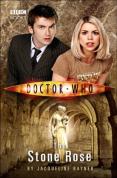 |
| ISBN | 0 563 48643 0 | |
| Published | 2006 |
| Synopsis: Mickey is startled to find a statue of Rose in a museum - a statue that is 2,000 years old. The Doctor realises that this means the TARDIS will shortly take them to Ancient Rome, but when it does, he and Rose soon have more on their minds than sculpture. |
Quirky... by Joe Ford 4/6/06
Delightful, easily the most entertaining book Jac Rayner has ever written. Let's face it her track record is pretty good; the quirky EarthWorld, the gripping Glass Prison, the hilarious Squire's Crystal, the witty and scary Wolfsbane, the educational Marian Conspiracy and the emotional Pirates... frankly the only piece she has written that I DIDN'T enjoy is Winner Takes All, where it felt as though she had abandoned all her strengths as a writer (atmospheric prose, funny dialogue and spot on characterisation) to talk down the kiddies the NDAs were trying to attract. She seems to have learnt her lesson and aims her goals much higher this time, whilst still writing a book that will appeal to children.
Frankly I think Doctor Who fandom can be a bunch of jerks sometimes. These latest three books had been practically written off by all before they had even been published. Whilst whinging on about the lack of PDAs and how the books are no longer "serious" because they don't have copious amounts of sex and violence... remember that we are lucky to have a book series at all whilst the TV series is running (we could have been stuck with novelisations of the TV episodes) and to have people like Justin Richards, Steve Cole and Jac Rayner so invested in seeing the Doctor and Rose in print. People were bitching about the same authors cropping up. Jac Rayner has brought out some corkers before as I listed earlier, Justin Richards has been responsible for some of the best-ever Doctor Who books (The Sands of Time, The Burning, Time Zero, Tears of the Oracle) and Steve Cole, whilst the patchiest of the three, knows how to spin a great yarn (I adored Timeless and Vanishing Point and found Monster Inside a real hoot). Stop yer moaning you ungrateful lot, these books are the more fun than practically anything the NAs or EDAs ever released (as good as those ranges were). Okay, rant over.
If Tennant's Doctor is even half as fun as he is in this book on screen we are in for a real treat. He is so markedly different to Eccleston's straight-faced, slang-ridden hero it is impossible to compare the two. Whereas the ninth Doctor was contemplative, frightened to act, careful with his involvement, the tenth Doctor jumps in with both feet and worries about the consequences later. He is always on the move, even when in one room, and I had a sense of fidgety uncomfortableness at being forced to stay anywhere for a prolonged period of time. Verbose too, he is always on hand with a fascinating fact, an insulting jibe or a decent joke whenever silence rears its head. There is a real sense of how much he cares of Rose, perhaps more than he should do, admitting she is beautiful, sharing a kiss and barely able to hold himself together when he thinks he has lost her. Ironing over the rough edges with his regeneration has led him to fall for her in an intense way and their chemistry is fantastic, sharing an adventure with this too is such fun because they clearly love travelling together and having adventures. It's amazing how much more entertaining this is than enduring a companion who clearly doesn't want to be around (Tegan, Peri, Anji). They goof around and play jokes on each other, extremely protective of one another and willing to go to any lengths to help each other out. It's a fine combination.
What's especially good is The Stone Rose gives both of them the chance to shine together AND on their own. The Doctor gets some brilliant scenes, stealing a royal nob's horse, being chucked into the arena and fighting off lions, tigers and bears (oh my!) and getting his own band of merry men. Rose is spotlighted in the excellent last third when she (not the Doctor) grasps the reality of the situation and after a few hiccups manages to logically think through their predicament and come up with the answers. And whilst you might think these large-print, reader-friendly books would leave little room for any kind of depth, the Doctor's musings on the greed of pleasure of human beings and Rose's thoughtful gazing at the sunset, thinking of everything crumbling around her before reaching her own time are both worth musing upon.
And it's funny too! Admittedly the first three NDAs were a series finding its feet, but the second batch showed more variety and willingness to experiment; I thought Gareth Roberts' excellent Only Human would be the funniest book they could offer up, but The Stone Rose matches its exuberance and jolly atmosphere page for page. The Stone Rose really does read like a new series episode, albeit one with more running time, an even bigger budget (hmm, could they really realise the Colliseum packed with bloodthirsty spectators?) and a huge dollop of imagination. Everybody is cracking jokes in this and they merely add to the sense of fun, even though the book never shirks its emotional responsibilities either.
It transforms from a shock trailer (Rose is a stone statue) to a period piece (a trip to Rome with some lovely educational touches, festivals, slave trading, astrology) to a chase (with both Rose and Tiro missing) to a SF fantasy. It zips along at an incredible pace but never feeling rushed and offering the odd moment for reflection and emotion. Dialogue is top notch and the characterisation of the guest cast is good enough to make them memorable, especially Vanessa and GENIE.
Hugely enjoyable, I read this in two long and extremely jolly sittings. Comprising of the imagination and wit that has ensured the Doctor's survival for four decades, this is a quirky piece that I will return to if I am ever feeling low.
A Review by Finn Clark 2/1/07
I really like Jac Rayner's voice. Reading this straight after Steve Cole's The Feast of the Drowned was like having a lovely refreshing bath after coming home from a unpleasantly sticky day at work. I found it breezy and charming. I've always liked her knack with character, even in books which seemed to get a lukewarm reception. EarthWorld, for instance, has heart, wit and a light but deft touch with its cast, which helped me enjoy it more than certain solid but stolid offerings.
Of these first three 10th Doctor novels, it's the only one where I actually enjoyed reading the pages as opposed to the story they contained. Steve Cole was Steve Cole, whereas Justin Richards was putting on his "Ho Ho Ho Look At Me I'm Robert Louis Stevenson" hat.
Unfortunately, the plot is bollocks. It starts well, if predictably, but soon wanders off in strange directions before disintegrating into complete bibble. The Doctor and Rose spend a third of the book not even suspecting what's been blatantly obvious to the reader from the beginning. If you'll forgive a digression, one of Farscape's virtues that one that I particularly appreciated was their ability to flatter the audience's intelligence. They recognised that these days we can see cliches a mile off and would thus take them as a mere starting point, subverting them in a whole chain of toppling dominoes almost before you knew what was happening. It was delicious. Jac Rayner, er, doesn't. She presents a predictable SF idea with utter wide-eyed sincerity and takes forever to let the regulars realise the bleeding obvious. It makes them look like idiots, not to mention the author.
Admittedly there are twists. The book's first act has genuine surprises alongside the complete non-surprises that had been obvious for eighty pages. That might even have been cool had the regulars been allowed a little intelligence. Unfortunately they're constrained by the plot to react instead of thinking, to potter in Jac Rayner's admittedly charming fashion through Ancient Rome without ever considering possibilities that might be awkward for the story.
Then the Doctor gets himself in trouble for no good reason whatsoever in a mini-episode with no relevance to anything else. It's lazy plotting. "Hey, it's Ancient Rome! We need gladiators!" It's his own stupid fault, too. He thoughtlessly annoys an influential local, is gratuitously flippant when they meet again and practically lets himself get captured. It's probably a good thing that this section has no consequences and goes nowhere, because it would have killed the book for something permanent to happen because of the Doctor's thoughtlessness.
What's most annoying is that these days there's even less excuse than normal for a "whoops, this needs padding out, better throw in a couple of pointless chapters that add nothing to the story before returning to the main plot". How long are these books? 50,000 words? Theoretically there's no reason why one of these annoyingly-formatted hardbacks couldn't feel like a normal book with the fat cut out. There's a simple dramatic spine to something like Love and War or Human Nature, for instance, although for something like Just War or Alien Bodies you'd have to start cutting out characters or plot threads. However The Stone Rose seems to think that being a 50,000-word children's book means it needn't bother with anything so boring as a well-constructed story.
Anyway, the gladiatorial stuff disappears after thirty pages never to be seen again and it's back to the plot. I quite enjoyed these bits, but again they weren't over-burdened with intelligence. The best example is a present-day scene with Mickey and the Doctor. The Doctor has some bad news. He tells it and Mickey reacts as anyone would in a genuinely well-written moment. The emotion in those more pages felt truer than anything in the Stephen Cole book I'd just read. I believed in Mickey's grief. What I didn't believe was that the Doctor would torture him like that by waiting so long to tell him the good bit. It made the Doctor look like a bastard and an idiot. Admittedly this lapse in plausibility is so blatant that even the book realises it, with Mickey getting a little speech in which he hurls precisely that accusation at the Doctor, but the response he gets isn't exactly convincing. The real reason is that Jac Rayner had a set-piece she wanted to write and wasn't particularly worried about riding roughshod over logic and the reader's intelligence to do so.
Despite such problems, there's good stuff in this section. We've long since left behind the pure historical narrative of the early chapters (which I'd been enjoying), but the book's still dangling some intriguing questions. Unfortunately, in due time we learn the answers. Sadly the ending is just stupid. I'm not going to stamp my feet and object that it's not real Doctor Who or anything so daft. I like silliness. Weird is good. My problem is that it's just not very dramatic or interesting. Yet again someone sheds about fifty IQ points for the sake of the story. This time it's Rose. Her stupidity is at its peak during a set-piece scene around page 200 although frankly she's a bit dim throughout the entire final act.
The book's last six pages are genuinely sweet. I really enjoyed those, but they didn't make up for the preceding 75 pages being amusing but bleah with an "anything goes" plot coupon and no dramatic tension whatsoever. There are developments which could theoretically have been interesting, but they're undermined by the twin curses of that aforementioned plot coupon and the obvious laziness of the plotting. If anything can (and probably will) be undone in a couple of paragraphs, who cares?
I liked the ancient Romans, even if they end up sidelined in favour of nonsense. If we must get all these Earthbound stories, at least give us some history. It's nice stuff, fun and interesting. However I was almost shocked to read in the afterword that Jac Rayner has a degree in ancient history. She could have written a nice juicy historical, but this Roman era feels more like a holiday destination. There's something slightly half-hearted about this book. It doesn't have the courage of its convictions, throwing in all kinds of random ingredients in a vaguely crowd-pleasing way without making the most of any of them.
This is the least intelligent book I've read in a long time... but I still enjoyed it. It's charming. It has heart. These are qualities that I've often felt can be lacking from the Doctor Who books in general. I admire Jac Rayner's way with words, but unfortunately this book makes her look stupid.
Roman Getaway by Andrew Feryok 5/3/10
"Hopelessness was not a feeling he would ever admit to, but right now the Roman world stood before him impossibly large and discouraging. Rose was a tiny marble needle in a giant Roman haystack. How would he ever find her?"The Stone Rose was a big surprise for me. I went into this book with low expectations after having previously read the middling but somewhat clever The Feast of the Drowned by Stephen Cole (although technically this book is supposed to come first if you go by the Gallifreyan numbers on the spine). The Stone Rose had a clever set piece to draw the reader in, but the cover looked rather bland and the blurb made it sound like this was going to be another runaround in Rome with the Doctor leading a gladiator rebellion and Rose befriending a slave. Boy was I wrong! Jacqueline Rayner has written a corker of a story that is well and truly a hidden gem. The deceptively predictable story opens into a tale of time travel and twisting realities that will dazzle anyone who delights in abnormal Doctor Who stories like The Mind Robber or The Greatest Show in the Galaxy.
- The Stone Rose, page 145, Chapter 10
I completely disagree with Finn Clark about the plot of this book. Jacqueline Rayner has written a story that starts out as a normal historical runaround and opens out into something bigger and better. In fact, the plot is so great that I will refrain from discussing it in any detail, especially the second half. The book doesn't exactly rely on its twists and turns, but it is these things that make it stand out from a normal adventure, so I won't spoil them for you and let you discover them on your own. Granted, this is probably the most small-scale story of 2006. While it does feature the Doctor and Rose in the midst of the gigantic and epic Roman empire, it feels remarkably small scale and personal since the story is less concerned about the overall story and more about its characters and how they are reacting to the situations. This means that the plot is more character driven than your average childrens book.
The characters drive the outstanding plot. There are no real cliched characters in the story, except for maybe Marcia and Rufus. Most of the characters have a depth to them that allows them to be interesting. Ursus is an obssessive artist who was denied the ability to create art all his life until a miraculous gift was given to him. Vanessa is a prophet who is more than she seems on the surface (I won't say more lest I give away the story). The gladiators the Doctor befriends in the arena each have a reason as to why they were put into the arena and they are all fascinating reasons. But my favorite characters of all were Gracilus and GENIE. I loved the idea of GENIE, especially what it does with Rose in chapter 15. I won't give the GENIE away except to say that is the best thing about the second half of the book. Gracilus makes a wonderful stand-in companion for the Doctor in the middle of the book while Rose is incapacitated. He reminds a bit of a Roman version of Donna Noble's grandfather. The Doctor saves his life at the beginning of the book and Gracilus attempts to repay him by saving his life in return. From then on, Gracilus becomes drawn into the adventure and makes a nice foil for the Tenth Doctor. It's a shame though that he can't continue to assist the Doctor in the latter part of the book, but his plotline gets resolved in order to make way for the return of Rose for the final part of the book.
The Doctor and Rose are captured extremely well here. I love the fact that Jaqueline Rayner has really captured the sense of cameraderie and friendship between the Doctor and Rose. Stephen Cole managed to bring out the worst of them, particularly the Doctor's character, from early season 2. But the Doctor here feels like the more mellow and experienced Doctor from season 4 and the final specials rather than the early hyperactive version. That is not to say that the Doctor and Rose don't act overly silly at times, but when they do it is usually to genuinely lighten the story or highlight their friendship. I also like the fact that they both get to play the role of hero and damsel during the course of the story and get to show their individual skills at handling increasingly impossible situations. They are a well-matched pair here and in the best tradition of all the best Doctor-companion teams, they are more than just "boyfriend and girlfriend", but genuine friends who could care less about what is inside each other's pants, but care more about each other as people.
For a book that was supposed to be dumbing down to a children's level, I was suprised that there was actually nudity and graphic violence in the book. Granted, it is not as gratuitously used as previous Doctor Who books had done, but you can tell that Jacqueline Rayner has not yet completely let go of some of the more adult tones from the last book series. This is to the book's benefit for older readers since it helps to bring out the brutality and reality of Rome itself. But it certainly isn't something you would have found in the old Target novels if that was what the BBC Books were currently aiming for. Granted, it is done somewhat discreetly, especially the violence which is never dwelt on in any detail that it would gross you out.
On the whole, this is book has won me over to the new series books. Granted, I have only read two so far, but if the book series can maintain the quality that Jacqueline Rayner has begun here, then the tenth Doctor book series has many delights awaiting me in the future. I now definitely want to tackle Justin Richard's The Resurrection Casket and finish the trilogy of the Tenth Doctor's first books.
This book is definitely worth reading. Don't let its bland cover and seemingly predictable premise fool you. What is given on the back cover is just the starting point covered in the first three to four chapters. The story only goes up from there and will leave you with a big grin at the end and wanting to read more Doctor Who books. Fantastic book Jac! 10/10
Modern Art! by Noe Geric 30/6/26
While the Christopher Eccleston run of books ended tragically before a seventh could see the light of day, I can remember each one of these quite easily. The titles are simple and memorable enough not to slip out of my head, the covers (with the uninspiring promotional shots of the cast on half of the whole surface) printed in my mind quite easily, and the stories could be summarized quite simply without looking dull (Rose is married to a caveman! The Doctor shares a cell with two Slitheen!...) But then came the six next. The first bunch of David Tennant printed adventures. And I can't bring myself to think about them happily. I always thought it began with fireworks (The Stone Rose) and ended with the dullest adventures ever (Price of Paradise, Nightmare of Black Island and *ugh* Art of Destruction). That's why I'm reviewing The Stone Rose out of these. Because it might be the most simple but exciting NSA I've read in a while.
The whole first half is mostly a historical exploration of Ancient Rome. I learned a things or two and had a callback to my youth, when I always had a history book with me wherever I was. The second is a weird SF adventure with a creature in a box that can grant wishes and manages, surprisingly well, not to spoil everything that had been done in the previous 150 pages! A wonderful idea to split two thirds of the books in two small aventures in which the Doctor, and then Rose, are the main focus. The non-linear bits feels weird when the Doctor's expedition must give way to Rose's escapade (it feels as if she needed to come back very quickly for the audience not to get bored). But it all ties up quite nicely in the end! Big-up to the GENIE, one of the few characters I cared since a long time.
There are an incredible number of great moments in that one! But the most memorable must be the Doctor fighting in the arena. Of course, everyone would've noticed it was just a distraction to no use except give a more Roman feeling and fill the word count. But I couldn't help but sink into it and follow the action. It's incredibly well-written and manages to teach a subtle history lesson. It add a lot to the fanfiction feel of it. Because, indeed, I found myself doubting this was really a book published by the BBC! The impression was that it came from the hand of a fangirl writing love stories between the Doctor and Rose... And that feeling was confirmed when they kissed. And I'm one of these who think the Doctor/Rose coupling in Series Two was a phenomenal mistake.
But I was more concerned by the whole Doctor adventure: of course it wouldn't have worked if we didn't see everything through the hero's eyes. But I'm not a fan of stories getting into the Doctor's head and motives (yeah, yeah Heaven Sent was cool). It was awkward to explore his thoughts and... Can the man think of something else than SAVE ROSE?! Another fanfiction aspect of the book. And I've got concerns about the Doctor walking around in a toga. He rarely felt the need to wander around in period costumes (particularly when he gets back to the present but doesn't take it off). Some of the jokes are... Well, just look at the Winnie the Pooh bit.
And stop calling it a book with Jackie and Mickey when they're barely in it (Why was the Doctor mentally torturing Mickey other than pure sadism?) and we've got a 16-year-old girl called Vanessa (in pure early NSA style) who just cries for 248 pages before deciding to destroy the world because she's bored (some rumours says she'll evolve into Angie)
Still a wonderful book! And one I should've read earlier: not just because it's fast paced, entertaining as hell and historically perfect, but because Big Finish decided to offer the opportunity to write a story of their Bernice Summerfield range, and I ended up imagining the exact same concept as the GENIE in the book (with a few differences). I just hope Jac Rayner wasn't in the judging panel or, in that case, I present all my excuses.
Recommended, as long as you can tolerate the Doctor/Rose totally-not-obvious romance all along and a few scenes that doesn't make it (but why did he have to do that to Mickey?!) and a must-have if you cried when the Doctor blowed up a sun and never finish his damn sentence. One of my favorite NSAs and fanfiction, by the way. 9/10