
The Sorcerer's Apprentice

|
|
Virgin Publishing The Sorcerer's Apprentice |
|
| Author | Christopher Bulis | 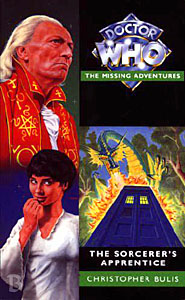 |
| ISBN# | 0 426 20447 6 | |
| Published | 1995 | |
| Continuity | Between Marco Polo
and the Keys of Marinus |
| Synopsis: The TARDIS crew discovers the land of Elbyon, where it appears the magic exists. But Elbyon has hidden secrets that may prove deadly to the time travellers. |
A Review by Sean Gaffney 13/8/99
Time for another happy-go-lucky review - the last for a while...
No, I'm not leaving, I just didn't think much of the August books.
This surprised me. It's very good. I think that we can now assume Shadowmind to be an aberration, as both State of Change and Sorceror worked very well. Despite the magic, and the Empire landing, this is pretty much true to its time. The characterization that I complained about in The Menagerie is spot on here. All four regulars work well, especially Susan with Ping-Cho...um...I mean the Princess. Ian and Barbara care about each other, but are not madly in love, thank you, Mr. Whitaker. Best of all, the Doctor remains spot on throughout. In State of Change, I felt that Colin sounded too much like Bill Hartnell. Well, here it fits exactly right.
The plot is excellent, with the scientific side of things explained away very first-seasony. The magic and dragons would not have made it on screen, but then these aren't supposed to be Target novels, as I think many people forget. The plot is sufficiently devious, and... well, overall a good read. I look forward to The Eye of the Giant.
9/10.
A Review by Stuart Gutteridge 2/12/00
Another in a long line from Chris Bulis, and an improvement as well.
PLOT: In short the TARDIS lands on a world where magic and science are two very different things. In fact the world of Avalon could almost be straight out of Dungeons And Dragons. It`s refreshing, but not necessarily representative of the era.
THE DOCTOR: William Hartnell was once quoted as saying he believed that The Doctor was "a wizard"; in fact he could almost be Dungeon Master.
COMPANIONS: Chris delivers the goods, with Ian, Barbara and Susan coming across as recognisable.
OTHERS: Gramling and Dahl really stuck in my mind; although I can`t remember why...
OVERALL: Very readable, the magic elements are explained in sci-fi terms and the whole book comes across as being highly enjoyable. 9/10.
A Review by Finn Clark 9/6/04
I love this book! This is one of my favourite Doctor Who novels, not just "pretty good for Bulis" but big bags o' fun by any standard. Obviously it's a pastiche of Tolkeinesque fantasy, but in addition it's an intelligent exploration of such a world and the SF reason for it all. If you hated Grimm Reality and The Scarlet Empress, rest assured. This doesn't have a mystical bone in its body. Note that it doesn't just star the 1st Doctor, as dogmatic and rational as ever, but a bunch of 30th century Earth Empire space marines who are not amused to find fire imps in their Mark 3 Solid Fuel Booster Units.
The key to the book is that central contradiction. It clearly fascinated the Bulis, so in turn it gets communicated to the reader. It's wonderful to explore the ramifications of this magical society. This is the Bulis's most intelligent book by light-years, in which it delves into the background, consequences and internal logic of its chosen scenario. This novel is Doctor Who to its fingertips, but in its own quiet way it's also a hard SF extrapolation of "idea as hero".
The characters are better than usual for Bulis, despite the get-out clause of Tolkein pastiche which would have excused lapses into cliche. Nyborg is sharp, intelligent and more complex than you'd expect from a military man of his type in Who. The Gramling-Hartnell confrontation kicks arse. Marton Dhal is a stereotyped "bwahahaha" Dark Wizard, but that's entirely appropriate. What's more the TARDIS crew is strongly portrayed, over and above the greatness inherent in Season One's regulars. Everyone gets plenty to do, with Barbara in particular at one point being left in charge of the whole investigation. She impressed me.
In fact the book's shallowest character isn't an Avalonian elf or goblin, but Captain Shannon of Earth's Special Services Directorate. He does everything the plot requires of him, but occasionally his scenes gave me that "oh God it's Bulis" feeling. Those are the only scenes where this book didn't carry me away. The plot twists also feel a bit obvious on second reading, though that's hardly a fair criticism. It's praiseworthy to put your clues in plain sight and give your readers every chance to piece 'em together.
There's genre awareness, with a Tolkein reference on p97 and a witch (Anni Glassfeather) who's the missing twin sister of Terry Pratchett's Esme Weatherwax. The names are suspiciously similar. However she's such fun that I loved reading about her anyway. What's more, this book isn't just a childish romp; the characters don't have script immunity from their world's unexpected dangers. Heroes can die. The first time that happened, it shocked me. Even the simple notion of Susan playing at witchcraft is scary if you've recently read The Witch Hunters.
There's a strong sense of history, with reference to the Whoniverse's 22nd century diaspora after the Dalek invasion and the fall of the Earth Empire as in Original Sin and So Vile A Sin. This book contains almost nothing I don't like. It's lively and cool, with an intelligently explored SF puzzle and some Bulis characters who for once actually feel real. Hartnell kicks arse, his companions are great and I loved the clash of Avalonian magic and 30th century space marines.
And the last line is perfect.
A Review by Brian May 24/6/05
How many times have you read the expression "Doctor Who is always at its best when its roots are showing"? Lots. Why? Because Doctor Who is not ashamed to be unoriginal, taking bits and pieces from literature, film and mythology, most of the time creating a wonderful tribute to its source material. And that's exactly what Christopher Bulis has done with The Sorcerer's Apprentice.
It's unashamedly unoriginal - I mean, just look at the title! The steal from Rapunzel, as Susan thinks up a method of escape from her cell, can be seen coming from miles away. The entire expedition the Doctor and Ian join is so blatantly a rip-off from The Lord of the Rings that Bulis feels the need to acknowledge this in the text. It's one of the original novels' earliest combinations of science fiction and fantasy - and one of the most successful (but then, with competition like Cat's Cradle: Witch Mark, that's not very difficult). Bulis presents a strange juxtaposition; the medieval world of Elbyon, with all its knights, princesses, witches, dragons, goblins and leprechauns, blended with the futuristic scenario of the Prince Randolph, which incorporates your sci-fi staples of soldiers, scientific officers, an important mission, a landing party and a galactic empire in the background. The contrast is jarring, but this makes the dichotomy all the more striking.
The non-regular characters are not that spectacular, but they meet the specified requirements of their genres. Bron is a dashing knight, Mellisa a plucky princess, Dhal a dastardly villain, Anni a witch with a heart of gold etc. I quite like Odoyle, the leprechaun - he's rather fun, and Queen Leonora gets some good moments. The space crew are similarly unremarkable, with the exception of Komati. She's the book's most sympathetic character, and the reader begins to feel she will choose to stay on Elbyon at the end of all this - until her death, of course, which is a very tragic moment. But overall, characterisation is sacrificed for plot, which seems feasible; you can't do much with walking and talking clich?, and we all know who they are and what they're meant to do. However the author has done a spectacular job with the regulars. Ian and Barbara are spot on. His rendition of the Doctor is also excellent, and he didn't need to include Hartnellesque "hmmm"s or line fluffs. Susan is a bit awkward at the beginning, but Bulis becomes more comfortable with her once she is moved into her sub-plot - here the character really comes into her own.
Not only has Bulis realised an excellent season one TARDIS crew, he's also managed to make this a believable season one story. It's quite lengthy; the TARDIS is rendered inaccessible and the plot facilitates a long and dangerous quest. The story is fairly slow, but never at a snail's pace. With all this, it sits comfortably among the likes of The Daleks, Marco Polo and The Keys of Marinus. You can even imagine the scenes when Susan is imprisoned in Dhal's tower having been pre-recorded in film inserts; the same could be said for Barbara's trek through the forest in the latter part of the book. The alienness of the Doctor and Susan is maintained (their conversing in an alien language as overheard by Barbara), but not too much is given away, no more than in the televised adventures, e.g. the descriptions of their home planet (The Sensorites) or the Doctor saying he was a pioneer among his own people (The Daleks).
The hard science-fiction concepts, the nanobotics and the structure of Avalon and its moons are all very well grounded, although there's one gripe. The TARDIS doesn't allow the travellers in because of the danger of the nanobots getting inside; but wouldn't the time machine have never let them out in the first place? Call me an anal-retentive goof spotter, but that factor niggled at me. Of course, it's a story catalyst, but still... But the whole history and back story of Elbyon is fascinating; Barbara's researches provide some quiet but interesting revelations. The role of the cephlies is cleverly and subtly crafted, with the appropriate clues becoming obvious in hindsight. There's a bit of dragging here and there - the lander's descent into Elbyon's atmosphere and the climbing of the glass stairway on Helm Island are both slightly overlong, while the showdown, all the back and forth sorcery between the protagonists and Gramling, could have been trimmed by a few paragraphs. But overall The Sorcerer's Apprentice is a very enjoyable, imaginative mix of sci-fi and fantasy that charmingly and unabashedly pays homage to those tales that inspired it. And that always makes great Doctor Who. 8.5/10
Bed knobs and Broomsticks by Andrew Feryok 26/8/11
"There's no such thing as magic."I already have a special place for this book in my collection. This was the first Doctor Who book I ever bought, along with Invasion of the Cat People. Of the two, I attempted this one first, but ended up switching over and finishing Invasion of the Cat People before coming back to this one. (I can't help it. I love Troughton!) It has therefore been a very long time since I last read this book. My memories of it were generally positive. I remember liking the opening few chapters which felt like the typical opening of a '60s story carried largely by the regulars, I remembered the Doctor and company visiting an ancient spaceship and finding the source of magic, and I especially remembered the Doctor engaging in a wizard's duel at the end complete with cape and hat. So now it's been fifteen years and I've revisited Christopher Bulis' adventure. Does it still hold up to this day?
- The Doctor's firm belief throughout the story, page 296, Chapter 26
It most certainly does!
Christopher Bulis writes a really good adventure/fantasy book. Setting the Doctor, Ian, Barbara and Susan down into a real-life fairytale kingdom - with elves, dwarves, dragons and magic - is a truly inspired idea. It reminds me a lot of such fantasy oriented stories like The Celestial Toymaker, The Mind Robber or The Greatest Show in the Galaxy. And the central question which drives this book along is: how can magic exist in a rational universe? The Doctor takes the unflinching side of rationality and science while Ian, Barbara and Susan are more willing to believe what they see with their own eyes. Susan even goes so far as to start practicing magic before anyone else in the team can! But, as is typical of Doctor Who when it engages the idea of magic and religion, there is a rational explanation behind it all. Hints are dropped throughout the story that such an explanation is forthcoming: the ruins of crashed spaceships, evidence of an advanced alien race and the people's comfort with the idea of people from outer space, not to mention the strange artificial moons circling the planet. Bulis then further ups the stakes by bringing in a militaristic space empire who attempts to invade the planet and seize the secret of magic for themselves, thus creating a truly surreal situation that only Doctor Who would dare to get away with.
The other problem Bulis sets for the TARDIS crew is the fact that all modern technology is rendered useless on this planet, leading passing spaceships to crash to their doom and preventing Avalon from evolving beyond its medieval-based society. And whatever is causing this is also preventing the crew from returning to the TARDIS which locks them out and engages all its defense systems. I'm beginning to wonder if this inspired Justin Richard's The Resurrection Casket, since that is the same exact plot only done with Treasure Island and steam-powered robots. So, on top of trying to figure out the source of magic, they also have to find out what is attacking the TARDIS and how they can get back inside, which brings an interesting spin to the usual Hartnell premise of being cut off from the ship and trying to get back again.
Bulis captures the regulars extremely well in this story. It's shocking to see the Doctor behaving so coldly towards Ian and Barbara at the start of the story, but this book is set almost immediately following Marco Polo, when tempers and tensions between the crew were still cooling down. This is the crotchety, backstabbing, mistrustful, anti-hero explorer of the early season 1. Although Bulis does make him a little more heroic than he actually was at this period of the season, he doesn't actually do anything that Hartnell's Doctor wouldn't have done. And the Doctor's moments of heroism are great, especially the end when he engages Dhal in a wizard's duel turning the world's magic against itself. This is really ironic after he spent the entire book refusing to believe in magic, and now he ends up using magic to solve all their problems! But this is only after he discovers the rational science behind it all. Ian ends up being the odd one out, characterwise, and doesn't get much to do except accompany the Doctor on his quest for Merlin's Helm. Barbara gets an interesting subplot as she delves into the history of Avalon before getting lost in an enchanted forest and befriending a friendly witch. But the true standout is Susan! This is a really good idea on Bulis' part because she usually ends up being the odd one out during the TV adventures, so it's nice for the books to show her having some adventures as well. In fact, she ends up being the most heroic of all the TARDIS members, as she keeps the Princess' spirits up and tries to find a way to escape Dhal's prison. She even manages to figure out the true nature of how to operate magic well before the Doctor does! If there is one thing I wish Bulis had done, it's to introduce this whole idea of Susan teaching herself magic earlier in the book rather than bringing it up towards the end, since the struggle to learn how to make magic would have been an interesting examination of Susan's ability to think out a problem and find a solution against all odds.
As for the rest of the supporting cast, they aren't a very memorable lot. The villain, the evil wizard Dhal, is a your typical scenery chewing, bwa-ha-ha-ing, nothing-in-ze-vorld-can-schtop-me-now megalomaniac. And, as a result, he is the only one who doesn't come across as dull. His arrogant evil presents quite a problem for the time travelers as he has clearly planned the whole hostage situation long before they arrived. He can easily match the Doctor when it comes to manipulating situations; his ability to adapt to new problems, such as the sudden arrival of space marines, is frightening. The wizard Gramling is also memorable. I love the sequence where the Doctor and Gramling square off upon first meeting. Gramling tries to use magic to open the TARDIS and then intimidate the Doctor. The Doctor sees through all his illusions and manages to perform a simple sleight of hand trick that manages to publicly embarrass him while reinforcing the Doctor's own ideas of rational explanations. And just when it seems that Gramling is becoming irrelevant to the plot, there is a massive twist with his character. I had completely forgotten about it from my first read through and it's so good, I won't spoil it here.
Other memorable characters include the leprechaun Kilvenny, who makes a significant change from all the Dungeons and Dragons characters milling about; his relationship with the Doctor and Ian is quite nice. Princess Melissa makes a nice friend for Susan in the "Ping Cho" mold. She also serves as the story's screaming damsel since Susan is taking a more heroic stance this time. Finally, you have Old Anni, the eccentric witch who befriends Barbara towards the end of the book. It's a shame that we had to wait so long for her to become involved and its story, but, when she does, she breathes some air into the area of characters. I was waiting for the moment when she would meet up with the Doctor and it's definitely worth the wait. Beyond this, most of the characters are faceless cliches of fantasy archetypes. We are meant at one point to feel great sorrow when a dwarf character sacrifices himself in battle, but Bulis did such a poor job of drawing him that I really didn't feel anything for him. The space marine characters are completely unmemorable and feel like they were tacked on at times. You can tell Bulis watches a lot of Star Trek since he bases a lot of the characters, spaceships and terminology on Star Trek cliches. Despite the fact that the above characters are memorable, Bulis did have a tendancy to sacrifice characterization and character interaction for explaining plot and describing the locale. I've always found that the mark of a good story is when it has characters that people are interested in. Bulis nearly gets it right here, but does fall into the trap of writing cliche characters spouting cliche dialogue.
There are a few other problems with the story as well. At nearly 300-pages, I was expecting a story with a lot of twists and turns. Instead, the story is surprisingly straightforward and as a result tends to feel like it is dragging in places. Bulis attempts to compensate for this by giving increasingly detailed descriptions of the world of Avalon. He spends more time describing what Susan and Melissa's cell looks like than actually having character interaction or plot. These deficiencies could have been compensated by increasing the number of trials the Doctor, Ian and friends had to endure in order to find the Helm of Merlin. After all, a lot of quest-oriented fantasy stories are all about the hardships and trials of the journey rather than the prize at the end. But Bulis instead makes the trials so insanely easy that you begin to wonder why no one has reached the helm before. Bulis does have a reason for making the trials so easy which becomes a plot point later on, but it doesn't excuse the fact that the quest that should be the heart of the story is dealt with in such a hurried manner as if to get it out of the way.
But getting back to the positives, I love how much Bulis understands the structure of a 1960s Hartnell story. He captures the feel of an opening episode featuring only the regulars as they investigate their landing site, uncover several mysteries and get themselves into trouble. The crew are as usual cut off from the TARDIS with getting back into it being one of the central problems of the story. We even have the TARDIS crew splitting up as the problems get worse so that each can engage in their own plot. And if it wasn't for all the magic and dragons, you could easily mistake the first half of this story as being a historical set in medieval times!
On the whole, despite its problems with characters and plot pacing, Bulis has written a fantastic First Doctor adventure. He captures the regulars wonderfully, creates an interesting premise that draws the reader in, and engages the Doctor in a setting and situation we have never seen before. This book is definitely worth the read and not to be missed. 8/10
There's No Such Thing as Magic... And Almost Magically the TARDIS Disappeared by Jacob Licklider 4/11/19
Having the First Doctor being placed in a traditional fantasy world as a premise is a spark of genius. The First Doctor has always been the most skeptical of the Doctors and the most driven by the search of knowledge. I mean, look at his actions in An Unearthly Child and The Daleks where his actions are dictated on exploring the new worlds he has found himself landing in yet never would admit magic is possible. This makes it extremely interesting as today's novel, taking place immediately after Marco Polo, sees the Doctor, Ian and Barbara landing on the planet Avalon, which is every bit the traditional fantasy world with kings, queens, wizards, dwarves and elves all inhabiting the planet, which just perplexes the Doctor. The plot of The Sorcerer's Apprentice really doesn't matter as it is standard early Hartnell with a companion being captured in Susan who needs to be rescued, but the intrigue comes in how this planet, which is in the thirtieth century, has magic, which by the Doctor's reckoning couldn't actually exist in the story. Christopher Bulis' third novel, while not as good as State of Change, is jammed packed with a mystery which knows exactly how to let out its reveals slowly over the course of the novel with plenty of red herrings.
Yes the reveal after reading the novel seems a bit obvious, as the show has never really been able to do something like this without it coming to mind, but Bulis succeeds in creating a vivid picture of a world with characters who feel like they came from 1964. This is especially prevalent in the way Bulis writes for the main characters, especially the Doctor. The Doctor doesn't do as much in this story as some other's but he feels every bit like William Hartnell's original portrayal and this novel really acts like it's trying to bridge the character gap between Marco Polo and The Keys of Marinus, which really makes the Doctor warm up to the prospect of having companions. While it is Susan who is captured, he doesn't want anything bad to happen to Ian or Barbara, as he promised to eventually get them home, even if there are going to be a lot of detours on the way there. His aristocracy also bleeds through, as he acts like his opinion on magic is more important than the evidence in front of his eyes that magic exists on this world and is just natural.
The characterization of Susan does not only reflect her portrayal on television but also amplifies it, as even though she is captured by the villain, she tries to get out of it using her mind and finding a way to corrode the bars of her cell, which is an extremely clever way. She is paired up with the princess Melissa, who is what Susan was on television, the girl who screams and screams. Melissa acts as a great foil for Susan, as Melissa is about to get married in a medieval-style arranged marriage, which, much like in Marco Polo, Susan is appalled by. I can just imagine Carol Ann Ford and later William Russell reading these lines in an audio adaptation of this story, as there are some things that would give the Big Finish Team a good challenge. On the topic of William Russell, Ian and Barbara are also characterized extremely well, with Barbara getting the better bits as she gets to fly on a broom with a Terry Pratchett style witch straight out of Equal Rites.
The villain of this story is Marton Dhal who is pretty much a mix of Maleficent from Disney's Sleeping Beauty and the Wicked Witch of the West from the 1939 version of The Wizard of Oz. Dhal is just a terrifying villain, and it is implied that he would do anything to get what he wants, which is power. He isn't very deep, but he is still an interesting villain to watch, as you don't know what he is going to do next. The novel's largest problems are that the rest of the supporting cast are standard fantasy characters and the subplot with the astronauts landing on Avalon really makes the flow of the story feel really choppy over the course of the 300-page novel.
To summarize, The Sorcerer's Apprentice is a novel full of good ideas and some good characterizations, but the story has a lot of flaws and quite a few holes in the plot. The so-called plot twists are extremely easy to guess early on, and Bulis would have made the pacing a lot tighter if he cut out the astronaut subplot to the bare minimum as a more effective twist that the lights in the sky were crashing spaceships. Still, very much worth it for an enjoyable novel. 75/100
Science & Fantasy by Matthew Kresal 10/3/25
One of my favorite lines of Doctor Who dialogue ever is spoken by Pertwee's Doctor in The Daemons:
"Science, not sorcery, Miss Hawthorne."It's a line that has very much defined the series for me as a fan of the show for nearly eighteen years now. It also sums up in a sentence why I'm not a fan of the fantasy genre on the whole. If you're going to toss a fantasy my way, you better invoke Clarke's Law or make a very good one. Which intrigued me when I came across this Missing Adventures entry from Christopher Bulis, published by Virgin in 1995. Because if there's an era of Doctor Who that could do this mix of elements, it would surely be the Hartnell era.
And that's something that's by and large true. As penned by Bulis, it's easy to imagine that The Sorcerer's Apprentice could have been made on the scale of The Keys of Marinus or The Web Planet. It certainly has the ambition to have been, complete with traditional fantasy elements including dragons and the titular practitioners of magic. As is often the case, however, it is no doubt far better realized in prose (and the reader's imagination) than it ever would have been in the mid-1960s.
On the characterization front, Bulis clearly got this first TARDIS crew. Perhaps because of their clearly defined roles on-screen, each is given plenty to do here. Even Susan, paired off as she is with a teenage princess, gets to put that rarely glimpsed psychic gift to use. Hartnell's Doctor is presented in mid-evolution, as he was where this story was set, starting to show more of his impish nature and wry sense of humor but still with something of a harder, authoritative edge. Ian and Barbara come across well, with Barbara getting a solid subplot in the latter third or so of the novel in particular. It's a solid recreation of the original 1963-64 TARDIS crew, which helps the novel immensely.
Yet, as was the case when I read the Pertwee era Missing Adventure The Eye of the Giant from Bulis last year, it's in the ending where The Sorcerer's Apprentice sinks under its own weight. Something caused in part by how the inevitable intersection between science fiction and fantasy is handled, with an interesting clash between fairly hard science fiction and something that straddles the borders of high and low fantasy. It's in that clash, reaching an action-packed peak in the finale, that Bulis revisits the original villain of the novel. It's a climax atop a climax and, as was the case with The Eye of the Giant, undermined as well by the characters that it's centered around and the contrived technobabble to make it possible. It's a frustrating conclusion, to put it mildly.
Even so, as a mix of science fiction and fantasy, The Sorcerer's Apprentice works far better than it has any right to do so. One that, in keeping with the range that spawned it, feels very much like a missing adventure from the early Hartnell era. And one that, in its closing scene, still managed to preserve the ethos of science.
Even if it means that Clarke's Law gets fairly exercised in the process.