THE DOCTOR WHO RATINGS GUIDE: BY FANS, FOR FANS

|
The Sarah Jane Adventures
Mona Lisa's Revenge
|

|
| Story No. |
17 |
|
| Production Code |
Series Three Episode Five |
| Dates |
November 12-13, 2009
|
With Elisabeth Sladen, Daniel Anthony, Anjli Mohindra, Alexander
Armstrong, Tommy Knight, John Leeson
Written by
???
Directed by
???
Executive Producers: Russell T Davies, Julie Gardner.
|
|
Synopsis: The Mona Lisa comes to life and wants to free her brother from another painting.
|
Reviews
Art Attack by Stacey Smith?
24/1/26
The disappearance of the Mona Lisa from an art gallery forms the centrepiece of a plot to reveal a hitherto unknown painting with alien influence. There's a debate about whether art can be conceptualised from mathematics or whether it has to be felt. The existence of paintings that cannot be seen opens up the issue about whether art can exist devoid of appreciation. The greatest painting of all time has clearly been tampered with, so we're invited to question whether that matters. But that's enough about City of Death, let's talk about Mona Lisa's Revenge.
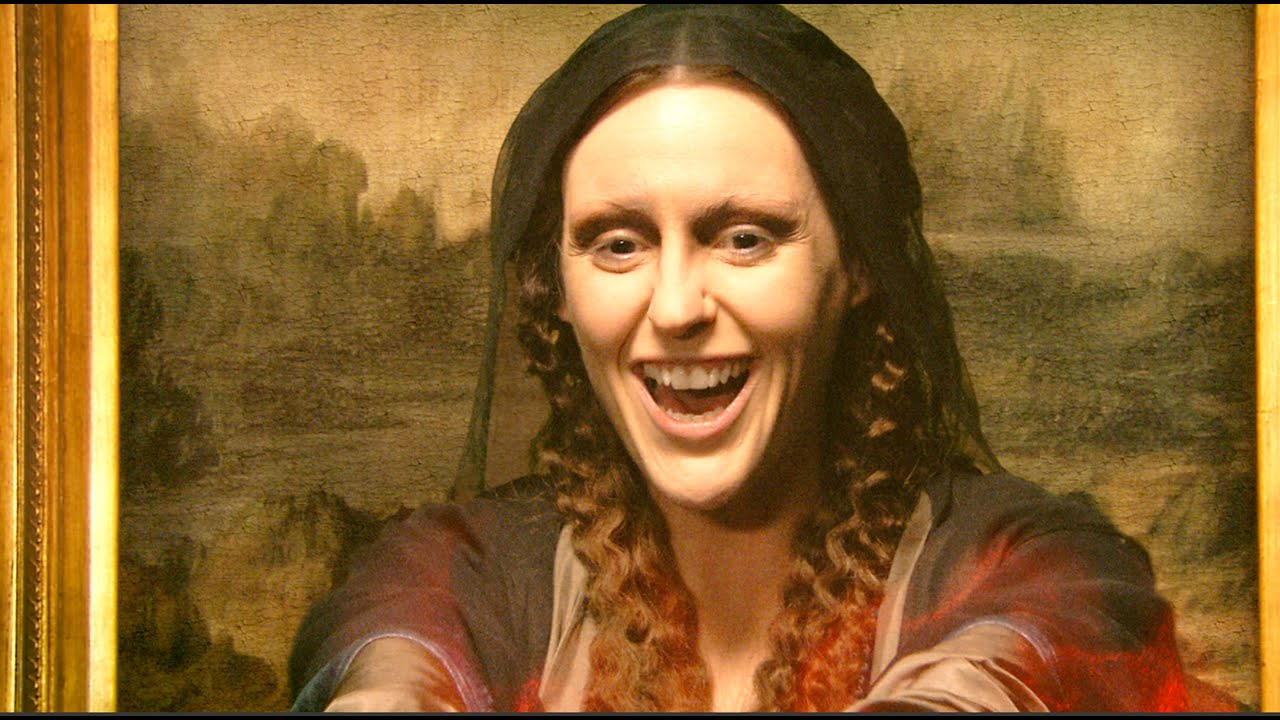
This story has a good claim to be the most bizarre of all the Sarah Jane Adventures stories. For a series that doesn't usually go in for the surreal, Mona Lisa's Revenge is possibly the most bonkers episode of all. The Mona Lisa comes to life... and she's a Northerner! The kids are attacked by a work of art... with no mouth! Sarah Jane is hardly in it... but when she is, she cosplays as the Third Doctor!
The episode opens with Clyde and Luke debating the merits of art, with Luke claiming --- Logopolis-like --- that everything comes down to maths. Clyde counters that you don't think art, you feel it... but his drawing of K9 is so technically correct that Rani brings it to life in Part 2 for the denouement.
Phyllis Trupp points out that the Mona Lisa is much smaller than you'd imagine, but the painting in the episode is still too big. I've seen the real thing, and it's pretty small indeed, only 77 cm x 53 cm (or 30 in x 21 in). That's not at all true of its inhabitant, with Suranne Jones's Lisa very much a larger-than-life figure. She's lively, aggressive and mildly flirtatious, taking Harding into her clutches by sheer force of personality. Jones later went on to play a larger-than-life embodiment of the TARDIS in The Doctor's Wife. She gives this performance her all, even if it's just bizarre that she's almost nothing like the real Mona Lisa, either in looks or personality.
Jones's Northern accent contrasts enormously with the middle-class original. Lisa del Giocondo was an Italian noblewoman, who was positively identified as the model for the famous painting only in 2005, four years before this story aired. Lisa del Giocondo was from an aristocratic family, who married a much older man (her husband was the one who commissioned the painting) and had five children. She eventually died of the plague, several decades after she sat for da Vinci.
Mona Lisa's Revenge is probably the story with the least Sarah Jane content that isn't explicitly about her absence. Sarah spends most of the first episode moping about Luke growing up, while Luke explicitly avoids telling her about their trip to the museum. This is darker stuff than usual for kids' fare and a strong contrast to the familial bond between the two paintings (Lisa goes to enormous lengths to free her brother). It's an interesting development, because Sarah Jane and Luke's bond is usually a bit too perfect, whereas here they fight like teenager and parent, which adds verisimilitude, even if it's somewhat awkwardly placed in a story about a wacky painting wielding a Sontaran blaster.
When Sarah Jane does become involved, she turns up wearing a frilly white shirt and green velvet jacket in an amazing Third Doctor cosplay. The Sarah Jane Adventures have always had one eye on the Pertwee years, being a series trapped on Earth with one of its lead characters (and guest starring another, in the Brigadier's final onscreen appearance, in Enemy of the Bane). With limited sets and extras, it evokes television of a bygone age, one that was more theatrical in style and whose legacy now only persists in relatively cheap kids' TV.
However, if you liked that sort of thing back in the day (as I certainly did), then there's an enormous charm to seeing it in the present. Sarah Jane's costume is utterly thrilling to behold for long-time fans, making up for the fact that she's sidelined for the bulk of the story. Upon entering the museum, she's promptly trapped inside a painting for the bulk of the story, leaving the kids to sort out Lisa's plot.
Said plot involves Lisa's alien brother, who was painted at the same time, but the artwork has been hidden away, because everyone who looks upon it goes mad, including the original artist. This brings up the tree-falling-in-the-forest question of whether art can still be art if no one can see it...
...although of course it's not actually art, it's aliens hiding in the art, which possibly adds a new dimension to the age-old philosophical debate. (Warning: it may not.) And, of course, despite art tourism being big business, with approximately 80% of visitors to the Louvre only there to see one painting, relatively few people in the world have actually laid eyes upon the Mona Lisa itself. (The replicas and photos don't do it justice.)
The fact that a very similar painting was done by Leonardo's neighbour isn't that far-fetched. There was another draft of the Mona Lisa; not an outright copy, as City of Death posits, but an earlier version with a younger Lisa, likely painted by both Leonardo and his students. This version is today known as the Isleworth Mona Lisa and was discovered in 1913 by a man named Hugh Blaker. Blaker was not only an art connoisseur; about ten years after his discovery of the painting, Blaker took in a 16-year-old kid, becoming his mentor and legal guardian, and sent him to study theatre. That kid's name? William Hartnell. Indeed, Hartnell and his wife later lived in one of Blaker's adjoining properties, and their daughter Heather was born there.
The disappearance of the painting as a plot device, both in City of Death and Mona Lisa's Revenge --- as well as countless art-heist movie --- dates back to the 1911 theft and recovery of the painting. Before then, it was not widely known outside the art world (although it was nevertheless appreciated by non-artists; Napoleon hung it in his bedroom in 1821!). Its theft by an Italian nationalist, who wanted the painting returned to its home country, was sensational news and instrumental in elevating the painting's mystique among the general public.
Most of the first-season Sarah Jane Adventures (and some from the second season) received 120-page novelisations. These faithfully retold the story and had a few pages of screencaps in their central pages. A few more stories, Mona Lisa's Revenge included, received 24-page pamphlet-style novelisations for young children, with small amounts of text accompanying pictures from the episode. The one for this story, titled Painted Peril, reworks the plot of Part 2 completely, with Sarah Jane saving the day rather than the kids --- and no mention of the demon brother.
The old trope of paintings that come to life or that trap people in them is a fun idea for an episode of a kids' TV show. But Mona Lisa's Revenge is much goofier than it probably should have been, with a bonkers villain, ruminations on parenthood and meaningful things to say about our appreciation of art. All this wrapped inside a spinoff TV show for kids. Picture that!