THE DOCTOR WHO RATINGS GUIDE: BY FANS, FOR FANS
| Episodes |
4 |
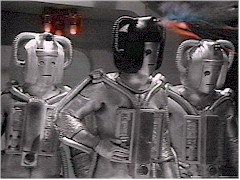 |
| Story No# |
79 |
| Production Code |
4D |
| Season |
12 |
| Dates |
Apr. 19, 1975 -
May 10, 1975 |
With Tom Baker, Elisabeth Sladen, Ian Marter.
Written by Gerry Davis. Script-edited by Robert Holmes.
Directed by Michael E. Briant. Produced by Philip Hinchcliffe.
|
|
Synopsis: The Doctor, Sarah, and Harry attempt to avert a Cybermen plot to
destroy Voga, the planet of gold.
|
Reviews
Rehash of the Cybermen? by David Masters
18/7/97
Without wanting to appear too glib, the success or failure of a
particular period in Doctor Who's history tends to depend on the
abilities of the script editor. Obviously, this is taking a deliberately
simplistic stance -- the producer, the lead actor, and various levels of
"showbiz chemistry" all come in to play. Nevertheless, we still break down
the various Who eras according to either lead man or producer, but
this seldom provides an effective guide to the various ups and downs in
the quality of the output, often during the same producer's reign. The
period of influence by a particular script editor (Whitaker, Bryant, Dicks
and Holmes especially) tend to be better indicators of script quality than
looking at who was either producer or actor.
I cite this in the introduction to the review of this story as
Revenge of the Cybermen (or should that be Rehash of the
Cybermen?) seems to stand out as a blot on editor Holmes' copybook.
There are two reasons for this. Firstly, the finished product is not
highly regarded by the fans, being only average amongst a period of much
vaunted classics and, secondly, because Holmes took it upon himself to
re-write Gerry Davis original script.
Using the "adaptation" published by DWB some years ago as a guide
(although I wouldn't necessarily suggest that this is entirely
representative of GD's efforts) one can quickly see why Holmes thought the
story needed re-writing, the original quite obviously being written in the
style of an early Troughton, with all the minutiae of that production
style factored into the script.
The problem it seems is these very amendments, as Holmes, apparently
rather pushed for time, replaced what he saw as Davis' flaws with a number
of stock characters and situations, such as Vorus the mad scientist and
his rocket (coming rather too soon after Genesis of the Daleks).
Despite a number of flaws, I don't consider Rehash to be quite
the dud it is often portrayed as. The story is well directed and although
it never has one too near the edge of one's seat, it pretty much keeps
ones attention. The major complaints tend to be "fan gripes" rather than
anything else; over-emotional Cybermen, spaceship interiors that don't
fare well under a second glance (and were never intended to). I also seem
to remember many favourable reviews of the story during the mid-80s
(around when it came out on video) before BBC Video had churned out most
of the Holmes era -- lots of comments about the authentic-looking cavern
scenes filmed at Wooky Hole. Well, these scenes still look good, even if
much of the remainder has turned to dust.
A Review by Keith Bennett
26/5/98
With the Doctor, Sarah and Harry having just escaped the clutches of
the Daleks in the classic Genesis Of The
Daleks, they now find themselves at the mercy of the Cybermen, the
first Cybermen story since The
Invasion, but there are problems here.
The good points first: Voga is extremely well portrayed and, with the
tunnels and underground rivers, very convincing, and the Vogans themselves
are interesting to look at (with Michael Wisher covering himself in
make-up again), if not interesting in character. The scenes on the golden
astroid are the best ones in the story. Overall, the production values
are fine -- but there are certain other factors that are less than
convincing.
There are many questions that could be brought up (as The Discontinuity Guide points out: why the Vogans don't
have golden bullets when everything else there seems to be made of gold?).
But one question I would like to ask is how on Earth did Kellman kill 47
people with the cybermats without Stevenson, Lester and Warner realising
what was going on?! And the Cyberleader himself is a bit of a curio to
his race. Not only does he show obvious emotion and sarcasm, but he also
has an accent which makes him sound like he's been invading Chicago
recently. There are also some dumb lines, including "Who's the homicidal
maniac?" and "I wonder if your Doctor's right in the head."
The Doctor, Sarah and Harry continue to be an enjoyable team and it's
a pity Harry didn't stay longer with the crew. Ian Marter was reported as
saying that he wasn't totally happy with Harry's clumsiness, but I think
he's totally charming and endearing.
Overall, despite its faults, Revenge of the Cybermen is
entertaining and not as bad as some people seem to think. 6/10
"Animal Organisms!" - a substandard close to Season 12
by Tom May
Updated 24/5/03 (originally
6/6/98)
"You have the ferocity of a cringing mouse,
Tyrum!"
This review is based on a whimsical viewing of the edited, non-episodic
BBC Video release of Revenge of the Cybermen that I retain. I was
curious to see whether it was as horribly tacky and laughable as on the
previous viewing; and indeed whether the critical consensus was correct.
Initially, you get a diluted aesthetic reading of The
Ark In Space; within a far less dramatic science fiction narrative. It
is apparent that the characterisation of every character is substandard --
even the regulars. Series veteran Gerry Davis' script is derivative,
seemingly of such dire stories as The Colony in Space
and The Wheel in Space, and is frankly so dull, that
even script editor Robert Holmes cannot induce any life in it. The crew
of four are a lamentable bunch of stiff-upper-lipped uniforms, speaking in
a language of bland cliches -- examples of which are duly given in Keith Bennett's above review. The Warner chap looks like he's
fittingly asleep; the scowling 'untrustworthy scientist' type Kelman is
the most compelling of the four, which does not perhaps say an awful lot;
while the other two are wooden beyond the need for comment.
As I can only make fairly accurate guesses at where the episodes begin
and end, I'd say that things liven up in the second episode a little, but
not by much. The Cybermen's appearance is a total anti-climax; with both
the title giving this away, and also the immediate mediocrity of their use
after the cliffhanger to Episode 1. The music is absurdly portentous for
such a dramatically limpid story; and such an unimposing band of Cybermen.
The costumes are reasonable, close at least to their fine appearance in The Invasion, but their handling in the script and
the playing of the actors are shoddy. Perhaps it is that they never did
work so well in colour as in black-and-white... the mystique and
facelessness seems squandered, mostly due to the above factors, and also
that Tom Baker's irreverant persona understandably can't seem to take them
seriously. Which is a big contrast to Troughton's brilliantly acted fear
of them - yet would it really have much improved things had Baker been
more like this here? As the Cyber-leader is frankly an embarrassment to
the art of the instilling of subtle fear, through the Cybermen's
emotionlessness. Christopher Robbie's much maligned pantomime performance
is clearly out of place and seems to have stepped forth from the pages of
a bad comic strip. But I would say, grudgingly, that at least he has some
character unlike his literally dumb and mute sidekicks, who convey just as
little presence in the sense of fear. But of course; should a cyberman
seem so emotive and prancing as Robbie's does? Not really in a story as
deadly sober and 'serious' toned as this is... but really, the script
writing and production are the main faults. Robbie's bizarre hands-on-hips
stance, and the clear gloating, anger, stupidity and taunting traits of
his character tend to completely overshadow the Cybermen's dull, insipid
plan.
The Vogan scenario is a little more credible, but antisceptic. The
voices of the Vogans are hilarious -- even stalwarts such as Kevin Stoney
and Michael Wisher are reduced to the stock of laughter. The politics of
Voga are not really worth mentioning, as Holmes gives, for once, little
depth, drama or humour in his creation of the overempathised "Planet of
Gold." Or should we say, he fails to add much to Davis' terrible script.
One does presume though that Holmes, or perhaps even Tom Baker himself was
responsible for the hilarious moment: "Harry Sullivan is an imbecile
!!" And Harry's obsession with the gold is faintly amusing and
refreshing. Tom Baker is generally amusing here, just about managing to
make this watchable... Ian Marter is a fairly amusing, if unsubtle comic
performer as the buffoonish Harry Sullivan. Lis Sladen is really very
forgettable and struggles to create any impression here; one of her few
'phoned-in' performances. So, the main cast, while maybe below-par
slightly, do provide what solace there is... but, make no mistake though,
I laughed a lot while watching this story -- I laughed at it, not
with it.
The first time you watch this, if you are a child, it might just pass
for a passable romp - helped a bit by nice location work in some caves -
but after that it gets worse each time you watch it. It could well be one
of the worst stories of the Tom Baker era, as it is substandard in pretty
much all areas. It is a disappointing close to a good, if very overrated
first season for Tom Baker. Baker himself is wonderful during the season,
but I would contend that the 'new style' is nowhere near fully developed.
Save the refreshing spin on the Pertwee formula, Robot - with an immortally madcap Baker - and the
thoughtful, compelling The Ark in Space, this season
really lacks direction, and clings onto such pointless matters as "Time
Rings" and returning old monsters. Don't get me wrong, Genesis of the Daleks is good, but this is largely due
to a good production, Baker and Wisher. It is over-exposed and bearing far
too many of the dull Terry Nation cliches to be a genuine classic. Anyway,
whereas the majority of Season 12 is decent, and certainly a step in a
better, if not entirely new direction, from the banality of Season 11;
Revenge of the Cybermen remains a - thankfully one-off - disaster.
3/10
A Review by Dave Odgers
8/9/98
As a little lad, not so long ago, I bought Revenge of the
Cybermen on video, and I loved it! It was brilliant! I couldn't get
enough of the bugger. Yet, according to The
Discontinuity Guide, it is "a contradictory, tedious, and
unimaginative mess," summing it up with: "No time. No money. No mercy.
Even the title's rubbish."
For a long time now, I have given in to the weight of peer pressure. I
dismissed it and hadn't watched it for years, but last night all that
collapsed. I watched it on a whim and, once again, I adored it. All it
took was for one of the above criticisms to be false (and I'm afraid only
one of them actually is) -- Revenge, I must now reveal, is not
tedious, and surely that's the most important thing.
In The Doctors: Thirty Years in Time & Space, Peter Davison
talks of an incident when, running out of time to shoot the final scene of
the day, the director shoved everyone on set, told them to get on with it,
say the lines, and edit as they went. Davison enthuses how the actors
didn't know where to look, the cameramen didn't know where to point, plot
explanation vanished in favour of TARDIS tittle-tattle, and everyone's
adrenaline positively gushed as they got a real feeling of creative
energy. He then goes on to state that, upon reflection, it was a load of
crap because no-one knew what they were doing, but ignore that for the
moment. It's that sort of spontaneous energy that makes Doctor Who
what it is, both in the rushed acting and direction, in the wobbly sets,
in the fizzes to which we're treated whenever there should be a bang and,
most importantly, in the characters of the Doctor and his companions who
are, with the occassional exception, amateurs improvising in an attempt to
do the best they can with what they've got.
Doctor Who thrives on an abandonment of slick, sober, serious
professionalism -- it's just another element of its anti-authority
perspective on the world.
For example, in the fourth episode of Revenge, as the
Cyberleader shakes the Doctor to the ground with a particularly ferocious
Swedish massage, Tom Baker completely neglects to act pain, simply
muttering the line: "We surrender," and then, as the Cyberleader fails to
stop shaking him into the floorboards, repeating the cue louder. There's
more errant silliness in Tom's sudden wail of: "Harry Sullivan is an
imbecile," before a slapstck collapse, and Harry himself, the perfect
companion, is utterly detached from the events about him, the absolute
amateur in the fight against the Cybermen. Meanwhile, the
American-accented Cybermen pose dominantly with hands on hips, using
Cybermats and Cyberbombs -- they probably have a Cybership as well, but I
missed that.
Skaro 7, in an article called "Feet of Tin," laments how
Revenge should have been a classic. The combination of Hinchcliffe,
Holmes and the Cybermen should have led to the ultimate in gruesome body
horror. It's true, but all those gothic yarns are terribly...
professional. This may be utterly uninspired and not in the least
memorable, but while you're watching it it's a good laugh. So there you go
-- watch it, re-evaluate it and, most importantly, forget it's in Season
12: it's just good clean family fun.
A Review by Stuart Gutteridge
18/4/99
After six years away from the screens, it would be fair to expect a
story that reintroduces the Cybermen to be reasonably entertaining.
Unfortunately, Robert Holmes turns in a somewhat lacklustre and
uninspiring script, resulting in an equally lacklustre tale.
That is not to say that Revenge of the Cybermen is not without
it`s good points; just that they are few and far between. The Vogans are
believable and nicely characterised, and their subplot works quite well;
but it does tend to irritate after a while. The Cybermen are also nicely
redesigned, complete with practical weapons in the form of head-guns,
making them more of a threat. The filming in the caves at Wooky Hole and
the ensuing gun battle between the Vogans also come across as realistic
and lends an air of atmosphere to the proceedings.
Unfortunately there are some faults, notably with the Cybermen
themselves. Their portrayal, complete with accents and hands on hips, is
ludicrous and quite frankly laughable as they almost appear camp at times.
The regulars are also less well characterised, and this is echoed in their
performances, none of which carries the weight as in previous tales.
Revenge of the Cybermen could and should have been so much
better than the end result, which is in itself painful to watch.
Cyberbums by Andrew Wixon
27/12/01
So near, and yet so far: cast your mind back to the very first official
BBC DW video release. And what did the guys at merchandising go
for? Well, a fourth Doctor story - great! A Hinchcliffe-produced story -
great! One with a lot of Holmes input into the script - great! An old
enemy - great! A season 12 story with a rocket in it - great! Revenge
of the Cybermen - D'OH!!!!
Revenge of the Cybermen is, let's face it, the runt of Season
12's litter, which is interesting considering how much of it is recycled
from other stories in the season in terms of sets and ideas. The script is
fuelled by silly contrivances and plot devices (the transmat clearly
shouldn't cure Sarah given its use in the story by the Doctor and
Cybermen, and why don't the Vogans use gold on the Cybermen...?), the
music score ranges from the mildly effective to the highly inappropriate,
and the Cyberleader, in both script and performance, is an extremely
dubious creation.
But it's not all bad. The location filming is good and there are some
effective action sequences in the caves. The Vogans are visually unusual
aliens, though they have a very simplistic culture and do look a bit like
something out of Stingray. I might even go so far as to say that this
would be an average story had it been part of the previous season, and the
fact that it's not shows how rapidly the show had improved under
Hinchcliffe's tenure. This is clearly a series no longer reliant on the
same old monsters and storylines (though the Cyber-costumes aren't that
bad). You might even consider this a low-key attempt to kill the Cybermen
off forever (the script strongly implies this). It certainly harmed their
image permanently - given their ridiculous vulnerability (mainly to gold)
in the later 1980s stories. It almost seems that this story and Genesis were attempts to conclude business with the best
known old enemies, allowing the show to move on to the remarkable new
territory it would conquer over the rest of the 1970s. Not a terrible
story, but hardly - what's the word? - excellent.
Flat Lemonade On A Cloudy Day by Matthew Harris
21/5/02
"Why's he got his hands on his hips?" asked my mother on one of her
sporadic trips through the living room while I was watching
Revenge. "Aren't Cyberpersons supposed to be emotionless?"
Usually when she makes commentary on Doctor Who I take her to
one side and explain whatever it is she's failing - or pretending not - to
understand. But this time I was a little stuck. I mean, I can cope with
Welsh Cyberlieutenants, genuinely terrible Cybermats, and a
convenient-to-the-point-of-actually-sporadically-ceasing-to-make-sense
cure for the plague (which just happens to act as an excuse for Sarah Jane
and Harry to go to Voga). But camp Cybermen?
And therein, and in there, lies the problem with Revenge Of The
Cybermen. If the best episodes of Doctor Who are like sitting
outside on a hot summer's day under a parasol with a bottle of cola and a
bag of chipsticks, then Revenge is flat lemonade and a cloudy day.
And no chipsticks. To cut through the belaboured metaphor: it's diluted.
In The Tomb Of The Cybermen, or Earthshock, the shiny blokes were genuinely menacing.
Here, there is no sense of menace whatsoever. This can be put down to two
things, if you're feeling glib: the fact that the Cybermen don't turn up
for two episodes, and the Cybermats. God, the Cybermats. My little metal
namesakes are changed from being quite worrying little metal rats, to
hulking great unweildy silverfish that move with all the grace of a
concrete hippopotamus. That episode one cliffhanger... oh dear lord, that
cliffhanger. The image of Lis Sladen desperately trying to look scared as
a stagehand pokes a metal silverfish at her will haunt me forever.
There's a little more to it than that. When the Cybermen do appear they
still aren't menacing enough, or at all. Christopher Robbie as mentioned
before, makes a worryingly androgynous Cyberleader. But worse than this is
the fact that the Cybermen don't actually "do" anything. At all. I mean,
for a "revenge" it's not especially pro-active, is it? Just blow Voga up
and have done with it. Oh, and the guns in the heads don't really work.
The Vogans aren't great either (and try to ignore the fact that they
have the Seal of Rassilon everywhere or you'll get a big continuity
headache. It was cheaper than drawing some new doodles, alright?). It's a
neat idea, but I probably would have sympathised more with the original
idea of some human miners, since they'd've been the same species as me.
Michael Wisher's in it, but he's terribly, nay criminally underused
(although I like the hanky he's always carrying), and it's not David
Collings' best work either. Although... is it me, or does his Vorus make a
better case than the self-righteous Tyrum?
That's not to say it's all bad, mind. It's not unexciting, and the
start, with the bodies strewn in the corridor, is quite affecting. But
it's just... not right. I find that my first impressions seem to be quite
accurate. I got it at Christmas. The first time I viewed it the first two
parts passed me by completely. And I only concentrated particularly hard
on part three because it was the first time I'd seen Cybermen outside the
80's David Banks era. Not a particularly good sign, I'm sure you'll agree.
Basically Revenge can be summed up well by that bit at the end.
As the Nerva Beacon rushes toward Voga, spelling certain destruction for
the entire Vogan race, Tyrum says, "It's going to hit. It's going to hit."
Not in panic, or in terror, or anything like that. Flatly,
matter-of-factly, he says, "It's. Going. To. Hit." The apocalypse is upon
us. Oh dear. Oh dear, oh dear. 4 out of 10 for those of you who need
numerical evidence to affirm their existence.
Long distance return by Tim Roll-Pickering
19/8/02
If The Sontaran Experiment proved to the viewer
that Tom Baker's Doctor inhabited the same universe as Jon Pertwee's, then
Revenge of the Cybermen proved that this was also the world of
Patrick Troughton's Doctor by bringing back the Cybermen for the first
time since The Invasion. Resurrecting a monster
after no less than seven years had elapsed is a very risky strategy but it
is one that brings a stir to the older viewer whilst for those who have
not seen the Cybermen before they can fit in as a previously unmentioned
race that the Doctor has heard of in the same vein as the Draconians in Frontier in Space. A key question in assessing this
story is thus whether or not it was right to bring back the Cybermen.
Whilst the gold vulnerability is one that hasn't been heard of before,
there is no reason for it to have arisen in previous stories. And it makes
the Cybermen extremely logical in that they are seeking to destroy a
potential threat before mounting a fresh assault upon the universe. It
would have been possible to tell the story with another alien race but it
would have been so clear that the Cybermen were meant to be in it that it
is better that they are used after all. The Cybermen in this story are a
great improvement upon many earlier portrayals with strong voices and no
Cyber-Directors reducing them to mere slaves. Physically they are far more
impressive than the rather skeletal look of many of the earlier designs,
whilst their voices are strong even if they do have clear accents. The
Cybermen may have gained an additional vulnerability in this story but
they remain a strong and deadly threat and it is a welcome sight to have
them back. Christopher Robbie deserves particular praise for his
performance as the Cyberleader.
The Vogans are an interesting addition to the series' mythology and
their society can be seen as an allegory of 1970s Britain - a power that
was once great but has now fallen upon hard times and which is bitterly
divided over how to exploit its remaining resources. The feud amongst the
race and Vorus' plan comes across as natural and logical. Unfortunately
the acting is weak in this part of the story, with only Kevin Stoney
bringing anything great to Tyrum, who is a far cry from his previous roles
in The Daleks' Master Plan and The Invasion. Otherwise the Vogans are either over
the top (David Collings as Vorus) or appear far too little to make much of
an impact (Michael Wisher as Magrik).
The decision to reuse the sets from The Ark in
Space makes sense from a budgetary point of view but there's very
little explanation at the start of the story as to why the time ring has
taken the Doctor and his companions to the wrong part of the Beacon's
history. It is also difficult to accept that the same Beacon would be used
for centuries before becoming the last refuge of the human race. One
benefit is that Revenge of the Cybermen focuses on very different
parts of the Beacon from The Ark in Space and so the
reuse isn't so obvious. None of the crewmembers make any particularly
memorable impact on the story, but Jeremy Wilkin makes Kellman a
convincing character who seems to be so obviously an agent of the Cybermen
that the revelation that he is actually working for Vorus and the Vogans
comes across as a genuine surprise.
Revenge of the Cybermen is by no means the greatest story ever
shown and is undoubtedly pulled up quite a bit by having an old monster
return but it is nevertheless a good story that holds together well and is
only let down by some of the execution. 6/10
A Review by Terrence Keenan
1/12/02
Hello.
My name is Terrence Keenan, and I'm an unashamed Tom Baker
Fan.
What this means is that I will invariably find the good in any serial
that Big Tommy B appeared in with his scarf and floppy hat.
Even in Revenge of the Cybermen.
Go ahead, laugh. Assume I'm on psychotropic drugs.
Yes, the plot is about as original as your typical fanfic. Yes, the
gold allergy was horseshit. Yes, the acting by the guests left a little to
be desired. Yes, a Cyberman with his hands on his hips is beyond
stupid....
However....
There are so many little funny moments. I always crack up when at the
beginning of episode 3, the Doc, Stevenson & Lester are doing
See-No-Evil-Hear-No-Evil-Speak-No-Evil bit while the Cyberleader is
ranting. Then there's Tom's Shakespearian soliloquy when he kills the
Cyberman with a cybermat. ("Dusty death. Out, out!"). "Harry Sullivan is
an imbecile!" Sarah's vanity moment -- "My ankles are not thick!" and
many many more.
Also, as a straight-up action story, it works. Just don't think about
things like plot. The location shooting is atmospheric, the caves of Wooky
Hole adding to the alien ambience.
There, I feel better.
The worst Doctor Who story ever? by Joe Ford
27/9/03
I think most people would join me in saying the period of Doctor
Who in which Philip Hinchcliffe produced and Robert Holmes script
edited was easily the most popular and stable of the shows long history.
Despite the Hammer horror steals the imagination, production values and
acting were rarely better. The stories were packed with spoilers, great
moments such as the mummies bearing down on Sarah in Pyramids of Mars, the Doctor assassinating the President
in The Deadly Assasin and any scene with Davros from
Genesis of the Daleks. There are so many more to
mention. Tom Baker, Lis Sladen, Ian Marter and Louise Jameson saw the show
through its coolest stories. They are justifiably praised. It was three
seasons of brilliance.
So how on earth did this steaming pile of horseshit get made right in
the heart of such talent? Beats me chief but it saddens me to say that
very same team who gave us Robots of Death (same
director, producer and script editor) offers up this, a story that lacks
even the most basic competance in any part of the production. There are
people out there that claim Revenge of the Cybermen is unfairly
treated. It isn't, IT IS SHIT. One of only a rare few Doctor Who
stories that I search in vain to find SOMETHING nice to say about it.
A poor script of course sabotages a story from day one. Why on earth
call in that old hack Gerry Davis to write the Cyberman story? What were
so great about The Tenth Planet, The
Moonbase and Tomb of the Cybermen anyway?
Revenge of the Cybermen is nothing but an almalgamtion of those
stories and a re-run of the last story (Genesis).
Crap Cybermen with stupid dialogue? Yep. A mysterious plague? Yep. A base
under seige? Oh yes. There are just too many flaws in the script it would
be absurd to list them all here but here are a few of my all time
favourites...
- The Cybermen are expected and yet when they arrive there is a big
mystery over what their ship is.
- The Vogans are living on a planet of Gold, the Cybermen are allergic
to the substance and yet when they beam down onto the planet they manage
to gun down the whole Vogan army!!!! Why aren't the bullets made of gold?
Why not throw chunks of the wall at them?
- The timing of the bombs... Kellman has planned to trap the Cybermen
on the Beacon so the Vogans can fire a rocket at it and destroy them. All
fine and well but the Cybermen have their own bombs on the surface of
Voga... the second they detect the warhead they just have to blow the
planet to pieces. A bit flawed innit?
But there are many more such moments. Why doesn't Vorus reveal his plan to
Tyrum so they can defeat the Cybermen together? Why does he continue to
fight his own people when the Cybermen arrive? Why does Kellman allow the
plague to kill so many people when he is actually on the goodies' side?
It's a hotch potch of ill thought out ideas that collide into each other
horribly on screen.
Maybe this wouldn't be so bad if the dialogue wasn't so awful as well.
It really is cheesy and not in a "oh it was the seventies so never mind"
kind of way. Sarah actually says "I know what this place isn't. It isn't
uninhabited", perhaps her most stupid line ever (and that's some feat!!!).
The story is chock a block full of cringe inducing lines that the actors
do their very best to try and make work. Alas not many actors could pull
off some of the Cyberleaders lines here and this could be the reason he is
so universally maligned.
Maybe the design can help, one thing you can usually count on in a
Hinchcliffe story is a rich look to the story. Erm, nope. The Beacon, so
beautifully photographed in The Ark in Space is
reduced to a cardboard nightmare, the walls painted a horrible shade of
brown-grey. Honestly it loses its scope, it appears so much smaller
without the cryogenic chamber and someone has undressed all the other
sets. The surface of Voga is no better, aside from some impressive
location work in Wookley Holes it is drab sets all the way, the gold on
this planet sure looks dull because instead of glistening city it is a
claustrophobic and grim looking. The primary colour is a sort of miserable
brown and it does not appeal to the eye.
The Cybermen are almost at their most stupid (nothing could beat their
cartoon antics in Silver Nemesis). It was watching
this story again that I realised I don't much like the metal meanies. Oh
the idea behind them is sound (and sometimes treated perfectly with Star
Trek's The Borg) but more often than not the realisation of the creatures
just sucks. Crap dialogue, stupid jug helmets and numerous mentions of how
they have no emotions does not make a decent baddie. Let's see them
actually DOING something evil like massacaring millions, tearing arms off,
crushing peoples hands (ohh that comes later). Here they look ridiculous,
they are so silver they glisten in the lights (showing up everything CSO
for miles around), their stupid tubes and jug helmets are bigger than ever
and their head guns are laughably inept. They look like the costumes are
made from sponge! The Cybercontroller has an obvious Australian accent
(casting error?) and struts around in a hysterically camp fashion giving
the Doctor neck massages whenever he gets a bit rude. Not exactly fearsome
are they. Only when they are on location do they look vaguely menacing but
then they are trapped in a web of plotting problems mentioned earlier so
I'm still annoyed.
Even Tom Baker seems awkward here, it's not first season blues by a
long shot because he has already proved himself worthy of the central role
in the past three stories. It's just the Doctor is a little surplus to
requirement here, he crosses a wire, carries a bomb, insults Harry but
he's not really essential to the story and that can never be a good sign.
Baker is lumbered with most of the horrible dialogue and struggles to
bring to life scenes such as the hostage scenario or the initial
exploration of the deserted beacon.
Sarah Jane and Harry fare better simply because they have such good
chemistry on screen it doesn't matter that their dialogue is trite. I love
the bits with them rushing about the caves dodging bullets, about the only
scenes with any kind of drama or excitement. Lis Sladen is so good she
could bring alive an episode of Voyager and Angel (and that would be
difficult) and Ian Marter is so lovable you would hug him despite his
chaunism and goofiness.
Michael E Briant has the ability to shine on Doctor Who. He did
so with Robots of Death, The Sea
Devils (a seriously overated story but beautifully packaged), The Green Death, Death to the
Daleks. He also had the ability to kill a story before the end of
episode one (the atmosperic opener is usually always a winner despite the
story) such as Colony in Space and this story. The
lack of any kind of restraint in the direction is the final nail in the
coffin for Revenge of the Cybermen. Sets are cramped and
uncomfortable, the actors nervous, the villains are over exposed and the
action scenes lack any of the vital spark to get them going. It's just a
mess and all these things could have been recitified by the director.
And I have never, ever heard such an innapropriate musical score on any
television serial before. Scrap Death to the Daleks
(same composer no less!), The Sea Devils, Paradise Towers and Battlefield
(even though they have similarly tension lacking scores) this horn blowing
nonsense pervades the entire story. It is a four or five note piece and is
played over every Cyberman scene... I half expected them to start dancing
around the sets it is so jolly! It is a bizarre final touch to a
desperately poor story.
I think I may gave stated before that this would be the only story I
would give one out of ten to. Well I've changed my mind, the negatives are
in such abundance here I can't even find it in my heart to give it that.
Zero out of ten. The worst story ever.
A Review by Ryan Thompson
14/6/04
The long anticipated return of the Cybermen is nothing short of
dissapointing, easily the worst story in an otherwise strong season. Here
we see the same beacon as before but poorly lit, dull, and colorless. The
sets are accompanied by competently acted but poorly characterized humans,
especially Kellman. They make the slightly wooden nature of Vira and
company (from the absolute classic Ark in Space)
appear virtually unnoticeable. I also find it unlikely that the Time Lords
of all people would give the Doctor a faulty piece of equipment (which
caused him to arrive on the beacon in the wrong time zone).
Harry was the largely ignored companion in Genesis of
the Daleks. In this story it seems as though both Sarah and Harry are
totally forgotten. There are some climactic scenes such as when the two
companions inadvertently arrive on Voga, the gold planet or when the
beacon is about to crashland, destroying the entire world. On the whole,
most of the action centers around a re-creation of the Troughton
base-under-siege type plot with lots of battles and corridor wandering
(cue those cybermats!). Sarah being infected seems like another arbitrary
excuse to write her out of a story, and stretch the second episode. The
Cybermen's takeover also drags on far too long
The color does nothing to improve the Cybermen. As a matter of fact it
shows the limitations in their design. Some of the greater moments in the
story come when the Cybermen confront the Doctor face to face. "You have
no home planet, no influence, nothing. You're just a bunch of pathetic tin
soldiers skulking about the universe in an ancient spaceship". Still, even
Tom himself cannot save this story from plunging into mediocrity. I'm not
sure if I've ever seen a 4 part story with this much padding in it.
Positive elements like the episode 2 cliffhanger or the Cybermen's new
ominous voices allow this story to retain a marginal below average grade.
4/10
A Review by Michael Creevey
11/3/05
Lately I have stumbled on this vast body of collected DW wisdom,
The Doctor Who Ratings Guide. I have been enlightened, infuriated,
entertained, and miffed at various times, but rarely bored. Such
definitely applied in my reading of reviews of this particular story. I
can understand that people have problems with this particular story --
let's face it, there are problems with the basic premise of the story, and
continuity regarding Cybermen is further damaged (mind you, is a
gold-allergy really all that much worse than a nail-varnish one?) and Tom
Baker seems a little low key. Other than that, I have always found it an
entertaining yarn, well structured and paced, logical yet not particularly
predictable. It recreates a world (Voga) and its politics convincingly,
with just a handful of Vogans (and hence little damage to the budget). And
it has Cybermen in it (a great bonus in my view).
There are many quality reviewers who contribute to this site. One of
them is Joe Ford, even if I don't always agree with his conclusions. His
review above motivated me to provide a dissenting opinion
-- and let's face it the claim "Revenge of the Cybermen is utter
crap" is the majority viewpoint so it can hardly be said that his is a
minority opinion.
To quote him:
So how on earth did this steaming pile of horseshit get made
right in the heart of such talent? Beats me chief but it saddens me to say
that very same team who gave us Robots of Death
(same director, producer and script editor) offers up this, a story that
lacks even the most basic competance in any part of the
production.
I personally cannot understand this kind of statement at all. The scenes
on Voga actually have real caves in them. I personally love much of what
this story does on Voga. The collapsing rocks actually look reasonably
real. The scene in which Harry tries to remove the bomb harness has a
palpable tension. And I always feel a sense of real hopelessnes as the
Doctor and the two beacon crewmembers ploddingly pace their way to the
centre of Voga. There are several other nice touches like this, for
example the byplay between Vorus and Tyrum over the future of Voga, the
young buck recklessly seeking to return to the surface with a suicidal
plan, and the other content to leave his race as a bunch of sun-scared
troglodytes for all eternity.
As far as embarassing grappling with Cybermats is concerned, which has
been mentioned in several reviews of this story, is that really
significant at all? I mean what is it, do we like DW for good
stories, ideas, well acted, and applaud at the relatively few occasions
when special effects are realized admirably considering the limited
budget, or are we special effects freaks? Of course Lis is holding that
cybermat to her neck. What would one expect? It's hardly an intrusive
effect however. This smacks of clutching at straws, a necessity to follow
the current 'received wisdom' on this particular story, and then saying,
'it has bad effects'. Oh please.
As far as the Cybermen itself are concerned, some find them
disappointingly realized or even a fatally flawed concept. Some feel that
in this story, they move too far from Cybermen as initially conceived by
Kit Pedler, being emotionless. Some find the dialogue they use in this
story bad, complain about them using Australian accents, etc.
Personally I think that the Cybermen as a concept, whilst obviously not
100% original, is terrific and echt-DW. They are an essential part
of the fabric of the DW cosmos. I love them as originally
conceived, but have no problem that they didn't maintain that weird
electronic sing-song for their entire existence. Continuity for the sake
of continuity, is pointless in my opinion. As an update on the 60's
Cybermen, the RoTC model works just fine. They should have kept
their weapon units in their heads, as later stories demonstrate. A hint of
emotion, irony etc is also a perfectly valid take and really a subtle
evolution of their character; truly soulless machines were terrifying in
the Troughton era, but a smidgeon of personality is no problem. As I see
it, each story needs to be internally consistent, and I have no problem
with consistent continuity, however there is no reason to be slavishly
obedient to it. If the basic problem with RoTC is that, 'Cybermen
can't display a shred of emotion 'cause they didn't appear to in an era
two Doctors previous' this is a very shallow premise indeed. Certainly to
then label it the worst in the show's history. As far as the so-called
ridiculous dialogue that the Cyberleader is given, I sense that this is
essentially an argument along the lines of the above. It's hardly worse
than uttering 'exterminate!' or 'answer!' or 'Do not move!' every five
seconds.
Perhaps then I should mention the other 'big problem' with this story,
the whole gold thing. I don't like the use of gold as an 'achilles heel'
for the Cybermen, as a principle, but it works completely acceptably
within the context of the story. It is difficult to explain on any kind of
scientific basis, but in my opinion it isn't theoretically impossible. It
is in any case, as I implied above, a lot less worthy of derision than
having Cybermen with plastic chest apparatus being destroyed with nail
varnish. Yet oddly this didn't really damage ,a href=moon.htm>The
Moonbase for me either. It is true, though, that from this point on
the Cybermen become progressively weaker, with Silver
Nemesis taking the gold weakness to very silly extremes indeed. But
this is not relevant to a consideration of this story as a story, because
the gold weakness is not overexaggerated here. The point about Vogans
impotently shooting rounds of gold bullets at cybermen without effect I
thought was explained by the Doctor, in his mention of a glitter gun
(which evidently was able to spray gold dust into cyber chest units) and
his use of gold dust (ineffective as it turned out) rather than gold
bullets, to attack the Cyberpersons.
Strangely, in the face of overwhelming and profoundly sage opinion,
this story is and always has been one of my favourites. Unlike the fate of
other stories, the revisionists have failed to alter my opinion of this
one much at all. There are defects, but very few DW stories have no
serious defects, and in any case the serious defects in this story have
more to do with context and continuity than anything inherent in what we
actually see on screen, if we see that without unecessary prejudgement. I
loved this story as a child, and the cybermen were a very memorable image
in my pre-teen imagination. I found them utterly chilling, with a very
palbale sense of threat, far more than say the Wirrn, the Sontarans,
Magnus Greel, the Taran Capel robots, or even the Daleks, even though all
of these appeared in more critically favoured stories in the early Baker
era. I believe that early fan responses to this serial were extremely
favourable, and this gels with my first (and indeed last) viewing. I say,
why not buck the trend and allow this much maligned classic of the
Baker-Hinchcliffe-Holmes era to stand on its own merits. Even if the herd
are all travelling in the opposite direction.
A Review by Thomas Cookson
21/1/06
The Cybermen were the second most popular of the Doctor Who
villains after the Daleks - touted by Doctor Who fans as being
easily in league with the Daleks' massive scare factor. The Cybermen have
appeared in Doctor Who since the early years of the 1960s when the
show was still in black & white, appearing in ten stories in total. In
fact, the black & white Cybermen stories are considered the best of their
adventures and the rest of the colour Cybermen adventures are often judged
against them.
I bought a rare copy of Revenge of the Cybermen recently from
the Doctor Who Exhibition in Blackpool (which is now closed for the
season) partly because I remembered viewing it as a child, and also
because I wanted to complete my Season 12 collection. I did not expect to
enjoy this a lot, beyond a nostalgic tickle, but upon viewing, I did enjoy
it quite a lot and am baffled as to why the story picks up such major
flack.
Despite being the conclusion of the Nerva Space Station/Time Ring story
arc running through Season 12, and being the first appearance of the
Cybermen for over five years, the story leaps immediately into action
without any ponderous exposition in sight. The time ring is simply a tool
to get the Doctor into the setting, and the Cybermen are simply defined as
"the enemy" who are simply metallic and hell bent on conquest.
So how does it fare as a Cyberman story? Well on the negative side of
affairs, the Cybermen have seen better days. The Cybermen voices are
probably at their weakest here, by which I mean they sound bland and lack
edge. The distinctive psychology of the Cybermen is absent here; the focus
is more on the action and the Cybermen are simply a two-dimensional
opponent. In fact a lot of fans are of the opinion that the writer Gerry
Davis had forgotten that the Cybermen are supposed to be emotionless
whilst writing this script as we see a few scenes where the Cybermen seem
to become angry and easily riled; but there again I think quite a few
Cybermen episodes were guilty of that. Most of the Cybermen stories are
exclusively about humans against the Cybermen and making a contrast of the
two races, and one thing this episode does well is to emphasise some of
the human elements that are alien to Cybermen, such as humour and
nobility, which Tom Baker's Doctor as usual delivers in massive doses, as
do his blundering companions. But part of the reason that I think the
Cybermen aren't explored well as villains here is because the story makes
the untypical move of introducing a third race of aliens into the mix in
the form of the Vogons, the inhabitants of Voga, leaving no room for that
villain's introspective or keeping the contrast balanced.
One thing that has only ever been achieved by the black and white
Cybermen stories is a sense of technophobia. Taking place in futuristic
settings with a lot of focus on technology and computers and spaceships,
the black and white film footage made it all seem ominous, it made the
technology as threatening and malevolent as the Cybermen themselves. As
this is filmed in colour, of course that atmosphere is missing here.
On the positive side, what this story has over the later Cybermen
stories of the 80s is that it treats the Cybermen as a threat that's very
hard to kill. Apart from Earthshock, the Cybermen
stories of the 80s that follow on from this see the Cybermen suddenly
being very easy to kill and becoming cannon fodder and dropping like
flies. Here we only have a small band of Cybermen here as opposed to
armies (which in a way makes the final victory rather more plausible than
usual), but they are tough as nails and can easily scatter the Vogon
soldiers like sticks. The Cybermen themselves are impervious to bullets
and can only be killed by the most sudden and concentrated violence. They
also are allergic to gold, but to kill a Cyberman with gold you have to
break down the gold into dust, get very close and embed the gold dust into
their chest plate, and given the strength of a Cyberman, you'll have one
hell of a struggle on your hands. In fact it is very likely that the
Cyberman would rip your arms out of your sockets before you got the
chance, or they'd blow your head off with their inbuilt cannon above their
head. We see a few scenes of physical combat that are actually very well
choreographed and directed, with plenty of point of view shots to give it
that up close and personal intensity and threat - and that's something
exceptional for Doctor Who.
Another thing it has over the 80s stories is that it maintains its
settings well. Its locations are the space station and the underground
caverns of Voga and it sticks to them rather than abandon one for the
other halfway through. In that way the setting and atmosphere is invested
in, and that's why for me it has more staying power than Earthshock or Attack of the
Cybermen where we keep jumping ship. The space station is the least
fun of the settings it must be said, very bland and lacking the
ominousness that the set conveyed in The Ark in
Space, but in that way it works as a safe location under siege. The
dark caverns on the other hand give the episode some bare bones, icy and
gritty atmosphere. But together they make me appreciate the story as a
whole well. And I think that's an opportune moment to get into the story's
thematic content.
Doctor Who has a reputation for being morally challenging, but
to be honest most of the series was very much black & white, good versus
evil sci-fi pulp. Those were the roots of the series and that was how it
was played in its formative first two decades of the 60s and 70s. But the
series was also one that occasionally experimented with more morally
challenging ideas. That's how we got thought provoking moral tales like The Sea Devils and Genesis of the
Daleks, which were the exception to the rule that marked the
highlights that the show became remembered for, and which were often
homaged when Doctor Who expanded beyond the formative period into
its post-modern era in the 80s and which continue to be homaged in the
show's revival today.
This story and its morality is pretty much as pulp as they come and I
suppose that's true of most of the Cybermen stories, because at their
root, Cybermen stories bear a lot in common with zombie tales and body
horror, which is all very pulp. We see here all the manly heroism
conventions where men like the Doctor and Harry and the crewmen of the
space station (who have noblely accepted a life in quarantine amidst the
deadly plague to safeguard the rest of the solar system) are brave and
have fighting spirit against all the odds, who never break a sweat or a
tear as their comrades die around them, who never co-operate with the
enemy when under their captivity, who gladly sacrifice their own lives for
the greater good. Whereas the more cowardly or duplicitous men meet sorry
fates indeed. I can't deny that the knighthood chivalry and fighting
spirit is something I find myself lapping up enormously here - the sense
of making a stand and making a difference.
The sense of fighting spirit even sees Harry, the Doctor's bumbling
companion, get to be more heroic than usual. Throughout Season 12, Harry
had started as a comic relief buffoonish character. But in the latter end
of the season he had managed to become more of an actioneering hero, and
here he engages in a few fights, escapes and danger dareings. But of
course he is still very much the comic relief and is often belittled by
the Doctor for his clumsiness. Harry had a great rapport with the
characters of the Doctor and Sarah, a well-meaning and good-natured idiot
who we could perhaps identify with for his fallibility, and very well
performed by the late Ian Marter. For me it was a shame that Harry had
such a short run as a companion to the Doctor; he'd had his season in the
limelight and would only appear in two more stories, but to be fair that
was probably because Doctor Who was moving into the kind of
subversive stories and serious, mature territory where Harry's comic
relief character would be obsolete.
The content of this episode is certainly not amongst Doctor
Who's most intelligent or thought provoking, but its dialogue is still
very eloquent and really makes the story a galvanising one; concerning the
discussions between the Vogon leaders of opposing political parties who
live underground on the planet Voga. Since the Vogons have long been
menaced by the Cybermen, they have had to retreat underground and have
lived this way for centuries; now the Cybermen have returned to the solar
system and Vorus plans to finally fight back using human mercenaries to
lay a trap for the Cybermen. The leader of the Vogons however objects to
Vorus' risky plans, believing it would expose them all to the Cybermen.
The result of this disagreement sees the Vogons descend into civil war
over the episodes. With the Doctor's intervention, their people and their
planet are saved and the Cybermen are defeated. The Doctor finally brings
hope and victory to a surrendered people, which is especially reassuring
given how the previous story Genesis of the Daleks
saw the Doctor fail in his mission to stop the relentless, all-destroying
expansion of the Dalek menace. You win some, you lose some.
Now, my reasons for choosing this story to review are because the
coming next year, the new Doctor Who series will enter into its
second season, and I can tell you now that among the things to look
forward to in the coming season, will be the return of the Cybermen, and
not only that, but the return of the Doctor's companion Sarah Jane Smith
as well. The latter point I am really looking forward to as Sarah was one
of the great companions of the old series. She had many great moments in
the old series, very outspoken, very spirited and confident and
intelligent as well.
Not only am I looking forward to seeing the Doctor and Sarah reminisce
on times past and what's happened in their respective lives since their
parting, but I'm especially looking forward to seeing what kind of rapport
Sarah will have with the current companion, Rose (played by Billie Piper).
Sarah being a mature woman whilst Rose is a teenager, Sarah being fiercely
independent whilst Rose is still reliant on her family roots, Sarah being
middle class and fond of the rural life, whilst Rose is as urban as they
come, Sarah being very intelligent whilst Rose is streetwise - not well
educated but she puts the knowledge she does have to good use. To be
frank, I'm mainly looking forward to Sarah's return because I think Rose
as a character has frequently been milked for her strengths too
excessively too quickly and I foresee the character drying up very soon,
whereas to me, Sarah as a character is a fountain of refreshment to the
series.
When looking for Sarah's great moments of being outspoken, budding well
with others and even challenging the Doctor's actions, you're looking at
episodes like her debut, The Time Warrior, at most
episodes of season 13 - Terror of the Zygons, Pyramids of Mars, Brain of Morbius,
Seeds of Doom - and I'd also say Genesis of the Daleks is an important Sarah episode on
the pretext that the undisputedly great and famous "Do I have the right?"
scene in the story belongs just as much to Sarah as it does to the Doctor.
This is perhaps not Sarah's strongest material as the character is
relegated to the role of the damsel in distress, in keeping with the pulp
conventions. Her few outspoken moments see her complaining at the
ineptness of her companion Harry at trying to rescue her, and in doing so
she comes across as simply bossy and at her most bitchy. Then again she
does bitchy so well, and for all sorts of reasons, her smile and the
confidence of her voice and the adventurer's twinkle in the eye, she is
such a delight to the episode, bringing a natural spirit to the role
that's so comforting.
She also does the damsel in distress wonderfully in the moment where
she is struck down by the plague that the Cybermen have created. We watch
her limp and dying in Harry's arms, breathing hoarsely and sweating, with
her curves well displayed, looking so helpless and vulnerable and it's
exciting: at once harrowing and somewhat sexy too, and it's wonderful to
imagine yourself as the manly hero who's going to save her life and how
romantic it could be. And that's another thing: the writers pull out all
the stops to really make that moment suspenseful. They even have a scene
where the teleporter that is supposed to transport Sarah quickly to
treatment fails to work because of sabotage, and so the Doctor has to
repair it whilst all the time Sarah is dying. It's great suspense and yet
fans still write this story off as a dud.
Well, that said, the story is not without its faults and some of the
criticisms are justified. There is no escaping the fact that this was
basically a cheap story run on a budget at its most shoestring, since it
was the season closer. That is why the space station setting from Ark in Space is recycled here. The most disappointing
special effects are towards the episode's end where we see rockets being
launched with very obvious use of stock footage from NASA, and we see the
surface of the planet Voga up close and it looks very plastic and the
horizons don't match at all; very unconvincing. The makeup on the Vogons
is also obviously made of masks but this didn't bother me as much. Also
towards the end the episode's events became very routine and predictable
with obvious plot devices to bring about the climactic victory, and yet I
still enjoyed it. Oh and there's a lovely continuity error whereby the
Vogon's parliamentary hall bears the Seal of Rasillon (or something that
happens to mlook exactly like it), a Gallifreyan insignia which doesn't
belong with such a primitive people. The thing is of course, us Doctor
Who fans can generally chill out about such continuity errors in a way
that your Star Trek/Star Wars/Buffy fans often couldn't.
One fan criticism that I refute concerns the Vogon soldiers battling
the Cybermen. The planet Voga is rich in gold and the Cybermen have an
allergy to gold and yet the way the Cybermen wade through the bullets
suggests that the Vogons were either too stupid to load their guns with
gold bullets or they were collectively all very lousy shots. At least
that's the official fandom view, which seems to overlook the fact that the
Doctor stresses in this episode that gold is only effective as a weapon if
it's broken down to the size of small gravel and embedded into a
Cyberman's chest unit where the gold dust acts like a spanner in the works
since it is an uncorrodeable metal. Therefore gold bullets would have no
effect, only the unseen "glitter gun" that the Doctor refers to would
work. And for the record I really like the way they make the Cybermen
appear invincible here.
I couldn't pretend that this was one of the highlights of Doctor
Who. I couldn't honestly say that every minute of it was sheer bliss,
but then again there are only five Doctor Who stories that I
actually could say that about, which would be The War
Games, Genesis of the Daleks, Seeds of Doom, Talons of
Weng-Chiang and Horror of Fang Rock. And it's not
a story I watch often but it's one I do find entertaining and motivating
when I put it on.
So there you have it, Cybermen and Sarah Jane Smith - and we don't have
long to wait before they return to our screens again.
"Loved it!" by Nathan Mullins
7/1/09
Or so said my brother, who absoloutly adores this episode after he was
terrified of it when he first saw the episode as a repeat on BBC2 once
from his childhood. He said that this episode made him literally hide
behind the sofa because of the cybermat that made for Sarah's neck.
Plus, it gave him nightmares for weeks on end so when I got the chance to
watch it for myself, I must say that the Cybermat is one of the creepiest
things in it. The Cybermen too, who have changed slightly since The Invasion, with their handlebars and the gun, now
placed in the top of thier helmets; I much prefer this to the Cybermen
with the hand guns in Silver Nemesis but that's a
minor quarrel, nothing to get excited about.
My opinion of this episode is that, for one, it's got an atmosphere
that makes you shiver because the planet Voga, where half the episode is
set, is a dark, menacing planet with political views running amok. The
beacon is a structure that's filled to high heavens with death and
destruction. And that's before the Cybermen themselves have stepped foot
on either planet. The Cybermat has already done half of the work they had
set out to do and thanks to a double agent working on either side of the
Vogans and the Cybermen, what he hopes to get as his reward is far from
what he expected. Kelman is the traitor who for so long operated and the
Cybermat and carried out the crews deaths, tricking them into thinking
that a plague had infected them all. Nothing could be further from the
truth after the Captain realises that the Cybermen are involved, thanks to
the Doctor.
It's the whole adventure that grips you. You sit through knowing that
the Doctor's bound to get involved and, when he does, things start to get
under way. Though, there's one thing that I don't get and that's how come
the Cybermen here don't know the Doctor? They've encountered him plenty
of times before and yet they treat him as though he's one of the crew.
Also, I must say that the regular cast are splendid in this solid
episode. I love the fourth Doctor; Tom Baker is splendid as the Doctor
and he's only into his first season. Here, though, he proves he can be
quirky, like in his first episode and others among the first season, he
has already proven how good he is and nothing rains on his parade. I
enjoy watching Sarah and Harry and how they play off one another. Like for
instance when Harry and sarah are sent to Voga and have an argument about
the gold they've found.
Lots of fans argue that the Cybermen here show far too much human
emotion, like for instance, when the Cyberleader becomes hostile, he has
his hands on his hips to show this. Fans say that this is one quirk that
just doesn't work here but I disagree, as we know that humans were
converted into Cybermen and so therefore, they must display some human
emotion. Also, before the Cybermen had become the finished article they
are here, they only began to upgrade themselves because they hated their
existence and wanted to sustain themselves over a longer period of time.
In that respect, I don't think there's anything wrong here.
The costume department have done the Vogans justice and their masked
faces remind me somewhat of the Exilons (well, just a bit). The adventure
is well paced throughout and picks up speed considerably when the
Cybership begins to dock at the beacon. This adventure truly is among some
of the greats of that season and so is one of the many highlights also of
the fourth Doctor era.
Remarkable, unfairly trashed by Konstantin Hubert
9/2/09
In this defence I'll advocate for Revenge of the Cybermen
(RofC, abbreviation), a very remarkable and unfairly trashed title
of the classic series, despite being at times flawed. I first saw
RofC several years ago and saw it again recently, and my view of it
has not changed. I continue to appreciate it and include it among my
favorites. I'll advocate it by first pointing out striking strong aspects
of the serial and then giving my reply to arguments/statements of
criticism directed at RofC. The term "striking strong aspects"
means striking positive features of the serial that set it apart from most
other Doctor Who stories.
Striking strong aspects (in no particular order)
a) Every setting, every place shown in RofC is threatened with
destruction: Planet Voga is the target of the Cybermen, who seek to blow
it up, while the Cybership and Nerva Beacon are the target of the Vogans.
This delicate situation results in a very tense, suspenseful story in
which any blunder/careless action from the Doctor's part may entail
disastrous consequences. If he saves Voga but not the Nerva Beacon, the
TARDIS will be gone forever, since it was to materialize in the Nerva
Beacon, and as a result his team will be stranded on Voga, perhaps
forever... If, on other hand, he saves the Nerva Beacon, but not Voga,
members of his team may die. The TARDIS team is in a very difficult,
stressful situation, sandwiched between the Vogans and the Cybermen,
without being any place that is not under imminent destruction, without
any alternative solution. In other words, the team accidentally found
itself trapped in the heart of a battlefield to be annihilated soon
without any chance of avoiding the collision of the two conflicting
parties (the TARDIS is not available, it has not come from the future!).
The "between Scylla and Charybdis" element usually makes great adventures
and in RofC it truly shines! This is the most important strong
aspect of RofC and no one can question its significance, its
ingenuity.
b) The Vogans are exceptional non-human aliens. In the old DW
TV stories, non-human aliens are usually depicted as being malicious or of
animal intelligence (predators). RofC presents intelligent
non-human aliens which are not evil, but in the end negotiate, ally with
the Doctor. They are an interesting and peculiar DW alien race.
c) The Vogan symbol. RofC belongs to those DW stories which
have had an impact on the show's mythology: the Seal of Rassilon, the
symbol of the Time Lords introduced in The Deadly
Assassin, was first seen in RofC but it appears here as the
symbol of the Vogans.
d) The great twist. Much to the viewer's astonishment, Professor
Kellman turns out to be a traitor of the Cybermen and an ally of the
Vogans, which is arguably one of the greatest twists in the show's
history, albeit rather far-fetched. Kellman planned to lure the Cybermen
in the Beacon, leave them there, then go to Voga alone and finally launch
the rocket that will annihilate the Cybermen. But his plan goes wrong,
when the Doctor arrives on the Beacon as if from nowhere and because of
the Vogans' civil dissension.
e) Two of the most tense action moments of the series are seen in
RofC (a result of the first described strong aspect). On the one
hand, the climax, with the Doctor piloting the bomb-carrying station over
the surface of Voga to avert the collision and the commander on Voga
trying to direct the rocket to the departing Cybership. On the other hand,
the sequence with the Doctor, Lester and the Commander in the asteroid's
caves at the mercy of the Cybermen, with a bomb on their backs, while the
launch of the Vogan rocket is imminent and the Doctor is unaware of the
whereabouts of his companions, one of whom (Sarah) had been poisoned
earlier. The action flows so thrillingly, so brilliantly. The TARDIS
team's task is particularly hard and delicate.
When it comes to the music (very good), the acting, the direction etc,
are adequate or effective, but I prefer not to focus on them, lest this
review becomes much longer. It is worth however mentioning that the TARDIS
team once again steals the show: on the one hand, Tom Baker, who delivers
some of his funniest lines ever, "Careful, careful I might explode!",
"Harry Sullivan is an imbecile!" (unforgettable Harry) etc., while Sarah
Jane and Harry make up a great duo of assistants.
Critical arguments/statements (in no particular order)
1) Why don't the Vogans use gold against the Cybermen?
Gold damages the Cybermen, but it is said that in fact their chest unit
is vulnerable to gold, not their entire body. In Terrance Dicks'
novelization it is written: "It (Gold) plates their breathing apparatus
and in effect suffocates them." The chest unit is their Achilles' heel.
Using gold on their legs, on the back or any other part of their body may
not have any effect, or it may have but not an immediate effect required
in battle conditions to suffocate them within seconds. Moreover, Vogans
could have used gold on their chest units, but they were badly organized,
given their civil conflict and dissension, and also they didn't expect
Cybermen to enter Voga's interior. The Cybermen attack was a surprise
attack, even Kellman was unaware of their bomb plan. However, I admit that
writer Gerry Davis could have included in the script the killing of a
Cyberman by Vogans for the sake of realism or of not humiliating the
Vogans, a nice alien race.
2) Cybermen and Cybermats are lame. I disagree, because in RofC
Cybermen were simply depicted in a different manner. In Tomb of Cybermen and other previous Cyberman episodes,
they were shown as robotic zombies, mummies. In RofC, they are
shown as senseless sharks who seek to destroy Voga and are not
zombie-like. Some will prefer zombie-like scary Cybermen, others will
prefer more energetic Cybermen in fast-paced stories, while others, like
me, will like both. It's a matter of taste.
Some have inconsiderately criticized the appearance of emotional
Cybermen in RofC: frankly speaking, I didn't detect emotion in
these Cybermen and if it escaped my attention, to demonstrate a tint of
emotion when you have demonstrated again and again a lust for destruction,
power and conquest is reasonable and should not be not condemnable.
Besides, Cybermen are cyborgs, not robots.
With regard to the Cybermats, methinks they are better, larger and seem
more threatening than the toy-like Cybermats of Tomb of
the Cybermen and The Wheel in Space.
3) Rubbish special effects. Let's be frank, cheap, very low-budget
special effects and sets are a trademark of the old series, a striking
feature that sets it apart from other series. After all, the vast majority
of the old episodes (1963-1989) appear dated, if not too dated. Of the
effects of RofC, the only ones that would make even a DW fan
cringe or laugh are the Vogan civil battle (the really silly close
combat), the use of a NASA stock footage of Saturn V to demonstrate the
launch of the Vogan rocket, and perhaps the detonation in the caves in
part 4. All other production aspects are respectable, decent within a
DW framework and typical of the series. Finally, noteworthy is
especially the wonderful depiction of Voga's surface in the end of Part 4.
Nevertheless, the DVD release of RofC should include CGI effects
like the DVD of Ark in Space and other serials. This
will give RofC a modern touch and make it more appealing,
especially to those fans who are more demanding in terms of special
effects.
4) Since Kellman serves the Vogans, what was the point in killing so
many members of the Beacon's crew?
I admit that this is a plot mistake, an extravagant plan and outcome,
but the vast majority of DW TV stories have a plot hole and
RofC was not an exception. Besides, it allows RofC to start
off as a whodunnit and contributes to the formation of a nail-biting
atmosphere.
But we could answer this critical question and make Kellman's plan much
less far-fetched, if we assume that Kellman was totally reluctant to
request the consent or the support of the Beacon's crew. Kellman's plan
involved, among others, the blowup of the Beacon. Which member of the crew
would accept Kellman's crazy plan and ambitions? Even if he told them that
he aims to annihilate the Cybermen, who would believe him? Cybermen were
supposed to have been exterminated centuries ago. Besides, who would
accept to suspend the crew's ordinary mission, destroy the station for the
sake of Kellman's plan? So killing the other members seemed the best way
to get rid of them. Besides, Kellman executed orders of the Cybermen, who
might have told him that they will come to the Beacon only if he kills
almost all humans, thus eliminating any chance of human threat/malicious
interference during the Cybermen's operation. Moreover, we may assume that
greedy Kellman did not want to share his Vogan reward (gold) with others.
Kellman is presented as a two-bit, contradictory and very secretive
plotter and murderer who fails to rise to the occasion when his plan falls
to pieces: without doubt a unique villain.
5) The Cybermen are expected and yet the Doctor and the crew are slow
to react, when a ship (Cybership) is detected.
Only Kellman and the VIEWERS know of the Cybermen's imminent arrival.
Viewers think in this way during Part 2: since RofC is a 4-parter,
Cybermen are bound to arrive in a few minutes. A thought not shared for
obvious reasons by the Doctor and his allies: Cybermen may arrive
days/weeks/months after the events in Part 2, they don't know when, how
and if the Cybermen will arrive. To them, the ship may have been an allied
ship, they don't know about the ship's identity and intentions. But since
extraordinary coincidence of events is common in Doctor Who,
viewers are led to believe that the Doctor and his allies are undoubtedly
aware of its identity, of which they are not, hence they try first to
contact it. Moreover, the Doctor isn't supposed to immediately identify
the Cybership. Finally, Nerva Beacon is a space station, not a battleship
or a spaceship equipped with phasers or other types of guns, so they
couldn't have fired against the Cybership.
Enjoyable, clever, absorbing, funny, action-packed, RofC has
been unfairly maligned, despite some flaws, which are outweighed by its
merits. Bear in mind that they don't make science-fiction serials like
this anymore and in the high-tech age of iPhones and Blu-ray discs I doubt
they will ever do again. It is a great science-fiction example of old
merry, low-budget Doctor Who, which may have inspired to some
extent Robert Holmes while writing The Caves of
Androzani (consider the various similarities between RofC and
this serial: the caves, the poisoned and dying companion etc). I am glad
some of the previous reviewers enjoyed it and I believe that RofC
will be more appreciated by future generations of DW fans.
Star Trek has usually been more serious and profound than Doctor
Who, but the latter has succeeded in usually being more enjoyable and
entertaining, more fun to watch. Revenge of the Cybermen is a very
notable title of this enjoyable, merry Doctor Who.
Fields of Gold by Joe Briggs-Ritchie
5/3/10
There's something that I'd quite like to get off my chest:
I LIKE REVENGE OF THE CYBERMEN! REALLY LIKE IT! I DON'T CARE WHAT
ANYONE SAYS ABOUT IT BEING CRAP, I LIKE IT AND I DON'T CARE WHO KNOWS
IT!!!!!!!!!!!!!!!!!!!!!!!!!!!!!!!!!!!!!!!!!!!!!!
There. I feel better now.
This is one story that has always come in for a thorough slamming,
hated and reviled by about 99% of fandom who instantly write it off as the
bad egg of Season Twelve. It doesn't even seem to be in many people's
"guilty pleasures" lists. I have to wonder how many people genuinely
dislike it and how many simply say that they dislike it because it's
become fashionable to bash it. There are some fans out there who are
prepared to admit that they like such awful stories as The Time Monster, Warriors of the
Deep and even Delta and the Bannermen, but not
this one. I mean, come on, are you seriously telling me that Delta and the Bannermen is better than Revenge of the
Cybermen? The only gripe I can find with this story is the special
effect used in episode 4 as the beacon is skimming the surface of Voga but
quite frankly, if you care about dodgy special effects then you really are
watching the wrong show. The thing that bothers me is the fact that Voga
should be utterly incapable of supporting life, it's just an airless rock
floating in space. Still, never mind. I'm prepared to overlook it.
The regulars are all doing a great job. Tom Baker has completely
settled into the role by this point and his chemistry with Ian Marter and
Elisabeth Sladen is evident. He's very flippant and amusing when dealing
with the Cybermen yet deadly serious when trying to save Sarah's life. Ian
Marter and Elisabeth Sladen are also great together. Since they spend part
of the story separated from the Doctor it allows us to see how they bounce
off each other and they have a nice sense of loveable bitchiness between
them. The rest of the cast are entertaining to watch. Kellman is an
absolute shit and clearly having the time of his life, judging by the
constant grin plastered across his face. David Collings always turns in a
good performance and this is no exception. Then there's Michael Wisher. In
the previous story he was playing a thoroughly evil megalomaniac with a
penchant for ranting and here he plays a somewhat timid and put-upon
sidekick with a bit of a sniffle. What a range.
And then there's Kevin Stoney, another magnificent actor who seems to
be able to turn his hand to any role. This is the first appearance of the
"talky" Cybermen. Before now they were monosyllabic lumbering killing
machines and all the better for it. The Cybermen of the 80's were fairly
pathetic really. Far too talkative, too easily damaged, always too eager
to gloat. The Silver Giants of this story represent the transition between
the two. I think they're very effective, their costumes give a real sense
of bulkiness and power. They look spectacular lumbering through Wookey
Hole and Carey Blyton's music in these scenes is excellent.
As locations go, Wookey Hole is pretty good for this story's
requirements. It's a pity the production team didn't take this into
consideration when they made Underworld. Combined
with the effective Nerva Beacon sets, it gives the story an impressive
visual quality which is an integral part of its appeal for me. It isn't
the usual budgetless, end-of-season story, it looks like just as good as
anything else from Season 12. The ending is also nicely done with the
TARDIS finally catching up with our heroes and bringing this season's
story arc to a close.
Another popular flogging point of this story is the music. Poor Carey
Blyton has really come in for some stick for his contributions to the
series and I really can't see why. I like the Electronic Kazoo of The Silurians (even though it was actually a crumhorn).
I adore the Saxophone of Doom from Death to the
Daleks. In Revenge of the Cybemen, he creates a sense of
ominous menace with the slower themes as the Doctor and co explore the
Beacon in episode 1 and a heavy, slow march like theme for the Cybermen. I
can understand why people find his previous two scores somewhat difficult
to take, they're very different from Dudley Simpson's scores but
Revenge of the Cybermen is easily his least experimental score. And
let's be honest, although Dudley's music did the job and fitted the series
very well, most of it wasn't particularly distinctive. A couple of his
scores stand out from the rest but a lot of it is very samey. You can't
really say that about Carey's music, each of his scores has its own unique
character.
This is a great story. It's about time it had some revisionist
thinking applied to it because it certainly doesn't deserve to be treated
as the compost heap of Season 12.
The scenery is golden... but I pity the scripting by
Richard Evans
6/3/11
Tom McRae certainly has a lot to answer for. In delivering the
triumphant 2006 revival of the menacing Cybermen, he provided me with an
undisputed favourite Doctor Who adversary and left me determined to
investigate the creatures' classic series appearances. I wrote Revenge
of the Cybermen and Earthshock on my Christmas
list that year, but the former had yet to be released on BBCDVD, so Earthshock was the first pre-2005 serial I ever watched.
Part Two of that story showcases Tom Baker's hilarious on-screen presence
in Revenge of the Cybermen (in the form of a flashback), so I found
it shocking that it seemed to have received such disgusting criticism.
Over Christmas 2010 and New Year 2011, I finally got around to sitting
through the Season 12 finale and, I must say, its mauling is mostly
undeserved.
The story opens, as expected, with the TARDIS crew coming to the end of
their time-flight by time-ring. From this, it immediately becomes clear
that the well-structured season is being rounded off just as it should be,
by revisiting the fancy Nerva Beacon (all right, they may never have been
to the Beacon before, but they were on the same vessel in The Ark in Space). Since his regeneration, the Fourth
Doctor has abandoned UNIT, taken a look at the indomitable future human
race, stopped a Sontaran plot millennia in the future and rewritten the
early days of the Daleks. To end all of this, here come the great
Cybermen: a race depicted as being at the end of its tether, completely
unlike the humans and Sontarans, and especially in contrast to the
fledgling mutants from Skaro. That's Season 12 in a very neat nutshell.
Revenge of the Cybermen makes a commendable effort to square the
circle, but falls down a couple of times.
First and foremost, the character of Kellman sticks out a mile as
someone who has not been devised carefully enough. In Part One, he plays
the antiquated role of "undercover traitor", and does not even come close
to capturing interest. No attempt is made to justify his character traits
or how he got himself into his position in the first place. A silly
Cyberman offers up an excuse, but as readers of my
Monster of Peladon review will recall, I can only describe it as
implausible. By Part Three, Gerry Davis has unsubtly jettisoned Kellman's
characterisation and redefined the man as someone else. I appreciate the
element of surprise in that, but it does not allow the story to flow, and
that can only be a bad thing. The character's final end is so badly thrown
in that it rivals the Sixth Doctor's death in terms of believability;
Harry Sullivan is able to survive what becomes of Kellman, despite being
in exactly the same position, just as Melanie Bush survives what
apparently kills the Doctor. (It is at least clear from Time and the Rani that the Sixth Doctor did not die in
the TARDIS crash. Revenge of the Cybermen cannot offer this
reprisal, so I don't know what to say about it.) What is particularly
unfortunate about Kellman is that I have known of actor Jeremy Wilkin
since listening to his voice acting in Gerry Anderson cartoons as a
youngster. He deserved so much more than this.
The Cybermen themselves really do look the part, being not greatly
changed since The Invasion, which saw the
best-looking Telosians ever. Contrary to popular belief, their head-level
guns are not an embarrassment. A Conservative MP states (on a special
feature of the Earthshock DVD) that Revenge's
Cybermen stink, citing "What do you expect from Cybermen under a Labour
government?" as a reason. I may be fiercely anti-Labour myself (apologies
to David Tennant), but the honourable Conservative gentleman certainly
slipped up on this appraisal, and I regrettably cannot agree with him. As
far as the Cybermen's dialogue goes, it is possible to sum it up fairly
concisely by paraphrasing Simon Cowell, of all people: "Three words.
Hor-ren-dous."
The question of Voga, the non-planet of gold, is much easier to answer.
It rocks. A terrific choice of location makes the caves of this asteroid
come across extremely menacingly. When it comes to reviewing Doctor
Who, it is always a great idea to take the scenery as a cause for
criticism, because if it is good, the story tends to excel. On this basis,
Revenge of the Cybermen comes into its own when Michael E. Briant
is touring Voga. The Cybermen are genuinely scary monsters when walking
around down there, and that's exactly what I want to see from them,
because in 2006, they made a terrifying first impression. Don't even think
about pointing out that "they should suffocate and die immediately on
Voga"; it obviously needs to be gold particles shoved into the Cybermen's
respiratory system before they drop dead, and this isn't possible if they
are moving around unimpeded.
I cannot quite make my mind up about the depiction of the Vogans,
however. It's good to know where Mavic Chen, Mawdryn and Davros can be
found in the Doctor Who universe when they're not doing their day
jobs (Kevin Stoney, David Collings and Michael Wisher are all disguised as
members of this race), but it does not help that Mawdryn is socially
isolated from most of the Vogans for a reason that I cannot explain. Nor
does it help that their ultimate weapon provides Doctor Who with
its most unintentionally funny moment of all time: namely, when footage of
a Saturn V represents the launch of a Vogan rocket. Nor is it very helpful
that the Seal of Rassilon serves as the emblem of Vogan society (although
it is certainly welcome in its appearance here).
The last few minutes of Part Four are highly nail-biting, and they
build to a slight anti-climax, but one that is forgivable. This is because
it demonstrates why the Doctor is so versatile as a hero. In chronological
terms, we also see a fitting final defeat for the exhausted, depleted
Cybermen (or that is how I like to think of it), which I am not allowing
myself to discuss any further. Having fulfilled my four-year goal with
regards to watching Cyber stories, a suitable conclusion for me to come to
would be "Fourth Doctor plus last, desperate Cybermen = definite victory",
which epitomises the sadness felt at the end of Earthshock: "Fifth Doctor plus many Cybermen = painful
results". It is enjoyable enough all round, but Revenge of the
Cybermen just does not achieve unquestionable greatness.