THE DOCTOR WHO RATINGS GUIDE: BY FANS, FOR FANS
| Episodes |
2
45 minutes each |
 |
| Story No# |
134 |
| Production Code |
6P |
| Season |
21 |
| Dates |
Feb. 8, 1984 -
Feb. 15, 1984 |
With Peter Davison, Janet Fielding, Mark Strickson.
Written and script-edited
by Eric Saward.
Directed by Matthew Robinson. Produced by John Nathan-Turner.
|
|
Synopsis: The Daleks return with a trap that ensnares the Doctor, and leads him to again confront Davros.
|
Back to page one (the first twenty
reviews)
Reviews
A Review by Brett Walther
21/10/04
Although the plot is undoubtedly rather sketchy, Resurrection of the
Daleks can only be regarded as a complete success in terms of
re-establishing the Daleks as a force to be reckoned with.
They've certainly never been as deadly as they are here. Not only do
they mow down entire groups of people with their weapons (the scene in
which the entire bridge crew on the prison ship are exterminated is wicked
cool), but the mutants inside the casings are just as murderous. The
destructive power of the Daleks is also upped to a new level by the
introduction of a nasty corrosive gas, which dispatches a number of prison
ship crew in a horrific manner in Part One. As well, the Daleks' new
voices have never been bettered -- their incomprehensible battle screeches
as they withdraw from the airlock in Part One is one of my favourite scary
Who moments. Director Matthew Robinson never lets the viewer
forget that these Daleks are war machines.
Apart from his occasional ranting soliloquies -- some of which I must
confess left me with goosebumps -- Davros actually has a much smaller role
than I remembered. Terry Molloy is quite good, though, screaming and
spluttering with manic energy throughout. A lot of fans have criticized
Davros' transformation into a raging loony in Resurrection, but I
think it's entirely appropriate -- it's terrifying to think that he's been
frozen for 90 years, and been conscious that entire time... His
bitterness towards his interment is completely understandable, and even
offers him a powerful new motivation. Furthermore, the improvements made
to the mask remain impressive to this day, and few Doctor Who
monsters have ever looked as eerie as Davros lurking immobile in that
cryogenic chamber in Part One.
Having said that, the script doesn't actually do Davros much justice.
I could've done without the inclusion of Davros' slave-making magic wand
thingy that is used to create a Dalek faction loyal to Davros. I mean,
it's all very clumsy, isn't it, for Eric Saward to give Davros this handy
little device that makes Daleks and humans into his slaves with a flick of
the wrist, and to gives this unexplained device such crucial importance to
the plot -- there wouldn't have been the Dalek battle at the end of Part
Four if it weren't for this miracle of engineering -- is a serious flaw.
It also denies Davros the opportunity to use his intelligence to
manipulate others into following him or seeing his point of view -- a key
character trait that is unfortunately ignored in Resurrection, save
for the sequence in which the Doctor attempts to execute him.
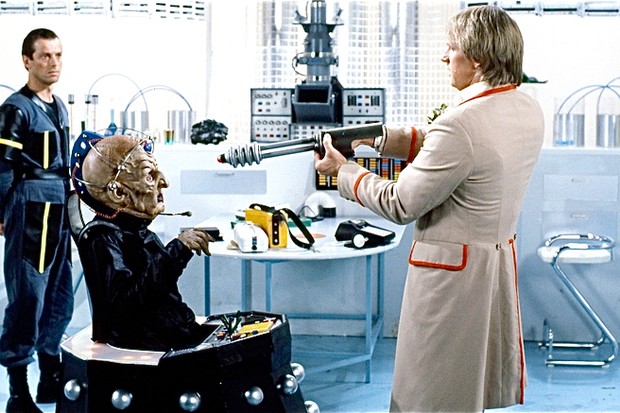
This is the only scene in the story that the Doctor and Davros share,
and it's a pretty decent one. Here, the Fifth Doctor is behaving
completely irrationally -- his scheme to assassinate Davros is
ill-conceived, and we don't believe for a second that he'll actually be
able to pull the trigger, but isn't it fantastic to have Davros call him
on it? With a gun to his head, Davros still calmly calls the Doctor a
coward...
And how cool is Davros' little voice over in Part Four when he checks
his escape hatch, and breaks the virus ampoule... "Now, for the Daleks!"
Ooh, I love that bit. It's a gorgeous and subtle nod to the Doctor's
discussion with Davros in Genesis of the Daleks about
whether or not he would unleash a virus that would destroy all life.
Here, it's no longer left for Davros to speculate on a theoretical
situation -- he has the opportunity to do it, and does so without
hesitation. It makes him so much more dangerous, and yet, as with his
unfolding madness, is a natural character development.
And maybe I've got a soft spot for bitches, but I absolutely love Rula
Lenska's Styles. If it wasn't for her, those scenes in the self-destruct
chamber would be excruciatingly dull. Instead, she offers hints of a dry
sense of humour under a gruff exterior as she's working out the code that
will end in their own destruction. In fact, the rest of the prison ship's
crew are perhaps surprisingly effective. Part One is given a tremendous
boost in the personification of just about everyone on board as complacent
arses -- the bitch factor is off the scale as personnel are smoking on
duty, flashing their green and silver nails and grumbling about how they
ended up on a forgotten prison ship.
Unfortunately, the loads of potential established in the first two
episodes are, for the most part, completely ditched in the final two
instalments. Whereas Part One is one of the most fast-paced episodes
ever, Part Three is a perfect example of, well, a bad third episode.
It's chock full of filler material and miles away from the frenetic energy
of the first half. Here we have Mercer and Turlough wandering aimlessly
through the ship, the Doctor strapped to a bubble-wrap bed, and Tegan
escaping only to be recaptured -- none of which advances the plot
whatsoever. There are a bunch of really stupid bits in the second half of
the story as well, like how Tegan is sent as a prisoner to the Dalek ship
sans escort, and how the Supreme Daleks suddenly decides to abandon the
entire plan because it has decided Davros is untrustworthy...
This is without a doubt my least favourite characterization of the
Fifth Doctor. He's a complete moron in Resurrection, and an
unlikeable one at that. It bothers the hell out of me that the Doctor so
neglects the safety of his companions throughout the four episodes. He
doesn't seem to be in any sort of hurry to get Turlough off the Dalek ship
after he gets snatched up by the time corridor, and when he does decide to
venture to the ship in the TARDIS at the end of Part Two, he leaves an
injured Tegan in the hands of people he's barely met, in a building that
at any moment, could become infested with Daleks. His callous behaviour
and uncharacteristic ineptitude in dealing with his enemies -- from
deciding at the spur of the moment to gun down Davros to using the
Movellan Virus -- makes Tegan's departure all the more realistic.
The Doctor, quite frankly, deserves to be punished for his complete
failure as a hero in Resurrection. The violence is sickening --
Laird's murder, in particular, coming across as completely sadistic and
unnecessary -- and the Doctor really hasn't done all that much to prevent
the death and suffering of those around him. Rather, his "solution"
merely consists of further death and destruction. Janet Fielding is
superb in her final scene. It could have so easily been maudlin, but
instead, it's utterly painful to see her go this way. It's the reference
to Auntie Vanessa that always breaks me down, and the "it's stopped being
fun" bit... It's perhaps the closest to achieving realism that a
companion ever got after Ian and Barbara in Season One.
Forget the Doctor's failure to save Adric in Earthshock -- it's in Resurrection that he fails
completely, and if it weren't for Tegan's brave decision to part his
company, I'm not entirely sure he would've recognized his folly. A
fantastic ending.
8/10
A Terrible, Terrible Waste by Ewen Campion-Clarke
21/1/06
"Hide your eyes if it offends you."
Resurrection of the Daleks has to be the most bored Doctor
Who story ever.
Not that it's dull, or boring, but bored. The story seems to be looking
around, desperate to find something interesting, and then dropping it,
bored, before finding something new.
Look at the way it treats the Doctor. For two episodes he's stuck in a
plot that has nothing to do with the rest of the story - skulking around
some eerie docklands patrolled by sinister police force that he never
meets. Working with the bomb disposal squad that ignore pretty much
everything he says. At the half-way mark, the Doctor travels into the main
plot with the Daleks... and gets locked in a room for another episode,
getting his memories sucked out in a flashback sequence. When he gets out,
he picks up a gun (something he was deliberately avoiding all through the
first two episodes) and heads off to kill Davros. Except he doesn't. Then
he goes back to the warehouse plot and releases a virus that blows up the
Daleks.
Resurrection of the Daleks is a story that has no interest in
the Doctor, Tegan or Turlough. And considering it's Tegan's swansong,
that's a bit of a shame. She gets knocked out in part two, then hides in
the TARDIS for the rest of the story, leaving it and running away, and
then changing her mind at the last minute. Her departure is one thing
that's handled well, but it would make more sense for her to depart in the
belief the Doctor's become a hardened killer than a general "being sick of
it". Tegan seemed "sick of it" before she joined in Logopolis and didn't want to leave in either Time-Flight or The King's Demons.
No, Resurrection isn't interested in the TARDIS crew.
Maybe it's the Daleks? Yes, the Daleks! After all, first time since
1979 we get to see the metal pepperpots from Skaro and this time no
Douglas Adams "sillyness". Yes, we can forgive a story for focussing on
the monsters that made the series famous.
One problem. Resurrection seems less interested in the Daleks
than it does the TARDIS crew.
Now, if I was in the position for writing a story for the Daleks, I'd
want to use them. Make them deadly, kill-all-biped psychopaths or very
cunning, self-controlled alien death machines. Make them scary, nasty and
feared by one and all.
Resurrection doesn't do that, does it?
The first time we see the Daleks, they explode through a door and...
get blown up. This gives them their new catchphrases. Forget
"Exterminate!" or "Resistance is useless!", the Daleks spend most of the
story shouting "Retreat! Withdraw!" or "My vision is impaired, I cannot
see!" They aren't even able to defeat a bunch of smoking layabouts who run
the space prison. They need Lytton and his men to get the job done, to
defeat Styles and Mercer, to face off against Davros. The Daleks have
seemingly dozens of plans working all at once and not one of them works.
The Supreme Dalek spends the entire story staring at a crystal ball and
complaining.
The Daleks don't seem to have any reason to be in the plot. When two of
them appear and wipe out the control deck crew, it seems like a token
gesture. See? Daleks are in this one! But Lytton's mercenaries do more
work. The Daleks pop in for a gloat at the Doctor when they record his
memory, and then run away leaving the human character Stien to do their
work. As many troopers are ambushed by Davros' little laser gun as are
Daleks, and they are interchangeable on a story level.
Not only are the Daleks badly used, they're treated with open contempt.
Lytton calls the Daleks stupid to their faces, plots behind their backs
and escapes with his life. Davros, their creator, is determined to make a
new race of Daleks that aren't as crap as the one that are here. The
Daleks explode, froth, melt and disgorge their contents at the slightest
provocation. They can't even go through doors without blowing them up
first and it's painful to see the humans using normal doorways you have to
step through while the Daleks have to wait to slide the entire wall back
to let them through. The Daleks we discover are, in fact, on the edge of
extinction with those rastafarian androids the Movellans completely
defeating their enemies off screen.
We're supposed to be impressed by these things? Scared by them? The
policemen are more intimidating!
No, the Daleks are as irrelevant to Resurrection as the Doctor.
Maybe it's Davros?
After all, Davros definitely gets a lot of screen time. He's the
prisoner who, in an hour after his release, has brainwashed four troopers,
a chemist and two Daleks to his cause and sensible created a batch of
weapons of mass destruction. Davros also appears, for some reason, to have
the moral high ground. The Doctor strides in, picks up a gun and is about
to kill this one-armed, blind cripple in a wheelchair.
And Davros stops him using the power of words alone.
Um, forgive me, but the Doctor is the hero of the series, isn't he? Not
Davros. Davros is an insane megalomaniac directly responsible for wiping
out his own species. Yet the scenes in Resurrection show him
cleverer than the Doctor and the Daleks combined. The Doctor is said to be
the insane one, rejecting the fact that all sentient life exists merely to
beat the crap out of each other. The Doctor said to be the weak one for
not murdering a helpless victim right away. Humans are pathetic too,
apparently, because we don't slaughter prisoners as soon as look at them.
<
Of course, Davros gets his comeuppance in the end. But the Doctor
doesn't defeat him, or the Daleks, or all the characters united. Davros
loses because he is stupid and forgets that a virus designed to wipe out
Kaled mutants might just effect his mutated Kaled body.
Well, maybe Resurrection is more concerned with original
characters...
Wait a minute, what original characters? We get three groups - Archer,
Laird and the troops on Earth, 1984; Mercer, Styles and the prison gang in
space, in the future; and Lytton, Stein and the mercenaries. These
characters aren't treated particularly reverently. Archer and his gang are
systematically killed and then replaced with clones. It takes ages to
drain the knowledge of the Doctor and it seems to be important for the
victim to be alive, but the Daleks are able to copy and convert several
dead soldiers as well in the living in around ten seconds. And why are
these perfect copies such crap actors? Why isn't Laird copied?
Now, it strikes me that if you kill off a character and then replace it
with a clone, in storytelling terms you might as well not have killed them
off at all. Are we supposed to care when the evil cloned soldiers get shot
by Daleks? But if it were the original, fighting desperately to keep the
Daleks in the warehouse and away from the rest of London, we might
actually care.
But we don't. They die. So do a lot of people. A lot of good people,
according to Tegan, and it's lucky she tells us that because we certainly
don't get a chance to make our own mind up.
Take Mercer and Styles. We get a good chance to know them. A chance,
anyway. The first sequence shows Mercer as young, idealistic and
rebellious and Styles as tired, desperate and corrupt. The crew of station
are more interested in relaxing and playing cards and smoking and laugh
aloud at the idea of their workplace actually getting attacked. But in ten
minutes Styles is gleefully determined to sacrifice her life on a suicide
charge into the Dalek ship, not to mention blowing up the station. In the
final battle, she's the first to be shot - which is either shockingly
innovative or dramatically pathetic, I'm not sure which. Similarly, Mercer
doesn't get any real emotion to his death, he doesn't even scream.
Indeed, there is so much carnage, you wonder if you're supposed to
care. The opening scene where a bunch of alien prisoners and a harmless
tramp are machine-gunned to death, that's shocking. Like the opening to
the author's The Visitation on speed. But then
there's another massacre on the space station when the mercenaries gas the
workers and the Daleks blast those that are left. By the time Turlough has
hopped over the heap of corpses, either trying to prevent infection or
stop himself vomiting with a hanky, I think we're fully desensitized.
Daleks shoot each other, shoot humans, explode with toothpaste... Tegan
seems to be the only one to notice it was a complete bloodbath.
Stein is the only character who dies with a point - and even that's
debatable. The Daleks shoot him and luckily his corpse hits the control.
And it's ironic because he is the most badly-plotted character there. Why
is he with the other prisoners? How come he hides when surely all he has
to do is wander into the time corridor for a welcome and that food he's
always asking for?
Come to think of it, who are the prisoners at the start of the story?
Why are they imprisoned on Earth 1984 in the first place? Why was Lytton's
lieutenant so stupid as to arrange for these "valuable specimens" to be
shot dead? Does it matter, if the converter seems able to work on dead
bodies? It seems the specimens are to be converted into evil Dalek clones
to bring down society... but why try that in the future as well as 1984?
Surely if human society collapses in the twentieth century, it won't exist
in the twenty-third for other duplicates? What is the plan the Supreme
Dalek has to control Davros and why the hell doesn't he use it? Where did
Davros get that funky brainwashing gun and why didn't he use it earlier,
like when he was arrested? I could complain at the bad continuity between
other Dalek stories, but I'll simply ask why Eric Saward was so utterly
useless at them after watching every existing Dalek story? Wasn't he
paying attention? Was he actually interested in writing this story at all?
Was there some subtext that the world needed to know?
Is Resurrection more of a message story? What is its message?
Er...
Well, I think it is that the only way for life kind to go on is to blow
up absolutely everything else.
After all, the day is won when Stein blows up the space station, the
Daleks, and (apparently) Davros. It's Lytton that survives the story by
killing anyone who can stop him. If the humans had blown up Davros, none
of this would happen. It's blowing up Daleks that stops them. The Movellan
canisters are rubbished by Tegan, Laird and Turlough when they discover
they are not bombs and can't blow anything up. The Doctor snatches up
bombs and blows up more Daleks.
So, the moral of the story is the only winners are those with superior
firepower and no moral scruples.
Remind me, why the hell was this allowed to be shown in Doctor
Who? Full frontal nudity has as much place in this program - and at
least that's slightly more wholesome! This story was written by the SCRIPT
EDITOR of Doctor Who and he couldn't even remember that the Doctor
is supposed to show a better way to resolving situations than shooting
your enemy in cold blood? Eric Saward recently admitted in DWM that his
heart wasn't in Resurrection of the Daleks. Which, considering he
had an extension of year to tinker with it, is a damning indictment of his
skills.
Now, this isn't to say that Resurrection of the Daleks has no
merit. All those involved (bar Saward) give their all to this mess,
making such a sleek and polished production that the fans of 1984 were
conned into thinking it better than The Caves of
Androzani (a fact now treated by people with the same amusement that
once people thought the Earth rested on the back of a tortoise). The
actors give it their all, the special effects are massive. The moment when
the TARDIS takes off carrying Tegan and Turlough to safety is treated with
equal respect if not emotion when the Doctor pulls the same trick in The Parting of the Ways.
Resurrection of the Daleks continues the harshness of Season 21,
and finally shows the characters cracking under the strain of this cruel
universe. The Doctor snaps and picks up a gun, while Tegan gives up and
walks away. The Time Lord avows to mend his ways and stop any further
carnage from now on. The rest of the stories in the season would show how
well this progressed.
A Review by Finn Clark
30/1/06
I've always liked Resurrection of the Daleks. I rewatched it
alongside Dalek Invasion of Earth and in many ways
it's a fitting companion piece (and companion departure piece: Susan vs.
Tegan). They're among the grimmest Doctor Who stories, taking the
Daleks to London and going apeshit with the body count. There aren't many
laughs in either story, but there's certainly death. Lots and lots of
death. Yes, this story isn't exactly fun... but for me, this is how
Dalek stories should be. It's very Terry Nation, like a 1970s Dalek
annual. EVERYONE DIES. (Okay, that's not quite true. One guest
character survives, but against that some people get duplicated and die
twice!)
In Hartnell's favour, Dalek Invasion of Earth has
that whole "Nazi occupation" thing and more realism. Resurrection of
the Daleks has a plastic SF future and even Matthew Robinson's rather
good direction can't quite overcome that. (From Genesis onwards, Dalek stories were impressively
directed.) However Resurrection also has enough brutality to
out-gross Season 22. Those melting faces on the space station, the
numbing body count, the way a Dalek trooper takes leisurely aim before
murdering that cute girl in episode one...
It's interesting that this story was scheduled for Season 20 until a
BBC strike derailed it. Season 21 is famously as bleak and gruesome as
Season 22 but with Peter Davison instead of Colin Baker, but imagine how
Season 20 nearly looked. Terminus,
Resurrection and Turlough trying to murder the Doctor!
The plot's a mess, of course. The Daleks are trying to do a million
things at once, random story elements get thrown in and dropped at whim...
but I quite enjoyed that! They're Daleks. Of course it's a complex
situation! There's Davros, the Movellan virus, Dalek duplicates and of
course the infamous plot to assassinate the Gallifreyan High Council.
Look at this Matthew Robinson quote from TV Zone #88: "You never knew
which side anybody was on, and there were about a dozen different sides...
I think I cleared the ticket of extra strands, chopping it down with the
writer a little. If I don't understand it, the viewers aren't going to
understand it."
However for once this really is part of a much bigger story.
Resurrection isn't just a four-parter, but Act Three of a
twenty-part epic spanning fourteen years from 1975 (Genesis) to 1988 (Remembrance) and
arguably beyond to the Time War of Russell T. Davies. If Genesis was the Time Lords' first strike, then
Resurrection is the Daleks' counter-strike! Okay, I'm using
fannish perspectives to prop up a slightly silly revelation.
Nevertheless one must wonder when Davros got so knowledgeable about
Gallifrey ("You are soft - like all Time Lords you prefer to stand and
watch."). Even the "goof" of Leela's omission from the Doctor's old faces
parade fits beautifully... he's hiding the identity of the only companion
he actually left on Gallifrey!
If you think that's bad, try another theory... when he's rigged up to
the Dalek's mind-spike torture device, the Doctor starts sending
information the wrong way to hack another piece of Dalek technology, viz.
Stein's mind. That helps to trigger Stein's conscience, but it also
explains where he learned about Lytton. (The 6th Doctor speaks of him
with great familiarity in Attack of the Cybermen, but
they'd barely met.)
Let's discuss Eric Saward. Earthshock and
Resurrection infamously borrow from the past (though Terry Nation
recycled too), but I think this story doesn't get enough credit for its
original elements. For starters, Saward writes the best Daleks since
David Whitaker. They're impulsive, murderous, double-crossing sons of
bitches, not just Davros's sidekicks (Genesis, Revelation) or robots (Destiny).
We see blobby things in destroyed casings. Their organic nature is even
vital for the plot (the Movellan virus) while the killer mutant in Episode
Two is one of my favourite things from any Dalek story. Blow up its
casing and it'll still try to kill you!
The continuity is heavy, yes, but look at how the Dalek stories from Genesis to Remembrance dovetail in
a manner possibly unique in television, let alone just Doctor Who.
What's more, the stories are good! (Compare in any respect with, for
instance, the Cyber-stories over the same period.)
Resurrection is sinister, especially on Earth. The severed
cable in the phone box, the killer policemen, that Invasion of the Body
Snatchers vibe... even Davros occasionally gave me the creeps. It's too
macho and fast-paced to be scary, but it's not without atmosphere. The
ending in particular is like nothing else in Doctor Who. It's not
tragic like Earthshock or Attack of
the Cybermen, but it's deeply uncomfortable. You've got Tegan's
traumatic departure, the Doctor's shellshocked reaction, Dalek duplicates
in strategic positions in Earth society, more corpses than a small war and
of course Lytton walking away at the end.
The production is solid. Compare with Warriors of
the Deep... it's not floodlit, but instead has lots of atmospheric
shadows and a distinctive futuristic look. Admittedly there were several
"downbeat SF future" stories around this time (see also Warriors' Gate, Terminus, The Mysterious Planet, Vengeance on
Varos, Frontios, etc.) but I rather like that
sub-genre. They're more interesting than overlit antiseptic utopias and
they work better on-screen when realised under 1980s BBC production
values! This story even characterises its bleak future with details like
ethnic minorities and cigarettes. (I'd even go so far as to defend the
gun designs, though I might be on my own there.)
The acting's impressive. The space station crew can be hit-or-miss,
but I relished Maurice Colbourne, Rodney Bewes, Rula Lenska and Del
Henney. Even Chloe Ashcroft (better known for presenting children's TV)
is far from being the weak link. On the DVD commentary track, Matthew
Robinson notes that JNT had been pushing for a strong cast for the return
of the Daleks. I can believe it.
And of course there's Peter Davison. I could watch Davison all day.
It's a masterclass. Watch his murder attempt on Davros. I couldn't call
it another "Do I have the right?" from Genesis, but I
prefer it to the sugar scene in Remembrance simply
for the subtleties of Davison's performance. Admittedly the Doctor
doesn't come out of that scene looking good. However in the greater
scheme of things I think it's vital, especially if you're watching the
five Davros stories back to back. It's the "why doesn't Batman kill the
Joker?" question. The Doctor doesn't kill the Master because they used to
be friends (except that in the very next story he did!), but not so with
Davros. Their history wouldn't make sense without that scene... it's not
that the Doctor never considered killing his enemy, but he couldn't do it.
Call him a coward if you like; Eccleston's Doctor explicitly embraced that
label after a similar decision in The Parting of
the Ways!
Of the companions, ironically Turlough has the better role. He's lots
of fun in episode three as a slippery bastard stuck with idiots dead set
on blowing themselves up. He's ruthless too. ("What about the troopers?"
"We kill them.") Mark Strickson is great to watch; I particularly loved
his expression when everyone else is excited about entering the
self-destruct chamber.
In contrast Tegan gets short-changed, though in fairness this wasn't
going to be her departure story until the last minute. She's unmemorable,
frankly. There's her goodbye scene, of course, but I'm even ambivalent
about that. It's shocking and in-character, but it's been shoehorned into
an already overstuffed last episode and it's barely sixty seconds long.
(If you include the Doctor's monologue afterwards and Tegan's brief return
after he's gone, you can add another forty seconds to that total.) It's
an awfully one-note scene for poor Janet Fielding, who might have
appreciated a few more colours to play in her farewell... but sadly by
Doctor Who standards, even this is pretty good.
I wonder... was the third cliffhanger moved to make room for Tegan's
departure? Part one does brilliantly with the hoary old cliche of a
"look, a Dalek!" first cliffhanger, but part three's ending is bollocks.
Overall, this is very much a bits-and-pieces story. It works best if
you're squinting to ignore its ramshackle structure and putting it in the
context of larger things, but it has some superb elements. It has a great
doom-laden atmosphere, great Daleks and a strong all-round production. I
won't say that it deserved to win the "best story of Season 21" poll in
DWM that year, but I can see why it did.
Beginning, Ending by Ben Kirkham
22/5/07
It all started off so well, didn't it?
We open on a grey and gritty shot of London, and some people in strange
uniforms are getting violently gunned down by silent and impeccable
policemen. Some die quite badly, and the policemen continue on their beat.
It's an excellent opening, setting the scene for what promises to be an
exciting adventure.
Broken promises. After this wonderfully enigmatic opening,
Resurrection of the Daleks goes badly downhill, and degenerates
into one of the worst Doctor Who stories ever made. The main
problem is the complex plot. That's not usually a problem in Doctor
Who (see the excellent Ghost Light), but here the
plot is so ridiculously and boringly played out that when the end came it
took me another 25 minutes to recover. When the Daleks mention the Time
Lords, I wonder how we got from point A to point B. Many talk about the
Fifth Doctor's xenophobic tendencies in this story. I would enter this
debate if the story weren't so full of itself that I really didn't care
less.
When the story fails, at least a decent director can pull it out of the
flames. Well, Matthew Robinson does a great job with the location scenes,
but the studio scenes don't cut the mustard. Dramatic shots come across as
flat and bland. To be fair to him, the cast don't do him any favours. This
story contains some totally awful guest actors (mostly aboard the
spaceship) with a few good performances (Lytton, Davros, Styles, Stien).
"The morale on this ship is appalling." Yep, and so is the acting.
The Daleks deserved much better, too. They come across as stupid
soldiers that just shoot at people. Davros has also passed his prime,
though Terry Molloy gives a good performance.
But really, I'm just skirting the issue. The real problem with this
story (notwithstanding the horrible "plot", terrible guest acting, uneven
direction, pointless and ridiculous violence, continuity obsession, and
rubbish Daleks) is the way the TARDIS crew are treated. Let's see, upon
discovering Stien inside the warehouse, the Doctor, Tegan and Turlough
investigate. Turlough vanishes, Tegan gets injured and the Doctor joins up
with some army men and Chloe Ashcroft to walk around inside the warehouse
doing nothing but poke sticks at cats and wait for some answers to some
obscure questions no one seems to be asking. Turlough, meanwhile, walks
around the Dalek ship, looking shifty and not really doing anything
significant (at least Eric Saward's being consistent here). This is all
intercut with boring scenes of Rula Lenska's Styles trying to figure out
how to stop the Daleks, and boring guest stars moaning about the morale on
their vessel. Slightly more interestingly, a mysterious man called Lytton
resurrects Davros to tell him that the Daleks lost the war with the
Movellans (but everyone's forgotten about Destiny of the
Daleks, JNT, so no one really cares). This is all played over with
excruciatingly awful music from Malcolm Clarke.
That's about as dramatic as it gets. The Doctor gets the occasional
tense close-up, with poor Peter Davison doing his absolute best to inject
some interest. Eventually, doubles of everyone pop up everywhere, so the
Doctor gets aboard the Dalek ship, we get pointless flashbacks of past
companions and Doctors, and the Doctor considers killing Davros. A big
bomb goes off and kills lots of Daleks, but by this point everyone is dead
anyway so what's the point?
In the midst of all this dreck is Lytton, a genuinely interesting
character skilfully played by Maurice Colbourne. Lytton has his own
motives for reviving Davros, but always keeps his cards close to his
chest. He can't be trusted for the slightest second, and his return
appearance was indeed warranted.
Fortunately, the story hugely picks up five minutes before the end
credits. Tegan's emotional departure is both well written and convincingly
portrayed by Janet Fielding and Peter Davison. This was quite a big deal
at the time, as Tegan had been with the Fifth Doctor since before Day One,
and her ultimate decision to leave is understandable. A brilliant scene,
and wonderfully downbeat.
So, a great beginning and a great ending, shame about the middle. Says
a lot about 80's Doctor Who as a whole, really...
A Review by Brian May
23/10/07
Resurrection of the Daleks is a story I have a long-running
love-hate relationship with; a story which showcases the very best and
worst Doctor Who could offer.
It's exceptionally well made. Matthew Robinson's direction is nothing
short of superb. The use of the then-derelict Shad Thames features some of
the programme's best ever location photography. The opening slow tracking
shot is gorgeous, while every other exterior scene is similarly evocative.
Robinson and cameraman Ian Punter definitely have an eye for capturing a
desolate moodiness. They can't take all the credit, of course; the weather
was on their side, and the shots wouldn't be half as atmospheric had they
been in full sunshine (but, then again, it is England...)
Robinson's good work continues inside, and he's helped by excellent
design. The sets are great, with the corridors and rooms of the space
station and Dalek ship looking high budget indeed, and the warehouse
mock-up is very convincing. I know that true Who fans shouldn't
criticise the classic series for dodgy special effects, but it's always
cause to cheer when they were actually pretty good, as is the case here.
The weakest effect is probably the ray of the Dalek craft as it fires upon
the station, but if that's the worst then there's no real cause for
complaint.
There are some excellent performances, but to emphasise the
aforementioned balance, there are some less than excellent ones. Peter
Davison and Mark Strickson are brilliant, the latter making the most of a
thanklessly diminished role. Janet Fielding is similarly sidelined, but
she pulls out all the stops for a wonderful, emotionally charged departure
scene for Tegan. However, the star of this story is Maurice Coulbourne,
who is absolutely stunning as Lytton. His amoral mercenary is such a
hateable character, but you can't help but feel relieved - or at the very
least bestow a grudging admiration - when he walks away at the end. Del
Henney (Archer) and Philip McGough (Calder) are similarly excellent -
except at the very end, with their awful death scenes (but more on this
later), while Rodney Bewes does well capturing all of Stien's
idiosyncrasies. Terry Molloy as Davros had a difficult task ahead of him.
He's much better than David Gooderson but still pales in comparison to
Michael Wisher's definitive portrayal of the Kaled scientist (a
performance no one could emulate). Molloy does well in quieter moments,
but his endless rants are too over the top, often unintelligible and
another pale imitation of the far more frightening mood swings Wisher gave
us.
Most of the bad performances come from the space-station crew, who are
thankfully disposed of quickly - except for Jim Findlay as Mercer, who
continues his combination of inexperience and awful dialogue through to
the final episode. While Rula Lenska is good as Styles, she's wasted in
the role, just walking through corridors, dithering in the self-destruct
room and matching Mercer almost word for word in spouting macho, would-be
cynical drivel. And Chloe Ashcroft is very poor as Laird - one of John
Nathan-Turner's less successful celebrity castings.
A couple of pieces of good dialogue aside - the Doctor's speech about
killing Davros and the exchange between the two - the script is rubbish.
It's a garbling of series continuity, in an era of Doctor Who
infamous for it, with occasional inaccuracies (Davros was aware of the
Dalek-Movellan stalemate) and another obligatory flashbacks sequence. This
time it's gratuitous, lacking the nostalgic charm of Mawdryn Undead's or the mournful recollections of those
in Logopolis. The story is an overall mess, with all
the plotting and counter-plotting merging into a maelstrom of confusion,
changing at the author's whim; the plan to assassinate the High Council
seems to have been written just to fulfil a fanboy thrill of hearing the
Daleks say "Gallifrey". When Stien yells out "I can't stand the confusion
in my mind!" he's not the only one!
The violence doesn't bother me as much as it used to. Death has always
been a part of Doctor Who, and despite the high body count most of
the killings are clean, laser gun dispatches (although, in my opinion, the
close-ups of the burnt faces went too far for what was still a kids'
show). There are some well realised, haunting images of death: the
massacre of escaped prisoners and the tramp at the beginning, and the
policeman shooting the man with the metal detector - a grim piece of
sadism designed to break Tegan's spirit. The off-screen deaths of Galloway
and Calder are other examples, but the best is the demise of Archer at the
hands of the two policemen; the vision cuts away at exactly the right
moment to leave the rest to our imaginations. But these are in the
minority; the rest are just so over the top. Ironically, the worst is the
duplicate Archer's death, a real shame given Henney's otherwise superb
performance. It's just one of many embarrassing, overacted incidents of
squealing and thrashing about that cheapens the intended effect. It's the
overall attitude to death that's more disturbing than any obvious violence
- and no, the attempted moralism at the end (Tegan is upset by it all, so
that makes it okay) doesn't work.
Oh, and all those hats and helmets are very silly too!
From the feature on the DVD release, it's interesting to see that Eric
Saward has acknowledged the shortcomings of this story while John
Nathan-Turner defended it to the end (and he died not long after this
interview). I've never liked the use of Davros beyond Genesis, but Saward also mentions that his inclusion was
imposed by Terry Nation, so the blame can't fall on the hands of this
production team.
Resurrection of the Daleks is another Doctor Who
blockbuster, following on from Saward's own Earthshock, but with none of that story's impact or
surprise. It's the programme at its most Hollywood: great to look at, but
ultimately hollow. 4/10
Cut and paste by Thomas Cookson
9/3/13
What if Resurrection of the Daleks actually had closed Season
20? Resurrection of the Daleks dances between a plotless incoherent
mess of nauseating violent excesses, and an interesting experiment in punk
art visual storytelling (which Revelation of the
Daleks later perfects). The opening massacre, whilst making no plot
sense, is an admirably audacious surrealist parody of police brutality.
The Daleks' entrance is expertly handled, and Davros' reveal is a genuine
surprise.
But a lack of focus makes the Daleks feel surplus to requirements in
their own story until their eventual mass destruction is overindulged,
completely eroding their robust formidable presence. For instance,
Lytton's men slaughter Styles and her crew in the self-destruct chamber,
simply so the Daleks can reprimand Lytton for his failure afterwards,
leading to him making his escape plan. It begs the question why not just
send a single Dalek to exterminate them all, rather than waiting on
Lytton's elaborate, cumbersome break in. That would make more sense and
show the Daleks as more formidable.
Alas, Saward's only interested in telling Lytton's story. Ultimately,
it's all rendered off-balance by its nightmarish excesses and vulgar
unpleasantness. But what if Peter Grimwade had directed it as originally
intended? Weaving his Earthshock magic again, turning
a potentially depressing, sadistic, leery production into something
satisfyingly slick and dynamic. Doing for the Daleks what Earthshock did for the Cybermen, given the same sharp
eye behind the camera? Would the story have felt focused and momentous
rather than incoherent? Punctuated by its violence rather than drowned in
it? Would he have captured the energetic, euphoric spirit of survival
horror instead of tired, mindless suicidal self-destruction?
As transmitted, there just seems no need for all its violence. But
ideally it should have felt wholly appropriate for a Dalek story with a
brutal honesty about the horrors of war that goes completely against 80s
'army chic'. Perhaps it would have worked if done with the same class that
Earthshock was.
Furthermore, would it have improved Season 20, making the season more
than the sum of its parts? Arguably, Season 19, which was all about
getting Tegan home, was the last time the show had a sense of direction,
before aimless navel-gazing and apathy of the main characters took hold.
Earthshock was perhaps the culmination of Season 19's
'we're all in the same tribe' ethos. So would Resurrection of the
Daleks have given Season 20 a sense of culmination, or direction, or
at least some pay-off?
Maybe it would have been felt that, after a season about the tedium of
existence, we had finally gotten a proper balls-out action story. That
pantomime villains like the Master and Black Guardian were merely warming
us up for the Doctor's true greatest enemy, now deadlier than ever. Giving
the season a finality that The King's Demons lacked,
and even possibly redeeming the Doctor for his failure in letting the
Master escape again by showing him annihilating a far greater threat to
the cosmos.
Resurrection of the Daleks could have justified The King's Demons after all if, as is rumoured, it was
Kamelion who was meant to fall under Dalek influence and then overcome
their control and self-destruct the station at the end, rather than Stien
(which would have made far more sense). Maybe The King's
Demons would have ended with Frontios'
cliffhanger rather than the Doctor playing that lame, characteristically
passive aggressive trick on Tegan.
Perhaps the moment where the Doctor can't bring himself to kill Davros
would nicely bookend the Doctor's shooting of Omega in Arc of Infinity (as would the Dalek plot to assassinate
the High Council). It also could have nicely echoed Turlough's choice and
the theme of understanding life's worth in Enlightenment.
Indeed, the idea in Terminus of a plague sweeping
the cosmos, and an isolated, decaying, lonely outpost in space, might have
felt like just setting the scenery for Resurrection of the Daleks.
The horrific fate of the soldiers in the warehouse might have also
complemented Mawdryn Undead's hint that the cosy,
innocent days of UNIT were over and that the world was far less forgiving
now.
But, more importantly, there is the issue of the Fifth Doctor's
character. The problem with Davison's Doctor is that he was entirely
defined by his contrast to Tom Baker. He was defined more by who he
wasn't. He was specifically cast because of his professional behaviour and
because, unlike Tom, he would play the part as told to. The trouble is,
few writers seemed to know what he should be. JNT and Eric Saward had
clashing ideas of who the Fifth Doctor was. To JNT, he was a dashing young
hero with a tragic vulnerability. To Eric Saward, he was a moral nuisance
who for too long had been validated by the pact trappings of a morally
trite kid's show. Other writers had other ideas, such as Bidmead's 'old
man trapped in a young man's body', but there was no solid writing team
and thus no consensus on the character. In fact, by most accounts, the
writers were utterly neglected and treated as disposable props by JNT and
Eric Saward.
The result is that his character was rarely written strongly. He was
sidelined and overshadowed by his companions. Hardly any writers, and
certainly not Eric Saward, seemed capable of being on the same page as the
Fifth Doctor, and ergo neither was the audience. This was pretty much
unprecedented for the show. So even when Earthshock
or Snakedance seemed a defining story for his Doctor,
afterwards a character reset-button got pressed. At the same time as the
Doctor was having his alien enigma and unpredictability eroded away, there
was paradoxically a consistent failure to get to the heart of the
character. He became buried in an impenetrable layer of earnest bluster,
self-righteousness and delusional, morally confused dogma, and, despite
his apparent nice guy image, he could sometimes be so high and mighty,
condescending and judgemental that he was more like the Sixth Doctor than
even the Sixth Doctor was.
Only Christopher Bailey seemed to truly understand his character, being
the only writer who liked the Williams era and was concerned that, under
JNT, the show's protagonist had regressed. The Fifth Doctor was not the
Doctor we knew. The Doctor we knew was somehow withdrawn and buried within
him. His essence was trapped in a more broken, timid, juvenile and
uncertain personality that had to serve as a vessel for him. It was the
Fifth Doctor who was the regeneration gone wrong. Not the Sixth Doctor (in
fact, the transition from the Fourth Doctor to the Sixth and Seventh makes
far more sense with the Fifth Doctor taken out of the equation entirely).
Now, on the one hand, this is an aberration. It means we endured an
entire era of Doctor Who where any semblance of the Doctor we'd all
come to admire was utterly absent. In which we're waiting for the current
Doctor to actually leave and be regenerated into the competent hero he's
supposed to be. But potentially this idea, if done right, could really up
the stakes and have emotional resonance. The idea of the Doctor's essence
being trapped within a weaker body and having never been in a more
vulnerable and fragile state, carried with meek delicacy by a humble
courier who is simply trying to survive in a savage universe, is
potentially thrilling. It might even be affirming and poignant for anyone
in the audience who could relate to feeling that sense of uncertainty,
foolish passiveness or failure to measure up. But the focus and heart
often wasn't there, and was instead on clueless attempts to homage old
foes and old stories note for note, which only further limited his
character growth, rendered him even more incapable of learning anything
from his mistakes, and made unfavourable comparisons with his more
competent predecessors impossible to ignore.
Warriors of the Deep's problem is that it has a
pathetic protagonist trying desperately to preach about our folly. And so
had to be written with belligerent, self-righteous insistence that the
Doctor is right, that suicidal dogmatic pacifist lunacy is what the Doctor
always has and always should stand for, and so should we (this would make
even less sense if the story was transmitted after we'd seen him wiping
out the Daleks here). But the overriding concern was to make stories
neurotically faithful to a warped fan notion of the show's misremembered
past. In fact, this became the only circumstance in which it was deemed
essential for Eric Saward to do extensive script edits.
Whilst many fans insist that they saw and responded to the sensitive
heart in Davison's Doctor, I doubt that the public did. The public quite
liked Tom Baker, and weren't as eager as fandom to have him replaced with
someone so self-consciously, desperately different. But then, the public
weren't told what to think by DWM, or told how to see Davison's Doctor in
a 'sensitive' light like we fans were.
Season 20 is arguably where the Doctor as a character really begins to
suffer. He'd been fallible and doubtful in Season 19, but usually for
legitimate, overwhelming reasons. In Season 20 he had become simply a
bystander. Now Terminus and Mawdryn
Undead had demonstrated that this need not be a flaw if all the Doctor
needs to do is let the hand of chance resolve all problems instead (the
'right kind' of nothing); thus he didn't really come off as anywhere near
the liability he becomes in Season 21. Snakedance is
one of the few stories to acknowledge this idea of Davison's Doctor as the
self-doubting, withdrawn vessel. A story very much concerned with the
Doctor needing to find his buried centre in order to succeed. Again,
though, anyone expecting this to provide a lasting breakthrough for the
character in stories after, would be sorely disappointed.
But whilst Eric Saward never seemed to regard the Doctor much,
Resurrection of the Daleks did utilise a similar idea to Snakedance. The idea of the Doctor's true essence being
buried is echoed by the scene where the Dalek conditioning is ripping
through his memories (again, this is visual, emotional storytelling).
After this, the Doctor's Hartnellian ruthless streak becomes reawoken, he
promises to correct the mistake he made in Genesis of the
Daleks and almost executes Davros, but ultimately chickens out.
On the one hand, that moment proves Davros correct about the Doctor's
weakness. It even retroactively ruins the Doctor's ambiguity and hinted
darker streak in Genesis of the Daleks when he
threatens to shut down Davros' life support and sounds like he's not
bluffing. Here there's no doubt he was bluffing. However, the audience
actually is on the same page as him in that moment, and it is perhaps one
of the strongest examples of Eric Saward's writing showing a post-modern
understanding that morality is simply a state of mind and merely based on
an individual's point of view. Like the philosophical musings in Snakedance.
If both Snakedance and Resurrection of the
Daleks, in the same season had portrayed the Fifth Doctor this way,
would we have had a more definitive portrayal of him in future rather than
the morally confused, utterly alienating portrayal we got in Season 21?
Could we forgive its moral torpor if it were simply a one-off in an
otherwise lightweight season that briefly flirted with morbidity in Mawdryn Undead and Terminus, but
otherwise featured happy endings that didn't stain the Doctor's hands?
Here, the Doctor's principles failed him and his only choice was to break
out the Movellan plague and wipe out the enemy. But would that be
forgivable if it were emphasised by stories prior that this was a rare
exception, rather than how Season 21 made it the rule? Maybe the Doctor's
"do you think I wanted it this way?" would ring far truer.
But for all that to happen, Resurrection of the Daleks would
have to be not only Season 20's closer story, but followed by a complete
production team changeover.
"They're dying. And so are you." by Hugh Sturgess
15/10/14
Resurrection of the Daleks is most commonly compared to Earthshock, being the return of a classic monster after
many years absence in a Sawardian bloodbath that re-establishes said
monsters as arse-kicking killing-machines. However, I think the
comparisons with Attack of the Cybermen are more
revealing, beyond Lytton's appearance in both. Both are pathologically
violent in a way Earthshock is not. Both end with the
Doctor defeating the bad guys, but his victory feels worse than his defeat
in Earthshock. Both push the Sawardian obsessions
(mercenaries; "real world" violence; unlikeable, unthinkingly aggressive
characters) to the point of being existential. Both are famously light on
plot.
There is also death. Lots of it. According to About Time, there are seventy-four onscreen deaths
in this story (including Daleks), and I can believe it. This story has a
cast of thousands, and they are hacked down mercilessly. Death is so
omnipresent that it's as though some metaphysical point is being made
about the meaninglessness of existence. Sometimes it's stomach-churning,
such as the station officer wailing "What's happening to me?!" as his face
and fingers corrode and melt. Sometimes it's sadistic, such as Professor
Laird screaming as she is shot in the back. Mostly, it's casual and
clinical, from the opening massacre to the fake policeman gunning down a
riverbank scavenger on the off-chance he might hear Tegan calling for
help, right through to Lytton's casual killing of the remaining Dalek
trooper. ("They're dying. And so are you.")
There are some truly gruesome things in this story. The disfigured
station officer is an exemplar, but let's not forget the long zoom on the
dead crewman whose face has been reduced to a shapeless mass of raw meat a
few scenes earlier. Turlough stumbles on a Dalek morgue filled with
rotting corpses. Those are the overtly graphic elements. There are things
that stay in the mind just as long that don't involve gore. What about the
Dalek trooper who takes a leisurely aim at Osborn before gunning her down?
Saying that Resurrection is too violent misses the point. It is
incredibly violent, nihilistically so, but it's not meant to be nice and
jolly. It's what happens when you have the misfortune to cross paths with
the Daleks. Think of all the lame Dalek stories that make them look like
idiots (The Chase, Planet of the
Daleks, Destiny, etc.). Everyone went hog-wild
over Resurrection on first broadcast, didn't they? That was
probably because this was the Dalek story we always had in our heads. The
Daleks turn up and kill EVERYONE. They even kill themselves! Like the
stories in our heads, it may not have the world's most coherent plot, but
its messiness is a selling point. The Doctor hasn't found his way to the
enormous plot at the heart of the Dalek Empire, but merely stumbled upon
its outer edge. He glimpses just a few of the plans they have in motion
and escapes amid a deluge of corpses. Think about what happened to the
Master in the story that was meant to precede this (The
King's Demons). He dresses up as a comedy Frenchman to derail the
Magna Carta. Seriously? While he was doing that, the Daleks were planning
to break Davros out of prison, cure the virus that was destroying them,
take over Earth with duplicates and duplicate the Doctor to create a
Manchurian Candidate avenger to assassinate the High Council of the Time
Lords. They make the Master look like a guy who can't even hold up a
convenience store. (Frankly, it's stories like The King's
Demons that make the "it's all a laugh" theory about the Master's
motivations essential.)
Saward does go off the rails trying to keep all the plates he's
juggling in the air. The Supreme Dalek tells Lytton that he has "a plan
that will force Davros to leave of his own free will". What is it? We
never find out, and within no time he's decided that Davros can't be
trusted and should be killed, even though he has previously asserted that
"without Davros we have no future". Is the innate Dalek bloodthirstiness
getting the better of him? And this has been asked a thousand times, but
what are the casings of the Movellan virus doing on Earth? When Stein so
much as mentions the virus, Tegan immediately concludes that that is what
is in the canisters, but why? Stein says that the Daleks thought the
cylinders were "safer" on Earth (fair enough, the Daleks would be afraid
of contamination, but they expect Davros to work on the virus onboard
their ship, so they can't be that frightened), and they "acted as a lure"
for the bomb disposal squad, who could then be duplicated and guard the
warehouse end of the time corridor. Saward compliments himself by having
Tegan remark that the scheme is "very neat". But surely the Daleks know
that the human authorities will get suspicious when the bomb disposal
squad fails to report in? Why not just shut down the corridor, which the
Supreme Dalek orders done after the Dalek sent to Earth is destroyed?
Motivation has been put through a fruit mixer.
The Daleks themselves look a little ratty, and I was surprised just how
silly they sound. (And it's weird hearing a Dalek say: "He must be
ex-ter-min-at-ed as soon as it is con-ven-i-ent!".) Lytton declares that
Daleks "kill anyone, even if they need them". Like the depiction of the
titular monsters in Attack of the Cybermen, this
characterisation is not flattering, but it is distinctive. These Daleks
are rage-addled psychopaths who decide to kill everyone and ruin their own
plans on a whim. When they attack the prison, they don't capture the crew,
no, they wipe them out and stack up their bodies like matchwood. They
don't capture and brainwash the bomb disposal squad, they slaughter them
and clone them. They're not emotionless tools, either. They can be poetic
("Nothing must interfere with the true destiny of the Daleks!") and clever
("You forget: Daleks do not need to invade.") Also like Attack, this story is fascinated by the squishy, gross
organic bits inside the metal shells. The plot hinges on the Dalek
creatures as organic beings vulnerable to a virus, and the Dalek in the
warehouse is still dangerous even after its casing is destroyed.
This is a Doctor Who story that feels dangerous. It begins with
the casual killing of an innocent bystander (and a harmless old man at
that) by men dressed as policemen. Twice, characters approach them with a
relieved smile on their faces. The first is Colonel Archer, who promptly
gets shot in the face. When Tegan does the same, knowing that she gets out
of it alive didn't stop me feeling a little twinge of worry. This
depiction of evil hiding behind a familiar face continues with Archer's
duplicate telling Tegan and Laird that the warehouse is under martial law
and that he will shoot them if they attempt to leave. Even though the
TARDIS crew are in fact the only protagonists the Daleks don't kill on
sight (the Daleks need the Doctor's memories, use Tegan as leverage and
"allow the boy to roam freely", for some reason; "This will be the Dalek
Plan!", the Supreme decides), it feels like they only escape by the skin
of their teeth. I wouldn't want to be Turlough, wandering the
corpse-strewn corridors of the prison, or Tegan, in the ghost-town
Docklands stalked by the killer policemen.
In almost any other story, Tegan's last minute decision to leave would
be hollow. Here, when she says that she's "sick of it", you believe her. I
was sick of the killing by the end. You can pinpoint the moment her
enthusiasm for travelling with the Doctor vanishes completely: her
horrified reaction to the casual murder of the riverside scavenger, a
death she caused by calling to him for help. Mere minutes later, Laird,
Tegan's only friend after the Doctor goes to the Dalek ship, is brutally
gunned down, screaming. Finally, upon arriving on the Dalek ship, she is
nearly killed by Mercer (who tells Turlough that she was about to scream,
but raises his gun after it's clear she won't). This isn't fun, this isn't
exhilarating. It's a nightmare. If this happened to me, I'd want to get
out of there first chance I got and keep running.
This is how Dalek stories should be. If the Daleks are such a big deal,
write them stories which slaughter their casts and from which the Doctor
is lucky to escape.
An under-appreciated strength of this story is its links to Destiny of the Daleks. This is a genuine sequel,
following on from the events in that story and showing how they affect the
broader Doctor Who universe. The other JNT Dalek stories (Revelation and Remembrance) do the
same to this story, developing the Davros/Daleks schism with the Imperial
Daleks and the Dalek Civil War and advancing the Daleks' cold war with the
Time Lords. Resurrection isn't just another story, it's part of an
epic that stretches from Genesis of the Daleks to Remembrance thirteen years later. There's nothing else
like it in Doctor Who, and this is the story that whips it into
shape and makes it a narrative. I saw this story long before I saw Destiny of the Daleks. Could anyone know what to expect
from that story after seeing this one? Those Movellans, for instance. They
were already the Daleks' equals, and then outsmarted them and drove them
to the edge of extinction. They must be terrifying, right? Can't wait to
see them. Oops. Like The Deadly Assassin with the
later Gallifrey stories, Resurrection of the Daleks provides the
anchor for the other stories, the tentpole that turns them from
disconnected stories into a coherent whole.
(Speaking of which, what becomes of the Movellans after this story?
Does Davros come up with a cure to their virus? He has to, to survive his
infection at the end. Does he synthesise it for the "renegade" Daleks who
capture him in Revelation? Is the child in Remembrance of the Daleks, and the creativity she gives
the renegades, a response to their dependence on battle computers in Destiny? So are the Movellans all wiped out once they
lose their tactical advantages? It's amazing that a bunch of disco-droids
who can be beaten by unclipping their batteries ever inconvenienced the
Daleks for a second, and the explanation in War of the
Daleks (that the Movellans were actually created by the Daleks
themselves as part of an elaborate ruse) is superficially plausible.
However, why would the Daleks actually create a virus that kills them?
Besides, I'm not having four stories retconned by the likes of War of the Daleks.)
The production is good too, appropriate for the heralded return of the
Doctor's greatest enemies. The battle sequence as the Daleks storm the
prison station is a shameless rip-off of the famous opening to Star Wars,
but has a fantastic mix of direction and music. The shot of Daleks and
troopers advancing slowly through the smoke, to an ominous martial score,
is one of the most distinctive and evocative shots in the programme's
history. Unfortunately, future battle scenes get confused as the
post-production team forgot which guns make which sounds. As to the
frequent criticisms of the gun props used in this story, yes it looks like
kids playing war. But it heightens the story's theme of death coming
quickly and unexpectedly. There's an almost pitch-black comedy to the
swiftness with which characters are dispatched with nothing more than a
light bulb and a special-effect sound.
Actingwise, despite what seems to be a cast of thousands, only Stein
and Lytton could be called "major characters" beyond the regulars and
Davros. (I had to look up Wikipedia to find Osborn's name, for instance.)
Maurice Colbourne's is a mighty, mighty performance, being, as he is in Attack of the Cybermen, virtually the main character,
eclipsing even the Doctor. Rula Lenska is good, but she's been given an
odd verbal tic of repeating other characters' dialogue: "The cruiser's
docked!" and "Uniforms!". How did Saward intend her to deliver those
lines? On a similar note, Jim Findley as Mercer flubs several lines,
particularly "So we're letting him go", which only after Styles replies
"no" do we realise is actually meant to be a (rhetorical) question. They,
and the humans on Earth, are perfectly serviceable, since they don't have
much to do beyond die. Again, it's almost existential watching these
characters we never really know or like being slaughtered. The thematic
point, if one was intended, is strikingly grim.
Resurrection of the Daleks is the perfect companion piece to Attack of the Cybermen. It's a disturbingly bleak vision
of the series, and about as far from being an adventure as possible.
Largely unlikeable characters abound, being gunned down without
compunction or regard to their role in the story. Its plot is a massacre
in a script-factory, a blizzard of severed plot threads and gouts of
ruptured motivations, but its thematic strength - producing the bleakest,
least optimistic Doctor Who imaginable - overcomes those drawbacks.
Come Season Twenty-Two, Saward devotes the entire series to this vision,
and the result is grotesque. Nevertheless, the experiment was a worthwhile
one, and the show would be poorer if it didn't have a few stories like
this one.
Better Than All That by Jason A. Miller
23/4/23
It's derided for its plot illogic, its single-scene subplots, its over-the-top gore and violence, and its unlikely use of Rodney Bewes, but Resurrection of the Daleks is a highly subversive, ground-breaking bit of Doctor Who. I love it to bits.
The prison space station crew is just about an all-minority crew. Mercer is black, as is the unnamed trooper whose face and hands horrifically melt off in a poison gas attack, Osborn is South Asian, and Dr. Styles is a red-headed Eastern European female. Doctor Who wasn't really "doing" international diversity for most of the Classic Series. In the Gerry Davis era, a "multinational" cast meant an actor playing a Brit, an actor playing a Frenchman, an actor playing a Swede, and an actor (badly) playing an American, but the space station crew here wouldn't look out of place in Jodie Whittaker's first season. None of them survive, to be fair, but neither did the all-minority crew of Rogue One.
The Daleks are truly frightening, for the first time in, honestly, at least 16 years. Check out the crewmembers' horrified reaction shots when Daleks invade the space station. The Daleks bring death to multiple crewmembers at a time, and their poison gas is twice shown to do stomach-churning things to human flesh. Doctor Who hadn't really shown this kind of graphic violence before; the Daleks usually represented dark comedy (Destiny of the Daleks), light comedy (The Chase), or light tragedy (Death to the Daleks) in the past, but this is dark tragedy, the Daleks at their most destructive since Evil of the Daleks way back in 1967.
You can't see it in the broadcast two-part edit, but in the original four-part cut -- the one sold to the US in 1984, and the one available on the second disc of the DVD special edition -- the warehouse Dalek's cry of "Exterminate!" bleeds into the end credits. That's remarkable editing.
It's odd not hearing Roy Skelton (or Skelton's New Series sound-alike, Nicholas Briggs) as the lead Dalek voice, but Brian Miller, AKA Mr. Sarah Jane Smith, is pretty terrific as the Supreme Dalek. Terry Molloy would play Davros for decades after this story, on TV and then in Big Finish, and later became a worthy heir to the great Michael Wisher -- his work in Davros, the brilliant Lance Parkin-penned Big Finish audio (with Colin Baker's Doctor) is nuanced and heartbreaking and wickedly funny -- but Resurrection is more of a rocky first outing for him. His two comical double-takes in Part Two (the US Part Two) are ill-advised, not in keeping with the rest of the script. But his Part Three (US) rant delivered directly to the cliffhanger, is a perfect Wisher homage (see Genesis of the Daleks, Part Four, cliffhanger to).
JNT's stunt casting gets called into question, with musical comedy actress Rula Lenska playing a hard-bitten space doctor and with Rodney Bewes of The Likely Lads playing Stien, a confusing character who serves multiple plot purposes. But it works, it works. The New Series has certainly adapted the JNT playbook, with each new Chris Chibnall season trumpeting its celebrity guest stars in special promos. The stunt casting here is nearly perfect. Nearly. Lenska's character never gets to meet the Doctor and exits the script a bit too early, but she's mesmerizing when she's on screen (but enough about her hair). As an American kid who'd never heard of The Likely Lads (and who, at age 49, has still never seen it), I had no preconceived notions about Bewes when I watched Resurrection for the first time. The script has his character all over the place, but he does well in his three separate roles: the stuttering coward, the hard-bitten deputy to Lytton, and the conflicted hero proudly committing self-sacrifice. Stunt casting in this case helped the story.
Speaking of stunt casting, the non-speaking extra who plays the Dalek chemist looks eerily like US late-night TV legend David Letterman, doesn't he?
The script is a disaster, but that's surprisingly not a problem. Things happen for no explanation, and most of the characters are never named on screen (which is problematic when Maurice Colbourne's Lytton comes back in such a prominent role the following season -- if you caught that his name is Lytton in this story, boy, you got good ears). Paul Scoones on the DVD commentary spends about 60% of his time pointing out plot holes and production errors -- many of which he tried to fix in his TSV novelization, which, by the way, is far better than Eric Saward's own uneven adaptation (which was marred by bad prose, a talking cat, and a bizarre coda involving Tegan). The Doctor never exchanges words with Lytton, never even gets to meet Dr. Styles. But the energy or novelty in each scene, for me, is more interesting than a list of plot holes. I don't get tired of watching the story minute by minute.
Part Two (UK edit) is about as grim and downbeat as a Doctor Who story has been since the Hartnell era, rivaling the final episodes of The Massacre and The Gunfighters and The Daleks' Masterplan for sheer body count and mood. Only Lytton survives from the guest cast, and most of the deaths are intentionally cruel or callous -- the metal-detector man and Professor Laird being among the saddest. Saward writes wicked final lines for two dying men: "They're dying -- and so are you", and "Gentlemen, you've saved my life!" Body after body dies, particularly in the final ten minutes. The Doctor's failing to execute Davros is, frankly, wonderful. Peter Davison is called upon to hold a lot of guns in this story, but offsets the violent imagery with great non-verbal acting against the props: holding them gingerly, or viewing them with scowls and frowns and winces. You can see why Saward wanted a Colin Baker type to replace Davison in the role, and something would be lost when Baker's Season 22 character became a physical avenging-angel of death. On the other hand, Davison almost gleefully activating the Movellan virus in the warehouse in the final minutes ("Lunch for our friends upstairs"), while violent and cynical, is earned by the script up through that point in time.
While there lots of sardonic death lines, and other dialogue that The Discontinuity Guide memorably passes off as "clunking macho nonsense", Saward reserves some of his best-ever lines for Davros. When the Doctor challenges Davros on the lack of compassion in the Daleks' programming, Davros gives a beautifully worded lawyer's response, and Terry Molloy delivers the line intelligently: "They will learn to recognize the ... value that can be drawn from such an emotion." How can you ever downgrade a script that includes that line? Another intelligent line is the Doctor observing that, for the Daleks, "any response is seen as an act of provocation".
Tegan's departure scene is pretty raw and emotional (and would be completely undercut by Saward in his novelization). It's hard to watch this even now, 38 years later, without feeling a twinge of anguish at her hasty departure, and her running back into the warehouse to watch the TARDIS depart without her. The story up through her moment of departure is violent, cynical, dark, and upsetting. But it's got a very human Doctor throughout, it mostly earns its Part Four bloodbath, and the violence is brought home by Tegan's exit from the series. Not every Doctor Who story should be like this -- as we learned in Season 22 -- and plots should generally be tighter than this one, but I still find it a riveting experience to watch Resurrection of the Daleks.