
Pocket Essentials' Guide to Doctor Who
|
|
Pocket Essentials Pocket Essentials' Guide to Doctor Who |
| Author | Mark Campbell | 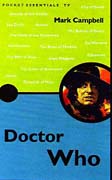 |
| ISBN# | 1 903 04719 6 | |
| Publisher | Pocket Essentials | |
| Published | 2000 |
| Summary: A short guide to the series at a glance, with every story reviewed |
Probably a Non-Essential Selection by Andrew Wixon 19/7/00
If you're saying 'What?', you're not alone: I hadn't heard of it either until my regular SF dealer pointed it out to me. Pocket Essentials probably didn't bother to send out review copies. Anyway, on with the review: Brothers and sisters, probably 90% of us could have written this book, being as it is another story-by-story, capsule-description-and-review style trawl through the televised series. Think a very heavily condensed version of The Discontinuity Guide and that's the format. The author (Mark Campbell) sat down and watched (or listened to) every episode and committed his opinion to paper. That's the book. Full stop. As I say, most of us could do the same.
This is a slim volume (less than 100 pages) and is thankfully correspondingly cheap, but it does mean it doesn't cover everything. The films, recent TV parodies, stage shows, and radio series get a review, the BF stories get a mention, and, er, that's about it. A few books and websites get plugged (but not this one).
So why even bother buying it? Well, Campbell's is a new voice and he's not afraid to be controversial or blunt. No sacred cow is safe, and he even goes so far as to suggest that the show is dead and gone forever. Many of his opinions come straight out of left field, and they'll provoke infuriation and sighs of 'thank God I'm not the only one who thinks that!' in equal measure. Just a handful of his observations:
And so on, and so on, and so on -- though Cambell agrees with fan orthodoxy a lot of the time too. (I personally agree with at least one of the above opinions, by the way, and think at least one other is utter nonsense -- but naturally I'm not saying which is which.) I get the impression this book wasn't edited terribly rigorously. There's the obligatory 'spot-the-source-material' slot for each story, and things get especially weird here -- we learn that 'The Great Escape' influenced Planet of the Daleks, 'The Wicker Man' inspired The Stones of Blood, and that apparently the key influence on Four to Doomsday was bearded Aussie vet-botherer Rolf Harris. You also have to question his ability to review things like Curse of the Daleks with such authority given that he can only have read the script.
So is it worth buying? Well, maybe. If you use the Guide you must have an interest in hearing other people's opinions of Doctor Who, and that's basically all this is. At the very least it'll make you think, if only for the length of time it takes you to retrieve it after you hurl it away in outraged fury. And you will.
A Review by Stuart Gutteridge 25/7/00
Pocket Essentials is basically a watered down version of the Howe/Stammers/Walker collection of handbooks, complete with reviews, quotes and observations. This would certainly serve the casual fan, although die hard fans would find it difficult to get anything new from it. At least it is up to date with reviews of the two Dalek films, the Big Finish Audios, the stage plays and various other television spin offs. What is noticeable is that author, Mark Campbell, doesn`t hold back in his reviews, being very blunt about what he does and doesn`t like. Not essential by any stretch of the imagination.
The nonfan's miniguide to Doctor Who by Konstantin Hubert 30/9/04
That The Pocket Essential: Doctor Who is a guide not aimed at fans is made clear since the very beginning, the introductory essay, where Mark Campbell believes that he will surprise the reader by revealing that this guide is not the first book written on Doctor Who and that the series is dead for many years now, two facts well-known of course to every fan. One therefore infers that revelations or exclusive information or long, insightful reviews should not be expected in Pocket Essential: Doctor Who, which the average fan obtains either out of curiosity or if he collects the programme's nonfiction books, for completeness' sake. The novice on the other hand will discover a notable, not perfect nor indispensable, miniguide, which by providing the essential knowledge on Doctor Who may function as his portal to this universe.
The guide opens with a highly informative but informal and of a rather low quality introductory essay, in which Doctor Who's 40-year history is recorded laconically, in just three pages. The introduction includes references to the programme's roots and its brainchild, Sydney Newman and summarises the way this institution was born and how it has evolved all those years. And although Richard Grant's contribution is mentioned, the introduction isn't so updated to include Christopher Eccleston's name (the new edition was published for the Fortieth Anniversary in late 2003, namely, before the BBC's announcement of Eccleston's selection).
The essay is then succeeded by the main and by far biggest section, that of the television stories. Information on the plot and the principal cast and crew of every single televised story, including the 1996 telemovie, is provided along with mention of broadcast dates and video or DVD releases. Non-Who sources of influences are surprisingly brought forward to our attention, whereas the writer's observations and evaluation of the story are the icing on the cake. With regard to the evaluations, the verdicts, fans will inevitably agree and disagree and to varying degrees. For instance, I disagree with the writer when he claims that the first Doctor's regenaration/rejuvenation in The Tenth Planet is particularly well-done and I have explained the reasons in my review. I disprove that the death of the cosmos by entropy in Logopolis is a very impressive element, because in its undue extravagance it becomes really ludicrous. On the other hand, I second Mark Campbell when he asserts that Timelash is unfairly maligned and that Peter Miles (Nyder) and Michael Wisher in Genesis of the Daleks give chilling performances. Disagreements and agreements are natural and very expected, so we should not judge the overall work by the writer's preferences.
The miniguide continues with an arrangament of all the relevant Big Finish audios released before 2004, a one-page reference to the missing episodes and a very comprehensive section on the spin-off productions and closes with the lists of nonfiction sourcebooks and websites. As a result, in 87 pages is crammed the alpha and omega of Doctor Who.
This Pocket Essential, although a decent sourcebook, is not free of flaws. The first imperfection lies in the introductory essay, which oddly lacks objectivity. The writer ought to record Doctor Who's history impartially disciplining his feelings, avoiding references to personal experiences and concealing his preferences. He shouldn't have evaluated in this essay any aspect of the programme's history. He calls for example the Hinchcliffe/Holmes years a period of recycled Gothic horror and yet to most of these stories he grants a good grade. In the same paragraph it becomes obvious that he likes very much the Fifth Doctor, who, according to Campbell, was wonderful and never gave a bad performance no matter what dross he was in and he complains about Peter Davison's relatively brief tenure of the Time Lord''s role through the exaggerated and tasteless joke, that there should have been a law prohibiting Davison's early departure. It is worth quoting Campbell: "Davison bowed out after a criminally short three years (there should be a law agaist it)." And when he evinces his dislike of Buck Rogers In The 25th Century and fondness of Queer as Folk, the unnecessary information on his preferences exceeds Doctor Who's boundaries. When it comes to personal experiences, we learn that Carnival of Monsters and Sea Devils were the stories that hooked him and that his two children watched Doctor Who regularly and even Doctor Who and the Silurians, a serial father Mark isn't fond of, had pleased them... In the last paragraph on page 8, it is implied that objectivity is sacrificed for honesty, "let's be honest here, (and honesty is what this whole introduction is about)". His "honesty" however is sometimes very subjective, statements such as "the Fifth Doctor was wonderful" and "Patrick Troughton the finest actor to take on the role" can raise objections, so those subjective and personal comments have tarnished the essay and should have been avoided.
The second flaw is its complete lack of pictures, most probably a common feature of the Pocket Essentials editions. Only one picture is found, that of the TARDIS on the cover (I am referring to the new edition) and even this one shows not the TARDIS in its entirety. A collection of pictures (not necessarily a lavish one, just 12 -15 black& white pictures) displaying each Doctor and the most popular companions and villains should have been included and would have been valuable to the novice, who would have thus gotten flavour of some of the series' most importants aspects. The absence of pictures results in the guide looking somewhat untidy, incomplete, whereas their presence would have simply slightly boosted the price of this inexpensive guide, which is currently sold at the price of a monthly magazine.
Informative and handy, Pocket Essential is a nice but not faultless little introductory guide to Doctor Who covering all aspects of this manifold universe, the fiction books and comic strips excepted. Its small size, low price and simple, hobbyist style are advantages over other nonfiction DW works making it accessible to the nonfan, of whom it might prove to be the key to the TARDIS and countless travels in space and time.
Grade: 7.5/10 or 8/10
"Multi-channel, multi-rubbish" by Hugh Sturgess 5/10/12
Getting an author who would speak his mind and not pay any service to "fan wisdom" was a good idea. Getting an author who is not merely the least representative Doctor Who fan in the world but also an arrested child who resents certain Doctor Who stories for being too good... not such a good idea. Reading this pamphlet-thin work is profoundly irritating, a mixture of condescending rubbish and a remarkable capacity to indulge in some of the most shallow appreciation of television I've ever read. I hope Pocket Essentials got it printed cheaply in India somewhere (I was handed a book made in such a way once, and my fingers were black with ink within seconds), because a penny spent on this was a penny wasted.
It's certainly pocket-sized, but the thought that it is in any way "essential" is sadly deluded. I suppose if one were to be interested in finding which Doctor Who stories to watch, it would be theoretically appropriate to buy Mr. Campbell's offering. (I received it donkey's years ago, from someone who had seen a book with "Doctor Who" written on it and was imbued with the wasted yet touching desire to buy it for the only "real" fan she knew.) But any unfortunate person who bought this work as a useful guide (as "completely and utterly unauthorised" it may be) would be fifteen miles up shit creek without a paddle if he followed Campbell's advice.
The evaluations (hopefully dubbed "informed opinions" by the blurb), short as they are, sometimes seem berserk. Ghost Light is judged to be worth 0/5 (the only story to warrant this rating), as it is "unintelligible", "scatter-gun", "inaudible" and filled with "complete disregard for the casual viewer"; the TV movie gets 4/5 and the praise: "As a pilot for a new TV series, it's hard to fault" (!). Pyramids of Mars is slammed as featuring "a villain who spends the entire story sitting in a chair" and the "nonsensical" trip to the devastated Earth of an alternate 1980; The Invasion of Time is found to be better, "an engaging story". Things grow steadily more stupid, with the ratings increasingly striking the reader as deliberate contrarianism: Timelash is 4/5, "a fun story with a tangible sense of humour"; Time and the Rani 3/5, "upbeat, snazzy and aimed straight at children".
Everything in me declines to agree with these assessments, not because the fan thought-police has brainwashed me into liking some and loathing others, but because that's my "informed opinion". Timelash isn't "fun" or even funny; Time and the Rani's problem isn't that it's "a bit shallow", but that it's a crock of shit. It chooses to be on the level of childish tat that makes no effort to be intelligent and, so yes, on that level it does succeed, but that doesn't make it worth watching.
We don't have to wonder what world Mark Campbell is living in, since he tells us in the short, badly written introduction charitably described as an "essay". Unlike Deep Space Nine or Babylon 5, he opines, Doctor Who doesn't waste its breath trying to "say something" or construct "something called a story arc" (had I been editor, I would have been sorely tempted to go along with his mock-ignorance and add "and I'm just too damn willfully ignorant to find out what that is"): "It exists for one simple reason - to entertain." Well, it was actually intended by Sydney Newman - the man whom Campbell condescendingly calls "a free-thinking Canadian" - to educate as well as entertain, but ignoring that, I'll be prepared to agree with that statement. Nowt wrong with entertainment. But I'd like to be entertained with something good, rather than something crap. Campbell's idea of entertainment is just that and nothing more. "Entertainment", it seems, is mutually exclusive from "intelligent". Apparently to "analyse it, contextualise it, criticise it or apologise for it" means that you don't enjoy it. This statement, like the one about DS9, speaks volumes. Heaven forbid you should try to appreciate something on a level above steak-and-chips. How pathetic you'd have to be to include themes, messages or subtleties in a TV series. The idea that intelligent people might want to watch intelligent TV seems to be beyond him.
At least he isn't (much of) a hypocrite. He adopts an ultra-conservative, one-note appreciation of the series and sticks to it. I suppose it's consistent for a man who likes The Invasion of Time and thinks that The Green Death represents the height of the series' artistic and intellectual ambition to find Timelash and Time and the Rani to be masterpieces. You certainly know what he's looking for in a story. He may try to cultivate the image of a relaxed fan who just watches the show 'cause it's a laugh, but he clearly has very strict ideas about what Doctor Who should be and what it should not be. I can enjoy Time and the Rani, in a drunk, brain-damaged sort of way, but it cuts both ways: why can't Campbell enjoy Doctor Who when it does "say something", or does appeal to adults as well as children? City of Death gets a good reception (though not as good as the McGann movie), but with the doomful qualification "as a light comedy". The Curse of Fenric is good because zombies are, like, totally awesome, but he is repelled by the notion that the story might deal with issues like the Allied wartime bombing of civilian populations and Ace's anger towards her mother.
Countless stories are commended for "looking good", while others are slammed for "unintelligible" (that is, complicated) plotting. Anything that tries to do more than give kids a good time is distrusted at best. Genesis of the Daleks is judged to be "talky" (!), while Robot is "stylishly put together", so that it "still works today". Weirdly, while The Green Death stands out primarily for its scary monster*, it also "attempts" to address "adult themes in an adult way". Words fail me. I shudder at the thought of this man writing for the Independent. (Strangely, his contributions to society through this organ are overlooked by Google...)
[* He thinks giant inflated condoms are "genuinely scary"? I think we can find a Freudian subtext here. Since condoms obviously represent sexuality (indeed, they are bulging, as though engorged), and thus growing up, Campbell naturally dislikes and distrusts them as symbolic of the unwanted arrival of maturity in his life. That they crawl their way into a juvenile Pertwee story and make little Jo Grant grow up and get married merely adds to the existential dread with which they fill our author.]
As I said at the beginning of this review, getting an author who is a casual fan, sitting him down in front of a TV and playing him every episode to hand is, theoretically, a good idea. It lets him appreciate the stories in isolation, without the weight of thirty-plus years of fan "wisdom" and consensus to prejudice his opinion. It's a much better idea than getting (say) Ian Levine to write it. But that's not what Pocket Essentials did. They selected a lifelong (albeit lapsed) fan, one who isn't really prepared to objectively assess what stories one would want to show to a new audience. Campbell evidently has a massive axe to grind about the show "growing up": he commends Season Twenty-Four for being aimed straight at children, and condemns its two successors for being "so adult". I personally think a lot of Season Twenty-Four is fun, and Paradise Towers is actually quite good, but I wouldn't show it to anyone with taste. Look at the font size: do you think this microscopic print was aimed at the under-tens, i.e. the people Time and the Rani was for?
Whether creating a deliberately infantile and childish series was a great way to get lots of kids watching is one thing; the question is whether anyone old enough to have the autonomy of thought to use this "essential" guide would conceivably want to watch the result. If this is what Doctor Who was when it was at its best, why bother? Why seek out videos from twenty-odd years ago, especially in today's "multi-channel, multi-rubbish" age? (I'm stunned such a shallow fool finds modern TV beneath him.) Not hiring a mindless mouthpiece for DWM was good, but artificially swinging the pendulum the other way and getting a guy who seems to actively despise stories with more to offer than Blue Peter was remarkably stupid.
So enraged does one become at the author that when he offers advice on how to improve a story, one cannot help but disagree. He says that State of Decay needed to make the horror more explicit and the vampirism more obvious. Sage advice, perhaps, but my first and abiding reaction was to tell him to piss off.
It's often said that you "need" contrarian views like Campbell's, because they explode consensuses and make you look at things in new ways, or just force you to justify your own position better. That's, in my respectful opinion, a load of crap. Who precisely is Campbell doing a favour with his drivel? This book is counterproductive on every level, as I can imagine many intelligent children turning away from Campbell's condescension and anti-intellectualism. I sure know I did. If that had been my first exposure to Doctor Who, I would not have looked further. Teenagers and conceivably adults would be unlikely to do otherwise. Who would want to watch the series Campbell seems to enjoy? A series whose missteps were primarily in the direction of subtlety, the development of themes and subtexts, and maturity. Doctor Who doesn't seem special, it doesn't seem to offer anything new and intelligent to its audience. Campbell asserts that the series was indeed very intelligent, unlike modern rubbish, but - having read this book - I'm left with no idea how or why.
In short, this book is worthless on almost every level, for the simple reasons that it wouldn't help introduce new viewers to the series and that its author is an idiot. This "advertisement" basically sells the series as something dumb and twee, and there isn't exactly a shortage of that in the world.
Oh, and he dedicates the book to his great friend Jesus Christ. No wonder he gives The Face of Evil 1/5.