
The Future History Cycle
Matrix
The Pit
The Future History Cycle Part Four

|
The Future History Cycle Matrix |
Virgin Books The Pit The Future History Cycle Part Four |
|
| Author | Neil Penswick | 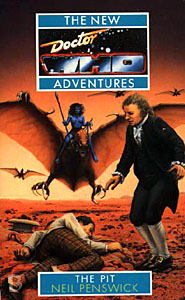 |
| ISBN# | 0 426 20378 X | |
| Published | 1993 | |
| Cover | Peter Elson |
| Synopsis: While investigating the tragedy of the destruction of the Seven Planets, the Doctor is thrown into an alternate universe. Teaming up with William Blake, they are present at the Whitechapel murders and UNIT's investigation at Stonehenge. On the Seven Planets, the ancient Time Lord Kopyion is trying to prevent the ancient enemy Yssgaroth from entering our universe. But what is Kopyion's true relationship with the Doctor and the destruction of the Seven Planets? |
A Review by Finn Clark 11/3/99
Today, I read The Pit for the second time. I first read it many years ago, on its first release, and I thought it was the biggest pile of steaming dinosaur droppings I'd ever experienced. Time has mellowed me. The dinosaur droppings have dried out and are no longer steaming. Here are my carefully despoilered thoughts...
In many ways, The Pit is a violently experimental book. The difference between this and Scarlet Empress, of course, is that the latter knows what it's doing and is entertaining at the same time. The Pit fails horribly in many ways, but that doesn't detract from the fact that what it's trying to do is actually quite interesting.
Its biggest failing is the characterisation. The Doctor is an ineffectual, random figure, being buffetted from pillar to post. Benny is unrecognisable. All but one of the incidental characters are insipid cardboard cutouts who fade from the memory as you turn the page. William Blake is a little more interesting than that, but even he doesn't actually do very much. No one ever does anything, they just go horrible places and die every so often.
One thing that hurts Penswick's characterisation is the style. Unrecognisable though she is, Benny is the only person who manages to sustain a stretch of text from her point of view. Elsewhere, the viewpoint gently drifts out of the characters' heads to float above them, observing dispassionately. The odd glimpse of someone's thoughts doesn't alter the basic fact that this is a camera's-eye narrative, deeply uninvolving and even sometimes alienating. Brecht would have loved it.
The characterisation of the Doctor is a special case. Sometimes it's just bad, but the explanations and justifications are there if you look for them. He mentions a "void in his mind" that worries him, while the final page sees him getting almost unbalanced in insisting that he and the TARDIS are perfectly all right. This ties in nicely with the Future History Cycle of Ace leaving and something wrong with the TARDIS, but I only knew that because I'd read all the Virgin novels before. It's never explained within the book itself and a casual reader's impression would certainly be of a naive, passive, ineffectual Doctor who can't even manage to <SPOILER SNIPPED> at the end. That bit didn't particularly shock me, by the way, partly because I knew it was coming and partly because it's so in-character for the confused, incapable Doctor this book presents. It's also over and done with very quickly.
What else is there? A horrendous cliche! The Time Lords have a secret which they have tried to hide! Is that possible? Groan... Some people would claim that a cliche can't be a cliche the first time it's used, but I disagree. A cliche is basically lazy writing, using the first easy idea that comes to hand. Doctor Who novels were still new and hadn't had time to lay in a recognised stock of cliches when The Pit came out, but this is still bad. As I said, you groan. There's yet another legendary figure from ancient mythology (Liall a Mahajetsu, for all you namecheckers out there). It works, sort of, but its presentation has a wide-eyed naivete that will make a more experienced Who reader want to snarl and kick puppies.
So what is good about The Pit? It's a mood piece. Even when it has the seventh Doctor namecheck Ken Dodd, that doesn't raise a smile. Everything is delivered deadpan and completely serious. This is Doctor Who from the incredibly short-lived era before the novels became self-aware. Reading The Pit is all about the atmosphere and the images. There's some wonderful evocations in there, conjuring up Hell in many different guises for us to gaze on, appalled. There's a well of souls and a land of typewriter creatures that would make Paul Magrs proud. There's Platonic philosophy: shadows on the cave wall and Philosopher Kings. If Scarlet Empress is the Arabian Nights of Doctor Who, then this is its "Book of Revelation." It's doom and gloom rammed to the hilt. It's just a crying shame that so much of it is utterly forgettable.
In many ways it's Lovecraft, stretched out. It's got a Lovecraftian theme with Lovecraftian utterly alien monsters from beyond (Yssgaroth). It just so happened that this was written before Who books officially embraced HPL, but this is certainly a million times more Lovecraftian than other Who books that just namecheck the monsters and leave it at that. Lovecraft was better at atmosphere than character too. There's also a wonderful accumulation of details, finding sinister significance in the insignificant. The Fellowship medallion will eventually chill your blood, and the chain of murders across time and space is distinctly unsettling.
As a Doctor Who book it's refreshingly different. You couldn't write anything as... well, innocent as this any more. It's just a shame that it's not very good. Even as Who lore it slips up -- the Doctor is over a thousand years old here and Neil Penswick can't spell Terileptil...
A Review by Andrew McCaffrey 21/5/02
"Outside, the poet turned to the Doctor and raged at him. Why had they gone into that building, asked a stupid question and then left? It didn't make sense." -- THE PIT, page 149.What in the name of God was that? Having read for years about how The Pit is supposedly the worst Doctor Who book ever written, I must admit that I approached it with a slight degree of trepidation. Still, I wondered to myself whether this book could really be as bad as all that. Surely there's no book on Earth that could possibly be as hideous as The Pit's shocking reputation would have one believe, right?
Reading the first page was an enlightening experience. The prose revealed here is among the worst that I have ever encountered. The sentences are jerky and disjointed. A sense of proper flow, which is so important to engaging reader interest, is virtually nonexistent. Every character's point of view and every character's speech patterns were all virtually identical with the form of the narrative. This didn't seem like a book populated by people, but rather a story inhabited by a mob of faceless plot devices, having no motivation of their own other than to do haphazard things to develop the story. The quote at the beginning of this review is unfortunately typical. People wander around for no good reason, say stupid things and then move on to the next plot point. It doesn't make sense, and no motivation is ever explained or revealed. Actually having a character point out the silliness of their motivations is no excuse for having characters with silly or no motivations.
Neil Penswick's choice of prose style did a fantastic job at holding me away from the plot. Working out the storyline required quite a lot of effort on my part simply because of the numbing nature of the writing. Yet there were portions of the plot that showed a flickering of potential but, for the most part, they sadly went underdeveloped. A few set-pieces here and there show a glimmer of what could have been an interesting tale. One can imagine a really superior wordsmith doing some marvelous work developing some of the ideas present. Unfortunately, the potentially good ideas fail to shine in the way that they should have.
The tone of the book is actually fairly consistent throughout its entirety. This is a dark and disturbing tale with no happy endings, no humour and no enlightening emotions. It succeeds at being a book without hope and without promise. Had the book made me care about any of its characters, it probably would have been quite powerful. Since I could barely distinguish one person from another, I could hardly care if any of them lived or died. A huge waste considering that the depressing nature of the story is one of the only things here that is handled surprisingly well.
After completing the book, I realized that I hadn't hated it as much as other people have, nor did I abhor it as much as I thought I would from reading the first few chapters. Make no mistake, I'm not recommending this as anything remotely resembling a good book, but it does have moments where one can see a few gems peeking through the mud. A pity though that the gems are mostly glass and the mud is far too thick and smelly to encourage one to wade through it. Every want-to-be author should definitely check out this book if they want to know how not to write quality prose.
Creatures from The Pit by Marcus Salisbury 24/10/02
While flicking through several websites and e-zines, I have discovered that The Pit is apparently a terrible book, if not THE worst Virgin NA of them all. I find this odd. You see, I didn't mind it when I read it. OK, it's badly written withal (incoherently so in parts), it has a so-so cover illustration featuring one of its direr plot incidents, and for no apparent reason the poet William Blake features as a supporting character/temporary companion. Blake and the Doctor get to wander aimlessly around a demonic realm presided over by a creature that chooses to manifest itself as a lamb, and we are treated to numerous scenes of infernal horror and desolation. Bernice gets precious little to do apart from wander aimlessly through the wilderness on a nameless planet, accompanied by shape-shifting dwarves and a few suicidal doomsday cultists. The book concludes with the heart-warming destruction of an entire solar system and its inhabitants by a one-armed Time Lord legend. Uplifting stuff indeed.
I just happen to go easy on books with BIG ideas in them. The idea of destroying a planet, even a solar system, to keep the evil vampiric denizens of e-space from our universe, for instance, has been used to great effect by Lawrence Miles in Interference. (You know, the Cold and all that jazz). The shape shifters are a weirdly interesting pair, and it adds to their appeal that they are named Butler and Swarf. Well, why not? The incorporation of local politics and TV/media coverage of the plot is a nice touch, and the character of Kopyion is far more interesting than most pre-8DA Time Lords.
At times, The Pit reads like proto-Miles in other ways... the whole remodelling of the Time Lord/vampire wars, for instance, is a notable plus point, as is the panoramic view of the exo-universal "Hell" through which the Doctor and William Blake undertake their wanderings. Even the lamb fits, in a self-consciously blasphemous kind of way. (And one of the best BBC 8DAs, The Blue Angel, similarly features a villainous elephant). It puzzles me that Neil Penswick chose William Blake as a suitable poet to have along for a wander through the infernal regions... surely Dante or Virgil would have made more sense? (Sure, Blake drew some illustrations for "The Divine Comedy" but the connection's still a bit tenuous).
Enough of damning The Pit with faint praise... here's the bad stuff. Yes, the words are put together all wrong, and are at times downright incoherent. Yes, there's no plot in the sense that a plot is conventionally a series of events happening in a sequence that conveys an overall impression of linkage and cohesion around a central theme. With a few exceptions, the characters are dull and faceless, and the most sympathetic is the alien doomsday cultist who gets his suicidal wishes granted at the book's conclusion.
My biggest beef with The Pit is the silly and cipherish recreation of William Blake. The real-life Blake was a phenomenal man, a poet and draftsman of humble origins and incredible talent. He also regularly conversed with the spirit of John Milton, who happened to turn up in his back garden from time to time. His neighbours complained constantly about Blake and his wife's wandering around unclothed. And Blake was arrested for treason after assaulting a soldier and making pro-revolutionary statements during the Napoleonic Wars. In life, William Blake was a genuine character. In The Pit, he's not a character at all. He's included simply to add a bit of offbeat colour to a plot that is already spiralling off in all directions.
I honestly didn't mind The Pit that much. I found myself reading it over several times. Well, several times for clarification of simple stuff. Not because I liked it immensely. But you have to admire the scope Penswick at least attempts to convey, the (hugely self-consciously) different approach he takes to storytelling, and the way he manages to sustain this chaos for three hundred-odd pages. Intricate plot layering is now a virtue in Who-writing, albeit layering conveyed by coherent and clear use of language, and well-drawn characters.
The Pit is a frustrating, occasionally interesting book. It could have been the calling card of a writer with new and vivid ideas on what the franchise was capable of handling, but instead it's a one-off miss (which is something of a pity). Neil Penswick should have been given another go. Sadly, he has never been heard from again. (Under that name, anyway..?) There are beautiful scenes in this novel, but awful chapters, which is more than can be said for some more recent attempts. The Pit is an interesting attempt at writing a genuinely different Who novel, and raises themes and sub-plots which have come to the fore in more recent times. On those terms, it's something of a success. On all others, it's a flop.
A Review by Brian May 12/5/04
The Pit has come in for a critical pasting from fans, considered to be one of the worst Who novels of all time. However, the three reviews listed above don't give it the condemnation its reputation suggests it deserves. That's good to see, for, like these above writers, I consider Neil Penswick's sole contribution to Doctor Who fiction, to be an interesting, moody tale, although definitely not without its flaws.
It's certainly true that the prose is bad. In fact, its downright awful. Penswick's use of short sentences means that everything is jerky, with constant stopping and starting. The words just stop. And then they start. They don't flow. It's annoying. Very annoying. Isn't it? It's especially irritating when you're relying on the flow of words to paint a mental picture of what's happening. Many times you're reading a paragraph or stanza and have to read the whole thing again, just so it makes sense. If he'd used some punctuation, a few commas or semi-colons, turning two or three short sentences into one long, flowing one, it would have been so much better. Some of the worst offenders of this staccato text are: the opening page (not a good sign!); Spike attacking the creature in the river (p.81); Bernice being attacked by ants (p.122); her attempts to escape from the shapeshifter (p.186) and a truly painful paragraph (p.259) describing Spike's efforts to climb the tower wall - practically every sentence starts with "He..." Funnily enough, the quote that Andrew McCaffrey uses to preface his review doesn't bother me that much - it makes sense in the context of what's happening, especially inside the mind of the confused Blake.
There's also some unnecessary repetition. Mann is arrested by the Justice Police, who ruin his shop (pp.75-76). Then, when he contacts Brown, we're given the lines
"It was the antique dealer. He had been arrested by the Justice Police and his shop had been virtually destroyed by the security officers." (p.133)Er, yes, Neil, we know. We've read it already, while it was happening!
With writing like this, it's little wonder The Pit has been reviled so much. But this is a bit unfair, because it's filled with some interesting ideas. Its prosaic shortcomings betray an intriguing story - I won't say plot, as it meanders too much for that. It's definitely a mood piece - in fact, it's dark, oppressive and depressing. There's death, ritual murder, hell, rape, slavery and anarchy. We also have the Doctor and Blake journeying through that ghastly exo-universe, filled with many disturbing images. The wanderings through Victorian London and Salisbury Plain are equally gloomy. Then there's the red death that seeps across the artificial planet (which the prose actually describes rather well.) The very end is the ultimate downer, but dramatically satisfying.
There's very little humour to brighten things up. There are attempts to be funny, but they all fall flat. The Doctor's namedropping of Ken Dodd is one case in point, as is Benny's "First of all the earth cooled..." quip, which is lifted directly from the spoof disaster movie Airplane. The various one-liners, including the "cleaning bill" joke after the destruction of the tower, are other failures. The fact that they're meant to be humorous makes them all the more dismal.
The Pit is a very metaphorical story - there's abounding imagery of descent and falling from heaven (whether God or the Prime Mover), the games of snakes and ladders being the most obvious example. There are many hells depicted here; the battle of Armageddon is acted out, first on Nicaea, before the final obliteration at the end. Biblical and literary references are aplenty - there's Milton, Dante and of course Blake himself, all incorporated into the proceedings. There's also Blake's reference to Plato; Academician Brown makes a "heart of darkness" style musing - while Bernice's journey down the river echoes Marlow on the Congo; the androids talk among themselves of dreaming, echoing Philip K. Dick (and Kopyion's "I had seen things which no-one should ever see" is a variation on Batty's dying words in Blade Runner). These references are knowing but subtle, which increases their impact significantly.
Among the characters, the best realised are Carlson and Brown. The former is a sympathetic man, wandering around the madness that is Nicaea, just trying to work out what's going on, while walking through his own personal hell. Brown is the most philosophical of the characters - indeed, his musings are given special attention by the author. They're quite beautifully described (proving that Penswick can write!); his denunciation of the parliament is an excellent moment, and the drug trip he and Mann experience just prior to their deaths is very lucid. Why couldn't the author have taken such care elsewhere? The use of William Blake is a bit gratuitous, and rather unnecessary, while it's obvious that Kopyion is mysterious and has a secret - it's blatantly spelt out during the first description of him! Bernice is very out of character, and it's clear that the writer isn't too comfortable with her. The rest are just bland, unfortunately.
As for the characterisation of the Doctor - I think it's magnificent! I know he's practically unrecognisable - he's moody in the extreme, aimless, and very subservient in the presence of Kopyion. But it's clear that, after all his manipulation and engineering, for once the seventh Doctor is a pawn in someone else's hands. That's a refreshing change.
As I mentioned earlier, The Pit has no real plot, but wanders back and forth through a variety of locations, all moving inexorably to the climactic end. This really contributes to the adventure's effectiveness. The use of such different locations in time and space gives it a wide, expansive feel, also serving to emphasise the ubiquity of the mysterious Fellowship (thus adding to the story's disturbing nature). The further exploration of the legends of early Gallifrey, first seen in Time's Crucible, is excellent, continuing to cast doubts on Time Lord legends, including Rassilon and (by implication) Omega. Given that this would continue later in Who fiction, The Pit is an important link in the chain.
However, I have one small gripe, although nothing to do with any of the above. In my review of The Highest Science, the novel preceding this one, I referred to the fact that people in the future always seem to enjoy 20th century culture only. It seems like a major cop-out, excusing the writer from thinking up something original. Well, here we have Brown listening to the Rolling Stones, while describing the favoured period as the "much-desired late twentieth century". How convenient. Sorry, just one of my pet annoyances.
The Pit is an interesting book, albeit heavy going, and overlong. The style of writing is definitely its weakest aspect - and stretched over nearly 300 pages, it's quite a major failing, marring what could have been something wonderful. It could - and should - have been so much better. 5.5/10
A Review by Matthew Clarke 6/3/11
The New Adventures Seventh Doctor is my Doctor. Brutalised, violent Ace and Bernice are my companions. I indentify with the New Adventures in a way I don't identify with, for instance, the New Series or with the Graham Williams era.
I am totally fascinated with The Pit. It's not the most higly regarded of the New Adventure stories and it is not the easiest one to read. It is totally lacking in humour and lacks any pleasent characters. The Doctor is portrayed as being in a state of depressed hopelessness. It does not make for an enjoyeable story. Yet I feel that it is almost my favorite of the New Adventures. Maybe it helped that I was on holiday, staying with my old folks at Hastings at the time I read it. I read a good portion of this book sitting in my favorite place in the world, the White Rock hotel bar, drinking delightful ale. Maybe because the book is so depressing, you have to be in a relaxed mood to read it.
The main reason I like this is Lovecraft. H.P. Lovecraft, the master of darkness! I am a huge Cthulhu Mythos fan. The whole reason why I rediscovered Doctor Who was that I realised how similar the two can be. The New Adventures effectively incorporated Lovecraft's Great Old Ones into the Whoniverse in All-Consuming Fire but this book, written before then, is much more Lovecraftian in style. Not only does it feature ancient, extra-dimensional monsters described as 'Old Ones' who are worshipped by secret cults, but it has that overwhelming sense of cosmic hopelessness. The Doctor, normally invincible and indomitable, is reduced to utter impotence. It totally deviates from the pattern of Doctor Who. If every New Adventure novel was like this, we could not take it, but this one gets it right.
I like the exploration of the 'Dark Times' of the Time Lords history. I think this is the most fascinating aspect of Doctor Who and as long as the mystery is maintained, it is worth exploring by writers.
The inclusion of William Blake as a character is a brilliant choice, even if his entrance into the story is not very well explained. He represents the same liberal, democratic values as the Doctor and seems them utterly wiped out in the dark misery of the future. Lovecraftian Cosmicism again. Unlike the Doctor's religiously indifferent companions, he asks the Doctor theological questions. This makes perfect sense. A book dealing with such vibrant religious imagery needs a character who can react to it. It has been suggested that the depiction of Blake is a lot less colourless than the real William Blake. I did find it odd that he does not mention his wife in the book. Being separated from her by time and space ought to be on his mind.
Maybe one reason I love this story and most fans hate it is that I am religious and have studied theology at the PhD level. It is a book using religious themes in which many characters are religious. It has a spirituality missing from most Doctor Who stories.
My favorite moment in the story is the scene where an Yssgaroth is seated on a throne. It first appears like a lamb, then turns into a winged serpent-like creature with a multitude of eyes. The imagery here is brilliant! It is taken straight from the Book of Revelation. It is like a scene that William Blake would have painted. It has been suggested that having a demonic being appear as a lamb is blasphemous. I don't think so! I have no problem with the powers of evil masquearading that way. In fact, in the Book of Revelation, the second beast or false prophet appears like a lamb (Rev 13:11).
I am not sure about the androids. I am not sure that you would get such sophisticated robots in this early period of colonisation. The androids seem far more advanced than the robots in the far future Robots of Death.
Ignore the people who say this is the worst New Adventure. It is one of the best. Track down an old copy.
Tyger, Tyger, Burning Dim by Jacob Licklider 29/6/16
I have heard that The Pit is the worst of the Virgin New Adventures, and, while I cannot confirm this fact, as I've only read up to The Pit, I will confirm that it is definitely the worst novel so far. This is Neil Penswick's only novel and after a Google search I cannot find any information on this author's other work. His page on the TARDIS Wikia only says that he wrote The Pit and nothing else about him. Judging by the way The Pit is written, I wouldn't be surprised if this is the only thing that Penswick actually wrote, as it has no sense of how to tell a good story. The sentences are extremely short, and they don't flow from one to another. The characters are generic, with two being basically the same character with two different names, and the plot is no more than a lot of random events strung together by threads.
I recently saw an anime review by Glass Reflections where a point was made that the events of a story should be connected by the words "but" and "therefore", not the word "and". This is because it indicates conflicts and solutions to those conflicts while the word "and" makes events unrelated yet connected for no reason. To exemplify this, I'm going to compare the basic plot of this novel to the plot of An Unearthly Child Part One. The plot of An Unearthly Child goes like so:
Barbara and Ian are ordinary teachers, but they are worried about one of their students, Susan, who is good at some things but awful at others, therefore they decide to follow her to her home. But her address is a junkyard, therefore they follow her inside, but only find a Police Box and an old man, therefore they want to leave to get the authorities, but they hear Susan's voice from inside the Police Box, therefore they break inside, but it is actually a spaceship, therefore they have solved the mystery, but the old man won't let them leave, therefore they are abducted into time and space.As you can see, the plot is a chain of cause and effect that can be easily linked together. The plot of The Pit goes a little differently:
The Doctor and Benny go to a planet and there is an experiment going on and shapeshifters, and poet William Blake has been teleported, and the Doctor and William Blake get transported into a parallel dimension, and Benny meets some androids, and there is a research team and a guy who may be the Tenth Doctor if you subscribe to a fan theory and a Time Lord called Kopyion, and the planet explodes and everyone dies.So you can see exactly how nothing is really connected and the plot just sort of happens and resolves itself with any involvement from the Doctor.
No, the real hero of the story is Kopyion, who is a Time Lord who really is the only person to have anything to do with the plot. He is supposed to be what the Time Lords were in The War Games but is really just a Mary Sue. He does everything to perfection and doesn't seem to have any flaws to his character. He created the entire situation of this planet and these shapeshifters performing experiments on people for no real reason. He doesn't want to trap the Doctor or anything and doesn't have any clear-cut motivations and doesn't even know what he is trying to do. This is the same for all the characters, as none of them have any clear-cut motivations for what they do. The only motivation I can think of is survival of the fittest, but that was done a lot better in Survival with Ace's friends because they had personalities. There are even two androids who serve the same purpose; when one ends up dying, the other takes over. This is until the other one that was dead comes back to life near the end for no real reason except to moan about, slowly dying.
Bernice Summerfield also gets the bad character treatment as she is basically a nonentity in the story, contributing very little to the plot except getting the Doctor to go to these doomed planets to begin with. It hurts even more considering the opening pages with the Doctor and Benny musing over the little ideas that popped into Benny's head getting them to the planets. Once they get to the planet, the thread to the plot is dropped out of the blue, which is when Benny becomes irrelevant for the rest of the plot until the very end when she becomes the only person talking sense when the Doctor assists in genocide on the planet with Kopyion. And that is something that even on his darkest days, the Doctor would never do. While I'm on the subject of the Doctor, the way Penswick writes for him is unrecognizable as the Seventh Doctor. He feels like a poor man's version of the Second or maybe even Third Doctor for most of the run time and has nothing to do.
Classic British Poet William Blake also appears in this novel as a pseudo-companion to the Doctor, but he is also a non-entity and takes up even more space in a crowded novel. All in all, I have to give The Pit 5/100, as it is an absolutely worthless novel that only has a few pages in the TARDIS that are easy to read. It is really going to be difficult to find worse than this novel.