
The Natural History of Fear

|
|
Big Finish Productions The Natural History of Fear |
|
| Written by | Jim Mortimore | 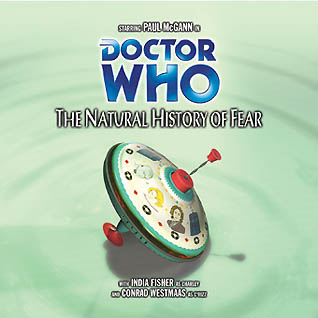 |
| Format | Compact Disc | |
| Released | 2004 | |
| Continuity | After The Telemovie |
| Starring Paul McGann, India Fisher and Conrad Westmaas. |
| Synopsis: IT IS A CRIMINAL OFFENCE TO COPY OR ATTEMPT TO COPY ANY PERSONALITY OR MEMORY-RELATED ARTICLE SHOWN OR DISPLAYED IN THIS PUBLIC THEATRE, INCLUDING THIS WARNING. PUNISHMENT OR CONVICTION IS AN UNLIMITED REDUCTION OF AUTHORISED OVERTIME HOURS AND TOTAL PERSONALITY REVISION. YOU ARE NOT PERMITTED TO BRING ANY JUKEBOX OR RECORDING EQUIPMENT INTO THIS PUBLIC THEATRE. THIS WILL BE TREATED AS AN ATTEMPT TO BREACH COPYRIGHT. ANY PERSON DOING SO CAN BE EJECTED AND THE EDITOR MAY CONFISCATE SUCH ARTICLES. WE ASK THE PUBLIC TO BE VIGILANT AGAINST ANY SUCH ACTIVITY AND REPORT ANY MATTERS AROUSING SUSPICION TO THEIR LOCAL CONSCIENCE. THANK YOU. |
A Review by Richard Radcliffe 2/4/04
Just when I thought Big Finish were back to telling easy, traditional tales (Creed of the Kromon), along comes The Natural History of Fear. A play that was so far out, so obscure, so different, so intellectual, I totally didn't get it at all!
I've recently been described as something of a traditionalist on the Ratings Guide - fine by me. I will admit that I struggle at times with more complex and intellectual Doctor Who tales. Not to say I don't have any brains, but I do prefer (generally) the more easy and straightforward stories. I think I get into that mindset, most of the time when I listen or read or watch, that is akin to unwinding - letting out the alleged worries of the day. An audio, a book, a comic, a TV production, they are all there for me to be entertained first and foremost. All stories are there to take me into a magical kingdom, with traces of reality, but with large dollops of fantasy at the forefront - I'm not even that bothered if it is all explained, it's mostly about imagination and atmosphere. The beauty about Doctor Who, amongst many other things, is the way is juxtaposes fantasy onto reality - a key feature of its success over the years.
Like many other Doctor Who fans I expect, I have been accused of having my head in the clouds too much. "You don't handle reality that well, do you" was the famous retort from my loving Mum whilst in my early 20s. "You're so much more comfortable with fantasy". She wasn't having a go, just stating a fact. Out of her eight children I was always the one who would strive for isolation, to disappear into a book for long periods. On family holidays in my childhood and teens I would find a secluded beach or field, and lie in the sun with my book - that was the best, most hassle-free, holiday companion (even though I wasn't adverse to the charms of other holiday liaisons either!).
I have since grown up, and whilst still largely a cloudwalker, I can appreciate all kinds of unreality - not just the easy-to-understand kind. A traditionalist I may be usually, but after a few listens I usually get what Big Finish authors are trying to say. There's so much imagination and wonder out there amongst Doctor Who writers, I simply hate to be missing out on some bit of magic. I was very hopeful for this story. Paul McGann (with quotes everywhere) said it was one of the best scripts he had read, Doctor Who or otherwise. That's quite a recommendation to live up to - and made me even more determined to discover its intricacies.
Written by Jim Mortimore, Big Finish sound engineer, (who's written two excellent books - Eye of Heaven and Blood Heat, and a few other average ones), we are brought to Light City - haven for a suppressed society, 1984 Orwell like. Such communities are not unusual to DW - Varos, Happiness Patrol planet to name two previous TV examples. Along comes our three heroes - The Doctor, Charley and C'Rizz - to stir things up.
Jim Mortimore uses his expertise in the field of Sound and Editing in this production. It is quite unlike anything else Big Finish have produced, and is rather inward looking at the whole Doctor phenomenon. The entertainment of the masses is indeed the Doctor's past adventures. Just who are the Editor, the Conscience and the Revolutionary Woman? They sound like the Doctor, C'Rizz and Charley - but they talk about our heroes as being elsewhere.
I listened to the story over two mornings. Getting up for Doctor Who on UK Gold on a Saturday and Sunday has been most enjoyable since I obtained cable TV six months ago. I usually watch the TV offering, then try something else - often an audio. This weekend it was this one. Whether I am totally awake at this hour in the morning is up for debate - and maybe that's why I was utterly confused on first listen.
Paul McGann was excellent, and clearly loving this different role - same with Charley. They were playing other characters, but glimpses of their familiar roles were apparent throughout. Then there was the vague Castlist, with no characters to speak of - clearly this was complex and worthy of greater attention. Then there was new companion C'Rizz - I lost track of him completely on that first listen (that can't be good in only his second story). With only one story to define his character, it is unfortunate he is somebody else here. I had glimmers of recognition as episode 4 rolled, as it backtracked to the Doctor's arrival at Light City. I was convinced that I could understand this complex drama eventually.
Thus onward to a second listen - and like Flip Flop and Creatures of Beauty, I was sure I would get it eventually. Much, much better. I actually followed the story pretty well. I appreciated the production much, much more. I really thought it was very clever the way the Doctors and his Companions had influenced and coalesced into the Community. It's a tremendously wordy piece too - full of subtle asides about freedom of speech and the individual in society.
I have now heard Natural History of Fear again - with my wife. She got it on first listen, the clever clogs. I found my third listen even more rewarding, and I marvelled at the structure and the production. After hearing each episode we ended up talking about it at length - I can't recall any audio producing that level of comment between us before. We both admired the way it made us think. I'm so glad I gave this fine story the attention it deserves. You just know these stories are going to make sense in the end - and you just know there is plenty to love about them. My eyes are open! 9/10
"WELCOME TO LIGHT CITY!" by Joe Ford 4/5/04
WARNING! WARNING! WARNING! THIS REVIEW HAS BEEN CENSORED! ALL UNACCEPTABLE MATERIAL HAS BEEN EXCISED! PLEASE NOTE THAT ALL COMMENTS THEREFORE ARE ALTERED TO MAXIMISE PUBLIC ENJOYMENT! REMEMBER HAPPINESS THROUGH ACCEPTANCE! PRODUCTIVITY THROUGH HAPPINESS!
QUESTIONS ARE NOT PERMITTED...
Can we really be sure that the CD The Natural History of Fear is the product writer Jim Mortimore intended it to be. In truth there are many hints and whispers throughout the tale to suggest it has been CENSORED COMMENT. Pauses, delays, quick edit cuts and suggestions that someone may well be listening to events and reviewing and editing them. However since Mortimore himself is responsible for the postproduction it would seem this is just a clever ploy within the frame of the story. Or maybe he is trying to tell us that our own lives are being CENSORED COMMENT but is not allowed to say it outright in fear of CENSORED COMMENT so he subtly frames his story of freedom persecution with a feeling of paranoia and suggestive manipulation. Or maybe he is trying to be too CENSORED WORD clever for his own good, as usual.
I recently read a fascinating piece of writing on this on Greatest Show in the Galaxy by Bor Swettham (NAME IS DISTORTED TO PROTECT SOURCE) where he states that the story in question is much more interesting to discuss than it is to listen to. The same could be applied to Natural History of Fear, clearly a compelling piece of drama and no mistake but one that lacks in even the basic ability to entertain. It is almost as if Mortimore is so obsessed with getting his point across he forgets that it is possible to have some fun too. As a result it is a very dry piece, consisting of lots of shouty interrogations and accusations and twists but very little in the way of identifiable material. It is a very clever piece and no mistake and ultimately the story does make sense but for at least the first three instalments it is impossible to grasp that the truth of the situation is CENSORED COMMENT. Scratching your head for two hours is not my idea of a good time, oh I can be distracted by the agonisingly good performances and some clever dialogue but one cannot escape the fact the premise of the story is a hugely flawed one and that the final twist of CENSORED COMMENT is hackneyed in the extreme. Audio does have its advantages in that we can only visualise in our minds what information is given to us but really the idea that a story about a censored/revised environment can be unravelled by the mere counting of CENSORED COMMENT lacks any kind of finesse you might expect from such a story.
It is an extremely layered story and one that takes its revised personalities from the idea of Russian Dolls. This in itself is rather clever, a story that is plotted rather like a Russian Doll and has ideas inside that use the idea too. As the episodes move on the layers of this extremely complicated onion are peeled away just as CENSORED COMMENT are and we finally get to see what's inside of story and characters before the end.
The title characters of CENSORED NAMES are adrift in a sea of chaos. As the story begins we are unaware if even they know who they are as they all seem to be acting extremely out of character. Perhaps they are protecting themselves by using false personalities. Or maybe they have had their minds CENSORED WORD. It is an intruging starting point and one that would have proven to be very rewarding had the answers been revealed earlier on but as it is you have to wade through CENSORED NUMBER episodes of false guesses and attempts to grip hold of the plot before the writer is kind enough to supply some serious answers. This reviewer often thought he had an inkling of what was going on especially during the scene where CENSORED NAME appears to have gone rogue and working for the greater good but as with much of the story this proved to be another dead end (alas the story is full of them, deliberate head banging on desk misdirections that please at first but annoy after a time).
Plus for a story that deals with characters in roles we are unaccustomed to seeing them in isn't it a little bit early for this sort of thing when it comes to CENSORED NAME as he is very new to the series and we have yet to get any sort of grip on his character. Since this is an audio production his voice is new to us and as such is hard to distinguish in this new role. This makes early episodes rather more confusing than they have to be.
THE FOLLOWING PARAGRAPH WAS EXCISED FOR THE GREATER GOOD. IT CONTAINED SUGGESTIONS OF A DEVIANT NATURE AND USED WORDS THAT ARE ILLEGAL IN THE PUBLIC DOMAIN.
However what does appeal and inspire intelligent conversation (as indeed my lover CENSORED NAME and I were talking in depth about many of the stories scarier notions) is the chilling idea of a society that is constantly monitored and CENSORED WORD (indeed...). I was just that morning suggesting that people are not vigilant enough when it comes to crime and complacent about such atrocities as 9/11 as our society has been built up around such terrible moments. We have become used to them. Accept them. Expect them. Surely a horrific event such as the recent train explosions should provoke more than a shrug of the shoulders. I suggested crime would be weakened if we were monitored more, were asked to explain our more violent actions, to justify them. Nomis (ALIAS) found my idea abhorrent and criticized it as a lack of CENSORED WORD, that self-will and liberty were not only essential but also our rights. After listening to this story I have to agree with him. Natural History of Fear deals with the terrifying notion that no individual has the right to an opinion and that if they feel otherwise one will be provided for them. To think of existence in a world where asking a CENSORED WORD is a crime, where you can never stand out as an individual and if you attempt to do so your personality is CENSORED WORD. Scary stuff and brought down to a very frightening level when certain characters are CENSORED WORD over and over again to a point where they can no longer remember what their last self was like.
Plus it deals with a popular theme in the media of late, betrayal. Of course because this makes good drama. Such programmes as The X-Files and Alias thrive on the paranoia that comes with the idea. Here we are never sure who is traitor and such is the twisty turny nature of the script that it could be a parody of those sorts of shows the way the characters are constantly having their roles subverted and altered. Not only are friends suddenly enemies and enemies friends but positions within the CENSORED LOCATION are changed too. The job of the Editor swaps about so much I completely lost track of who the hell was supposed to be the CENSORED WORD of the piece.
Without a shadow of a doubt this is much superior to CENSORED and CENSORED but then they were the aural equivalent of being stabbed in the guts repeatedly with a pair of garden shears. And yet it is far too experimental for its own good and does not have the power or the emotion that made CENSORED (similarly experimental) so damn good. It is a blistering satire on the corruption of censorship and brings up so many interesting suggestions that could make a more emotional listener paranoid in the extreme. Mortimore has constructed the story for a patient and intelligent fan and I have been privy to both extremely complimentary and scathingly critical comments about the story. It is VERY COMPLICATED and will require a lot of internal thought; I should imagine my dear friend CENSORED NAME who I mentioned earlier would get a great deal from this. Let's face it after 100 minutes of duplicitous behaviour and philosophical debate are a tad boring, not CENSORED-boring but 'oh God please put in a gag!' boring.
And yet it contains the best ever performance from CENSORED NAME, as the title actor of the series you would expect constant flow of quality thespian skills but given the appalling material provided thus far this year he has been underwhelming and disappointing. Great joy for Mortimore then who allows CENSORED NAME to stretch his wings by playing a character who is very different from the CENSORED NAME and be a damn sight more aggressive and powerful than usual. Some scenes he is screaming his lines with such anger you would imagine a very tense and worried studio. I was very impressed by this performer especially during the scenes where he discovers his character has been CENSORED WORD all along. CENSORED NAME provides terrific support as ever as his female companion and at times outdoes his emotivee performance, she is proving more and more reliable and manages to portray fear, panic and confusion with intense ability.
Achingly different to anything you have ever seen/read/heard from CENSRORED TV SHOW NAME before. If that is a good thing or not depends on you opinion of the material itself, severe, unrelenting and bloody clever but censoring all the joys of a regular story, humour, likeability, eccentricity. It will no doubt give you a Grand Canyon sized headache but I'm sure the more intellectual of you will come away with some new perspective on just how much of the world that we actually see...
THIS IS THE VOICE OF LIGHT CITY. WELCOME TO YOUR NEW WORK DAY. YOUR STATE LOVES YOU. HAPPINESS THROUGH ACCEPTANCE. PRODUCTIVITY THROUGH HAPPINESS
QUESTIONS WILL NOT BE TOLERATED...
A Review by Stuart Gutteridge 25/10/04
The Natural History Of Fear is unique in that it is quite unlike any other Doctor Who story, in terms of the way it's told. However the story itself is somewhat traditional, and harks back to George Orwell`s 1984. Basically it is a tale of an oppressed society and their rise and ultimately their rebellion against the oppression. This is also partly the tale`s own undoing; as the story is a tale of oppression, the characters lose their identity; thus it becomes difficult to care about characters because you don`t know if they`re real or not. This doesn`t benefit the enigma that is C`Rizz either; given that we still know very little about him.
The peformances are excellent however, aided by some strong and remarkable sound design. This aside The Natural History Of Fear is an ambitious tale, affording it plenty of relistening time and for this it should be applauded.
Fear of Unnatural History by Jamas Enright
This is the voice of Light City. Welcome to your new work period. Today is review day.
"The Natural History of Fear is Jim Mortimore."
Jim Mortimore is hard to get away from in this audio. Just cast an eye over the credits, and guess who did the sound design, post-production, music and CD mastering? Not content to produce a normal audio, this man even changes the opening theme tune, a piece of music that has had many lead ins, many exits, but has remained a constant across audio after audio. The line between the story we hear and the normal format is blurred, and this even extends to the trailer at the end of the CD (although I'll just sidetrack here to say that one trailer for Dalek Empire 3 is enough, we don't need to beaten over the head by it on every audio!). Jim Mortimore pays careful attention to the production of this CD, leading us through scenes, making them segue from one to the other, and makes us wonder which parts really are the info-tainment. (All this and a gorgeous piece of cover art by Clayton Hickman.)
Oh, and Jim Mortimore wrote this story as well. Although, it must be said that this is one of his more straightforward pieces (in that it's possible to understand it without having your brain dribble out your ears). It is the story of Light City. It is about change. About how change itself changes. Like a revision. Like, in many ways, how this review is being revised as I write it. (Although, on a more prosaic level, I was reminded heavily of V for Vendetta.)
Okay, so it's not that straightforward. In fact, let me revise the above line.
"The Natural History of Fear is Doctor Who."
Certainly what can be said is that this audio has Paul McGann in it. And India Fisher and Conrad Westmaas. (Although, that said, I have a hard time spotting Conrad Westmass' voice, and that doesn't help when he doesn't get a lot of screen time. In this audio, I don't think he's in episode 3 at all, which is fairly emblematic of the current season of McGann audios. Although C'rizz is in the crew now, the writers still want to just do Doctor/Charley scenes.) And we also have Sean Carlsen, Jane Hills, Geoffrey Searle (who has a wonderful voice), Alison Sterling, Ben Summers and Wink Taylor.
But it wouldn't be fair to say that we have the Doctor, Charley or C'rizz. Let me attempt to describe the situation by saying "We do have the same person but not the same character". Or maybe "We get the character, and we don't get the character." How about "We get the idea of the character. More or less." (Although in the spirit of the audio, let me point out that I may have revised away what I really want to say.)
In fact, let me once more revise that line to really expresses this play.
"The Natural History of Fear is not Doctor Who."
And that's isn't necessarily a bad thing.
Happiness through acceptance. Productivity through happiness.
A Review by John Seavey 26/1/06
It's a pastiche of a movie that did the same thing, not too very long ago (here's a hint: 'Dark City' was a movie about extracting people's memories and giving them new ones to see what made them who they were; this story is about extracting people's memories and giving them new ones to see what makes them who they are, and is set in "Light City".) But it does do a good enough job with its pastiche (even if Mortimore is downright sloppy at times about the whole "no questions" thing. Sometimes it's deliberate, sometimes it's deliberately accidental, but I'm pretty sure I caught some genuinely accidental questions. But I'll grant, it's a very daunting thing to try to script.)
The twist at the end is also kind of cool, too. It would have benefited, I think, from being a bit later on, so we could actually get to know what C'rizz normally sounds like; as it is, I had difficulty picking him out of the crowd of voices, and since he doesn't have much to do anyway, he faded almost totally into the background of the audio. It's almost like he's not a companion at all.
No question you should listen by Charles Berman 2/9/10
For some reason, I never got around to reading any of Jim Mortimnore's Doctor Who novels for Virgin or BBC Books. Listening to The Natural History of Fear has made me want to reverse that oversight immediately, as well as wish that Mortimore would once again lend his pen to Big Finish, though not for a literal wish for "more of the same" of this utterly unique, self-contained and brilliantly executed play.
The Natural History of Fear has its place in the continuing adventures of the Eighth Doctor, but would be just as excellent devoid of that particular part of its context. It is just as experimental and brash as Zagreus and Scherzo, but in a way as different as those two plays were from each other (which if you ask me is a real credit to the work Big Finish was doing up to this point). In the context of Doctor Who, it is very difficult to categorize because, while not rejecting the established order of events, it is, like the Unbound play Deadline, in many ways more of a an extraordinary story -- in part -- about Doctor Who than a Doctor Who story.
The Natural History of Fear is a testament to the somehow ineradicable power of ideas against the strongest of opposition. ("There are things no one is allowed to know. But someone has to know them. How else would we remember what to forget?" a character asks in one very memorable line.) That is what is reflected in the title. On the other side of this coin, it is a chillingly resonant exploration of nothing less than the nature of power itself. Through that, it reflects truths about all the institutions of power that we as humans create.
Its invented society is one of the most frightening, yet in many ways conceptually plausible, I have encountered. The concept of a state that has outlawed the use of questions is one of those ideas that is brilliant in its simplicity. It's an illuminating reductio ad absurdum of the philosophy of generating loyalty and obedience that it seems is perennially generated by institutions of power: questions being asked are by nature threatening to that power. Hence, when asked, they usually meet with non-answers and suspicion as a response since, in the words of Light City's unsettling but half-true mantra, "Questions lead to answers. Answers lead to knowledge. Knowledge leads to freedom. Freedom leads to dissatisfaction. Dissatisfaction leads to unhappiness. The state wants you to be happy."
This in combination with the certainly that one can only obtain "happiness through acceptance" generates an illuminating dystopia on the order of Brave New World or Brazil. It is haunting not just for its depiction of an autocratic and powerful state but for that of a people who accept and fight for oppressive ways and an impressive ideology even as the concepts that they are fighting against are within them; else how would they know what questions are in order to turn in people who ask them? It's a very real human response to - and method of - pervasive power; I'd never encountered it expressed before in quite the way The Natural History of Fear does.
The concept of a Jubilee Day is another very memorable and insightful one, strongly reminiscent of a totalitarian regime such as Mao's, paying ostentatious lip service to the arts, while making sure they do it in a way that makes the art produced totally non-threatening (and therefore devoid of one of the most powerful qualities of art).
In short, I don't know that I'll ever really look at a state or institution of power again without thinking of, among other things, Light City in The Natural History of Fear and seeing it, in its minor way, trying to destroy names, destroy inquiry, hold off ideas and hold the people under its sway in that spinning, sleeping, changeless (but imminently toppleable) state of a spinning top; a wonderful image, by the way. And that is an extraordinary achievement.
The Natural History of Fear feels too disquieting to be literally funny, but it is nothing if not witty. The police are the conscience and their subordinates are the subconscious. Light City and its Broadcast Lodge are inches away from White City and its Broadcast House. And the use of Doctor Who itself -- and clips from previous Eighth Doctor stories -- is witty.
By that token, The Natural History of Fear treats Doctor Who interestingly: as dangerous but also with tremendous respect. In essence, the adventures of the Doctor turned into "infotainment" programmes (which is to say, Doctor Who itself) can be easily arranged into indoctrinating essential propaganda tools of the state. It makes us ask whether in our own watching, listening and reading of Doctor Who, we have been subjects or victims of this kind of manipulation. However, principally, we learn that Doctor Who is the carrier of the ideas of the Doctor, which champion freedom, inquiry and creativity, and which cannot be entirely eradicated. They are the seed of revolution against a power like Light City. That's a very nice message to hear about the power of that which the Doctor champions.
Speaking of the Doctor, there's Paul McGann. Quite simply, he's amazing here. This might be the best performance I've heard from him and that is saying something. He can really rise to a good script, and I can tell he liked what he was given in this one. As the Editor, he is compelling to hear struggling with the essential conflict between his love for the state and the power of the compulsions through his memories of the Doctor to questions, music, action and metaphor. India Fisher is excellent as well, playing several mind-wiped iterations of the same character with impressive believability and earnestness each time.
The design of this audio story is extremely impressive as well; Jim Mortimore is a musician and worked on both ends, so the production is very suitable to the story. Most memorable perhaps are the "This is the voice of Light City. Today is High Productivity Day..." announcements, but everything is right, especially the altered Doctor Who theme music, which is changed towards the end to become something screeching, discordant and difficult to hear, just like the meanings of the Doctor's memories in the infotainments.
The twist at the end could have been too much, but worked perfectly for me. It came as a surprise but one that made perfect sense to me that the Doctor, Charley and C'rizz are long gone, that the Editor was never the Doctor at all, that these are totally different creatures with life cycles short enough that generations of their entire society could be influenced very quickly. The revolutionaries shouting "Why?" en masse was a wonderfully triumphant sound. Though our realizations about some of these characters towards the end are heartbreaking
It seems wrong to point this out as a flaw since on its own this piece is tight, but two stories in we know very little still about the new companion of C'rizz other than that he is a "monk", shot his lover to save her and is not human. That's all right by me as far as The Natural History of Fear is concerned because this play was telling a very different story, but its placement as C'rizz's second story is odd. That said, it does embody, much more than The Creed of the Kromon, a universe where time has no meaning, a place where a spinning-top world is a danger.
This will bear relistening very well, and has quickly shot into my mental list of best Doctor Who stories.
An Orwellian Nightmare by Jacob Licklider 6/11/19
Transcript of the official court case of Reviewer 1013152, who is accused of expressing an opinion on infotainment The Natural History of Fear staring Paul "The Doctor" McGann, with India "Charley" Fisher and Conrad "C'rizz" Westmass, property of scribe Jim Mortimore and cameraman Gary Russell. Originally aired on channel BFP in February 2004.
Court presided by the honorable Conscience. Reviewer 1013152 opted out of an appointed attorney. Attorney 711825 acted as prosecutor in this case. The jury was one hundred men bribed by Attorney 711825 in according with the proper procedure.
Bailiff: All rise for the honorable Conscience. All Rise.
Conscience: I now call this court to order on the case of Reviewer 1013152. Recite creed. Productivity through happiness, happiness through acceptance. All sit. All sit. I call on Attorney 711825 to read the accusation.
Attorney 711825: Gladly, your honor. Reviewer 1013152, you stand accused of committing the gravest crime in our society, expression of a dissenting opinion on 126 accounts. Expression of dissenting opinions is a grave matter. Independent thought leads to unproductivity, unproductivity leads to unhappiness, unhappiness leads to disorder, disorder leads to chaos. Conviction of leading men to chaos is execution. How do you plead?
Reviewer 1013152: Innocent on all accusations. There is nothing unlawful about opinions.
Attorney 711825: Your honor, this man just committed another dissenting opinion, which will lead to even more chaos. Do we need to hear any defense?
Conscience: Attorney, he will be accused of another opinion in another case. This trial is for the opinions expressed on 05/15/16 on Infotainment code BFM54. Please read his first opinion on that Infotainment, and we will give him a chance to explain himself.
Attorney 711825: He claims, and I quote, "The plot is a real return to form exploring themes of Orwelian horrors, as everything is recorded, censored and released to the public that makes up for the previous release being way too boring. While yes, the story could be done in a traditional universe, the storytelling style keeps in with the theme that time does not exist much more than the previous release in the range did."
Reviewer 1013152: Objection, your honor this is often regarded as public opinion and there was no dissenting.
Conscience: Overruled, Attorney continue.
Attorney 711825: You went on to say "The performance given by Paul McGann is one of total intrigue, as he is allowed to play a different character, which may well be more interesting than the Doctor. The same goes for India Fisher and Conrad Westmass. Westmass especially gives as sense of uncertainty, as we don't know who C'rizz is after his introduction giving you the question if he can actually be trusted"
Reviewer 1013152: But did I not go on to say that it works as a preparation to get some intrigue back into the roles for the continuing Divergent Universe Arc? That the many plot twists allow their true characters to shine through?
Attorney 711825: Objection, he is interrupting me.
Conscience: Sustained. Reviewer, another outburst and we will go straight to judgment. Attorney, continue please
Attorney 711825: You also mentioned, and I quote, "The fact that the author also had a hand in the music of the story makes the setting really come to life, as you can feel this city is an oppressive civilization. The direction is one of Gary Russell's best after the last release felt like he wasn't really giving it his all." We rest our case.
Conscience: Reviewer, if you would refute the Attorney.
Reviewer 1013152: Gladly, your honor. You say that I said I disagreed with popular opinion on the direction and acting, but that was not for this instance, it was for the previous instance in which I was found innocent. I was with popular opinion that this is one of the cast's strongest performances, one of the best scripts to ever come out of the company with some of the best direction and music. The added bonus of the music suite at the end was a great treat, and I just can't help but shout for joy every time I see the flashback sequence. The story is an emotional thrill ride from start to finish, and if that is wrong sir, then I deserve to die.
Conscience: Any other defence?
Reviewer 1013152: I rest my case sir.
Conscience: Then I beg members of the jury to please retire to your room and come to your decision. Court will be adjourned until a verdict is reached. Dismissed.
A break of three hours passes before recess ended.
Bailiff: All rise for the honorable Conscience. All rise.
Conscience: All sit. Ladies and gentlemen we are here to end the case of Reviewer 1013152. The jury has reached their verdict. Head Juror, please pronounce verdict.
Head Juror: Your honor, Attorney, Reviewer, I think that the verdict is very clear. For his expression of enjoyment of the plot, characters, direction and music, with a vote of 100/100 for, we pronounce Reviewer 1013152 guilty of having a dissenting opinion on The Natural History of Fear.
Conscience: Reviewer, for expressing an opinion not matching the one of your Conscience, you will be sent for execution forthwith. Security will take you away to a cell where you will fill out the necessary paperwork. The transcript of this session will be posted as an example to quell any unrest. I now call this court adjourned.