THE DOCTOR WHO RATINGS GUIDE: BY FANS, FOR FANS

|
BBC
Meglos
|

|
| Episodes |
4 |
 |
| Story No# |
111 |
| Production Code |
5Q |
| Season |
18 |
| Dates |
Sept. 27, 1980 -
Oct. 18, 1980 |
With Tom Baker, Lalla Ward,
John Leeson as the voice of "K9".
Written by Andrew
McCullouch.
Script-edited by Christopher H. Bidmead.
Directed by John Flanagan.
Produced by John Nathan-Turner.
Executive Producer: Barry Letts.
|
|
Synopsis: A shape-changer impersonates the Doctor, and leaves him accused
of murder and heresy.
|
Reviews
Overlooked a little too often by Tom May
20/5/98
"I like his coat!" Brotadac, on the Doctor
One of the many surprises thrown up by the recent DWM poll was the
position of the often overlooked Meglos: 138th. Meglos
appears in a very consistent Season, although only Warriors' Gate is a true classic from Season 18.
Meglos, in contrast to The Leisure
Hive, is a barrel of laughs. The two stories are so different in every
way that I tend to imagine Meglos as a late Season 17 tale -- a
fleeting reminder of the pros and cons of the Williams Era.
As a big fan of Seasons 15 to 17, I enjoy Meglos a lot. It has
a similar feel to The Creature From The
Pit, a story that grows on you -- as does Meglos. The concepts
lean dangerously on the Technobabble side, but why not? It all provides a
humour that the other six tales of the season lack. The only things people
comment on about Meglos are the Chronic Hysteresis (which is fun) and the
fact that Meglos himself, is cactus-covered.
The eponymous doppelganger is a very good, powerful advesery for
Romama and The Doctor, but then again, he was played by Tom Baker. The two
hapless Gaztaks are amusing and unsurprisingly, have a nice little
confrontation with K9. Brotadac's constant dreams of having the Doctor's
new (since the previous story) coat are a little unrealistic, but
personally I have to say it's in keeping with the style of the story,
which works.
It seems JNT had yet to really get to grips with production of
Doctor Who yet, and the tone is comicly reminiscent of Season 17,
with Tom Baker giving a gloriously grandiose performance, revelling in his
last chance to play for laughs as the Doctor. Lalla Ward is, as ever,
stunningly good as Romana, having quite a lot to do here. Jacqueline Hill
appears as Lexa, but sadly dosen't match her performances as Barbara
Wright in the '60s. The Dodecahedron (if that's the spelling!) is a good
and curious artefact, and is central to the ending.
There is good visual work here -- after all, it's Season 18, and I
find the music suitably absurd -- witness the Sound Effects when Meglos
roars "I AM MEGLOS!" The dialogue is occasionally ridiculous ("Having
lived in the future, I can hardly die in the present."-Meglos), sometimes
cliched, but mostly great ("Let's hope many hands will make the lights
work," and "He sees the threads that join the universe together, and mends
them when they break."-Zastor, on the Doctor).
There's nothing poor at all about Meglos, yet somehow it fails
to fully satisfy. 7/10
A Review by Stuart Gutteridge
20/6/99
Meglos is the one story in Season 18 that always gets slated
and quite frankly it isn`t hard to see why. After the triumph,that was The Leisure Hive, Meglos comes as something of a
letdown. For a start the visuals are terrible in comparison, the Tigellan
jungle isn`t really any different from any other seen in Doctor Who
and the whole thing has a dated feel to it.
The acting isn`t that much better either, the Gaztacs and the Earthling
seem totally unnecessary, and it isn`t explained why Meglos needs them.
Brotadac is the worst offender, his only interest being in The Doctor`s
coat, and Grugger doesn`t fare much better; kicking K-9 doesn`t add
anything. Jacqueline Hill gives a competent performance as Lexa, a role
not really worthy of her talents.
There are some plus points to Meglos however, the first being
the storyline concerning the conflict between science and religion a theme
carried throughout the tale. Tom Baker and Lalla Ward is another; it is
particularly interesting to see how Baker differentiates between the
characters of The Doctor and Meglos; the doppleganger idea itself though
is unoriginal even being suggested as the basis for a story (the Doctor
has an evil son) by William Hartnell at one stage. Overall, Meglos
is a disappointing tale, in an otherwise excellent season.
No no no!!! by Mike Jenkins
18/3/02
The person who reviewed this story before me said that Meglos
was (and I quote) "A disappointing story in an otherwise good season". I
would say it's the other way around. Meglos is a CLASSIC in an
otherwise boring season. I don't know what it is. Maybe it's just that for
a Graham Williams groupie like myself, the JNT 'it has to be serious'
stuff tended to wear a bit thin. Particularly after Tom left. Let's face
it, after Tom, it was a different show. It was good, but it was a
different show. It might be all the eggnog I've drunk but the wonderfully
cliched villiany in Meglos, the creature that is, and his woefully
inadequate henchmen, not to mention the way Tom plays off of everyone.
There are some moments where it pretends to be serious and they are the
best of all because they are the most funny. I've always wondered if DNA
(Douglas Noel Adams that is) wrote this under another pseudonym, as he did
with City of Death. And where this story may not live
up to that one, it's very close and easily the highlight of this overly
serious season.
What was the point? by Tim Roll-Pickering
11/11/02
The new look Season 18 continues with another story that feels like a
left-over that has been destroyed through rewrites and creative conflicts.
Meglos is a very difficult story to categorise, being a terrible
mixture of doppleganers, the all too familiar religion versus science
conflict and a runaround with a bunch of intergalactic space pirates. The
result is a confusing mess that is difficult to follow and leaves the
viewer wondering what it's all about.
The story is immensely slow, with the Doctor and Romana literally
frozen out of the main events until well into Part Two. Very little effort
is made to flesh out the individual characters, with the result that they
all come across as weak and ineffective. Meglos himself is an interesting
idea but it is exceptionally hard to understand just how a giant cactus
has been able to survive and plot for so long. Also unclear at times is
the importance of the 'Earthling' to Meglos' plans or what might have
happened had the Earthling been a different size from the Doctor. The
middle parts of the story are little more than a runaround on Tigella,
before the final part which focuses on Zolfa-Thura and sees the Doctor and
Meglos each impersonate the other and try to win through. It is puzzling
that when Romana, K9 and the Tigellans reach the cell holding the Doctor
and Meglos, the latter makes no attempt to pretend he is the real Doctor
and thus escape from the planet. Finally the whole thing ends in an
explosion and coy ending back on Tigella as the Doctor and Romana offer to
get the Earthling back in time for tea before they answer the summons from
Gallifrey.
The guest cast is noticeably weak in this story, with virtually no
performances standing out at all. Former companion Jacqueline Hill plays
Lexa, a role far removed from Barbara, but brings so little to the part
that one wonders if it would have been an improvement had someone else
been cast. Bill Fraser manages to inject a little life into General
Grugger but the character is over the top at times and ultimately fails.
Ultimately the main performance is Tom Baker's dual role as the Doctor and
Meglos. The former remains a subdued ageing individual, as he was in The Leisure Hive, whilst the latter at times behaves
like a pantomime villain. Although it makes it clear throughout just which
is which, it does little to enhance the story.
Production wise Tigella is a mixture of straightforward interior sets
and an artificial studio jungle, whilst the Gaztak ship and the
Zolfa-Thuran sets are equally cheap. However the video effects are an
improvement, most obviously the surface of Zolfa-Thura where CSO is used
but techniques are in place to allow actors to move around objects and
thus the environment feels a lot less artificial than before. This is
however the only noticeable feature of an uneasy dreary story that is best
forgotten. It is unsurprising that, at the time of writing, this story is
the only one from the 1980s that has yet to be released on video.
1/10
A Review by Will Berridge
10/3/03
It’s easy to see why Meglos is the ‘forgotten
story’ of season 18 (in fact it seems to be the joint-least reviewed
surviving story on this site), as it doesn’t convey anything like
the sense of importance that accompanied the two epic trilogies that
followed it.
The Zolpha-Thura side of the plot actually starts of rather well, the
series reaching its far-fetched best, as the Gaztaks, entering
Meglos’ control room, try to figure out where their host’s
voice is emanating from and find themselves staring at a large plastic
cactus. ‘Yes’ it responds ‘I am a plant. A xerophyte, to
be precise.’ It could only happen on Dr. Who. The
villain’s not only a giant cactus, it’s a giant cactus that
likes using big words. The audacity of it. Having him impersonate the
Doctor most of the adventure was a bit of a cop-out though, and giving him
a control centre designed for humanoids was a big oversight. (Almost every
being in the Dr Who universe is humanoid, and those that
aren’t metamorphose into one as soon as they can. You just
can’t get any cactuses that can act, can you?) The Gaztaks
themselves are loveable rogues, and succeed for many of the same reasons
as the slaver crew in the same season’s Warriors'
Gate, though Grugger doesn’t have Rorvik’s manic edge, and
you suspect they’re really only there to provide the light
entertainment, especially when, amongst other things, they’re too
thick too work out where the extra burgundy coat came from.
Being acted for laughs is, however, preferable to just being laughably
acted, as all the Tigellans are, bar Lexa, whose one dimension is brought
out well enough by Jackie Hill. Caris is woeful, especially when trying to
show distress or astonishment (watch out for her frequent expressions of
gobsmacked awe, especially in the ‘ultimate impossibility’
scene), and whoever’s playing her should be acting in Wizadora.
Deedrix, too, is acutely painful, particularly when he scoffs smugly at
the Deon’s beliefs. And whatever giving the savants less than
convincing blonde wigs was meant to achieve, it doesn’t. But if
they’re bad (they are), Zastor is much, much worse, a character
whose relatively promising lines could have been read with more conviction
by a tellytubby.
It might be a tad spurious of me to rant on about the inability of the
guest cast, as (a) I can’t act to save my life (b) plenty of the
series’ stories filled with dull incidental characters have been
redeemed by magnificent performances from whoever’s acting the Doc,
especially in the case of the great Tom Baker. However, this story
unfortunately sets a (rather obscure) Doctor Who record - for the
longest time it takes any of the TARDIS crew to exit the time machine,
which doesn’t happen until midway through the 2nd Episode. (It would
be running Castrovalva pretty close, but in this
Adric’s actually outside the TARDIS the whole time. And they never
leave it in The Edge of Destruction, so this
doesn’t count.) And half the TARDIS scenes the Doctor, Romana and K9
appear in are in fact the same scene, as a result of Meglos’s
ingenious ‘chronic hysteretic loop’ (if the word
‘hysteretic’ does exist, then I don’t know how to spell
it.) Being able to play the same piece of film 8 times (if you include the
reprise, I think) must have done a lot for the budget, though.
Unfortunately it also wastes entirely the two best characters in the
story, Romana achieving little in plot terms at all, and the Doctor just
managing to provide someone convenient for Meglos to impersonate, and turn
up and the end to ensure the villains get blown up. At least Baker made up
for this by turning in a sublime performance as Meglos, relishing in
‘old favourite’ lines like ‘this is only the
beginning…’ and conveying a traditionally arrogant and insane
quality within an utterly one-dimensional character. And bringing
arrogance and insanity to a cactus is quite an achievement.
Embarrassingly enough, I like this story for a series of traditional
reasons - likeable villains, insane villains, some of the more hilariously
bad acting (Didn’t you realise Deedrix, Zastor and Caris were meant
to be self-conscious parodies of badly acted characters all along?
Oh…), and the direction of those with the ‘screens’ of
Zolpha-Thura which I find stimulating for some highly unfathomable reason.
It’s a pity the crapness inevitably shines through in other aspects
of the story. 7/10
A Review by Paul Williams
12/5/03
With a few exceptions fandom has been harsh on Meglos. The
acting, the sets, the characters and the script have all been criticised,
perhaps a little bit unfairly. Jacqueline Hill's performance as Lexa is a
case in point. This isn't bad, merely average and should not be compared
with her acting as Barbara fifteen years earlier. If we are making
comparision with other stories then let's look at the preceeding season
seventeen. Is the acting of the characters on Tigella any worse than those
on Skaro, Chloris and Eden? I think not.
The sets are indeed awful, especially the jungle plants which don't
even look dangerous although Lalla Ward does a more convincing job than
the Gatzeks in making them appear so. Even the Eden jungle was more
convincing than this. A previous reviewer highlighted the implausibility
of Meglos having humanoid controls in his ship. Unless of course his
people had enslaved others from neighbouring planets in the past. Still
the crime of bad sets was one committed in many other previous, and later
stories.
Now we come to the characters. Meglos is a delight, and not just when
played by Tom. He comes accross as one of the better villains in the
season and makes up for the ineptitude of his servants. The earthman seems
irrevelant to the plot. If Meglos can copy the Doctor's body from a video
screen then why can't he do that to anyone. The characters on Tigella
suffer, like the TARDIS crew in episode one, from a lack of action in
episode four. The death of Lexa was completly pointless and not even
dwelt upon. Meglos aside, the characters created for this story can
easily be forgotten.
It is the script which is both the best and the worst part of this
story. Episode one, despite the absence of the regulars, could have been
fantastic. The scene is set well on Tigella and on Zolfa-Thura but better
editing would have interspersed these scenes to create more tension.
Padding, such as the endless reptition of the same TARDIS scene, the
jungle chases and the mental battle between Meglos and the earthman occurs
frequently in parts two and three. Somewhere en route the story forgets
about the conflict between science and religion and becomes a standard
run-around with a villain grabbing an impossibily advanced weapon. This
sits uneasily on the fence between the silly sesason seventeen and the
serious season eighteen.
The high points of the script lie in some of the dialogue and in
fantastic cliffhangers to episodes one and three. The "Oh, but he does"
line is a chilling moment, offering hope for the remainder which is rarely
fulfilled. Nevertheless Meglos is not as bad as it is described.
A Review by Paul Rees
1/9/03
I find Meglos to be one of the less successful of Tom Baker's
serials: it's rather dull, it drags a little and the whole thing is just
unengaging.
I think the main problem is that Meglos is not quite sure what
it wants to be. There are moments of silliness which are reminiscent of
the preceding 'pantomime' season; however, the production values and
Baker's measured performance are more in tune with John Nathan Turner's
'harder-edged' ethos. As a result, you have an unsatisfying mixture of
farce and realism. In particular, several things appear to have been
included primarily for comedic effect, and seem oddly out of place: for
example, how does Meglos trap the TARDIS crew in a time loop? And how do
the TARDIS crew manage to escape from it, merely by 'going through their
lines'?
The central premise - a cactus attempting to take over the universe -
sounds like the plot from a very bad B-movie. It is, indeed, impossible to
take seriously - unlike the similarly themed Seeds of
Doom. As if aware of this, the guest cast seem to be just going
through the motions - even Jacqueline Hill fails to shine - and I am, by
this point, tiring of Romana's desire to be a 'mini-me Doctor'. We also
have the perennial religion/science divide, inserted this time a little
clumsily into the plot. These sort of issues were explored much more
effectively and sensitively in stories such as Planet of
Fire and The Daemons.
Whilst the guest cast are lacklustre, the lead actor turns in an
astonishing dual performance. Tom Baker is simply wonderful here as
Meglos; it's a timely reminder of what an accomplished actor he actually
is. The idea of the Doctor having a doppleganger who has already betrayed
those whom the real Doctor has come to help is an interesting one, and
much less contrived than the Massacre's 'what a coincidence, there's this
chap who looks just like the Doctor!' story line.
I must also mention the production values, which are generally pretty
high: the set design and the musical score in particular are worthy of
praise. We do see some dodgy CSO (especially in the first and the last
episodes) but by no means is it the worst realised Who story.
Despite these positives, however, I'm not a great fan of Meglos.
It does have potential and Baker is excellent, but it just seems to fall
generally flat. Much style, but little substance. 6/10
A Review by Thomas Tillier
11/11/05
As we all know, Meglos is the shadowy story of season 18 but it
is significant for some reasons. Firstly, it is Chris Bidmead's first
fresh script (Lesiure Hive and State
of Decay don't count) and secondly it is the end of an era really
(before the arrival of Adric). True, the design of the story is poor but
so were others (Underworld anybody?).
Meglos is a nice little story that trundles along but is far
from perfect, but can you tell me a perfect Doctor Who?
A mega loss by Richard Evans
18/5/11
It's an awful lot easier to write negative reviews than very
complimentary ones, I must admit, but I only pelt a story with vicious
criticisms when the story deserves them. With this in mind, any reader of
a sensitive disposition should read on with caution. I hacked Victory of the Daleks down to size brutally
because that episode let me down greatly, but Meglos, a charade far
less memorable than that, deserves even less recognition. The fan
community don't seem to think it is the worst Doctor Who story
ever, but, at the moment, it definitely is. (Note: I have seen and
preferred a number of stories considered to be worse than Meglos,
notably Fear Her, Timelash,
and the third episode of The Underwater Menace.)
Comparing the very good with the very bad is often helpful when it
comes to highlighting what is wrong with any televised material. The Caves of Androzani and, of course, The Curse of Fenric stand out because their
characterisation is rock solid and their plots very deep. Meglos,
on the other hand, has an anthropomorphic cactus, an incomprehensible
bunch of pirates, some bland white-haired youths and an unoriginal,
ignorant faction leader for characters. Simply put, this does not make for
inspiring viewing. Depicting the collapse of a society onscreen could have
been a visceral moment, but what we get instead is a series of loud
arguments reminiscent of Prime Minister's Questions. (Another sign of
weakness is that I cannot decide who is supposed to be the equivalent of
the Labour leader and who represents the Conservative side; I'm not
cheering for either the white team or the magenta team. It later becomes
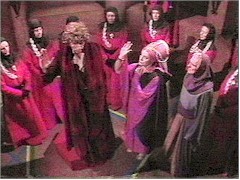
apparent that the magenta team, the Deons, are the backward faction,
undeserving of my support - just like the Labour Party - but both they and
the white Savants are individuals as iconic as a disorganised rabble at a
mass meeting.) Any suggestion that these people are strong characters is
damaged even further by the unbearable suggestion that this is the same
Jacqueline Hill that played such a key part in Doctor Who's early
years. As Lexa, the unfortunate Ms Hill has nothing better to do than be a
general pest, spout religious gobbledygook and suffer possibly the worst
death scene in the series' history. (This scene happens with no prompting,
Hill doesn't get a chance to go out elegantly and it is followed up with
the classic "She's dead"/"She saved my life" exchange. In other words,
it's just a bit amateurish.)
The whole premise of Meglos fails to ignite on any level, with
the regulars delivering highly below-par performances, as if they wanted
to build up to their imminent departures by acting badly. Tom Baker
stutters his way through the four episodes, so it is hardly surprising
that the Doctor fails to clear his name when the Savants and Deons turn on
him. Lalla Ward looks and sounds bored, while John Leeson succeeds in
displaying K9 as a massive irritant. In the role of the loud-mouthed
Meglos, Baker is doing nothing but transposing a cockier form of the
Doctor into another character, which is basically a remake of Patrick
Troughton's double role in The Enemy of the World,
even down to the "if Meglos/Salamander can impersonate you, you can
impersonate Meglos/Salamander" line. Disturbingly, when he's not looking
like Baker, Meglos is either a spiky humanoid, a static plant or a
crawling, deflated green mass. If this is what they call good stuff, Hovis
is not quintessentially British.
Evidence of lazy plotting is rife throughout the serial, and I'm not
going to let that slip through the net. Despite its fancy name, the
"chronic hysteresis" in which Meglos somehow traps the TARDIS does not add
anything to events seen. The TARDIS only gets trapped because Meglos
conveniently presses a few buttons on a keypad, almost certainly one of
those dreaded "keypads which can do absolutely anything when you want them
to for no apparent reason". Despite being billed as a recurring circle of
time, no two cycles of the hysteresis are the same. Despite being
incredibly clever Time Lords with great memories, the Doctor and Romana
struggle to recall things they have done many times within the hysteresis
(I, for one, was able to memorise the sequence better than them). The
Doctor later impersonates Meglos highly unconvincingly, with lots of
pauses, but still manages to convince Bill Fraser that he is an
anthropomorphic cactus. Then, of course, the aforementioned keypad somehow
allows Meglos to take on the form of the Doctor, making for a bland
cliffhanger. Another bland cliffhanger is a classic overhyped "Kill her!"
moment. If all of this is what you call exciting, then Victory of the Daleks is the greatest story in
Doctor Who's history.
My old acquaintance, Timelash, has been much
maligned for its production values. In response, I said to myself that the
quality of the basic story was what killed or elevated a serial, and the
quality of the sets was a less important factor. Timelash is an adequate story in terms of both
narrative and design, but Meglos is shoddy in terms of the two.
When director Terence Dudley is not parading his way through the most
pathetic artificial plants ever grown, he is standing around in rooms that
look like, variously, Rassilon's resting place (The Five
Doctors), the Xeraphin's cellar (Time-Flight)
and a larger version of Nerva Beacon (Revenge of the
Cybermen). In the room that looks like the Xeraphin's cellar, a
massive lump of rock appears to be hanging from three ropes tied to the
floor, but it is clearly suspended from a metal clip on the roof. If I
ever see Meglos' design praised, then I shall have to start
thinking that water is a molecule that contains carbon atoms. (It isn't.)
Then there's the fourth episode, a total embarrassment all round. After
warming us up with at least two boring minutes of recap, Meglos
indulges in switching scenes far too quickly for anyone's good. The
episode, including this recap (if I remember rightly), runs for just 18
minutes before the credits roll. As far as anti-climaxes go, this is a
flimsy, insubstantial classic. The same judgement can be applied to the
whole story; in other words, it fails miserably. At least the Fourth
Doctor only had room to go up in quality after this point - and with his
final five stories, most notably Warriors' Gate, he
certainly excelled himself. Why couldn't Meglos match them?
Also, why did nobody bother to get the closing theme right on Part
Four?
Doctor Who and the Cactus That Wore Burgundy by Joe
Briggs-Ritchie
2/11/11
Meglos is somewhat out of place in Season 18. Stylistically, it
belongs in the previous season, its somewhat flippant manner and comic
touches being something at odds with the generally more straight-laced
approach that JNT saw fit to adopt. It is very much the black sheep of
Season 18 whichever way you look at it. Whether or not you consider that a
bad thing is very much down to personal taste. Personally, I'm really
quite fond of it and I don't think it deserves to be overlooked the way it
so often is in favour of the titans standing either side of it. It is
certainly the shoddiest looking story of the season, but that's almost an
unfair judgement when you consider that this season is one of the most
visually arresting. Therefore, if anything is even slightly below par it's
going to stand out like a sore thumb. Although I feel I should mention
that the SceneSync techniques are actually quite impressive for the time
and there is very much a sense of pushing the then-boundaries. Still, at
least it's fairly imaginative. I mean, which other story in the series'
history has a megalomaniacal cactus as its principal villain?
It's another story revolving around the idea of religion being an
idiotic principle for fools, a dangerous ideology, ignorant and inferior
to science. I like how Doctor Who has always considered rationality
and reason to be superior to mysticism and superstition. A similar
slamming of belief systems can be seen in Colony in
Space, The Face of Evil, Planet of Fire, The Mysterious
Planet.... Science always comes out on top in Doctor Who. As it
should.
Character-wise, it's a bit of a mixed bag. Jacqueline Hill is powerful
and nicely convincing as Lexa, coming across as basically a good person
who is dedicated to her beliefs and somewhat unhinged with it. Her death
is a bit pathetic, however, and not worthy of Jacqueline Hill. Deedrix is
of variable quality. He's clearly giving it 500% but maybe that's the
problem; he's just trying too hard. Still, at least you can't deny his
enthusiasm. Caris looks like Annie Lennox which is quite an amusing
thought considering that this story almost has the visual look of a 1980's
music video. She's much more serviceable than Deedrix anyway. Zastor is
likeable but at the same time a bit hopeless. He doesn't bring much
authority to the role and just seems a bit exasperated by everything.
Grugger and Brotodac form the comic double act of the story. They're
mightily incompetent but think they're actually pretty fearsome even
though they aren't and very few of the characters actually seem to
consider them to be a genuine threat. Bill Fraser and Frederick Treves are
obviously enjoying themselves and they obviously appreciate how to
approach this type of Doctor Who story. Brotodac's constant
obsession with the Doctor's coat is very amusing. I can see where he's
coming from though; it is a very nice coat.
The regulars are on top form once again. Tom Baker is allowed to really
show off his range here and the contrast between the Doctor and Meglos is
very impressive with the latter coming across as genuinely nasty. The way
that he advances on Caris and drags her into the alcove is really quite
unsettling. Meglos is a great concept; never before have we had a cactus
as the villain in Doctor Who, a cactus that has waited for 10,000
years under the desert no less. There is definitely something sinister
about cacti and they are well suited to villain material. I think it must
be all the spikes. His mannerisms and expressions are all subtly different
from those of the Doctor and it's a treat watching Tom Baker relish the
oppurtunity to play the villain for once. Is it just me or is he actually
more subdued as the Doctor than he is as Meglos? Hmmm, says rather a lot
about what was going on behind the camera if you ask me. Romana is as
engaging as ever and her outfit is lovely.
The doomsday weapon plot has been done before but then again so has
just about everything else in this story with the exception of the talking
cactus. Let's see now, a civilisation which is divided into two groups,
the planet's surface no longer inhabited to the extent that it once was,
the inhabitants worshipping technology as divine, a doomsday weapon, a
maniac trying to seize control of the weapon... But enough of Colony in Space, let's get back to Meglos.
The jungle isn't great but then again jungle sets in Doctor Who
are always hit and miss. Usually miss. It's far too overlit (a problem
that is only going to get worse as the JNT years go on) and as a result it
just looks like it's made of plastic. The Bell Plants look good but that's
about it; as soon as they're required to start being any kind of credible
threat, all sense of realism or suspension of disbelief goes straight out
the window.
The music is very effective, courtesy of Paddy Kingsland and Peter
Howell, continuing in the same style as that of the previous story, by
turns atmospheric, menacing and beautiful. I particularly love how the
theme tune is briefly incorporated into the score in episode two as the
Doctor comes round the corner. You know, just so we know that it IS the
Doctor and not Meglos... The whole Earthling thing is never really
explained; wouldn't it have made more sense to just use a Tigellan?
The confrontation between the Doctor and Meglos is very well done,
especially so when you consider that all it involves is a tiny set, one
actor effectively talking to himself and some camera trickery to enable
both characters to be appear on the same set simultaneously. I think this
speaks volumes both about the quality of the writing and Tom Baker's
acting skills. It's wonderful to see both of these two characters on
screen, we really get a sense of what level Tom is working on.
The weakest story of Season 18 for sure, but the fact that it's still
eminently watcheable should speak volumes about the strength of the season
as whole.
Oh and could you really solve a Chronic Hysteresis that way...?
A Tale Told by Idiots by Jason A. Miller
19/9/21
I really, really want to love Meglos. Why wouldn't you want to love Meglos? You loved it as a kid! When I was 12, this story was everything, man. You had the adrenaline rush provided by the new starfield opening titles and by Peter Howell theme arrangement -- later the background music to the very first answering machine outgoing message I ever recorded, in my college dorm -- the theme music that still sends a rush of energy to my legs, as if I still need to make it over to the TV in time to watch the show.
Beyond the music, into the story itself, you had Lalla Ward in that elegant velvet pants-suit, and the Gaztaks, who were perfect (for 12-year-old boys) comedy villains. The chronic hysteresis bit is -- hysterical, really. To this day, who among us doesn't want to comically trip over an apron, or say, "Oh, that's easy, just waggle his tail!" (plus five, if you've ever said that in bed). And who can't sympathize with Brotadac? His pirate crew wants to raid the galaxy, Meglos wants to annihilate planets -- just like Governor Tarkin on the Death Star! -- but all Brotadac wants is to do is wear Tom Baker's coat.
I'm going to repeat that point, because it's important. All Brotadac wants to do is cosplay as The Doctor. That's right, 33 years before Osgood in the New Series, Brotadac was the first in-series character who wanted to cosplay as Doctor Who.
Awesome stuff.
Until you grow up, that is.
As a grownup, you quickly realize that the script was written merely to accommodate certain existing jokes, and that just doesn't work. I mean, it works if you're 12, and don't care that the plot hinges on all the characters (except Romana) being idiots. The idea of an immobile cactus as the main villain is cute, but not a very good idea. Zastor interrupting Deedrix's "I've always argued" with "I certainly have" is a funny line (I can't wait to use that in court), but the timing of the joke is distractingly staged to allow for Zastor's interruption.
None of the actions taken by any of the guest characters make any sense. Meglos has godlike powers with no decent explanation -- and then stupidly reveals himself to Caris as Meglos, thus enabling the Doctor's escape from execution that will wind up foiling Meglos' own plan. The Savants-versus-Deons setup on Tigella is painfully message-y, as are all the scenes in which the two castes argue with one another. It takes the Doctor forever to realize that somebody's been impersonating him for the past two episodes. The whole act-your-way-out-of-the-chronic-hysteresis conceit is the sort of mumbo-jumbo that pales very badly in between the science-heavy stories on either side of Meglos. The Gaztaks also take forever -- like, 20 minutes of Part Three, which is short enough as it is -- to realize that Romana is trolling them. Nobody realizes that the Doctor is impersonating Meglos in Part Four. The countdown to the destruction of Tigella in Part Four changes when the person counting down the numbers loses his place!
The climax is played for laughs, with one Gaztak getting distracted and laughing at K9 and Brotadac pushing the wrong button that blows up the whole complex. When you're 12, it's nice to realize that you're smarter than the villains, but as a grownup, it's hard (at least for me) to appreciate a plot that's almost making fun of itself.
Terrence Dudley's direction is wonderful, though. The septuagenarian actors playing Zastor and General Grugger add a nice authenticity to the proceedings (and the CSO work in Part One literally turns Bill Fraser into Bluebeard!). Frederick Treves is wonderful as Brotadac, a bad guy you can actively root for. Even now, as I was back in 1985, I'm really invested in him getting to keep Tom Baker's coat. It's still the only element of Part Four that makes any sense! Also, it's kind of awesome when Meglos generously lets Brotadac pick the first planet to be destroyed by the Dodecahedron -- and Brotadac can't choose, and just asks for the coat instead.
And how prescient was Dudley in casting? The Earthling looks like future PM John Major, and the fat Gaztak looks kinda like future Saddam Hussein. The DVD production notes tell us that Edward Underdown (Zastor) was Ian Fleming's choice to play James Bond -- couple that with George Baker in the next story, who actually played Bond's voice for 30 minutes of On Her Majesty's Secret Service, and you've got Doctor Who's most James Bond-intensive season since 1970.
As much as I love Lalla Ward -- one day I have to write up a list of the ten Romana 2 moments that made me want to bear Lalla Ward's children -- isn't it wonderful seeing Jacqueline Hill again, even if she's only playing a thankless secondary villain?
Oh, wait, there's another of those Lalla moments right here -- after the Doctor rudely accuses her of forgetting her lines in Part Two, she wrinkles her nose at him and silently mouths, "Oh, you!" Oh, my aching heart!, more like. Lalla Ward is my soul's True North.
But Lexa -- oh, Jackie Hill here is everything that Barbara Wright was not, and her majestic declarations and sinister religious chants are a thing of beauty. Her trying to have the Doctor killed at the Part Three cliffhanger is a nifty payback for all those insults that Bill Hartnell's Doctor threw her way back in the early '60s. Her character's rushed and pointless demise in Part Four is a black mark on the script, though -- the story is begging for a final scene that shows Savants and Deons learning how to work together to build the new Tigella, or at least needs to turn her into a martyr whose absence is a presence in the final scenes, to give payoff to all the endless science-versus-religion debates earlier in the story. But, in a seriously under-running script, the scriptwriters couldn't even manage that.
Meglos for me is a story that makes me wish I were still 12 again. I can see through all the joins now. I still love the directing, the acting, Lalla and some of the jokes -- and did I mention Lalla? -- but, in the end, it's a painfully bad story that asks the audience to insult their own intelligence. And it misuses Jacqueline Hill, which may be the biggest crime ever committed in the whole Doctor Who canon. When I was 12, this story sung to me, but now it just sounds criminally off-key.
Meglos vs Science and Religion by Andrew McCaffrey
13/9/23
This is not a review of the entire production of Meglos; rather it's just me spending too long complaining about the one aspect of the story that annoyed me the most on my recent viewing.
Science vs religion/superstition/magic is a topic that Doctor Who has returned to time and time again. Some serials use this as a theme running through the whole story (see The Daemons or The Masque of Mandragora) while in other places it's used as little character moments ("I too used to believe in magic, but the Doctor has taught me about science. It is better to believe in science." - Leela, The Horror Of Fang Rock). But, big or small, has the debate ever been staged as superficially as it is in Meglos?
Let's set the parameters of the discussion. On one hand, we have the science-based caste called the Savants. They speak about the Dodecahedron in physical terms. It has a width and a height. They estimate its mass and weight. They know it can produce energy (in some unmentioned form), though are unable to calculate how much.
On the other hand we have the religious-based Deons. They revere the Dodecahedron as a holy object. They believe in human sacrifice. They worship… well, the dialog isn't quite clear what they worship. Sometimes the Dodecahedron is referred to as a god. Other times it is an object controlled by the god. Or gods. (The dialog switches between a singular god and plural gods.) At one point the phrase "Oh great gods of Ti" is used suggesting Ti refers to a home of the gods such as Mount Olympus. In the same line of dialog we get the phrase "Thanks be to Ti" alternatively suggesting Ti is the name of (one of) the god(s), which is at least consistent with the earlier plot-point (which goes nowhere) about the Doctor/Meglos needing to swear an oath to Ti. (The name of the planet is Tigella suggesting that "-gella" may be a suffix denoting their world as a creation or protectorate of "Ti", which may also imply that their religion predates the arrival of the Dodecahedron.)
As much of a mess as the religion of Tigella is, their science isn't terribly well-established either. The story doesn't engage with science as science, it simply has the trappings of science; it's character actors shouting numbers into microphones and then complaining about the religious folks. If we're getting into a debate where you have each side portraying a fundamentally different approach to life, it would make more sense to show them doing actual science. There's plenty of stuff that could be cut to make room for this (the unending chronic hysteretic scenes for instance). The story could have had the scientists form an actual theory about the failing Dodecahedron and then testing that theory to see if it holds up; i.e. the scientific method. Instead, there's just a lot of dialog about the lights going off.
It's hard to imagine this group of scientists actually engaging with the Dodecahedron in scientific terms, yet their ancestors must surely have done so. Some inhabitants must have figured out that there was a form of power (electricity?) coming from this newly arrived object and how they could use that power to run machinery. But that presumed backstory just doesn't come across. The current-day scientists seem as inflexible as the religious types.
Going back to the origins of a Dodecahedron as a power source also begs the question of why a religion formed around it. Religions don't just spring out of nothing. In our world, we didn't have anyone in the 18th century worshiping the steam engine as a religious expression. There's usually a charismatic religious leader involved. Or a new event that happens to fulfill an object or action prophesied in a pre-existing religious text. Or perhaps an unlikely coincidence at some point in the past that explains why on earth Lexa assumed a human sacrifice would possibly have any effect in the real world. None of this is even hinted at in the script. The religious people are religious just because the story insists that they are.
We the audience are presumably supposed to be on the side of the scientists in this debate. After all, this is a science fiction show. The Doctor has always been portrayed as a scientist. Script editor Christopher H. Bidmead is definitely a science guy who wanted this season's stories to be more grounded in hard science that previous seasons had. And yet, the pro-science portion of the debate is massively undercut by the story itself where escaping from a time loop is done basically by engaging in a magical incantation, which gets a gobbledygook, technobabble name.
Perhaps the most maddening thing about the debate over the Dodecahedron is how the story never resolves what actual function the Dodecahedron performs in their society. Although there's a lot of breathless dialog about the city collapsing within two hours without the Dodecahedron running at full power, when that time limit passes, nothing terrible seems to happen. It's hard to imagine what the actual threat is. The planet's atmosphere is breathable. The temperature is moderate (despite a line about them needed to preserve the heat, the temperature inside isn't portrayed as being much different that what's outside). Is there some convoluted supply chain for their food that's getting messed up? Whatever the issue is, when the story ends and the Dodecahedron is destroyed, nobody seems to particularly mind that it's gone.
Nor is there a religious aspect that's given much thought. What was the role of the Dodecahedron in their religious life? Was it forgiving their sins? Did it have healing powers like Lourdes? Did it provide a spiritual guide to the afterlife? Was it protecting the city from some evil gods? Killing Lexa removes the only voice of the religious side, but again once the Dodecahedron is removed from their society there doesn't seem to have been any great upheaval as one would imagine if, say, the Daleks exterminated the Pope and left the Catholic church leaderless.
In all the scientific vs religious rebates we've seen in Doctor Who, one side is usually given short shrift. But perhaps Meglos is the most fair of these debates by giving short shrift to both sides. It's a pity given how underrunning the four episodes are and how much padding had to be added in the script-editing phase in order to even get them up to that short length that some of the extra scenes couldn't have had some relevance to the actual theme at hand.