THE DOCTOR WHO RATINGS GUIDE: BY FANS, FOR FANS
| Story No. |
192-193 |
 |
| Production Code |
Series Three Episodes Four and Five |
| Dates |
April 21 and 28, 2007 |
With David Tennant, Freema Agyeman
Written by
Helen Raynor
Directed by
James Strong
Executive Producers: Russell T Davies, Julie Gardner.
|
|
Synopsis: To survive, the Daleks must consider options
they've never considered before.
|
Reviews
Technobabble of the Daleks by John Nor
5/7/07
"Helen Raynor?"
"Yes?"
"Hi. I should point out YOU ARE NOT ACTUALLY Helen Raynor. I have
imagined you here to this review to ask you a few questions. I've already
written a version of this somewhere else on the web. I usually just
produce reviews here for the DWRG only, but this review is based on my
lengthy comment to another review elsewhere. With apologies to Stu as I
was inspired by the dialogue format of his original review. And with
apologies to the actual real Helen Raynor. No offence is meant."
"Okay, but make it quick, I'm due to be imagined somewhere else this
afternoon."
"Now, I've got to say, part one of this story, Daleks in Manhattan, was very good. Some people
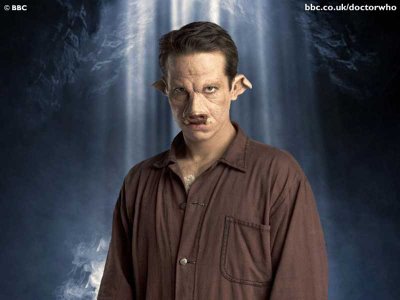
questioned the coherence of the plot, but the Pig-Humans, the Dalek blob,
they seemed to me to clearly lead into the Human-Dalek (of which Dalek Sec
was obviously not telling the full story about to the Bronze Daleks). It
all made sense."
"Thanks."
"But Evolution of the Daleks - Helen, Helen, Helen. WHAT was
that all about? Solar gamma-ray flares? Why the lightning?"
"NASA have associated gamma-rays with lightning and thunderstorms on
their website."
"Okay - gamma-rays and lightning go together, but unless I wasn't
paying attention I don't think that was made clear at all."
"Is that it?"
"No. The image of a Human-Dalek was a great one. The image of the
serried ranks of mysterious body-bags was chilling. When one body-bag was
unzipped - what a let down! A human looking slightly pale.
"Well, we have to work within budgets. Talcum powder is cheaper than
prosthetics you know."
"Fair enough, but as well as being highly disappointing visually, what
clarity there was to the Final Experiment was completely lost with all the
talk of gene solutions. The Bronze Daleks who were repulsed over racial
impurity now thought it was okay, so long as they upped the proportions of
Dalek element over human element in the gene solution. Dalek Sec wanted,
say, 50% Dalek DNA liquid - the Bronze Daleks wanted 100% Dalek DNA liquid.
For such a triumphantly visual story to suddenly hinge on slightly different
forms of liquid was frustrating!"
"Well... I'm not sure I agree. Anything else?"
"Yes. I have to say this. The slightly pale humans with the DNA liquid
was one thing - any clarity to the Final Experiment had now gone. The
icing on the cake was Time Lord DNA somehow being mixed in by the
lightning."
"I thought that was quite good."
"No way! Any pathos generated by the Doctor being the Last of the Time
Lords is undermined by the brief existence of Human-Daleks-Time-Lords the
new race (Really! WTF?!). Also, that moment was the biggest pile of
technobabble so far in an episode littered with it."
"Doctor Who always has technobabble."
"Not really. I would categorise things like the mega-MRI in Smith and Jones as a playful and understandable
extension of existing science, but Evolution of the Daleks had
nonsensical technobabble by the bucket-load."
"You shouldn't just be talking to me! You have to remember Russell had
quite a lot of input. He did zhuzzh up the dialogue and there WAS an
extensive shopping list that he gave me."
"I thought this Dalek two-parter was brilliant! Hooray!"
"Russell. This isn't Doctor Who Confidential. This is an imagined
conversation in a review. I have to say to both of you that Nu-Who
so far is a staggering triumph and I have immense respect for what you
both have done. The four episodes of Season 2007 up until episode 5 were
some of the best Doctor Who since March 2005. Evolution of the
Daleks though was a real disappointment. Some people are saying the
production team are running out of ideas. I think and hope that it was
just a blip, like New Earth was. There have been
two and a half years of freshly invigorated and radical Doctor Who,
and I hope the rest of the 2007 season is as superb as it looks from the
BBCi trailer."
"Hooray!"
Song and Dance by Mike Morris
4/9/07
I'm in a bit of a quandary about this.
A while back I published a review of The
Runaway Bride - or rather, a single scene of The Runaway Bride, because I was in that kind of
mood - in which I complained that Doctor Who was showing signs of
turning into the sort of programme that does things because that's what
Doctor Who is supposed to do. There's elements of this which remain
true - witness the oh-look-Earth-gets-invaded-again finale to Season 3,
which would have been annoying if it weren't so nicely done - but if
anything showed me that this was still a fair way off the money, it was
this two parter. It's brash, confident, and hugely unpredictable. Daleks
meet Broadway, essentially, with a production that oscillates between
Singin' in the Rain and Frankenstein, except with more colour. Half an
hour in we have the Doctor discovering that a green squishy thing is from
Skaro, and then we cut to a musical number. In spite of the Broadway show
being uncomfortably minimalist, the sight of someone slinking between
beautifully choreographed dancing girls dressed up to look like red
peacocks, replete with shots from above, is as visually arresting and
beautifully alien as anything seen in Doctor Who. It's obvious that
the corniness of the production is deliberate, and so even the truly
appalling American accents seem appropriate somehow.
In other words, it's rollickingly entertaining television. The first
part is a long way ahead of the second, and it's obviously silly, but it
would be churlish to claim otherwise. Even the slightly dodgy makeup of
the pigmen doesn't damage the production, because all the
stageplay-vaudeville stuff around us serves notice that we're operating in
a world that's gone quite some way from naturalism, and besides which it
doesn't look all that bad. There aren't really any points that you'd
describe as really frightening, as opposed to something that looks like it
should be frightening; however there's lots of sights that are beautifully
grotesque, and that's also perfectly fine. The conclusion of the story is
another matter, and we'll come to that later, but for three-quarters of
its length the story is rollickingly entertaining. Oh, and don't Daleks
look good when they fly?
Hey, look, I've mentioned Daleks.
And here's the thing; if this story featured the Ugwats or the
Thretatrant or the Silliandstupids, I don't think I'd have such a problem.
I don't want to be stuffy, but my reaction was simple; don't do this for a
Dalek story.
To clarify; this is the first story in which the Daleks are rubbish,
really really rubbish. They even look rubbish. I'm all for Doctor
Who getting rid of all that
let's-make-everything-frightening-by-never-turning-the-lights-on-and-if-we-do-let's-make-them-sort-of-blueish
Battlestar-Galactica-inspired nonsense, and I ain't got nothing against
colour schemes that actually feature colours. Having Daleks that are all
coloured gold, rather than that old gunmetal-grey we all got used to,
seemed a bit of a bonkers decision when I found out about it; however, put
them in dark cellars and glitzy sci-fi surroundings, or even the
gorgeously coloured alienness of a Dalek ship, and they look bloody
fantastic. However, stick them in surroundings which are fake art-deco,
and everything looks like a gaudy costume and they look like... gaudy
costumes, or at best gaudy props. The Daleks in this story aren't
believable, and nor are they menacing. In fact, it feels uncomfortably
like they're being sent up.
Which ties into the second objection. There's been a lot of comment
along the lines of how the Daleks are back to being menacing, scheming
creatures. This is nonsense, and seems to me to be based on the fact that
their plan's a bit like Evil of the Daleks (one of
those 'classic' stories that doesn't actually exist anymore). The Daleks
might have seemed menacing and scheming in 1966, but here they come across
as being composed of B-movie cliches. Their squabbling doesn't help
matters either, partially because it happens at unconvincing points (why
on Earth would Caan object to Sec's Final Experiment just seconds before
it starts, rather than when they first hatched the idea?) and mostly
because seeing Daleks argue with each other is even less entertaining than
seeing them argue with Cybermen. It just about works in Daleks in Manhattan, largely because the full
enormity of their plan hasn't been revealed, but even then it's hard to
feel anything but nonplussed when that Builder Bloke is eaten by a giant
CGI tentacle that anyone should notice isn't big enough to actually
accommodate a human being.
In Evolution of the Daleks, though, it's simply pathetic.
There's something in the notion of a Dalek being humanised by being
cross-bred with a human, but you immediately start to wonder why the other
Daleks would put up with it for so long. After the obligatory
action-extravaganza at the start, we're into Sec explaining what he's up
to and... well it's bollocks, isn't it? It's one of those stories that
throws the word "DNA" round as a magic cure-all, but doesn't actually know
what DNA is. I'm never arsed by whether the science makes sense, only as
to whether it's interesting or threatening, but here - well it isn't, and
that's all there is to it. Essentially we've got a bunch of humans who
have their personality removed, into which you can pour Dalek-ness. So why
bother with the tentacle-headed thing at all? How witless do you have to
be to talk about the Dalek/Human mix as if it's like the mixture between
gin and vermouth? And that bit at the end is crap on two levels (and I'm
shamelessly chanelling Lawrence Miles' comments here, but he put it best);
the Doctor's lightning-strike intervention makes about as much sense as
someone hacking a computer by rewiring its plug, and it also establishes
him as some sort of demi-god who sorts everything out by touching it.
Oh yeah, and the line "Humans with Dalek DNA" really bothered me; my
long-held, arse-to-the-science viewpoint can survive many things, but even
I couldn't stop myself from shouting at Martha that humans with Dalek DNA
would be, y'know, Daleks.
More annoyingly still, there isn't any real progression in the
story; since all the Dalek developments are nullified by the story's
conclusion, the Daleks are pretty much where we left them. Part of the
new series' terrific use of the Daleks is tied up with the fact that
they've always been there for a reason: in the story Dalek, we're give the last relic of the Time War, in Parting of the Ways they're presented as a
quasi-religious gathering darkness, and their subsequent appearance serves
as an effective shock-tactic as well as re-establishing them as a
presence. This is the first story that smacks of "oh, we'd better do a
Dalek story"... which is why I think I'd warm to the story more if it had
used some other adversary.
And yet I don't, I can't dislike it. All the things that should be
terribly wrong with it don't matter; the dodgy pig makeup seems to fit,
Solomon's death-speech somehow works in spite of its cheesiness, and the
general feel of the production comes through unscathed. There's a
grittier, tougher story embedded in this - just as there's a nastier
portrayal of Hooverille which doesn't make it to screen - and yet the
version I've got doesn't bother me. The Doctor does rather too much
sermonising for my taste, but I cheered at "Oh Tallulah with three l's and
an h, just you watch me." Even Tallulah was a caricature that worked.
Helen Raynor doesn't show much understanding of science fiction, but she
does clearly understand how to make good television - and that's the right
way round to have it. Along with James Strong's somewhat perverse
interpretation of the script (it's light years from his previous work on
the show) we're left with a unique slice of television. Just as I can't
dislike it, though, I can't quite warm to it either. It's entertaining
while it lasts, but as soon as it finishes all sorts of things start to
bother me.
So what's there is... strange. I'm sure there'll be some people who get
more out of this than I do, but ultimately I was rather nonplussed.
A Review by Joseph Gillis
30/10/07
After how good the previous Dalek appearances were, this kind of let it
down a little bit. The Cult of Skaro themselves were fine, but everyone
else apart from the main actors really weren't on scale.
This is more or less a follow-up to Army of
Ghosts/Doomsday, but it doesn't live up to the high quality those
episodes showed. It also gives a reference to the previous episode, Gridlock, which I felt really wasn't needed. One
thing, though, it's nice to see the old, scheming Daleks back. They worked
really well, and I personally like these Daleks instead of the new "kill
anything in its path" route they've gone down.
The acting was good, but not as strong as the previous performances:
David Tennant and Freema Agyeman are both brilliant in this episode and
unlike Rose~Rs tenure in Season Two (who just got jealous of every woman
the Doctor even looked at because of what he did in The Parting of Ways), she seems to have genuine
feelings for our Time Lord. Ryan Carnes and Hugh Quarshie both do
incredibly well as Lazlo and Solomon, respectively, so that when Carnes
becomes a pig-mutant... thing (more on that below) and Solomon is shot
after delivering his speech to the Dalek, you really do feel sorry for
them. Eric Loren didn't really do a lot as Mr. Diogras, and when he merged
with Sec, it didn't really have any impact, but you really did feel sorry
for Sec when they killed him. I loved the Black Dalek armour since it
looked really cool and sleek.
The biggest disappointment, out of everything in this two-parter, is
Miranda Raison as Tallulah. Her voice was incredibly annoying, she never
shut up about her pig-boyfriend... thing, and it just came to a point
where you just wished that a Dalek came along and did something that would
make her die. The other major disappointment was the pig slaves of the
Daleks. There was no actual need for them, other than a need of mutant
animals that would answer to the Cult of Skaro. It doesn't help that the
make-up on them didn't make look realistic enough. Speaking of make-up,
the Dalek-Human looked really cool and it must have been a pain for the
actor to be in that helmet, but it really came across as cool.
Overall, a bit below average for the Daleks in the revived series, but
it's still a good episode despite the bad points above.
A Review by Finn Clark
7/7/10
I've quite liked the Dumb Kiddie Two-Parters. They're not brilliant,
but I'm baffled by phrases like "the Dalek disaster". This particular one
is the most ambitious and least successful of Tennant's three examples,
since the other two aren't aiming as high but as a result more or less hit
their targets.
Daleks in Manhattan is ponderous, but
straightforward. Nothing unusual there. No, it's the second half of the
story that's completely done its brains with high tragedy with Manlick Sec
and heatfelt pleas to try to make the Daleks become less evil. Eh?
Somehow this works when it's the Doctor talking, because he must know he's
beating his head against a brick wall and so the scene becomes about his
characterisation. However, it's a joke from Solomon, since he's going to
die. We know this within milliseconds. Predictability needn't
necessarily be a problem with tragedy, but this is just daft. Will the
Daleks become nice? Sure, after Dracula's turned vegetarian. Obviously,
we all know the episode will end with all hybrids squashed like jellyfish
and all the surviving Daleks still being evil, so we end up sitting there
for 45 minutes just waiting for what we know is going to happen.
This poses two further problems. The first is that it requires you to
care about what happens to Daleks. Personally, I think this is great.
Completely bonkers and the attempt goes down in flames, but it's a
glorious thing to have tried. Imagine a Dalek Hamlet, starring a Dalek
Sec who enslaves Yorick and exterminates touring players. Me, I'm 100%
behind the idea, but I'm mad. What about the poor viewers who watch to
see the adventures of the Doctor?
Nonetheless, I still enjoy watching these Daleks. They have a plan!
How cool is that? They haven't had a plan for years! I love the way even
the other Daleks back away from the mutated Dalek Sec. This story may be
a poor vehicle for them and thus a wasted opportunity, but I have a lot of
time for what it does manage to achieve.
The other problem is that the plot is badly constructed. The tragedy
fails because it's railroaded. It's nice to see that everyone gets a
little speech or two, but look at the structure. Dalek Sec has his
Damascus moment and even talks the Doctor into trying to help, only for
his allies to betray him as we always knew was going to be inevitable.
Sounds great so far, right? That's a good starting point for a story, but
unfortunately Sec's only plot involvement from then on is to crawl about
in chains and then die. Eh? Admittedly the sight of him is hilarious,
but it's hardly dramatic.
So much for the Human Dalek. That's only half of the mutant equation,
but the Dalek Humans are even more ill-served and in a way that doesn't
even make sense. I like the way they turn on their masters, although this
would have been stronger had Raynor managed to make it due to either their
their Humanity or Dalekicity. You could have mined either of those for
characterisation and theme. Admittedly, I also quite like her eventual
choice, but that mostly because the science involved is so ludicrous as to
become an art form. David Whitaker rides again. Lightning bolts can now
go on the Magic List along with mirrors, mercury and static electricity.
That's funny, but it's what happens next that's rubbish. Dalek Caan
activates his Saward option to kill everyone before the plot can get
interesting, but if he was capable of doing that, then why didn't he do
something a few minutes earlier when they were blowing away his comrades
and making him the last Dalek in existence? D'oh. I guess he'd been busy
on his Playstation or something.
Admittedly, it's wise not to expect plotting in a New Who Dalek
story. Parting of the Ways gives Eccleston
nothing to do but die. Meanwhile, Journey's
End runs around furiously, but in ever-decreasing circles. The Daleks
are unstoppable. This makes them impressive, yes, but it doesn't make for
very interesting stories. What happens when the irresistible force meets
an all-too-movable object? G'wan, take a guess. Answer: almost nothing
until almost the end, when Rusty pulls a magic lever from his backside.
Nevertheless, there are two New Who stories in which the Daleks are
underpowered and trapped on Earth. One is Dalek and
the other is, yes, this one. This could have yielded a terrific
ding-dong, especially since Raynor gives us machiavellian, scheming Daleks
of a kind we haven't seen since David Whitaker.
This was a opportunity. It wasn't taken.
All that said, there's still stuff I like here. Tennant does wonders
with his final plea to Dalek Caan, which is a scene that should have
looked ridiculous. Similarly Bondage Sec in chains is funny. There's no
reason for the Daleks to be getting so theatrical, but they do enjoy being
flamboyantly nasty from time to time, don't they? They're even better
when being conspiratorial and backstabbing. Moving across to the humans,
I laughed at Tallulah's assumptions about the Doctor. "He likes musical
theatre, what a waste." I like the historical angle and I don't mind the
pig-men, although I can't say I cared much about any of the cast.
They're not that interesting and they have "loser" tattooed on their
foreheads, that's all.
Of course as a production, it's astonishing. Everything about it is
impeccable... except that, for me, it lacks a certain style. Something
about it is heavy-handed. There's so much potential in the idea of 1930s
Daleks in the Empire State Building, but we only ever get the faintest
taste of it. I wanted more flair, more fun. The scene of Martha crossing
the stage during a performance doesn't work at all, to a degree that's
actually shocking when you realise how it should have come across. I also
adore the idea of Daleks in a 1930s Universal Frankenstein laboratory with
lightning bolts and gigantic Tesla coils, but what we see isn't getting
into that right spirit. It looks pretty, but that's it. It doesn't
remind me in any way whatsoever of James Whale. They even have a body
under a sheet being winched down from the roof, for goodness sake, yet
somehow even that manages to be neutral.
They're doing Golden Age of Hollywood pastiche, but I think they're
trying too hard. It would have done them good to let their hair down and
have a bit more fun with it.
However, that said, the details are impeccable. There's nothing wrong
with the acting or even the American accents. The photography, the
effects, the costumes... all beautiful. It's also the only Russell T.
Davies era kiddie two-parter not to be set in a contemporary London.
Historicals are good things, you know.
Of all New Who's stories, this is the one I most want to
rewrite. It had so much potential. It's heartbreakingly close to being
bold and daring, which had it got there could have raised the 2007 season
to a level that would blow away Eccleston. I admire the way it gives
story time to the Daleks as characters, not monsters, which is something
that the previous season had fallen down on. The 2006 season had often
rather rushed through its monsters and as a result felt at times like
something put together by children with Meccano. This story on the
contrary falls too deeply in love with its Daleks for its own good. It's
not advisable to think too deeply about this story until afterwards, but I
can still watch it peacefully enough and go gooey at the George Gershwin.
It's okay.
What the hell are you two clowns doin'? by Evan
Weston
5/3/15
Right off the bat, I will not hesitate to call Daleks in
Manhattan/Evolution of the Daleks the weirdest Doctor Who story
I've ever seen. There are Daleks, Hooverville, showgirls, horrible
American accents, pig men, technobabble, a Dalek-Human hybrid, Andrew
Garfield and a host of other random crap thrown together in one of the
strangest, most off-the-wall episodes of television I've watched. And yet,
after the insanity ends, it's utterly forgettable, even for its abominable
performances and overcooked plot. Actually, it's worse than forgettable;
it's downright terrible.
It's evident from her portfolio that Helen Raynor just isn't a good fit
for Doctor Who, and the absurd places she takes this episode are
perhaps the best (or worst, depending on your viewpoint) examples of this.
Why, exactly, do we have Daleks running about the sewers, determining
which downtrodden New Yorkers are fit for experimentation and which need
to be turned into demented pig slaves? I know, it's crazy. And none of it
really makes any sense. The pig men have almost absolutely no use except
to facilitate the worst subplot of the episode - "the pig and the
showgirl" - and even there Raynor chickens out of the more powerful
ending, choosing to let Laszlo live. The Cult of Skaro's plan sounds cool
in concept, but in practicality it's inane. Why go through all this
ridiculous trouble instead of just using the power from the gamma strike
to rehabilitate themselves and take over the world? They wouldn't even
need the stupid MacGuffin, they could just fly up there and get zapped.
Sec, in particular, is a completely incoherent character, made worse by
Eric Loren's interpretation of the role.
Oh god, we have to talk about the acting. Loren is a mess: his voice is
so weak and his American accent so crappy that he's never seriously
intimidating as a villain, even after he transforms into Dalek Sec. His
enunciation of words post-transformation is just odd, too, and it actively
detracts from the character. Ryan Carnes is only slightly better as the
personality-free Laszlo, laying out pointless exposition with all the
enthusiasm of a dead turtle. Hugh Quarshie is alright as Solomon, but then
he gets killed off, and the wonderful Andrew Garfield (love that he was in
this, by the way) is given almost nothing to do until the final 15
minutes, and even then he's just running around. Even Freema Agyeman's
Martha is more annoying than sweet in Daleks in Manhattan/Evolution of
the Daleks. I think it's fair to say that this is her worst
performance in the role, at least until Series 4. Only David Tennant
manages to make it through unscathed, and that's because he's basically
reacting to everything and going along with the psychotic script.
But, for all of that, by far the worst performance in Daleks in
Manhattan/Evolution of the Daleks or perhaps in any Doctor Who
story ever, goes to Miranda Raison as the pointless, witless,
mind-numbingly horrendous Tallulah. Three Ls and an H, my ass. Tallulah is
a helpless wimp with a horrid New York accent and an excruciatingly
grating voice, amplified by Raison's stupid faux-sultry blocking.
Everything she does is completely outside the main thrust of the
narrative, and all that her "obvious character moments" with Martha do is
call the Doctor gay. Real clever, Helen. Every minute spent with Tallulah
is one I'd rather spend carving out my eyeballs with a butterknife. She's
almost insulting, a misogynistic wreck, rushing to her pork-bound
boyfriend every time anything remotely dangerous happens.
Then again, there isn't much danger in this episode at all. The Daleks
are pathetically neutered, smack dab in the middle of their decline that
would become far more severe in The Stolen
Earth/Journey's End and culminate in the awful Victory of the Daleks. There are at least four
separate occasions on which the Cult could have killed the Doctor with
absolutely no repercussions whatsoever. Even Sec's "he's a genius, we need
him" thing doesn't make sense; the Daleks are geniuses as well! The only
death we get is Solomon, and that one is so obviously telegraphed that it
loses half its impact. I never buy the Doctor's claim that the vulnerable
Daleks are more dangerous; give me the criminally insane Daleks of Series
1 any day of the week and twice on Sunday.
The Doctor goes on a weird journey in this episode, too. He doesn't do
much in the first half hour, presumably because Raynor's script was way
too thin for a two-parter but hey, we've got to give the Daleks some
space. Eventually, he begins his moral grandstanding in the Empire State
Building and starts taunting the Daleks with some Brit braggadocio, and
none of it makes any sense. Then he starts... working with them? And then
he gets struck by lightning and has his DNA transferred at the same time?
Please, Ms. Raynor, I know my way around basic science, and you just
crapped all over it. The Doctor learns nothing from this story, and after
his first utterance of "they always survive, while I lose everything,"
that thread is never touched again.
I can't entirely dump on Daleks in Manhattan/Evolution of the
Daleks, as much as I might want to. Dalek Sec is a conceptually cool
character - though his new attitude certainly doesn't jive with the
manically violent personality he displayed in Army of
Ghosts/Doomsday - and perhaps the episode would be more interesting
had the Dalek-Human hybrid not been a complete failure of execution. The
Daleks still look great, and this is something that changes across their
decline as well. Here, they glide menacingly, especially after their
inevitable turn against the sappy Dalek Sec. There are some interesting
aspects to James Strong's direction, and if it's not entirely well done,
his use of quick foreshadowing cuts throughout the episode adds to a sense
of approaching chaos. I also really enjoy the flapper-girl scene -
Tallulah's only decent moment - for the way it's staged, shot and
executed. It's refreshing to see that on Doctor Who, and it was a
cool moment that took away from the dullness of the story.
The story also does a nice job respecting the American Depression, and
I have to tip my cap to the feel of the era. The Solomon character is way
too obviously altruistic, but the slum life feels real, even though New
York is clearly being re-created on a Cardiff set. Andrew Garfield's Frank
is a big asset in this - it's no surprise he's an A-list star today - and
I'm also a fan of the sewer tunnels connecting Hooverville to the Empire
State building. The production design is generally great for an episode
that was filmed with a far smaller budget than the script required, and
that's something to be commended.
Still, while this is a story with a few of things going for it, none of
them quite work, and the result is an unwatchable wreck. It's not the
spectacular failure of ambition that Army of
Ghosts/Doomsday was, but Daleks in Manhattan/Evolution of the
Daleks feels like the kind of Doctor Who episode you dream up
subconsciously in your sleep. It's half-baked, incoherent and very weird,
in a bad way. Fortunately, the remainder of Series 3 is almost all
excellent, and I'm thrilled to dive into what is probably the best stretch
of the New Series ever. Positive thoughts, people!
GRADE: D+
"The show must go on" by Thomas Cookson
20/10/16
Tat Wood has argued 2006 was New Who's Annus Mirabilis, which has shaped everything since. It's perhaps why Day of the Doctor's anniversary nostalgia didn't reach much further back than the year of Tennant and Rose. Almost seeming tailor-made for viewers who hadn't watched the show since Doomsday. I was disappointed that it gave viewers no incentive to explore the show's illustrious past.
Philip Sandifer, despite his previous petulant complaints about The Five Doctors for its failure to accommodate Leela or an emotional reunion scene between Pertwee and the Brigadier, claimed that fans like me who wanted more classic Doctors in Day of the Doctor were guilty of showing 'toxic entitlement'.
But 2006 seemed to mark the line in the sand. Hence why perhaps Series 3 felt like the bitter, overlong, hungover morning after the party. Certainly for me the golden days when the new series was must-see television had long since gone. It was clear Series 3 wasn't going to be high on my viewing agenda. But, since I've always liked Daleks, I was more compelled to set the clock around watching and recording this two-parter, whereas most Saturdays I was missing stories, either forgetting they were on or having better things to do.
Which brings me nicely to the Daleks' overuse. We're only three seasons into New Who and already fans were getting sick of them and were less than enthusiastic about this comeback story. Probably because we've been teased too often by the false assertion that these Daleks are the last Daleks in existence, only for the Doctor to then come across another lot of them.
Perhaps if there hadn't been a 'time war', we might be more enthusiastic about each Dalek encounter. If we knew that, no matter what the outcome, the Dalek Empire remained an omnipresent threat out there, waiting to strike again, there'd be more a sense that new Dalek stories were worth telling because we hadn't come to the end of their story. Indeed, that very concept first arrested me at the age of eleven. But the current 'there's another bunch of last Daleks here and when they're gone it really will be the end' just seems half-hearted. Having your cake and eating it too. Russell's remit has been pretty opposed to science-fiction elements, so there's been a reluctance to do alien worlds or look at the wider universe, and certainly interplanetary wars have been a no-no, which is a shame because it was one less incentive for me to keep watching.
But I was moderately looking forward to this story and didn't yet agree with the despondence of those critics who were expecting the story to be redundant.
In fact, this story was considered a major stinker even by fans who embraced Love & Monsters.
For a while, I've struggled to determine not so much why this story is considered bad, but why it's seemingly hated in excess of the rest of RTD's run. Most complaints about this story - it's silly, unimaginative animal-head monsters, unbearable working-class stereotypes, preachy dialogue, dodgy science, the Doctor being apocryphally out of character - certainly could be equally applied to any RTD-penned story that had been praised to the hilt on Outpost Gallifrey. This story, however, went down so badly on the same forum that author Helen Raynor was reduced to tears by their vitriol.
Perhaps fans could still get behind RTD's stories in spite of those faults, because they were pacey and exhilarating enough. By contrast, this two-parter starts leisurely but severely drags the longer it goes on. Also, given RTD's own near-death experience, his work's usually embued with an existentialist hedonism about appreciating life's joys in the certainty of our mortality. By contrast, this story just feels supremely hollow.
What's sad is that it's painfully clear in places that, as a writer, Helen Raynor really is trying here.
For the first half, the story isn't so bad and could almost pass for being one of the better Williams-era stories. The aesthetic design is very much a charming pastiche of 50's B-movie sci-fi. But the script takes its central theme and backdrop of the Great Depression and makes it an all-encompassing feature of the storytelling, from the exploitation of Mr Diagorus' workers to the state of the Daleks themselves.
There's even some lovely one-liners ("I guess you could say they're from outta town..."), and the scene of Diagorus and the Dalek looking out upon Manhattan and marvelling at human endeavour is an outstanding moment. There are some faux pas, such as the toe-curling scene where Solomon divides the bread between feuding paupers, and Tallulah does grate on the nerves, but for the most part I was behind the story and its characters and believed in what I was seeing, from the Hooverville denziens to the chase in the sewers and the Doctor's horror at finally seeing a Dalek.
I'm going to go on a tangent again to discuss the recent culture in online geek video reviews. I can still remember a time back in 2009 when I considered the Nostalgia Critic's reviews unmissable, before I gradually came to hate everything he and his hysterical clique stood for.
Yes, Sturgen's Law unfortunately means that a fair amount of review videos out there are hideous sound and fury affairs. Nash's review of Daleks in Manhattan/Evolution of the Daleks was so hissy and melodramatic (particularly when it came to Tallulah's musical number somehow offending his sensibilities) it begged the question of how someone so snooty and conservative in their nerdiness ever became a fan of this show in the first place. And that's one of the few of his I've actually managed to sit through.
For me, that musical sequence works perfectly in showing the naive vibrancy of life in the contrasting shadow of pitiless, murderous evil. But it all seems to fall apart when Dalek Sec emerges in half-human hybrid form. It's partly that he looks ridiculous and overly phallic. But I think, more than anything, his appearance fails to conjure anything sinister. When Davros had the appearance of a half-human living corpse on top, with a Dalek bottom, it perfectly conveyed the idea of a half man, half Dalek and made him irradiate a definite measure of their evil.
Dalek Sec looks more like a confused, fertive half-octopus. And there was a missed opportunity when so much else here is conjuring the iconography of both Frankenstein and The Fly, to show him as an inarticulately angry, volatile, tragic figure who keeps having uncontrollable rages. Something to show that he's absorbed a Dalek nature but his human side is trying to control it.
And then gradually the dynamic, organic propulsion of the story gives way to something far more creaky and in places it becomes so clunky I almost found myself choking on what I was being expected to digest. Chiefly, the moment when Solomon's speech of peace to the Daleks meets an expected outcome and yet the story so forcefully tries to convey a sense of hysterical shock and horror at this that we just don't feel. And of course we get the idiocy of the Doctor volunteering for extermination out of the utterly unfounded belief that it will stop them killing the rest. Which is such a gross insult to the character and his history that it's instantly unbelievable that this is the same Doctor of old.
Now both Nash and SfDebris took issue with the Doctor's willingness to go with the Daleks' plan. I have to say, I had no problem with this. The Doctor doesn't exactly have any other options but to co-operate. He knows the Dalek survival instinct is too great and that past attempts to exterminate them entirely have failed. But if he can guide their evolution into a better, more benevolent species and that becomes the path they all naturally follow without resistance, then it seems the better option for ultimately saving lives.
As SfDebris says, they'd still retain some Dalek aggression, but then there's a risk with every human life created that they might be born a psycopath or grow to follow their savagery or do evil instead of good. It doesn't stop us procreating. As for the charge that the Doctor's being complicit with murder and bodysnatching as a means to that end? Well, events had already gotten that far when he arrived and now the final phase is about to begin, so he's pretty much guiltless. There's probably not a civilization out there that wasn't in some way founded on some act of atrocity. Ultimately, this is a part of Dalek history that the Doctor hopes can finally be left in the past.
But then things just get boring.
Perhaps the worst misstep is having the Daleks send their Pig Slaves into the elevator to kill Martha and her companions. They're just not scary or threatening. Send a Dalek after them, hovering around the top of the building and you've got something far more thrilling. Also, Freema's performance of remorse after killing the Pig Slaves is just utterly flat and terrible.
But where this story really goes wrong is in wasting its premise of human Daleks armed with lazer tommy guns terrorizing New York, only to reveal they were already redeemed by the Doctor mixing his DNA into the lightning bolt (makes sense?). And then suddenly it's all over in an all-too-short Dalek gunfight.
The Daleks seem on low power or full power based on what's convenient to the scene. When the Daleks want to shoot the Doctor or massacre people, their power cells are too low. When the Daleks pull forth their weapons factory of powered-up Tommy Dalek guns or they want to teleport away, the script conveniently has them on full batteries again.
It's completely implausible that Dalek Caan had enough power to escape yet passed up the opportunity to finally kill the Doctor. And why's the Doctor stupid enough to put himself at Caan's mercy without bringing weapons? Sod this "A man who never would" nonsense, it's a Dalek for crying out loud! Is this being written based on some fannish belief that the Doctor's so wonderful and powerful without a weapon that even fully armed Daleks realize this and run scared from him now, instead of finishing him off? What's this turning the Daleks into? How can we be afraid of them now?
And make no mistake, the implication is that because the Doctor doesn't try to kill the Dalek, it doesn't kill him. That his very compassion scared it off. It's an insult to everything we know about the Daleks. It's trite nonsense.
Like Warriors of the Deep, it's guilty of having the Doctor's compassion and moralizing be given so freely, and so unearned, without any wiser judgement, that the effect is to make his compassion less precious, less valuable, and here rendered useless. Wasted on the unworthy. Making him a hypocrite for every time he showed less mercy to foes more deserving of it.
Yes, Warriors of the Deep. JNT's shopping-list approach often produced watered-down stories that somewhere lost their symbiosis and their soul. Given a similar list, Raynor initially does a fairly competent job of putting thematic meat into 1930s' New York and the Daleks. The depression makes a strong theme initially and even symbiotically extends to the Daleks' depleted resources.
Lazlo originally died in Raynor's script, but Russell's rewrites forced a happy ending on this. Lazlo and Tallulah, representing the bleakness of the depression, get a free-ticket happy ending, cheapening the realistic historical backdrop in favour of a saccharine conclusion, despite everything we've been told about Pig Slaves being beyond saving. Russell you muppet!
In conclusion, this story's just criminally wasted potential. A build-up to nothing. Wasting the idea of a better species of Dalek and of a Skarosian Mafia rising to power. When it ends, the viewer's just left questioning what was any of this piffle supposed to be about?
They always survive, while I lose everything by Hugh Sturgess
20/12/19
I'm tempted to say that this isn't bad, but that would be wrong. It is bad, in ways that are not ignorable, but it has a solid premise (or rather two premises), and it manages, most of the time, to execute them pretty well. In fact, despite its unavoidable badness, it comes close to actually being really good.
To begin, this manages to be a great Dalek story - that is, a great story for the Daleks. The decision to adopt the iconography of the era's Universal Pictures horror films is brilliant, most notably the Daleks' Frankensteinian lab with bubbling test-tubes, belching flames and lightning bringing zombie monsters to life. The Daleks have aspects of all the three most well-known monsters of the classic '30s horror cinema. Dalek Sec is Frankenstein and his monster, creator and experiment in one, and the Wolfman (a mutant feared and hunted by his own kind). The Daleks are hiding away in a huge tower, lording it over the impoverished locals on whom they prey, evoking Dracula as much as the more obvious allegory of exploitative capitalists. The Daleks fit very well in this context, giving their more macabre and outrageous tendencies free rein: Sec in chains, crawling before them, and the bizarre and freakish pig slaves.
Despite this being their first appearance in the new series as monsters of the week rather than unstoppable embodiments of the apocalypse, the Daleks still retain a certain doomful power that has been thoroughly drained from them by now. (It is not at all surprising that a story with four Daleks makes them more ominous than a story like Asylum with thousands of Daleks.) Helen Raynor has evidently taken to heart Russell T Davies's statement that Daleks should be given eloquent, even poetic dialogue, giving Dalek Caan the speech about New York and the survival of humans and later his line to Sec: "You asked us to imagine. We imagined your irrelevance."
I'm even willing to defend Dalek Sec's human form. Pace most commentators, the "penis tentacles" ringing his head aren't the design's greatest weakness, but rather its goofy little fish mouth, perpetually set in a faintly desperate-looking frown. It's one hell of a weird, eye-catching design regardless, and makes for an effective final shot of the first episode. The combination of Daleks, the human/Dalek hybrid and the pigs in a story divided evenly between a theatre, the Empire State Building and a mad scientist's laboratory makes for one of the most visually eccentric episodes of its era.
The story's premise is hugely inspired by past Dalek stories, particularly Evil of the Daleks, an influence that gives its utterly bizarre view of genetics the feeling of an homage. The notion of the Daleks asking themselves how they can be the supreme beings if they never win and proceeding from that debate to accepting the need to change and evolve, is a great seam to mine. Raynor actually seems interested in exploring how the Daleks would react in such a situation, in a way that Russell T Davies was not. One of the weaknesses of Davies's era is a tendency to treat the SF plot of an episode (as opposed to the emotional or personal arc) as a most uninteresting bit of sound and fury. Raynor has a fair go at actually telling an interesting, hard SF story.
Unfortunately, if anything she is too faithful to the pattern set by Evil of the Daleks. Sec reacts to his hybridisation by becoming a good guy. While he initially seems to draw strength from humanity's "genius for war" (a direct quote from The Daleks' Master Plan, which must surely be deliberate), by the time Solomon has been killed, he wants the Dalek race to turn its back on being evil and even asks the Doctor to relocate the new human Daleks to an empty world where they won't bother humanity. He has become an unambiguously virtuous character, even sacrificing himself to save the Doctor. It's a decision to take the story in the most uninteresting direction. Simply having Sec desire to establish a human Dalek colony on Earth ("Most of the surface of this planet is uninhabited by humanity. There is sufficient space for a new species...") would have given the story an extra frisson. Would the Doctor essentially obliterate the modern day that Martha comes from in order to end the menace of the Daleks forever? That would introduce a parallel between the Doctor and Sec: both among the last of their kind, willing to go to extremes to achieve peace. Making Sec turn good almost immediately is a predictable decision.
As El Sandifer argues, this story is a mash-up of a 60s Dalek epic and a Hartnell-style historical story. Again, Raynor is taking the task very seriously, producing something that harks back to the educational mandate of Doctor Who's earliest days (see the Doctor's history lesson about Hoovervilles). There's a recurring theme about the threat of unemployment coercing people into obedience: Tallulah refuses to ask after Lazlo; the workmen on the Empire State Building will work appalling shifts because Diagoras could quickly replace them; the denizens of Hooverville are willing to take the dangerous work down the sewers for want of any alternative. The relevance of the Great Depression to the episode's audience is way more obvious now than it was in 2007. On first broadcast, the political critique being mounted was entirely historical - i.e. that the Great Depression was bad - but in the new age of extremes it fits in perfectly.
It's a good theme as far as it goes, but I don't see how it connects to the Dalek half of the story at all. Perhaps if Raynor had developed the idea that the Daleks feel forced by the threat of extinction to compromise their genetic purity, the equivalence would have been more obvious. That said, I admire a story that turns the Daleks into capitalist pigs.
An aspect of the historical setting that riled a lot of fans at the time and still sticks out sorely today is the apparent decision to depict Hooverville as a post-racial utopia (Solomon's claim that everyone is equal in Hooverville regardless of race). Needless to say, this is not historically accurate. Most depictions of history in the New Series feature anachronistically non-white actors playing parts (mostly extras), as a result of the BBC's colour-blind casting policy. This is a tricky decision, in my view. A commitment to rigorous reproduction of history would mean never casting black people or women except in menial roles. Equally, casting black men in prominent roles in (say) 1930s New York serves to create the false impression that racism either didn't exist or was the work of individual racists or specific racist laws. The decision to explicitly claim that Hoovervilles were post-racial is bizarre regardless of what side of that argument you come down on.
Raynor is an obviously inexperienced writer, which produces the episode's strengths and its weaknesses. As the preceding paragraphs have suggested, Raynor is clearly working her heart out in her first Doctor Who script. The feeling of responsibility is virtually palpable. She is thoughtfully engaging with the historical and Dalek premises. But she also struggles to realise them with her writing.
Vast swathes of dialogue are clumsy and unnaturalistic. Often, characters say things to each other that they already know for the benefit of the audience (Diagoras's line about Sec "broadcasting your thoughts into the corners of my mind" is a stand-out here, along with the workman's awkward remark about his wife describing the Empire State Building as a spire to heaven). Raynor also steps into the unfortunate habit of the RTD era of giving the tenth Doctor ham-handed displays of moral outrage, as when he rails at the Daleks for chaining up Sec and then killing him. Martha absorbs this moral vanity too, twice venting her outrage at the Daleks' immorality. Fair enough, the Daleks are immoral, but it's not like they or we needed to be told that. "It's inhuman!" she yells upon hearing of their plans to experiment of the captured humans, a flagrantly pointless bit of dialogue entirely so the Dalek can quip that they are not, in fact, human. Raynor is echoing Russell T Davies's weakest writing habits here, hand-holding the audience through the emotional beats of a scene, presumably to give David Tennant and Freema Agyeman a chance to emote.
As often with the New Series, a weak script seems to engender a general weakness. The whole story has a kind of overwrought melodrama to it, with Tennant in particular screaming his head off at various dramatic moments (see notably his unnecessarily extreme reaction to Frank being captured by the pig slaves). With the exception of his suicidal decision to offer himself to the Daleks after Solomon is killed, none of it feels very earned. Throughout, Murray Gold's music is going for the very extreme, over-the-top orchestral notes that plague Series 3 (as in the climax of The Sound of Drums/Last of the Time Lords). Gold's problem is two-fold. First, it is always very clear about what emotion it wants to be encouraging in the audience and is never subtle about it. Secondly, it's consistently put too high in the mix so an obvious tune is made more obvious. But Gold is always following the lead of the script. This has the unfortunate effect of making the melodrama even more melodramatic.
Some of the American accents on offer here are awful to listen to, even those wielded by actual Americans like Eric Loren as Diagoras. His exaggerated New York accent coming out of Sec's mouth is so ridiculous that it goes a long way towards making it impossible to take the character seriously. Tallulah's equally dreadful effort to sound like she's from Noo Yawk really puts in perspective bad accents offered by American actors pretending to be British/Australian/German/etc. I'm not expecting Daniel Day Lewis here, but actors and directors should at least pay attention to whether the work they're doing sounds good or not.
It is also beyond terrible that the first woman to write for the new series cannot find anything for the story's only two named female characters to talk about with each other apart from men. Tallulah twice changes the subject of a conversation with Martha onto her relationship with the Doctor, which she assumes is romantic because of course why else would a man and a woman hang out with each other? That they stray onto this topic while trying to find out what the Daleks have added to the final design of the Empire State Building is almost eye-wateringly amateurish and offensive to the characters' intellects to boot. The assumption appears to be that two women alone will naturally gravitate to talking about their romantic misfortunes, regardless of their circumstances. This is enough to make their scenes together almost unbearable. As with a similar dynamic in Hide, the two girls talk about love and commitment while the Doctor and other male characters discuss bravery, war, honour and so on. This is a problem Russell T himself rarely had, and it is deeply disappointing that it slips in here. That this story was broadcast ten years ago does not in any way excuse it.
Considering this story and Raynor's second (and so far last), The Sontaran Stratagem/The Poison Sky, it looks a lot like Raynor is testing her skills as a writer by emulating known styles of Doctor Who stories. Daleks in Manhattan/Evolution of the Daleks is echoing the Hartnell forms of the historical and the Dalek epic, while The Sontaran Stratagem/The Poison Sky is doing a UNIT story. This story is far messier than her second, but the ideas at work as so much more interesting. Raynor feels eager to impress, whereas next year she's content to successfully execute a predictable and uninteresting formula. Raynor never develops a distinctive style of her own. What was needed was for RTD to push her a bit more in the direction she starts out in, though given that Series 4 is plagued by stories that successfully execute a predictable and uninteresting formula, it's no surprise that he didn't.