THE DOCTOR WHO RATINGS GUIDE: BY FANS, FOR FANS
| Story No. |
201 |
|
| Production Code |
Series Three Episode Thirteen
|
| Dates |
June 30
2007
|
With David Tennant,
Freema Agyeman, John Barrowman
Written by
Russell T Davies
Directed by
Colin Teague
Executive Producers: Russell T Davies, Julie Gardner.
|
|
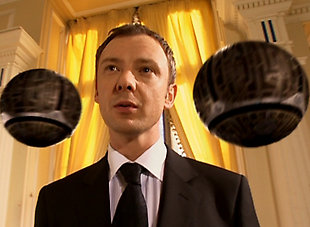
Synopsis: The Toclafane are in control and Earth is going
to be turned into a new centre of power. Only one person stands in the
way: Martha Jones.
|
Reviews
The Last of a Fan's patience... by Steve Cassidy
27/11/07
"We can't get across London at night, it's full of wild dogs.
We'll get eaten alive."
I'd have liked to have seen that in The Last of the Time Lords. It
would be better then what we got. I'd have quite liked to see Martha and
Doctor Milligan race across the capital with slavering, man-eating hounds
on their tail. We might have actually got a bit of tension, a bit of
believable action - but instead we get a mess. Easily the worst of the
season and possibly one of the worst Who's ever written. I say
written because the production design, direction, music, acting is all top
notch but there are so many presses of the big red reset button that the
adventure keeps on self destructing. The shark jumping keeps going on and
on until your belief in the programme aches all over from the kicking it
has just received.
I've reached the stage now that whenever I see the decals 'By Russell T
Davies' on screen I lower my expectations so dramatically that they hit
the centre of the earth (and meet Russell's little baby spiders). I don't
want flawless storytelling; granted, the Old Series was pretty shaky in
that, but I don't want to be embarassed watching the story. When Russell
writes well he writes brilliantly - The End of the
World, Tooth and Claw, Utopia and Smith and Jones
were all terrific adventures. But when he doesn't... I don't need to say
more. RTD always seems to use ever-growing scale as a substitute for a new
plot. The end of each season of New Who has been effectively the
same; the only real distinction is that the number of invaders involved
has gone up a scale. "We've gone 5 billion years into the future a few
times. We need a new story? Okay, we'll go a few trillion into the future.
That's different, right?" No, it's just altering the parameters, it's not
a different story at all.
When, oh when, is RTD going to get over this obsession with scale?. It
can't be a deadly virus, it has to be a deadly virus that kills a world in
seven minutes. It can't be an alien invasion, it has to be an alien
invasion that sees six billion maltesers fall out of the sky and wipe out
the population, leaving the survivors to live in holes and slave camps.
The resolution, though, was predictable in the extreme: not only is he
content to betray what drama he creates with a massive reset switch, RTD
even flashes that reset switch in our faces the week before as if to dare
us to suggest that there might be another way to get him out of the corner
he's in as a writer. Like I said at the start, when you scale it up to the
point where a deus ex machina turn-back-time scene is your only option,
then you've scaled it up too far.
It's not all bad; as I mentioned before, the SFX are pretty impressive
(the prosthetics for the head inside the Toclafane is wonderful). Martha
is the only one of the regulars who is well used; Tennant is barely there
and Barrowman is kinkily chained up for most of the adventure. Martha goes
commando (if only?) and tours the world as a preacher of "the word" to get
the masses to raise the messiah and destroy the Master. There's a lot of
religious imagery in Martha's actions. I'm sure Davies meant it to be
"uplifting" and "life-affirming" but for a programme that has always been
about rationality and dispelling superstition, it is curiously jarring.
My thoughts on John Simms' Master are covered in my review of The Sound of Drums, but are borne
out here in a very strange scene. Martha is hiding with the
slaves/oppressed when the Master and his entourage track her down and
arrive in a darkened street. The music turns moody and the cavalcade is
accompanied by armed men and buzzing Toclafane. Eveything is fine until
Simm steps out of the car and delivers the line "I can SEEEE YOU!!" in a
high camp way. Any tension just evaporates into thin air.
And then we have the Paradox Machine that no one must touch in The Sound of Drums. This same Paradox Machine that
solves all the problems when it is shot with a machine gun a year later.
Was the original line, "Don't touch it for a year, and then shoot it
lots"? As for the real resolution - I can forgive the Paradox machine,
it's a given that things will be reset right there, no problem. What I do
have a problem with is the idea that a telepathic network set up to subdue
the population could not only be subverted by the subdued thinking one
word, but that that subversion would somehow give the Doctor the ability
to reverse aging and have magical powers. Let's run that one again. A
telepathic system (telepathy, the ability to pass a message on mentally)
can reverse aging and create forcefields and levitate people? Just because
the Doctor had, a year previous, been able to presume this outcome and
tell Martha exactly what to do in 5 seconds of chat.
Don't you feel... cheated when Russell does this time and again? As an
example - look at Moffatt vs Davies.
In Blink, we establish that the creatures can't
move when observed. The perfect solution is reached by getting them to
look at each other. It's clever, it's logical, its neat.
In TLOTTL, we establish a telepathic network is telling humanity
to obey. Martha spreads a story of the Doctor around humanity (OK so far),
so they can all say "I believe". Will this break the Master's hold over
them? Maybe the reversed telepathy will somehow overwhelm the Master -
he'll become the slave rather than the Master, if we are trying to be a
bit logical... but no. The telepathic field will embue the Doctor with
super powers, and reverse aging and just make things all right, you know -
because, if you wish really hard, things will get better, won't they?
They will, you know. And then the story can end.
And having gone so overboard on setting up a situation of rock-bottom
bleakness, RTD had nowhere to go, and the Master's war plans, presumbly
meant to be a focus of tension, were merely a case of "so what?" So here's
the real paradox. How come the bigger, the more expansive, the more epic
the stories become, the smaller the programme gets?
And what the f*ck were the Sea Devils doing in the Time War, or did I
mishear that bit? Riding their Myrkas into battle?
I haven't touched the sharkjumping that happened in the latter stages
of this adventure (incorporating ideas from Harry Potter, Superman the
Movie, Return of the Jedi and Flash Gordon) because, well, I can't be
arsed. I don't really enjoy giving an adventure a hard time and I wonder
if what I want from NuWho is different from what an audience wants.
There have been some crackers this season - Human
Nature/Family of Blood, Shakespeare Code,
Blink, Utopia and Smith and Jones. Even The
Lazurus Experiment and 42 were enjoyable. Series 3
has been a step up in quality compared with Series 2. But the horse
stumbled at the final furlong. The Sound of
Drums/Last of the Time Lords has been the worst season finale we have
had. I've got friends who defend RTD to the hilt. But they were knocked to
the canvas by this one.
Here's to series 4 and better times!
Time's Cramp(ion) by David Blyth
12/2/08
LOTTL seems to be the most hated finale out of RTD's tenure on
Doctor Who. This isn't just a case of the people who have never
given RTD a fair nod, this is from people divided over RTD, who praise and
criticise him in equal measure. People who love everything he does hates
this.
Last of the Time Lords is more the victim of bad timing, and too
many endings with the same resolution; only the last two finales couldn't
exactly boast "the public were built up and made insignifcant".
In Parting of the Ways, the public rise,
and die, to defend the Earth against the Daleks. In Army of Ghosts, the public are dupes who make full
advantage of the Cybermen's "Ghost" stratagem with celebration, paying the
price when the Cybermen and Daleks emerge.
In LOTTL, the human race make another mistake, but when Saxon
takes command, Martha begins her "legend", the human race show exactly
what the Doctor's always boasting they do... they rise and fight to defend
themselves. They are shown to take a stand, they help Martha reach Saxon
at the cost of their own lives.
We ARE the public, they are an extension of us, who would love to help
the Doctor, be a companion, save our planet, save our country, which half
of us would back out of in the blink of an eye if it happened.
When the public are made to forget their contributions, are we supposed
to take that as "you don't matter, you benefited us"?.
It may not address it on a direct level, but the sublety of that idea
is what fuels a lot of the hatred for this episode.
It's not fair to the human race; then again, all three episodes of this
story have reflected that we are supposedly "doomed" to become a
delusional, childish, selfish and depraved race of machines who forsake
our humanity to enslave our own history out of joy for the wrongs we dealt
our ancestors. Do humans have an ego problem?
Yes, but the Doctor's faith in us, the fact that Martha's family will
remember, that the soldiers will remember the "lost timeline", means the
public aren't as lost to time as we think, and if they remember, their
children may be told, and we could ensure the Toclafane never come to be,
nor the human race become desperate enough to seek an invisible paradise.
A "Time cramp" such as this should not be seen as a bankrupt idea,
but as a way of pushing forth DW's greatest strength: consequence.
The Doctor only discovers later any decision he has produces
consequence. You didn't see it here, you might read about it later;
you might see it later, it depends on writers who choose to think
deeper... and writers who will remember what happened.
As for the Doctor whispering to Martha about "the countdown" and its
specific time and day, the Doctor could have started tapping into the
Psychic Network as soon as The Master started playing Voodoo Child,
thinking ahead of his enemy quite literally. How'd he do it? "Faaar mooore
than just another time looooooord."
How'd he reverse engineer his DNA decoding and restore his youth? See
above. Scenes shouldn't be deleted when, in hindsight, they could explain
much more.
Of course, Whovians dont need things explained. We watch Doctor
Who to enjoy it, but, more importantly, to also think if prompted. The
Psychic Network isn't a plot-hole, it's part of an obvious jigsaw puzzle
that, once solved, makes this story the more enjoyable.
On to the performances, dynamic as usual. Freema's character is
strengthened as a messenger; too bad her medical background couldn't have
been used more effectivly, making her a "healer" as well as someone
spreading the message. The inclusion of her supporting cast, the
"relatable" human race, had their moments too, as they had to to make us
care so much about their place by the episode's conclusion. Simm and
Tennant took the concept of being the last of their kind and turned it
into a terrrifying and emotional paralel, one being determined to hold on
and care for a mass-murderer, pure race-driven bias considering he was
going to kill the humanized Dalek in Dalek, and one
side delighting in breaking the rules as he's always done, knowing he's
likely to survive (well, we know he will), and cheat the Doctor. He may
not be alone any longer, but he may as well be figuratively.
My minor nitpick is the cliff confrontation between the Doctor and the
Master. What was... that? I think about every fan assumed this was going
to be the season's surprise cliffhanger, a surprise "final stand",
Reinbeich Falls revisited, Tennant regeneration perhaps?
But, instead, it was more or less this:
The Doctor: Gimme that!
But, prior to that, was that scene gorgeous! Murray Gold's excellent
cliffhanger music blaring in the background, the Toclafane missiles
preparing to launch, the universe about to be sliced and diced... would
LOTTL be as critically spat on if it had been a cliffhanger and we
got a full-length Chirstmas Special where The Master falls, Gallifrey is
restored, and we have a gap year on THAT note?
So many reasons why the story is hated, and yet... I don't care.
LOTTL was, as with Utopia and TSOD, a convulted, yet delightful collection of
ideas and sympathetic characters, drama, expansion on exisiting mythology
and intensity. Good against evil, wibbly wobbly, timey wimey stuff. This
is RTD emulating Moffat and Christopher H. Bidmed.
LOTTL is truly the soul, the mythology, the spirit, of any
strong aspect of Doctor Who. Time cramps, the human race saved,
forgotten heroes, the Master, a big freaking ship smashing into the
TARDIS, and one day, I hope more people appreciate it like I did.
LOTTL is True Doctor Who, what's all this racket?
Thunderbolt and Lighting, Very Very Frightening by Anna
Zinn
6/3/08
When I saw Human Nature, The Family of Blood and Blink, I thought Series 3 had reached its zenith.
These were what you might think of as ideal stories. They were like the
TARDIS: the basic idea looked simple, but the inside was bigger than the
outside. Nothing in these stories is quite what it seems, but everything
fits together elegantly.
Some episodes are like this. They have a cool perfection which
resembles the music of Mozart - at least, if his music had ever sent
anyone diving behind a sofa.
And some episodes are like Last of the Time Lords.
It's the last of the three-parter which ended Season 3. Elegant,
logical, perfect it's not. At best, it's a tour de force. At worst, a
gallery of dodgy plotting. Not so much Mozart as Queen's Bohemian
Rhapsody.
The one-year spoiler ban means I can't say much about the dodgier bits
of Last of the Time Lords. It would be fun to try to decide which
is the dodgiest. Could it be Harold Saxon's miraculous global organising
ability? In a very short period, he accomplishes things which would make
our current leaders bang their meaty fists with envy. How does he do it -
through local authorities? Or does he persuade the Toclafane to cope with
priorities and targets, though they appear to have a mental age of about
eight? His scheme of world domination is horrific, but not believable. (Of
course, that could be said of a lot of government plans.)
As far as other twists in the episode are concerned, one owes far too
much to a certain classic story about the children of the world and
fairies, and another possibly isn't so bad - at least, we were warned
about it - but comes off with confusion in the detail.
Never mind. A review has to mention this kind of thing, but LTL
almost flaunts it - and succeeds anyway.
One of the reviewers of Blink said that he
wasn't sure it was an episode you could watch over and over, once you had
solved the puzzle. (I've watched it several times - the sheer terror of
the 'blink' sequences hasn't faded yet.) But LTL isn't watchable
because of a puzzle. It's watchable because of the relationships between
the characters - especially the Doctor and Harold Saxon and the Doctor and
Martha.
The spoiler ban means that I can't say everything I would like to about
Harold Saxon or John Simm's portrayal of him. He's evil, but never simple
or obvious. He will remind you of every manipulative person you've ever
known - just when he seems to be communicating, you hit the earth with a
thump, realising that, for Saxon, everything is about himself, first last
and always, and that you've fallen for it again. In one sequence he sings
along with his music and tries to make his dysfunctional family of
captives into a chorus line - they practise passive resistance, and he
goes on undeterred. He radiates psychopathic energy and charm 24 hours a
day, never tiring of making the other characters - and us - watch him.
David Tennant as the Doctor tries to ignore him loftily. For a while,
he succeeds - but then the battle is joined again. Saxon's tactics range
from the crude to the breathtaking and the outcome is the last thing we
expect.
The Doctor's relationships with the other characters would bear more
writing about, but until the ban is over, I'll just mention his
relationship with Martha. Saxon's villainies are her opportunity and she
proves herself so thoroughly that not a hair of her new Florence
Nightingale hairdo ever falls out of place. But heroic effort often brings
changes the hero never intended - and seeing her ride with them is one of
the best things about this episode. Freema Agyeman's performance lives up
to the scope of her character. Her part-time appearance in Season 4 seems
advantageous to me - instead of knowing where we are with her, we have to
be curious for three quarters of a year.
LTL is a triumph in spite of itself - too much thunderbolt and
lightning, but it works.
A Review by Graham Pilato
25/7/08
What a massive pile of overkill and unwanted, mostly unenjoyable
almost-crap! The extra five minutes that people got so excited about in
the States and elsewhere where the edited version was broadcast turned out
to be a bizarre music video with the anti-Tenth-Doctor John Simm's Master
singing (!) lines like "I can't decide whether you should live or die".
Aren't we glad we got to see that on the DVD? Never in a million years.
I feel dirty in a way that might only be improved by burning so many
British pop CDs. And I still love the Beatles and the Verve and so much
Oasis. What's wrong with RTD? Did he think that maybe we needed more
sugar in our medicine? Covering up some crappy plots with some saccharine
songs?
Why does the Master love Britpop you ask? The problem is that you have
to ask.
So I loved the big paradox and the revelation about who the Toclafane
are. But a shrunken CG Doctor with huge anime eyes? Yet another
season-ending tech turnaround where the Doctor gets to be all-powerful for
a minute and a half? It's a big, painful cheat to bear. And this time,
epic as it all is, it hurts the most. Mostly because of what becomes of
the Master, though.
Ask yourself, now, after you've seen this big three-part finale,
wouldn't a Britpop-free Derek Jacobi (Professor Yana) have made a much
better Master to stay on for the last two parts instead of the manic one?
And what a waste this ends up being here, too for this appearance of the
Master to be so nuts. I think Simm knew it, too. He puts the rock opera
into his performance like only Roger Daltry could do, but it just doesn't
make any more sense dramatically for the Doctor to apologize to him than
it does for him to do what he does in the last moments of his act. He's
just a wild and crazy vengeful Master of madness.
Martha gets a great send-off, though. But her family still feels like a
lot of peripheral nonsense, here, even after all of that. They just didn't
ever get enough focus. She was no wonder-filled first-year Rose,
unfortunately. She was a good performance, for the most part. A bit
bland, but who cares? She had a very nice arc, and she's coming back for
more in a couple episodes next year. And she'll be on Torchwood. That's
something. We'll see how that goes.
"Jump the shark" is a phrase that well and truly deserves to be applied
here, but might as well have been thrown out when this show started in
with the Shadow Proclamation and the giant Babyfaced aliens in fat human
skinsuits. Russell T. Davies knows about pushing the envelope too far, and
he likes it. Too bad it only works about two thirds of a time in his
episodes.
Dammit. A fine finale ruined by madness and death. I'm highly
ambivalent.
5/10
Catch 22 by Thomas Cookson
1/6/09
I used to love trying to guess from available clues in the episodes of
the running season what the finale would be about. I was sure Season One
was going to end on prehistoric Earth where we'd find out that bad wolf is
actually a race memory. I was also sure that the Doctor, in Cartmel
fashion, would turn out to have been in the know about it all along. Also
I noticed how after the story Dalek, where a Dalek
absorbs Rose's DNA, there were several references to pregnancy in the
following stories. The Face of Boe (who also has some relevance in this
story) was announced pregnant in the future news of The Long Game; there was the shotgun wedding bride
in Father's Day; Nancy in The Doctor Dances; and even that pregnant woman
that Margaret Slitheen showed mercy on. Maybe these were clues that the
Dalek was pregnant with Rose's offspring and maybe instead of
self-destructing it had teleported somewhere else in time to breed. I also
expected the Gelth to return (because the Controller resembled one in the
"Next Time" clips).
In Season Two, I knew in advance about the double whammy of Daleks and
Cybermen in the season finale, and I had a theory that when the devil fell
into the black hole in The Satan Pit, it had
entered a gateway to all parallel universes and was going to exact revenge
in the finale by unleashing upon our universe both the Cybermen from
Pete's world and Daleks from a parallel universe where they won the Time
War. A friend of mine had a theory that Rose's 'death' was going to be
something similar to Charley in the Big Finish adventures. Rose was meant
to die originally and the Doctor would have to kill her or send her to
'heaven' to put the timeline right. Perhaps her existence upsets the
space-time continuum and that's why that rip to the parallel universe
appeared in Rise of the Cybermen.
Gradually, it became apparent that the puzzle was intellectually
beneath me. This year, I just hoped it would be borderline sensible and
believable in its gravity and not be too irritating.
My furious venting on the New Series is in some way out of a sense of
being 'forced' to like it, for so long having my arm twisted to go along
with the praise of the opinion fascist creeps of the Planet Skaro forum.
I think that is what Russell wants. He doesn't want his critics to make
considered, thoughtful criticisms, he wants to bait and aggravate them
into blind ranting so that their opinions have little credibility with
others. And boy was Last of the Time Lords infuriating. Irritating,
tedious comedy, saccarine companion mooning over the Doctor rubbish and a
deux et machina ending that was such an insult.
Sure, people can say that Doctor Who was always implausible
nonsense, making the impossible possible. But, in Inferno, you couldn't pour water to the centre of the
Earth. You can't ignore basic physics to that degree. And people can point
out the faulty prehistoric dating of The Silurians,
but that story didn't feature the Doctor making a miracle cure in 30
seconds, let alone bringing the dead back to life because that's cheating
the audience. They cease to care if dilemmas and threats can simply be
turned off with no effort, because none of it matters anymore.
But now, with hindsight, I realise that the story was a catch 22.
Without those elements above, Last of the Time Lords would have
been a far more ugly viewing experience. In fact, it would have been a
return to the dark days of Season 21 and 22.
In a way, the season finale has always been like an Eric Saward story.
The Parting of the Ways is virtually a remake
of Resurrection of the Daleks. Doomsday is a typical plotless, pointless shoot-em-up
amidst unlikeable self involved heroes.
But Last of the Time Lords is as ugly and Sawardist as the New
Series ever got, except it knew how to hide it.
Well, some viewers were deeply offended by the sub-plot of Mr Saxon's
domestic violence leaving a sour taste in the mouth. But it's rather like
Planet of Fire where the Master twisted Peri's arm,
the moment where the perversely likeable arch villain crosses the line and
galvanises the audience for the moment where he is finally killed off.
I'll admit it does feel rather cynical, hollow and manipulative, but if
we're comparing to the Saward era, at least in its favour it isn't the
Doctor indulging in domestic violence as in The Twin
Dilemma.
Indeed, that's one thing the story seems to have the right idea of.
Saxon is a villain without a plan, which means that much of what we see is
simply random violence and villainous gurning. But having Saxon win and
gain total subjugation over humanity and the Doctor and have him spend a
year bloating himself on his unquenchable sadism, and then we really
understand that Saxon will never be able to have the satisfaction he
really wants. A typical 80's villain, a mass-murdering yuppie whose
homicidal nature reflects an era of excess and unsatisfying consumption.
Reusing the technique from The Leisure Hive (at a
time when Tom Baker seemed to have gotten too invincible), the Doctor's
invulnerability is snatched away by the sight of him turned geriatric. The
fundamental difference being that, in The Leisure
Hive, the Doctor looked so old that he was likely to snuff it any
minute. This story does away with that by ageing the Doctor a second time
by several more centuries. There was a gasp from me as I saw the Doctor's
crumpled suit and thought maybe he'd been literally dusted, only to reveal
a small wrinkled goblin who spends the rest of the story in a bird cage. I
was all ready at that point to write it off. Surely by taking it that far
it was reducing the menace to absurdity, and more importantly seemed to
make it clear that if this didn't kill the Doctor, nothing could. And yet,
it worked at showing the Doctor at his weakest and most frail and showing
how Saxon couldn't simply kill the Doctor because that would never satisfy
him enough.
But what does bother me is that there's only one way back to normal for
the Doctor, and that's hocus pocus; once that happens, you never fear for
the Doctor's safety again if he can just magically be rejuvenated like
that. So the threat is retroactively reduced to non-existent. And this is
just the kind of contempt for the viewer's intelligence that defines this
story and most of RTD's efforts.
With the Doctor out of action, Martha has to become the hero today,
travelling the world and searching for a way to beat Saxon. Meeting people
around the world along the way and telling them how in love she is with
the Doctor and how they should have hope and other such saccharine
bullshit. She has her trusted perception filter to get her across the
treacherous landscape of killer Toclafane. Rubbing in the fact that Martha
might as well have been invisible for most of this series as the blandest
companion ever. Here, she's part of a plan that's so underwhelming to the
point of inconsequentiality that it's hardly her great swansong that
leaves me begging for more of this saccharine nonsense. Though,
surprisingly, her eventual exit manages to be somewhat memorable by virtue
of not being drippy, but I doubt I'll notice that she's gone in Season
Four.
She actually pursues something of a red herring plan involving that
special weapon in four parts scattered to the corners of the Earth. Why
does Russell have to taunt us with a good plot idea before discarding it
for a shit one? It turns out that Martha's plan was a worldwide message of
hope. Of course, this idea is saccharine nonsense without any fallout. In
fact, all the death and devastation is undone, and all the people had to
do was think good thoughts. Even Peter Pan never made the mistake of
making 'if you believe in fairies' its final resolution. Having the
Toclafane butcher families last week seemed too dark for Russell - and lo
and behold he eventually chickened out. So the followup to last week's
cliffhanger was five minutes of easy resolution, after 40 minutes that
didn't really happen and didn't matter.
Even the cop-out conclusions of the old series, like the Master
changing his mind and repelling the Autons, or the Daemon self destructing
because of something Jo said still conveyed some degree of 'what a fluke,
we were very nearly done for'. With Russell's endings, there's no sense
that the threat was ever real in the first place.
And that's when I start to think maybe Russell's eventual goal is to
ward off the 'nutter' fans, the obsessives or the ones who believe it's
all real. So maybe he's been actually vetting his stories of any
inadvertent believability, subtlety or detail that would provoke trivial
fixation, and making the Doctor cliquey. This Doctor wouldn't want to know
a saddo like you and he'd tell you straight.
The Toclafane certainly seemed a dangerous enough threat to deserve
better than to be rubbed out with an eraser. Like I said, its ugliness is
hidden. A bit like how The Sunmakers and Creature from the Pit have mean-spirited moments that
show the heroes killing the villain in cold blood, but in such an absurd
way that you avoid taking it seriously. If those stories had been produced
in the JNT era and were similarly po-faced, they'd come across like they
really mean it, and so would probably get into the same trouble as Attack of the Cybermen and The Two
Doctors did.
But the fate of futurekind is probably the most pitch-black, dark idea
in Doctor Who, and it's never resolved. It also isn't treated as an
imponderable like the weeping statues were or the werewolf blood curse on
the Royals were. You can almost hear the story obtusely saying 'Who cares?
That story's old and out of fashion now. Let go, you obsessive saddo' in a
mocking, sneering fashion.
So instead we get something horribly defeatist. There's no future for
humanity and all our achievements are worthless; or, if there is, we don't
get to see it. As defeatist as mid-80's Who and its twisted scorn
on humanity. The 'You can never evolve or civilise Androgums, they'll
always be scum' in The Two Doctors, and 'You humans
are pathetic savages for not sharing my suicidal pascifism!' in
Warriors of the Deep. Mind you, the 80's was a very
conformist, defeatist and scornful decade.
And, like the mid-80's, it's as if the view of humanity has become so
degraded that the show and the Doctor even points to cold-blooded killers
as deserving of sympathy and praise, like in Warriors of
the Deep and Attack of the Cybermen; here, we see
something similar with the Doctor's cozy rivalry with his arch enemy,
Saxon. The best examples for me of a perfectly mirrored rivalry are Logopolis and the BF audio Davros. Where the Doctor and his enemy really are
morally polarised but flipsides of the same coin. Where the polarising
symmetry is beautiful and poetic, but also daring. It's not afraid to
suggest that the compassion and aversion to violence which separates the
Doctor from Davros or the Master perhaps makes him just as monstrous in
allowing those monstrosities to go on living and causing death and
destruction.
But this, like Warriors of the Deep, crosses the
line. Making the Doctor's compassion for his enemy seem like treacherous,
twisted favouritism. The Third Doctor may have made a dignified request
for the Master to be spared, but he didn't force the issue in as ugly a
manner as here. As in Warriors of the Deep, the
sight of the Doctor, having been incompetent for so long and failing to
protect the innocent, suddenly becoming proactive about forcibly reviving
his wounded enemy, forcing back to life an irredemable murderous creature
with a death wish, is ugly on so many levels. And primarily, because
instead of that polarised poetry, we simply get mawkish emotional
arm-twisting.
Besides, any sentiment I may feel is spoilt when the homages to Return
of the Jedi and Flash Gordon become so artificial that I just can't care
anymore.
Russell seems to have a vendetta against critics of his emotional
content. Earlier this ,year he figuratively spat out at fans for being
emotionally vacant straight males, and it seems like he wrote this ending
in which Martha's love wins over all adversity just as a fingers up to us.
Russell has said how, despite the warm reception of Human Nature and Blink,
he's going to keep the series from getting dark because dark is bad, and
he practically invited us to complain. So, both the critics who hate
emotional content and those who actually quite liked Human Nature are wrong. Make your mind up
Russell; they can't all be wrong, and there comes a point where your
belligerence just pisses off everyone.
But Russell, like Saward, honestly can't seem to see the difference
between dark and defeatist. The point is that Doctor Who was at
best a pragmatic series, if not a realistic one. A series that understood
that death is a fact of conflict and when the taking of life is, and
isn't, necessary. This became subverted in the 80's, as villains cheated
death for a diminishing return, the violence was used as a cheap shock
tactic and became contrived, the Doctor became a cliched shell of his
former self indulging in thoughtless violence (The Twin
Dilemma) and twisted sympathising with cold-blooded killers over their
innocent victims (Warriors of the Deep, Attack of the Cybermen). The violence stopped being
pragmatic and became sensationalist, and the ideals became twisted into a
nihilistic, defeatist direction whether it be saying that the Doctor can't
fight evil without becoming evil, or that you can never truly civilise an
Androgum.
But, as much as it's a manipulative distortion to contrive death and
defeatism, it's also an insulting cheat to resurrect all the good guys and
exonerate the Doctor's fondness for Saxon by eliminating the consequences
of Saxon's actions.
And yet, ultimately, it probably was wise to soften the blow of such an
ugly story, to the point where it is just disposable. Where it can cop out
of showing the Doctor's perverse fondness for the villain, by pressing the
literal reset button and undoing all his crimes.
Critics of New Who are often accused of having rose-tinted
spectacles. But, if anything, Doctor Who has taught me never to do
that. The show's historical and allegorical ethos often saw it looking
back to the 'good old days' as our elders called them and brought their
ugliness to the fore, whether it be Nazi Germany or even the subtle racism
and chauvinism of Victorian England. Indeed, Masque of
Mandragora and Brain of Morbius were especially
about the importance of breaking with tradition and rebelling against the
old guard, lest we remain in the middle ages of witch hunts and
xenophobia.
But often saying that New Who is a step above 80's Who is
the kindest thing I can say about it. And, with this story, I'm not sure I
can even say that anymore. By playing safe, it avoids offending me in the
way many Saward stories are, but it's clear that the Saward ethos hasn't
gone away. A shame because in the main, New Who had been enough of
a reboot and a clean slate that I could happily pretend the old series had
ended in Season 17 for all the difference it made. Sure, it was often
cringeworthy in its desperate attempts to seem hip, funny and sexy in a
way that the humourless, chaste and reactionary JNT era wasn't. But, for
most of Series One and Two, the show at last seemed to have a future
outside the JNT era's shadow. But not anymore. My first doubt about New
Who was my reaction to End of the World's
opening scene. When the Doctor takes Rose in the TARDIS to various future
stop-off ponts, each time Rose doesn't bother to even have a look. To me,
that was just not believable, and displayed some very contrived and clumsy
writing. It marked an awkward two-stool transition from televised
stagecraft to the cinematic. The aesthetics said total cinema, but the
character's actions were showing up the limited budget and stage room.
Forgivable perhaps, but it burst the bubble too early in the story. And it
didn't improve. When the sun filers fail, the delegates stupidly remain in
the room with the biggest window. Strangely, now it seems like it should
have been my wake up call of the show's contrived, lobotomised direction.
Even with something outreaching, intelligent and unforgettable like Human Nature or Blink, I'm
still only seeing false dawns of quality, just like
Enlightenment and Caves of
Androzani were false dawns back in the 80's. They don't change how the
trashy and lobotomised still dictates the show's direction. And I'm not
prepared to sift through the dirt to get to the gold anymore.
Suddenly New Who seems like it barely deserves to be watched.