THE DOCTOR WHO RATINGS GUIDE: BY FANS, FOR FANS

|
BBC
It Takes You Away
|

|
| Story No. |
309 |
|
| Production Code |
Series 11, Episode 9
|
| Dates |
December 2,
2018
|
With Jodie Whittaker, Bradley Walsh, Tosin Cole, Mandip Gill
Written by
Ed Hime
Directed by
Jamie Childs
Executive Producers: Chris Chibnall, Matt Strevens, Sam Hoyle
|
|
Synopsis: A widower in Norway has disappeared, leaving his blind daughter behind.
|
Reviews
A Frog is a Universe by Basil Unsworth
5/10/20
It Takes You Away is a story that stands out from the rest of Series 11 by primarily trying to deal with a whole mash-up of sci-fi concepts and go cinematic, instead of characters and making points about humanity (a theme Chibnall continues into Series 12). But in a way, that is also it's weakness. It all seems a little crammed, and nothing gets a proper explanation. This could be overlooked had there been much action, but since the story relies on the audience to just be amazed by the concepts, it does fall down a little.
For the first ten minutes, we get some properly Doctor Who elements, an abandoned building, the Doctor name-dropping (about sheep of all things!), a mysterious object (a mirror) and an apparent base-under-siege with a missing father and abandoned blind daughter. However, even though I said this story didn't seem to be about characters, each of the TARDIS team do get a moment to shine without any acting being forced like in some episodes.
This all means it is quite successful in creating mystery and thus far the story really holds its own.
That really is concept one: The Mystery of the Fjord!
Then we get concept two: The Atmosphere!
This section is a clear Twilight Zone pastiche, which flops a little. We are presented with Ribbons, who isn't the greatest villain but, just as with the Fjord, we are presented with a beautiful set (meaning atmosphere) and magnificent prosthetics, which really is what this section must be about (or Ed Hime just really could only write villains that were as shallow as a puddle). Though what Ribbons does do for a (very) short while is convince us that he's the reason that Hanne's Dad is missing. This does add a bit to the flop actually, as he seems his only purpose is as a red herring, rather than a villain in his own right.
Now for concept three: The Big Reveal!
So, Hanne's mum is alive. And so is her dad. But this all falls a little flat compared to the next revelation: Grace is alive (or is she?). Unfortunately, this is where it all flops again. We are just over halfway through the story, and the character amount has practically doubled since the start of concept two, possibly explaining the lack of explanation, as it's all going into giving everyone something to say.
Then we get a nice little anecdote from the Doctor about one of her aunt's stories. But this seems a little off kilter, since a moment ago she had no idea of what was happening. Either the Doctor's inclination needed to happen sooner or just get rid of the anecdote, however lovely it is.
This is where the main problem starts happening. As with the lack of room for explanation due to character, the red herring that is Ribbons and his moths seems to have squashed this section down. Especially since we are flicking back also finding out about what Yaz and Ryan have discovered.
Then the next few minutes go smoothly, with some nice exposition from Graham, but apart from that nothing particularly special since we know it can't really be Grace, but Sharon D Clarke does give a good performance anyhow. But it is nice to think about for a few moments. All of this means the build-up is somewhat anticlimactic. Then again, maybe that's deliberate, since we about to have a sudden burst of drama.
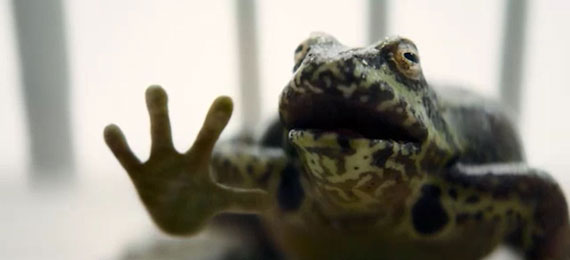
With the Solitract collapsing, the Doctor is having to say some tough things to Graham, and we see Bradley Walsh show proper emotion in a heart-wrenching scene but, should you have watched The Curse of Fenric, you can tell she doesn't mean it, which detracts a little. But then we get either, depending on your point of view, a complete 'uh' or something quite cool. With a universe sounding like Grace in the form of a frog (given the quality of sets, couldn't they have put more than 3p into a frog puppet?), this somewhat detracts from the pace, peril and tension of the previous scene whilst giving you a chuckle or shows you something mad that people will love, however bonkers it may seem, summing up Doctor Who.
Then we are back home, in gorgeous Norway.
This story does have a few ups that aren't just about atmosphere: to name but one, there's Yanne, who is bolshy and who throws any stereotypes about blind people out of the cabin window.
Because of the clash and overload of concepts, centring around a story written for atmosphere, I'd rather they'd have cut the Ribbons section and expanded the Solitract concept and Mystery of the Fjord concept.
In conclusion, this story had a good tone and atmosphere and overall good acting.
7.5/10
Through the Looking Glass by Niall Jones
26/8/25
They may look cute, fluffy and just a little daft, but the Doctor knows that sheep are not to be trifled with. In the year 2211, they will rise up in the Woolly Rebellion and the ensuing bloodbath will lead to a 're-negotiation of the sheep--human relationship'. The idea of a violent ovine uprising may seem ridiculous, but it's also rather delightful --- the sort of serious silliness that Doctor Who does so well. This kind of whimsicality would become increasingly rare as the Chibnall era went on, however, instead becoming more insular and self-serious. The nearest equivalent would probably be Karvanista in Flux, a doglike humanoid who reluctantly fulfils his contractual duty to protect one middle-aged Scouser. In the self-consciously gritty world of the series, however, his reward is to have the entire rest of his species wiped out offscreen.
Fortunately for the killer sheep, they weren't dreamt up by Chris Chibnall. Instead, it was up to Ed Hime to imagine the Woolly Rebellion in his Doctor Who writing debut, It Takes You Away. It may only be a throw-away reference, but it's one that lingers long in the mind and sets the tone for a story that is at times almost bewilderingly original. In fact, It Takes You Away feels like an alternative vision for the Thirteenth Doctor's era, one that thrives on strangeness and imagination, rather than on sci-fi grimness and continuity references.
One of the intriguing things about It Takes You Away is that it's initially not clear what genre it is. The sight of a boarded-up, wooden hut in a remote part of Norway, accompanied by tales of a monster roaming the woods, would seem to place the story firmly within the horror genre. However, as the plot starts to unravel and the focus shifts towards Hanne's relationship with her absent father, it becomes more of a Nordic-flavoured domestic mystery. The question becomes not who took Hanne's father, but why he left. By the midpoint of the episode, however, the story shifts genre again: with its magic mirror, tricksy goblin and flesh-eating moths, it tips into fairytale or even fantasy. These shifts in genre mean that the story cannot be taken for granted. Viewers cannot rest easy, confident that they know what kind of thing is about to happen, but instead have to watch closely and have the patience to go along with its various twists and turns.
While the story's shifting relationship to genre sets it up as intentionally strange, what it does with the companions should be relatively unremarkable, but feels alarmingly radical in its context: it takes their characters, established in The Woman Who Fell to Earth, and develops them. Graham's bringing cheese and pickle sandwiches with him expresses his down-to-earth practicality; Ryan's harsh outburst to Hanne, asking her how she knows that her father 'didn't just pack up and leave' reflects his own hurt at being abandoned by his father; Yaz's using the Arctic Monkeys to establish a link with Hanne builds on her police training. Even the offbeat humour of Ryan's comment to Graham, after they realise that they don't cast shadows in the mirror, that, 'We'd know if we were vampires, right?', feels distinct to him. To be clear, none of this is exactly rocket science, but it's amazing how often the Chibnall era fails to do this, too often presenting the companions as blank cyphers, there solely to ask questions. That Hime writes them as distinct characters, keeping in mind their backgrounds and personalities, marks him out as a promising writer, and it's a shame that his only other contribution to the show, Series 12's Orphan 55, turned out the way it did.
It isn't just the companions who are well-written, however. Hime also has considerable success writing for the Thirteenth Doctor. The problem with her generally isn't that she doesn't feel like the Doctor --- she does, even in weaker stories --- but that she too often comes across as generically Doctor-like, rather than as a character in her own right. While her characterisation in It Takes You Away feels consciously modelled on the Tenth Doctor --- eating soil to determine their location, referring to gift shops --- Hime also makes the effort to explore what makes her character distinct. Throughout the episode, she is characterised by her sharpness, both intellectual and emotional. She is highly astute, but also slightly prickly, both towards her companions and to Hanne and her family. Although this prickliness will eventually sour into lack of compassion, here it balances well against her general exuberance and energy, and her moments of harshness --- taking advantage of Hanne's blindness in order to lie to her, or dismissing Graham's feelings towards Grace --- always come from the best of intentions.
Given the strength of Hime's writing, it's unsurprising that Whittaker puts in arguably her strongest performance as the Doctor in It Takes You Away. The point at which she is at her most convincing is at the end of the episode, when she comes face to face with the Solitract, a sentient universe who just wants to make friends. The Doctor instantly strikes up a relationship with it, and her decision to leave it feels genuinely pained. She tells it that, 'You are the maddest, most beautiful thing I have ever experienced.' The strength of Whittaker's performance is such that you believe her. The shot of her blowing it a kiss as she leaves is a beautiful moment that expresses a side of the Thirteenth Doctor's character that we never really see again: the angst-free traveller, head over heads in love with the madness of existence.
The appearance of the Solitract --- literally a green frog that sits on a wooden chair and speaks with the voice of Graham's dead wife, Grace --- is only the last in a line of deliberately weird moments that makes It Takes You Away so much more interesting than most of the rest of the Thirteenth Doctor's stories. The scenes set in the Anti-zone, a sort of non-place between universes, push the story most strongly towards fantasy, as the Doctor, Yaz and Graham encounter Ribbons of the Seven Stomachs. Ribbons, a vaguely demonic figure with an unusual way of speaking and an obsession with trade, is perhaps the oddest thing in the story. In truth, he doesn't fit at all, as the scenes set in the Anti-zone have no bearing on anything else. It's not clear what he's doing there, or even how he can be there at all. He tells the Doctor that he has always been there, but this doesn't fit with what else we are told about the place, and it's not clear if we are meant to believe him. For all his redundancy, however, Ribbons remains an intriguing aspect of the episode, largely as a result of Kevin Eldon's unsettling performance.
Interestingly, the Anti-zone scenes were heavily cut down and were initially intended to also feature a sinister cloaked figure called the Spindle Man. Scenes with the Spindle Man were actually shot, and he was played by Paul Sturgess, who, at 7ft 8in, is Britain's tallest man. Curiously, Sturgess took on this title following the death of Neil Fingleton, who played the Fisher King in Under the Lake. Whether the inclusion of these scenes would have made the Anti-zone make more sense is unclear, but their exclusion suggests that Hime had a more developed vision of it than appears on screen.
The presence of the Solitract gives the story its emotional heart, as it seemingly resurrects both Grace and Erik's dead wife, Trine. The story uses it to explore the pain of grief and the longing of the living to be reunited with their loved ones, which it ultimately presents as a temptation. In joining with Trine, Erik ends up hurting Hanne, his failure to process his grief leading him to become neglectful of the person who needs him most. For Graham, the chance to spend time with Grace once again almost leads him to abandon his friends. As the Doctor puts it: 'It's her or the real world.' The reunions that Erik and Graham experience are presented as, at best, distractions and, at worst, dangerous fantasies. Unlike some other stories that deal with similarly serious issues, It Takes You Away never comes across as preachy. It's not communicating a message; instead, it explores its theme of grief through its characters in a way that feels natural.
It Takes You Away may not quite be the best episode in Series 11 --- for me, that honour belongs to Demons of the Punjab --- but it is the most interesting. It represents the highpoint of the series' intention to do something different. Its mix of genres doesn't always work, but it ensures that the story is never dull. What It Takes You Away does is to show an alternative vision of the Chibnall era, one that is stranger, less predictable and more interesting.
Following Orphan 55, Hime did not return to Doctor Who. He was, however, initially scheduled to write for Series 13, before the Covid-19 pandemic forced a drastic restructuring. Quite what he would have written is unknown, but, given that his back catalogue includes a radio drama about an uprising at a zoo called We Outnumber You and a vegetarian-sounding play called The Meat on the Plate, it's entirely possible that we would have been given front row seats to the Woolly Rebellion…