
Planet of the Spiders
Christmas on a Rational Planet
Alien Bodies
Dead Romance
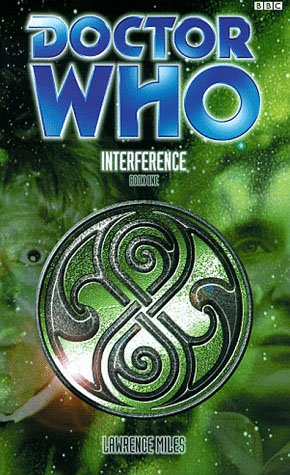
Interference: Book 1
Interference: Book 2
The Compassion/TARDIS arc
Interference
The first ever full-length
two-part Doctor Who novel
|
Planet of the Spiders Christmas on a Rational Planet Alien Bodies Dead Romance Interference: Book 1 Interference: Book 2 The Compassion/TARDIS arc |
BBC Books Interference The first ever full-length two-part Doctor Who novel |
| Author | Lawrence Miles | 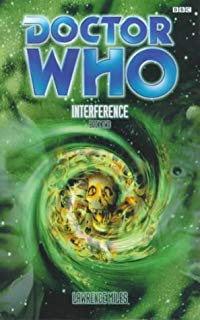 |
 |
| ISBN | 0 563 55580 7 and 0 563 55582 3 |
||
| Published | 1999 |
| Synopsis: The third Doctor, the eighth Doctor, Sam Jones, Fitz Kreiner and Sarah Jane Smith discover that the past, present and future are being manipulated, with ghastly consequences for all involved. |
Doctor Who In An Exciting Adventure with Terrence McKenna by Hugh Sturgess 22/3/11
It's been over ten years since this book was published. I shall now consider it acceptable to thoroughly spoil its contents, and thus this review is not recommended for children or those of a nervous disposition...
Lawrence Miles was, in his time, THE big name in Doctor Who. Between Alien Bodies and The Ancestor Cell, it was his ideas shaping the Doctor Who universe. Even if you loathed him and only read the PDAs, you knew his name, at least as That Man who killed Jon Pertwee and destroyed continuity and stole away THE MAGIC OF DOCTOR WHO. Considering that by the time of Interference he'd only written two Doctor Who books and one Benny adventure (and it wasn't Dead Romance), he was, in short, kind of a big fucking deal. These days, despite having a blog with which to bitch about things he doesn't like (Steven Moffat, Matt Smith's age, Neil Gaiman, society, etc.), he's a nobody, nothing more than a running gag on Jared Hansen's blog, fannish shorthand for 'a wanker'. That can be attributed to the colossal inflation of the Doctor Who universe after 2005 (Lawrence was significant when the Doctor Who universe reached a few thousand people, but not when that figure is around seven million), but also to his own mistakes. His refusal to compromise with the forces of evil (i.e. 'the system', television executives, Matt Jones...), his rapid recourse to ad hominem assaults on anyone, and his general antisocial attitude mean that he's perpetually bitter from rejection and with no sounding board for his ideas. His blog, now devoted to taking the overheard comments of four-year-olds and using them as fuel for more bitterness-driven rants about Matt Smith's "prettiness" (I'd like to say that only a straight man could call Smithy "a pretty-boy", but I've also heard Producer Piers Wenger call him "handsome". What is going on?), has made the cardinal mistake of being boring and, since he never let evidence get in the way of his arguments, reading his stuff is now a lot like reading the comments of any angry internet deadbeat loser complaining that Obama's a socialist. You're always expecting him to say: "Anyway, MOFFAT SUCKS! That bastard's got my phone tapped. He killed my cats, did you know that?" If he went a little mad in 1998-2000, that was because everyone was listening to him and no one was prepared to apply the brakes; if he's gone very mad now, it's because no one at all is listening to him and even he doesn't care. That's a bit sad really.
Apparently, Miles thought Interference would be the most popular thing he ever wrote. Hmm. It used to linger around the bottom of DWM polls (when DWM cared about the books), and it became the divisive poster-child for modern fandom. 'Traditionalists', those who liked their Doctor Who a bit more like The Talons of Weng Chiang, generally hated it, 'Radicals' tended to like it. Obviously, the divide wasn't that simple, but it's generally true to say that you were more inclined to dislike it on the grounds of its continuity sensationalism and its treatment of the Doctor than for (say) its prose or its characters. Which misses a bit, needless to say.
Nearly twelve years on... well, it's difficult reviewing a story like Interference, because there's so much going on that summing it up with "good" or "bad" would be simplistic. I have the overwhelming desire to break my review up into neat little headings - CHARACTER, PROSE, PLOT, LE MORT D'OCTOR, etc - because the quality of the book is practically schizophrenic in its variability. There's so much that's good about Interference, but so much that's bad that when you stumble across it it's enough to make you forget the good stuff is there, and vice versa. If any central message comes from it, it's of the failure of Stephen Cole as an editor. Justin Richards was responsible for the alternative universe arc and Peter Darvill-Evans wrote Deceit, but Cole was most notable for having no discernible crap filter.
But in regards to brass tacks...
The characters are part of the good stuff. The eighth Doctor is out of it for about three-quarters of the story, but - remarkably - you hardly notice this until he returns to the picture and you wonder when he last appeared. Fitz is given similar treatment, and so the majority of the book is carried by Sam Jones and Sarah Jane Smith. By the beginning of Book Two, I suddenly realised how centred this book is on these two bright, independent women, and I found myself enjoying the Doctor's absence for the strength it imbued in the companions. The comparisons Lawrence drew between Sam and Sarah were also very interesting, and it certainly helped me like Sam more.
Most other reviewers have already noted the efforts to which Lawrence goes to make Sam a rounded, likable person, but what's so remarkable is how easy he makes it seem. The lengthy scenarios the media put her through on Anathema were, in my opinion, the weakest segment of her story, as it's a perfect example of Lawrence lecturing the audience and claiming it's a debate. Just wandering around, investigating, meeting Sarah, Guest, Compassion and so on... it's in these sections that Sam shines, as a companion who manages to seem like a real person, experienced in Doctor Who adventures but not lame enough to number escape attempts, principled but not just, to paraphrase Finn Clark, a cardboard-cutout teenager with "Greenpeace" spray-painted on her. Her final scene (well, technically her first, speaking chronologically from her perspective) is perfect, and her breathless, drugged-up desire to "save the world" culminates in the wonderfully understated "I want to change everything... Is that enough?" Lawrence has a reputation for cynicism, but I couldn't disagree with that more. He's not cynical, he's a romantic idealist raging against the imperfections of the world. With Sam's ultimate fate, he reminds us that extremism in defence of liberty is no vice and moderation in the pursuit of a better world no virtue. And her final parting with the Doctor is also well-written, understated but also quite intimate. For this book, I actually liked Sam.
For Sarah... there isn't that much to say, since she was always about 99% Lis Sladen's performance. She's not quite as we remembered her, but the narration explicitly acknowledges this at one point. We get to see her doing her investigative journalism stuff and it's much more satisfying to see her used thus than just as yet another old companion. Also, I spotted an easy way to reconcile this and School Reunion: since everything Lawrence Miles has ever written is deleted at the end of The Ancestor Cell, we can assume that there are no Remote to start the plot here, and the location of Anathema definitely won't exist. As a result, Sarah won't have had this adventure and won't remember it for School Reunion. Ha! Continuity preserved...
K9's lovely, too. I loved the revelation about him at the end of the Earth story.
Fitz has undoubtedly the most dramatic "arc" in the book, which I won't spoil just because of the excitement first-time readers will get from it. The trouble is that there's the unavoidable feeling that Lawrence either really didn't care about him or that he was asked to shoehorn him into the story at a late stage. That's not very fair, as he's integral to the story of Ordifica, the Remote, Kode and Dust (just never on the page), but it can't be helped when his passages are two- or three-page interludes called "Travels with Fitz", as though Lawrence had to put him in somewhere and didn't have enough pages for a real participation. And in his first scene in the UN base with Coldicott, he's actually asleep, as if Lawrence couldn't be bothered writing another source of dialogue. Overall, I liked Fitz's role in this story, but the execution could have been improved immeasurably.
On the down side... Well, there's no way around it. The Doctor does shit all in this story. "Both of him, actually." Given that he is in more scenes, it's impressive that the third Doctor suffers more than the eighth. The eighth is totally absent from about three-quarters of What Happened on Earth, locked in a Saudi gaol for a grand total of three days being electrocuted every once and a while by the guards and basically going loopy because he's a softy, but at least his absence means that we don't have to dwell on his inaction and general limpness. The third Doctor gets more 'page-time', but spends it all wandering around an Old-West-style colony world and generally thinking that it isn't very nice. I normally agree with Mike Morris, but not in his review above, where he says that the conceit of dropping the third Doctor into an eighth Doctor story is very clever. Well, maybe the idea is, but the execution isn't. The basic storyline is that an isolated human settlement on a distant, barren human colony world is under attack from alien soldiers who are so mustache-twirlingly evil that they actually hang the heads of their enemies on their walls. Nothing groundbreakingly unusual.
I liked the loneliness and barrenness of Dust, and I generally liked the story, but the Doctor is degraded by stumbling around the place saying "This is totally expanding my mind!!!" at every opportunity. At one point, he mentally declares that he has been exposed to a lot of senseless brutality that he can't cope with; at this stage, he's had coffee thrown in his face and been punched by a sinister black-clad villain. In short, cut the crap, Doctor, and start acting like a hero. The third Doctor didn't spend his time on TV attending the opera and arsing around on punts. He's brutally interrogated in both Inferno and Day of the Daleks, and The Monster of Peladon, despite its reputation for cosiness, features more onscreen deaths than any previous Doctor Who story. Given that, when Sarah tells him he's hurt, he muses that she could mean anything from the coffee to the punch in the face, when they are the only times anyone on Dust has physically accosted him (so really, it could mean "either" of those things), I wondered if there had been more and Stephen Cole had cut it without Lawrence's knowledge.
On a similar note, the eighth Doctor's book-long imprisonment is intended to serve Lawrence's purpose to explore real-world violence and brutality. As far as I can gather, the guards come in to electrocute him about three times a day, maybe less. Yet he's cracked under the strain after only three days, and even believes he has gone mad by the end of it. Oh, come on! The reason given is that there's no routine he can exploit to escape, and can't focus his mind because of that. But I really doubt that would have any impact after 72 hours. You wouldn't even fully grasp a routine within that time. How does he know the guards just look random and purposeless, when really it's a clever ploy to make the prison system seem arbitrary, specifically to provoke this response from the prisoner? He mentions being a prisoner of the Daleks, and that had the unfortunate effect of making me think that the greatest killers in the universe, who scientifically study torture and imprisonment to determine the optimum pattern, would probably have stumbled up a seemingly "random" system of torture if it produced effects this dramatic on a Time Lord within three days. If this was all it took to break the Doctor, he'd have got his arse handed to him around the 100,000 BC mark.
I can't think of another story that depicts the Doctor in such an unflattering light. He's a pedant, an idiot, an ignoramus and an incompetent bumbler. The eighth Doctor is a dope. Almost every judgement call he makes is wrong. He cracks within days, he screws up his own timestream, he can't stop Guest. Two Saudi soldiers lost aboard the TARDIS completely slip his mind and he's left thinking "I'm sure there's something I've forgotten" like a complete moron as his personal history goes to hell in a handbasket behind him. The only thing he achieves is in regards to Sam's destiny, and even then he only prompts her to decide her fate.
But, surprisingly, that's easy to overlook and ignore, because that's balanced out by the focus on Sam and Sarah.
The discussion of the treatment of the eighth Doctor segues naturally to the book's political themes. These again show the book's hopelessly muddled approach to quality. We're ready for a 'political' book right from the author's foreword, a bizarre opening gambit that basically explains that this is book is going to be about politics and gun-running. "The word I think I'm looking for is 'allegory'," Lawrence condescendingly states at the end. The question is, who was this intended for? Interference isn't prudish when it comes to flaunting its political credentials, and I swear I found a few sentences and statements from the foreword replicated in their entirety in the main body of the text. Did Lawrence really think we needed the 'message' spelt out quite so explicitly? Did he think the Remote were too obscure an allegory for the ordinary Doctor Who reader to pick up on? The contempt for the audience continues throughout, as every political statement is repeated and explained for the hard-of-thinking. The book's allegory is at its best when it doesn't labour its point, like in the scenes from Kode's perspective, or the Doctor's 'television zombie' comment to Guest. It's at its worst when Lawrence takes his finely drawn allegory and explains how to understand it. Sarah and Sam spend the entire book thinking to themselves how applicable the society of the Remote is to Our Modern World and that they are a kind of twisted reflection of us. Taking his own examples from the foreword, this is like the characters in The War of the Worlds thinking every few pages: "Hey, have you noticed how much this is like British imperialism?"
Lawrence Miles has never been afraid to make grand, sweeping statements without evidence. (Lance Parkin archly notes in AHistory that "science disagrees" with Miles's notion that the mastodon became extinct five million years ago.) Sometimes, it's funny and a little bit enlightening, like when he insisted that Steven Moffat treated David Tennant "like a squidgy little voodoo doll through which he can absorb our love-vibrations". But no one ever likes being lectured, or rather aggressively ranted at, without any evidence offered behind it. With Sam pushed into the spotlight, she becomes the protagonist in Lawrence's analysis of politics and morality. I was eerily reminded of The Doctor's Daughter in the story's contrived attempts to 'confound' Sam's morality, and it recalls Lawrence's lifelong habit of spouting utter cackpole and claiming it's a definitive statement.
When Compassion challenges Sam, at last likable and acting as our audience-identification figure, to explain how weapons of mass destruction are worse than cars, she can only gawp and think "I have never thought of that!" like a complete pillock. Again, Compassion tells her that Sam hates electroshock batons more than matchsticks because batons look nasty and evil and matchsticks don't, and Sam can't come up with a counterargument even if (in Adrian Loder's memorable phrase) "Immanuel freaking Kant sat her down and wrote her one." Hmm, is this the comeuppance Sam has long deserved? To have her list of causes, a mile long and an inch deep, exposed as shameless fashion-accessories, pathetic and contemptible fads grabbed off the TV? No, because this is meant to resonate with readers at home. Lawrence is really accusing us all of being inch-deep, self-righteous ignoramuses, with Sam as a convenient scapegoat. I'd've thought that an intelligent 22-year-old who has spent five years travelling the universe with the Doctor would be able to make a cogent case for an extreme moral difference between matchsticks (which are intended to burn) and electroshock batons (which are intended to electrocute living things and cause pain) as potential instruments of torture. She can't, and Lawrence expects us to be just as invested as she is in doltishly coming to accept that our morality is a lie. This didn't make me open my eyes and see the light, or deeply question my principles and whence I derive from, or even remotely tax my brain to think of a comeback. How utterly feeble in your opinions, and how totally undefended by the powers of reason would you need to be to succumb to this preening?
The theme of the book is politics, through and through. Comparisons are drawn between Britain's media-culture and the atmosphere of fear in Saudi Arabia, with the West and Earth's relationship to its colony worlds in the twenty-sixth century, with Britain and the Remote and Faction Paradox, and between (of course) the Time Lords and Everyone Else. The Doctor concludes that he is "beyond politics" at the end, and this forms the book's most satisfying thread. The spirit of the series fits perfectly with the professed anarchism here and - unusually - Lawrence is clever enough to show us the flip-side to this putative anarchist utopia, Anathema. It's sophisticated, impassioned, and far more than what you normally expect from a Doctor Who story. This is a genuine political call to arms for us in the present day, and the Black Seed Manifesto in the end pages feels a much more satisfying coda than the more fannish aspects of the War and the Doctor's infection. Whatever the relative merits and the realistic applications of anarchism in the real world, I enjoyed this theme a lot. Something this reality-based is not what you might expect from the author of Alien Bodies.
The focus on the real-world arms trade is also particularly interesting, as is the broader SF allegory of the Remote, the Faction and the Time Lords, all trading weapons and 'security hardware' (two buzzwords repeated quite deliberately in the Dust segment in regards to the Ogrons). There's a genuine sense of outrage in the CODEX scenes and the depiction of Peter bloody Morgan, and Lawrence's message extends far beyond an impassioned plea to vote more responsibly next election. His cynical look at New Labour is doubly impressive when you remember that this was written in 1999, when the world was still in love with Tony Blair.
Unfortunately, this being Lawrence Miles, he has no appreciation for limits and no ability to apply the brakes when he's on a roll. Singing with outrage for the DTI, for international corporations, for politicians, in his high, he pushes off into the deep-end and one quickly realises that he's only pretending he can swim. If his foreword, in which he explains that the situations, characters and companies you are about to read of are fictitious but based on true events, is like listening to a sensible-looking gentleman explain that corporate interests have a disproportionate influence on policymakers, then the chapter titled "Voodoo Economics" is logically the point at which this sensible-looking gentleman starts talking about the secret radio transmissions he picks up on the silicon chip implanted in his rectum; that little statement of lunacy that makes the bottom drop out of your soul and renders the rest of the argument shaky at best.
Even within the reality of the story, the scenario is outlandish. We're expected to believe that Sarah Jane Smith, an veteran journalist of twenty to thirty years, would risk the acceptance of her story and her entire reputation by indulging in bizarre conspiracy theories? It doesn't matter if she thought it was true, she wouldn't announce on national television that there are secret societies like "medieval black magic cabals" that test electroshock weaponry on each other for pervy thrills when they aren't secretly pulling the strings of British society. What the hell? What in the rest of the story has remotely hinted at anything like this? If she published/broadcast that the DTI is effectively the Illuminati in suits, people would laugh. Things have tripped over into Miles's pet obsessions (the phrase "medieval black magic cabals" is the giveaway), and they never quite regain their previous respectability. Does Lawrence really believe these things? I have no idea. The Doctor Who universe is naturally flamboyant enough to accept this as 'real', but it jarred in a book that prides itself on being grounded and gritty.
And that's before Sarah deliberately sabotages her news story by interviewing a silver-catsuit-clad Iris Wildthyme (I can't stand the confusion in my mind!) who spends half the time asking about her fashion and talking about Aum Shinrikyo's sarin gas attack in Tokyo. Why?
Just like the rest of the book, the prose varies wildly between great and crap. The Foreman's World segments are wonderful, as are the descriptions of Dust: "an entire archaeological layer of lynching rope." The introductions of both Sarah ("fifty-first century, aren't they?") and K9 are perfect, and the first chapter to feature the third Doctor, "I'll Explain Earlier", is titled better than any other. Some suggested that the prose is Douglas-Adams-esque, but that's not really true, though a few sentences jumped out at me as something Adams might have written: at one point, a character is at death's door, "and waiting to be asked inside for tea and crackers", and elsewhere someone hopes that, in the end, death will say "only joking, here's the afterlife". The bleakness of Dust is beautifully evoked and Mr. Llewis's neuroses made me laugh, while his childhood nightmare was very spooky.
The flip-side is irritating, self-aware prose that is both overly familiar and condescending. The introductions to the "What Happened on..." sections and the subsequent recaps are some of the most annoying passages ever committed to print. Lots of arch (translation: I'm not sure this is funny) crap that Paul Magrs might consider a bit too smug for an afterword. The "explanation" of voodoo and the loa was sickeningly superior and left me wanting a shower. Every time the prose says "you" it's directed theoretically at Sam, but 'you' know he's talking to us. Never have I read a book that holds its audience in such contempt.
Passages from Magdalena's perspective mirrored Llewis's in that they introduced the setting and the scenario, and also in that she too made her own problems and neuroses expand to swallow the whole world. This woman is simply loathsome, a self-obsessed, self-pitying loser wandering around the story with a gun. At the beginning of the Dust segment, she takes about a page to get from the idea that someone is speaking to the idea that she should look at him. Llewis was funny, but Magdalena is just a loser. I wonder if Lawrence can only do a few characters and one of them is 'neurotic loser'.
Miles is most famous for ideas and they're fantastic enough to make up for these other flaws. The Remote are a clever parody of Our Modern World, and I.M. Foreman's Non-Genetically-Engineered Travelling Show is certainly quite loopy. But I.M. Foreman's first incarnation was an irritation to me, primarily as he's one of those characters that knows everything. Miles is on the record for his dislike of the know-all modern Doctor (hence, presumably, his near sub-normal levels of intellect in this story), but seems to replace him with his own characters who know everything and aren't phased by anything. I.M. Foreman has a plan for every occasion, he doesn't seem even flustered by the threat of the Remote or of Number Thirteen. No, Foreman paled before the smaller ideas on show. A universe-in-a-bottle, remembrance tanks, temporal equations to remove the Doctor from time, the implications about the Earth and the Yssgaroth (in light of Inferno), Ogron Lords, biosphere manipulators. The interpretation of the 'alien Voord' in Book Two was absolutely brilliant. Oh, and there's the first appearance of the Eleven-Day Empire. Seriously, there's enough stuff here to start a dozen arcs.
Lawrence's solution to NA/EDA continuity, the idea of bottled universes, is certainly unique. I'm not sure it was needed, really, but like so many of the ideas here, I finished the book saddened that no one ever really gave these ideas their due. I was also amused in retrospect at the blatant comeback in The Shadows of Avalon, in which the Brigadier mentions Benny's wedding in a way you just know was Paul Cornell trying to get even with Miles.
In fact, this book's conclusion is just so delicious that it's a crying shame that no one ever followed these ideas up. I mean, I think Justin Richards's idea to sweep everything clean and start from scratch was the right decision, given the overhaul of the Doctor's character. If it was good enough for RTD, it's good enough for the books. However, I do wish we could have seen where Lawrence wanted to take his ideas. The third Doctor's premature regeneration on Dust, his eighth self's infection by the Faction biovirus, Compassion's later transformation into a TARDIS... these will all be discarded in The Ancestor Cell without being given time to breathe. Lawrence never got to write Beneath the Planet of the Spiders, and that's the saddest thing about Interference: it's the set-up to an arc that never happened.
This book isn't the best Doctor Who story ever written, and it's certainly not the worst. It's something mad, angry, epic, bloated and plodding. It deserves a top-ten position for the good stuff, but the bad stuff is criminal. What the books really needed was an editor prepared to say "cut the crap". Stephen Cole wasn't, and so even a great book like Interference suffers, becoming merely 'good' because no one has trimmed the fat.
A Review by Steve White 6/11/15
The moment has arrived. It is finally my time to read the opus that is Interference by the brilliant Lawrence Miles, the guy who wrote the best book of the range so far, Alien Bodies. So what do I know about Interference before embarking on the mammoth of task of reading it? Well for the first and I believe only time, the novel is spread over two books. If that wasn't long enough for you, each book is night on 310 pages and has writing so small your Nan would struggle to read it. From a story point of view, it features both the 3rd and 8th Doctors and is Sam's final story. I just punched the air with anticipation.
The first novel, Shock Tactic, starts off with the Doctor visiting IM Foreman and telling her about what has recently happened. This first chapter really hammers home just how bold Lawrence Miles is; he basically says "to hell" with what we know about the Doctor Who universe and challenges our views, whilst moving the entire show forward. How cool would it be if Lawrence Miles got to be show runner? What leaps and bounds might the show take in that time? Anyway I digress.
The main plot of Shock Tactic is that aliens have come to Earth to try to sell a new weapon to the humans, a substance called Cold. The authorities are suspicious and call for the Doctor, who brings Sam and Fitz along for the ride. The story then heads off in various threads, with a future Sam, Fitz and Doctor all working on their own. Where this sort of writing normally bugs me, Lawrence Miles does it in a way that doesn't. Everything is clear as day, and you don't have a "what the hell is going on?" moment. Just as things start getting interesting, however, the story stops and a whole other one is started.
The second story tells us of a planet called Dust, and the arrival of the 3rd Doctor, a blind man and the Remote. Whilst not quite as interesting and enjoyable as the Earth based part, it still manages to entertain. Again, as soon as the plot gets interesting the book ends.
The Doctor doesn't really get a lot to do in Shock Tactic, spending the majority of the novel locked up; however, his pieces are brilliantly done. The IM Foreman bits add to the intrigue of the series as a whole as this is the name on the junkyard in Totters Lane. The 3rd Doctor doesn't make an appearance until late on though and is fairly bland. I'm sure it will be rectified in book 2 though.
I was a little let down by Fitz, as his chapters were all rather short and he was absent for huge parts of the novel. In my eyes, Fitz is the saviour of the range, so for him to have a backseat in what is the most pivotal novel thus far borders on criminal.
The main focus of Shock Tactic however is Sam, and, despite my despair at too little Fitz, this is probably the way it should be. At the end of Autumn Mist, she made it clear she wanted to leave the Doctor for no real reason and now that the TARDIS has landed back on Earth, in a time frame close to her own, she's leaving after helping the Doctor with this one last thing. Miles makes her likeable: he has her berate protestors and at the same time realise she would have been with them at one point. However, she still isn't good to read about.
An older Sarah Jane Smith also features, and she brings K9 along too. Like Sam, her bits are fairly prominent and she takes on the role of the Doctor, seeing as he is absent. An earlier version or herself with the 3rd Doctor is also present. Miles has both versions down perfectly.
True to form, Miles has created some wonderful support characters. Llewis is basically any office worker under the sun, moaning how Peter bloody Morgan always gets the good jobs, but when he has a chance to shine throws it away spectacularly. Compassion, Kobe and Guest are interesting as the villains of the piece and the gradual introduction to them being the Remote is great character building. The fact that they tie into Faction Paradox also helps.
So Interference is half way done and in all honesty Lawrence Miles has cemented his place as top writer for the range already. An interesting story meets brilliant characters with plenty of in-jokes and references to the show littered throughout. The few minor niggles are easily negated by the sheer brilliance of the rest of it. All in all it's a joy to read. Roll on book two.
9/10
Hour of the Geek essentially carries on the story from Shock Tactic, picking up where the previous book left off. Again the novel is split into two, with an Earth-based story and a Dust-based story.
The Earth based bits are really good, with the Remote getting more and more back story until you realise they are not actually bad people after all, just confused. The Dust part is even better this time round, with revelations galore.
The characters are not wildly different from Shock Tactic, which isn't surprising. The 8th Doctor gets a little bit to do after he escapes, but the story is still totally Sam's. Talking of Sam, she leaves at the end of the Earth-based bit and goes to live with Sarah. It's all a bit mushy: she tells the Doctor she loves him, and I did cry a very small tiny bit. Hardly the exit I'd envisaged for her, but at least she's gone. For the record, I think we should have had Dark Sam for a few novels.
Fitz actually gets some love, even though he's a pale shadow of the Fitz we know and love. Unsurprisingly, Kode turns out to be Fitz all along, just remembered so he's only an imitation of his original self. The Doctor fixes him in the end though. I do sort of feel like he was shoehorned in at the very last minute and that his bits were originally due to be Compassion's. In the Dust part, it turns out Fitz joins Faction Paradox and now wants to kill the Doctor after many years as a sort of cyborg. I'll be honest I'm and say I'm confused as to whom Fitz is now. I believe the version with the Doctor is the "old" Fitz but made from a copy, whilst the real Fitz is tumbling through the vortex of the bottle universe. I'm not really happy with the way he was portrayed or what happened to him.
I suppose it's worth mentioning Compassion as she's the new companion, but her bits are so forgettable there really isn't much to say. Again I can't help but feel Fitz took a lot of her role. Sarah is a joy to read for the Earth-based bits, but for the Dust bits she's the old Sarah which is essentially just a generic companion.
The Remote as a race are fairly interesting and it's good to see a bit of Faction Paradox history through them. They are not really big bad villains though; the Remote are just misguided and the Faction are playing a very large game of chess.
The best bit of book two, however, is the 3rd Doctor and IM Foreman bits. The Doctor is a generic version of the 3rd, obviously out of his depth, although Miles has deliberately made it this way. IM Foreman is revealed to be a Gallifreyan priest who now travels in a sideshow through space and time with acts who are his other regenerations. The concept and the outcome of IM Foreman's story is sheer brilliance. At the end of the book, the 3rd Doctor saves the day, only to be killed and forced to regenerate into the 4th Doctor but with a Faction Paradox virus attaching itself to his DNA, with the Faction saying it will be 4 or 5 regenerations before it takes hold...
Hour of the Geek isn't quite as good as Shock Tactic for the main reason that the payoff isn't quite worth the build up. It's still a well-written and well-thought-out novel, it just doesn't live up to the hype. Although setting the Doctor up as a time bomb is genius.
8/10
Interference - As A Whole
Interference is stonker of a story, big ideas, big characters and a big story. Overall the novel is brilliant, although a few niggles remain: namely, the usage of Fitz and Compassion and the early bits set in the Dust. You can't help but feel the novel doesn't need the Earth- and the Dust-based stories running simultaneously and that you could just about squeeze the Earth-based bits into one novel, and the Dust-based bits into another. That said it's trying to be epic, and it does mostly hit the mark. Still worth a read.
9/10