THE DOCTOR WHO RATINGS GUIDE: BY FANS, FOR FANS
| Story No. |
196 |
|
| Production Code |
Series Three Episode Eight
|
| Dates |
May 26
2007
|
With David Tennant,
Freema Agyeman
Written by
Paul Cornell
Directed by
Charles Palmer
Executive Producers: Russell T Davies, Julie Gardner.
|
|
Synopsis: Schoolteacher John Smith is enjoying his very
ordinary life in Farringham School, England, shortly before the Great War.
But there are other wars and some of them are closer to home.
|
Reviews
A Review by Joe Ford
22/6/07
Quite simply spellbinding. My favourite episode of Doctor Who
since it returned to our screens and screaming pure quality from every
second of its precious celluloid.
Adaptations are strange beasts. It all depends on your opinion of the
original as to how you receive the altered version. With Dalek, BBC TVs adaptation of Big Finish's Jubilee, I felt Rob Shearman had missed a trick. He
captured the drama and stunning dialogue of the original play but forgot
one of the things that made the story so distinct, its sadistic and very
funny black humour. Human Nature, in my opinion is an
overrated New Adventure. It's good and it has a brilliant central idea but
I've never been that fond of Paul Cornell's over-egged prose. Fortunately,
Cornell has the incredible luck of wiping away the (frustrating) seventh
Doctor and using the far more likable tenth, the added strength of Martha
Jones and gets to turn the whole story into a hunt, which adds far more
tension to the proceedings. All the important features are there - the
romance with Joan, the fact that he embraces humanity, the incredible
atmosphere of the boys' school - and the result is a TV adaptation that is
vastly superior to its novelisation. An extremely rare feat.
Performances in the new series of Doctor Who are generally very
good but occasionally a cast is assembled that is outstanding. The Impossible Planet/The Satan Pit is a good
example and Human Nature is another. The three central performances
sell the story so convincingly you are dragged against your will into
their lives and feel a real connection with them. David Tennant outdoes
himself in the central role of Dr Smith. It is enviable for any actor to
be able to, in the middle of a series, play a completely different
character. Usually science-fiction deals the alternative universe card to
achieve this and the regulars ham it up but Human Nature depends on
this being our Doctor and our Martha. It's frightening watching Tennant
play John Smith, almost as though this is role he has been playing for a
season and a half, such is the confidence and the realism in the part. I
love his stiff upper-lippedness mixed with a great deal of intelligent
charm and a streak of pure eccentricity. You can see precisely why Joan is
attracted to him from the off.
What's this? A romance in Doctor Who... for the Doctor? I
wouldn't imagine Jessica Stevenson as the woman who would capture the
Doctor's heart but that's only because of her phenomenal success with
Spaced and the lazy character she plays. I have never been more pleased to
be wrong; she's superb as Joan, the most successful celebrity guest spot
yet. There's so much truth to Joan and Stevenson convinces entirely as the
love-struck widow; she's quite a serious character (behaving with proper
manners as was appropriate at the time) but there are glimpses of humour
that make her very charming. The brief admission, "It's been ages since
I've been to a dance but no-one's asked me" could sound desperate but from
Stevenson's lips it breaks your heart. Think back to School Reunion last year and Rose and
Sarah-Jane bickering over the Doctor, the animosity between Joan and
Martha (who must desperately try and stand in the way of this romance) is
far more gentle. Had Joan been played by a lesser actress this could have
been a real nasty character, but there is such depth to her that we see a
subtle understanding between Martha and matron.
I do hope the rumours about Freema Agyeman are untrue. I love Martha. I
have since Smith and Jones. She's a far more
intelligent and independent character than Rose, she complements the
Doctor in the same way that Emma Peel complimented John Steed. Even
better, Freema is a fresh young face for the series and it is clear that
the show has challenged her and driven some fine performances. Human
Nature is as much Martha's story as it is the Doctor's and she is
inflicted with more indignity than any companion has for a while. The
racial comment about her hands made me gasp, it's almost as bad as the
assumption that as a maid she should not be familiar with her master and
use the side entrance. Watching Martha tiptoe around the Doctor is
fascinating, trying to cope her best with this hastily improvised
situation. The sequence where she returns to the TARDIS is beautiful, like
she is coming home. The music during that sequence was particularly good.
Suzie Liggat's first stint as producer is a huge success. The resources
she has made possible have resulted in a high-class production with some
atmospheric location filming and some authentic sets. The feels of the
episode is elegance from the relaxed pace to the depth of characterisation
through to the special effects and camerawork. Doctor Who's
production values are astonishing these days, truly beautiful and it is
pleasing that they can make last week's dirty, roasting spaceship as
classy as this week's upper class boys' school. Certain shots in this
episode took my breath away: the light scanning through the field, the
scarecrow bursting from the field to attack the little girl with the red
balloon, the moody shots of John Smith and Joan walking through the
fields.
Harry Lloyd is the spitting image of a young Captain Jack Harkness;
should they need to cast the role he would be superb. He gives an
interesting performance here, really up himself as Baines but completely
chilling (with possibly the scariest alien eyes I have ever seen) as a
member of the Family of Blood. He makes a great foil for David Tennant's
straight-acting John Smith and their confrontation in the final set piece
is a quality moment. Many people playing possessed characters use the
excuse to ham it up but Lloyd stays on the right side of silliness with
his psychotic grin and glinting eyes.
It's another great cliffhanger in a series that seems to have
remembered how they work. This one is especially good because I don't
think it is something the series has ever tried before in its forty year
plus history. Such a simple, brilliant conceit: have the Doctor fall in
love in an episode and lose faith in his companion and then risk their
lives together in the finale. Who does he save? So simple and so
effective.
Human Nature deserves the praise that has already been lavished
on it, from the papers to the fan reaction. It is as close to an adult
drama as the series is going to get without feeling like another series.
For one episode the Doctor gets to fall in love, live as a human and lead
a normal life. The drama and the potency of that idea are captured
beautifully.
After such an amazing opening can I pray that the conclusion isn't a
disappointment?
Horror amongst the French verb text books by Steve
Cassidy
7/8/07
What is it about episode nine? Why in each season is it so good?
It's as if RTD saves his best story for both episodes nine and ten.
That each year this is the highlight of the season. And Human
Nature doesn't disapoint. It's easily the best story of season 3. Paul
Cornell pulls it out of the hat for this one. I was slightly irritated by
the emotional armtwisting of Fathers Day in
season 1 but this one blows it out of the water. A good yarn with sinister
villains, an interesting premise and a couple of twists and turns. This is
the kind of adventure I was hoping for when Who came back.
Like The Empty Child and The Impossible Planet, a lot of the success
of the adventure is down to setting. This time we go back to a very strict
Edwardian public school set somewhere in the English countryside. The
location filming and production design absolutely reek of time and period.
You can almost smell the carbolic soap and old textbooks, you can almost
feel the cold baths and taste the 'cod liver oil' administered by matron.
Everything about an English public school is recreated beautifully from
double Latin to the institutionalised bullying ("fagging") that permeated
those schools and produced commanders of Empire . A boys public school is
natural Who territory. It worked well in Mawdryn
Undead but would have worked well in any era. Certain Doctors would
have thrived in such a setting. I kept imagining Troughton as a mad maths
professor and Pertwee striding the corridors in flowing cape and mortar
board bellowing "You boy! Stop running in the corridor! See me after Greek
tutorial!"
But the setting is important. A little self-contained world to hide
from an outside menace. It's a good story which keeps you gripped until
the cliffanger. Of course you know what is going to happen to the Doctor
but the fun is guessing how and where the changes are going to occur. The
story has cause and effect and combines character pieces with that little
dab of fantasy sci-fi. The script from Cornell is sharp and the romance
works within the framework of the story. When I heard that his novel
starring the seventh Doctor was going to be televised by RTD I wasn't
surprised; it was right down his street. A humanised Doctor falling in
love; that's almost a natural for the RTD years. But to his credit, he,
the writer - and the production team - pull if off with aplomb.
The object of the story's romance is Jessica Stevenson as Nurse
Redfern. A starchy Edwardian lady verging on middle age whose petticoats
go all of a flutter when a dishy history teacher arrives at the school.
Stevenson does very well managing to be stern (her dealings with the hired
help Martha) and at the same time soft as butter. She has quite a rapport
with Tennant and her scenes with him are charming. She's intelligent too
and the scene near the end when Martha is panicking about the McGuffin and
she calmly points out that it "was on the mantelpiece John" is very well
done. Cornell doesn't write her one-dimensionally.
Of course, any adventure worth its salt has to have good villains. And
Cornell comes up with some of the most effective in Season 3 (although I
do like the Carrionites) with the Family of Blood. No background is given,
no "born at the start of the universe"; we just know they are effective
killers by the reaction of the Doctor . Also the fact that they are on the
hunt is very creepy. Alien possession of humans is an old Who
standby but this is very well drawn. The sibilant whispering and sniffing
of their quarry is very effective. Kudos must be given to the striking
Harry Lloyd who played the dual role of Jeremy Baines/Son of Mine. The
actor does a brilliant job of portraying menace. His face portrays slyness
while his eyes project power. Easily, my favourite actor of season 3.
Both Tennant and Agyeman rise to the challenge. Having Martha Jones in
a rural Edwardian English public school means you can bring sexism, race
and class into the story. Cornell manages this very well. The casual
rascism of the prefects when Martha and friend are scrubbing the floor is
shocking but accurate. These boys, as Cornell suggests, will go out to
rule the empire taking their public school structure with them. Class,
obviously, is another one and Redfern's rebuke to Martha for being
"overfamiliar" with John Smith is the case in point. Then, there is the
sexism: the way women sit outside country pubs on a freezing night as it
is "not the done thing" for them to sit in with the men. And, finally,
there is the military culture propogated in such teaching estabishments.
Eton and Wellington public schools produced the officer class of the
British army. This gives the school a brutal feel. When Latimer messes up
a military exercise one of the prefects asks "Can I take him out and flog
him?" Without drawing breath, the Tennant Doctor/John Smith agrees and the
boy is dragged off to be beaten. The casual cruelty of such installations
is shocking.
Agyeman is very good. She is in an impossible situation which she
hates. She has the added insult of watching the Doctor fall for someone
under her very nose. One of the things which hasn't worked this season is
Martha Jones' unrequited love for Doc 10. RTD recently admitted that he
was writing the same storyline as Queer as Folk and he has not done the
character any favours. But Agyeman rises above this. She is our focal
point in this adventure. It's she who has to keep everything on track and
does so marvelously. We get anger at the injustices meted out to domestic
staff at the school, despair at the situation she finds herself in,
frustration at the Doctor's impotence in the face of danger and loneliness
as she goes back to the TARDIS repeatedly to remind herself of the Doctor
as he once was. It's an excellent companion piece and Freema Agyeman
shines. Certainly, I can name at least three companions who would have
killed for such a meaty role.
Tennant pulls off one of his best perfromances but his material is
good. There's no bouncing around flashing his teeth as per usual, because
the story doesn't need it. What it does need is an actor who can immerse
himself in the role of quiet schoolteacher John Smith. And Tennant does
so, his whole demeanor is different: his poise, his intonation of voice.
His whole persona becomes John Smith and we believe it. His performance
will get even better in Family of Blood.
The SFX are used sparingly and are all the better for it. There's a
wonderful scene set in the nightwoods where Baines first stumbles on the
forcefield-protected vehicle of the Family of Blood and the flashing green
matrix lights up the screen. But there aren't many SFX in this adventure
and even the "monsters" are people in rubber suits. The "scarecrows" are
scary and are a good set of soldiers for the Family of Blood. So, all in
all, a superior effort. I expected a fair bit of schmaltz from Mr Cornell.
But no - he disapoints. There's romance, sure, but it flows with the
story. And the whole thing builds to an effective very creepy climax.
Well done Mr Cornell! Easily the best story of the season!
A Review by Anthony L. Bernacchi
Updated 11/8/10; originally 4/1/08
It seems to be my lot to disagree with my fellow Who fans about
the merits of certain widely praised or criticized episodes of the new
series. Not all such episodes; I loved The
Christmas Invasion and Doomsday, and disliked The Runaway Bride and Evolution of the
Daleks as much as anyone. But The Long Game
was one of my favorite episodes of Series 1 (and the reason I made sure to
see Hot Fuzz, now my favorite movie of the past five years), while I
considered Dalek the weakest New Who episode
prior to The Runaway Bride.
This phenomenon seemed to repeat itself when I first saw the highly
acclaimed Human Nature. The book on which the episode is based is a
classic of WhoM fiction, albeit ranking slightly below Transit, Dead Romance and The Stone Rose in my estimation. Now that the
episode is also universally regarded as a modern Doctor Who
classic, it's curious to look back on my initial reservations about it.
My lack of enthusiasm may have been due to a feeling that the episode did
not live up to its rapturous critical reception, or that it was not as
good as the novel. Or it may simply be that any episode with as strong a
central premise as this one has a hard task to do the concept justice, and
therefore I was more concerned by minor defects than I ought to have been.
Freema Agyeman, always infallibly excellent as Martha Jones, is at her
best here, her every emotion perfectly legible on her face. Jessica Hynes
matches her, delivering a performance that would surely have won the
female guest star poll in DWM any other year. Having seen and greatly
enjoyed Spaced since first watching Human Nature, I can now
appreciate how different Daisy Steiner and Joan Redfern are, and yet they
have a certain commonality expressing Hynes' core screen persona: an
intelligent, warm-hearted woman with a strong sense of the ridiculous who
defies expectations and is capable of profound friendship, love and moral
courage. Hynes is an underappreciated British national treasure. It's no
wonder Russell T. Davies kept her in mind for a return appearance, however
fleeting.
I once felt that the romance of Smith and Joan moves too quickly,
especially given that this is the first part of a two-part episode.
However, the speed of the relationship is more apparent than actual when
you consider that (as Joan points out) they have known each other for two
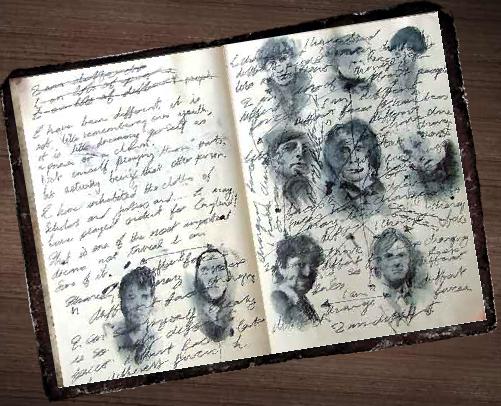
months at the beginning of the story. Similarly, the drawing of Rose in
Smith's journal is a mediocre likeness, whereas Smith makes a beautiful
drawing of Joan later in the episode, and in Jac Rayner's novel The Stone Rose the Doctor [SPOILER]... but, then
again, Rose is only a half-remembered dream to Smith, while Joan is a real
woman sitting in front of him. I also originally carped that the Tenth
Doctor always acted so human that the difference between him and John
Smith was not a vast, shocking one, and that Smith seemed more like the
Tenth Doctor with amnesia than like an entirely new character. Now,
having seen another year and a half of Tennant as the Doctor, it's much
clearer to me how effectively he differentiates the Doctor and Smith. In
reading the book, I found it quite difficult to imagine Sylvester McCoy
playing the love scenes with Joan. Human Nature the TV show does
not reveal such a drastically different dimension of David Tennant's
acting skills, but Smith and the Doctor are still distinct characters.
On the other hand, the whole business with the watch remains a weak
point. As Dave Owen pointed out in DWM, why does the watch have to be on
Smith's mantel, where anyone can see it and pick it up? Why couldn't it
have been almost anywhere else: on a shelf in front of some of Smith's
books (on an aisle out of plain sight), or in a tree (like the Pod in the
novel), or in the TARDIS? (The TV version omits the book's explanation for
why the object can't be kept in the TARDIS; it would interfere with the
telepathic circuits.) Best of all, as Dave Owen suggested, why doesn't
Martha keep it on her person? It might start giving her flashes of the
Doctor's memories, as it does to Timothy, but that would have been less
serious than what actually happens.
On a related note, why does Timothy take the watch from Smith's mantel?
That's stealing, and makes him an unsympathetic character. It may be an
object of marvelous power that whispers wonderful things to him, but that
doesn't excuse stealing it. Once again, the book is far superior in this
respect, as Timothy finds the Pod in a tree and has no particular reason
to believe it belongs to anyone else until he gets to know it better.
Ultimately, television this well-written, handsomely mounted and
perfectly acted is something to treasure, whatever its slight faults and
inconsistencies. Human Nature fully deserves its high ranking in
the recent DWM retrospective poll, and would have deserved the Hugo which
it would surely have won in a year without the incomparable Blink.
A Review by Graham Pilato
24/2/08
Shock and awe, this is another adaptation for TV from a popular off-TV
era work of Who. So many of the best new series stories are
pilfered from the recent great works of fandom. Interesting, huh?
Back in 1995, more than any other Doctor Who novel, this one
epitomized the value of the series in book form, allowing the Doctor to
try out being human for a while. Never had the examination of him as a
hero been made so personal and so poetic in a story before, here, where
the alien that looks human gets to be actually human for once. Beautiful
stuff.
Never again would the books exist as a possibly dubious alternative to
televised Doctor Who for anyone who had read this. Noting that this
story is not as timeless as one might think, based as it is in the
politics of its era, as the "New Adventures" and the 7th Doctor's era on
the whole were very much so anti-capitalist and anti-war, we still got the
turning point of the NAs here. The series turned toward basing itself ever
more deeply in its own continuity with a united epic as a goal, despite
any author's differing politics showing up from novel to novel. It was a
major work for any fan following the novels. Here, on TV, it's actually
still a major work, if not quite as powerful or impressive for the
comparison.
Simply put, the book is slightly better. Had there been another episode
to this half of the two-parter, to better establish the Doctor and Martha
on Earth and to better build the relationship of Joan and John, I think we
might have had some of the best TV of the new series. As it is, it feels
too much like a leap to the cliffhanger here, where Joan is barely "the
one he loves" and Martha isn't at all "his friend", really. The novel is
much, much better in the most important way: the part where it deals with
what it means for the Doctor to be a human.
The advantage that the TV version has over the novel - as they are both
written by the same person, Paul Cornell, with a bit of Russell T. Davies
adding on scary scarecrows and some fine, assured help for the TV
adaptation - is quite plainly: the monsters. The baddies are, while less
powerful here, a lot more enjoyable; plus, they've got strawmen with scary
faces on their side. The Aubertides, as they are called in the novel, were
plenty more nasty and nowhere near as much fun to read about as it is to
watch these fine and terrifying performances.
A lack of CGI monsters is well-argued for here, actually! What a
wonderful actor Harry Lloyd is as Baines (a.k.a. Son-of-Mine)! Why, oh why
can't we try to keep this up? More well-acted monsters and villains would
make a huge difference over these guys we keep seeing lurching at us with
flat-looking CG horror all aglow (see The Lazarus
Experiment, The Satan Pit, School Reunion for some of the best examples).
On the DVD commentary for this, someone, I believe Paul Cornell, makes a
remark about the wonders of a classic green light for aliens. Yeah.
Exactly. As simple as it is, it works wonders just to see an actor acting
alien. That sells me ten times more than the CG acting -- even when it
does work a lot of the time. Because we just aren't getting WETA digital
and Gollum/Smeagol here, folks, and no steely-eyed Krillitane, snarling
werewolf, or CG makes up for the effective performances of a real person
yet in Doctor Who, even if covered in make up (e.g. Brannigan the
cat-dad in Gridlock).
The case for this
first-part-episode-that-I-wish-was-two-so-this-could-really-be-the-beginning-of-a-three-parter
is still pretty good, though. But the knowledge of just how good this can
be obviously comes from knowing the source material. We who review
adaptations always have more to say because of what the comparison offers.
And this adaptation is key to the whole third season in dealing with the
discussion of what human nature tends towards as a theme. Central. And
it's a story that comes from 1995.
The novel is a lot more pacifist while still offering a lot of the same
storyline surrounding the boys getting ready for World War I. The theme
changes a bit here to mean something more like "we fight wars and they can
be survived but only with the right attention to survival over
aggression". But that's such a toothless, slack little message when the
novel hammers home with some brutal subtleties on the choice of pacifism
for a world on the edge of war that needs to catch itself and think before
destroying itself.
9/10
(No point in holding anything against this episode for what it's not.
What it is though, feels a lot like a rush to get to the cliffhanger,
despite being a really wonderful episode of charming, brilliant, new
Doctor Who.)