Seeds,
the Doctor seems almost pathologically uncaring, grinning manically as he
tells the stranded toffs that they could all die, relishing his plan to
dispose of the Rutan ("But by then, you'll be dead."), treating
Palmerdale's death like it's a joke and finally walking away from the
chaos with a smile and a poem. He deliberately tries to alarm shipwreck
survivors, and there's no other way to describe his decision to carry
Palmerdale's (probably rather crumpled) corpse into the living quarters
with the clearly anxious Adelaide present other than to horrify her. (And
there is no objection from him when Leela slaps her to shut her up.) He's
superficially friendly, but nothing he says is reassuring; he's distant
and unapproachable, and doesn't display any grief or remorse over the
deaths that he acknowledges (in the famous "I've made a terrible mistake"
cliffhanger) are partially his fault. As with his other grumpy
performances (Pyramids of Mars, The Seeds of Doom), he's fascinating here.
Pairing him with Leela makes this more dramatic. In Pyramids, another story in which the cast is picked off
by marauding killers in an isolated environment, the Doctor is so
dismissive of the body count that Sarah finally blows up at him:
"Sometimes you don't seem -" "Human?". Here, Leela is as ruthless as the
Doctor: she is the one, for instance, who tells Skinsale, upon finding
Vince's corpse, "We must forget him now." In fact, this is the only time
the Doctor follows her usual prescription for an adversary: lure it to a
well-defended place then unleash a series of lethal booby traps on it.
"Enjoy your death as I enjoyed killing you!" Louise Jameson is just great,
all the time. Almost everything about her performance is perfect, and -
strikingly - the writing for her captures her evolving character (saying
"Tesh-nician", for instance, a perfect symbol for her half-way position
between superstition and reason). And I agree with Colonel Skinsale that
she does indeed look rather fetching in that grey jersey.
Beyond the tightness of its script, what makes Fang Rock such a
great exemplar of the base-under-siege story is its characters. The
Troughton era, the sort of "home" of this sub-genre of story, generally
had characters that fulfilled predictable, banal roles in the story. How
many besieged bases are there with an irascible, unstable leader
(Hobson/Robson), lone female staff-members, an internal traitor...? Dicks,
not a writer famous for his subtle and evocative approach to character,
has filled his hapless, isolated dead-men-walking with lives of their own.
The three toffs are deliciously acidic with one another: "Oh, not another
story from your Indian service, they're even more boring than your House
of Common stories." As has been noted elsewhere, this small piece of
dialogue is wonderfully evocative:
VINCE: Hawkins, Vince Hawkins, ma'am.
ADELAIDE: Thank you, Hawkins.
Combined with Harker's memory of Palmerdale forcing the ship's captain to
sail on in desperate weather and then abandoning ship and leaving the crew
to their fate, there's a quiet little strain of class commentary in the
story. The upper-class characters are a greedy, immoral cheat; his
entitled, pompous secretary; and an "officer and a gentleman" who gives
away stock knowledge in exchange for money, endangers everyone in order to
protect his reputation and ultimately dies scrabbling for a dead man's
diamonds. It's a bit like slasher-movie moral logic, in which the deaths
of the characters are in some way a consequence of their past (usually
carnal, admittedly) sins.
Reuben is a somewhat archetypal (not to say stereotypical) gruff
old-timer who don't trust this damn electricity, but Colin Douglas gives
his performance surprising depth - mocking with Ben, kind with Vince, cold
and hostile with the Doctor. And that's before that creepy serial-killer
smile he sports as Rutan-Reuben.
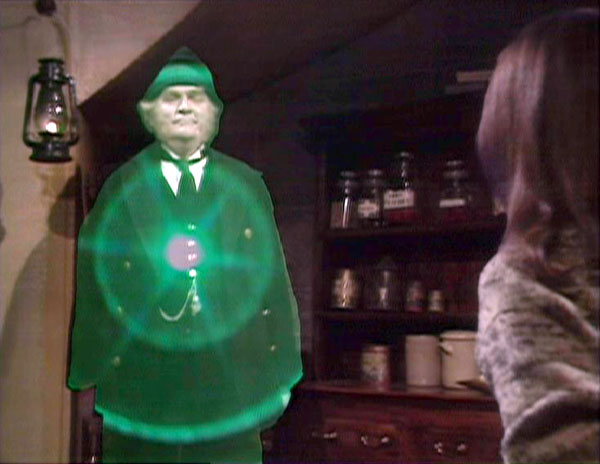
As usual, the BBC has put far more effort into a period story than it
does into the stories set in space. I didn't even mind the model of the
shipwreck, which isn't great, but it certainly doesn't make it impossible
to suspend disbelief. There are also some problems with the direction,
part of which is the soft-censorship of the BBC and the rest is just
flawed direction on the part of Paddy Russell (another returning presence
from Pyramids of Mars). Since we're never going to
see a hideously mutilated body in family TV (though the rat-gnawed cabbie
in Talons of Weng-Chiang comes close), the camera
studiously avoids Ben's body, making the conversation between Harker, the
Doctor and Leela almost incomprehensible on first viewing. The classic
cliffhanger to part three is somewhat damaged by the fact that there's no
clear shot to show us that it's Reuben's body (we only get his face in
profile, pale and prostrate, half in shot).
Horror of Fang Rock isn't going to change anyone's life, nor
will it surprise anyone with its cleverness. It is simply a superbly
executed production by a writer, a cast and a production team right on the
top of their game. It's hardly the first nor the last base-under-siege
story, but it's worth doing something again if its done perfectly. Any
list of Doctor Who stories to show to a non-fan should include this
story: it has character, it has an interesting selling point, and it has
chills and thrills in bucket-loads. It's not flashy, it's not important,
it's not momentous; it's just a perfect example of how great an "ordinary
Doctor Who story" was when the series was at its best, an era that
was, unfortunately, to come to an end with the very next episode...
Before the Gaping Door by Linda Marie Petersen
13/10/21
Gothic Horror. The genre that automatically conjures up thoughts of Bram Stoker's Dracula, Mary Shelley's Frankenstein and maybe Charlotte Perkins Gilman's The Yellow Wallpaper. But the writer I always think of is Wilfrid Wilson Gibson.
It was a classic Doctor Who show that introduced me to the genre of gothic horror and poetry. And did so masterfully. In a very real sense, this was the gateway into other realms. I had never heard of Bram Stoker or any of the other authors up to this point in my seventeen years.
There are those who choose to look at something and find whatever is wrong with it. I look at that same something and ask myself if it was enjoyable. If the answer is yes, then it was a good story. It doesn't have to have cutting-edge special effects or a star-studded cast or have multiple locations. Four rooms of a lighthouse and a staircase is more than enough space to tell a good tale. Yes, I am talking about The Horror of Fang Rock.
This story meets all my requirements and then some. When I say this show was a gateway into other realms, what I am saying is it took my interest outside of my own comfort zone and dangled a bit of mystery in front of me. Up until now I was content to read the Target novelizations of Doctor Who and even some Sherlock Holmes and some Urban Fantasy, but then Tom Baker's Doctor quoted this at the very end of the show:
Aye: though we hunted high and low,
And hunted everywhere,
Of the three men's fate we found no trace
Of any kind in any place,
But a door ajar, and an untouched meal,
And an over toppled chair.
The quote grabbed my attention, and I had to know more. But this was in a time where computers were things only companies used and the way to search for something wasn't Google, it was the Dewey Decimal System in the card catalog at your local library. In my case, the library was the one at school and the only thing I could remember about the poem was door ajar, untouched meal, over-toppled chair. And do you think I could remember the author's name? Not a chance.
With the help of a very kind librarian who showed me to the poem section and specifically that on naval and sea stories, I was able to find the much-coveted piece after about an hour of searching the stacks. And since it took so long to find, I sat down at a table and copied the poem for myself.
Once I found my pot of gold, I went back to the librarian and asked to be pointed in the direction of mysteries. I said I was looking for something of a supernatural feel with ghosts and abandoned castles. Little did I know what I was asking for was classified as "Gothic Horror". In a way, Flannan Isle fits that genre just as nicely as it fits the seafaring one in which I found it.
What does all this have to do with The Horror of Fang Rock? This is my attempt to show not only fans of Doctor Who but also readers in general that liking one genre of story can lead a person to investigate and find different genres which are equally enjoyable. While gothic horror may not be too distant from science fiction, naval poetry certainly is. And if it weren't for this one story, I may never have found another style of writing I so enjoy.
Now, please allow me to put to rest several criticisms about this specific story:
It has been said the two groups of people on the lighthouse were irrelevant, except for Palmerdale, who held the cache of diamonds needed to defeat the alien menace and that could have been done another way. To this, I would argue the first set of keepers is necessary, as it gives us a history of the lighthouse, its mysterious Beast and the setup for the events to come with the light failing after being converted from oil to electricity and the later possession of Reuben by the Rutan. Without electricity, would the Rutan have come to the lighthouse? My answer is no.
As for the set of shipwrecked characters, this subplot, while not necessary to the plot, was fun to watch. The inclusion of the over-the-top outbursts of Adelaide Lessage, along with the location and the supernatural threat either real or perceived are all classic tropes the gothic horror style employs, and, in my opinion, this episode delivers on that perfectly!
It has also been said the Doctor seemed disinterested in the fate of those on the lighthouse, almost to the point of being bored. When I read this, I rolled my eyes just as hard as Leela did when Adelaide fainted, and to these critics, I have five little words: the Doctor is not human. This is a good reminder.
The Horror of Fang Rock is timeless; watching it now gives me just as much pleasure as watching it the first time and, even though I know what will happen next, the show never fails to deliver on its promise of dark mystery combined with a science-fiction edge and packaged in such a way as to draw the watcher into the story time and again. It made quite the impression on me as a teenager and to this day remains one of my favorites. And just as the Doctor and Leela disappeared from Fang Rock, I still stand on the shore with Gibson and ponder:
We seemed to stand for an endless while,
Though still no word was said,
Three men alive on Flannan Isle,
Who thought, on three men dead.