
The Mind Robber
Dragonfire
Love and War
Conundrum
Millennial Rites
The Room With No Doors
Head Games

|
The Mind Robber Dragonfire Love and War Conundrum Millennial Rites The Room With No Doors |
Virgin Books Head Games |
|
| Author | Steve Lyons | 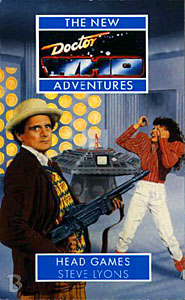 |
| ISBN# | 0 426 20454 9 | |
| Published | 1995 | |
| Cover | Bill Donohoe |
| Synopsis: Dr Who, superhero and gentleman to boot, and his trusty sidekick Jason must battle the evil forces of his morally ambiguous evil twin, known only as 'The Doctor'. |
A Review by Sean Gaffney 23/8/99
Ah, me. I'm going to try to make this a little more in-depth than usual, as this book will probably be one of the more debated on USENET. Remember those questions that Marc and Paul bring up in their books? Steve Lyons is apparently trying for some mythos writing as well. In addition, the mental anguish scale is well up on the Kate Orman level.
OK, let's start with the book itself. I thought it would be comic, but it's much more serious than I imagined. Not that it isn't highly amusing in spots, it's just that the tone of the book is very heavy. There's betrayal in the air, and we get to experience every minute of it.
Characters other than the regulars: Good. Nice characterization of Bambera, and I like the twins! The aliens are well characterized, and the ebony reverse racism thing actually works well after Toy Soldiers. We don't get to find out their future, but that's the point. Chris's girlfriend is particularly well done.
Dr Who - A plot device (but tha's a good thing)
Jason - Very well written. The idea of Dr Who occasionally reminding him of all the people he's just destroyed helps us to understand his inner self better. The ending also leaves hope for him yet.
Roz - She reminded me a bit of Dana Scully in this one. Partner, partner, partner. Nevertheless, even with her doubts, we trust her from the start. She needs more development, though. Judging from the cover, Warchild might do that.
Chris - Long overdue. Chris has been the least well-drawn character, and it's good to find him given more depth. He has the ability to do whipped dog extremely well, and he certainly gets it here. He does, however, get a chance to examine the greys of the world in his uneasy alliance with Dr Who and Jason.
Bernice - Well, typically Benny through most of the book, but then, this isn't her book. She does, however, get to reinforce her status as the "true" companion, and furthermore the only one out of all the Seventh Doctor's "bimbos" than he can unburden himself to. The bartender role.
Ace - Yeah, she'd back, but it makes perfect sense. This Ace is from only a few days after we left her, but we can still see the peace that she has gained. She may have learned a little too much from him, as her manipulations are just as devious. She can even get to him. Nevertheless, she doesn't abandon the Doctor, and when he is at his worst, she still makes him realize this. We even see that the Doctor is now becoming part of her life, now. Excellent cameo.
Mel - Ah, Mel. In Millenial Rites, I thought Mel to be too developed, if that is possible. We didn't see enough of the computer expert, IQ 163. We saw the whining screamer. And we get that here. But, this is a good thing, because it reminds us of how the Doctor has changed, which is after all the point of this book. I don't think a reunion would be a good idea, here. Also, for you "why the hell'd she go with Glitz?" naysayers, well, I guess the answer is obvious in hindsight.
The Sixth Doctor (sorta) - Jeez. Now, I can't accuse Steve of being a Colin-basher, because Time of Your Life was brilliant (yeah, you heard me), and we've got another one on the way. But then, this isn't really the sixth Doctor, but that asect of the Doctor's psyche. This is where the book actually gets scary, because we see what the Doctor's guilt has done to his psyche. So much for Colin ever being in the Doctor's mind. (Though I did notice Patrick there. I onder what that explanation is).
Our hero - Well, he goes through a lot. This might have been more affecting if we knew it would change him. But actually, I suspected that it wouldn't. Time's Champion is not yet retired, and therefore we can't see that regeneration yet. It even gives a decent explanation for the "hitting the head on the console" thing. We see all of the aspects of the New Adv. Doctor that have been criticized, and yet we see many of the strengths, too. This is a grey Doctor, dark grey, in fact, and he knows it. He knows that he can still become the Valeyard. And in the end, we still see him doing things secretly, without consulting his companions. Hey, it's our Doctor. Go for broke. Even if you don't like him, understand why people do.
Overall - Well, 10/10, but then you knew that. But this one will keep me thinking for a while, and only Paul and Kate's books have managed to do that. Welcome, Steve.
A Review by Graeme Burk 14/6/00
The Good news about Head Games: I liked the in-jokes (Dalek Attack being canonized, the Doctor bonking-head-on-console regeneration explanation, the CSO dinosaurs). I liked Mel's character (it's a nice complement to Millenial Rites, although Craig Hinton does her better than Steve Lyons). I really thought Cwej came into his own with this adventure. Amd there are passages-- including a decent pastiche on Set Piece -- that border on brilliance. It has a nifty plot (the Land of Fiction is spilling into the real world and Jason the former ruler has invented a doppelganger of the Doctor called Dr. Who).
But at the end of the day I find Head Games ultimately troubling and frustrating.
I'm a big fan of Cartmel Who, but I've often found Virgin's own take of it at times a bit difficult to take. Whereas Cartmel Who seemed to be a fulfilling of the Doctor's potential (if you were a 900 year old Time traveller, wouldn't you know a bit more of what's going on than the average bear? Even the manipulation is in keeping with the Doctor's character, particularly Troughton Doctor and the Doctor's games are implied to be spread over his incarnations).
Virgin's writers added a lot of things to the character, which are in the main literary conventions like the Time's Champion, the Gods of Gallifrey, the jungian mindscapes (begun in Timewyrm: Revelation and constantly abused since), the way the other Doctors are still inside and still interacting with the current incarnation. Like I said, these are literary devices-you would never see this on the TV show because television is not an interiorized medium like books.
But all these devices have led to an interpretation (unlike Cartmel's) where the Seventh Doctor is somehow more Important (with a capital I) than the others -- He's now Ka Faraq Gatri, Time's Champion, a guy who talks with death and time, maybe linked to THE OTHER, on a mission to preserve time and his own meddling of it, etc. etc.
And on the whole I can live with it, it's not my cup of tea, but I can live with it. Mostly because it's not in every blessed book, and it's limited to a dreamscape here, something else there. But over the years, these add-ons have been taking greater prominence. We see Gallifreyan Gods in non-dream sequences. The Doctor acknowledges in waking and now lives out his role as Ka Faraq Gatri and TIME'S CHAMPION. And then we get novels like Head Games.
Which brings us to the bad news about Head Games: Head Games' characterization practically wallows in this stuff. The Doctor is revealed: a) to have manipulated Mel to leave his company so he can "fulfill his mission" (which also has the added bonus of invalidating one of the most beautiful writing out scenes in the TV series since Sarah left in Dragonfire). b) to be barely holding his psyche together (it seems that Time Lord's previous psyches still exist within him -- so much for the simple jungian archetypes in Revelation -- and have trouble co-existing at points -- so much for "personality changes due to an imbalance in body chemicals" of Mark of the Rani). c) to be so committed to his mission, to his games, that nothing else, seemingly matters. (I thought we resolved this in Lucifer Rising...No Future...Human Nature...)
And for the first time in my open-minded existence, I'm going to say this isn't Doctor Who for me.
I like an alien, unknowable Doctor. I like a Doctor who at last admits to his capriciousness in manipulating companions (hey, even the so-called innocent Davison Doctor did it). I like a Doctor who acts within a morally ambiguous universe (one of the strengths of the Jason/Dr.Who storyline in Head Games I'll admit) But this driven, cynical man-with-a-higher-moral mission is none of these.
I agree with Karen Funk Blocher who said on rec.arts.drwho (when the book -- and this review -- came out orignally) that she had a hard time connecting the sad, torn man who agonized over the cosmic ramifications of destroying the Daleks in Remembrance of the Daleks or the man felt agony over manipulating Ace in The Curse of Fenric.
This book seriously made me rethink whether I wanted to continue with the NAs because it's thrown all the elements of the NAs I dislike in my face. I decided to keep with the line, because two months after this book there's a Season 6-esque Terrance Dicks Doctor and the character will continue to be reconstructed anew every month for years to come. But it does make one wonder why I bother sometimes.
I don't think any NA has made me more frustrated with Virgin's editorial and authorial decisions than Head Games. I will give it a 7/10, because aside from that minefield of material there is a good story there, although like Conundrum, it sort of ends at the 3/4 mark and then keeps going for another 45 pages inexpicably. Plus, there's a gratuitous appearance of Brigadier Bambera and a great joke at her expense by Benny that made me laugh out loud on a bus. And Ace is in it.
But even that's left me with little solace. I don't think an NA has ever made me feel more certain that Virgin has missed the what the point of the Doctor's character is exactly.
A Review by Finn Clark 27/3/03
Conundrum has a good reputation, unlike Head Games. I reread the latter expecting a lacklustre retread of the Land of Fiction stuff with a side-order of repellent Virgin-itis. I disliked this novel back in 1995, but time has put Virgin's odder decisions in perspective and I found myself quite enjoying it.
The obvious comment is that Steve Lyons seems to hate something, but I don't know what it is. Depending on who you listen to, Head Games is putting the boot into the 7th Doctor, all his predecessors, the Virgin novels or a combination of the above. Certainly the Virgin regulars aren't portrayed at all flatteringly, with the Doctor being put through the wringer by untrusting companions and an extremely unwelcome sub-theme about murdering his 6th incarnation. His NA Dark Doctor ways are contrasted (twice!) with more innocent times, once by Mel (who remembers Season 24) and once by implication with Dr Who and Jason (who are bursting with TV Comic continuity). In 1995, this was very unpleasant to read.
Mel has had a pretty miserable time since leaving the Doctor and there's a massively unwelcome retcon about why she went off with Glitz in the first place. New Ace is, um, New Ace. Even Benny isn't much fun. However as a sequel to Conundrum, this works surprisingly well. That book had strife among its TARDIS crew as a lead-in to No Future, so if you read Head Games straight afterwards then it feels like Steve Lyons digging deeper into similar themes. Most of the regulars learn to trust each other again in the end, and we've learned more since about the ones that don't (see Heritage).
Similarly the Doctor's nonsense has become less significant with hindsight. On one level it's totally batshit to say that the 7th Doctor's NA role as Time's Champion is so big and important that it was worth murdering his predecessor to bring him into existence. However the 8th Doctor's BBC antics have made Time's Champion a complete joke and The Room With No Doors retconned the "murdering my predecessor" stuff. We can thus take it less seriously and see this Doctor as just lonely and a bit fucked up.
Having put aside all of the above, I quite enjoyed Head Games. Detrios is a bit cardboard and this time it isn't supposed to be, but it's not as if the whole book rests upon it. I enjoyed seeing Mel again, even with her reactions to the Doctor. I got a kick from the TV Comic continuity. I liked what happened with Jason, which was more interesting than the usual last-minute self-sacrifice or "see a baddie, kill a baddie". And there's something very odd going on with Chapter 17, which is nearly a self-contained short story doing a Doctor Who rewrite of that Ray Bradbury tale of someone going back in time to tread on a butterfly.
The Land of Fiction stuff is present, but more in the background than I'd expected. Instead the book's more interested in Dr Who, a character we heard about but never saw in Conundrum (though he did appear in Conundrum's Prelude in DWM 208). Overall I enjoyed Head Games. It contains massive misjudgements, but they're more palatable these days. Worth a second look.
A Review by Andrew McCaffrey 8/9/03
Head Games features Steve Lyons returning again to the ideas Peter Ling created in the television serial, The Mind Robber. The main difference here is that instead of people being trapped inside the Land of Fiction, the encroachment is going in the opposite direction. The previous Master (Jason) is venturing outside the Land, but still retains its fictional powers. And one of his first actions is to create a hero to travel with. He produces a mysterious scientist/time-traveler. Someone who fights monsters and rights wrongs. Someone by the name of "Dr. Who".
Despite the heavy moralizing and angsty emotional stuff, there's a lot of fun material here. The comparisons between Dr. Who and our own Doctor are amusing and only occasionally overbearing. One of the main themes that the book touches on is the shift in personality that the Seventh Doctor undertook when he: (a) first changed companions, and (b) switched mediums, going from television to book form. Much of this comparison takes place through the eyes of Mel, the squeaky-clean and utterly boring first companion of the Seventh Doctor. Her characterization is very much based on the stories that she appeared in and it's hysterical to see her reaction to the darker and ambiguous universe that the Seventh Doctor now finds himself dwelling in.
There's an unfortunately large part of the adventure that is so cliched and stereotypical that I wondered if Lyon wasn't making some grand statement about formulaic stories. Actually, given the rest of the book's contents, this almost certainly is a statement of some sort, but that doesn't excuse it from being a mostly uninteresting waste of time. Rebels running up and down corridors. Fanatical religious rulers misleading a population. A mysterious artifact that gives life to a whole planet. A boring conflict between humanoids and reptile-aliens. Just thinking about it makes my eyes start to close. Lyons' prose is decent enough here to alleviate much of the pain, but it certainly isn't enough to breathe life into these sections.
Despite the cover featuring an ugly question-mark pullover and an ACME weapon waved at a Bonnie Langford publicity photo, there's also quite a lot of seriousness going on here. The Doctor faces both his past and his possible future in the forms of the Sixth Doctor and the Valeyard. There's a large decision affecting the lives of lots of (admittedly boring) people. Head Games is playing many games at once, and manages to win more than it loses, but only barely. The Doctor is at his darkest, yet this aspect of his personality seems very contrived here.
In fact, a lot of the angst is handled awkwardly. While Mel's reaction to the difference in tone is entirely believable (the universes in stories like Time and the Rani and Delta and the Bannermen have a completely different flavor from what we would see in later, darker adventures), her reaction to the change in the Doctor seems much more over the top. If Mel had stuck around for one extra story, would she have freaked out at the end of Remembrance of the Daleks? And if so, why should we care? We all noticed the Doctor upping his game as he settled into his seventh persona, but was there anyone out there who hadn't figured that out already and needed it pointed out in a novel? Granted, Mel's behavior here could been seen as being consistent with her TV character, but if something was annoying on-screen, why go through pains to recreate it? While it was fun to laugh at her exaggerated reactions, I'm just not sure that the comparisons were quite as clever as Lyons thought they were.
Although I'm spending a good deal of time talking about the negative points, there were many set pieces and individual scenes that I really enjoyed. The sequence of the Doctor stuck on a train while the adventure slowly falls out of his control is something that I remember vividly from my first reading, many years ago. The parts dealing with the Land of Fiction's creations are for the most part handled well, and there are one or two moments that put a shiver down my spine. The Doctor and company's battle of wits against Dr Who and Jason is a fun diversion.
I did enjoy Head Games overall, but there were major portions of it that I simply wasn't interested in. The bad sections weren't enough to actively turn me off, although I found some places to be a tough struggle to get through. In a book that's doing lots of things at once, there's always something different just around the next page, and, fortunately, there was just enough good stuff to pull me through. As controversial as the Valeyard/Sixth Doctor material turned out to be, I found myself quite interested in these sections (especially the hints that would be explored later in Kate Orman's The Room With No Doors), but I'm just not sure what they had to do with anything else.
A Review by Jamie Beckwith 2/8/11
Conundrum has always been one of my favourite NAs but it seems odd that I've never read the sequel until recently.
I liked the concept (It's an evil doppelganger set up only the twist is our Doctor is the evil one!) but I wasn't overly keen on the execution. I'm not sure I can put my finger on it exactly. There's absolutely nothing wrong with Steve Lyons' prose, but I found the alien planet Detrios really quite dull and it's only once the plot moves on a bit and we get involved with Dr Who trying to polish off past companions like Mel and Ace that it gets moving.
In many ways, this novel is both a critique and a defense of the Seventh Doctor; the master chess player who will sacrifice pawns and play for big stakes and it makes it interesting by having both Mel and Chris turn against him, but it never quite satisfactorily addresses the central point. Is the Doctor an anti-hero making cold hard choices for the greater good or have we also been duped into thinking the Doctor is great when actually he's pretty crap? The short story Continuity Errors (by Steve Moffatt and set in a planet-sized library...) does it better, but then it plays it for laughs.
This was obviously written in the mid 90s when Mel's character was still quite loathed amongst fandom and before her Big Finish rehibilitation. Head Games, along with the Missing Adventure Millennial Rites, were the first to make steps towards this. Unfortunately, although it was written years later, I read The Quantum Archangel first and that also features Mel horrified with the Sixth Doctor for destroying a whole planet due to miscalculation so it sits oddly that if she could forgive him them (as she obviously must have done because she carried on travelling with him in to his next persona), she ends up hating him here.
Not a bad book and maybe better if read in context, but I wouldn't recommend it as a standalone and would point new comers to the next release, The Also People, instead.
A Review by Matthew Clarke 16/8/12
Head Games is a sequel to the author's masterpiece, Conundrum. It lacks the radical literary style of that book and is a good deal more serious, but it is still a very strong and impressive novel.
Like Conundrum, Head Games follows up the Land of Fiction first seen in The Mind Robber. The Land of Fiction is a great idea, but one that could get old rather quickly. Lyons puts a new twist on it by having elements from the Land of Fictional interacting with the real world. We are therefore given a much stronger contrast between fantasy and reality.
Head Games also follows Conundrum in suggesting that the TV Comics exist only in the fictional universe. I prefer to view those stories as genuinely part of the Doctor Who canon. I don't think this is too much of a problem. Jason, the master of the Land, has based the appearance of his doppelganger Doctor on the real one, so it's quite possible that all the TV Comic references, such as John and Gillian going to Zebedee University are based on the Doctor's memories. Steve Lyons also seems to make the common assumption among fans that the Doctor is not really called 'Doctor Who'. This is an assumption I do not agree with (just The War Machines!). The Doctor does not normally call himself Dr. Who, but that does not mean he has never used that name before.
As with NAs by Paul Cornell and Kate Orman, there is a huge amount of angst going on and Head Games brings into sharp focus the Doctor's morality. The Seventh Doctor is presented as a very morally questionable figure who uses people horrendously. The novel demonstrates this by bringing back not only Ace (who had left the Doctor in Set Piece) but also Mel. This helps to elaborate just how much the Doctor has changed since Season 24. Mel is appalled that the Doctor should associate with the gun-totting Roz and is horrified when she finds out that Dorothy is no longer that 'nice little girl'. Lyons does a bit of a retcon on her departure and the revelation only alienates her further from the Doctor and she departs from him on bad terms. The return of Ace is also effective. She has come to terms with the Doctor's meddling and manipulation, but she does not let him forget about it. She tries to help Mel comes to terms with the Doctor, but is scorned by her. It's great to see all the various companions of the Seventh Doctor interacting (just a shame it was written before Klein turned up in Big Finish; I'd love to see Mel's reaction to the Doctor hanging around with a Nazi!), though the downside is that Roz gets a bit neglected and she is not so well-developed here.
Head Games follows Timewyrm: Revelation in using a past incarnation of the Doctor to challenge the Seventh. The Seventh Doctor finds himself under attack from his Sixth incarnation who accuses him of his various 'crimes' (as does the doppelganger Dr. Who and Jason). This is a little different from Timewyrm: Revelation in that the past incarnations of the Doctor were not so much real personalities as symbolic manifestations of the facets of his psyche. Some fans dislike the notion in this and other NAs, that the Seventh Doctor was somehow special and that he is the Time's Champion and the Ka Faraq Gatri. Personally, I have always liked this idea. While it is true that the other Doctors could be dark and manipulative, the Seventh Doctor does seem to be remarkably more proactive about it.
One small fault is that Jason does not really come across as a sixteen year old. Much of his dialogue and his worldview seems much more like that of a nine or ten year old boy. One thing that is definitely worth noticing is the very clever reference to the Dalek Attack computer game. Did you ever play that game? Head Games is not as magnificent as Conundrum, but nevertheless it is still amongst the strongest of the Virgin New Adventures.
Dr Who in an exciting adventure with Noe Geric by Noe Geric 30/4/19
In this episode, Dr Who is joined by a young man called Jason for brand-new adventures! This story is the funniest I've read for a long time. Seeing the Doctor fighting against a parody of himself, it couldn't be better. Most of the book is gold, except the bits set on Detrios. I was warned it was bad, and it really isn't interesting.
Dr Who is particularly good. He's the best character I've read in the New adventure so far. He can't make the difference between good and bad, he's the biggest Doctor-cliche, and the scene where he tries to attack Buckingham Palace are hilarious. Most of the books began with a bunch of characters we don't know doing something to introduce the plot. These sorts of beginnings are really boring, as I don't know who are these characters, and all I want is the Doctor and his companions to appear. But here, for once, I only wanted to see how far could Dr Who and Jason go.
I really wasn't expecting them to kill the Queen... I didn't thought Steve Lyons would go so far. But all these bits set in 2001, where Dr Who and Jason trying to kill the Queen is the best part of the whole book.
The worst, as I said, is the Detrios Adventure. The first part with Dr Who and Jason trying to kill the lizards is nice (even if I was bored during the giant reptile sequence), but it get worse when Chris landed on the planet and that the Detrios part wasn't finished. At the end, Detrios become the typical ''Planet in danger'' of the show, with a mad religious order, an unlikeable royal leader and a group of rebel fighting for freedom. I must admit, I found the last part really touching, with Kat wondering why Chris never came back. She'll perhaps never find out, and that's sad...
There are also some scenes set in a dreamworld with Benny and Jason. Benny's dream is fun, and I really liked how Dr Who captured her. But Chris' adventure was like the Detrios sequences: dull.
But, at last, there's the reason for why I bought this book: Mel. She comes back and find out that the Doctor isn't the old chap he was during Season 24. The exploration of her reaction could've been better if she hasn't disappeared in the TARDIS 30 pages before the end, only to come back for her goodbye. There's also a brief cameo from Sabalom Glitz and Brigadier Bambera, but, sadly, they only get one or two scenes before disappearing.
Benny, the most interesting character of the TARDIS crew, was really unlikeable for most of the book. Treating Mel like an idiot just because the young woman doesn't like guns. Even Ace was more interesting. Chris get all the fun on Detrios, and Roz doesn't do anything memorable; even Wolsey got more things to do.
Well, I never enjoyed an NA so much. It confirms that even if the Doctor isn't as manipulative as he was in No Future, there's still darkness in his mind. His fight with the sixth Doctor is sidelined; it could've been better instead of only appearing at the beginning and the end and being completely forgotten between the two. His final scene proves that he can't be trusted even after all that hapenned. His great plan must continue.
A perfect book. Even if Detrios spoil it, Dr Who and his adventures are great fun and I give Head Games a 10/10.
Into the Woods You Go Again by Jacob Licklider 1/7/20
Sequels are rarely ever as good as the stories they follow and as much as I hate to admit it, Head Games has quite a few moments in it that cause its quality to diminish in comparison to Conundrum. Luckily the few moments are quite literally a few, which I will get out quite quickly. First the subplot with Detrios, while eventually serving as a way for Mel to have first-hand experience with what the Doctor has become, doesn't go anywhere interesting quickly enough to keep things moving at a good pace. It does give Chris some more things to do in sequences which show how Lyons is great at Chris' character and building an alien society, but nothing else. Second, let's just say that the sheer amount of references to Millennial Rites are excruciatingly bad, as, while they do get me to want to read that novel (which wouldn't have been published when people read this novel), it takes me out of this story, as I want to find out what happened to Mel in 1999. Luckily, the rest of the story is great, with some amazing writing. Steve Lyons knows how to keep your attention and write some great characters.
The plot sees Doctor Who and his new companion Jason going after his doppelganger, the Doctor and his five previous companions. They are going to lock them up in Galactic Prison, go to Earth in 2001 and depose the Queen so they can make the Earth a better place. Now the plot is extremely simple, which really helps bring out the characters, which of course Steve Lyons is great at portraying. The story is used to comment on the Virgin New Adventures and what it really means for the Seventh Doctor and what he has become. We also get closure for where the Sixth Doctor's portion of the Doctor's mind was in Timewyrm: Revelation in what is a brilliant cameo from the Sixth Doctor. Lyons of course does the traditional Virgin New Adventures route of taking the Seventh Doctor and pushing him into the background for most of the novel, which really works here, as it isn't throughout the entire novel. There are points where the Doctor takes the center stage, with some great character moments with Mel to reflect on what he has become. The idea that the Doctor has lost his way and almost become the villain in his own story is of course great, as that is basically what has been happening with the Seventh Doctor. The man has manipulated those he thought of as friends, committed genocide more than once and turned his closest friend into a hardened soldier. Mel's outburst on what he has become is completely accurate, as Mel represents the innocent portions of the Seventh Doctor's life. Lyons nails the characterization of Mel here, as she is far from the screamer seen in Season 24 but still remains the optimist. The Doctor crushes her spirits now, and her reactions to the new companions just make her go in disgust. The only person she seems to approve of is Benny, because Benny doesn't put up with any of the Doctor's bullshit. It really feels like Bonnie Langford could portray this older Mel.
The current companions of the Doctor are also portrayed in a brilliant way by Lyons. While Benny doesn't get much to do later on in the novel except to sympathize with Mel, she does shine in the early portions of Head Games, as she is trapped in a comic-book-style plot with the White Knight from Conundrum, which just has some amazing moments and sees Benny against basically the Riddler from Batman. It allows Lyons a chance to write Benny as the snarky archeologist we know and love. Lyons also succeeds in capturing Roz, whose highlighted as the soldier who will follow the Doctor implicitly, which is basically who she is. She is able to repress not only her own emotions but also Chris's rather emotional side, but she still cares enough about the universe to see it put to rights. Chris is a different story. Oh, Chris Cwej how much the emotional rookie you are! You refuse to allow the Doctor to sacrifice a planet even though it is interfering with the Web of Time. Lyons is great at making him sympathetic, even if his actions are extremely irrational, and Roz has to be the one to snap him out of his delusions. He gets to spend most of the novel with the villains, which is great, as it allows them to become a bit more relatable.
Now this novel isn't just famous for the return of Mel, as it also features the return of another companion who we haven't seen since a rather good Kate Orman novel set in Ancient Egypt. Yes, Chapter 13, "The Bitch is Back" heralds the return of Dorothy "Ace" McShane for one story only, and, while that chapter title is apt if this was during the later Ace run of Virgin New Adventures, Lyons actually has Ace be similar to the older version of the character seen in the Big Finish run of audios featuring her and Hex. It is honestly a breath of fresh air, as Ace feels like the character I originally fell in love with on television, and she along with Benny actually get to sympathize with Mel, who is of course distraught with the Doctor's actions. Moving on to the actual villains of the piece, Dr. Who is just an amalgamation of Jason's wishes to travel in space and time fighting evil and green things. He looks like the Seventh Doctor as seen in Season 26 where he wore the question-mark jacket, and it seems like he was meant to be Peter Cushing's Dr. Who from Dr Who and the Daleks and Daleks: Invasion Earth, 2150 A.D. This is mainly due to some of the comments made by Dr. Who, which just sound better in Cushing's voice, but it still works as a parody of McCoy's Doctor. Jason is also another of the villains in this story, returning from Conundrum, and he is honestly sympathetic, as he wants to help people but can't. Brigadier Bambara also returns from Battlefield, which is a nice bit of continuity.
To summarize, Head Games is a novel that is difficult to briefly sum up, as it is the culmination of many different character arcs in a piece of brilliance. It is a celebration and analysis of the Seventh Doctor and his previous adventures as seen through the lens of an innocent in the form of Mel Bush. There are a couple of problems with a subplot not really being that engaging and annoying continuity references that really aren't needed, but it is still pretty good. 90/100