THE DOCTOR WHO RATINGS GUIDE: BY FANS, FOR FANS
| Episodes |
6 |
 |
| Story No# |
69 |
| Production Code |
TTT |
| Season |
10 |
| Dates |
May 19, 1973 -
Jun. 23, 1973 |
With Jon Pertwee, Katy Manning,
Nicolas Courtney, Richard Franklin, John Levene.
Written by Robert Sloman (with Barry Letts).
Script-edited by Terrance Dicks.
Directed by Michael Bryant. Produced by Barry Letts.
|
|
Synopsis: An oil refinery creates a toxic green waste which causes widespread
disease and mutation, while the refinery staff seem to be under outside control.
|
Reviews
Strong social/economic/political undertones by Troy Irvin
21/11/97
Addressing issues that are as relevant today as they were in 1973,
The Green Death is a story that examines the inevitable clash
between the profit-seeking resource company (Global Chemicals) and the
ever-growing environmental movement (the 'Nuthutch'). Also examined is
the dehumanisation of management (with the leader of Global - BOSS -
actually a juggernaut of a computer) as the quest for ever-increasing
profits takes priority over the welfare of the people. I rate the Green
Death a healthy 9/10 not only for the strong social/economic/political
undertones but also for the appearance of the striking blue crystal from
Metabelis 3, the disgusting concept of giant maggots that simply must grow
into giant insects and, as I work as a mining engineer, I have to give it
an extra mark for the mine sequences. The only unfortunate result was the
loss of Katy Manning.
A Review by Keith Bennett
2/5/98
One of those Doctor Who stories which has many fine qualities,
but suffers from the special effects. The characters of The Green
Death are rich, from the regulars like Jo and the Brigadier, to the
terrific Dr. Clifford Jones. Their interaction through the story gives it
thrust and believability. Dr Jones' relationship with Jo is one of the
better romances of the series (although... um... there aren't a lot to
chose from), and Jo hits it right on the head when she tells the Doctor
that Dr Jones reminds her of "a younger you." He does indeed have a lot
of similarities with the Doctor, and one can fully believe Jo falling for
this man, rather than previous drips she has met, like King Peladon and Planet Of The Dalek's Latep. Even the way
she meets him, clumsily messing things up like she did when she first met
the Doctor, has its poignancy.
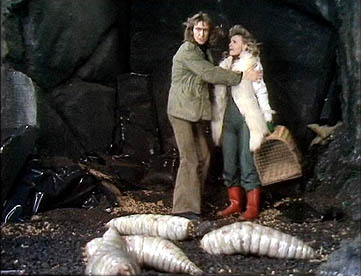
The story itself is enjoyable. The maggots are good, but, I'm afraid,
are badly let down by the CSO, and it's impossible not to think about how
obvious the studio scenes are compared with the location shootings.
Having said that, this isn't enough to diminish the effective scene of the
maggot crawling up behind Josephine while she's quietly reading. Quite
"horrific" by Doctor Who standards.
BOSS is a refreshingly different computer -- mad yes, but at least
with personality and a sense of humour. It brightens up every scene it's
in with its oddball style.
And the final scene of Jo announcing her marriage to Dr. Jones and the
Doctor's sadness at her departure is one of the more moving goodbyes in
Doctor Who's history. One can look back and see how they started
on the wrong foot, but how he grew more and more fond of her. The Doctor
and Jo's relationship remains one of the best Doctor-companion
relationships of all, helped a lot by the performances of Jon Pertwee and
Katy Manning.
Overall, despite some technical difficulties, The Green Death
is good enough to make one curl up contentedly at its best moments and
say, "I love this show".
Not as good as you've been lead to believe by Michael Hickerson
9/5/98
Whenever fandom compiles a list of the great Pertwee era stories, it's
inevitable that The Green Death is at or near the top of the list.
And every time I see a list like this come out, I pull out my copy, power
up the VCR on the hope that I might finally figure out why it is everyone
loves this story so much.
I still haven't found it.
Don't get me wrong--I love the Pertwee era. And The Green Death
is a good story. But it's just not the classic that everyone's made it out
to be. Yes, it's got some interesting themes such as preserving the
enviroment, taking responsbility for what we do, and not allowing our
humanity to be superceded by technology, but is it really worth the ride?
I always enjoy the story, but it never provides me with the feeling
that I've watched a classic story that I get when I see The Sea Devils or The
Daemons. I think part of it is that these stories take the
conventions and rise above them. And The Green Death is just
contest to stay within the estbalished Who conventions--you've got
UNIT, some rather lackluster effects, a threat to humanity, and the Doctor
at the center of it all. About the only Pertwee cliche it's missing is
the Delgado Master.
I think part of problem is that UNIT has become such a comedic foil
for the rest of the cast at this point. I love the Brigadier of Silurians and The Daemons. But here, he seems rather like a ham-fisted
buffon, leading a bunch of guys who are playing at being soldiers. Gone
is the stark realism that made UNIT so effective in the early Pertwee
years. And it's sorely missed. Not that UNIT comes off as badly as they
do in The Time Monster (well, except
for Benton calling to the maggots... that's just embarassing!), but they
don't make a good showing here.
What does work, however, is the theme of serendipity. The story is
about lucky changes and how they affect our lives--from the Doctor finally
making to the fabled Metablis III to Jo meeting the love of her life,
Clifford Jonest, to the discover of how to defeat the maggots. That is a
nice touch of symmetry in the script.
So, I'll keep watching The Green Death. Because someday, I
hope it's all going to come together and I'll finally see why it's held in
such esteem by my fellow fans. Until then, I'll just enjoy as a pretty
good Pertwee adventure.
"The One With The Maggots" by Christopher Fare
22/1/99
Sadly, the title of my review of The Green Death is probably
how the story will always be remembered by the general public. This is
unfortunate, as the story, whilst not the greatest Pertwee ever made, is
full of memorable and thought-provoking moments. It also features,
however, some excruciatingly bad parts as well. The best point to make
about this story is that it is truly a mixed bag.
There is a rather straightforward and somewhat tedious main plot
concerning the plan by BOSS to take over the world. I did not find this
plan to be believable for one minute. Take the case of The War Machines: there, WOTAN's worldwide hook-up was
believable because it was supported by the government and the computer was
housed in an important building, the Post Office Tower. Here, BOSS is
housed on the top floor of a medium-sized petrochemical plant and has only
about four people supporting it. The other inadequate point is that BOSS
looks like a "standard BBC computer", with spinning tape spools and
oscilloscope voice. The good thing is that John Dearth creates a
memorable and urbanely sinister voice for the computer.
However, The Green Death also has a charming sub-plot about
Jo's departure and marriage to Cliff Jones. The progression of this plot
and its seamless integration into the story is a real high point, as are
the poignant final sequences where "the fledgling flies the coop". No
other romantic element concerning a companion feels as right as this.
The performances are a mixed bag, too. The regulars and UNIT are as
sterling as always; the brainwashing of Mike Yates worthy of special
praise. Stewart Bevan and Mitzi McKenzie bring a nice mixture of
intelligence and "alternative" ideas to Cliff and Nancy, and Jerome
Willis' somewhat wooden portrayal of Stevens improves when he rebels at
the end. Talfryn Thomas and the other Welsh characters do their best with
some dreadful dialogue, but probably the best performance is that of Tony
Adams as Elgin; sometimes an actor comes along with the right idea of how
to play for Doctor Who -- predominantly serious for children, but
easygoing enough for adults to appreciate too.
And so to the special effects. Generally, they're very good for the
period when the story was made. The front-axial-projection effect of "the
green death" itself; the green sludge which is pumped down the mineshaft;
the maggots, in all their various forms; and the giant fly, whose first
appearance is a real "jump out of your seat" moment.
However, all this good work is totally ruined by one thing: CSO. No
other story has worse CSO than this, except perhaps Terror of the Autons. No matter whether it's the mine
lift or punting through the sludge, the CSO here is truly terrible.
Worst of all are the sequences meant to be filmed on location, but due to
time reasons mounted in studio instead. These are not convincing for one
second, especially when the Doctor and Benton are "driving" around
distributing the antidote. Normally I overlook bad special effects, but
here they are too much of a hurdle to jump over. This is what finally
drags The Green Death down to a passable rating rather than an
excellent one.
Still, this story features the best writing out of a companion ever,
memorable monsters and a timely ecological theme. Well worth watching,
especially if you're in the mood for some Pertwee nostalgia.
The Fledgling Flies the Coop by Will Jones
4/7/99
For every era of the programme, a story comes along that transcends
whatever the limitations of that particular era may be to become a
definitive classic. The Green Death is one such story.
The limitations of this particular era, the late Pertwee, are
well-known: an over-reliance on Earth locations, stories where 'themes'
threaten to engulf the plot, a huge amount of dodgy CSO. To a greater or
lesser extent, all three of these problems raise their ugly heads in
The Green Death. Yet none of them really ruin or even disturb the
enjoyment of one of the series' greatest tales.
For me, the most important thing about the story isn't the
maggot/BOSS/Global Chemicals plot. It's the tale of Jo Grant's departure,
and in general the almost poetic feeling of sadness which infuses this
story. Most people cite the final sequence as being fairly heartbreaking,
and indeed it is, but for me the most moving of scenes has to be the one
early in Episode One where the Doctor attempts to persuade Jo to come with
him to Metebelis Three, but instead she chooses to go to South Wales on an
ideological crusade. The Doctor realises what this means for their
relationship; really, we don't need Cliff Jones to pop into Jo's life
later on - she is already on the verge of leaving the Doctor behind.
Further evidence for this emotional undertone can be found in the
magnificent scene in which Stevens, finally rebelling against his
tyrannical BOSS, destroys the computer as it fruitlessly pleads for mercy.
Despite being, essentially, a direct rip-off of Stanley Kubricks' 2001:
A Space Odyssey, I actually find the Doctor Who version more
moving (well, I would, wouldn't I), particularly due to the tear visible
on Stevens' cheek just before he?s blown to pieces.
It's a story that's been criticised by some, sometimes for good
reasons (I too cringe at the laughable Welsh stereotypes) but sometimes
for abominable ones. Just because no better special effects were
available in 1973, does not invalidate the whole story. Yes, it might
have been more 'convincing' if they were better, but they're not. Oh for
God's sake, just watch it in black and white if it upsets you that much -
you can hardly see the blue lines.
My only personal criticism of this fab story is its use of characters.
The characterisation is generally weak, and not just the Welsh residents -
the people in the Nuthutch are fairly bland and those working at Global
Chemicals all seem to have undergone a personality transplant, except for
Stevens (and to a lesser extent Elgin, although that's down more to Tony
Adams than anything else). But who am I to criticise?
More needlessly and boringly criticised than any of the classics,
The Green Death is magnificent, an intelligent spinning together of
characters, plots, themes and ideas into one of those stories that really
deserves all six episodes. 8/10.
A farewell in the hillsides by Andrew Wixon
29/11/01
There are some stories that take you completely by surprise when you
come back to them after a long gap. The Green Death is one of those
for me. I wasn't enormously impressed on first sight of the story in early
1994 on its terrestrial rerun, but I saw it again in late 2000 and once
more now and each time I'm more impressed by it.
There are lots of good things going on here: the maggots are unusual
and viscerally repellent monsters, and suit the 'close to reality' feel of
the story - they're well realised, too, even today I caught myself
thinking 'how did they do that?' during some of the CSO sequences. There's
some strong characterisation and performances, too - Jerome Willis is
rather good, as are the character actors playing the miners (you can tell
I can't be bothered to look their names up, can't you). The script is
clever and literate and manages to dodge the six-parter dog-leg with some
style. Best of all, the Doctor gets to be funny (his turn as the milkman
in episode four) for a change, and the Brigadier gets to be serious.
Well, not quite best of all, the icing on the cake here is the way that
Jo is written out. It's done with such care and attention to detail and
character that it seems absolutely natural for her to stay with Clifford
Jones - it's arguably the best of all the companions' departures, in that
it would've seemed quite unusual for her not to leave. Stewart Bevan plays
the Prof with such warmth and integrity that you really feel happy for
them (all the fanfic about him turning out to be a cad and Jo winding up
with Yates just strikes me as sour grapes). As it is it's a tremendously
poignant closing scene. I would bang on about the ultimate loneliness of
the Doctor but we can all do without that sort of thing.
Well, it's compulsory to point out a few flaws, so here goes: the
maggot storyline clearly wouldn't have made for a very dramatic climax
('Here kitty kitty' etc) and so the story instead concludes with a close
reprise of bits of The War Machines. The script and
John Dearth work wonders in making the BOSS an interesting and memorable
foe but it's obviously contrived, having little to do with the ecological
thrust of the story, just being there as an exciting ending. Still, you
can't have everything. I'm also curious to know where the Doctor's crane
comes from in episode two (and how, if we're supposed to believe that's
Maggie on the phone in Terror of the Zygons, the
PM's name is Jeremy here...).
But this is the worst kind of nitpicking. A very fine story indeed,
which manages to combine serious concerns with a entertaining and rather
moving adventure story. And, its own way, the end of an era.
Time wasting and poorly executed by Tim
Roll-Pickering
30/4/02
And so Season 10 comes to a close with its most original story. The
Green Death sees the Doctor finally reach Metebelis 3 by himself but
the visit is a poor anticlimax given the hopes built up in earlier stories
and serves as little more than a light hearted time-filler with a few
giant monsters thrown in for fun. In many ways it sums up the story as a
whole.
Fundamentally it fails because in no way are the main elements - the
polluting of a coal mine Global Chemicals, Jo's relationship with Cliff
Jones and BOSS' plans for world domination - are extremely loosely
linked and the result is a story that is little more than a series of
set pieces. Consequently as a whole the tale fails and thus comes across
as one of the weakest of all the Pertwee stories. This is an especial
pity given that it sees the departure of Jo, one of the longest and most
likeable companions seen so far in the series.
Of the three story strands, the BOSS element is by far the weakest. The
idea of a contemporary computer becoming sentient and seeking to take over
the world by linking up with other computers is not only dull in itself
but is also extremely unoriginal, having already been done in The War Machines. BOSS is written for laughs and this
gives no gravitas to the story at all. The degree of light-hearted humour
is worryingly out of proportion and detracts from the serious elements in
the story, as well as continuing the process of sending up UNIT and in
particular the Brigadier. The romance between Jo and Cliff is handled
sensitively and makes Jo's decision to marry Cliff at the end seem far
more realistic than many relationships in the series.
It is the pollution element for which this story is best remembered.
The giant insects are a good idea on paper but they are let down terribly
by some extremely poor CSO and props that don't always match up. There is
very little terror generated by the insects consequently and so they serve
little purpose other than as a set piece. Of far more interest is the
'Green Death' itself, given the exposures it gives on corporations and the
environment.
Whilst some elements of the story have aged terribly (such as the idea
of the PM being Jeremy [Thorpe]), the fear of the corporation has if
anything grown since the story was originally made. This gives the story a
strong environmental message about the dangers of corporations and over
reliance on limited resources such as coal, but it is watered down by
everything else in the tale that drags it out to an inordinate length.
Ultimately The Green Death is a sign of tiredness in the series,
producing a weak story with some nice elements in it. The ending is
wonderful though, as the Doctor slowly accepts that he has lost Jo and
quietly disappears into the night and is thus a wonderful end to the
season. 4/10
"Honestly Doctor, you never listen to a word I say!" by
Joe Ford
7/10/02
CSO, isn't it just marvellous? When used properly we can plant our
actors into a breathtaking lanscapes and imagine terrifying monsters
roaming around London. But when it's used excessively and unproductively
you get The Green Death. I cannot think of a worst effect in
Doctor Who than the Doctor and Jo swimming through the maggots in
episode three, the fringe line around them is so obvious (and wobbly) it
is difficult to wonder why it was kept in and a line wasn't just inserted
to say they escaped the maggots (okay it would have been a cop out but not
half as embarassing!).
I can still remember one glorious evening when I was fifteen and I had
a girls night in with my friend Hazel. We wrapped ourselves in duvets,
made the cocoa and settled down in front of The Green Death. Her
laughter still haunts me today. Oh she didn't hate it, quite the opposite
but two dire FX moments will stay with her forever (and she reminds me
about them all the time!), the Doctor pretending to wobble on his way down
in the CSO lift and the CSO-ed giant fly that attacks Bessie! Oh did she
laugh.
But to judge The Green Death on it's special effects alone
would be unfair. As a character based drama it's excellent. As a SF
chiller it hits all the right chords. As a last stab of nostalgia for the
UNIT team it is utterly perfect. On the whole I love The Green
Death with a passion bodering on insanity and would stand up and cheer
it out in any convention hall when Pertwee is bashed.
Stereotypical to the Welsh? Who cares? Do people think it's
stereotypical when Austin Powers represents England with a red bus and a
few post boxes? Or when Goodness Gracious Me (an indian comedy show) pokes
holes (and quite hysterically so) in the more exotic aspects of Indian
life? I'm sorry but if you can't laugh at yourself than you're not worth
knowing. The Welsh do say "Boyo" and have a few daft moments but christ
there are more than enough characters to tip the balance. Bert, Nancy,
Professor Jones and all the mining staff come across as honest, hard
working professionals with a very caring nature. If this is a dumbed down
portrayal of the Welsh then I would hate to see what they're really like!
Doctor Who works with stereotypes, British, American (the
ambassador in Mind of Evil is hysterically bad),
Chinese (Shou Young in Battlefield), African (oh my
god it's... Toberman!!!). It paints its international characters with very
broad strokes. And anyway, the actors didn't mind reading the script, did
they? Okay, rant over.
The central issue of The Green Death is, of course, to see off
Jo. It is this plot thread that keeps you watching and tugs at the heart
strings throughout. From their very first scene together Jon Pertwee and
Katy Manning seem desperately aware of their upcoming split and inject a
strong sense of loss into their performances. Pertwee's lost, lonely look
when Jo defies his wishes and leaves for Wales is about as revealing of
his character as we're ever likely to get. This youth, this dippy, clumsy
blond who blundered into his life accidentally actually turned out to be
the best friend he could ever have. She was fiercely loyal and resourceful
too. She asked all the right questions and handed out compliments at all
the right moments. He had grown to care for her very deeply, to a point
where he couldn't imagine his life without her. And now this Time Lord,
the man who can travel to any time, any place and meet any person is alone
because he has lost her. It's truly compelling to watch but hard to sit
through without a lump in your throat.
The biggest problem is you like Professor Jones immediately. He is
patronisng and rude and has a wicked sense of humour (sound like anyone
else?). We want to hate this boyish looking man who is tearing up the
Doctor's heart but we can't. His tender scenes comforting Jo after Bert's
death show how kind the man is. When he finally gets around to asking Jo
to marry him (albeit, forgetting somewhat and just blurting it all out!)
you're behind him all the way even though the Doctor is nearby,
heartbroken. From their very first scene together real life lovers Stewert
Bevan and Katy Manning light up the screen with their chemistry. It is
great to finally see a companion have a snog too. As Pertwee walks through
the farm and drives off in Bessie in that glorious sunset shot you know
that the story could not have ended any other way but you're still left
speechless by the Doctor's grief. Hazel and I went through several packets
of Kleenex before the end and I had to show her The Time
Warrior to prove that he would be happy again.
It is unusual to have this amount of emotion hanging in the air of a
Doctor Who story but that is part of what makes this story so
unique.
What of UNIT? Well the Brig's on form. He has several bitter
conversations with Stevens which highlight him at his best (the excellent
cut to the Prime Minister) and his interaction with the crew of the
Nuthouse is smashing ("It's beef! IT IS BEEF!"). He looks devillishly
handsome in a suit and his first line is one of his best ever ("But Doctor
it's right up your street. This fellow's bright green apparantly and
dead"). Yates gets more to do than usual which is great but I'm sorry I
just can't take such an effeminate guy seriously. His rather camp hand
rubbing after losing the gaurd at Global Chemicals surely can't be the
work of a big butch trooper?
The story is a good'un but it does play second fiddle to the private
dramas happening elsewhere. Stevens and the BOSS make quite a threatening
pair (despite those awful seventies controlling earmuffs he has to put
on!) and Pertwee seems to relish his scenes with both of them. The
Doctor's "If I were to tell you that the last thing I said was..." scene
where he is supposed to be under Boss' control is one of the best of the
year. The Maggots, despite my earlier CSO concerns actually become quite a
menace, I especially love the shot of the one knashing his teeth at the
end of episode two! The cliffhanger to episode three is a corker too, as
Jo sits alone the maggot creeps up behind her ready to pounce... don'tcha
just love the way it pops it's head up as it sees her? So they were made
from condoms were they? Classic Who, using whatever came in handy!
No seriously though, Maggots have long since become a staple of Who
memory along with Daleks and Cybermen and in their one story you
understand why!
The classic Pertwee era ethics of keeping the world clean are
demonstrated better here than anywhere else. I don't like the show to
preach to it's audience (Pertwee's wrap up in Invasion of the Dinosaurs is surprisingly clunky)
but they have incorporated the 'Say no to pollution' elements into the
story perfectly. In particular the cross cutting of scenes between Jones
and Stevens in episode one ("No waste, no pollution...") work extremely
well. The Green Death has a point to make and it makes it well.
Any complaints? Feeding the maggots that fungus is hardly a dramatic
ending to their plot but I can forgive them wrapping things up a bit
quickly since they have to save the world from destruction by a mad
computer and have Jo break the Doctor's heart in the final episode.
At the end of the day, it has some of the most natural character
scenes Doctor Who has to offer. It bursts with energy and loads of
brilliant one liners ("I think you'll find this is the worst day's work
the world has done for many, many years"). The plot rattles along at a
fair old pace and the ending leaves you devasted. It's quite an achivement
so close to the end of Pertwee's reign but this is easily as thoughtful,
gripping and poignant as anything made in season seven.
And that includes the dodgy CSO.
A Review by Terrence Keenan
18/12/02
Before I get into the meat of the review, I have to mention that the
CSO in this one is nearly as bad as the CSO in Carnival
of Monsters.
Now that we got that out of the way, let's get to the fun stuff. The
Green Death is a good-bye story. Jo goes hasta la vista. Everything is
set up in the first couple of episodes, the conversation between the
Doctor and Jo and the initial meeting between Clifford Jones and Jo. In
fact the first time Jo and Cliff meet is a dead ringer for the first
meeting between the Doc and Jo in Terror of the
Autons. Professor Jones is set up as a Doctor-clone purposely, making
it blatantly obvious that Jo loved the Doctor and vice versa. By the end
of The Green Death, Jo has been proposed to twice, and accepts
Cliff's over the Doctor's promise to show her the Universe. We see the
Doctor slip out the back and ride off into the sunset, heartbroken. It's
a touching moment and the second best leaving scene, ever. (The best was
Sarah's departure in The Hand of Fear.)
Jo's departure is one of three stories. The second story is the
environmental angle, with the hippies taking on Big Money and pollution.
Fandom in general may state that political agendas in DW might have
started with the 7th Doc's era, but the reality is that it started with
Pertwee (The Tory Doctor?!?). The maggots are a variation of the
nuclear-energy mutated critters from Fifties B movies, and represent the
obligatory Who monster requirement. The ideas of alternative energy
and vegetarianism as delivered with the subtlety of a foot up the ass. Not
that this is a bad thing, especially if you're aiming your message for
kids and teens.
Story number three is the BOSS/Stevens story line. The saving grace of
this story line -- as Stevens is bland for a villain -- is BOSS itself, a
goofy computer with a sense of personality. It's obviously a rip-off of
HAL 9000, but who cares. BOSS saves the story by having a personality
that's not the cliche. If you can't laugh while BOSS tries to figure out
the Doctor's logic problem, then you have no sense of humor and should
watch crappy abominations like Buffy the Vampire Slayer.
The Green Death is good DW. It plucks your heartstrings
with Jo's story line and entertains with a loopy computer and some gross
maggots. What else do you need?
A Review by Stuart Gutteridge
27/9/03
The Green Death signals the beginning of a time of change in the
Pertwee era, not least because of the departure of Jo, but also in that it
is the last truly great UNIT story. There are aspects that don`t work such
as the Welsh stereotypes (everyone is called boyo), the idea behind BOSS
(previously and more effectively used in The War
Machines) and some of the CSO. But despite these shortcomings, The
Green Death is a solid story, with a strong central theme still
relevant today. It is also good to see Mike Yates get some character
development as he goes undercover and Jo`s leaving scene is possibly the
strongest the series has ever presented. In short,its great and the best
story of season ten.
A Review by Rob Matthews
18/5/05
Well, colour me a greenish shade of impressed. I liked this one a lot!
The Green Death is, of course, a story recognised by fandom for
three things - being the one with the giant maggots, sending Jo Grant up
the Amazon with a groovy shaggy-haired scientist, and wearing its
ecological, anti-big business message very prominently on its sleeve. I'm
not going to suggest there's a good deal more to it than that, actually,
but I've been very impressed by how ahead of its time this story is, even
while being very overtly of its its time.
Terrence Keenan notes of this story that it was here in the Pertwee
years, rather than the more frequently cited Cartmel/McCoy era where
political agendas starting being threaded into Who serials. Quite
right too - the only other Doctor Who story that comes straight to
mind as so boldly taking our sympathy with its left-leaning agenda as a
given is Andrew Cartmel's Cat's Cradle: Warhead.
Plainly, if you're looking for ambiguity or moral grey areas you're not
going to get them here. But, dammit, I don't think there are that many
grey areas in the assertion that big business is poisoning the planet for
profit, that corporate selfishness comes ahead of concern for others or
for future generations. My feeling is that this isn't something to be
even-handed about, because there's nothing reasonable or even-handed about
greedy thugs nicking off with the free world.
It's either a very wonderful or a rather dispiriting thing to realise
that Doctor Who, even in its onscreen heyday in the seventies, was
treated with total indifference by the suits upstairs. On the one hand
this means it was able to get away with carrying anti-authoritarian
messages on a regular basis, but on the other hand it makes you wonder how
much those messages matter in a show that's not taken taken seriously even
by the corporation who disinterestedly shove it into their schedules and
broadcast it. Interestingly this is something Doctor Who has in
common with one of the other truly great TV shows, The Simpsons - both get
away with their deeply embedded anti-authoritarianism only because no-one
outside of their audiences take them seriously enough to believe they're
anything other than silly children's shows. Of course you could take the
more pessimistic view that the matter of what these shows actually say is
simply irrelevant because a mere television programme is never going to
change society or bring greedy capitalism to a grinding halt, but I think
I'd still incline to a more optimistic stance; there's still a reason
you'd rather show a child a series of Doctor Who than a series of
Celebrity Donkey Wanking or whatever it is this week; for all that it
seems we might as well give the world up as a bad job, it's still better
to care and be disappointed than to not care and be content with ... what
was that phrase? Something about work, sleep and going home to your baked
beans?
The Green Death is, unless I'm just in the mood for a bit of
hyperbole this week, somewhat of a masterpiece of kids' television; it
teaches the little blighters to rage against the dying of the light long
before they even know it's dying. That being an anoraked freak bashing at
a big drum in paganistic-looking protests outside a big horrible factory
is far, far better than being the buttoned down jobsworth who runs that
factory, or being one of the unfortunate members of the workforce who end
up bright green and dead. The serial probably qualifies as top-notch
propaganda, come to think of it, being less successful as a linear plot
than it is as kind of a sociographic tableau - yes, I'm making up words
now -; something like a televisual version of Tom Sharpe's satirical
landscapes, except, you know for kids. And with a dash of magical realism
chucked in in the shape of monstrous maggots - which work a bit like the
Primords in Inferno, in that we don't question
exactly how these creatures were created by the events of the story
until long after we've finished watching it. We just accept them on an
intuitive level, and only get a bit tetchy when we try to rationalise them
afterward. But what you take away from the story is not its plot - I
couldn't remember how BOSS had been defeated ten minutes after watching it
-, but the image, the idea, of big business pumping out demonic green
slime and creating horrible monsters; doing this not because big business
is intent on spreading evil, or is dedicated to it like the bogeyman
figure of the Master, but because it simply doesn't care one way or the
other about the side effects of its search for more money. What you
remember is the idea of the free spirits of the 'nuthutch' versus the
buttoned-down crap-moustached Global Chemicals employees in their
depressing faddish-looking sterile offices, slaved to the machine in the
most literal way.
The 'grey area' I mentioned is noticeable by its dearth; if the story
really wanted to look at all sides in this argument, it would give some
screen time and scripting attention to the ordinary miners and their
families, the people who need Global Chemicals to exist not because they
agree with or care about its aims but because it lets them pay the
mortgage and put food on the table. But these people are given a voice
only once, in the opening scene, when an, I think, unnamed chap yells at
Cliff that it's alright for him to have his ideals because he can afford
to live how he wants. Which is a salient point, but in the context of the
story as a whole, mere lip service. This isn't about the people in the
middle. As is perhaps the case with all propaganda, it's about good people
versus bad, and so it focuses on the extremes. The good guys, the ones who
side with Jo and the Doctor, are passionate, imaginative, ingenious,
attractive, have long hair, funky flares, senses of humour, have a laugh,
drink wine and kiss with tongues. The bad guys are a bunch of
polyester-clad dorks in thrall to a BOSS who doesn't let the fact that
he's an evil supercomputer stand in the way of more important bosslike
attributes, like being a pompous self-satisfied bore.
BOSS is brilliant, even if the method of his defeat is utterly mundane.
It's by no means an original idea, the sentient computer, but it's handled
in an original and comic way that would - surprisingly - have fitted
seamlessly into a Graham Williams-era Tom Baker story; only in Doctor
Who could you have a villain who's a fusion of HAL from 2001 and
Reginald Perrin's boss. His absent-minded Wagnerian humming in the latter
episode is very funny. Funny but, like a lot of the references in The
Green Death, clever too - BOSS's hankering for a bit of Wagner to
accompany his moment of triumph is obviously there to link him with
fascism, but it's not something that's spelled out. If Sloman had wanted,
he could have put this line into a scene with the Doctor present, so that
Pertwee could hiss something along the lines of 'Yes. That bounder Hitler
liked Wagner too!' Instead it's just slipped in there for the benefit of
those who'll get the reference. And having Stevens, in his speech to the
locals in the opening scene, inadvertently mimick Neville Chamberlain's
'Peace in our time' with 'Wealth in our time' is a wickedly funny way of
suggesting his complacent shortsightedness, but also a rather scary
demonstration of how easy to fool people and fob them off with empty
promises of imminent prosperity. His later paraphrase of the famous
'What's good for General Motors is good for America' is another smart bit
of allusive scripting, not a reference the kids would get, but something
that might chime with the parents who are also watching. Jumbling
anti-capitalist references up with anti-fascist ones, in effect treating
them as being of equal menace, would probably seem de rigeur if Russell T
Davies and his gang did it now, but it was surely pretty radical for a
kids TV show in 1974. 'Freedom from freedom!' - minus the sarcasm, sounds
like a slogan George Bush's eventual successor could run on, and win. The
aforementioned indifference of the suits upstairs to Doctor Who
could easily have led to a similiar indifference on the part of its
creative team, churning out any old slop to fill the weekly slot. Instead
they've taken advantage of it to say things they think are important to an
audience who haven't yet been ground down by the weight of the world.
Never occurred to me I'd say this, but thank you, Barry Letts.
Additionally, the environmentalist sympathies of the story are
reinforced by its being not just another week-in, week-out
what's-the-Doctor-up-to-this-time affair; instead it's a landmark story,
the kind that will stick in a child's mind and become part of his 'native
mythology' - it's a story where a companion leaves. That she leaves our
hero not just so she can go and get married to that nice bloke, but
overridingly because she's passionate about going off and fighting for
what she believes in, is noteworthy and commendably handled.
Indeed, when you consider the offhand way Liz Shaw's departure had been
handled three years before, the care given to Jo's is amazing. The scene
where she first meets Clifford Jones is designed, like, on purpose, to
resemble the scene where she first met the Doctor in Terror of the Autons. The repetition of a motif - yes,
repetition of a motif, like what people do when they create stories
they've actually given some thought to - suggests the progression she's
made in taking her first steps towards independence (and it is
independence really - she's not being 'married off' to Clifford, instead
his proposal feels like an optional extra on top of a decision already
made), and, by association, it emphasises the semi-romantic nature of her
relationship with the Doctor. There wouldn't be as overt a hint of this
between-the-lines lovin' in the show again until McGann's Doc suddenly
decided to give Grace a big snog, or more pertinently, and in a similiar,
so-implicit-it's-explicit vein - til EccleDoc hooked up with Rose.
(Mike Yates' more explicit look of disappointment at the news of her
engagement is a bit unconvincing, mind. I'm sure I won't be the first to
point out that it's easier to believe he had his eye on Cliff than that he
was carrying the torch for Jo)
And that scene where they first meet is quality. Cliff is really
convincing in his role as a younger version of the Doctor: brilliant,
distracted, and not apparently all that interested in Jo at first. This
was long before there were any youthful incarnations of the Doctor with
which to compare him, but looking back you can even see points of
comparison with Davison and McGann. The sense of instant chemistry
probably aided by the fact that the performers were in a relationship at
the time (ah, can't you just see them strutting down Carnaby Street in big
blue fluffy coats and mile-wide flares on a sunny seventies day?) -
there's none of that boring will-they-won't-they shite, just an irritable
and rather hilarious 'You'll contaminate my spores!' followed by a few
laughs and - we'd assume - a lot of slap and tickle. It's not every girl
who'd track down a giant maggot as a romantic gesture.
The ending scene, with the Doctor and Jo finally bidding farewell,
overplays its hand a little in my view. I almost expected Jo to say 'Oh,
not that bloody crystal again!' Her regretful backward glance after the
Doctor nips out into the night seems to last for too long, and the fact
that the director cuts way before she turns back to Cliff gives a -
presumably unintentional - impression that she still cares more about the
Doctor than her new fiance. But, well, I guess it's all about as subtle as
you could expect from a production team more accustomed to showing
fish-men in string vests attacking oil rigs or horned god-aliens turning
up in village churches to shout at the Earth.
I'm not one to complain about poor effects in Who, but there was
one thing here that really disappointed me: having heard quite often about
this final scene where the Doctor leaves Jo and Cliff and rides off 'into
the sunset', it was a bit of a letdown to discover that he actually drives
off in what is clearly the middle of the day with a blue filter over the
lens ('sunsets' usually being characterised by the sun setting, not
shining high in the sky above). Fandom seems to have nostalgically
remembered it as a genuine sunset anyway, but... oh, I don't know, it just
seemed one cheap shortcut too many, when a genuine sunset would have made
for a glorious 'special effect', and an entirely free one at that. It
probably just irks me because fandom has given this scene a certain
stature which it doesn't really live up to.
Watch it with the commentary on, though, and Katy Manning will soon
have you blubbing along with her... I only hope Dicks and Letts gave her a
big cuddle once they took the headphones off!
The Green Death is a lot of fun, quietly - and occasionally not
so quietly - ahead of its time. It's easy to watch, easy to enjoy, and
easy to respect.
And the giant fly is... erm, incredible!
A Haiku by Finn Clark
Updated 3/5/20
Working class miners,
Environmentalism,
Great baddies... and Jo!
Death in one shade of green by Nathan Mullins
30/1/10
I like this episode! Why? Because its set almost entirely on location
and because the episode itself is such a triumph. Let's first start of by
saying that I had this episode on video but then bought another copy on
DVD. I first saw this episode, however, on UK Gold and sat through it all
thinking this is so exciting, and I was only about four. You see, this
episode is what first got me into Doctor Who. This and Planet of the Spiders, but that came sometime after and
was only broadcast on UK Gold about a couple of years later.
I love the 3rd Doctor's era. I liked all the companions who gave their
time to travel with him. Elizabeth Shaw, Jo Grant, Sarah Jane Smith.
Here, in this episode, Jo Grant is at the mercy of the Doctor when she
tells him she's leaving to marry Professor Jones, and to go to the Amazon
with him. When the Doctor says "The fledgling flies the coop", the
relationship the Doctor thought he and she had bears a comparison to the
Tenth Doctor and Rose's relationship. It also explores the Doctors
selfishness when, at the beginning, he tells the Brigadier he intends on
visiting Metebelis 3 rather than drive down to South Wales.
Both Manning and Pertwee really prove to us that both the Doctor and Jo
have a great friendship and companionship, that has somewhat torn between
them both at the very start of the 1st episode. The Doctor's instinct
tells us that Jo has begun to take an interest in something other than
travelling with him to another world. She is concerned about what's going
on on her planet and she knows how she can help.
Jon Pertwee was known for portraying the Doctor as himself. The
action, super-hero type and a bit of a daredevil when it came to him
performing his own stunts. When he comes up against the 'baddies' at
Global chemicals, after an attempt to search for cutting equipment, his
run in with them really excites you as you watch the Doctor deal with a
load of blokes 600 years younger than he is. Jo gets a lot to do, as
always, wanting to help Professor Jones in putting a stop to pollution,
whilst the Brigadier pops in for a chat at Global Chemicals.
The main villain is a great villain, that I hope makes a return. The
BOSS is one of the best 'baddies' to come up against the 3rd Doctor. The
voice is rather clever, speaking as though it were a human and not a
machine, however dependent on logic it is and comes across as. The maggots
are another triumph of the production team. They look real and look like
the disgusting creatures they are in real life. But what I like about this
episode is the atmosphere. How it all builds up, in terms of the Doctor
and Jo bickering at the beginning, then when the two depart from one
another at the very end. You know how every story has a beginning, a
middle and an end? Well... the middle in this is Jo and the Professor
getting to know one another and Jo drifting away from the Doctor.
At the very end, when the Doctor drives of in Bessie, and the scene is
darkly set as the Doctor drives of into the sunset, you almost sense how
sad the Doctor is over losing a great friend. Unlike the Tenth Doctor
almost weeping over the loss of Rose, this Doctor takes it on the chin.
That last scene is my all-time favorite and really highlights The Green
Death. For me, it comes under one of the very best ever!
Close but not quite a classic by Michael Hickerson
19/10/10
Outside of The Daemons, The Green Death is
one of the most iconic and best remembered stories from Jon Pertwee's era
as the Doctor.
It's got just about all the elements of a typical third Doctor
adventure: set on Earth, the UNIT cast and a story that deals with a
threat of humanity's own creation rather than just an alien invasion. One
of the consistent themes from the Pertwee era is that while we do face
horrific threats from outer space, it's often times humanity's own
short-sightedness that presents the biggest threat. That's especially true
of The Green Death, one of the few stories in the history of the
classic run that sprang forth from an agenda rather than the agenda
springing forth from the story.
Concerned by stories about the destruction of the environment, producer
Barry Letts decided to use Doctor Who as a platform to make a
statement about conservation and the need for alternative fuels. To the
end, he contacted his writing partner for The
Daemons, Robert Sloman and the two hatched this plotline involving the
Doctor and UNIT doing battle against an evil corporate body that used a
new process to get more energy from oil but was hiding the toxic
by-product from the government and the world by sending the green goo down
the local mineshaft. The goo is deadly, transforming and destroying cells
of the humans who come into contact with it and mutating a bunch of
maggots into giant, deadly maggots who can spread the disease by contact.
The story takes places in Wales (ironic that the new Who is
filmed there now) and features a lot of stereotypical Welsh characters.
Also on site is the new conversation group, led by Professor Clifford
Jones. His group wants to revolutionize the world, finding new sources of
food and energy that don't involve animals or oil. Jo is inspired by news
coverage of Jones to head up to Wales and join the fight while the
Brigadier is called in to look into the mysterious deaths taking place and
to protect the interests of Global Chemicals.
Both encourage the Doctor to join them, but he's got to pop off to
Metabilis III first, something he's been trying to do all season. He
hardwires the coordinates into the TARDIS and finally arrives, picking up
a blue crystal from the planet and barely escaping a variety of hostile
flora and animal life. (It's interesting that the Doctor is so obsessed
with visiting the planet during the season since his two trips there lead
us to believe this is not exactly a tourist spot; the planet must have
some great marketing people.) The crystal is important because it will be
used as a plot device later.
Once he gets back to Earth, the Doctor heads up to Wales and things
start to pick up a bit. Global Chemicals and its head man Stephens
consistently stand in the way of UNIT and the Doctor's investigations and
attempts to delve into the truth. The company is run by the BOSS, which
for the first couple of episodes only appears as a mysterious voice on a
monitor screen. At times, the voice sounds enough like Roger Delgado as
the Master that if we didn't know he had tragically passed away earlier,
you could see the Master being behind the plot. Instead, BOSS is a giant
computer, bent on world domination. One thing in the story's favor is that
the script at least gives us an explanation for the computer's
megalomania: it was programmed by linking to Stephen's mind and has
enhanced his own aspirations for profit and domination in the corporate
world into something more. The computer can also brainwash people by use
of headphones, thus ensuring that most of the Global Chemicals people all
become good little minions.
Of course, the way to counteract the brainwashing is the blue crystal.
Looking into its center reboots the brain and gets rid of BOSS's
influence.
But all of that isn't what this one is remembered most for. That would
be the giant, green maggots, which are pretty well realized on the budget
of the time. One of the DVD extras delves into how the maggots were made
and it's fairly interesting to see how it doesn't quite add up with the
popular myth that the maggots were made using inflated prophylactics.
The story is also the final one for Jo Grant, who falls in love with
Cliff and decides to marry him at story's end. The story spends a lot of
time setting up Cliff as a younger version of the Doctor and seeing Jo
slowly fall in love with him. At least the story spends a few days in
Wales so it's not quite as abrupt as Leela's departure in The Invasion of Time. It also shows that a
romantic attraction between the Doctor and a companion wasn't just a new
idea of Russell T Davies, since the story and era strongly implies that
the Doctor is half in love with Jo and she half in love with him. The
story also highlights the "aloneness" the Doctor feels and the final scene
of the Doctor leaving Jo's engagement party and driving off into the
sunset is an effective one.
The Green Death is a nice coda for Jo and it actually allows for
some character development and an arc for her. She's moved beyond the girl
whose uncle pulled strings for her to get a job as a spy with UNIT in Terror of the Autons and grown up during her three
years onscreen. There's a reason certain companion farewells are held up
as the most effective and the least "out of left field" of the original
run. Jo's feels like that and it feels like the production team actually
planned for it and then executed that plan to near perfection.
Alas, I can't say The Green Death is one of my favorite stories
from the original run or even the Pertwee era a whole. It comes from the
second half of the Pertwee years, where the stories were beginning to lose
their edge and we were getting more duds than winners. The Green
Death isn't a dud, per se, but, memorable visuals aside, the story
itself if a bit lacking. It feels like a collection of greatest hits
moments at times and there are instances when it feels a bit padded (most
Pertwee six-parters do). It's also about as subtle as a two by four in its
agenda. It too clearly makes Cliff and his crew the good guys and Global
Chemicals the bad guys. It may be a necessity for the script, but it also
makes the story work too hard to make Global Chemicals and Stephens appear
melodramatically evil. The late addition of BOSS's desire to take over
computers around the world feels like it's thrown in just to show how evil
the computer really is and to lend some tension to episode six.
It's not necessarily a bad story. It's just not quite equal to the sum
of its parts.
Jo's Choice and the Conceptual Unity of The Green Death
by Yeaton Clifton
22/8/12
I won't defend the padding in The Green Death (it could be a
four episode story) or the bad special effects. I will, however, explain
how various elements of the story develop into a coherent plot, and defend
the story's central message. The character Jo Grant had three ways that
she could live her life: Jo could live with Doctor exploring strange
worlds, and have a life free of responsibility; Jo could take advantage of
her uncle's ability to pull strings and have a stellar career in UNIT; or
she could give up the "rat race" and live in a commune called the
nut-hutch while fighting to save the planet from pollution. Barry Letts
wanted us see why she made the choice that she did, and the
action-adventure aspects of the story exist to give Jo a reason to make
her decision.
That Jo had chosen not spend more her life wandering with the Doctor
can be seen from the end of Planet of the Daleks,
where the Doctor tells her she can visit any number of planets. She says
she wants to go back to Earth ("home"). At the beginning of The Green
Death, she refuses to travel with the Doctor to Metebilis III and
decides to involve herself in an environmental crusade. Dr. Jones, whom
she marries, is not just a younger version of the Doctor. He represents a
person with a more responsible attitude towards saving the planet.
A more subtle contrast than the choice between life on earth and life
with the Doctor, is the choice between UNIT and the nut-hutch. Professor
Jones created a community devoted to sustainable and ecologically safe
living. The nut-hutch is presented as a community not driven by corporate
greed. The evil computer BOSS, who controls Global Chemicals, is motivated
by greed is so preoccupied with advancing his own power that he does not
see that his oil-mining operation poses a threat to the earth's very
safety. BOSS also believes that taking over the planet to advance Global
Chemical's profits must be good for everyone. This implies that corporate
greed is a bad basis for our society because pollution can destroy the
planet. By leaving UNIT, Jo is making a firm commitment to preventing the
destruction of the planet by corporate greed. Of course, working for the
United Nations to help the entire world (which is a plausible path for Jo)
is not the same working for a corporation to advance its own greed, but Jo
leaves UNIT to make a positive statement in favor of change. Jo believes
that, in order to make this statement, she will have to give up UNIT.
Before her time with the Doctor, a career was her central concern. Because
of what she learned with the Doctor, she decided to give that up, ending
her role as the Doctor's assistant and breaking his heart.
The belief that small communal groups should replace corporations is
called syndical-anarchy (world with many syndicates but no governments or
corporations). According to the June 2012 issue of Doctor Who
Magazine, the idea had been defended as a way to avoid environmental
disaster in an issue of the Ecologist called "A Blueprint for Survival" (a
document which impressed Mr. Letts). The idea that environmental
catastrophe can be created by our current economic system is more
plausible now than in 1973, because global warming is a real threat that
corporations are actively resisting. The reason that the story did not
violate the rule against party politics was because it was advancing ideas
that were too unusual to be represent by any of Britain's major political
parties, but you cannot defend the story just because it did not violate
BBC policy. Preaching can often ruin a story. I am defending the
peachiness of the story on the grounds that:
- The message is sufficiently different from typical environmental
messages that come across on TV to be worth listening to.
- A story requiring the character Jo Grant's response to the threat of
ecological disaster is in the true spirit of science fiction. SF is about
people and how they respond to social change, scientific discovery or
technological advances (such as advanced pollution that can create giant
maggots).
I qualify the defense: It isn't one of the two greatest classics of the
Barry Letts era (The Time Warrior and Inferno). It is, however, the best window we have into
the vision and passions of Barry Letts. Mr. Letts had enough talent to
save the show from sagging ratings, and I believe his ideas are profound.
I suggest it is worth your time to watch the The Green Death and
learn what Barry Letts was all about. I noticed many of the other reviews
did not think that various plot elements connect to each other, and I have
debunked this idea. The plot is complex, worth viewing over and thinking
about. Every aspect of the plot (Metebilis III, the giant maggots, the
evil computer) is connected to Jo Grant's choice. Her choice is to become
explicitly political (in The Death of the Doctor, the 11th Doctor
said that she had handcuffed herself to Robert Mugabe), and more heroic
than the Doctor.
A minor classic: 8.5/10.
I am The Boss, I am all around you by David Rosenthal
9/6/22
What a brilliant story this is. We get hippies, cool people who are against a corrupt place called Global Chemicals led by a scientist Professor Jones. Head of Global Chemicals is Mr Stevens. The Doctor deciding he wants to travel to Metebeis Three gets a weak welcome; he does, however, pick up a blue crystal. We find out the real head of Global Chemicals is a evil computer called Boss, which reminds me of HAL from 2001: A Space Odyssey. He brainwashes his workers into working for the company. Love the scenes where Jon Pertwee disguises himself as a milkman and a maid. He always has a knack for comedy .
Jo starts to fall for Professor Jones. Mike Yates is undercover at global Chemicals when the Doctor escapes; he is brainwashed by the Boss and tries to kill the Doctor. However, the Doctor uses the blue crystal on him and the brainwashing stops . Stevens at the end sacrifices himself and the whole global Chemicals blows up. This is certainly in my top 25 greatest Doctor Who stories. I think that ending brought a few tears to my eyes as Jo and Cliff are engaged to be married and the Doctor played by Jon Pertwee rides off with Bessie. A perfect 10 out of 10 I give The Green Death.
Wealth in Our Time by Paul Williams
9/5/25
The Green Death is a farewell story to Jo Grant and, one senses, the era. The Doctor choses to go to Metebelis Three without Jo after she declined the offer. Just as he is lost without her, the Brigadier is lost without him, frantically trying to call, after what seemed to be a routine interview. Against this family break-up is a story that brings the ecological theme of previous stories closer to home.
A small village devastated by the closure of the mines is offered a solution. Human greed is another recurring theme from the era, and here is it is exploited by a computer. Mining is being replaced by other forms of energy. Human labour is being replaced by automations. Carnivores are being replaced by vegetarians, and traditional politicians and academics by left-wing hippies. Even the village milkman is on his way out.
Jo showcases a range of emotions. Bravery to go down the mine, fear of driving through the maggots, distress at the loss of Bert and affection for Cliff. The romance is well written and acted, without distracting from the drama. She refers to Cliff as a younger Doctor and some of her scenes with him resemble her first encounter with the Doctor. Another nod to the show's recent past is the concept of a government-backed project causing pollution that creates monsters with the ability to kill by touch.
The maggots emerging at the end of Episode Two is an effective cliff-hanger, eclipsed by the terror of a single maggot approaching Jo at the climax to episode three. The final half of the serial loses focus, with some running around and silly dialogue and scenes.
The main adversary is Stevens's Boss, revealed as a machine at the end of the fourth episode. Only minutes before the Doctor had been informed by Yates that someone on the fourth floor gave Stevens his instructions. The much-heralded security failed to deny him access. BOSS's plan for world domination is unnecessary and lacks credibility.
Stevens has enough humanity to not be a typical villain. He cares about Fell's suicide. Moments like this help the audience care and, even, feel some sympathy when he commits suicide himself. There is less sympathy for the hapless maggots and the poorly realised flying creature that one becomes. Undeterred by bullets and grenades, they succumb to the fungus, a new human super-food. Serendipity without explanation.
This Is The Future by Jason A. Miller
1/9/26
After almost 40 years of Doctor Who fandom, my tastes have ossified. I've spent years being blah on The Green Death (the story was too unsubtle, the maggots too gross). As I approached it in my rewatch, I wasn't quite looking forward to it. So I was surprised to find that Episode One was quite possibly the perfect Doctor Who script, surpassing the magic of Inferno and The Daemons.
Robert Sloman came from a theatrical background, and his Who scripts, far more than others', focus on human characters and relationships. Add to that Letts' themes of environmentalism versus corporate profiteering, and it's a remarkably confident script. Jo is growing up before our eyes, incensed about the arrival of oil manufacturer Global Chemicals over a shuttered coal mine in Wales, but all the Doctor wants to talk about is a trip to Metebelis 3. They start bickering and, at the same time, shout "You never listen to a word I say!" at each other, before dissolving into giggles. Jo is falling in love with Nobel laureate Professor Cliff Jones: "He reminds me of a sort of... younger you", and as she leaves the UNIT lab to throw her support behind Professor Jones against Global Chemicals, the Doctor ruefully murmurs: "So... the fledgling flies the coop". Heartbreaking.
Episode One also highlight the eco-themes. Stevens insists that he's manufactured clean oil; Professor Jones understands the chemistry and knows this can't possibly be true; Stevens promises the Brigadier a limitless supply of energy for the UK, while, down in the mine, several laid-off miners succumb to the story title's menace. If you had to pick one perfect Doctor Who script, the best 25 minutes out of its first ten seasons, Green Death Episode One is surely high in the running for its character moments, its clever intercutting and its literally timeless themes. We are still having this debate today, in the US, as we dig out from years of Donald Trump. In real life, the Stevenses of the world are winning, and the ecological disasters predicted by Professor Jones are still happening, and worse than before.
The rest of The Green Death is mixed, lacking the intensity of Episode One, but remarkably good in spots. The story pivots in Episode Two, introducing BOSS (at first as voice-over) and hissing maggots. This diminishes the story from poetic to prosaic, but the Doctor's first meeting with Professor Jones is wonderful, Pertwee making several fine actor's choices --- check out the expression on Pertwee's face and his slow walk across the set, once he realizes who Jones is.
With the Brigadier and Jo on different sides of the same assignment, this is the best use of the UNIT family since Season 8, a very sharp (and longer-haired!) version of the Brigadier suspicious of Stevens, holding the latter's feet to the fire in convincing way. Sergeant Benton, as the common man, again makes several key deductions at the climax, and Mike Yates undercover and as BOSS's mind-control victim, begins a long hero-to-villain-to-redemption story arc --- something else we can thank the Letts' era for, sustained character development across years (for Jo as well as for Mike).
The Wholeweal dinner scene in Episode Three is also remarkable. More eco/green discussion as Cliff talks about the urgent need to replace meat (conversations still happening today); Cliff and the Brig laugh over toadstools for dinner; the Doctor tells more tall tales from his travel... and the deflated mood when Bert's death is announced, Jo's subsequent grief, and Cliff's sensitive handling of that grief, followed by the Doctor impishly separating an amorous Jo and Cliff. Brilliant story-telling, something you didn't get in '60s Who and certainly would never see in the Eric Saward era.
This is also the first Doctor Who script to reference Prince Charles and Nietzsche, and to use the phrase "perigosto stick" (the latter a staple of the novelizations). All that and Pertwee's hilarious milkman's-granddad impression and his too-brief drag turn as an imperious cleaning lady.
Director Michael Briant (Colony in Space and Sea Devils) continues to impress, with good casting and striking visuals, like his Episode One zoom-in on Bessie shot through the coal mine's lift-shaft winding-gear. The blue crystal visual effects are gorgeous, and Fell's long mind-control and suicide sequence in Episode Three is disturbing. The Doctor's Episode Two fight with the Global Chemicals security team is fun, though older fans who saw the Molyneux Mix mock this via 1966 Batman, will scoff.
Briant does attempt a lot of CSO shots that, regrettably, don't work, such as the Doctor and Jo's escape from the mine in Episode Three, and the pretty unimpressive climactic Green Death Fly in Episode Six; Barry Letts on the original commentary track (one of three on the special edition DVD and Blu-Ray) regrets Pertwee's line about the fly being beautiful because it, um, wasn't. Now I typically don't hold weak visual effects against classic series Who, but the production values of the Pertwee era are so astonishingly high, that this is an instance where the team could have done much better with the resources at hand --- especially airing right after David Maloney's gorgeous Planet of the Daleks.
The reveal that it was the computer all along strips a lot of grace from the story. John Dearth is funny as BOSS, the illogical computer with the manic racing thoughts, and Dearth's singing "Connect, connect, connect, connect, connect, connect, tzing-boom" to the Brandenburg Concerto No. 3 is basically what the inside of Jason's head sounds like, daily. However, it still pulls the story in a bizarre direction, and I'm not sure the two halves sit comfortably together. Episode Six at least ties up all loose ends, its first ten minutes wrapping up the maggots and fly, the next ten minutes wrapping up BOSS, and the last five minutes on the gut punch of Jo's departure, Cliff's marriage proposal, and the Doctor's heartbroken exit. All credit back to Briant for Jo's look at at the Doctor, and the final long-distance shot of Bessie driving away by starlight. Wow. Chills.
In the year-2014 DWM survey, Green Death is the third-best Pertwee (behind Inferno and Spearhead), and #30 of all time. Perfect. And this story could not have been a bigger influence on the Russell T Davies era, with its real emotions, real discussions on social issues and insane sci-fi plotting (between hissing maggots and singing computer). It's fitting that RTD hosts a DVD commentary track, and then directs Jo Grant's return to the series in The Sarah Jane Adventures. The Green Death is both wonderful for 1973 and a soft pilot for the New Series. Thank you Barry, Terrance, Robert, Jon, Katy, Michael... and thank you, Russell.