THE DOCTOR WHO RATINGS GUIDE: BY FANS, FOR FANS
| Story No. |
169-170 |
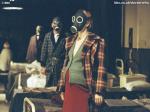 |
| Production Code |
Series One Episodes Nine and Ten |
| Dates |
May 21 and 28, 2005 |
With Christopher Eccleston, Billie Piper,
John Barrowman
Written by
Steven Moffat
Directed by James Hawes.
Executive Producers: Russell T Davies, Julie Gardner, Mal Young.
|
|
Synopsis: It's the Blitz, but there's still dancing to be
done.
|
Reviews
Dark Soldiers by Mike Morris
14/6/05
The single-sentence review goes like this; new shorts please, and at
least I managed not to cry this time. Now for the longer version.
This wonderful story is probably the most memorable of the series so
far. I'm getting heartily sick of praising the series to the high heavens,
but dammit, I just have no other option. Think The
End of the World is good? Bam, have some Dalek.
Think Dalek was emotional? Crunch, have some Father's Day. Think Father's Day had some scary bits? Well here's a
lethal four-year old in a gas mask. Enjoy.
My rational head tells me that, in fact, this story isn't the best of
the series, although it's clearly Very Good Indeed. The End of the World is more imaginative; Dalek is more primal; Father's
Day is more emotionally affecting. Meanwhile this story (which I'm
going to title Shell Shock from here on in, just because I can, and
I couldn't think of a title that went The [something corny] of
[something corny] that didn't sound even shitter) hangs initially from
one hook; that lethal kids in gas masks saying "mummy" is shit-scary. And
fair's fair, it is. Gas masks are intrinsically frightening; I remember
actually trying one on as a kid, and it was a dark, evil thing. It was
almost as if it carried the echoes of the war with it; the fear, the
hatred, the suffering and the pain. Gas masks make us think of people
dying, and really that's the connection.
Still, stories require more than that. There have been the usual
moronic comments that this is "real Doctor Who," i.e. Doctor
Who that Hinchcliffe might have made, but I don't see this as being
particularly similar to any previous story - with the partial exception of
the darker McCoy-era stories. However, I think the one factor that will
lead to this one lingering in the memory - beyond people growing gas
masks, of course - is the two episodes. Having been sceptical about the
single-episode format and then won over, this was a salutary lesson that
ninety minutes can just hit harder than forty-five. Given how much I bang
on about discipline and clarity in my reviews the following may seem like
a direct contradiction, but here goes; Shell Shock benefits because
it's able to digress, to meander, to thoroughly inhabit its setting
(actually that isn't a contradiction, but I'll come to that later).
As Lawrence Miles said in his fascinating review of Rose, ninety
minutes allows you to live in a world, but forty-five can only give you a
view from the window of the bus. We're immersed unapologetically in the
Blitz here, and it works; the production values are outstanding, the
performances are excellent, and while I'm told that the research is a bit
flawed in places I couldn't give a toss. For the first time ever, I
actually felt that I understood what the Blitz was like; I recognised that
it took place in the world I live in, not some parallel universe that only
exists in the memory of old people; I saw how heroic yet banal the
resistance to it was (the guy shouting "Don't you eat?" at the German
planes was a joy). It did what television can, which is make history come
quietly alive. And it was a humbling thing to view.
Steven Moffat's script is excellent, albeit laced with a few flaws that
have been evident in most of his work. Unlike the other guest writers, we
didn't really know what to expect from Moffat; he's a writer who we
instantly associate with Doctor Who, but unlike the others he has
no track record of writing it (unless you count the unfunny The Curse of the Fatal Death, that is). In fact, in
interviews - or indeed, the Doctor Who references in Coupling - his
attitude to the show has seemed cosy and nostalgic, so much so that I was
concerned about his contribution. I've been concerned by a few things in
this series. I've been consistently wrong.
Anyway, it's still got some of the problems evident in Coupling (and
Moffat's previous Cool Show, Press Gang - a kick-ass kid's programme if
ever there was one). Moffat's humour tends to be funny at its core but too
laboured - as with the mobile phone gag early on, the Doctor talking to a
ringing telephone for what seems like ages, and the sonic
blaster/screwdriver argument which goes on forever, all of which are
one-liners extended beyond their means. We also have the Cool American
Rogue as previously seen in Press Gang, and Captain Jack Harkness isn't
any less hackneyed than the six million other Cool American Rogues who've
made it to screen over the years. John Barrowman initially comes across as
the poor man's Tom Cruise, and the scenes between Jack and Rose are a
truly cringe-inducing exercise in adolescent fantasising; that Rose should
suddenly become such a dizzy cow when faced with someone good-looking is a
lamentable drop in characterisation (of course, the women in Coupling were
a pretty lame bunch as well, so it's hardly surprising). She actually
swoons, for chrissakes.
But Moffat's gift is story structure and the way he can expertly build
his stories to key moments, and this is no exception. In many ways
Coupling was the bastard child of Friends and Spaced and it had an awful
lot wrong with it, but its isolated surreal scenes and narrative tricks
were bloody magnificent, and once had the sheer gall to do an episode in
split-screen for crying out loud. This story is an exercise in
crafting tremendous set-pieces, and it does so without them ever seeming
parachuted into the plot; whereas someone like, say, Mark Gatiss
writes stories, this one seems to be more constructed. It has
half-a-dozen brilliant scenes and a phenomenal cliffhanger that all seem
to grow organically from the story, and every set piece and every scene
has something to do with the storyline. It's a highly structured tale,
very self-sufficient, and this comfortably overrides all the predictable
jokes about alien tech and Spock. Oh and all that stuff about dancing,
which I still don't get.
Okay, and on to the setting. It's the Blitz, you know.
Those of us who read Doctor Who books feel like World War Two is
familiar territory at this stage, when the televised series only really
went there once - and then in an artificial, confined way (The Curse of Fenric). But this is the Blitz turned up
to eleven. The story delights in its setting, not in the pastiche-y way
that The Unquiet Dead resorted to, but by
genuinely making its story about the period, rather than just being
set there. The plot revolves around - spot the irony - a warship being
thrown into World War Two, and with this plot device deliberately echoing
the setting Shell Shock manages to express war with graceful ease.
It's about the war in most senses, with a sideplot of repression and
the moral majority thrown in - although even that's related, really. The
entire alien menace here is a simplification of what war is about; take
young, damaged children with no hope, get them healthy, give them the
tools and technology to fight, and turn them into mindless zombies who
kill for reasons even they don't understand. The sight of mute gas-mask
clad creatures stalking the shattered streets of London is frightening
because, quite simply, it's an elegant vision of what war is. It's the
sort of image that Wilfred Owen might write about; it's the sort of image
that could make an effective painting. And the revelations about how and
why all this came to pass are numbingly perfect and frighteningly apt (not
to mention the sheer obviousness of the culprit, flagged at the story's
beginning and still being a gradual shocker when it all becomes apparent).
The direction here is simply top-notch, and it's a visual treat. For all
the places we've seen so far, this is the most alien; dark, dirty,
dripping with club singers and homeless children who are told to observe
their table-manners. The setting is a character in itself, and it's a
complex, fascinating one...
...all the better for the way Shell Shock neatly avoids the
cliche of the morally perfect working-class hero. There are some lovely
atmospheric scenes about the war; the Doctor's "tiny wet island" speech
may be oddly anglophilic for an alien (I'm used to the Doctor being amazed
by humans, but not by the English specifically) but it still works, not
least because of the way its beautifully shot and the way Nancy reacts to
Eccleston's Doctor with tired, miserable confusion. Then there's Nancy's
refusal to believe in the future, which brings home the sheer terror of
the time in a way that no documentary I've ever seen has before. This is
an average anyone who believes that the world is going to end, that evil
is inexorably taking over everything. When she's told to have hope, she
just tells Rose to look around her. Quite.
But all this could have been hammy if it weren't for the way that the
society we see is a picture of tyranny and repression in any case. The
good honest family turn out to be black marketers with a repressed
homosexual at their head. The victims of the bomb-that-isn't-a-bomb are
abandoned without any care, and it's mentioned that everything will be
covered up by blowing up the bloody hospital (possibly a subtle dig at the
health service, backed up by the Doctor's joke about cutbacks and the
welfare state at the end). The evacuated kids return because (it's
implied) they're abused. Every good British staple we see is cunningly
subverted, to the extent that the fundamental plot element is repression
of something similarly unacceptable socially (and still stigmatised today)
- and that's another cracking example of an obvious plot twist that I
didn't spot until a few minutes before it happened. That's the sign of
good drama, where the viewer is misdirected and caught up in the
excitement, and simply doesn't think about who's really who (as in The Deadly Assassin - Goth is the only workable suspect,
but it's still a surprise when he reveals himself, simply because we
haven't been given the time to really think about it).
I should add that, after his woeful start, Cap'n Jack recovers quickly
and I suspect he'll prove a welcome addition. The "last drink" scene is
tacky, but somehow works because of its tackiness, and the scenes towards
the end of Part One are excellently played. The Time Agency sounds
intriguing and it's nicely underplayed here.
Of course, whenever I go on about themes and what have you, it might
seem like I'm overanalysing. Not really (although I do think there's more
going on here than a show produced to frighten kids): it's just that
ultimately, a story that has a consistent theme is just more exciting. The
themes are there as a backdrop, sucking us in so that we'll really shit
our pants for the scary bits, and tying everything together to pack more
wallop than the sum of the parts. And by golly there's some genuinely
frightening stuff in Shell Shock. Richard Wilson (whose cameo is
simply magnificent, and you don't find yourself waiting for him to say "I
don't believe it" for a moment) growing a gas mask will probably be
remembered in the same way as Jo pulling a face off an Auton or the
squirming maggots of The Green Death - the eyes were
particularly creepy. But then there are so many other bits; the gorilla,
the bit where the kid points at the door, the pictures in his room, "I'm
here," Nancy handcuffed to a plague victim, and oh for the love of god the
typewriter. There's great care gone into the incidentals, such as one of
the children remaining terrified at the table as all the others run off.
And any show which has the line "Life's easy, it's just nature's way of
keeping meat fresh" is one to watch. They even delayed the "Next week"
preview after the cliffhanger! Hurrah!
It's very funny too, even if some of the jokes are overextended. The
woman's leg growing back is a hoot, and I must admit that "I'm busy
resonating concrete" has superseded "I'm washing my hair" for the number
one spot in Mike's Deliberately Crap Excuses For Not Attending Social
Gatherings Because He Can't Be Arsed. And while it doesn't seem like much,
I'm very fond of "I like bananas. Bananas are good." Made me laugh.
The performances are uniformly excellent, particularly the wraith-like
Florence Hoath as Nancy, who produces a tour-de-force of honest
vulnerability and gorgeous facial expressions. The kids deserve a special
mention also, recreating the feel of a group of children without ever
seeming stilted - their continual laughing at each other is lovely. The
fact that Part Two is called The Doctor
Dances is either a ludicrously frivolous title or some sort of theme
which I just don't get (although the fact that "dancing" is used as a
substitute for "sex" makes me wonder if we're just being told something...
and also if I've watched the first ever Doctor Who episode that's
actually about shagging). The plot's conclusion is very very moving - I
didn't cry, but I certainly felt, em, uncomfortable - and pulls off the
old trick of making a story's vast tapestry actually just be about a
simple moving drama between two people. The aftermath is played by
Eccleston with customary ebullience, and just made me want to shout for
joy.
Lessons to be learned: Two-parters are great. Gas masks are scary. Oh,
and this is one the best, most beautifully structured and most quietly
morally-driven story of what's proving to be the best British series in at
least a decade. Any questions? Good.
This story is, without hyperbole, something quite wonderful.
A Review by Finn Clark
22/5/06
I like the two-parter which is comprised of The
Empty Child and The Doctor Dances (oh,
for a proper title!). It's good. It's fun. I don't adore it above all
else and I'm certainly not joining the "best story in the show's history"
love-in, but I can appreciate the things it does well.
On the production side, it's almost flawless. Visually it's stunning.
I complained that The Unquiet Dead looked dull,
but this is magnificent. There's certainly nothing flat or empty about
these compositions. I seem to remember hearing its portrayal of 1941
called "romantic" and it is, in that we don't see the horrors of war,
mutilations or other gory things like that. It's a chocolate-box picture
of wartime London, but that's not to say I don't love it. It's skilful,
it's beautiful and even if it's not doing so documentary-style, it still
evokes the period so well that you can almost taste it. The music helps
enormously. Mmmmmm, Glenn Miller.
Also there's more to the visuals than just the nineteen-forties. The
gas mask transformation is horrifying and yet could (perhaps should!) have
been laughable, while everyone was probably having palpitations at the
prospect of so many child actors. In the end they're great. The interior
of Jack's Chula spaceship looks weird, but this is Doctor Who.
Weird is good.
On the script side, I love the fact that Steven Moffat is having fun
with Doctor Who. (That's another thing I'd have appreciated more
of in The Unquiet Dead.) For example, the TARDIS
phone rings. Fantastic idea! It's so simple, yet it's never been done
before, not even in a book or a comic to the best of my memory. Another
example: Captain Jack's sarcastic comments about the sonic screwdriver.
A third example: that wonderful cliffhanger resolution. A fourth example:
the dancing-as-metaphor discussion. There's a playful element to the
writing, thinking completely new thoughts about Doctor Who, which
after all these years is a harder trick than it looks. It surely wouldn't
surprise anyone to learn that this was from the author of Continuity
Errors in Decalog 3.
I like its sense of history. We don't see severed limbs and buckets of
blood, but the script doesn't let us forget that people were dying.
There are also two big flag-waving speeches, the first from the Doctor in
The Empty Child and the second from Rose in The Doctor Dances. I suspect that most viewers
will have found one of them absolutely note-perfect and the other a bit
overdone, but opinions on which is which will vary greatly. These things
are impossibly subjective, but no matter. Personally I love the fact that
the speeches were there in the first place.
Most importantly, this story scared people. A lot, apparently. I've
read a quote from Steven Moffat in which he hypothesised that this story
was scarier for adults because children don't see anything extraordinary
in the idea of another child being frightening. Hmmmm. I'd always
suspected that I was immature beyond my years.
My only niggle with the story is that at the end of the day this is
another simplistic Eccleston-era plot, perhaps even the season's simplest.
The Doctor gets to be more active than usual, as is easier to do in
two-parters, but even so this is a story without an antagonist. There's
no bad guy. There's a monster (the Empty Child), but with him there's
nothing you can do but run away. Nancy is a strong character, Captain
Jack is vaguely entertaining and Richard Wilson makes the most of his
cameo as Doctor Constantine, but had this fallen flat as a horror story
then we'd be seeing a lot more criticism of its structure. That's the
horror genre for you. It's full of stuff which doesn't advance the plot
but is merely there for atmosphere... but fortunately it all works, so
we're happy to keep watching.
Captain Jack Harkness gets some backstory (two missing years with the
Time Agency, whoever they are), but as with certain BBC Book companions,
one tends to judge from the actual character rather than the writers'
guidelines. He's not actually a one-joke character... there are two in
there, but for now they're both pretty good jokes. (Joke #1: smut, smut
and more smut. Joke #2: he's Mr Sci-Fi Hero in a show that's never had
much time for such things.) As with much of Eccleston's season, the
writers have the luxury of having all these things to say about Doctor
Who that the TV show had never previously explored. Now having said
them, in subsequent years they'll have to stretch a little further.
We've never seen a Captain Jack character aboard the TARDIS, which I
suspect is the main reason he's been written and played so broad. He's
making these jokes for the first time. I imagine his characterisation
will have to get subtler when he's the lead in Torchwood, if only because
Joke #2 will no longer apply.
Personally I can't imagine anyone actually disliking this story. I may
find it a little slight, but it's lovely television in so many ways.
It's witty, atmospheric, touching and gorgeous to look at. Oh, and:
"Everyone lives."
A Review by Brian May
1/9/12
The Empty Child/The Doctor Dances is one of the most iconic
stories of Doctor Who's 2005 season, full of images to imprint in
the viewer's mind. The gas-masked child wandering around, and the freakish
transformation of people as the masks grow out of their faces, are the
next in a long line of what the programme does best: scaring the children
and possibly some adults. As earlier tales made an impression on even
casual viewers, who may simply know them as The One with the Mummies or
The One with the Giant Maggots, this will at the very least be remembered
as The One with the Boy in the Gas Mask. The repeated "Are you my mummy?"
will ensure an indelible soundbite to complement the imagery. It's come in
for much critical praise and is the first Doctor Who story to win
the esteemed Hugo Award.
Personally, I think it's overrated.
Don't get me wrong. It's great television and good Doctor Who.
But among the honour roll of best stories ever, it's hardly top 10. Not
even top 20. It's certainly not the pick of 2005 (Aliens of London/World War Three, Dalek and Father's Day are
all far superior). No, I have to bring The Empty Child/The Doctor
Dances down a few notches.
It marks Steven Moffat's official, canonical writing debut for the
programme. His apocryphal spoof The Curse of Fatal
Death was clever and funny, and his non-Who body of work is
very impressive. It starts off well, with two separate and contrasting
strands: the suspense and horror element of the masked child; the sci-fi
angled presence of Captain Jack and the mysterious object the Doctor and
Rose are following. The horror base provides some unnerving moments: the
police box telephone ringing, the toy monkey coming to life and every
encounter with the eponymous child, whether visual or aural. But the
merging of the two at the end is a little unsatisfying. It's a malaise
common to Doctor Who: a sci-fi resolution can sometimes be a
fizzer. The atmospheric build-up simply becomes an unseen alien race with
convenient technology. Despite some clever ideas (the explanation behind
the gas-mask faces) and some good moments (the tape running out, for
example), the second episode is largely a runaround.
I have further issues on the scripting front. Jack informing the Doctor
and Rose he's really a conman occurs just before the cliffhanger. This is
exactly the wrong point; it would have been better to leave it until the
second episode, during one of the quieter moments the trio share. It would
have left some mystery about him hanging in the air during the week's
break. The Doctor's speech to Nancy re the British is incredibly
parochial; yes, he's gushed about humanity as a species, but not a single
country. Thankfully, it avoids being jingoistic, but it does smack of
patriotism a Time Lord shouldn't have (and has never displayed
previously). But what I really don't like is the whole Doctor dancing bit.
A section of the script so obviously analogises dancing to sex, or at the
very least a sexual awakening. I know that, by the rules of 21st century
character-based series television, the Doctor will be a more sexualised
individual, if only in terms of attraction. No problem, I can accept this.
There will be sexual tension, but being the Doctor, it has to remain
unfulfilled; that can't and won't change. So why bother with any of this
dancing nonsense? Is the Doctor's sexual awakening meant to be
metaphorical only? But even if so, what's the point?
(Am I reading too much into this? Do I need to get out more? Probably
both. Anyway, I don't like the second episode's title, nor the actual
dancing scene.)
However, the best thing about this story is indeed a sexualised one, in
the form of Captain Jack Harkness. This charming, suave and sexually
ambiguous hustler steals the show, unforgettably brought to life by John
Barrowman. I've listed some scripting problems, but now I'm going to
mention one of the triumphs: Jack's recollection of his executioners. It's
hilarious, and proof that Who can now be risque in its dialogue
without compromising itself as family entertainment. It's wonderful to see
him join the TARDIS crew at the end. Barrowman is the highlight, but
Florence Hoath also deserves a special mention as Nancy, so too Britain's
ultimate grumpy old man Victor Meldrew (aka Richard Wilson), a great actor
who unfortunately has too little screen time. I haven't mentioned
Christopher Eccleston or Billie Piper yet. Normally when I have, I've
praised their performances to high heaven, and when I haven't it's been
more a condemnation of a dull script than their acting (e.g. The Long Game). I'm going for the middle ground
here: they're good, but not spectacular. They put in their usual solid
efforts, but nothing stands out. The possible exception is the charming
moment as the Doctor chats with the children at the dinner table, but
that's about it.
The story looks terrific, but that's a given thanks to the design, the
costumes and this era of CGI. The incidental music, in the first episode
at least, is wisely kept to a minimum, letting the eerie feel tell the
story. It's more prevalent in the second episode, and Murray Gold's
tendency for the bombastic returns. However, the use of Glenn Miller tunes
makes up for this; they're inspired choices that match their scenes
perfectly.
The Empty Child/The Doctor Dances is by all means enjoyable, but
it's nowhere near brilliant. It's not even very good. It's merely quite
good. But given some of the year's previous outings, that's almost a
disappointment. 7.5/10
Everybody lives, Rose. Just this once, everybody lives!
by Evan Weston
12/7/13
When I watched this the first time, I didn't really know what to think.
It was at times extremely graceful and poetic, at others clunky and
disorganized. I could see why everyone loved it, but I felt a bit chilled.
Watching it back a second time, having gone through the entire new series,
it's a meta-experience unlike any other watching this show.
You see, in its 84 minute running time, The Empty Child/The Doctor
Dances manages to pack just about every Steven Moffat cliche into one
episode.
It's all here. Every trope Moffat has ever used, every quirk he has
ever written. The entirety of the Matt Smith era, the basis for all that
is Doctor Who today, is contained right in this two-parter. I just
watched Christopher Eccleston deliver Matt Smith dialogue. How easy is it
to picture Smith dancing with Karen Gillan's Amy Pond while trapped in a
zombie-infested hospital during the Blitz? How easy is it to hear Smith
respond with "good source of potassium!" when asked about the banana?
You've got the Rory element (on a lesser scale) with Captain Jack
Harkness. There's even, for the first time in new Who, the
misunderstood villains who aren't really evil - a trope that would quickly
become a Moffat staple.
It's so difficult to review this episode because it would fit so
perfectly into either Series 5 or 6. Going back, I thought it was the most
ambitious story of Series 1 that ran into itself a few too many times
along the way. That's still true, but that's true of virtually every good
Moffat story in his first two seasons - excepting The Eleventh Hour, A
Christmas Carol and The Girl Who Waited. This isn't an Eccleston episode at all. Hell, half the time, Eccleston is playing the
Eleventh Doctor. It's actually uncanny.
However, I'm going to do my best to review The Empty Child/The
Doctor Dances on its merits - and there are many. For one, the mood of
the blitz is achieved brilliantly. Doctor Who doesn't always
capture the essence of the time period in its historicals, but the two in
Series 1 (this story and The Unquiet Dead) both do
a marvelous job bringing their respective eras to life. 1941 London feels
like 1941 London, and even if the CGI Luftwaffe isn't totally convincing,
the environment still feels like a dark, dangerous city. It also gives the
episode a tremendous sense of scale that was fleeting in the early parts
of the Davies era. You often forget that the entire episode happens
roughly in real time on just a few blocks of London, because it feels like
such a monumental story. Moffat's script and the longer running time both
do a good job assisting in this, but the production design is the star.
That's not to say everything else is weak. The acting is pretty good
throughout, too. This is one of Eccleston's better performances, even if
he is playing Matt Smith for solid chunks of the episode. When he gets to
be Eccleston, he's on top form - his reaction during the climax is classic
Ninth Doctor, and you believe his poor reception of Jack is half-mistrust,
half-jealousy, because Eccleston sells the balance so well. Still, there
are so many things the character does in The Empty Child/The Doctor
Dances that are so Smith. The Eleventh Doctor would have popped up at
the dinner table and taken two slices of meat. The Ninth would stand
disapprovingly in the doorway. The Eleventh Doctor would have awkwardly
tried to dance, swearing up and down that he once knew how. The Ninth
would have said a curt "no" and we'd move on. Moffat's attempts to inject
his own spin on the character end up falling a bit flat, but that might
just be due to our familiarity with Matt Smith's version of the Doctor.
It's possible other writers change the character, and we don't notice
because we haven't seen two-plus seasons of their work.
Oh, right. The acting. Billie Piper is up and down in this episode. She
tends to oversell the blushing in her scenes with Jack, coming across as a
teenager who just danced with a hot man for the first time. However, her
more serious moments work, and her best scene in the episode is her
conversation with Nancy while they mend the barbed wire. You can see
Rose's transformation from shop girl to savior at work here, as she adopts
the responsibility of a time-traveler with a woman who sees no hope.
It's the guest stars who are begging to be talked about here. John
Barrowman makes his debut as the immortal (quite literally) Captain Jack
Harkness, and while I've come to love the character over the years, he's a
very rough outline here. Barrowman doesn't seem sure of himself. He isn't
quite as comfortable playing a self-assured space captain as he is a
desperate con-man on the run, and it's nice to see that the writers chose
to go with the latter in the final story of the season. It gives the
character a nice redemption arc. But in this story, Barrowman's
performance is uneven. The line delivery is flat at times, and he never
really steals the show like he's obviously supposed to. I do have to
credit both Florence Hoath and Richard Wilson for wonderful supporting
turns. Hoath's Nancy is great, both determined to help and utterly
terrified of what she's lost. The character's ultimate redemption at the
end of the episode is a touching moment, even if the plot twist is
predictable. Wilson really only gets one scene, but he's totally
captivating in his minor part. Plus, let's face it, the most memorable
moment in the entire story is when Dr. Constantine's face turns into a gas
mask. "Mummm... meeeee..."
Speaking of, how creepy are those things? Here we are with that
oh-so-common Moffat device - the villains who aren't actually villains.
Like the clockwork robots, the Vashta Nerada, the star whale and the
Androzani trees before them (and those are just the episodes he wrote
himself), the gas-mask zombies are pretty scary monsters that are absolved
of all responsibility for their crimes by the end of the episode. Still,
the kid saying "Please let me in, Mummy" is really unsettling, and this is
the scariest episode of Series 1 by a comfortable margin. The way Jack's
nanogenes are worked into the plot is really clever, and the main story
works nicely as a horror story and as a domestic drama between sister and
brother (or mother and son).
The Empty Child/The Doctor Dances is a fascinating preview of
the Moffat era, and a pretty good story in its own right. There are so
many stories over Series 5 and 6 that have an insanely similar feel and
arc, some written by Moffat and some just edited by him. But Moffat is
pretty good at what he does, and while this isn't one of the strongest
stories in an exceptionally strong season, it's still a really good
exercise in mood and tension with some really nice guest appearances and
brilliant production design. Let's just be thankful that Steven Moffat got
a chance to write a few more episodes of Doctor Who.
GRADE: B+
Curse of the Mummy by Kaan Vural
14/5/14
Well, we've reached the end of a third year of Steven Moffat as
showrunner. Coincidentally, I just started rewatching the New Series after
showing my girlfriend Blink got her interested. So
I've found myself gravitating towards Steven Moffat's RTD-era episodes,
comparing the man as a writer to the man as a showrunner - especially
since I think I liked him a lot more as a writer of one-off episodes than
as decider of the show's creative direction. So to kick off a minor
retrospective, I'm starting with The Empty Child/The Doctor Dances.
Or Shell Shock, I suppose - a much less clunky title to work with
(copyright Mike Morris).
I'm currently rehearsing for a production of Oliver! in which I play
Fagin, coincidentally reprising the role from about a decade ago when I
played him as a fifteen-year-old in high school. One thing that struck me
upon rereading the script was how twisted and dark much of the story is.
Nancy, the former child prostitute; the young thieves who are kept loyal
with alcohol; Bill Sikes the alcoholic woman-beater; Fagin the vaguely
pedophilic old coward. And yet parents volunteer their children to play
roles in it! What shocked me more than any of the content was how
efficiently we all process it out of our minds, both as children and as
adults exposing our children to the material. Part of it is just that
today's parents are, well, rather thick about certain issues, but there's
also the fact that much of it is told through implication.
In fact, I wouldn't be surprised if Oliver Twist was a substantial
influence on this story, down to the moral fulcrum being a
conscience-ridden woman named Nancy who committed sexual impropriety at a
young age. (And funnily enough, Bart's next musical after Oliver! was a
family tale set in the London Blitz and drawing on his own childhood
memories.) This is a better Dickens story than the actual Dickens story we
got half a season ago!
But the point here is that Moffat, writing this two-parter, understands
the same thing Lionel Bart did in composing Oliver!: that good
storytelling lies as much in suggestion as it does in explanation. One of
Shell Shock's greatest strengths is that so much of it is told
through suggestion.
For instance, the way it looks. Something which surprised me about this
story is how well it's aged visually. The 2005 season looked bloody
brilliant to those of us weaned on Classic Who, but even it's
started to look a wee bit dated in the cinematography department when you
compare it to the high-definition era. Not so with this two-parter. It's
actually a weird trend I can't get my head around: writing aside, the
Moffat-penned episodes of the RTD era just look better than all the stuff
around them. This story makes great use of contrast between the blue,
lightless night and the orange warmth of shelter. The Doctor "e-mailing
the upgrade" by spreading the yellow-orange glow of the nanogenes through
the air takes on a whole new level of magic with the color scheme.
The characters are painted in colors as well. In this dark time, Rose
wears bright Union Flag colors and dyes her hair blonde, suggesting the
bubbly naivete of a girl who believes this world has a future. Jack
Harkness's dark, shiny hair and clean, gray uniform suggest an officer's
detachment from the front lines and the true horrors of war - appropriate
enough considering it is Jack's unthinking actions that cause the plot.
And of course the Doctor's black, slightly brutal attire suggests the
opposite of both: a man robbed of innocence and a man who fights on the
front lines. (It's also something of a visual inversion of the Chula
warship - the plot is driven by an ambulance that kills, and our male lead
is a Doctor who killed.)
There's nuance to their appearances and the way their appearances
interact with the world. Jack compares the Doctor to a U-Boat captain -
perhaps a better comparison than first meets the eye, when you think about
the cynical and war-weary sailors of Das Boot. Not a throwaway comment,
but an organic if indirect evaluation of the Doctor's character in the
context of the story. Rose's colorful attire makes her a prime target
during the Nazi air raid. Jack deduces that the Doctor and Rose are from
another time period based on what they wear. The 1940s attire is the first
substantial clue we get to the setting of the story before we're told it's
the London Blitz. The Doctor notes that Nancy is older than she looks;
part of that is the way she braids her hair, more characteristic of a
schoolgirl than of an adult woman. Obviously it's the job of a decent
costume designer to help bring a script to life, but this is one of the
few episodes of Series 1 where I feel like Lucinda Wright actually had the
writer on speed-dial. The costumes work with the script and the script
references appearance. I love that kind of harmony in storytelling. It
does a lot more to make a story feel real than good SFX.
In fact, this is an example of a story that's quite high on effect
without being high on special effects. The grainy quality of 1940s audio
equipment, the silhouette of the child in the glass of a front door, the
synchronized motion of the hospital patients; these are integral to the
horror, but none of them take so much effort as they do creativity. Horror
is so often at its best when it works with simple tricks of lighting and
choreography: the unseen motion of a Weeping Angel, the repeated speech of
the entity from Midnight, the boneless march of
the scarecrows in Human Nature. Much of the
horror here works because it works with simple elements: shadows,
repetition, delayed response. These may not be CGI, but they are effects -
an important distinction lost in more derivative work like The Lazarus Experiment.
Weirdly, when it comes to the actual dialogue, I'm a bit less enamored
of this two-parter.
Steven Moffat's dialogue is still something I struggle to understand
from time to time, composed as it is of an odd mix of easy wit and of
trying too hard. As Evan Weston pointed out, a lot of the Doctor's
dialogue sounds at least as comfortable, if not a lot more so, in the
mouth of Matt Smith. Certainly Moffat has certain habits that have become
a lot more visible over time. We get repetition of basic observations when
the Doctor says the TARDIS phone isn't a real phone three times, we get
the first iteration of a decade-spanning running joke about a screwdriver
not being cool, we get our rogueish love interest character spouting
innuendo, we get the Doctor being awkward about sex. It's all funny and
good when it's done here, but I don't think I've met a running joke in
Doctor Who that didn't wear out its welcome too long before it was
retired and the rewatch suffers a bit when you know you're still going to
be hearing half the jokes in six years' time.
We've also got essentially the first seduction in New Who,
and... well, I'm not sure what to make of it. John Barrowman not being my
type I don't quite connect with Rose's stammering reaction to how gorgeous
he is, but then again my girlfriend liked the hell out of him and she's
got a good deal more common sense than Rose does, so... um? If nothing
else, it's a hell of a lot better than Ace seducing a soldier in the
thankfully brief low point of the otherwise excellent Curse of Fenric, and I think we can forgive a bit of
ham-handedness in these early days.
There's a degree of patriotism here that confuses me a little:
specifically, the Doctor's mini-speech to Nancy about the "little island".
Admittedly the Doctor tends to back the underdog, but would the Doctor
with his better understanding of the context be so ready to compliment the
British? The Soviet defense against Operation Barbarossa was probably a
lot more important towards wearing down the Nazi war effort than anything
the UK did, but it's not terribly likely that we're going to get the
Doctor making the same speech to a widow in Communist Stalingrad, is it?
My point is not so much that the Doctor thinks of the British war effort
as necessary (which it was), but that the Doctor's sympathy should be with
the little man rather than the national spirit largely drummed up by
monarchism and government propaganda campaigns. Perhaps he's trying to use
language Nancy would be more receptive to, but it still comes across as
out-of-character to me, in the way that the Doctor's later relationship
with Winston Churchill comes across as too comfortable given their very
different ideals on certain issues.
On the other hand, there are some inspired moments. The Doctor joking
around with the street children is a wonderful, warm moment, suggestive of
Bill Hartnell's remodeling of the paranoid and standoffish First Doctor
into a warmer and more caring fun-grandfather role. Nancy is brilliantly
written, showing humor, strength, vulnerability and despair - often in the
same scene - without ever feeling like a caricature. Doctor Constantine is
a wonderful character, straight out of the Bob Holmes book of understated
hilarity - casting Richard Wilson was a stroke of genius. "Dying, I should
think, I just haven't been able to find the time" instantly reminded me of
Organon's "I'm sorry I haven't died yet, my Lady, it was an oversight". I
adore dry wit and there's just not enough of it in Doctor Who these
days, don't you think?
My main sticking-point in really loving this episode, though, is in how
it treats the Doctor's sexuality.
I don't have anything against the idea of the Doctor having a sex life,
though I'm not really interested in knowing about it. My issue is that the
story sort of withdraws from saying anything definitive or clear about the
Doctor on the subject. OK, so the Doctor knows that sex exists; he had a
family, so we can assume that he probably did something resembling human
sex at one point. Now that's all well and good, but that applies to
basically most people on Earth, surely? So why was there this apparent fan
reaction to the Doctor telling us he's been around the block? My take is
simply that TV Who was usually (not always) so sex-starved that it
took on a chaste and bloodless impression in the heads of most fans, so
that even the slightest mention of sex around the Doctor caused a
disproportionate response. But measured in more objective terms what's on
display here is hardly that daring. Really, it doesn't go far enough.
Based on Nancy's story, I assumed we were going to get something from
the Doctor grieving over his children - not necessarily in the Time War,
but even just from his choice to start traveling. This is a question I
almost never see asked: taking on face value that Susan is the Doctor's
granddaughter, what's the story with the wife and children he abandoned
for a life of exile? Did he love them? Did he resent them? I would think a
Doctor who lost his family in the Time War would have profound regret that
he abandoned them all those years ago and never really stopped by to say
hello. Instead we get an - admittedly very cathartic - expression of joy
that "everybody lives". Which is all well and good, but it lacks a certain
something.
Others have of course scratched their heads over the title of the
second episode, and I have to agree. "The Doctor Dances" - well no, not
really. I mean, there's no one in this episode to whom he expresses sexual
attraction, no one he even falls in love with. It's a title more suited to
Moffat's Series 2 offering. Structurally it works a tiny bit better if you
think of dance as a metaphor for having a family rather than just
boinking, but who on Earth would think that that was a good and intuitive
comparison?
There's also the rather uncomfortable placement of this episode. The
previous story, Father's Day, is setting up the
Doctor as an alternative father-figure to Rose. Really, most of the season
has; Rose is a child without a father, and the Doctor is a father without
a child. So what am I supposed to make of a scene in which a father-figure
"dances" with our protagonist? Isn't that a bit... well... off? This is
something I could see working with a character like Reinette, who loves
the Doctor but in a romanticized way; with Rose, the deadbeat teenager, I
can't help but feel a bit dirty inside. Imagine the Seventh Doctor having
a sexual relationship with Ace. Or, better yet, spare yourself that
horrible image and just agree with my point already.
This part of the story bothers me because it's a loose end in a tale
that resolves by simplifying. The climactic sequence in which the Doctor
tells Nancy to go to her child is all the themes of the story in
microcosm: the loss and gain of family, sexual conservatism, the horror of
war, the survival of innocence in dark times and the acceptance of
consequence. It works because it takes all ninety minutes' worth of
characters and subplots, and summarizes them in such a way that the viewer
can grasp it all at once. It operates on the same logic that gives the
sentence "there are more atoms in a grain of sand than there are stars in
the sky" an elegant poetry in its comparison of scales. But it's marred -
for me, on later reflection - by the fact that the Doctor is actually one
of the less well-developed characters in an episode that bears his name.
Eccleston gets some range in this story, but I learned more about his
character in the five seconds where Jabe holds his hand than I did in all
ninety minutes of this story.
And really, wasn't that moment a better visual shorthand for the
Doctor? An alien holds his hand as his eyes fill with tears. Coming from a
man who seemed filled to the brim with cynicism and misanthropy, that
moment had punch. But when the Doctor dances, I don't really know what to
make of it at all. That's the danger with suggestion, of course: keep it
too vague and you risk losing track of what you're actually trying to say.
But let's not be churlish. This is not really a story about the Doctor
or Rose; it's a self-contained story which happens to give context to
their characters. So really these complaints are more about incidental
details that aren't vital to what really makes this episode work.
Early on in this review, I called this two-parter a Dickens story, but
really it's about as Whoish as a story can get. The conflict at its
core is about facing your fears, a theme that goes all the way back to the
time when two abducted schoolteachers first stepped out of the doors of
the TARDIS and into a harsh, alien world.
Final verdict: nearly a decade on, Shell Shock is still a thing
of beauty. The word "classic", to my mind, means two things: a story that
impresses even years after it was made, and a story that will reward you
for rewatching it. Revisiting Moffat's first TV offering with a new fan
was a joy, not just for vicariously recapturing that feeling of absolute
wow!, but for throwing up all these little details that missed my
conscious brain the first time around. I have no doubt it's a story I'll
cherish for years to come.
"Be careful what you wish for" by Thomas Cookson
4/11/16
I've felt a need lately to chronicle Moffat's incomprehensible decline as a Who writer. Thus it's necessary to start at the beginning.
The Empty Child/The Doctor Dances. The story that first secured Moffat in fan's eyes as the show's great white hope, at a time when farting Slitheen already left many of us regretting placing our faith in Russell.
The first time I started watching this, I wasn't impressed. After the solemn grittiness of Dalek and Father's Day, this rather nudging meta-Who comedy was rather too off-beat for me, and it still strikes me as Eccleston's most anomalous story.
RTD had definite ideas how the show should play to the masses to be a success, and he heavily rewrote nearly all his guest writers' scripts to make them more homogenously modern, populist and sentimental. But Russell said he never felt need to do this with Moffat's scripts, as they 'got' the zeitgeist and needed no amending, so he would leave them untouched. This is rather glaringly obvious when watching The Empty Child/The Doctor Dances.
Rose's character here alternates between a Star Trek fangirl trying to tell the Doctor how it's done in her favourite show and the classic dumb blonde who gets all easy and swoony over Captain Jack. This is at odds with Rose's usual level-headed self, and seems more suited to the character of Izzy or Sam Jones or Emma from The Curse of Fatal Death.
Secondly, there's the Doctor being shocked by the TARDIS ringing. When Moffat wrote this, he probably wasn't expecting RTD's World War Three would have the Doctor reveal his TARDIS had a landline phone. Unfortunately, this means that, when the TARDIS phone rings, the viewer assumes it's Rose calling him back from her mobile, desperate to be rescued from the balloon she's dangling from. We're eagerly expecting the Doctor to rush to answer it and leap into action.
That he's instead baffled by this as though it's never happened before winds up making little sense in this context and demonstrates how RTD and Moffat Who are pulling in completely different directions.
Now there's a tendency of Moffat's writing to sometimes have such deliberate authorial intent that the viewer becomes all too conscious of the writing and stops believing its fiction. The more misjudged the intent, the worse the effect. The nadir of course being Death in Heaven's teaser where Clara tries to fool us out of the blue that she's been the Doctor all along.
But whilst this rather meta, misjudged scene plays consciously with the idea of the TARDIS doing something we long-term fans know it shouldn't, it doesn't quite break the fiction.
The performances of Eccleston and Hoath are so strong, giving the scene real conviction, and bafflement is the intention either way, but the story's done enough to ensure we're still intrigued. The story has us, and this scene can't shake us away once we're hooked.
My initial problem was with Rose dangling to her death from the balloon. I wanted to savour the suspense, but the action kept repeatedly cutting away elsewhere, leaving her in sustained peril, then returning to her still evidently hanging on. As though her safety could be taken completely for granted off-screen. Thus far, the new series hadn't done that before. Previously, when Rose was in danger, it felt real and vivid, and we were with her every step. The only time we'd cut away whilst she was in mortal danger before was in Dalek, in a moment which implied she'd been killed instantly offscreen, and back then we genuinely believed it. The show had never taken her safety for granted before, and it was frustrating that it should do so now. I mean why bother establishing such high stakes to begin with?
This I think illustrates the problem with Moffat. Even with RTD giving him free reign as a writer, Moffat still had other limitations that in hindsight made him a better writer.
Moffat is aware here that the season's budget will only stretch so far for this one story. When he has full reign of the budget all season, we'll see careless missteps of overspending in the likes of Let's Kill Hitler and The Wedding of River Song, which indulge extravagant settings to no real storytelling purpose.
This story works when it's written almost to suit Classic Who's limitations. It only needs the BBC's historical wartime sets and costumes department and lots of gasmasks, and it'd be just as creepy and effective for it. So, tellingly, the most problematic moment, which could've easily been cut out and reworked with something simpler and cheaper, is the big bombastic special effects moment.
The other limitation was that, under RTD, Moffat was only the master of these characters' fates for an episode or two and then could do no more with them. One time we may have wanted to see more of Nancy or Sally Sparrow. But, in hindsight, seeing what a pig's ear Moffat made of River Song as a recurring character, maybe we're better off. Thus Nancy remains the best companion the Ninth Doctor never had, and they share some of the show's best and most warming Doctor-companion interplay. Nothing since has tainted that.
So this is almost a microcosm of Moffat's style and era but compacted nicely into a mostly winning recipe. The main plot and intrigue is strong enough that the story can afford to be indulgent with Captain Jack and his shameless flirtations with Rose. If those moments entertain you, the story's enriched by them. If they frustrate your patience and you find yourself tuning out during them, you need not worry because, rest assured, when the story returns to the main plot, it'll quickly hook and involve you again. Besides, Captain Jack proves to be too important to the plot to imagine the story working without him. The problem becomes when Moffat masterminds seasons and the space between tacky indulgences and simple, involving storytelling becomes unbreachably vast.
There's much here that Moffat managed to get away with at the time that he probably wouldn't have by Series 6, when tumblr feminists and social justice warriors in their consensus of crazy declared war on him. I was actually on a feminist forum at the time, and this story went down extremely well. That Rose suddenly becomes a swoony and babbly dumb blonde over a man as lecherous as Captain Jack didn't seem to offend and indeed amused them.
Moffat managed to pitch this just right, so that even women who knew better recognised an affirming kernel of truth in Rose's cringey lovestruck behaviour and could be self-depreciating and laugh along with it and let their hair down about it. Implicitly understanding that if watching this from an uptight position, you're doing it wrong. It doesn't hurt that Billie Piper's clearly enjoying the hell out of this.
It is almost the Scream of Doctor Who (to RTD's cartoonish Freddy sequels). A love letter of knowing pastiche with an excess of in jokes that ironically somehow brings the franchise closer to its roots and its prime.
This story has been talked of as this generation's The Talons of Weng-Chiang. Possibly by design and intent by Moffat or because Moffat can't help being a conduit for our own shared fan memories of Hinchcliffe's era. But at times the magic that makes this a classic seems completely of its own. That it works without anyone trying too hard and that this was written in innocent ignorance of just how successful it would be.
Unlike Scream, its parody never seems meanly meant, and it's not sociopathic in tone. It's immensely affectionate to the show and the Doctor's morality and written with heart, without being insufferably sentimental or maudlin.
The problem with Scream ultimately is it's all gimmick, and when that's stripped away, there isn't an interesting plot or story there. The beauty of The Empty Child/The Doctor Dances is it's actually a coalescence of interesting stories. Captain Jack's story. The story of Nancy and the boy. The war itself. Even the story of Dr Constantine, having to man a crumbling medical facility alone and deal with this strange plague. All fitting snugly into the runtime without being stretched too far, outstaying their welcome or ending abruptly in ways that leave us short changed.
Again, fast forward to Let's Kill Hitler, where nary an interesting story to be told exists (at least not one that's been told umpteen times before), or if it does, the episode seems to have no interest in telling it with any lucidity, and what happened?
But in the battle for writer's supremacy between RTD and Moffat, let's consider the ending. To be honest I'd already guessed that the nanites would be revealed as the reason for the Empty Child's condition, and I'd begun to suspect the truth about Nancy, but that doesn't diminish anything. I do think the climax tries a bit too hard to establish a ticking clock and a world-ending peril, in a slightly confused way. If the site is due to be hit by a German bomb, taking the zombies with them, then surely the threat and menace is at least postponed rather than accelerated. But, nonetheless, the ending is beautifully done.
I've tried to excuse The Parting of the Ways' deus ex machina ending, but I don't think I can anymore. And comparing it to this resolution demonstrates why.
There are admittedly times I do miss RTD's exhilarating energy and hunger for this show. Except when it comes to moments like God-mode Rose having swallowed the time vortex. Those are the moments where RTD honestly seems to assume that as long as he has the budget for it, he can just let the special effects do the storytelling for him and treat it as 'this'll do'. So we get CGI fairy dust allowing the characters to suddenly do or undo anything and everything they want.
So why does this story's ending get a pass when you can complain it's the same thing? Well, because it isn't the same. What happens is characters afflicted by a bizarre life-sustaining plague are cured back to normal health by the same technology that transformed them. No one was transformed into a ridiculous state of all destroying God-hood.
Watching Nancy approach the child, there is a sense of very human vulnerability to her and that she is having to be very brave here. Terrified of what might happen to her if this fails and terrified of the shame of admitting she is his mother and if he might be upset with her for it. The courage matters because everything's stacked against her. The victory matters because it almost didn't happen, but someone dared to try.
With God-mode Rose, all she was expecting to do was return to the Doctor and take him away to safety. The bonuses she gains are ridiculous and make this too one-sided. There was eventually the danger that she might burn her head up, but by then most of the advantages and victories made that seem almost like small potatoes. The balance was just that skewed by the unlimited powers she'd achieved, and there was no trusting the writer wouldn't overstep the boundaries again and produce a miracle cure for that too against the rules.
Maybe we were proven mistaken eventually, but Moffat here seemed clearly more the writer to trust. Unfortunately, we now know Moffat was writing here with the stabilisers on. Whilst Moffat could trust Russell to worry about making this once tainted, nerdy show and its hero appeal to the masses, he could concentrate on writing a clever, self-contained, original story that channels enough DNA from Hinchcliffe/Holmes to appeal to all ages and create a terrifying new foe that realistically should've made the Cybermen's 2006 return already redundant.
With those stabilisers removed, Moffat's shame and anxiety about the show's stigma runs so rampant that he's compelled to keep rewriting chunks of the Doctor's history and changing so much at once that it's increasingly impossible to care.