THE DOCTOR WHO RATINGS GUIDE: BY FANS, FOR FANS
| Episodes |
4 |
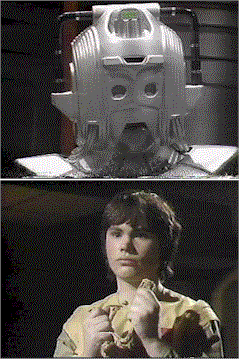 |
| Story No# |
122 |
| Production Code |
6B |
| Season |
19 |
| Dates |
Mar. 8, 1982 -
Mar. 16, 1982 |
With Peter Davison, Matthew Waterhouse,
Janet Fielding, Sarah Sutton.
Written
by Eric Saward. Script-edited by Anthony Root.
Directed by Peter Grimwade.
Produced by John Nathan-Turner.
|
|
Synopsis: A deadly plot is set into motion on 25th century Earth by the Cybermen,
where the Doctor is thought to be a conspirator.
|
Back to page one (the first twenty
reviews)
Reviews
A Review by Will Berridge
29/8/03
Earthshock's first episode begins in a more than typical fashion
for a season atypical of the traditional DW format. We have an
argument between two members of the TARDIS (The Doctor and Adric on this
occasion. It's normally two of the Doctor, Adric and Tegan, not Nyssa who
just stands aside thinking 'It's all rather silly, isn't it?'), and
plentiful references to previous stories, including Full
Circle, Warrior's Gate, Logopolis and Black Orchid. These
represent an attempt to introduce to the series two concepts which
previous writers had not seen as necessary to guarantee success;
continuity and soap. The new focus on continuity (which remained till the
cancellation) isn't something that particularly irks me, even though I'm
someone who tends to take a hop, skip and a jump through DW
chronology when choosing what to watch. Only one of them is completely
superficial in any case, (the Doctor reading the Black Orchid), the rest
being pertinent to Adric's return to E-Space (though this is a bit of a
red herring in itself, in plot terms, just serving as an excuse to get
Adric hacked off.) Worryingly, however, concern for continuity does seem
to be indicative of a greater emphasis by the writers to make the show
more 'realistic'. This does seem to be why the other novel aspect of
Season 19 which does perturb me, that is the increasing attempts to turn
my favourite SF show into a soap opera, originated. In my mind SF and
Soap, as forms of drama, have two entirely different prerogatives. Soap is
all about the trials and tribulations of everyday, real, life, SF is all
about escaping from the depression of reality into an SURRealistic
universe of time-travelling Police Boxes. If I wanted to see a teenager
year-old whinge about not being paid attention to, I'd watch Neighbours. I
don't.
Anyway, fortunately this only ever happened in Season 19 DW,
being a far less prevalent approach than in American SF series like Star
Trek other trashy modern SF. Even here it only causes 10 minutes of
torture at the start of the episode, so this minor rant aside, I don't
completely hate Earthshock. In fact I disagree with quite a few of
the criticisms the Post-modernists have made. For a start, The Discontinuity Guide complains 'Emotional concepts
expressed by the Cybermen include betrayal, vengeance and cruelty.' This
strikes me as a trifle unfair. Why?
- The Cybermen express a perfectly logical motivation for their cruelty
towards Tegan and the other Humans - they are conducting, as the
Cyberleader put it, a 'scientific' analysis of illogical human emotional
weakness, such as the pain they suffer when forced to watch their home
planet be destroyed.
- The Cybermen only take revenge on Ringway because they think he has
betrayed them and is hence both useless as an informant (he's pretty
useless in this capacity anyway since they have captured the ship by this
time), and likely to betray them again. Nothing illogical about that.
Their reasoning for thinking he has betrayed them is rather irrational
however - they seem to know enough about the TARDIS, so why couldn't they
have guessed the extra troopers came from there?
- And most importantly of all, the Cybermen WERE human once, and
perhaps a vestige of human spirit remains within them. Just because the
Cyberman like to think they are a 'master race' not weakened by emotion or
illogicality doesn't mean they actually are. Or perhaps they even
recognise from having been human, that irrational human behaviour
sometimes has beneficial consequences. (Both Davros in Destiny of the Daleks and BOSS have shown awareness of
this previously.)
That said, the cyber-voices are less effective for not having the same
spooky, monotone quality of those of Tomb and Moonbase. The Cyberleader, though he's quite
well-acted, has a nasty tendency to get too excited whenever he talks
about 'great triumph's for the
Cyber-race. Still, the new costumes are impressively detailed (apart from
the foil of course) and the spine-tingling Cyber-March music makes up for
the voices.
The plot, specifically in terms of the cyber-planning, also seems to
have been criticised somewhat over-zealously ('good.for a first draft' is
The Discontinuity Guide opinion), and makes sense to
me. Till the final episode, anyway, where I get completely lost. Anyway,
to respond to some of the complaints:
- 'Where to the Cybermen evacuate to?' (The DC
guide)- does it matter? A cybership somewhere, I presume.
- 'What'll happen when 15,000 Cybermen land on Earth?' (The DC Guide + Ari Lipsey) As His Flippancy stated,
they're to mop up survivors.
- 'If they could arrive in secret to plant a bomb, why are they going
to such trouble now?' (The DC Guide) They probably
didn't plant the bomb themselves, they probably used human agents like
Ringway, who smuggled it in with the androids. Anyway, they're probably
going to such trouble because the peace conference they want to target is
about to occur and they probably don't have time to repeat their more
elaborate plan A. It's explicable!
- 'Why not kill the freighter crew, who are bound to have a go at the
controls?' (The DC Guide) Because the Cybermen want
to study them suffering a prolonged death (see point (a)), and are so
cocky and irrational (see point (c)) that they are convinced the crew have
no possible chance of altering their fate. It's only because they had a
mathematical genius (Adric) handy that they came close.
- 'Why leave several of the crew behind on the freighter, some of them
still dormant?' (The DC Guide + Ari Lipsey). The
freighter was not originally intended to crash into Earth, this only arose
as a contingency plan, and hence the Cybermen hadn't prepared for the
eventuality of having to evacuate them all. Besides, they're not supposed
to have any feelings, so what do they care if a whole 1000 Cybermen die
when a whole planet of Earth People and interstellar delegates are wiped
out?
- 'If the Doctor wants to convince the crew of his credentials, why
doesn't he introduce them to the high ranking military officer he has
brought with them?' (The DC Guide). Because he's in
the TARDIS. Which Ringway won't let him show them to.
Phew. The one bit I really don't understand is how the freighter travels
back in time to destroy the dinos, hence conveniently linking up with the
scenes at the beginning of the story with the Doctor tells his companions
how perplexed he was about their extinction. Adric seems to think 'that's
what happens when you have an alien computer overriding your controls'.
Eh? I'm sure travelling in the 4th dimension is going to take a little
more than what appears to be some random side effect of Cyber Technology!
Especially when we have no indication the Cybermen have developed
time-travel technology themselves in any case! The whole last episode's
far too bloody convenient. Cyber troopers who were massacring humans in
droves in Episode 3 now in episode 4 when a whole army of them is
awakening suddenly start dropping like foil-covered flies fighting a
handful of soldiers.
It's a very large niggle, but as Mark Irvin points out, who really
cares if you can settle back and enjoy the action? Well, then, is the
action any good? It helps that Davison's Doctor is at least on form. He
shows plenty of sparkling wit (the '.you would be rather crumpled' line
makes me crack up), and a great deal of genuine concern and anxiety in the
last episode as he is impotent to prevent the Cybermen showing the
weakness of his emotions and conquering Earth. There's a tremendous deal
of evidence for his flawed, indecisive, anti-heroic character in this one.
Have you noticed it seems to take an age for his to make his mind up to
stop the Cyberman killing Tegan? Enough time for him to have followed the
Cyber-Leader's orders and gunned her down. And as the freighter hurtles
towards Earth, he seems incapable of thinking up of any action which might
prevent Earth's destruction, and just watches only helplessly, to the
point he drives Tegan beserk. In the end it's only fortuitous chance which
resolves the situation for him. And, of course, the death of Adric raises
a few interesting questions. Could the Doctor have avoided his companion
getting killed if he hadn't taken such a reckless attitude towards
investigating the genocidal planters of the bomb he has just defused?
Adric has every right to be worried when he tracks them to their bases and
starts shouting 'I want to announce my presence!, and it's arguably this
flippant 'Oh well I've got 7 other lives left in any case' attitude that
leaves his slightly more ephemeral colleague doomed in the end. It's
surprising the Valeyard never brought it up in the Trial, in fact.
Unfortunately apart from Davison, and occasionally the amusing tension
between Ringway and the ship's captain, there aren't any characters worth
watching. Adric is still a nauseating monkey-face adolescent, even if he
becomes a heroic nauseating monkey-faced adolescent. All this achieves is
incongruity. Tegan behaves stupidly throughout the whole adventure- if she
thinks the Cyber-leader's plan has failed because Earth will register the
TARDIS, why does she try and tell him? And then there's Nyssa. Nyssa's the
sort of person who you'd have to play tig with and set a time limit on
staying in the den. She spends the whole adventure hiding in the TARDIS,
criticising everyone when they go out, and explaining to Kyle how little
there is they can do. In fact, these two characters share 4 or 5
pointless, pointless scenes in the TARDIS in eps 3 and 4, which only go to
show how much of a struggle was being had writing Nyssa into plots as a
4th companion. But why is Kyle there? She performs no function at all
after the first episode so she should just have been killed of then!
There's no particular sense of importance to her death, despite the
emphasis on Scott's rather bland statement of 'It's too late. She's dead.'
Oh no, I wasn't going to let him off the hook. He is the single most
painful character I have ever had to endure. He's a traditional
single-minded military idiot, but I don't even find him amusing, probably
since he has no obvious personality whatsoever. His generic lines are too
often delivered in excruciatingly embarrassing fashion- 'The hold
is.CRAWLING with robots', and 'I realise going down again must be.HARD.'
Ouch, ouch, ouch.
Despite all these irritating moments, however, the story maintains
attention throughout. It is helped by the tale starting off with an
impressively tense first episode set in the caves, where the Doctor helps
defuse and bomb and destroy a couple of androids who seem capable of
turning human beings into an impressively gooey mess. The Cyberman
take-over of the freighter is also relatively exciting, largely due to the
funky march music, and there's one great shot of a Cyberman stuck in a
wall which the Doctor makes re-solidify around him. It's a pity, however,
that when then do eventually break through, the doors don't seem to be
made of steel, or anti-matter or whatever it is. Something distinctly
more, well... papery, actually. 7/10.
A Review by Gareth McG
23/9/03
The 1980s, in general, was certainly a fun time, though rather
inevitably it is a decade that has become synonymous with the term "all
style and no substance" and in many ways that may help to explain why the
once awe inspiring Earthshock might feel a little flat and
one-dimensional when viewed today. It looks great for its time. The
direction is highly impressive and this is probably as disturbing and
atmospheric as Doctor Who had been in years. The dark, gloomy
caves of the first episode are wonderful as is the impending
death-warnings forecast by the flares on the scanner. The sinister
looking androids pre-date the critically acclaimed Raston Warrior Robot of
The Five Doctors by a full year and a half. The
flashback sequence of previous Cybermen adventures is exciting, relevant
and very well done, the red tint giving it a seamless, timeless look.
The whole thing is also great fun and those complaining about emotional
Cybermen are really missing the point of Earthshock because its
main purpose is to entertain and emotionless Cybermen are certainly not
good entertainers. They're frightening for kids, for adults they work on
another appropriate level becoming hilariously camp, the different pitches
with which they express their delight ("Exxxcellllent") becoming, as
intended, hysterically funny and one of the great joys of the show. But
the crucial thing about the Cybermen here is that they deliver a superb
performance and, asides from the Doctor, they are the only characters that
give great value. It is not just their superb look and towering presence
that make their highly anticipated return all the more glorious but also
their ruthlessly determined streak. Their basic drive here is survival.
Their whole existence is under threat from Earth's superpowers and their
options are to destroy or be destroyed. As if to emphasise their
determination they have an ingenious contingency plan up their sleeves.
Once the Doctor has foiled their original plan they immediately proceed to
turn the freighter into a flying bomb set for Earth. I'll never forget as
a youngster feeling a real sense of doom for the Doctor and his crew as
the metal meanies penetrated and took command of the one great refuge that
we could usually always rely on - the TARDIS.
In mentioning that I like the Cybermen's motivation it's fair to
conclude that I like most of Earthshock's plot. It's nothing
spectacular but at least by staying simple it doesn't turn into a muddled
mess like its sister-in-law, Resurrection of the
Daleks. Well, that is with one awful exception - the very contrived
dinosaur extinction bit tacked onto the end. Again this shows Doctor
Who's unfortunate habit of abusing its time travel concepts. Saward
deserved to be pleased with himself for fusing the plot of The Visitation with The Great Fire of London and so he
decided that he wanted to do the same again. So he considers another one
of the great unexplained mysteries of Earth's history and rather
predictably comes up with the dinosaurs. But hold on we can't have the
Cybermen waging war on the ancient world because there were no humans
around at the time to pose any threat to them. Oh well, let's just set
the whole adventure in the future and then transport it back in time right
at the end. Who cares that the Cybermen have no idea about what time
travel involves. The kids will hardly bat an eyelid. Problem solved.
Not so. Analysing Doctor Who these days with such a critical eye
is very worthwhile if it means that lazy scripting ideas like this don't
escape judgement. In retrospect it forecasts the chaos to come in Resurrection because here is a writer whose had an idea
and is determined to run with it no matter how many logical hazards seem
to stand in its way.
Even more of a problem here is a cast is full of boring characters and
uninspired actors. Davison does well, and even if that might seem a bit
biased it's worth adding that the staunchest Fifth Doctor critics seem to
agree that this is one of his best outings. Tegan, at least, gets one
great line and Nyssa, despite being left out for the most part, delivers
the most touching reaction to the tragic finale when she screams "Adric".
Unfortunately the rest are poor to put it mildly. I'd almost forgotten
about Kyle, Berger and Ringway an hour after watching this story, I wished
that the androids had disposed of Scott in the first five minutes so that
we didn't have to bear him for the remainder and, while Beryl Reid might
not be the disaster that many people believe, her performance is nothing
to write home about either.
Of course the great irony of Earthshock is that while it is
renowned for the return of one of the show's greatest audience grabbers it
is also renowned for the death of one of the shows greatest ever
turn-offs. So what of the mathematical geniuses demise? Well, I have to
wonder why his passing seems to have somewhat redeemed his much maligned
reputation because it is a far from glorious send-off. I just wish that
Adric's survival instincts could have matched that of his tin counterparts
because, frankly, a central character should never die as meekly as he
does. I don't deny that it's an emotional moment but really it should
have been much more so. Indeed the fact that Dr. Who usually
handles these leaving scenes so sensitively (Jo's, Sarah's, Tegan's and
most of the regenerations) makes this missed opportunity all the harder to
bear. Adric should have been bashing desperately at that keyboard until
the second before he died, trying in vain to get it to work even if deep
down he knew he was done for. Then one last close up of his doomed, tear
drenched face. As it is, you get the impression that he's ambivalent
about the prospect of death - his last line is just so cringeworthy - and
if he doesn't care for his own survival then why should the audience? To
add insult to injury the credits sequence for the new DVD documentary is
also so much more effective than the original silent ending.
So Earthshock doesn't really stand up today as adult viewing
material where sound acting and bullet-proof plots are all important.
Nevertheless it's still easy enough to appreciate what this might have
meant to an impressionable youngster back in 1982. For myself, and
probably for most kids of my age, it featured a TARDIS crew that I was
extremely fond of, featured a dazzling array of memorable images and
invoked a whole load of emotions from being frightening to being a load of
fun to being terribly sad. And, when all's said and done, arguably the
most important thing about Doctor Who has always been the reaction
that it sparked in kids down through the years. So Earthshock is
pure nostalgia and, even if taking another look at it today may tarnish
its reputation slightly, it's still worth it just to bring back a flood of
poignant memories.
A Review by Keith Bennett
23/4/04
We're all different, aren't we? Whether Doctor Who fans love
stories like Earthshock or not, depend on whether they can overlook
gaping plot holes (which, I don't think, any of us deny actually exist in
the story) in favour of the action, or not.
I can. I remember being enthralled when I first saw this story on its
initial screening. Like seemingly everyone else, I loved the first
episode, and gave an amazed cry of "The Cybermen!!" as the ending credits
started to role. The rest of the story held me gripped throughout, and
then at the end... the death of Adric...
Nowadays, I can appreciate that Adric could be irritating (at least)
sometimes, but at his death the first time I saw it, I was in shock.
Straight afterwards, I cried for an hour in my bedroom (hey, I was much
younger then). I was never going to watch Doctor Who again. I never
wanted to see anyone killed in any television programme or film again
(like many young boys, I had a fascination with people getting killed).
This was too much.
Of course, by the next morning, I was all better, and couldn't really
care less whether they actually did go back in time to save Adric (as I
had hoped) or not.
But these factors remain marvellous. Having just watched it, I was
gripped by the last episode... knowing what was going to happen, or not...
Nyssa crying out "Adric!"... the boy looking at the wrecked console...
Brilliant stuff.
The rest has its pluses and minuses. True, Nyssa has little to do, but
that's sometimes inevitable when you have a three-companion TARDIS crew.
Scott and co tend to annoy me with their "tough dude" talk (it's something
that I rarely find inspiring, hence my less than great adoration for Ace),
but the Cybermen, even if they do show emotions, are good. I also lile
Beryl Reid - she has that down-to-earth style I like.
The early argument between the Doctor and Adric does annoy me,
especially as the squabbles are getting a bit tiresome by this stage, but
it does lead up to a quite lovely making up scene. I think that remains
one of the best Doctor-companion interchanges in the programme's history.
Overall, I love this story. It's exciting and it's entertaining;
something, I'm afraid, I don't think too many of the other Davison stories
are. I'm still to make up my mind on Caves Of
Androzani, but at the moment, I would have to say that
Earthshock is definitely my favourite Davison story, and one of my
favourite Doctor Who adventures of all.
A Review by Ryan Thompson
17/6/04
A surprisingly triumphant return for the second most important villan
in Doctor Who history. Eric Saward's scripts for this episode fall
prey to most aspects of the 'Davison' syndrome, but they're also brimming
with action, twists, atmosphere and even a few mould-breaking ideas. While
this may not be the most coherent story, the abscence of the technically
minded Kit Pedlar in Gerry Davis' pathetic solo effort, The Revenge of the Cybermen, is readily apparent.
But make no mistake, Earthshock is no typical Davison fodder.
The images and concepts are a key aspect to this story's success but there
are also some prevailing moral themes. There's a sense of timing and
spontanaiety with the many plot twists. Now for the downsides.
The cave/hatch/android subplot is not very well thought out and only
the regulars and the freighter crew are well acted. The troops are pritty
hopeless there. The commander is a cross between Lethbridge Stewart and
Buck Rodgers. "Why draw attention to yourselves and your bomb by attacking
on the first day?". I think it would make a lot more sense to say "Why
draw attention to yourselves by waiting". I guess I don't function as
logically as the Cybermen.
There are several more signifigant plot holes I won't mention here
because I'm not a spoiler. There are probably more tightly plotted Davison
stories that I would not give such a favorable review to because they
don't recapture the feel of a classic sci-fi 60s/70s episode as this one
does. Matthew Waterhouse gives his only good performance since the
departure of Tom Baker. The scenes in the frieghter generate an absolutely
classic atmosphere. The scenes in which the cybermen emerge have to rank
at the top of the series. I see this story as less like a replication of
the Troughton themes (base under siege) and more like a tribute.
John Nathan Turner's production style is just what the Doctor ordered
here. It gives the story a remarkably artistic feel and emphasizes the
fact that this is a modern rework of the Cybermen. Yet it doesn't
undermine the classicism of the story. A solid effort with a few flaws and
a poignant ending. 7/10
Simply the best by Adrian Sherlock
29/6/04
Where does one start with a story like Earthshock? I was in my
fourth year of secondary school when this story hit the screens. The last
time I'd seen the series, season seventeen had climaxed with the Horns of Nimon. Now seasons 18 and 19 had screened in
one long run on Australian TV and I was spellbound, it seemed that it just
couldn't get any better. And then the Cybermen appeared! Wow! And as the
story swept towards it's conclusion, I somehow felt that I was watching
the best story of all time and that nothing would ever come close to this
again. And then Adric died. And as the credit rolled in silence, I
thought, while Adric was not the best character, this is so great, why not
just go with it and appreciate it for what it is, he's actually died and
that's stunning, because the good guys just don't die in Dr.Who.
Ofcourse I'd been impressed by Dr. Who stories before
Earthshock, Genesis of the Daleks was pretty
special, and I would be impressed again, The Five
Doctors, Resurrection of the Daleks and Caves of Androzani were yet to come. But somehow,
nothing ever seemed to match the impact of Earthshock.
This is a story where the inventiveness and showmanship of the writer is
so totally visible on screen, you can almost feel his presence and it is
not surprising to me that Eric Saward became Dr. Who's equivalent
of Quentin Tarantino, suddenly in the spotlight and under huge pressure to
repeat his success. It's startling then, to realise that
Earthshock's darkly stylish and slick techno-thriller, which
emulates Alien and predicts the style of James Cameron (two years before
Terminator!) while brilliantly reinventing classic Hartnell/Troughton
Who as 80s art, is absolutely nothing like the charming simplicity
and Robert Holmes style character play of The
Visitation. It is even more startling to take a look at Revelation of the Daleks with its delicious black
humour, its ensemble cast of grotesque characters and its arty line in
graphic horror and realise that it too, is a million miles away from
Earthshock. It is also interesting to note the straightforward and
almost naive feel of Earthshock's narrative thrust compared to the
complicated and dense plot and murky morality of Resurrection of the Daleks.
But the most astonishing thing of all is that in the 20 years since
Earthshock's legendary first broadcast, Eric Saward's reputation
has been based almost entirely on Attack on the
Cybermen! Even worse, many fans and reviewers seem to think all of
Saward's scripts are essentially the same as Attack of
the Cybermen. This is bizarre really, because not only are they
totally different in terms of the basic premise, but the fact is no two
Saward stories even employ a similar approach to narrative structure,
character focus, theme, tone, or anything else.
The Visitation has only one proper guest
character, Mace, and the rest of the time is focused entirely of the
regulars. Revelation barely features the Doctor and
Peri at all for the most part.
And Resurrection of the Daleks is complicated to a
degree that it is a challenge to follow it.
Earthshock is totally in a league of its own. Lacking any of the
Ian Levine influence on the later Attack story,
Earthshock is more like Robots of Death,
featuring a small, cynical group of humans who are trapped in a confined
area inside a dark, futuristic ship and faced with a horde of cold,
implacable mechanical killers. The blank faced androids and the gleaming
silver Cybermen are a truly menacing adversary and the Doctor's moral and
philosphical perspective is beautifully and eloquently scripted as he
faces the Cyberleader. The time travel twist is also deeply ironic and
revealed like a trump card by the writer, adding deep layers of ironic
meaning to the story and illustrating the limits of machine logic. By
helping to create the human race, the Cybermen have helped ensure their
own defeat. So much for their assertion that nothing can go wrong because
they are so logical and superior. David Banks should be complimented too,
for convingly mimmicking the human persona, he comes across as chillingly
as being threatened by the talking clock, all his words given a jarring
and unnatural delivery. And check out his cold reaction to one of his own
men dying at his feet, dripping machine fluid. "Very skilled resistance",
he notes. A million miles from the emotional reactions of the Tardis crew
to the death of Adric. And that's Saward's point. To us, death is tragic,
we care about each other. The true horror of the Cybermen is that they
simply do not care, they cause pain and suffering but they cannot
experience it.
By accident or design, the death of Adric juxtaposed with the return of
the Cybermen, an emotional event placed beside a race of emotionless
creatures, makes a very provocative and memorable impact.
This is a unique story and probably the best story ever made, bar none.
I can understand that people would complain that some Dr. Who seems
campy, cheap or badly done, but this story is so totally the opposite,
that criticising Earthshock is almost like criticising a story for
not being cheap, and campy enough! It's been two decades since I first saw
Earthshock and I am never going to be a fifteen year old boy again,
so I doubt that anything will ever have the same impact on me as this
story again. I'd like the new series with Christopher Eccleston to blow me
away and prove me wrong, but I have a feeling that in another 20 years, I
will still be saying the same thing. The best Dr. Who story I ever
saw was called Earthshock. It was the one where the Cybermen came
back, the dinosaurs died out because of an unexpected time warp and Adric
died in a massive explosion and the credits rolled in silence. It was
vastly more than the sum of its parts and compared to the Ewoks which were
dominating cinema screens in 1983 and the childish antics of Buck Rogers
and repeats of rubbery monster filled Lost In Space that were on TV at the
time, this story was so real and so powerful that it seemed to be in a
class by itself. Earthshock. A masterpiece. Simple.
Shock Earth by Jonathan Martin
24/10/04
Ah, the 80’s. So stylish… After watching lots of early
70’s DW lately, I just had a real craving for pretty colours,
flashing lights, and lots of whiz-bang action, thus Earthshock was
slid in to the DVD player, though naturally there are plenty of other
candidates from this particular decade.
Here, the Doctor and his homeboys encounter a brand new race of evil
opponents! Oh, they’ll have you believe that they’re the
Doctor’s old enemies from those 60’s classics, but I’m
not convinced. Their appearance may be somewhat reminiscent, and
they’re still spouting lines about having none of those silly things
we call emotions, but someone forgot the little fact that to be
emotionless you actually have to avoid incorporating emotion in to your
speech patterns. Our Cybermen friends go through the entire emotional
rainbow here. And Cybermen don’t stand around corridors nattering
away to their pals about their local football team or whatever it happened
to be. Clearly their local team is far from successful, as our silver
friends march around with permanent snarls on their faces.
I don’t particularly care for their re-styled appearance
however… they’re a little too tinfoil-like, and I don’t
like the ‘line’ across the middle of their faces. Being able
to see someone’s mouth moving behind the chin piece is an
interesting idea, which harkens back to the original idea of them being
part-man and part-machine, with the remnants of a humanoid body still
kicking around under the tinfoil. Whatever changes they’ve gone
through, the Cybermen remain powerful and threatening here…
Davison once more indicates he’s more talented then his blandish
characterisation will allow. His delivery of “Cybermen” upon
the first sighting of his old friends is more effective then any other
Doctor could probably manage. I could see the typical reaction from other
Doctors being one of grim acceptance, but Davison genuinely sounds scared
shitless.
Young Adric buys it and the end of this story, which you’re most
probably aware of. Thus, he is even allowed to usurp Tegan as ‘top
companion’ in regards to things to do. *Shrugs* I never minded
Adric, he made a change. And he does all right in his last story, and one
could imagine the scenes when he and the Doctor first arrive on the
freighter being quite fun if he was paired with the ‘less
immature’ former incarnation of the Doctor.
People like mentioning plot-holes but it doesn’t worry yours
truly… it all held together for me. Ringway’s characterization
is the only thing that makes me go ‘huh?’ He goes from
seemingly being genuinely concerned about the fate of members of his crew,
to stating how much of a “joy” it will be to kill the Doctor,
even though I can’t really see why he would have such a grudge
against him, seeing as he would have known that it was the Cybermen that
killed the crew-members. Just noticed how many reviews of
Earthshock there already is on this site, I’m probably just
repeating stuff everbody else has said.
What makes commenting on a story like Earthshock so popular, as
opposed to a story such as Terminus or Four to Doomsday? Because Earthshock is real
impact televison despite its faults, and that is to be admired, and
appreciated.
A Review by Finn Clark
30/4/06
It's H.R. Giger's Alien series all in one story!
Episode one was the first time I've thought that a TV story ripped off
James Cameron's Aliens (1986), which is doubly impressive since
Earthshock predates that story by four years. Dan Abnett made a
few risible attempts in DWM's comic strip, but Earthshock's opening
is pure Aliens. A civilian female accompanies a squad of gun-toting
troopers down into a place where monsters will kill them off one by one.
They even have the equivalent of those motion detectors which are there to
warn the audience when death's a-comin'.
In episode two we move to the freighter, a setting so reminiscent of
Ridley Scott's original Alien (1979) that Janet Fielding namechecks it on
the DVD commentary. Both stories showcase freighters crewed by space
trucking grunts bitching about their bonuses until the point where they
start getting killed off. Both stories have a hidden traitor in the crew.
Tegan even gets a Sigourney Weaver moment, blasting a Cyberman at
point-blank range. It's harder to find links to Alien3 (1992) and Alien
Resurrection (1997), but the former film kills off its lead character and
the latter is about blurring the lines between the aliens and humans
before culminating in the aliens heading for Earth in their
now-depopulated spaceship.
Importantly Earthshock is one of the few scary eighties stories,
or at least intense. It's well lit, by which I mean gloom! Part one does
great things with darkness, reducing its androids to sinister half-seen
shapes. Even the line of trotting troopers' helmet lights becomes eerie,
like monster's eyes.
The production design is convincing, with pitch-black caves, a splendid
freighter set and lots of tough-looking hardware. I love the TARDIS
toolkit, which went on to appear in the Doctor Who Technical Manual and
thus eventually the 1996 TVM. I initially thought
the new Cyber-designs were too 'busy', losing the mask-like quality of
their blank Troughton-era predecessors, but they're effective in close-up.
I particularly like the glass jaw, which is the only time we've ever had
the Cybermen's organic origins acknowledged in visual design.
They're too chatty, though. There's at least one "excellent" when a
silent shot would have worked better.
So is this a rare case of strong production rescuing a half-arsed
script? Good director, good designer... and Eric Saward? Some would say
so, but not me. There's some head-scratching plot logic if you look for
it, but unlike Resurrection of the Daleks the story
always feels straightforward. Killer androids! A bomb! A freighter
heading for Earth! Cybermen! It never feels muddled, even when you're
looking for the plot holes.
Personally I think this story is well-written. It does everything it's
trying to do. Adric's death works. The dinosaur foreshadowing does
rather spell things out for the kiddies, but I suppose you can't assume
that 9.1 million viewers are all au fait with their prehistory. It's
educational and of course in service of a delicious irony in episode four.
However the most important thing is that the story has good scares.
Cybermen approaching the bridge is a "yikes" moment, as is Tegan and some
soldiers finding themselves surrounded by an awakening Cyber-division.
Possibly the creepiest Cyberman of them all is the one that does for Adric
by staggering from the darkness and blasting the keyboard before expiring
with a mechanical death rattle.
Personally I think it's Saward's best script. The
Visitation needed more intrigue and complexity, while Resurrection of the Daleks needed a lot less. As for Revelation of the Daleks... well, it's enthralling and
ironic, but nothing happens in part one. Earthshock has a ruthless
simplicity to its storytelling.
The guest actors try valiantly in some fairly thankless roles, but I
loved Beryl Reid. Theoretically the Captain should be just another
tough-talking idiot in a script that's full of them, but she's more
watchable than the rest of them put together. Alec Sabin is kinda creepy
as Ringway, but ultimately, as always, Davison's the main man. Look at
his choices in part one's Adric bitch scenes. He could have played it
straight and made Adric look even more like an unlikeable whiner, but
instead he goes deeper. He makes the situation real. He plays what
Adric's complaining about. Some of Peter Davison's finest work in
Doctor Who involved pressing diamonds from coal. He's astonishing
in Warriors of the Deep, for instance, and that's
also true here. He justifies Matthew Waterhouse's performance. It's
kinda like acting for two.
Incidentally the Doctor and Adric have a strange relationship. In many
ways they're equals. They speak the same technobabble and they've been
TARDIS-travelling together longer than the girls have. Earthshock
eventually splits the crew along gender lines, putting the Doctor with
Adric as in the old days. What's more, Adric's right in his complaints!
It's his own dumb fault, but he is treated differently. Look at how
reluctant the Doctor is to enter his room, though you can hardly blame him
considering the argument that blows up when he does. Suddenly the
Doctor's effectively a father with a moody teenager, whereas with his
other companions he'd been a best friend. He handles it surprisingly
badly, actually.
Donning my fanboy head, these Cybermen are blatantly time-travellers
from the future, with these Cyberwars being the very cause of their
disappearance 500 years before Tomb of the Cybermen.
Two of the three clips on the Cyber-scanner are from stories that haven't
happened yet, but more importantly an Earth freighter becomes time-capable
when linked to a Cyber-computer! The Cyberleader even knows that a TARDIS
only needs one pilot despite never seeing the TARDIS in any previous
story, while Cyber-technology can detect the TARDIS in flight as it
approaches the freighter.
Earthshock's Cybermen are blatantly emotional, but this works
better than in The Moonbase and Revenge because David Banks is a decent actor who's
putting the effort in. There's a good case for saying that our fan
perceptions of the Cybermen are thanks to David Banks digging into
Doctor Who history and eventually writing that Cybermen
book... all for the sake of playing a rubber-suited monster! I don't
mind Cyber-emotions. They're simply in denial.
The script has some good lines, although it's no coincidence that they
always seem to come from the better actors. I relished Beryl Reid's "I've
just composed a particularly nasty epitaph for him" and Peter Davison's
"You would be very crumpled."
Ultimately however this story is about Adric's death. It's an unusual
kind of tragedy. He's giving his life trying to save a world he barely
knows, but he's doomed to fail and had he succeeded he'd have destroyed
mankind as we know it. We even know that as we watch. Brrrrr. Sadly
we'll never recapture the shock value of the original broadcast, but
there's some nice foreshadowing and the tragedy works in a different way
with foreknowledge. I think they cut away too fast from the explosion,
but the sequence's power comes from the regulars' reactions and the silent
closing titles. It's better not to think about Fielding, Sutton and
Davison trying not to giggle, though.
Sometimes I think that fan opinion differs more on Earthshock
than on any other story. Eric Saward: shockingly incompetent or one of
the greats? He has his critics, to put it mildly, but personally I think
this story is a winner.
A Review by Brian May
11/4/07
Earthshock was Doctor Who's first blockbuster, an attempt
to catch up with the torrent of sci-fi action movies that cropped up in
the late seventies and early eighties. While obviously unable to match the
budgetary likes of Lucasfilm, it still looks impressive, with its
spaceships, robots, macho soldiers, big guns blazing and new improved
Cybermen. The sets are very good and, glory be, it's wonderfully underlit!
The camera work and editing are fast and furious, while Peter Grimwade's
direction is spectacular. He wasn't the most-liked man on set, as several
actors comment on in the DVD feature - and the excerpt from the 1986
interview does make him look a bit of a pompous martinet, but if that's
what it takes for him to come up with the finished product as we see it on
screen, then so be it.
For such an action runaround, the story is unevenly paced: the first
part is one of the slowest set-ups in a Doctor Who story for ages.
At times it feels like a Hartnell episode, especially with the focus on
character interactions - which, for the first time with the season 19
TARDIS crew, actually works. But there's a dark, dank and doom-laden
atmosphere throughout, assisted by some fantastic music. Part two has
quick bursts of action: the Doctor's attempts to defuse the bomb
especially, but it's still fairly leisurely compared to the final half,
when it explodes in a frenzy of tension and thrills. I remember when I
first saw it in 1982 it was practically unbearable. There's so much going
on; the Cybermen marching through the dark corridors of the freighter
(complemented by Malcolm Clarke most memorable composition), the attempts
to stop them taking the bridge, the lone Cyberman trying to infiltrate the
TARDIS, and above all the ultimate the race against time to rescue Adric
and the ultimate shock when this fails. Such an unrelenting build-up and
the subsequent pyrrhic victory are startling; it remains one of Doctor
Who's best scenes. And even though I'm an Adric-disliker (not quite
hater!), his death still tugs at the heartstrings.
It all makes Earthshock another success for John Nathan-Turner
and his approach to the programme. Making the Doctor more human is a nice
change and the right move after the Tom Baker era, and Peter Davison
understands this perfectly, astutely pinpointing his character's
vulnerability. Most of the acting is quite good: Matthew Waterhouse seems
to have upped his game for his last regular performance, and is often very
convincing as Adric. In fact, his "It's not our problem, Doctor" in part
two is perhaps his finest moment. His delivery has all the restrained
emphasis it requires; his quiet chat with the Doctor in the TARDIS en
route to the freighter is another example. Waterhouse occasionally
relapses into his usual awkwardness, but it's good to see him go out with
a bang (sorry, couldn't resist!) There's only one performance that irks
me, and that's Beryl Reid. The ultimate genteel English comedienne, who
was simply divine as a Mary Whitehouse pastiche in The Goodies, is
ludicrously miscast as Briggs. June Bland (Berger) would have been much
better playing the freighter captain. The other contemporary I could have
imagined in the role is Jane Sherwin, based on her turn as the rebel
leader Kasabi in the Blake's 7 episode Pressure Point.
Another problem with Earthshock is the writing. This is not to
criticise the action component, but it's obvious it has been written as a
flashy, breakneck thriller for its own sake, rather than with the intent
to tell a story. The plot-holes are gaping, the Cybermen act so
illogically (but to be fair, they always have done) and some of the things
that come out of the characters' mouths are embarrassing. Sarah Sutton is
very good as Nyssa, despite being relegated to the TARDIS for the best
part of three episodes, but she also has to say lines like "Whoever they
are, they're fighting back!" Clare Clifford is convincing as Kyle in the
first half of the story; similarly she's TARDIS bound in the latter and is
made to deliver: "They're HUGE!" James Warwick is excellent as Scott,
despite every second line being bravado nonsense. Thankfully Tegan's "I'm
just a mouth on legs!" adds some rare sparkle.
While I'm being negative, I suppose it's only fair to point out the
(few) weak points in Grimwade's direction: the two Cybermen chatting, an
unfortunate shot of one's silver painted moon-boots, and the mix-up of
extras when the Cyberman attempts to get inside the TARDIS in part four.
But I've never been able to spot that woman reading the script in the
corner!
Like Kinda and Black Orchid,
Earthshock works because it is so different from the Doctor
Who norm. It's a brave experiment, but should have remained a one-off
rather than a template for future stories. But that's a matter for other
reviews. Earthshock was in the right place at the right time: it
was the Nathan-Turner era's first instance of monsters making a return
appearance, the first glimpse of Hartnell and Troughton clips in God knows
when (the first ever for me!) and a continued focus on the dramatic. If
you viewed it only once, never to watch it again, it would remain in your
mind as a masterpiece. Alas, Who fans will watch it over and over
and naturally the weaker points will filter through, but it holds up well,
remaining a high quality, important serial. And the cliffhanger to the
first episode is one of the best ever! 8/10
"More Power!" by Hugh Sturgess
16/1/11
The 80s are sometimes remembered as the dark times for Doctor
Who, and I can see why. We think of Time-Flight,
Arc of Infinity and the cancellation crisis, and see
it as a grand, grotesque descent into Time and the
Rani. I thought that way, until I recently realised that it isn't
true. Season Twenty-One, despite beginning with Warriors
of the Deep, isn't really any worse than Season Eighteen, and actually
has more good stories (The Awakening, Frontios, Caves of Androzani -
and even Resurrection and Planet of
Fire aren't bad, from a safe distance). Season Twenty-Two is bad, but
I remain perplexed why the BBC chose to suspend the series then, rather
than in 1965, or 1971, when it experienced ratings which were much worse.
The 80s, like all the eras of Doctor Who, is surprisingly uniform
in quality, and uniformly quite good. My re-evaluation of the 80s has gone
so far that I've come to look on the Season Nineteen TARDIS crew as one of
my favourites.
I know, an odd position, since it's remembered as Tegan before she
became nice, Nyssa before she had a character and Adric while he was
alive. However, I think it is also one of the best, most original and
interesting crews since the original team of Ian, Barbara and Susan.
Stories like Four to Doomsday, The
Visitation and Earthshock show off a cast that has a new sense
of dynamism, a sense of reality about what they're doing. Gary Russell, on
the Earthshock DVD, said that this crew had all the different
"companion" archetypes, as though it was a bad thing, but he also thinks
The Invasion of Time is a good basis for a
drama series, so what he thought was a criticism is, in fact, a sign of
this crew's strength. Say what you like about the Doctor/Romana/K9 team,
you never got the feeling that they were responding to the situation in a
human way. That was understandable, because they weren't human, but
ultimately I think Tegan's panicked reaction to being lost in space,
Adric's alienation from the others and the Doctor's frustrated attempts to
jolly the rest of them up are more interesting material for stories than
two Time Lords and a robot exchanging witticisms in a cave set. Which
brings us to Earthshock, which is just one of those great Davison
stories that is set (at least partially) in a cave.
Earthshock, I'm going to facetiously claim, is The Talons of Weng-Chiang for Peter Davison. They're
both stories that aren't especially deep but represent everyone at the top
of their game, something that appropriates the conventions of other kinds
of literature (Victoriana for Talons, alien for
Earthshock) and subverts them in a Doctor Who way.
Earthshock may not be as visually sumptuous as Talons, but it's a pleasure, a real pleasure, to watch.
Every scene is bursting with something brilliantly competent and fun to
watch. If Resurrection of the Daleks had been half
this good, then it would be remembered as probably the second best Dalek
story of the original series. Peter Davison is fantastic in this story
(well, he always is), from his amazing selfishness at the beginning with
Adric and righteous anger at the CyberLeader, to his desperation at the
end; this is what the Doctor should be like. I know some people think
Davison is bland and boring... damn it, you have to watch this story
again! You can mistake his incongruous politeness with Scott in Part One
("Can we be of any help? Oh! Obviously not...") for being all wishy-washy,
but only Tennant could have delivered his diatribe to the CyberLeader
about emotions as well as Davison, and only Davison could have captured
that desperation as he kills the CyberLeader. No other Doctor can match
the fifth's desperation, his frantic belief that things won't go right.
Like Leela in Season Fourteen, these are companions who retain their
characters over the course of multiple stories. They're all on fine form
here. Tegan does things only Tegan would do, from running to grab the
Cyber-gun to throwing herself on the TARDIS console ("this is my planet
they're about to destroy!"). Even her lame attempt to calm the Doctor down
("breathe deeply and relax," she suggests) fits with her character as an
air-stewardess and the "co-ordinator" of the TARDIS crew. Nyssa gets the
short end of the stick here, but she gets a really cool moment at the end
when she shoots the CyberLieutenant. And Adric...
... is really good in this story. What I like is that Eric Saward has
simply made up a character arc for him and retroactively imposed it. We
finally see why he has become such an unbearable little creep since the
Doctor regenerated. And we know that he is telling the truth when he says
the Doctor is too busy flirting with the girls to talk to him, mainly
because the Doctor's ignoring him even as he explains it. Teenage
temper-tantrums are easy to do, but Matthew Waterhouse is actually likable
in this story, a genuine maths genius who happens also to be picked on by
the girls while the Doctor looks on. The scene after the bomb-defusing
sequence, when the two men kiss and make up, is probably Adric's best.
Davison and Waterhouse actually display something approaching a rapport,
which was lacking from previous stories. For comparison, take a look at The Visitation, the previous Saward story. In that
story, the Doctor (played, by Davison's own admission, as Tristan from All
Creatures) is like a mother duck, trailing whinging companions in his
wake. Adric, the most established companion, is also the worst, both
because of Waterhouse's offensive acting but also because he's scripted as
a sad, self-righteous loser. Here, he's the Doctor's equal in mathematical
ability and actually displays a desire to learn. Putting him with the
Doctor throughout the story is both a) commonsense for his final story and
b) very good indeed. A touch I particularly like is when he is the one who
prompts the Doctor over the Cyber-plan ("remember what you asked me in the
caves on Earth?") instead of the Doctor prompting him to recall it. It's
that kind of attention to character (not normally something Saward is
remembered for) that makes this story so polished.
There's a domesticity to this crew, but it's not "soap" as some claimed
it was. It's just a more realistic portrayal of space-time wanderings than
we've seen since the Hartnell era. These people have been thrown together
and have to work together. And, when they do work, they work brilliantly.
The rest of the casting is great too. David Banks's CyberLeader is
wonderful, and - despite being blatantly emotional - also has that
Cyber-arrogance that insists that he isn't. He is familiar and in the know
with the Doctor, cruel with his taunting of Tegan and almost mockingly
polite when he "returns" the freighter to Captain Briggs. This CyberLeader
is Darth Vader, it's true, but he's a cool character too.
The Cybermen are blatantly emotional, as I've already said, but this
isn't a problem, because I think that should be cultivated in Cybermen. To
me, there are two kinds of Cybermen. You have a type that is still
partially human and truly unemotional, like the valium-zombies with
power-steering of The Tenth Planet; their
emotionlessness makes them unnerving; like the robots of The Robots of Death, they are like walking, talking
dead men. The other option is the race of testosterone-fuelled
arse-kicking killing-machines of Earthshock, who have hidden their
human frailties and deny that they have any emotional "weakness" and yet
are still possessed of them, simply because humans just can't remove
emotional desires from themselves entirely. This makes them much better
than the mindless tin men of Revenge of the Cybermen
and why, I think, the New Series Cybermen are a bit faceless. In a
Freudian twist, these Cybermen have suppressed their natural urges (why
else would they so eagerly try to make the humans suffer to "convince"
them that emotions are weaknesses?) and sublimated them into a desire for
external domination. That's obviously not the intention of Saward or the
production team, but it makes the Cybermen actually more interesting in
concept than they are otherwise.
In a sense, the Earthshock Cybermen are like Fascists. Normally
they are compared to Communists because of their lack of emotion,
conformity and hive-mindedness (which can only be seen as "Communist"
traits if you swallowed John Birch propaganda like it was chocolate cake),
but here they have far more in common with historical Fascism. Firstly,
they have a horror of human weakness (notably pity, compassion, enjoyment
of life), especially in themselves, and they display a cruel contempt for
the victims of their sadism. As with Fascists, they worship naked power
and the strength and durability of machinery (hence the quote chosen to
head this review). I could even point towards Fascism's inherent contempt
for women and homosexuality in the fact that there are only Cybermen, and
a theme on the erotics of speed and machinery (as articulated by the
Mussolini-loving Futurists) in their appearance. I think this makes the
Cybermen far more engaging and interesting adversaries than the stomping
machine-men of the New Series. Like real-life Fascists, all their
aggression and loathing towards others is really just suppressed
aggression and loathing towards themselves; beneath the bluster and
machismo and armour, they are really frail, pathetic creatures.
However, nothing can forgive the elaborate hand gestures of the by-now
notorious "CyberChat" in Part Three. A sad lapse. Also, I couldn't help
but notice that one of the actors playing a Cyberman (as can be seen
during the length shots of Cyber-crotches in Part Three's cliffhanger)...
umm, how shall I put this? I sure the other men in the cast were feeling
threatened is all I'll say. Curse my dirty eye!
A lot of people have said that Beryl Reid was miscast at Captain Briggs
(Ian Levine, Eric Saward, Peter Davison, everyone who's ever reviewed the
show...), but that's precisely why I like her. She's written as a "real,
hard-nosed marine" (to quote Levine) who doesn't have a funny bone in her
body, and yet her character here is a wonderful, canny old lady ready to
put down all this eager youngsters. "Don't call me ma'am on the bridge" is
written to be snapped with contempt, but Beryl makes it more of a put-down
because she acts as though he's a sleazy car-insurance salesman who's just
called her "darling", not anything to get worked up about. "Would
threatening to kill him slow those things down?" is meant to be cold, but
it's better the way Beryl delivers it, since it sounds like she's really
hoping they'll be able to follow through on the threat, flourishing the
gun rather than brandishing it. This sounds sarcastic, but I'm being
perfectly serious: Captain Briggs is one of my favourite Doctor Who
characters because she subverts our expectations and the conventions of
the genre. Which is, after all, one of the best things about Doctor
Who. There's something wonderful in the idea that, in the Whoniverse,
Sigourney Weaver's role in Alien was taken by Beryl Reid. (Now, if only
she'd said "let go of her, you bitch" to the CyberLeader...)
Peter Grimwade's direction is also superb. Normally with Old School
Doctor Who, you don't notice direction that much, since it was
pretty pedestrian and often organised from the gallery rather than the
floor (in fact, Grimwade was one of the few BBC directors who directed
from the floor, much to the crew's displeasure). As a result,
Earthshock is one of the best-directed stories in
Palaeo-Who. The actually unnerving cave sequences in Part One (I
rewatched it a few months ago and felt a nervous thrill of excitement
every time the silhouettes sidled behind the soldiers; I remain bewildered
as to why I didn't think it was terrifying when I first watched it when I
was ten or whatever) have a beautiful collaboration of lighting, direction
and music. The androids feel incredibly dangerous and (particularly given
their nasty way of doing away with people) incredibly evil, something that
can't often be said about Doctor Who monsters; at least, none for
at least five years before Earthshock. Perhaps only the ersatz
policemen of Resurrection of the Daleks come close to
the androids' casual contempt for human life.
Grimwade's crowning moment is the story's climax. It's also Saward's.
Earthshock is one of the few episodes of the old series that
doesn't appear either slow or padded to the modern eye. If this was made
in 2010, I'd still make it in two episodes. Part Four, for instance, has
108 scenes. Imagine directing that, in 1982, in only a few days. No wonder
Grimwade was supposedly an arsehole to work with.
With Adric trapped on board the freighter with Briggs, Berger and
Scott, and the Cybermen on board the TARDIS, the end of Part Four races
towards a grimmer and grimmer situation every moment, and the tension is
ramped up with every scene. It's become quite routine, but having the
Cybermen hijack the TARDIS is actually a pretty unusual and exciting plot
development (see how the Master stealing the TARDIS in Utopia is used to establish how dangerous he and the
situation are). Adric's decision to get out of the escape pod at the very
last moment is beautifully and also simply written, as it is both by
chance (say, he had his epiphany half a second later...) and seemingly
inevitable. All of Part Four seems to centre on this moment, indeed,
Adric's whole character: "the boy who got his sums wrong," as Monarch puts
it in Four to Doomsday.
It's also a very clever plot point to have Adric's star-badge as the
means to kill the CyberLeader. It makes him key to both the TARDIS and the
freighter scenes and its destruction is also a nicely (and, for Old
Who, unusually) symbolic way to saying that Adric isn't going to
get out of this one. The final fight-to-the-death with the CyberLeader is
brilliantly handled; Davison has a real desperation in his movements and
his expression. He grinds Adric's badge deep into the Cyberman's chest
unit, before wrenching its gun off it and firing repeatedly into its
chest! The CyberLeader's enraged and agonised scream as he dies is also
pretty horrific. Imagine if he was an ordinary human being and not a metal
robot-like thing. It would never be broadcast.
I'm not going to say much about Adric's death itself. This is one
element that works best on first viewing, when the audience is expecting
everyone to get out of it and have a happy ending, not to have the young
boy lead blown to atoms in an horrific explosion. That makes the silent
end-credits acceptable, because it's as though the show is as shocked as
its audience. I agree with Davison, though, in that it would have been
better to have the death and then go into the normal credits; by having
that shocked silence at the end, by making it seem as though the series is
stunned by this development too, it makes the show seem less
unpredictable; if Adric's death was followed by ordinary credits, it would
have carried a kind of "if you thought that was amazing, wait until you
see next week!".
Though, since "next week" was Time-Flight Part
One, perhaps it was for the best.
The beginning of everything else... by Thomas
Cookson
16/7/13
Earthshock is the closest I get to understanding the praise of
the Davison era (Enlightenment and The Caves of Androzani feel too anomalously Holmesian to
really represent the era). I think fandom's long believed it's a miracle
that our fragile show survived Tom Baker's departure, which encourages the
fallacy that the Davison era must have been good if it kept the show on
air. Hence the undue praise of what's actually a rotten era with a few
remarkable highlights that stubbornly refuse to be anything more than
false dawns.
Earthshock is one such false dawn. A rather superficial one.
Although I usually agree with Tat Wood's assessment of 80's Who,
what doesn't quite sit right with me is how he described JNT's takeover as
where the show "goes all philistine and illiterate." The 'illiterate' part
I get. Failing to be coherent or to understand characterisation or how
narrative works (this was the production team that completely destroyed
the show's 'hero's journey' by regressing the Doctor's character). But to
describe Season 18's cerebral, hard-science approach as 'philistine' is a
complete oxymoron. I get that dry scientific types might be myopic and not
know their arse from their elbow when it comes to making a connection with
ordinary people who watch the show or being fluent in the language of TV.
Like how relaying communication is a pointless exercise if you either bore
someone or give them too much information at once for them to process. But
'philistine' is what you'd call Season 24 or RTD's era. Both of which Tat
Wood seemingly praises to the hilt simply for not being Attack of the Cybermen.
Even under Saward, there are still stories which can't remotely be
called 'philistine'. Kinda, Mawdryn
Undead, Terminus, Vengeance on
Varos, even Terror of the Vervoids have
intelligent ideas that just don't translate into good plots and feel
uncomfortably like being given a lecture. There's even intelligence in
part one of Warriors of the Deep, which begs the
question how it went so quickly off the rails into gobsmacking
moronicness.
I think that's crucially the point though. The philistine business had
a way of creeping in like rot setting in, choking up would-be clever
writing until stories didn't work as either intellectual exercises or
populist fluff. Tat Wood somewhat addressed the parameters by highlighting
Earthshock as where the show does a complete U-turn from Bidmead's
aproach.
With hindsight, it's clear what happened. Earthshock became
Season 19's highest-rated story by fans, whilst the more intellectual Kinda came bottom of the poll. I won't be snobbish about
why. Arguably Kinda's a pretentious failure which
suffers a barrenness of organic narrative or plausible character
motivations, and Adric's at his most obnoxious. Season 20 favoured the Kinda approach, with stories like Snakedance and Enlightenment
demonstrating that, for all its faults, Kinda was at
least a promising starting point to build true masterpieces on. But by
Season 21, this model was clearly out of fashion, and the
Earthshock model took over as the rule rather than the exception.
The problem is, JNT read the fan polls and was all too aware what fandom
wanted more of.
It feels like Earthshock should have been the beginning of a new
golden age. Had this been a season finale, the ratings would have soared
for several seasons after. Instead, it was followed up in the worst way by
Time-Flight, which inherited ten million viewers
from Earthshock's buzz. This was probably the first nail in the
show's public credibility.
I don't think Earthshock set the bar too high, because that
suggests the disasters that followed would be any less disastrous in
another context or had any standards to fall short of. However, it did set
a problematic model for the show and just about got away with making it
work once but then led to many rotten imitations.
Earthshock's basically nonsense of a high calibre. But, like Genesis of the Daleks, it's more than just a standalone.
This is the story that establishes a more dangerous universe. Earth on
Red Alert. The Williams era was like a holiday break for the show. Most of
Season 18's enemies had either been ancient crumbling relics or abstract
natural disasters. Castrovalva started Season 19 with
the vanquishing of the Master. And from then it was more holidays. This
time with complaining kids in tow and tour-guide lectures. (This features
a particularly egregious one where we're expected to believe a qualified
air hostess like Tegan doesn't have a clue about dinosaur history, just so
the Doctor can explain it to us. So that's why Romana was gotten rid of.)
But Kinda hinted at lurking evil, the snake in
paradise. That the Master isn't so dead as they think. All suggesting that
the Master's return in Time-Flight should have been
genuinely chilling stuff, rather than reducing him to a pratt without the
fall. That's immediately ahead though. For now, expectations are lived up
to.
Of course you could probably cut all the Cybermen scenes out until the
Doctor first sees them, and make it a more thrilling, tense story where
we're as much in the dark as the Doctor, and the threat is more nebulous
and unpredictable. But JNT was fixated with the idea that the camera has
to cut away somewhere every so often to keep the illusion of pace, whilst
pushing the Doctor away from the centre of his own show and from the
audience's viewpoint. Until there comes a time the Doctor ceases being a
point of empathy and will just become an exhibit piece in the show's
museum, defined by superficial catch-all terms and trademarks. Then the
handle on the character will become so poor, it'll be impossible for the
audience to even be in the same book as the character, nevermind the same
page.
Again though, that comes later. Here we're perfectly on the same page
as the Doctor, even whilst the story barely manages to anchor itself.
As Terrence Keenan highlighted, this is a very
top-heavy story. To the point it doesn't really have an ending. It has a
cliffhanger instead. Any proper resolution will have to wait until the
beginning of Time-Flight, where we'll find out what
happened next via hearsay and bad exposition. Matthew Brenner has
highlighted this problem of Davison stories being more fixated with
cliffhangers than anything, as well as the protagonists' tendency to
conclude a story by dumbing down what has happened and what it meant by
telling rather than showing. I think the main problem is simply JNT's
four-part restriction. This was criticised at the time by fans pointing
out that the four-part format wouldn't have allowed stories like The Talons of Weng-Chiang to work, and how Kinda lacks the room to explore its anthropological
themes or how Logopolis does almost nothing with the
dilemma of Nyssa being conned into deceiving the Doctor. Likewise, maybe
an extra episode could have made sense of Resurrection of
the Daleks. Maybe if Warriors of the Deep's
original script hadn't had to be trimmed down, then Eric would have left
its original ending alone.
Adric's death is supposed to be the Fifth Doctor's defining moment, but
it ends up being anything but. The idea of the Doctor being motivated by
guilt and striving to be a hero to make amends for past failures should
work. Mindwarp should have been the defining moment
of the Sixth Doctor's character, motivating him to be a better Doctor. But
events conspired to kill that bud early.
But the Fifth Doctor isn't at all defined by Adric's death. In Time-Flight, he quickly moves on and forgets it
happened. In Terminus, his neglect of Nyssa as she's
dragged through the seven gates of hell really shows how little Adric's
death has affected his concern for his companions one iota. And I sorely
doubt the apologists of Warriors of the Deep would
be so quick to exonerate the Doctor of his insane appeasement methods if
they'd led to the deaths of one of his companions at the hands of the
genocidal lizards he'd been sucking up to. Let's say if Tegan had to take
a bullet for him instead of Preston because he'd long refused to use the
gas. Earthshock is the tragedy of the Doctor who failed to save his
companion. Warriors of the Deep retcons him into a
Doctor who wouldn't have lifted a finger to try. But sadly, the Fifth
Doctor was conceived only to fail, not to learn from his failures or grow
from them. After Warriors of the Deep, there's no
possibility of character growth for him, only character contradictions.
Which inspired the NA writers throwing the Sixth Doctor under the bus
rather than his impotent predecessor.
Of course whilst Earthshock was fresh, spontaneous and dynamic,
its Season 21 successors were just tired and depressing and leery, and far
from feeling like a race against time, they felt like just killing time by
having the Doctor uselessly procrastinate until everyone's dead.
Perhaps it's just 80s fandom's nature to hold 'iconic' downbeat endings
over everything else. Regardless of whether the apathy and character
incompetence surrounding them supported the notion that the characters
were affected or changed in any way by the event. Regardless of how stupid
they had to be to not see it coming and not take obvious preventative
measures for it. Thus one of popular culture's greatest intellectual
heroes became reduced to a complete moron, and Doctor Who became a
string of incoherent charmless tokenisms that fandom just accepted.
Eric Saward can just about pull off that more superficial formula and
the art of visual storytelling. When his focus is on his own work and he
keeps his fingers out of other's scripts. JNT stories are usually a
drunken car crash. This is a rare example of a sober and vivid one. The
Cybermen leaving their own troops on the freighter they then deliberately
crash has always bothered me and made little sense. But otherwise this
story mostly coheres, and Saward's handle on the regulars is anomalously
strong. Opening with Adric wanting to return home does actually give
poignancy to how he'll never get home. Unlike in Resurrection of the Daleks, the presence of the doomsday
bomb actually gives the Doctor a good reason to stay in one location,
procrastinating on chasing the Cybermen's ship, and keeps him thinking
actively to save the day. As for his killing of the Cyberleader, I think
it's handled very well. The situation demands immediate action against an
overpowering enemy. The Doctor's first shot is one of self-defence, the
next are the Doctor being aware of the Cyberleader's agonies and trying to
make this as quick and painless a death as possible. That's very Doctorish
in my book. In stark contrast to Eric's later Resurrection of the Daleks, where the Doctor uses
corrosive viral weapons to inflict needlessly prolonged, agonising deaths
upon his enemies.
This is the exception that disproves the rule. Proving you could
reassert suspense via establishing a stronger adversity, not by
senselessly weakening the hero. This actually tests the Doctor to his
limits rather than forcing false limits onto him. He relies on all his
quickest wits (whilst they're still present) to jam the bomb or make the
antimatter barricade. The Doctor loses with a valiant fight to an enemy
that's actually worthy of beating him. An enemy that briefly seemed worthy
of superseding the Daleks, if later Cybermen stories hadn't treated them
with contempt.
It's so successful at making the Doctor fallible, it begs the question
why it kept needing to be done again.
It's generally accepted that Classic Who practically owed its
post-Tom Baker survival to this story. Mainly because it's impossible or
even too depressing to imagine the era without it. But if you look
closely, you can see how these became the very foundations 80s Doctor
Who was built on, and how inevitable it was that it was all going to
quickly fall apart.
Have You No Emotions Sir? by Jacob Licklider
8/4/17
Don't ever say John Nathan-Turner didn't know how to shock his audience into watching Doctor Who. He may have been the producer of the show when it was cancelled in 1989, but early on as producer he knew what he could do to get the ratings high with a shock factor to keep people watching. Earthshock is one of several times Nathan-Turner put in a shock and is arguably the most successful instance of this happening, as there are two shocks present in this story. The first comes at the end of Part One, where it is revealing the return of the Cybermen after almost seven years being off the screens and fifteen years since they had a good story. They have had a total facelift from their previous appearance, wearing more of a loose-fitting suit with a chest piece and heads with the human chins showing. They may look like cheap androids, but there are subtle signs of their lost humanity that make me love their design almost as much as those seen in The Tenth Planet and The Tomb of the Cybermen.
The plot of the story sees the Cybermen infiltrating a freighter to crash it into the Earth. That would in turn stop a World Peace Conference being held to put Earth together to explore space and destroy threats to the human race. This plan, while weak in originality, is better than some of their previous plans like getting revenge by blowing up a planet and invading a space station because of reasons. The Doctor is there to stop their plans but not without dealing with some character drama of his own, as Adric wishes to return home to E-Space and wants to prove that he is capable of actually doing it.
Eric Saward actually succeeds at making Adric more likable as a character in his script, compiling this with that ending. Saward presents him more akin to the character we saw in Season 18 and not the whiny overprivileged brat we saw through Season 19. This is also seen through the performance of Matthew Waterhouse, who is clearly giving it his all and has found a director who can help him through the tough job of being a young actor in their first real big role. There is of course his performance in Part Four where we get to feel the impact of that ending on the character as, eleven minutes into Part Four, Adric realizes he is the only one in the story who has the mathematical know-how to get the freighter to stop crashing into the Earth. This action, however, is what leads to the second shock of the story, which is Adric dies as he runs out of time to get the ship off course, and it crashes into the Earth. This sacrifice hits hard for the Doctor, Nyssa and Tegan, who all react differently, which I will go into later on in the review, but a complaint people may have is that Adric could have left in the escape pod as the freighter had been sent back in time long enough so it wouldn't impact humanity. These people forget that it is the audience, the Doctor, Nyssa and Tegan only who know this important piece of information so Adric's sacrifice isn't lessened in any way. The death is beautifully shot and performed, with the final credits being silent.
Moving on to the Doctor, Peter Davison gets the chance to show off his range as an actor. Now on television he is the weakest of the Classic Series Doctors, as he plays him as a normal human, but here Eric Saward writes him as an actual human with flaws. They aren't very large flaws, as he is just a bit arrogant to Adric because of the danger and because he knows best. His reaction to Adric's death is also pulled off very well, as he has no lines, but Davison gives Tegan this single look that this has happened and they cannot change it. The way Peter Grimwade directed this made it even better, as he has the shot focusing on Tegan hugging Nyssa as they just realized what happens with the Doctor in the background. His interactions with the Cybermen are also great range showcasers. Saward has the Doctor shoot the Cyber Leader, played by the brilliant David Banks, down in cold blood proving just how much according to The Doctor's Daughter he is the man who never would.
Tegan Jovanka also gets to have moments in the spotlight in this story as she is fighting against the Cybermen and in the foreground for the entire story. Yes she gets captured and has her moments to complain, but is far away from the mouth on legs actress Janet Fielding would often comment upon. Nyssa is the companion whom I have a problem with in this story, as she does nothing. At this point, the TARDIS is so crowded she gets pushed to a corner. This becomes more obvious when you consider how many supporting characters Eric Saward forced into the story. They are all boring, with the exception of Beryl Reid as the captain, Briggs. On a better note, the direction by Peter Grimwade and the music by Malcolm Clarke matches up to near perfection, which is great.
To summarize, Earthshock is a truly shocking story that has a great plot and sees the real return of the story. The writing for the main cast is mostly good, with the exception of Nyssa who has absolutely nothing to do. The supporting cast doesn't fare much better, which brings the story down, along with some odd effects decisions. 85/100.
Right Way, Wrong Way, Ringway by Jason A. Miller
11/10/22
As someone who's watched the Davison era probably a couple of dozen times, I no longer watch the stories to understand the plot of a given episode. I'm watching now to enjoy favorite lines of dialogue, or hum along to bits of Paddy Kingsland music. Or I'm watching to understand how behind-the-scenes drama affected or changed a story. As I watch a story on Blu-Ray or DVD, I read the novelization, too, the latter of which was usually based on the camera scripts and not the finished product. There's a big gulf between Earthshock the book which, though written by Ian Marter, is pure unvarnished Eric Saward, and Earthshock the TV story as it was later filtered through Peter Grimwade's direction and Peter Davison's acting. One key to understanding how Earthshock changed in studio is to read Paul Scoones' pop-up production notes on the Season 19 Blu-Ray release. Scoones himself has novelized a Saward script -- the TSV version of Resurrection of the Daleks -- and it's interesting to see his very critical take on the Grimwade production of this particular script. His notes seem to pin a lot of fault on Grimwade and guest actress Beryl Reid.0
To the extent that Scoones had an agenda, I'm not sure that my latest rewatch of Earthshock has me siding with him. My continuing enjoyment of Earthshock owes a lot to Grimwade and Davision and Reid, more than it does Saward. Marter's novelization is gory, atmospheric and visual; he's constantly telling us what things sound like or smell like, and it's easy to imagine that Saward's original script suggested all that graphic detail. So that's good. But the TV story is fundamentally altered by Grimwade's decision to double the scene count. As the story flies by, you have less time to process all the numerous plot holes in Saward's story.
But, whomever you credit -- Saward and Marter, Grimwade and Davison -- Earthshock remains terrific fun to watch on TV, even though it no longer holds any surprises for me. The business on 26th century Earth with the androids in the caves is vastly improved by Grimwade. Trooper Walters on the surface watching all his platoon members die as represented by lights vanishing off a monitor screen? The Doctor trying to defuse the Cyberbomb, as achieved by fast-cutting between static props? These are remarkable examples of what the Classic Series achieved on a limited budget in a cramped studio. You can see clear influences from Alien, and possible influences on Aliens.
Saward as a writer was a fan of lengthy TARDIS scenes with the Doctor and companions sniping at one another. Grimwade directs these scenes quite well in Earthshock, assisted by Davison's numerous ad libs (as detailed by Scoones), and they're intercut with the massacre of the 26th century Earth troopers. Which shows you how silly all that TARDIS infighting really was, as actual death and destruction is going on outside, while the Doctor is inside, trying to outwit Adric.
And, boy, do those killer androids look great -- to the extent that you have to think they were an outsized influence on the Five Doctor's Raston Warrior Robot 18 months later. Pity they exit the story midway through Part Two. Similarly, the caves sequence is traded out for similar action in the silo hold of the space freighter, but Grimwade directs the heck out of the numerous chases and pitched battles
The Cybermen famously returned in this story after a seven-season absence. Because this is still 1982 and not the 21st Century, they don't get all that much to do; their Part Two scenes are limited to two actors on a cramped set barking banal observations at one another. That's not Saward's or Grimwade's fault per se; that's just how Doctor Who was made in the 20th century, with men in tight costumes working out of a corner of a cramped studio. Not until the New Series and CGI did alien monsters get to do more than just stand around and talk. At least David Banks and Mark Hardy are terrific here.
Scoones's text commentary led me to believe that Earthshock was a disaster to film and that Beryl Reid's forgetting her lines led to too many retakes. If you ignore all that and just watch the story, I think Reid adds a world-weary gravitas that's fascinating to watch. Most ship captains on Doctor Who tend to be either flinty square-jawed male action heroes or mentally unhinged youngsters. Reid plays a stubborn but ultimately competent commander, and, as an older woman, gives the sort of performance that Doctor Who rarely offered to an actress (never minding that Saward, per the production notes, scripted the thing as a male role). Growing up in the States, unaware of who Reid was and that her appearance on the show was a bit of JNT-era stunt casting, I thought she was quite good, and still do -- as I think of Nicholas Parsons in The Curse of Fenric. Very good work, even if playing against what in the UK was their type.
The script is full of holes, and the Discontinuity Guide and Scoones' notes lovingly track every single one of them. I really don't care. The only thing that irks me is Cybermen in the 26th century watching video footage of Revenge of the Cybermen, which took place over 300 years later. But in spite of the high body count -- and in spite of the fact that Earthshock is simply a repeat of plotlines from every previous Cyberstory (sleeping army awakens to march in formation, human traitor, Cyberbombs, humans vainly defending the concept of emotions), I still think this story has a softer and more human edge than JNT's two later Cyber epics, Attack of the Cybermen and Silver Nemesis. And I credit Grimwade and Davison for that softer edge.
The death of Adric is nicely signposted by Grimwade, from Adric losing his iconic badge in Part Three, to that shamelessly manipulative medium-shot of him saying goodbye to Tegan and the Doctor in Part Four, as Adric's musical theme from Full Circle is replayed. The earlier fight is resolved in an underrated moment in Part Two where Davison playfully bonks Adric on the head with a notepad -- I dare you to not to smile at that moment, almost certainly unscripted business from Davison and Waterhouse. And this is still positively bloodless and casual compared to the later emotional manipulations of the New Series.
While the story is still worn smooth in my mind from countless rewatches over 35 years, I still found myself getting emotional at Adric's death this time. The New Series plays up companion deaths and then gives us a qualified reset button that plays out over 20 to 30 minutes of screen time. Classic Who would stick in a soul-wrecking moment and then move on, never going back to revisit or rethink. Maybe this make's Adric's death more resonant than Clara's or Bill's, neither of whom properly stay dead. Cue the silent credits and Adric's broken badge. Chills.