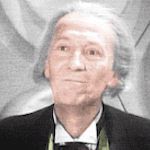
The First Doctor's era
(1963-1966)

William Hartnell
|
|
The First Doctor's era(1963-1966) |
William Hartnell |
Hmmm? by Robert Smith? 15/8/01
The time has come. We've been scattered and disorganised for far too long, but it's time for us to rise up everywhere and proclaim our love for an era of the show that has been criminally neglected. Hear me, siblings! We've whispered in the corridors, we've held secret meetings and we've denied everything when questioned, but I call on you now to stand firm with me. Together, we can be strong. Together we shall have mastery over other fandoms throughout all of Spain. Er, space.
Hello, my name's Robert and I'm a William Hartnell fan.
Editor's note: You can read the rest of this article in Time, Unincorporated, Volume 2, published by Mad Norwegian Press. For copyright reasons, we are unable to display the online version simultaneously.
A Review by Stephen Maslin 9/2/13
It didn't take long for Doctor Who to get mixed up with history: literally (drowned out by the Kennedy assassination) and narratively (traveling 101963 years into the past). Perhaps then it is no surprise that the Hartnell era is known for its 'historicals', with twice as many as the other classic Doctors combined. By that I mean stories that are about history: Pyramids of Mars may be set in 1911 but it is not about 1911; The Evil of the Daleks is not about Victorian Britain, any more than The Abominable Snowmen is about the 1930s; take away the period music from Black Orchid and most people would be scratching their head as to which decade (perhaps even which century) it was set in; The War Games appears to be a trip to the past, but that turns out to be as unreal as the show itself. On the rare occasions when the Third and Fourth Doctors end up in Earth's history, they, unlike the First, manage to avoid the great events (other than the one invented by the writer). That is not why they are there: by that time, history was just another stage set.
What is less well accepted is that, while Doctor Who's first three years may have more stories about history, they also happen to be history. Such statements could be made about any period of the show (or of any cultural artifact) and it depends of course from which point in time you choose to look. To me, Seasons One through Three sit on the far side of a line between the beginnings of the world we live in now and the end of another. Why?
***
(i) The Past is Another Country
We have become very used to all manifestations of culture dealing with the past by telling us that 'the clothes may be different but they're still people', by which they mean 'still people like us'. This is so much accepted that we no longer notice it and it is trotted out in endless films and TV programmes, dressed in modern attitudes but in period costume. It is seen as somehow more honest and as being potentially more dramatic. The view contains the viewer: the past is only of interest by virtue of its relevance to the present. Hartnell-era Who, on the other hand, did not do this because, at the time when it was made, nobody did. Forget the fact that everyone spoke BBC English wherever or whenever you went in the universe (nobody thought to mention the translative function of the TARDIS until much, much later); the visiting of the past and the visiting of far-flung alien worlds was much the same thing: unknown, different and in need of explanation (so it was lucky we had two schoolteachers on board). It was generally not the supposed similarities to our own time, but the differences from it that were explored, the whole of time and space as annotated exhibits in a museum. This could work and, in William Hartnell's first batch of eight stories, the historicals are the stories that have stood the test of time. Take a look at the others: The Daleks may have had a huge impact at the time but, as a story, it's morally rather dubious (and is far too long). Inside the Spaceship is not only more concise but a much braver tale under the circumstances; yet it would have worked a lot better had we had time to get to know the regulars a bit more. The Keys of Marinus and The Sensorites are impossible to take seriously now and I doubt whether that was possible when they were first broadcast. Compare these with Marco Polo, which must have been sumptuous by the standards of the day, or The Reign of Terror, which is a more than passable hybrid of education and entertainment. Even The Aztecs, the least satisfying of the three, looks splendid. Alas, it's an historical fact that newness was all back then...
Season One Overview
An Unearthly Child 6/10
The Daleks 4/10
Inside the Spaceship 5/10
Marco Polo 8/10
The Keys of Marinus 3/10
The Aztecs 6/10
The Sensorites 2/10
Reign of Terror 7/10
***
(ii) The Function of Culture is Improvement, Not Commerce
The 'Dalekmania' of the mid 60s may have marked the start of a rethink but, for most of the Hartnell era, Doctor Who was under-exploited. Britain was only just beginning to reawaken to the power of money, specifically that of the stock market, which would gradually unleash a tide of economic opportunism and ultimately kill off almost all of the country's manufacturing base. Like buying up shares and undertaking hostile takeovers (something brand new in post-war Britain), the exploitation of culture did not at first seem to be the gentlemanly thing to do either. It's worth bearing this in mind when confronted with the bewildering range of Doctor Who tie-in materials that surface every Christmas. One might think of a time when that was not the case (and, given the recently abated post-war austerity, could not have been the case). Yet the story that had the impact (and what an impact it was) was, once again, a Dalek story. Watch The Dalek Invasion of Earth now and - though it is often ludicrous and weighed down by Terry Nation's leaden dialogue - like The Beatles, it struck a chord: "Cometh the time, cometh the mania." It is a shame that, along with its younger sibling (the entertaining but preposterous The Chase), it overshadowed a much stronger run of stories. Again, with hindsight firmly in place and rose-tinted spectacles dispatched to the nearest bin, the historicals (The Romans, The Crusade, The Time Meddler) outshine their future-orientated competition in almost all departments and for design, Planet of Giants remained unbettered for years afterward. Yet we did not get Vikingmania (or Giant Plug Mania): the writing was on the wall for the historicals along with the notion of television as an improving medium. A visual clue to this comes at the very end of the last story of season two, The Time Meddler. In a quite unexpected change to the end credits of episode four, the three regulars - the Doctor and his two companions: Vicki (the first of a companion type that served the show well until the early 80s) and Steven, a 'space pilot' - are seen gazing out at the stars. They are not poring over history books. Neither of them are history teachers. From this point on, the historical literacy of companions would be almost zero and the future began to take over.
Season Two Overview
Planet of Giants 8/10
D I V O F T E 5/10
The Rescue 8/10
The Romans 8/10
The Web Planet 3/10
The Crusade 8/10
The Space Museum 3/10
The Chase 5/10
The Time Meddler 8/10
***
(iii) This is how we're doing it because that's how it's done.
Look at a list of composers from the Hartnell era: check out their respective biographies and you will see that they are 'real' composers. No disrespect to some of the folk who later made music for the show but these are classically trained, well-respected types, two of whose names carried quite some weight in those circles: Richard Rodney Bennett (The Aztecs) and Humphrey Searle (The Myth Makers). No surprise, really; that's what one did in those days: resorted to expertise. Such things still mattered. The distinction between composer and composer-for-television hadn't really set in. Nor had the idea that music was a necessary part of any story (or if you're making modern TV, an essential accompaniment to every second of screen time). It gradually became clear that certain individuals, specifically Dudley Simpson but also Tristram Cary, could work faster, more economically than others and they were the beginning of the house style that emerged during the later Pertwees. Yet we were still a long way from Brain Hodgson's glorious soundscapes for The Wheel in Space or Don Harper's idiosyncratic scoring for The Invasion. Hartnell-era stories have a sound world that, again, is from a past mode of production, from history, virtually indistinguishable from other contemporary shows. As was the hiring of cast and crew: good, solid dependable chaps were what you needed, not charismatic loose cannons. So it is that Hartnell's time at the helm has a pervasive air of conservatism (what would at the time have been better described as familiarity). Think of Galaxy 4 being made today and it would be inconceivable to cast the somewhat matronly types that got the gig back in 1965. Think of casting the Toymaker in the 21st century and you'd be expecting some second-string comedian to take the Michael Gough role. Think of recreating The Myth Makers now and it would be an unashamed post-modern confection of testosterone and homo-eroticism. Think of re-making The Massacre of St Bartholomew's Eve and it would actually be a massacre, as opposed to the coy hints provided by a few contemporary prints on loan from the British Museum. Think of redoing The Gunfighters and... well, you wouldn't. For all its shock tactics and trying to be all grown up, The Daleks' Master Plan is the most conservative of a very conservative season: it is riddled with banal moral platitudes, narrative cliche, and acres and acres of padding; the misogyny of centuries rears its ugly head when a female character gets above her station, aspiring to equal status with all the men, and therefore just has to be killed off. (As if ejecting Katarina into space hadn't been enough for the writer and producers to show off just how 'bold' they were being.) And, close friends having died or not, everything stops for Christmas.
Season Three Overview
Galaxy 4 6/10
Mission the Unknown 3/10
The Myth Makers 7/10
The Daleks' Master Plan 2/10
The Massacre 7/10
The Ark 4/10
The Celestial Toymaker 8/10
The Gunfighters 5/10
The Savages 4/10
The War Machines 8/10
***
(iv) Now Is Then
Look at The War Machines, the Season Three finale. It's a story that is set 'now' (i.e., the summer of 1966) and yet it has the feeling of an historical piece. Obviously enough - even a few minutes ago is history - but here again, this is history in the conventional sense of a past age. Less than a year later (with a different Doctor but two of the same companions), one does not get the same feeling in The Faceless Ones. This is partly to do with the way everything was filmed, but also the fact that the latter story is plot that could easily have been transposed back or forward by a decade or two, rather than a plot situated firmly in time: The War Machines focuses a great deal on what is around and about and in choosing the Post Office Tower as a point of focus; they could not have fixed the story more firmly in temporal space. Yet this is the last time we see this. Doctor Who's fourth season kicks off with The Smugglers, an attempt a return to 'proper' historical - albeit in a less professorial manner - but is derailed back into the present by the distinctly modern presence of Polly and Ben ("Good old 1966") Jackson. They do this again in The Tenth Planet and it is in these last three stories for William Hartnell, the first three for his new companions, that Doctor Who as we know it finally takes shape. Ben and Polly are not there to help instruct us: they are us. It's a combination of accident, an admission that times were a-changing and an infusion of energy that we had simply never seen. The difference between The Savages and The War Machines may be immense (not least in quality), but the latter story is still fixed in a far away time, rather than a seemingly timeless one. Yet, from this point, Doctor Who would develop along its own unique path and for nearly twenty years would remain unlike anything else.
Season Four (Hartnell Stories) Overview
The Smugglers 7/10
The Tenth Planet 8/10
To watch the majority of the First Doctor era now is to watch something that is, TARDIS notwithstanding, Doctor Who in name only. I feel the same about all of the Sixth Doctor's short tenure (wrong 'tone') and about quite a lot of the self-congratulatory populism of 21st century Who. This does not make any of it bad TV per se (though I would rather saw my own leg off than watch a Sixth Doctor episode ever again); nor are questions of loyalty and continuity worth a damn. It does however raise vague nagging doubts about how one's critical faculties are upset by assessing something that just happens to have the same name as something else you truly love.
***
Postscript: Five Doctors in History
The First Doctor
100,000 BCE - An Unearthly Child
c1250 BCE -The Myth Makers
Leading up to 18th July, 64 - The Romans
Late Summer, 1066 - The Time Meddler
October, 1191 - The Crusade
1289 - Marco Polo
15th century - The Aztecs
22nd-23rd August, 1572 - The Massacre of St
Bartholomew's Eve
c1696-99 - The Smugglers
5 days, ending 27th July, 1794 - The Reign of
Terror
c1596 (Shakespeare, Bacon & Elizabeth I) - The
Chase
19th November, 1863 (the Gettysburg Address) - The
Chase
25th November, 1872 (the Mary Celeste) - The
Chase
26th October, 1881 - The Gunfighters
The Second Doctor
16th April, 1746 - The Highlanders
2nd June, 1866 - The Evil of the Daleks
1918 - The War Games
c1935 - The Abominable Snowmen
The Third Doctor
Early Plantagenet dynasty, c1200 - The Time
Warrior
The Fourth Doctor
Late 15th Century - Masque of Mandragora
1505 - City of Death (Da Vinci's workshop scene)
1911 - Pyramids of Mars
The Fifth Doctor
325 - The Council of Nicaea (Big Finish Audio)
4th March, 1215 - The King's Demons
1483-85 - The Kingmaker (Big Finish Audio)
The Church and the Crown (Big Finish Audio) The Awakening
5th September, 1666 - The Visitation
1714 - Phantasmagoria (Big Finish Audio)
11th June, 1925 - Black Orchid