THE DOCTOR WHO RATINGS GUIDE: BY FANS, FOR FANS

|
BBC
Delta and the Bannermen
|

|
| Episodes |
3 |
 |
| Story No# |
150 |
| Production Code |
7F |
| Season |
24 |
| Dates |
Nov. 2, 1987 -
Nov. 16, 1987 |
With Sylvester McCoy, Bonnie Langford.
Written by Malcolm Kohll. Script-edited
by Andrew Cartmel.
Directed by Chris Clough. Produced by John Nathan-Turner.
|
|
Synopsis: The queen of a dying race is pursued to 1950's Earth by an army
of cutthroats.
|
Back to page one (the first twenty
reviews)
Reviews
The Doctor Dances... Awkwardly by Daniel Saunders
5/6/07
It's not very fashionable to admit this, but I really like Delta and
the Bannermen. It's easy to point out the flaws. There are little
niggling things (Sylvester McCoy can be seen wearing his glasses in some
shots while on the bike, which is bad direction). Plot holes abound.
(What is the toll port? Why don't the Bannermen kill Weismuller and Hawk?
Why do Goronwy's windows shatter when the Chimeron princess screams, but
not those in the holiday camp? What happens to the Bannermen after the
end of the story?) There are bigger problems too. There are some
terrible performances, with the Billy-Delta love plot ruined by the
failure of the actors to put any conviction into it. Too much "comedy"
fails because of poor writing, or because the acting or direction
overemphasise it (by contrast, there's a tiny gag about the Doctor trying
to bite into an apple, but never quite succeeding, which works because no
one draws attention to it). It also contains one of my pet hates in
Doctor Who: "the future" and "outer space" are seen as all being a
single, uniform environment, where everyone knows about everything and
everyone else. Keillor knows of the Doctor and recognises Delta before he
hears from Gavrok; the Doctor knows of the Chimeron, the Bannermen, and
Nostalgia Tours, and has the necessary parts to fix the "bus". Time
travel is taken for granted too, which is at odds with the rest of the
series.
Despite all these flaws, the core of the story works. The story seems
fresh, even watched out of context all these years later. At this stage
in the series' history, there hadn't been a proper twentieth century Earth
story for a couple of years. But Malcolm Kohll doesn't use that alone to
set itself apart from its recent predecessors. He uses the series'
cliches in order to subvert them. I complained earlier about the fact
that in "the future/outer space" everyone knows the Doctor, the Bannermen,
the Chimeron and time travel, but Delta and the Bannermen makes
good use of that. By taking the outer space cliches for granted, the
world of holiday camps, bee-keeping, Rock 'n' Roll and people falling in
love is made to seem alien, strange and alluring. It's the reverse of the
UNIT/Russell T Davies method of using the present day, give or take a few
decades, as the benchmark of normality to make the alien seem shocking.
Here, it's the mundane that's shocking.
Delta and the Bannermen is fundamentally a character story. It
features a bunch of characters who don't even belong in the same genre as
each other: the rebel without a cause; the love-sick teenage girl; the
comedy spies; the alien princess; the holiday camp manager out of Dad's
Army via Hi-de-Hi!; and Goronwy, who doesn't really fit any genre, but
with his instinctive understanding and ability to commune with nature, is
a wise man of folklore, almost Merlin (especially as he's Welsh). The
story takes these eccentrics and misfits and shows them coming together to
oppose the aggression and hatred of the Bannermen.
The Bannermen are the perfect foils for these heroes. The brutal
conformism of the Bannermen makes the diversity of the heroes more
obvious. This relationship between the two groups of characters is why
the slow pace of the first episode works. We know from the opening
sequence that the Bannermen are evil and ruthless. Spending time setting
up the jolly atmosphere at Shangri-La actually builds the tension as we
wait for the Bannermen to arrive and attack.
This is a particularly good story for the Doctor. For once, he saves
the day not because of his superior technological or scientific knowledge,
but because he coordinates the different members of the group to use their
unique skills when necessary. Moreover, we see the Doctor as he should
be: knowledgeable about technical matters, yet out of his depth with
emotions. His line about love never having been known for its rationality
adds mystery and emotion to the character in a much more powerful way than
conscious attempts to do that over the following seasons down to the
present. McCoy delivers the line in a way that suggests a troubled past,
yet it isn't dwelt on at the expense of the rest of the story. At the
same time, it also suggests a completely untroubled past, implying the
Doctor just can't understand why humans have to cause so much confusion -
and spoil his plans - by falling in love. This discomfort is also seen
reflected in his inability to comfort Ray. In fact, he has a generally
unworldly air here, reflected in his awkward dancing, his instant rapport
with the hermit-like Goronwy, and his quirky behaviour; for example,
listening to an apple.
And if all that wasn't enough, it has perhaps my favourite Doctor
Who line ever: "You are not the Happy Hearts Holiday Club from Bolton,
but instead are spacemen in fear of an attack from some other spacemen?"
A Review by Brian May
27/4/08
At first I hated Delta and the Bannermen, but it's grown on me.
Twenty years on, I appreciate the story a lot more, as both it and my own
tastes have matured. Perhaps the best description for it would be "brave".
Experimental is another that comes to mind, but it lacks the obliqueness
or dark bizarreness such a word warrants. But it's certainly Doctor
Who at its most different and atypical, and that's always a good
thing.
I suppose the rudest shock upon first viewing was the all-pervading
jokiness in part one. The Tollmaster, the Doctor and Mel winning a
competition, the appearance of the Navarinos... it's all very pantomime.
Even if it's a light relief antidote to the unpleasantness of the years
immediately preceding this, it's hard to ignore a lingering sense of
flippancy. Doctor Who should never take itself too seriously, but
is this going too far in not doing so?
Tacky is the next word. The Tollmaster is tacky, so too the Navarinos
and above all the holiday camp. Not coming from the UK this institution
isn't ingrained in my childhood memories or national psyche, but after
some research (and having lived there from 2001-2003 when Butlins were
still advertising in tabloids), I have enough knowledge of them to be able
to make an educated opinion. And that opinion is that they're...well,
tacky! Also as I'm not British, Ken Dodd is not a household name, and it's
obviously the intention that UK audiences would have recognised him
immediately. Perhaps that's why I detested everything about his
performance until I learned who he was. Now I can't hold this against him;
Ken Dodd is playing Ken Dodd, so he's doing a more than capable job.
Bonnie Langford, whose history is synonymous with pantomime, is very good
as Mel. They're one of Doctor Who's most derided actor/companion
identities, but the script plays up to Langford's strengths as a light
entertainment performer. Okay, so Mel has tacky tastes, but at least she
gets to be competently written for once. (A pity it has to include one of
her regular screams!)
But come the dance, I'm mellowing out and enjoying myself. It's nice
seeing the TARDIS crew letting their hair down. As was the case in Black Orchid it's fun to watch, especially so for
Sylvester McCoy's performance as the Doctor, the first that's truly his
own. The final two episodes revert to being a Doctor Who adventure
proper, but there are problems arising beyond those of tackiness. The
script is very wanting. Who are the Bannermen? Why do they want to destroy
the Chimerons? Are they mercenaries? Are they from a neighbouring warring
planet? Although Delta's background is not elaborated upon, the script
clearly places her in the right, which just makes Gavrok and his minions
nothing more than generic, black-suited space thugs - in spite of Don
Henderson's excellent performance and the well-designed, Samurai-inspired
Bannermen uniforms.
There's an extremely juvenile moment when the Bannermen are covered in
honey and swarmed by bees. It's a scene straight out of one of those
god-awful kids' programmes when incompetent adult villains are outwitted
by smarmy, obnoxious children. The opening sequence is horribly edited and
the genuinely alien-looking Chimeron baby is replaced by an unimaginative
child-in-a-white-romper-suit-and-green-face-paint effort. Thankfully, the
direction is good (the end of part two is great), and Keff McCulloch's
music is highly memorable, especially the "Here's to the Future" song.
Now, the acting. Most of it is very good. Alongside McCoy, Langford and
Henderson, the bulk of the cast do their best. Richard Davies as Burton is
my favourite, stealing the show as an ordinary man thrust into the
extraordinary and seizing the opportunity with gusto. But, unfortunately,
there are also some dreadful excuses for acting: Belinda Mayne is so dull
as Delta it's difficult to care for her situation, so too Billy (David
Kinder). Their romantic scenes are so bad you'd think it was some dreadful
teen soap. Morgan Deare is another name to add to the awful American
accents hall of shame, especially as he's matched up with an authentic one
from Stubby Kaye. But worst of all is Sara Griffiths as Ray, from her
shrill, horrendous attempt at a Welsh accent to her wooden delivery and
expressions (look at the cliffhanger to part one for an example of the
latter). It's shocking to think she was actually considered as a
companion!
But, nevertheless, in Delta and the Bannermen something
different is being attempted, despite the varying results. I like it, with
reservations. 7/10
A Review by Gladys Spume
30/6/12
I had always done my best to allow the cast and crew of a serial the
benefit of the doubt and take into account the budget, time, and situation
that were allowed each story when appraising it. This had allowed me to
enjoy every story, from Timelash to The Chase, to The Horns of Nimon
(all three personal favourites in fact) thoroughly.
So for many years I would easily claim that I didn't dislike a single
Doctor Who story. Until one Thursday afternoon I decided to watch
the DVD release of Delta and the Bannerman. Good heavens no.
The story opens with tremendous promise. A strange alien landscape,
populated by intriguing aliens blowing the goo out of each other, and a
glowing box of great importance. Before we get to learn any more, we are
transported to a marvellous gritty spaceport set, with the TARDIS
materialising in the centre of it. At this point, I was gearing up for an
excellent story, but alas the first minute would be this story's best.
I could forgive Ken Dodd's performance, as though he is somewhat
irksome, that is what the character is meant to be, but then we're
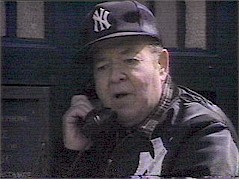
introduced to the two American agents, who are just painful to watch. The
fumbling with the telephone and "in case you can't recognise the accent,
my hat and jacket are a clue" costume, are ruined further by the primary
school play dialog of the two.
Then, when you think it can't get any worse, the Navarinos are
introduced, played aptly by someone convulsing inside a duvet. The
Navarinos are apparently free to use time travel, which, according to some
sources, is because the Time Lords know that it's only for fun and is
harmless, yet the safety and security precautions are seemingly
nonexistent, leading to both a strange alien lady and a Navarino Bannermen
agent getting onboard with no problem whatsoever.
There is some relief in the character of Burton, who is quite charming
and well played, a small island in a sea of tedium, easily the most
believable character in the whole story. One other standout character is
Gavrok, who is a fascinating character. The newly-hatched Chimeron infant
looks marvellous, and is a triumph of simple puppetry, only to be spoilt
almost instantly by becoming a baby in a jumpsuit.
There are also far too many nagging questions that are left unanswered
by this story. Would it really have been so easily acknowledged that so
many middle-aged people would be into rock 'n' roll? I find that very
unlikely. How does the South African Navarino assassin know all about the
Bannermen, the Chimeron and the Doctor, and know how to contact Gavrok so
quickly? The soundtrack is also appalling, much of the incidental music
being from '20 tediously sanitised synthesiser rock and roll tracks' and
eliminating any real dramatic tension from the tale, cheapening the story
further.
There is one theory that allows me to appreciate this story somewhat
better though. It is never addressed exactly why the Bannermen are trying
to wipe out the Chimeron. And, apart from this mission, there is nothing
else that's really mentioned to condemn the Bannermen. Add to this the
haughty arrogant attitude of the Chimeron, and it's not entirely unlikely
that the Chimeron are in fact racial-superiority-obsessed aggressors, and
are perhaps a devastatingly bloodthirsty race that is a genocidal threat
to the peaceful people that the Bannermen come from. Perhaps the only way
that the Bannermen (which I don't think are the race, but merely a group,
possibly even of human colonists) can survive the evil dominance of the
Chimerons is by eliminating them. Although Gavrok seems vulgar by our
standards, perhaps he is the last hope of the downtrodden Bannermen, and
his ruthlessness born of watching everyone close to him being massacred.
What a different story this would have been if the Doctor were to find
out that he was backing the wrong side, and he has caused the extinction
of a peaceful, yet relatively unattractive race. Surely one of the most
classic Doctor Who themes is that beauty vs. ugliness should never
equate good vs. evil, especially after Goronwy gives his speech about the
ugliness of the pupa and the beauty of the butterfly.
In any case, this is by far my least favourite story. I suggest you
give this one a miss.
"Your mama don't dance and your daddy don't rock 'n' roll" by Thomas Cookson
9/7/16
JNT's idea of light entertainment was something I struggle to get behind. The last attempt at such a story was Time-Flight, and JNT was the only one on the production team who didn't come away thinking it was a terrible mistake. Perhaps inevitably, with Season 24's new creative blood, JNT tried something of its ilk again.
I've tried to reappraise Time-Flight only to keep finding it a worse story than I remembered. Aside from its flimsy plot and misjudged followup to Earthshock, the problem was JNT had already come to the show with a humourless, killjoy, anti-Williams agenda and wouldn't or couldn't reverse it enough to make Time-Flight's frivolity work.
Perhaps Time-Flight could've worked as a retro B-movie adventure throwback. A light relief to audiences during an oppressively modernist age, with an all-inclusive air, much like Earthshock.
JNT's tastes were inherently retro. He'd stopped watching TV when working in the industry had killed its magic for him. But maybe had the production, pacing and directing all delivered (or if the design weren't so unsightly), then Time-Flight could've worked as Season 19's happy ending.
Delta and the Bannermen may on balance be the second easiest Season 24 story to get through, and it shares enough of Time-Flight's retro aspects to almost be worthy of the same title. On paper, it probably made sense as affordable and as retro enough to offer casual viewers something different from the rest of the crop.
On screen, it simply resembles a wrong turn. An oddball, but not a particularly witty or compelling one, with maybe hints at being a prototype for next year's more accomplished Remembrance.
Unfortunately, aside from a few moments worth relishing (mostly Gavrok chewing the beef), one can only be glad when it's over.
In fairness, it hasn't dated much worse than Harry Enfield's sketch show, which is almost unwatchable now. Likewise, it seems to aspire for the same zeitgeist as 1987's Spaceballs.
But for what's supposed to be a hip, happening, eventful chase adventure in three parts, it still manages to be infernally boring.
Compare it to Enlightenment, which was written so that every scene mattered and was compelling and rich, adding up to a very dense 90 minutes that left you wanting more.
Delta falls far short of that, with a flimsy runaround of a plot struggling to sustain itself, with limp pointless characters and insipid scenes of waffling that you just wish would end.
The crusty old CIA agents take up too much screentime and serve no story purpose. They get chained up, then released, then disappear from the plot. The story's littered with extraneous, cumbersome scenes like this. Another example being the aftermath of the first cliffhanger where the bounty hunter from The Flying Pickets is disintegrated, and then we get the Doctor having to explain to Ray like an idiot what's clearly just happened.
Furthermore, the parts of the story that sorely require attention, screen time and progression don't get it. The unlikely romance between Billy and Delta is one where the story elects to refuse to show us them even exchanging words in their first meeting before expecting us to believe they're suddenly in love. It's just contemptful of the audience.
Taking that unlikely romance and removing our capacity to care by treating the romance so mechanically that it seemingly doesn't matter what draws them together, it's just because the writer says so. Now Billy is clearly his own self-determined man who'll go his own way to pursue his dreams, regardless of what other people think. But I can't buy he'd willingly mutate himself into an alien species on the spur of the moment. Especially when for all he knows he's been stealing Delta's last supplies of jelly and leaving her baby to starve.
Yet again it's 80s Who exhibiting the kind of nonsensical, alarming behaviour that common sense and courtesy should forbid, for no sensible reason. Making it impossible to understand or empathise with these characters when they adopt such almost mentally ill behaviour. A grim reminder of why people stopped watching this show and came to consider its fans to be undesirable, socially maladroit weirdos who could only enjoy a show about people like them.
Maybe I also instinctively dislike this blanket, uncritical celebration of 50s culture. The nostalgia for what was actually a horrendously oppressive, patriarchal time. So I'm left cold by this story's loud insistence at how awesome this period was.
Unfortunately, in this supposedly fun romp, the more doddery, older characters drain all energy from this, making them seem misplaced in a story that requires far more dynamic and flamboyant screen presences. They're just people you really want off your screen.
Most of the characters are. No one, barring Ken Dodd, has a comic gene or any charisma. Ray is hopelessly drippy, ditzy and self-absorbed. Having witnessed the sufferings of the people of Varos or Skaro, watching Ray blubbing because Billy fancies someone else, I can only think "You think you've got problems?"
Billy is utterly wooden. The Butlins manager is the butt of a terrible attempt at comedy when he's earplugged and then startled by the Doctor into swordfighting action. This is a comedy with inane delivery and lame punchlines.
Delta herself is wasted potential. As a much-harassed mother protecting her child from evil forces, I'm reminded of the protagonist in the Japanese horror film Dark Water, who conveyed a very fraught, sensitive, fragile but loving mother who eventually proved stronger than we realised. There's so much potential for passion in this role, but Belinda Mayne plays her colder than a fish and as more interested in appearing dainty in every scene than in conveying any emotion.
With just a bit of furious passion, I could've got behind her and found her compelling. Even the braindead moment where she terminates her chat with Gavrok by shooting the monitor could've really meant something or been a promise she'll deliver later to Gavrok, which maybe the Doctor will have to dissuade her from.
That's the problem. There's no natural conflict of interest between our good guys. They just all blankly go along with everything. Delta could've been a vengeful loose cannon that the Doctor needs to hold back for her own safety. Ray's jealousy of Delta could've been addressed and reckoned with as they help each other survive. It's just too pat all round, and resultantly it's rather uninteresting.
Don Henderson as Gavrok, however, is the best thing onscreen, taking nothing for granted and playing him with a far nastier viciousness than the script allows. You really wish he were in a better story.
Fans have complained about the lack of explanation as to why the Bannermen hate the Chimeron and are exterminating them. Henderson's performance makes any explanations redundant. He convinces you he's that obsessively hateful and determined to hunt Delta down. It's a bloodsport to him. He seems cut from the same cloth as post-Thatcher dramas like Naked or Ladybird, Ladybird, where the nastiest people have free reign to relentlessly victimise society's most vulnerable (because economic poverty also means poverty of security) and do so because they can.
Unfortunately, it's directed haplessly in ways that resemble some fanboys let loose with a video camera. It wants to look spectacular and exciting, but it lets too much wide exposure and dead air enter the frame and just looks almost indistinguishable from a making-of documentary. So you're like an observer on the set watching it all fail to impress.
Lance Parkin in DWM cited Delta as a beautiful turnaround for the show, comparing it to Vengeance on Varos' parade of corridor cliches and how this was doing something refreshingly new and incorporating such rarities as romance, love and babies into the show. However, it's clear which of the two stories has aged better, and it ain't Delta.
Anyone can appreciate good Doctor Who. But equally Doctor Who only works if it doesn't care that its content might be unpleasant or off-putting to those who like their entertainment fluffy. Doctor Who largely works because of its moments of uncompromising masochism. It's an integral part of the show's morality that we as the viewer suffer with its characters as they look into the pitiless eyes of death, and through that we gain a vivid understanding of man's capacity for inhumanity to man and the true evils of our real world. That's how the show in its prime taught us to be humanists, and in stories like The Sea Devils, the masochism was even about understanding the doomed plight of our enemies.
This feminizing of the show, both in this and the New Series, to me has only served to achieve a shallowing effect. Yes, a lot of older fans have come to hate what a nerdy, girl-repellent dinosaur the classic show apparently was and went on to revere RTD for ruthlessly removing anything from the New Series that might be off-putting to teenage girls or concerned mothers. The result is the show loses a lot of its substance and grit, the sci-fi storytelling becomes a secondary consideration, flippant and lazy, and the alien, intelligent Doctor becomes shallowly characterised as all the worst, idiotic, annoying, stereotypical things the public thinks he is.
In the Pertwee era, the Doctor's anti-military stance made sense. Pertwee's Doctor was a sci-fi hero who represented the genre's values of progression, eccentricity, open-mindedness and innovation. Basically everything antithetical to the military's conformity, obedience, and wartime destruction of mankind's achievements.
As the show became more fan-aimed and cultish, this didn't really work anymore. Not when the Doctor had to deal with old enemies he already should've had the measure of and there was nothing new for him to be open-minded or wondrous about, but he's still forced to act as precedent dictates, even when it's suicidal, and expects everyone else to act accordingly.
Here the Doctor waves a white flag, steps unarmed into Gavrok's turf and yells his demands, making the idle threats of a chiding schoolteacher to anyone who breaks the truce (essentially saying "If you kill me I'll make you regret it... somehow."), releases his friends and somehow leaves unharmed. Fans enamoured of what the Doctor stands for may champion this moment's 'rightness'. Yet it's exactly the kind of nonsense the average Terry Nation story showed would get you killed.
To me, this isn't the Doctor but a fan wanting badly to be the Doctor. Because the Doctor was never this much of an idiot. That he can act this way and survive destroys any believability, exposing how the pat rules of children's TV dictate his safety and muzzle the villains. If there's nothing cautionary and the Doctor can enter the Lion's den and survive, there's no danger or threat, and I don't believe in what I'm watching.
This was definitely part of the JNT era's critical mass of bad that almost validates its fellow worst ilk by diminishing fan expectations and conveying weak moral messages that weren't self-sustained.
Being about a woman targeted for extermination by genocidal militias but who manages to get the better of them, tie them up and kill only one, this story gives further succour to Warriors of the Deep apologists who insist the human survivors were going too far and were just as bad in suggesting using the Hexacromite, because it's only self-defence if they keep hiding and hoping each Sea Devil only comes for them one at a time and never manages to shoot them first each time.
There used to be a hardship and cost to every option in a given conflict, leaving the Doctor's methods the best of a bad bunch. Warriors disgraced this by having the military solution be the most absurdly easy one that the Doctor hides and sabotages from everyone.
Apparently, those humans' crime was not realising they could do things Delta's way and survive.
It's difficult to hate this story until you realize what an ancillary insult it is to real war survivors and what they possibly really had to do to survive.
Not the Bees! by Jacob Licklider
16/3/17
This is the twenty-fifth worst story as voted on in the 2014 Doctor Who Magazine Poll, and I would argue that it deserves to be even lower than that. The story, even though it is just a three-part story, has some extreme padding with a cast of ten plus at least thirty extras that could be cut in half to be a cast of five main characters with maybe fifteen extras. Malcolm Kholl does not know how to write for characters, as he is trying to make this a space opera and a love story, but to do both of those things you need to be able to do one thing: make the characters interesting so we can understand their motivations. The characters here are as dull as a lead pipe. They also don't act rationally throughout the entire story, with the exception of Bonnie Langford as Mel, who actually is pretty decent in this story. You know that something is wrong when Mel is the best character in your story. Sylvester McCoy is obviously trying his hardest, but the Doctor doesn't do anything except pop in to remind you that he is in the story. While that may seem like it's like one of the Virgin New Adventures, what the novels do is make the Doctor be doing stuff behind the scenes, while here he is doing nothing except near the end of Part Two where he gets a great speech just before the cliffhanger.
Now I said that this story was trying to be a love story, which occurs between Delta - who is basically a humanoid alien bee - and Billy, a biker from the 1950s. While that is a weird pairing, it could easily work if there was good chemistry. Sadly, Belinda Mayne and David Kinder look like two children in a school play who don't know the first thing about acting. The romance isn't helped by the script, which has them glance at each other and suddenly they have fallen in love. What makes the romance worse is that Billy eats some magic alien bee juice to turn him into one of the Chimeron's so he can get in bed with Delta. The romance also doesn't work for the reason of what we know about the Chimeron life cycle is that every 24 hours they gain about ten years on their life, making Delta about two days old. Yes Billy is shortening his life by several decades to be with a woman whom he's met for a day and will die in about a week. But it wouldn't be a romance story without a really forced love triangle, and the third wheel is Ray, Billy's childhood friend who is obviously smitten with the man for no real reason. Sara Griffiths is trying her hardest to come across as vulnerable, but it just doesn't work, as the script is too weak to actually carry a love triangle. It also turns out that Ray could have become a companion even though outside of the forced triangle she doesn't do much within the story.
The story is also trying to be an action space opera with the evil Bannermen, who are not a real threat, as led by the insidious Gavrok. Gavrok is a really boring villain, who is just evil for evil's sake. He is trying to commit genocide but doesn't have any motivation to do so that is stated on screen; we are just told that he is evil. He is played by Don Henderson, who cannot act his way out of a paper bag. He is just mugging for the camera and oddly delivering his lines. The Bannermen are also extremely awful as in the way they intimidate you by sticking their tongues out and hissing, which isn't intimidating. With these villains, there is a ton of mood whiplash, where you have the tone being all comedic and suddenly half the cast is blown up near the end of Part Two.
Now there are also four or five other characters who are extremely boring and really are there to get from Point A to Point B in the story. There are two Americans who do nothing, a Beekeeper who acts all mysterious but is just a way for Malcolm Kholl to be pretentious, the bus driver who is annoying and a toll master who has a grating voice. All these people are awful, and as the story keeps shifting locations with different characters at different places they could be cut out completely and you wouldn't really miss anything.
The direction for this serial was done by Chris Clough, who did five other stories in the late 1980s. Sadly, this is not one of his best direction efforts, as he can't seem to work around some of the tiny sets, making some of the actors look like they don't have good peripheral vision, and some of the shots look really badly put together. He also doesn't know where to put music correctly as at points the music is way too comical, causing some of the crazy mood whiplash.
To summarize, Delta and the Bannermen is a story that fails in almost every aspect, with stupid ideas and a really weak script with bad actors. The only positive performance is the character of Mel Bush. It doesn't even hold up on a so-bad-that-it-is-good level. 10/100