THE DOCTOR WHO RATINGS GUIDE: BY FANS, FOR FANS
| Episodes |
4 |
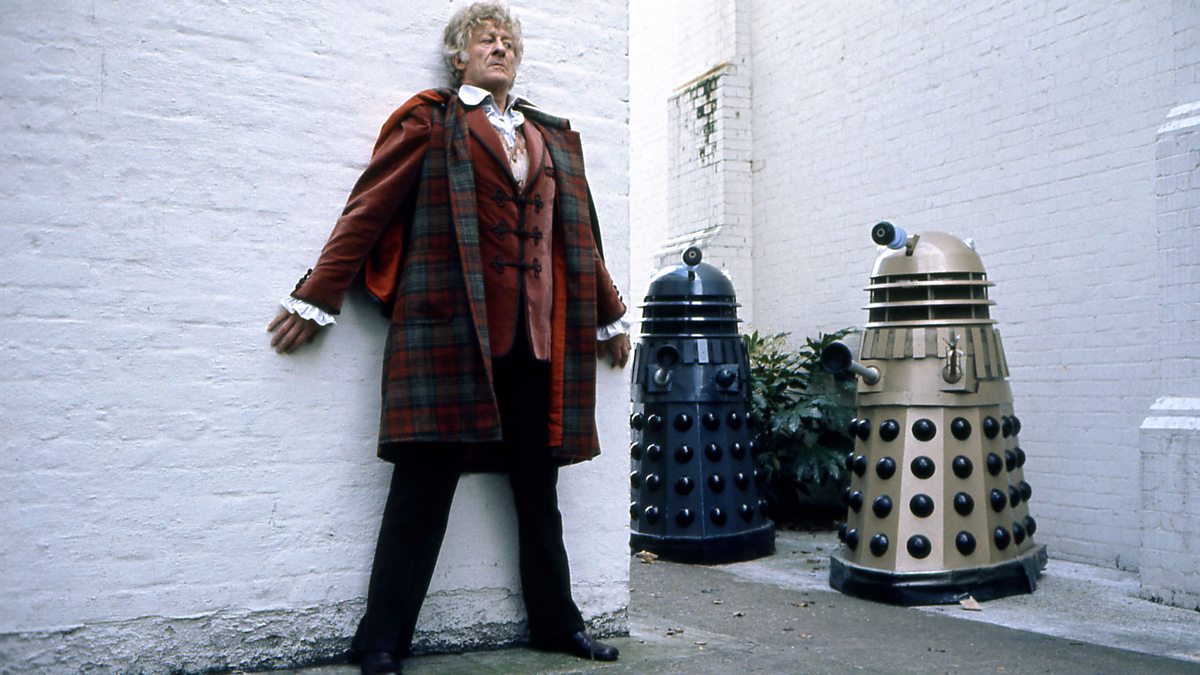 |
| Story No# |
60 |
| Production Code |
KKK |
| Season |
9 |
| Dates |
Jan. 1, 1972 -
Jan. 22, 1971 |
With Jon Pertwee, Katy Manning,
Nicolas Courtney, Richard Franklin, John Levene.
Written by Louis Marks. Script-edited by Terrance Dicks.
Directed by Paul
Bernard. Produced by Barry Letts.
|
|
Synopsis: Soldiers travel back in time to prevent the Daleks from conquering
22nd century Earth.
|
Reviews 1-20
Interesting SF premise, but not quite a classic by Michael Hickerson
Updated 12/3/03
What a difference ten or more years can make in the
“classic” status of a Dr. Who serial. When the BBC
started releasing Who on VHS all those years ago, one of the first
Pertwee stories to see the light of day was Day of the Daleks. I
remember that when it came out, it was heralded as just a great story, a
classic, one that every fan had been dying to own for years. Fast forward
about ten or so years to the days of DVD when the entire series is being
released again on DVD and Day of the Daleks hasn’t even shown
up on the radar, nor has its name even been thrown about as a possible
future DVD release. Has a story that was once considered a classic fallen
so far in the fan estimation, simply by making it readily accessible to
the fan community through the wonder of VHS?
It appears so.
Certainly, when I reviewed this story several years ago, I stated that
while it was a good Pertwee story, I didn’t necessarily find it to
be the classic that a lot of other fans found it to be. And years later,
as I dust off my old copy and watch it again, I have to admit that while
the story has grown on me in some ways, I still have a lot of the same
problems with it that I did back when it first saw the light of day on
VHS. Does this mean I wouldn’t buy it on DVD? Absolutely not.
I’d love to have an episodic copy of the story, but you can chalk
that up to my obsessive nature as a Who fan and not the classic
status of the story.
Day of the Daleks certainly starts well enough. The premise of
ghosts coming from the future to kill a current political leader who may
just send the world spiraling into the third world war is an intriguing
one. With the world events of today, the references to a possible war and
there being one last chance for peace are hauntingly familiar and a bit
eerie. There is something very disconcerting about the scenes of the
Brigadier listening as the world situation deteriorates seemingly moment
to moment to the brink of utter destruction. And it’s interesting
to see that the world will in fact, go to the point, thus allowing the
Daleks a chance to come in and conquer Earth, as they failed to do during
the Hartnell years. (Thankfully, none of the absurdity of making the Earth
into a giant spaceship to travel the cosmos is brought up here)
Day of the Daleks is one of Who’s most serious
examinations of time travel and its possible consequences. Surprisingly
enough, the script does a good job with this, creating a future that is a
temporal paradox and having the Doctor set about making it right. It
almost makes one wish that a hero such as the Doctor existed in reality to
see the future of where world events are taking us and then give us a
nudge in the right direction to keep history on its correct course.
There is something reassuring about seeing the Doctor not only be able to
defeat his greatest enemies, but also have to deal with the possibility
and the ramifications of a time-paradox and being caught up in one. One
of the greatest themes of the Pertwee years is that humanity is it’s
own worst enemy and that theme shows up here time and again.
We even see the Doctor get a chance to make some impassioned speeches
about the role of conquers and aggressors. The scenes in the Dalek
command center as he debates the Controller are strikingly well done.
And it’s also interesting to see Jo so easily persuaded that the
Controller is doing the right thing and is actually one of the good guys.
That little bit of conflict between the Doctor and Jo is surprisingly
refreshing and well done. It was rare in the Pertwee era to Jo openly
disagree with the Doctor and while it’s not quite as open as Ace or
Sarah Jane would be, seeing her argue with the Doctor is a nice touch.
And the first two episodes do set up an intriguing premise for the
story. And the first two episodes seem to go by at quite a good clip,
easily flowing from one scene to the next.
It’s once the focus shifts to the future and the Daleks step up
and become more of the catalyst for the action that the story begins to
fall apart a good deal.
The final two episodes just don’t have the fun factor or the
intensity the first two do. Part of it is that a lot of episode three is
meant to show us the terrible future and then have Pertwee get a chance to
ride around on a giant go-cart (an embarrassingly bad scene since it
requires the Ogrons to basically pace after the car menacingly in an
attempt to make it seem as if the machine is going faster than five miles
per hour). Because of this, episode four is packed with trying to figure
out what went wrong, overthrowing the Daleks, fixing history and saving
the day. That’s a lot of material to pack into 25 minutes of
screen-time and the final episode suffers a good deal because of it.
Also, another problem with the story is the inclusion of the Daleks
themselves. After a five-year absence from the program, I was honestly
expecting more from their return visit than we got here. Part of this I
think is because the original script didn’t include them. The
production staff felt the story needed an extra spark and the maybe the
metallic pepperpots could provide that. But the Daleks are so limited in
what they do on-screen (mainly screaming and threatening the Controller)
that they because a bit of a parody of themselves. They don’t feel
like they’re really all that menacing or an integral part of the
plot.
I will, however, admit that I do like the Ogrons and find them some of
the more effective and intriguing Doctor Who monsters from the
Pertwee era. The costume, the make-up and the design of the Ogrons is
nicely done and it’s easy to see why they’re brought back
later in the Pertwee years for a second visit.
I will have to admit that I think part of my disappointment with
Day of the Daleks stems from the fact that I read the superb
Terrance Dicks novelization of the story first. Terrance takes the story
and expands it, giving us backstory and characterization that just simply
can’t be realized on screen. This was before he was turned into a
novelization machine by Target and the dedication, effort and work show in
the novel. I always wonder if my reading the book put unrealistic
expectations of the story in my head and that no matter what happens a
four part story could never live up to them. I’m not sure, but that
may be part of what keeps me from enjoying this story as much as some of
my fellow Who fans. If you’re looking for a good Dr.
Who novel read, I recommend this one highly, if you can find it.
A Review by Leo Vance
21/1/98
This story is important to the series as the first appearance of the
Daleks in five years, and the first appearance of them in colour. Let me
say that I don't like it very much.
On the top side, there is a superb performance from Aubrey Woods as
the Controller, the best character in the story. The Daleks make a return,
though they are far less menacing than they're 60s counterparts. The
Ogrons are superb monsters, perhaps the best new creations since the
Autons in season seven (Silurians and Bok are the only challengers).
Nicholas Courtney is excellent as the Brigadier (as usual) while John
Levene and Richard Franklin are as usual believable. The disentegrator
guns are well thought out, the script is an intriguing and well-plotted
one, and the effects, direction and sets can be bundled up as good. The
idea that the whole plot is a temporal paradox is superb.
However, on the lower side are important sections: Except for Shura,
the guerrilas are a little characterless and boring, and they're
performances are awful. The Controllers Deputy and the girls in his office
are less than interesting as well. Jon Pertwee doesn't provide even his
usual believable performance, but not because of bad acting. Louis Marks
simply hadn't written for the show since 1964, so this can be excused.
Katy Manning is awful as Jo Grant, and the Daleks unfortunately are
rather boring. This is bad, because in The
Daleks, a less interesting script than this, they were one of the best
elements. The agent (ZV10) is a well thought out and interesting
character. This incident is a good demonstration of the World War II
elements of the 22nd Century section (episodes three and four). This is a
little like The Dalek Invasion of Earth,
but it is well used.
All in all, a reasonable tale, but it could have done without the
Daleks or a fourth episode. 6/10
Close, but no banana by Joseph Nunweek
23/2/98
I've never been entirely happy with the Dalek stories after Evil of the Daleks. I feel it was a
brilliant conclusion to the Dalek saga, and though many of the stories
afterwards were good, even terrific, it does seem like a cop-out. But
Day of the Daleks isn't terrific, just good.
Good points first, as usual: Unlike previous reviews, I was interested
by the way the story didn't centre on the Daleks. Instead of the great
armies of The Dalek Invasion of Earth,
there are fewer, so they sit back and manipulate the events instead of
being in them. I don't like the voices though. They change from a dull,
low moan to a more grating, loud Roy Skelton voice. Especially with the
Gold Dalek.
On other races: The Ogrons, as others have said, are great, and I'm
glad they were further developed in Frontier In Space and The
New Adventures. Aubrey Woods steals the scene as the Controller, going
from arrogant to manipulative to finally realising the true extent of what
he has done, and paying with his life. The main plot, the time paradox is
brilliant and tense, like the atmosphere as international war looms, made
more realistic by the news report with the delegates. The battle scenes
range from average to bad (it can be explained, as the Oggies are poor
shots, yet the Daleks still use them. The reason? They're loyal and
they're too dumb to queston orders.)
On the bad side: Styles was awful and annoying. UNIT is beginning to
get old and becoming a used plot device. The Brigadier is showing signs of
becoming the silly old buffoon army commander that ruined Battlefield for me. (But the cute scene with Benton and
Yates coming to the house to scrounge for food is funny and well done.)
The guerillas are trying to be good, but only Shura truly shines. The
dirt bike scene? BAAAAAAAAAD! But the ending is good, as Shura grins and
blows himself and the Daleks to smithereens. But the Daleks don't end
there...
A Review by Guy Thompson
8/12/98
This is a great story, with perhaps only one weakness. The story could
have stood up very well on its own without the presence of the Daleks (the
same thing would happen in Revelation of the
Daleks), who really only act as framing for the major plot involving a
time paradox created by a guerilla taskforce from the twenty-second
century who have travelled back to our time to execute the man they
believe to be responsible for starting a Third World War. The Daleks could
have been replaced by several other (more mobile) villains, but they fit
in comfortably enough alongside the far more exciting Ogrons (perhaps the
first convincing Who monster?).
All the UNIT regulars are on show (Katy Manning looking particularly
foxy) and seem relieved to be fighting someone other than the Master for a
change. The acting is of the highest calibre (especially Aubrey Woods as
the Daleks' human Controller in the 22nd century) and most of the scenes
(especially the film sequences) are superbly shot and convincingly staged,
excepting the dirt-bike chase when the Ogrons are running at a rather
suspiciously slow pace to cope with the faulty prop they're following.
Even the music is for once reasonably unintrusive. The time loop created
by the guerillas is superbly structured, with motivations and thought
behind the actions involved, just don't try and think too hard about how
future events occur after the destruction of Stiles's house (bearing in
ind that it has become an accepted part of Who continuity that the
Daleks captured Earth in the twenty-second century, however at the
conclusion of this story that has been prevented... hasn't it?)
A bit of a triumph all round then, really. This story might just sneak
into my all time Top 10, it's certainly one of the top three Pertwee
stories, along with Spearhead from Space
and Inferno. If you're lucky enough to
own a laserdisc player, this story has recently been released on that
format, so I would advise a quick trip down to HMV and treat yourself four
episodes of classic Doctor Who.
Dull Daleks by Therese Drippe
4/4/99
All right, I confess it. I bought Day of the Daleks simply
because it had a Dalek on the cover. And the Brigadier on the back. I
paid for my indiscretion however (besides the twenty bucks), in having to
sit through one of the most incredibly dull Dalek adventures I have ever
seen (if it could even be called a "Dalek" adventure, since the Daleks
were not really very important or interesting). They just kind of lurked
in the background looking rather Dalek-ful. And as for being the most
intellectual... I find it rather frightening to think that some people
find it so. The time paradox is absolutely ridiculous, and is a case of
the script writers insisting that two plus two is five. If you
think logically: "but what caused that" you'll see what I mean.
Of course as this is typical of most Doctor Who science, and quite
funny, one can forgive them.
What is harder to forgive is the dullness of this story. Jon Pertwee,
though an admirable and pleasant Doctor, hardly does anything memorable
here, with the possible exception of the scene where he is sampling wine
and waiting for the "ghost". Jo Grant is rather silly, unusually gullible
even for her, and appears to be wearing red underwear. But the fight for
the prevention of World War III and the inner moral crisis of the Dalek's
human "slaves" simply drags on and on. I think the scene with the Doctor
and Jo on the dirt bike sums it up: slowly they ride, slowly the Ogrons
catch up, and then in weary chagrin the Doctor surrenders. I hope it was
not intended to be an "exciting chase scene" because it was such a
dismal failure.
The story was fairly unmemorable on the whole, or when it is
remembered is remembered as the "time paradox one" with a handful of
Daleks and some nice Ogrons thrown in. Normally Daleks can make a dull
story fun, but in this case the dull story makes for dull Daleks. Of
course as usual, another grand old British manor bites the dust, and as
usual the Doctor helps to save planet Earth by letting the U.N. do their
wonderful work. Whew! 5/10
A Day like no other by Andrew Wixon
5/11/01
Normal people, bless 'em, have a few misconceptions about our series.
The most obvious one is that it's spoofy rubbish, of course, but following
close behind are the ideas that it's got the Daleks in it every other
week, and that it's in some way about 'time travel'. Which it's not. No,
honestly: DW uses time travel to tell its stories but it isn't
usually about the philosophy and consequences of time travel in
same way as (to pick a very relevant example) The Terminator. There are
far more time-paradox themed episodes of Star Trek: The Next Generation
than there are of Doctor Who.
Day of the Daleks is, obviously, the exception to the general
rule. It lives up to regular folks' expectations: there are Daleks in it,
and it's about a time paradox. (Possibly for this reason, no less a
luminary than Fandom Missionary Extraordinaire Paul Cornell recently
nominated it as the most representative DW story of the lot to show
a newcomer to the series. Me, I'd've gone for The Sun
Makers or State of Decay, but then I don't even
watch Casualty...) But is it spoofy rubbish?
Well, no: it's not exactly great, but it's a solid piece of work in
many ways. The central paradox hangs together pretty well as these things
go and the script is competently written too (if Styles is 'vain to the
point of arrogance, obstinate, but basically a good man', then the
guerillas getting him mixed up with the third Doctor is entirely
forgivable). Solid performances from the regulars, although Jo doesn't get
much to do. Aubrey Woods and Anna Barry are particularly good in guest
roles. The direction is fine, but the editing's a bit hair-trigger in
places. The Ogrons are nice, but the realisation of the rest of the future
world leaves a bit to be desired.
The story really falls down in two main areas: the action sequences and
the Daleks. The studio fights are fine, but the location work is not up to
the usual standard. The tricycle chase is risible (Barry should've learned
to say no to his star's requests) and the climactic battle, which
should've been one of the most memorable in the history of the series
(UNIT vs. the Daleks!) is just too slow and static. And as for the Daleks
- well, here's another paradox for you. They're the main reason this isn't
another 'forgotten story' - without them this would be a worthy but dull
SF tale. However, they've clearly been imposed on the script at a
relatively late stage: they really do very, very little before episode
four. And that's disappointing in so many different ways. It's not the
triumphant return to the series one might have hoped for - perhaps
Off-day of the Daleks would've been a better title?
Suddenly dated by Tim Roll-Pickering
11/5/02
Until recently, Day of the Daleks would not generally have been
considered to have dated significantly. However in light of recent
international events the story now seems extraordinarily naive in its
main plot point: that the history of the 22nd century believe that an
insane Sir Reginald Styles was responsible for the destruction of the
peace conference, rather than either a terrorist organisation or a
belligerent state. Consequently the logic of the story now fails to work
as well as it did previously.
Otherwise Day of the Daleks contains many strong ideas and is an
excellent opening story for Doctor Who's 9th season. At its heart
is the idea of using time travel to change the course of history, which
has hitherto only been touched upon in The Space
Museum. It also makes a reasonable attempt to explain why this device
has not been used in many other episodes of the series. Equally strong is
the idea of the world being on the brink of a catastrophic world war that
only an alien invader can benefit from. Less successful is the portrayal
of the Daleks themselves, being confined to a control room for most of the
story and unable to mount a full scale assault by themselves. which shows
all too clearly how few actual Dalek casings were used in production.
The Ogrons are an interesting addition to the series, helping to fill
in the gaps left by the limited numbers and manoeuvrability of the Daleks
but are not as well developed as they might be. Of far more interest are
the humans serving the Daleks. Aubrey Woods gives a brilliant performance
as the Controller, seeking to serve his masters whilst at the same time
trying to overcome his doubts about whether there is any alternative. The
guerillas are more stereotyped and show little sign of having thought
through the possibility that they may have a distorted version of history
that will undermine their efforts to change it.
Of the regulars Jon Pertwee has by now fully settled into the role and
gives a strong performance as the Doctor that is only let down by the
scenes in the first episode when he seems far more concerned with the
wine cellar than the guerillas. Katy Manning gives one of her best
performances yet as Jo, but UNIT is increasingly portrayed as far weaker
than it should be and almost reaches caricature at times.
The direction is reasonable although not particular spectacular and
often fails to cover up the switch between location and studio work or
the limited number of Daleks available. Design wise the story has good
sets for the twentieth century sections (other than the yellow CSO
backdrop that can still be seen in the scene where the Doctor and Jo
briefly meet their alternate selves) but the twenty-second century is
less spectacular and looks rather mundane at times.
For its time Day of the Daleks is a good story, but now a major
plot hole has been exposed and so the story does not work as well as it
once did. 6/10
Baby Joe's story... by Joe Ford
19/6/02
Since I was four years old I have been writing stories. You know the
sort, explosions, spaceships, beautiful companions… all wrapped up
in school text books when you’re supposed to be concentrating on
school work. I loved the idea of time travel. I loved the Daleks (although
at the time they were known as garlics!). I loved scary monsters with big
guns. I loved the Doctor fighting all the monsters. But most of all I
LOVED explosions.
And this the reason Day of the Daleks is just so damn PERFECT.
Of course at twenty one years of age I can now also appreciate the
production and acting but all of the things I loved most as a kid turn up
in this story and I’m somewhat mortified to discover practically
everybody think it’s ‘predictable’,
‘standard’ and ‘average’. Well I am here to
announce I’m batting for the other side (no pun intended).
Everything Doctor Who does really well turns up here.
Jon Pertwee is not my favourite Doctor, although I think I like him a
lot more than others. I do agree that he did turn in some bland
performances later on in the era but I think he quite successfully
continued the legacy left by Hartnell and Troughton and definitely stamped
his own mark on the part. I cannot see any other actor getting away with
the frilly shirts and venusian karate… somehow Pertwee pulled this
off with his usual charisma. Pertwee is on top form in Day of the
Daleks highlighting some of his prime characteristics… his
arrogance and vanity is great when he practically takes over Styles’
house, his name dropping (“Boney I said…”), his belief
in justice and freedom for all (“Do you run all your factories like
that Controller?”) and of course he dashes into the action scenes
with the usual aplomb. Truly I think one of the best scenes of the entire
era is Pertwee’s excellent moment of realization of the guerrillas
causing the paradox.
The plot is actually quite complicated but told at a simple pace with
enough explanations given so you never get confused. I love the the time
paradox idea and genuinely think this is the best use of it I have ever
seen (simply because it is so unexpected). The scenes with Shura and the
Dalek bomb in episode four carry a lot of dramatic weight and tension
right up to the climax. The first episode is an enjoyable connection of
mysteries which I feel is quite important for any story (Why try and kill
Styles? Why did the attacker disappear? Who is controlling the
Controller?).
The Daleks come in for a lot of criticism for this story and in some
respects I can understand why. They are a little depleted in numbers and
menace and don’t really contribute a whole lot. And yet they provide
that wonderful cliffhanger in the tunnels and look utterly FAB when
emerging from the tunnels in episode four as they head to attack the
house. They would have been a real let down if it wasn’t for one
character: The Controller. This is a ‘villan’ who is given
unexpected depth (“They would have always found someone else”,
“Who knows I might have helped to exterminate you”) and is
played to perfection by Aubrey Woods. He really steals the show,
sympathetic and yet still creepy. Ben Aaronovitch was right, the whole who
is the puppet and who is the master situation is compelling.
The Ogrons were a fine innovation. Great direction (lots of low
angles) make them terrifyingly fierce.
Even the guerillas are wonderful. Anat, Boaz and Shura make a good
team and at first seem genuinely menacing but as things develop it appears
they are not quite what they seem. This was more moments of surprise and
depth that is frequently missing from others stories.
The direction is glossy throughout and the action scenes are
especially well done. The Ogron attack on the house is wonderful and the
final battle looks great all shrouded in mist as the monsters approach. To
see the Daleks glide across a field exterminating is one of my childhood
dreams (especially during sports so they can exterminate the horrible
teacher!) so that was marvelous to finally get my wish.
The music is great considering it’s Dudley Simpson and adds a
lot of excitement.
I suppose the greatest compliment I can give is the fact that I really
wanted to write a story after I finished watching this. Of course being my
age I realized Doctor Who books were just childish and silly (until
I discovered the excellent EDA range) and gave up writing them at about
fifteen. Watching this has made me want to write a really exciting
Doctor Who novel with lots of traditional elements but in a more up
to date setting. Proof readers, anybody?
Back in Black (or gold) by Mike Jenkins
27/6/02
I always have and always will adore this story. Timeloop-oriented plot
holes aside, this is one of the few Doctor Who stories you can
honestly sit down, watch and say 'that only felt as though it were 15
minutes'. Easily Pertwee's strongest Dalek story and next to Mutants, the most enjoyable fare of this season. The
imperial leader playing second fiddle to the Daleks is an interesting take
on the 'political puppet' syndrome. True, I could name about half a dozen
contemporary science fiction novels with the very same concept of
alienesque machines controlling a planet behind the shadows of what is
deemed an 'acceptable' figurehead. Many of you see the parallels between
this and Dalek Invasion of Earth, I'm sure, yet by
re-directing the focus away from the Hartnell story (shortening the
length, altering the time period of the Daleks invasion, a script geared
toward action and pace instead of characterization) an original work is
created in the process.
All performances are top notch. Styles' effeminate air of diplomatic
arrogance and authority is quite enjoyable, particularly in the prescence
of the no-nonsense straight arrow level headed down to earth Brigadier.
The fast pace makes it feel as though The Doctor and Jo are just two other
characters in this non stop action masterpiece. The scenery and filming
are breathtaking, not an adjective often set aside for camerawork in a
Doctor Who production. Styles' safehouse has an undoubtable haunted
feel about it. So effectively portrayed that the premise of the whole
story could've been a source of evil in the house as opposed to Daleks.
Now onto the Daleks themselves. Is it a triumphant return in every way
shape and form? Well, many might say 'not entirely' or indeed, 'not at
all'. However, when compared to other long-awaited Dalek comebacks it is
either far superior (Resurrection of the Daleks) or
of equal merit (Destiny of the Daleks). The
importance of tolerance and understanding between nations is much more
successfully characterized here then in the previous season (The Mind of Evil), perhaps because that plotline is
much more fundamentaly pertained to the main story line in Day of the
Daleks. A near faultless story and a strong start to the season.
A Review by Terrence Keenan
7/5/03
There are only two Dalek stories where the pepperpots can be removed
from the plot with no discernable change -- except in the title of the
serial.
Day of the Daleks is one of them.
Now, I'm not all that enamored of the infamous pepperpots. I like them
in the background. So, despite being a last minute addition to a tale
about a big temporal paradox, they work in the early episodes. it's only
in episode 4, where the Daleks come off as bad, especially in their
rationale for as to why they have to kill off the members of the
conference. I like them making threats to Aubrey Woods (the Controller)
and manipulating events form the sidelines.
For the record, I haven't seen the Whitaker Dalek stories, so I can?t
comment on how better their manipulative sides are in Power and Evil. It works well
enough in Day.
Now, the main storyline is the guerrilas travelling back in time to
kill Reginald Styles in order to prevent the Dalek invasion that happens
after Styles allegedly murders the delegates at a peace conference and
causes World War 3. It's the series first proper look at paradoxes, and
works well.
I think, however, what drags down Day of the Daleks, are
cringeworthy performances (most of the cast), and some set pieces that
should have been rethought -- the tricycle chase is the big offender. On
the acting side of things, the guerrillas are one-note functionals. UNIT
is general is used for comedy fodder, except for the Brig. Nick Courtney
is quite good in the crisis scenes at UNIT HQ. Katy Manning is okay in
this one. Jon Pertwee phones in most of his performance, except for a
couple of good moral indignation scenes with the controller and the
guerrillas when he figures out the paradox that occurred. Bets of the lot
is Woods, who is a weasel, a coward, a bully, and in the end, very
sympathetic. Unlike a lot of Who villains, the Controller has a
rationale for his actions, and Aubrey Woods does an excellent job of
showing all sides of this character.
Of the three Dalek stories during Pertwee's era, Day of the
Daleks is the strongest, if only because the Daleks aren't really
needed. The story about paradoxes is strong enough to maintain interest.
Shame the acting couldn't have been better.
Oh, the Ogrons. Very cool.
One of DW's finest by Daniel Clarke
6/7/03
Let me get one thing straight: I hate the Tom Baker serial Terror of the Zygons. This may seem a bizarre thing to
say at the beginning of a review of Day of the Daleks. Nevertheless
I believe it to be a vital comment because the difference between the two
stories represents the different views regarding the phrase "adult
television". The former serial is pure B-movie stuff; It's a simple,
bog-standard alien invasion in which a comic book, one dimensional alien
race attempt to wrest the planet Earth from one dimensional, stereotypical
Scotsman. Everything is portrayed in black and white with, of course, the
one dimensional, stereotypical Scotsmen being firmly in the white. To make
matters worse the cast do not take the (admittedly laughable) situation
seriously, Tom Baker's Doctor in particularly taking the mick out of the
dearth of Zygon invaders. The cast's lack of conviction is such that the
audience cannot be expected to take the situation seriously either and the
result is a story without a credible threat. Despite the story's obvious
shortcomings, fandom labels this story as both a "classic" and even more
inexplicably as "adult television". If "adult" connotes the presence of
blood and guts then sure this story is "adult". If "adult" connotes
references to drugs and prostitution then sure the Hincliffe era as a
whole is "adult". Yet in my opinion "adult television" is nothing to do
with gratuitous violence; Indeed given Doctor Who's large child
audience the inclusion of such violence by Hincliffe was nothing short of
irresponsible. Instead I am of the opinion that "adult television" is
television which explores complex human characters and their reactions to
events in a mature (yet entertaining) way, possibly giving the audience
food for thought in the process, Against such criteria Day of the
Daleks is an astonishingly adult piece of television which thirty
years on is as compelling and (given the present international climate) as
relevant as it has always been.
For a series in which time travel is a key element the lack of
Doctor Who stories concerning its consequences is nothing short of
pathetic. Fortunately for viewers of Doctor Who on the two
occasions where the series explored the subject (here and in Mawdryn Undead) two brilliant pieces of television were
made. In this case, in a twist which along with that in the film The Sixth
Sense remains one of the finest that British viewers have ever witnessed,
it is revealed that the terrorists in attempting to change the past were
caught in temporal paradox; In short they created the terrible future
which they were attempting to avert. There can be little argument that the
aforementioned revelation is both exciting, original and on first viewing
totally unexpected. The power of Pertwee's performance and the brilliance
of Marks' writing combine to make the "you did it yourselves" scene truly
special. Even Dudley Simpson's incidental music contributes in a positive
way! Despite the greatness of the scene, the revelation contained therein
and in turn the basic plot, a good twist does not alone create classic
television. A quick look at The Sixth Sense demonstrates this well.
Although the twist therein is outstanding, the film does not (in my
opinion) bear repeated viewing because once you know the truth there is
very little to look out for; The whole film is geared towards surprising
the viewer and no-one can be surprised by a revelation on more than one
occasion. Where Day of the Daleks succeeds (in contrast to The
Sixth Sense) is that it does far more than surprise the viewer. It sets up
a situation which is in itself genuinely interesting (and frightening) and
as all good "adult television" does shows us the reactions of diverse,
complex characters to that situation...
In Day of the Daleks the audience is confronted with the
terrifying situation of a Dalek-occupied Earth, an Earth in which as the
Doctor puts it "human beings are only fit to live the life of a dog". The
Daleks regard the human race as little more than an expendable workforce,
whose only value is to dig for the minerals that they need to service
their ever expanding empire. No-one disputes the undesirability of the
Dalek occupation. What is disputed is the way of making the lives of the
downtrodden and subjugated human populous better and Louis Marks presents
us with two polar-opposite "solutions", that of the "quisling" controller
and that of the "terrorist" guerrillas. The actions of both parties are
entirely understandable and sympathetic. The latter believe that the
correct response is to fight and defeat the Daleks (through the murder of
another human being) so that their children can grow up without the need
to live through the terrors that they themselves have experienced. The
Controller in contrast, believing that it is impossible to defeat the
Daleks, sets about working with them so he can negotiate a better lot for
his people. Both reactions are, as I have said, sympathetic, but
importantly both provide no solution to the undisputed problem of the
Dalek occupation. The terrorists in trying to defeat the Daleks actually
create the situation which they are trying to avert and the weak-willed
controller, driven by the selfish (yet understandable) desire to protect
the life of himself and his family, fails to extract any significant
concessions from the Daleks; Instead he accepts the demands of the Daleks
for inhumane increases in factory production and uses Dalek-like tactics
to get the factory owners to comply with those demands. Far from aiding
humanity, the Controller, to the benefit of the Daleks, moulds his human
subjects into an efficient working force. The key point is that in the
world of the 22nd Century there are no good guys and bad guys. Nothing is
black and white. Instead there are several groups of misguided, but
well-meaning individuals who all lack the correct answer to their problem.
In short Louis Marks creates a believable situation...
My thesis thus far is that in creating a situation in which
nothing is black and white Louis Marks manages to create a piece of
genuinely "adult television". However this is not a case of
serendipity. There are several indications in the script that the writer
was keen to get across, as a theme, that in this world there are no black
and white solutions to complex problems. The contrasting characters of
the Doctor and Jo are interesting in this regard. Jo represents the
simple minded citizen who blindly accepts the situation as it is
presented to her. Significantly she believes that the situation in which
is plunged is black and white. She calls the terrorists "thugs" and
states that at the root of the problem in the 22nd Century is the
"criminal guerrilla organisation". As she sees it the Controller is
whiter than white and is doing his best for humanity. The Doctor in
contrast considers the situation to be complex one and throughout the
four episodes is keen to point this out;
Doctor: "Fanatics, not thugs Jo"
Jo:"You don't know the situation"
Doctor:"Neither do you Jo, neither do you".
He castigates first the Controller, then the terrorists for the blindness
of their actions; "You sir are a traitor, a quisling", "You're still
asking me to perform murder". By showing us the natural interaction of the
Doctor and Jo, Louis Marks manages to emphasise his theme about things not
being black and white without forcing the message down our throats.
Significantly he doesn't even come down on the side of either the
Controller or the terrorists (both parties allow the Doctor to travel back
to the 20th Century at the story's denouement when they realise he has a
chance of defeating the Daleks); Instead the author merely gives the
audience food for thought which of course is what all adult television
should do.
In a story so dedicated to portraying a complex world the presence of
the "evil" Daleks themselves, the ultimate black and white race, may seem
somewhat perplexing. I nevertheless believe that their appearance in the
story is both effective and necessary. First of all a world in which human
beings are enslaved by fascist monsters is not in the least bit
unrealistic; Only 60 years ago the free world was at war with the Nazis
who despite their unquestionable evilness were real people with real (if
terrible) motivations. As such the presence of the Daleks who are
motivated by genuine feeling of xenophobia and hatred for the unlike in no
way undermines the complex world created by Louis Marks. More importantly
still if the occupiers had in any way sympathetic motives the entire
dynamic of the story would change. As previously mentioned what makes the
story work so well is that the undesirability of the occupation is
undisputed; The Controller and the terrorists both want to improve the lot
of the human race but have different methods of trying to achieve that
aim. If we had any sympathy with occupiers then Louis Marks would have had
to construct a horrendously complicated and in turn less effective story.
Indeed if we had any doubt about the "evilness" of the occupiers the use
of a suicide bomb by Shura at the end and the Doctor's positive response
to it would be I submit utterly unacceptable. In this light the use of the
Daleks was quite intelligent; Why create a substandard, undeveloped and
(given Doctor Who's budget) lousy looking, fascist alien race who
are no more than poor relations of the Daleks when you can use the Daleks
themselves? Finally fans often criticise this story for failing to use the
Daleks enough. I respectfully contend that such critics miss the point:
The Daleks are meant to be the power behind the throne who, as all
occupiers do, use a misguided member of the occupied race (here the
Controller) to rule the said race according to their will. The Controller
is such an effective character precisely because in trying to help
humanity he actually helps the Daleks.
All of Louis Marks' work would however have been for nothing if his
script had not been played out with conviction by the members of the cast.
Fortunately the actors all give charged performances in a production which
really does the talent of the writer justice. From the excellent
performance of Aubrey Woods to the wonderful portrayal of the Doctor by
Jon Pertwee there is barely a duff performance to be seen. Even the minor
characters play their parts with utmost seriousness. The factory owner for
example only appears in one scene but in his short amount of screen time
the subject actor manages to put such intensity into his acting that his
performance is genuinely memorable. The performances, for which in truth
one cannot find enough superlatives, are nicely complimented by the
stylish production. The sets and costumes, in contrast to those in The Dalek Invasion of Earth, really make the audience
believe that they are viewing events in the 22nd Century and every time I
watch this serial I cannot help but find myself being drawn into the world
on screen. So determined are the production team to make this serial work
that they even decide to create a fabulous looking new monster in the
Ogrons, possibly the best monster ever designed in the series. Finally
Dudley Simpson, not wanting to be left out, creates a quality score which
given some of his work in Season 8 is not something that Paul Bernard
could take for granted. Put simply the entire production gels so
fantastically that only the cynical could fail to be convinced by the
situation presented to them.
Earth of the 22nd Century is so fantastically realised that it is easy
to forget the sheer tension of those scenes set in the present day. This
tension is partially created through the innovative technique of having
the worsening international situation reported to us through the media.
Both newspaper articles and UNIT radio broadcasts are used to pass on to
us the required information. More originally an actual television reporter
gives a live news report of the events which are unfolding at Aulderly
House. Although the above methods are used to cut costs (it would for
example have cost a huge amount of money to show us soldiers massing on
the Chinese-Russian frontier convincingly) they are nevertheless effective
because in real life most people don't see international conflicts first
hand; On the contrary we get international news through, often hysterical,
reports in the media. In this way the use of aforementioned techniques
make us believe in the unfolding situation on screen because they are so
familiar to us.
The tension in the 20th Century scenes is augmented further by the
convincing acting of the guest cast with the portrayals of the Brigadier
and Sir Reginald Styles being particularly noteworthy. Sir Reginald Styles
is shown throughout to be so committed to the cause of peace that he will
not let "minor" issues such as an assassination attempt sway him off
course. From his angry response to the Brigadier's offer of protection to
his exasperation at having to hurriedly leave Aulderly House during the
Dalek assault we get the portrait of man genuinely terrified at the
possibility of a third world war. Significantly the portrayal of Sir
Reginald makes the audience believe that there is a genuine, credible
threat facing humanity. Equally charged is the performance of Nicholas
Courtney who gives one of his finest performances in a UNIT uniform. The
Brigadier is shown throughout both to be short tempered and committed to
his responsibilities and this helps to bring home the impending threat in
a truly chilling way. Unusually the Brigadier is shown not to suffer fools
gladly... including the Doctor. "This particular squabble may end up in a
third world war", he barks. The man means business...
As I see it the three most successful Doctor Who adventures of
all time are Inferno, Day of the Daleks and Pyramids of Mars. All three have something in common,
namely that we are shown what will happen if the Doctor fails. In the
former we are shown the destruction of the Planet Earth through volcanic
explosions and in the latter we are presented with the famous 1980s scene.
Similarly in Day of the Daleks the principle source of tension lies
in our knowledge of what will face humanity if Sir Reginald and his peace
conference fails... namely the horror of Dalek invasion and occupation.
Thus in contrast to Terror of the Zygons where the
audience never truly believes that six Zygons will take over the Earth, in
this serial we are presented with a credible threat which seems
frighteningly real.
Finally I will turn to the two common criticisms of this serial, the
most famous of which is that "Only three Daleks actually attack Aulderly
House". My response to this criticism can be shortly stated. When I first
saw Day... I never noticed the dearth of Daleks. When I saw
Day... for a second time I never noticed the dearth of Daleks.
Indeed I never realised the truth until I was told about it by various
fans. Paul Bernard directed the sequence with such style that even knowing
of this "fault" I cannot help but be excited by it. The continual shouting
of the Doctor, Brigadier, Benton and Styles only adds to the tension and
the shot in which Bernard zooms out from the Brigadier-Styles argument to
reveal Captain Yates barking orders on his walky-talky is a particular
favourite of mine. In contrast the presence of the bloody awful Magma
creature in The Caves of Androzani is painfully
obvious on first viewing. To those fans who continually say that Caves... is classic in spite of the Magma creature but
that Day... is ruined by the "three Daleks sequence", the word
hypocrisy comes to mind. A second criticism of this serial is that after
beautifully constructing a time paradox, Louis Marks undermines his own
premise by allowing the Doctor to go back in time and change history. Such
a criticism is fatally flawed in the following respect. Whilst the Doctor
does avert the murder of the delegates by evacuating Aulderly House, we
are not given any evidence that he actually succeeds in averting a third
world war. Instead we are left with the very real prospect that the peace
conference will fail. More than that in the present unstable international
climate the idea that the cost of failing to bring peace is all out war is
very sobering one. How very sad that 30 years on, Louis Marks' serial is
as relevant as ever. Humans ARE always "squabbling about a-something".
In conclusion Day of the Daleks is an astonishingly powerful and
adult piece of television that should, in my view, be regarded as one of
the true classics of Doctor Who. Forget Bowling for Columbine, this
wonderful example of BBC drama should be seen by every British child...
A Review by Stuart Gutteridge
29/8/03
Day Of The Daleks is a middle of the road story being neither
too bad or too good. The return of the Daleks is handled well although
their impact is slightly lessened, as for the most part they are barking
orders at the Controller; similairly their voices are less harsh too. Jon
Pertwee is on fine form, being more lighthearted yet still able to command
authority when the situation calls for it. Likewise both Jo and the
Brigadier seem more mature as characters.
Of the supporting cast Aubrey Wood`s Controllor impresses the most as a
character merely acting for himself rather than any compulsion to obey the
Daleks. Also the addition of the Ogrons is inspired, as visually they are
as striking as the Autons and Silurians before them. The other thing
notable about the story is that it is the first to use time paradoxes as
part of its plot (although this was hinted at in The
Space Museum). The only thing that really lets the tale down is the
pacing of the final two parts, but this is a small complaint in
what is otherwise a very average yet highly enjoyable Pertwee tale.
A Review by Brian May
16/12/03
Day of the Daleks is a stylish, fast-paced action adventure,
very much a definitive Pertwee story. There's the Earth-based scenario
(albeit split into two time zones), the strong presence of UNIT, lots of
oppression of the weak for the Doctor to rail against, with stunts and
bravado galore on the side. Add to this a clever script and you have a
very engaging tale.
The opening story of Season 9 is more hard-edged than the previous
year's offerings, which cemented the "UNIT family" and overloaded on the
Master. Well, now he's safely behind bars (after the events of The Daemons), it's a fairly wise move to keep him out of
the proceedings, for a little while at least, which the production team
accordingly did. It's more like Season 7 than anything else, with some
distinct similarities: the TARDIS console is once more removed and a freak
time disruption occurs as the Doctor is working on it (The Ambassadors of Death); the Doctor once again travels
to a different Earth (Inferno). There's also a grim
and gritty atmosphere that is more suited to Jon Pertwee's first year.
While the Master dealt with convoluted schemes to dominate and conquer, in
Day of the Daleks the conquest has already happened - and it is in
22nd century Earth, ruled by the Daleks, into which the Doctor is thrust.
The first two episodes get the story off to a great start, with a good
blend of mystery, suspense and action. The grim tone is established early,
with the world poised on the brink of war. This is best realised in the
scene when the Brigadier and UNIT staff listen to the announcement on the
radio, instilling in the viewer a sense of the knife-edge situation. The Discontinuity Guide refers to the international
politics as "moronic", but remember when this story was made! The
references to China would have been quite relevant in 1971. The "ghost
story" concerning the attempts to murder an important politician is
intriguing, as are all the appearances and disappearances of the
guerrillas and Ogrons, the two time zones, and the case of mistaken
identity as the Doctor is believed to be Sir Reginald Styles. What's also
good is how the Doctor doesn't realise that he's up against the Daleks
until the end of episode two - exactly halfway through.
Part three shows us the Daleks' Earth. The location filming is used to
good extent in its portrayal of a barren world. The scenes of the slave
workers in the factory are quite effective, however it's what you don't
see, but what you hear, that makes the greatest impact... the Daleks
informing the Controller of their production quotas at the expense of
human life; the Controller's account of the Dalek invasion. Budgetary
restrictions have always forced Doctor Who's writers
to?describe great, calamitous events rather than actually showing
them. In this case, it works. (The same can be said for the political
situation outlined in the previous paragraph.)
The concept of the time paradox is ingenious and thought provoking.
Although not an original idea in the annals of science-fiction, it's the
first time Doctor Who has looked at the intricacies of time travel,
and it's done quite well (and more than a decade before Hollywood cottoned
on to the idea with The Terminator and Back to the Future series of
films.) The final episode has a good blend of tension and action that
keeps it going to the end. While some scenes are less satisfactory than
others (mainly the Daleks' advance on Auderly House - but more on this
shortly), the ending is satisfying, with no real padding.
I mentioned before that Day of the Daleks is an archetypal
Pertwee tale - well, it's certainly a definitive Pertwee performance. He's
suave and cultured (all that wine and cheese!); he bops a few guerrillas
on the head - although the Ogrons are a match for him in terms of physical
strength, but so were all those henchmen that James Bond had to grapple
with (for, really, Ian Fleming's spy is essentially the basis for
Pertwee's Doctor!) But that trike chase is extremely silly and should have
been left on the cutting room floor. Pertwee's best scenes are when he
verbally cuts down the Controller, and also when he implores the
guerrillas to spare his life.
Aubrey Woods puts in a terrific performance as the Controller. It's
only near the end of the story that we realise what a tortured soul he is
- the Doctor's accusation of "quisling" genuinely hurts him. His finest
moment is undoubtedly his final, defiant words to the Daleks: "Who knows?
I may have helped to exterminate you!" Many Dalek stories have a martyr
character - it's both fitting and sad that it is the Controller. Anna
Barry as Anat is also very good, revealing both a desperate freedom
fighter but also a sympathetic, kind-hearted human being, while that
senior guard (he's never given a name) is one of the most sadistic
characters encountered in Doctor Who. There are no real bad
performances in this story, but unfortunately, Katy Manning as Jo is (once
again) reduced to helpless companion who has to be rescued by the Doctor.
It is interesting to note that the Daleks were a last minute addition
to the story. It's certainly true that it could have worked without them,
but I can't think of any other (established) alien that would have worked
better in their place. The best option, in my opinion, would have been a
human enemy, i.e. a fascist dictatorship, but at the time would have been
too reminiscent of Inferno. But, after a long
absence, the Daleks would no doubt have been welcomed back onto the
screen. They work well in some areas - they are back to their menacing
ways and are treated seriously. On the downside however, their voices
aren't as good - they're just not the same as Peter Hawkins or David
Graham. And it's blatantly obvious there are just three working models, as
evidenced in the final battle.
Nevertheless, Day of the Daleks works. It could simply have been
a rehashing of The Dalek Invasion of Earth,
resulting in a poor sequel. But this is not the case. It's a completely
new take on the invasion theme and is an adventure in its own right. Add
to this an examination of the foibles of time travel, with a gritty,
well-paced script and you have a fine story. 8.5/10
A Review by Brett Walther
30/3/04
A night in a haunted house... A devastated future Earth ruled by the
Daleks... UNIT desperately struggling to facilitate negotiations on what
appears to be the eve of World War Three...
Day of the Daleks is one of my favourite adventures of the
Pertwee years. It starts off as a ghost story, and becomes so much more
with each passing episode, the momentum building until the Daleks, who are
orchestrating events behind-the-scenes throughout the story, leave their
headquarters and travel back in time to join the final attack. It's also
infused with a tangible atmosphere of desperation and oppression --
somewhat of a rarity in the Barry Letts era.
Louis Marks' script is nothing short of brilliant. Absolutely every
scene has relevance and builds on the previous scenes in a natural way.
Even the charming scene in the first episode in which the Doctor and Jo
meet future versions of themselves contributes to the storyline, with the
Doctor explaining the doppelgangers as a sort of "ghost", much like the
time travelling guerilla who threatens Sir Reginald Styles in the opening
moments of the serial. The ghost-theme is continued as the Doctor and Jo
spend the night at Auderly House. It was during this sequence in
particular that I fell in love with Day of the Daleks. The creepy
sets -- just look at all those gorgeously detailed tapestries! A real
rarity for early seventies set design in Who! -- combined with an
impressive location for the exterior shots and an eerie incidental score
provide the chills.
I've always found it downright bizarre that Jon Pertwee often cited
Day of the Daleks as one of his least favourite stories, because
he's absolutely on fire here. Just look at the power with which he
delivers the great lines Marks serves up. My all-time favourite is the
"You did it yourselves!" moment of truth in part four (a real goosebumps
moment!), although his "Who really rules this planet of yours?" to the
Controller is just as memorable. In fact, the exchange between the
Controller and the Doctor is crackling with energy. Pertwee delivers his
sharp, biting dialogue with absolute conviction, and Aubrey Woods proves a
worthy sparring partner.
Although some would say the rot sets in with UNIT later on in the
Pertwee era, I think Day of the Daleks is the organization's final
grasp at greatness. It's great to see UNIT playing such a believable role
in the proceedings -- the Brigadier's duty is to ensure the security of
the one man who can bring the world leaders to a peaceful accord, and
there's a palpable sense of tension hanging over the Brig that makes him
more believable as a military man than at any other point in the series
after Season Seven. The scene in which the Brigadier and the
communcations personnel at UNIT HQ receive the emergency radio
transmission warning that World War Three is imminent sends shivers up the
spine. The combination of the eerie siren wail heralding the news
bulletin and the look on Nicholas Courtney's face drive home the terror of
the situation.
The time travelling guerillas are a fantastic bunch, and Marks' script
cleverly disguises whether they're the goodies or the baddies until part
two. They're also tremendously acted and convincing, all edgy and
nervous, with Anna Barry's Anat coming across as particularly sympathetic.
It's easy to understand how the Doctor comes to admire them -- their goal
of ensuring their timeline never comes to exist necessarily means they
themselves will never have existed. This kind of self-sacrifice is simply
beautiful, and perhaps not enough is made of it. Then again, maybe this
would be maudlin in a story that thrives on its gritty atmosphere.
Just take a look at the Doctor's interrogation in the factory in part
three. It's one of the most convincing and brutal moments of the era,
with Pertwee playing to the hilt. Even though he's been roughed up and
looks at the point of collapse, his defiance in the face of the guard is
positively cheer-worthy -- you can see it's taking all he has to keep his
fury from bubbling over. Following this scene is the chilling moment when
the Factory foreman is confronted by the Controller for being "too soft"
on his workers.
This man is absolutely terrified, and it's impossible not to feel for
this good man in a horribly cruel world as he's trembling and watery-eyed.
As I've mentioned above, every scene has relevance in Day of the
Daleks, and little moments like this serve to drive home the
importance of the guerilla's mission: to prevent this nightmare future
from ever occurring.
Paul Bernard's direction is absolutely first-rate -- miles apart from
his less impressive follow-ups in The Time Monster
and Frontier in Space. The wipes used between
scenes lend an air of class to the production, and the large amount of
outdoor filming make Day of the Daleks look as though a great deal
of money was spent on it.
Without a doubt, one of the best Pertwee stories outside Season Seven.
8/10
Start at the Top and Work Your way Down by Joe
Briggs-Ritchie
4/5/07
Day of the Daleks, by far the best story of Season Nine and
arguably the first story to use Doctor Who's time travel concept in
such a sinister way. I'm sure you've all noticed the similarities with The
Terminator. Perhaps this was an inspiration for that film. Who can tell?
The Daleks are kept to a minimum, nicely seasoning the story instead of
over-egging it. Unfortunately if you start the season at your absolute
peak then the only left to go is down. And by God, does Season Nine go
down. Jokes about sinking ships are leaping rather enthusiastically to
mind. I'm just not a lover of The Curse of Peladon,
despite the fact that nine-tenths of fandom seem to adore it. Then there
is a brief resurge of quality with The Sea Devils.
And finally we reach the absolute nadir of the season and of Jon Pertwee's
entire Doctorship. You can peruse my reviews of The
Mutants and The Time Monster if you wish but
be warned, it's not pretty.
Day of the Daleks must have made quite an impression back in
1972. After the somewhat more lighthearted Season Eight, this gritty
temporal thriller must have seemed very fresh. And what with the return of
the Daleks after five years, viewers must have been drooling with
anticipation. Jon Pertwee is once again absolutely on peak form.
Spiffing,what? I think I've mentioned in all my reviews of his stories
that he is elegance personified. And I'm going to say it again. I cannot
expound enough the standard this man sets for suave, classy, arrogant self
conduct. His "cheese and wine society" routine is wonderful, totally in
character for the Third Doctor. And while some people may tire of his
namedropping, I certainly don't.
One of the finest moments in this story is when the Doctor coolly downs
Shura without breaking into a sweat, casually stopping to take a sip of
his whisky/brandy. Actually he's quite the alcoholic in this story,
downing a fair amount of booze in the space of four episodes. And why
exactly is he drinking whisky/brandy first thing in the morning? He was up
all night fiddling with the guerilla's time machine and he probably spent
most of that time drinking wine. Clearly his exile is causing him to hit
the bottle.
The Daleks do sometimes come in for some flack where this story is
concerned. Many criticisms often revolve around their lack of mobility or
their new voices. I have always loved their voices in this one. Since the
voice artists never graced the Daleks with their vocal talents after this,
it gives them a truly unique distinctive quality. They seem far more
metallic and threatening than usual and anything which makes the Daleks
seems nastier is thoroughly welcomed as far as I'm concerned. As a small
child, there were three stories in which I found the Daleks to be truly
threatening: The Dalek Invasion of Earth, Day of
the Daleks and Remembrance of the Daleks. I don't
know why. There's just something about them in these three stories that
seems to be missing from all their other appearances. A big thumbs up for
the new colour scheme as well. It's actually a benefit to the story that
they are kept to a minimum as the less desirable aspects of their nature
become less obvious.
Another criticism that is often directed at this story is that there is
no need for the Daleks to be in it at all, that it isn't really about
them. Rubbish. This story is most definitely about the Daleks, they just
don't happen to be in it very much. Similar in a way to the Triffids in
Day of the Triffids or the Cenobites in Hellraiser. Though quite what the
deal with that space-time Magnetron is, I don't know. It looks like a
piece of modern art.
On the design front, I think that Day of the Daleks comes off
very well. Even future Earth is quite convincing, if somewhat limited. The
bleak, dystopian future world once again smacks of Terminator. Or rather
Terminator smacks of this. Yes, ha. We got there first Mr Cameron. Has
anyone else noticed that all the people in the future Earth control centre
have shiny faces. Particularly the women. Perhaps it was deliberate. Or
perhaps the makeup and the studio lights were just not getting along. We
just don't know. And despite his shiny face, Aubrey Woods practically
steals the show with his superb, subtle performance. He starts off as a
villain yet by the end you actually start to sympathise with and even feel
sorry for him. We know his number's up when we see the guard captain
hiding behind the wall after he's just let the Doctor and Jo escape. And
sure enough, two minutes later the Daleks turn him negative.
Jo is perfectly acceptable in this. By this point she's well and truly
into the role of being patronised by the Doctor and treating him like he's
some kind higher power. And I'm afraid it's only going to get worse as
time goes on. Oh well, at least she's not too bad here. I may be wrong but
I believe I once read somewhere that Jo is dressed like a porn star in
this. It's not a wholly unfounded accusation.
The band of guerillas are all nicely acted and Scott Fredericks will
turn up as even more of a psycho in Image of the
Fendahl. The music is a very refreshing change from the wall-to-wall
EMS Synthi-100 in the previous season, having a distinctly military beat
to it at times. And how could I forget? That news report from
then-real-life news reporter Alex MacIntosh. How wonderfully postmodern.
Day of the Daleks does, of course, have its flaws. Why oh why
does the Doctor's lab keep changing. It's practically a different set
every story. Hello? Consistency, anyone? Continuity? Oh well. Sir Reginald
Styles is an arrogant pompous oaf. In an era of arrogant pompous oafs from
the Ministry, he isn't too bad. But he'll probably instill in you a desire
to steam him to death. Jon Pertwee drops a line about the Blinovitch
Limitation Effect but is interrupted before he can explain what it
actually is, thereby setting off a fan favourite throwaway line for
evermore. It is never explained quite why there is a network of tunnels
under the railway bridge and I for one find this quite irritating. They're
not the sewers surely? The Ogrons are a serviceable alien race but no more
than that. Why is there a "mini dematerialisation circuit" in the
guerilla's time machine? It's a product of Gallifreyan technology. Not
something that would be kicking around on 22nd century Earth. And even if
they did have such a device, surely it wouldn't look like what we see on
screen. Laziness, I'm sure.
Speaking of the time machine, pay close attention to John Levene when
he brings the device out of the tunnel to show the Doctor and the Brig. We
all know that Levene was originally from the West Country. If you listen
very carefully when he says "it was hidden about fifty feet inside the
tunnel", you just hear his accent. Then there is Dalekenium. Wasn't it
supposed to be a constituent of their armour shells in The Dalek Invasion of Earth? Well, here it's an
explosive. There goes consistency again. And quite frankly, that motor
trike is risible. We all know that Jon Pertwee liked his vehicles but this
is one vehicle too far in my opinion. And is it just me or does the
accompanying music begin in an ever so 007-like fashion?
The ending does seem a bit rushed. Auderly House blows up, we get a
quick cut to Style, the Doc and Jo and then it's cue the theme music. But
then again this is a very economical story. There isn't really much
padding in it. I have to say that the scene of the Daleks emerging from
the tunnel and their subsequent attack on Auderly House is superb. Iconic
even. So what if there are only three Daleks. Who cares? I don't. There
you have it a wonderful, powerful start to a season which is going to
rapidly go downhill.
"Don't they like being happy and prosperous?" by Neil
Clarke
7/7/10
I love Doctor Who's capacity for undermining my expectations.
Though (if I'm honest) it is a huge part of my life, there are still areas
of the show I expect to enjoy in only a 'humouring' sense; the majority of
Pertwee's era - which seems to me one of the flimsiest periods of the show
- being one of them.
I'm not hugely into this era, but I was in the mood tonight (partly
because of recently finishing Who Killed Kennedy,
which fired my appreciation for the period). The grainy VHS copy I watched
it on actually added to the strange pre-natal nostalgia of it; that I did
so late at night, under a blanket, while eating birthday cake during a
relaxed weekend at my parents' probably helped.
However, only a little way in, after the clumsy introductory scene
involving the Doctor and Jo's doubles (which is a rehash of the similar
scene from The Ambassadors of Death anyway), I found
myself surprised by how decent this story is. As I say, I love Doctor
Who, so I should know this! But I still found myself expecting
something enjoyable in an ironic, dated way, and then being surprised by
finding it pretty decent, once the scene is set.
True, I stand by my comments about this period's flimsiness, but it's a
question of looking at things in context. Yes, the colour is garish and
diffuse; yes, people swim in and out of focus; and, yes, the editing is
ponderous by today's standards, but all these are unavoidable elements of
its age.
However (and perhaps I can be too swayed by these things), there are
several handsome visual touches, especially on location around the railway
bridge, which are conversely pleasing (the train noise as the Ogrons
depart for the first time is an inspired touch, suggesting a world beyond
the story). There are lots of lovely shots though the sunlit grass on the
wasteland, though maybe a few too many lovingly uplit moustaches! The
Controller's set is also comparable with, say, The
Long Game, aside from some smears and scuffs.
Being more of a season-seven fancier, Pertwee's costume here (red
velvet and purple silk) really couldn't be more garish. I'm not sure if
we're really still within that Pertwee-backlash thing, but this is a story
that's often held up by critics of his 'Establishment arrogance' (etc,
etc). Actually, I prefer this Doctor's louche confrontationality to his
(slightly forced) urbane jocularity earlier on in the story. However, the
line, "A most good-humoured wine; a touch sardonic, perhaps, but not
cynical," is genius. The classiness of defeating someone in hand-to-hand
combat whilst holding a glass of wine is fantastic too.
I love his short-tempered weariness under interrogation, and the, "Do
you run all your factories like that?" scene is great. Yes, it seems
unfair, as we've been allowed to see the Controller in a less-negative
light from Jo's PoV, and, yes, the Doctor comes across as bullying ("You,
sir, are a traitor"), but... Given that the classic series didn't
investigate the Doctor's emotional side in the way we're used to now, I
think it's ambiguous moments like this - the difficult bits - which make
him most interesting in the past series.
As part of this, the Doctor can seem excessively patronising to Jo. But
then, she is a moron. I actually have something of a soft-spot for her...
but I also can't stand her either. She's the archetypal 'Doctor Who
girl', in the sense of an even more braindead Bond girl: wide-eyed,
fashionable in an all-too-easily dated way, 'kooky', with a heart of gold
and a tendency to repeat everything with added incomprehension. Though
she's likeable in spite of her drippiness, she still gets on my tits,
frankly. "That's right, Jo; I mean a ray gun."
Day of the Daleks does seem like it was made for morons
(children?), so perhaps Jo - as the audience-identification figure - is
just pitched at the audience Barry Letts was aiming at. (Behold: comedy
disappearance sound effects! Overly-accessible explanations of
really-not-too-taxing concepts! And all the ghost stuff and
incomprehension of basic things like people disappearing should be bread
and butter to UNIT.)
As for the Daleks... because of their ubiquity, it's hard to judge them
objectively. In fact, I don't really feel much about them either way. They
certainly look shit here, with their horrible gloss paintjobs; they're
much neater and more precise in their sixties appearances, and, to be
honest, they only look really good again in Remembrance (in the classic series; I was reserving
judgement on the bulkier, more fiddly new series 'bling' models... until
the bubblebath/dodgem/Renault Megane/Mighty Morphin iDaleks came along).
It's quite typical for people to bemoan the fact that, despite being
'popular' recurring creations, the Cybermen are rarely - if ever - used to
their full potential. I can't help wondering if the same is true of the
Daleks. I don't want to seem hopelessly biased toward the sixties, but
that was the Daleks' decade, during which they were genuinely nasty and
scheming in a way that's never quite been matched since - as well as
balancing their pulpiness so they didn't become too cartoonish (which I
feel is true of some of their most recent appearances). This story is an
insubstantial dribble of nothing compared to Evil of the
Daleks, their preceding story. Here, they are static, weedily-voiced
and flimsy, and disappointingly unemotional; they aren't unhinged or
machiavellian as in Master Plan, Evil, or Power.
In fact, all their sixties stories are cracking (and yes, I'm including
The Chase in that - albeit in a different way). The Dalek Invasion of Earth seems the ropiest and most
disjointed to me these days, which is possibly Joe Ford's fault, because I
couldn't help but find myself agreeing with his
review last time I watched the story.
Beyond the sixties, though there are good Dalek stories, it often
doesn't follow that they're particularly well used within them (ie, in Genesis and Revelation they are
almost irrelevant in themselves). Dalek is great, in
its unique approach, but then the series one and two 'finales' put them
back to square one.
However, even in drearier stories like Destiny and
Resurrection, their innate appeal always pulls
through: they are another of DW's inadvertently everlasting nuggets
of genius (along with the endless freedom of structure afforded by the
TARDIS/time travel structure and the concept of regeneration). They are
one of those marriages of various elements - concept, design, realisation,
vocals - that are somehow unbeatable. Even when there are only three of
them staging an 'attack', wobbling through a field with some Planet of the
Apes rejects in tow.
Went The Day Well? by Matthew Kresal
23/7/11
When I discovered that one of my local public libraries had a massive
collection of Doctor Who on VHS over three years ago, this was the
first story I checked out. After all, it had my then-favorite Doctor and
the Daleks in it, plus it had what looked like an intriguing story. So
having seen it many times since, I find myself asking the question (which
is also the title of a very good 1942 World War II film incidentally):
Went the day well?
Well let's start by looking at the main cast members. Jon Pertwee gives
as good a performance as the third Doctor as any other story, especially
with some nice character moments in episode one. Katy Manning gives a nice
if not adequate performance, though she seems to fall rather too easily
into the traps and machinations of the Controller. Nicholas Courtney,
Richard Franklin and John Levene all give adequate performances but
nothing special about them here. In fact, that could easily summarize the
main cast members: adequate but nothing special.
The supporting cast favors much better. In particular, the performance
of Aubrey Woods as the Controller stands outs as his character makes a
fascinating journey thanks to a crisis of conscience. Anna Barry, Scott
Frederick and Jimmy Watson give believable performances as the guerrillas
on a desperate mission to change history. Wilfrid Carter gives a fine but
sadly underused performance as Sir Reginald Styles, the diplomat at the
center of the story. There's also a nice cameo from real-life BBC reporter
Alex MacIntosh in the final episode which adds some realism to the story.
This story is one of the rare occasions where the supporting cast is
better then the main cast.
The story is perhaps known as the return story of the Daleks after
their apparent extinction in The Evil Of The Daleks
back in 1967. Sadly though, this was far from a grand return. The problem
really is that the script wasn't written for the Daleks originally and it
shows. For the first three episodes of the story, the Daleks do little
else but sit in a room issuing orders and when they finally move in
episode four the results are less then great, particularly in the finale.
Exacerbating the problem is the fact that the Dalek operation seems
limited and unimpressive as a result. Worse yet is the voice work. The
Dalek voices of Oliver Gilbert and Peter Messaline are by far the worst of
the entire original series. I'm sure I'm not the only person who was
overjoyed when it was announced there would be new voices for them in the
special edition version for the DVD release. This story wasn't the Daleks'
finest hour and the story is hurt by that fact significantly.
Also other aspects of the production don't help. Dudley Simpson's music
for the story becomes almost unbearable to listen to at times, due to its
volume and overuse of electronic elements in it. The editing of the story
is a mixed affair with some really slow segments going on for too long
(especially the sequence with the Doctor and Jo at Styles' house). The
story's biggest problem is direction of Paul Bernard which comes across as
the director being uninterested most of the time. These elements all hurt
the story and it never really recovers from these faults.
There are good aspects to the production, though. The Ogrons are not
only well-designed but well-acted too, making them strangely more
effective then the Daleks in this story. The design work of David
Myerscough-Jones makes for nice sets which are complemented nicely. Then
there's the script by Louis Marks.
If anything can be said about Day Of The Daleks, it is that it
has a fine script behind it. Marks deals with the issues of time-travel
paradoxes intelligently years in advance of other science fiction shows
and blends them well into a story about the world on the brink of World
War III. When the story moves to the 22nd Century, it becomes a familiar
tale of a handful of people fighting to free themselves from oppression.
While this has some echoes of The Dalek Invasion Of
Earth in it and lacks the depth of that story, it still makes for some
intriguing viewing. The script does have two problems: the Daleks
(discussed above) and the fact that the ending leaves a few interesting
strands of the plot loose. Those flaws aside, Day Of The Daleks has
one of the finest scripts of the Pertwee era.
With adequate performances from the leads, a nice supporting cast, poor
Dalek usage, an overly loud score, slow pacing and uninspired direction,
plus well-used Ogrons, well-designed/lit sets and one of the best scripts
of the Pertwee era, we return to the question at the start of this review.
So went the day well? The answer is average, yet it should have been
better.
It wasn't their day, that's for sure... by Nathan
Mullins
23/10/11
Season Nine has a mix of gems: The Curse of
Peladon perhaps, and most definitely The Sea
Devils, and then stories such as The Mutants and
The Time Monster being stories I wouldn't go
searching for on DVD if I had any time to spare. However, that's from
what I've heard from other fans, and can't really judge them as I have
never actually seen; or, at best, at a very young age. Then of course, I
find Day of the Daleks would sit in the middle of the four stories
mentioned already, thus making up the whole season.
I actually am quite fond of this story, however, though I wouldn't say
it was one of the best of Jon Pertwee's era, but then up against say for
instance Carnival of Monsters, which I recently
bought and viewed, it is far superior. The Daleks are under threat from a
resistance force, out to kill a man called Styles and want to bring the
rule of the Daleks crashing down. Now, what I'm a about to bring up has
been spoken of many times before, but really it has to be addressed. The
Daleks voices are horrendous! Seriously, that is a major dislike of mine,
and of many other people also. But moving away from that subject, I like
their scenes when they discover the Doctor is about, questioning one
another and hatching ways of kidnapping him.
The Controller reminds me, for some reason, of Nick Clegg, his voice,
and in appearance also. But he probably has the views of say Gordon
Brown, stuck in change, thinking there's no way out of a dictatorship
brought about by the Daleks.
The Doctor and Jo are a good team, who work well together, and their
relationship is at ease and never on muddled terms, unlike the
relationships the Doctor shares with his companion these days. All this
romance, and whatnot. Jon Pertwee seems very fit here, chasing the
resistance force and defeating an Ogron with kicks and quick hand
movements. The Ogrons are a good way of establishing right from the get
go that the Daleks are somehow involved. Jo is her usual silly self, and
the UNIT team are also doing something other than their usual sipping of
tea and larking about.
But the story overall is quickly paced, taking off in all sorts of
directions: a couple of escapes, chases, fights, deaths and even the
Daleks being blown to smithereens. It just wasn't their day, the Daleks!
Overall, I give this six and a half, because, for me, it didn't have as
much drive as The Sea Devils, which was full blown
adventure in its simplest!
An original plotline has its privileges by Richard
Evans
5/3/12
How many times have you taken "freedom of thought" for granted? It's a
fundamental ingredient in a democratic society, but we don't seem to take
full advantage of it. I am a particularly bad culprit: after watching a
special feature on the Genesis of the Daleks DVD, in
which the Third Doctor Dalek stories are said to have provided "nothing
new to Dalek mythology", I made a great effort to avoid those stories. (I
was also led to believe that Victory of the
Daleks would be utterly fantastic - and was definitely proven wrong.)
Having taken the time to watch Day of the Daleks, I again find
myself eating my words, for this saga is an unforgettable one.
This conclusion mainly lies in the observation that Day of the
Daleks is not a typical UNIT story, a typical Dalek story, a typical
time-travel story or a typical Cold War satire. Compared to a rather large
number of other UNIT serials, it has a very great sense of urgency about
it. World politics appear to be at a crucial crunchtime, and this strongly
benefits the story, because it is fair to believe that every small
on-screen detail could easily have a major impact on events. The
Brigadier's phone call, for example, is a masterclass in tension, ensuring
that Day of the Daleks does not drag. Things are made even more
frightening by the use of the contemporary East-West Cold War, which
allows for a greater emotional engagement than does one of the many
futuristic Cold War analogies (take Frontier in
Space or Warriors of the Deep).
Then, out of the blue, Anat and her two friends emerge, and are
depicted as uncompromising thugs. If I'd only exercised my freedom of
thought, I might have seen through this neat misdirection. We're
immediately told that they want to assassinate Reginald Styles, but aren't
treated to an explanation. Louis Marks deviously dispenses with this
plotline until the story's climax, leaving Anat and the guerrillas
partially undefined for most of the time. We only get the answer after
seeing the effects that they hope to prevent, with Styles' personal
connection to things being the very last thing to be revealed. Suddenly, a
beautiful twist throws this explanation out and adds a whole new momentum
to the energetic proceedings. In short, if there were a Nobel Prize for
Intelligent, Mindblowing and Revolutionary Scriptwriting, Marks would be a
serious contender for the accolade.
The main element that originally put me off watching Day of the
Daleks was the overwhelmingly irritatingly bad Dalek voice acting.
"Ex-ter-min-ate them!" whispers a somewhat bored actor. Therefore, it is
no surprise that Nick Briggs' recreation of the voices for the DVD release
was a major pull factor for me. "EX-TER-MIN-ATE THEM!" is much more like
it, keeping up with the Daleks' reputation as ranting destroyers. The
distinction is akin to having Nick Clegg as world dictator until Hitler,
Stalin, Mussolini or Mao comes along to replace him.
Speaking of world dictators, that's exactly what the Daleks are in the
22nd century, and it's a perfectly sensible use for them. They're largely
withdrawn from the main goings-on of the story, dictating things from
behind the scenes. Instead of playing an insufficient role in proceedings
(as one reviewer has suggested), they draw parallels with the unreachable
despotism of Hitler, or the invisible menace of Pol Pot in Cambodia, while
the Ogrons - their own version of the SS - go out to do their deeds. This
chilling juxtaposition is an interesting success, partly because it allows
Day of the Daleks to build to a truly thrilling climax at Auderly
House. Predictably, with not many props to play with, the original story
is unable to depict a massive army; once again, the 2011 remake is one to
watch to see the improvements.
With this massive grievance out of the way, I am still annoyed by
something else in Day of the Daleks: the repetitive leniency shown
by the normally intolerant Daleks towards Aubrey Woods. He keeps pleading
for mercy after his many mistakes, and they always give him what he wants,
until he becomes disposable within the story. For a tale of such
innovation, a textbook approach like this is very frustrating.
Hang on a minute… I've just been reprimanded by my friend, who has
asked me an extremely irritating question. "If the Daleks don't do very
much in Day of the Daleks, just like they don't do very much in Victory of the Daleks, why don't you hate them
both?" Taken at face value, this seems to be a reasonable query, but on
closer examination, it completely disintegrates. The key difference
between Day and Victory is that one
is very innovative and mysterious, and the other feels more like a bland
revisiting of previous Dalek attacks. Both Day and Victory are the first appearances for the
Daleks since their "final ends", but while The Evil of
the Daleks does not explicitly kill off every single Dalek left in the
universe, Journey's End does exactly that.
This allows Day of the Daleks to get away with bringing them back
after a five-year rest. Victory of the
Daleks comes just 21 months after Journey's
End, and it tries to explain the return of the Daleks, but only
manages to do so in a cheap, tired throwaway line. In Day of the
Daleks, they mount a massive assault on present-day Earth, just like
the Battle of Stalingrad was a massive assault by Nazi Germany on its
enemies in Soviet Russia. By contrast, Victory
of the Daleks smells of 2011's Battle of Tripoli, where Gaddafi's
loyalists were apparently holed up in a shrinking area and not offering
much resistance, only for them to escape to other parts of Libya, just as
those Daleks abruptly escape from the year 1941.
One of those climaxes is memorable, but one is infuriatingly old-hat. I
think I know which is which.
Day of the Daleks is the first UNIT story that I have watched
since Nicholas Courtney's death, and I will now never be able to watch any
of his stories in quite the same light as before. We all know how
charismatic and gentlemanly he was both on-screen and off, so it's
impossible to enjoy the Brigadier's finest moments without feeling deeply
nostalgic. I salute you, sir; there will never be another man quite like
you.
The idiot's guide to Day of the Daleks would be that it is a
story that seems far ahead of its time - and it's all the better for that.
"Activate the Magnetron!" by Hugh Sturgess
1/9/12
A strange one, but a good 'un. It's lodged in my memory as the
archetypal Pertwee story, probably because it was the first one I saw, way
back when in the distant mists of at least 1996. It's remembered as one of
the - umm, two? three? - Doctor Who stories before wibbly-wobbly
timey-wimey Moffat came along to actually be ABOUT time-travel rather than
just a man WITH a time machine. I still have the original VHS, with its
striking cover image of Daleks staring down the potential buyer, and
personally I find it rather touching. But it's actually pretty weird. For
a Dalek story, it's bizarre (not in a bad way) and its direction is
probably the oddest in the entire series (it's not the normal kind we got
in Old Skool Who, nor the more cinematic direction of the New
Series). I still liked it though.
Firstly, that direction. This was Paul Bernard's first and last foray
into Doctor Who, and I don't know what he was trying to do here,
but he produced possibly the most distinctive direction in
Paleo-Who. No, seriously. It isn't as out-and-out weird as The Daleks or something like that, but it's odder for
that. There's barely any music, which gives the whole thing a slightly
verite feel, even before we have Alex Macintosh and faux-news footage of
the diplomats arriving. I'm thinking particularly of the early filmed bits
of UNIT and the Doctor discovering the dead/dying guerilla by the canal
and later the same guerilla being put in an ambulance. The lack of music
leaves background sound effects to become apparent, with the chattering of
ticker-tape in UNIT HQ and the practically roaring hum in the Doctor's
laboratory. And when music does show up, it's the electronic-kazoo-type
stuff we got a lot of in the '70s. A lot of people hate it, but I
personally like it, at least here.
The hideous day-for-night (made more obvious by Anat saying "we'll wait
here til it's light" when they have sunlight reflecting off the canal
water into their faces) leaves much to be desired, but I really liked most
of the location footage in this story. There are also little touches that
I appreciated. The mix between the disintegrator gun in the Doctor's lab
and a light source in the twenty-second century, the framing of the
beginning of the second scene with Styles (where the Brigadier scares him
with the disintegrator), even the cuts in the scenes in which the
Controller speaks to his masters, the end of episode three (in which the
use of the title sequence for the mind-analysis device "merges" into the
title sequence proper)... they're not unique in Doctor Who but
they're odd, nevertheless.
The whole story feels slightly unusual for Doctor Who. For once,
here is a scenario that UNIT would plausibly be involved in, and the story
treats the Brig, Benton and Yates with a bit more realism (and respect)
than you remember of the UNIT era. Benton actually acts like Yates's
inferior rather than a comedy working-class lad to Yates's upper-class
twit, but the story abandons them to take us two hundred years into the
future. Despite Daleks, Ogrons and time-travel, the threat and the stakes
seem very human. The Doctor and Jo are trying to make sure a peace
conference can go ahead. UNIT stories are surprisingly small in scale,
with minor menaces in isolated locations, and it's only later UNIT (book)
adventures that are Tom Clancy techno-thrillers. To have a global
peace-keeping role (similar to but more effective than The Mind of Evil) is good.
As I've already said, that makes the UNIT regulars realistic soldiers
rather than comic foils for the Doctor and Jo. The Brigadier isn't the
pompous fool he'll have degenerated into by The Time
Monster, and he is, as a result, Made of Awesome. He's a competent,
respectable soldier, albeit with a light touch when it comes to the Doctor
and Miss Grant. Benton I've already mentioned, though I thought the scene
with Jo was very nice. I'm sure slash fiction authors have mined that for
its potential for some Lady Chatterly's Lover style rudeness between a
"posh girl" and a "working man". Yates is also much more than people
normally see him. He's as camp as ever, but he has a clear military
function this week and that's to the better.
For the wrong reasons, I also liked his response to learning that the
"last chance for mankind" conference is going ahead as planned: "Oh,
when's it on for?" He might as well have said "lovely". The Brig looks
understandably impatient with this degree of upper-lip-stiffness.
'70s Doctor Who tried to reflect the concerns of its times, with
stories about environmentalism (The Green Death, Invasion of the Dinosaurs), alternative energy
(Inferno, Doctor Who and the
Silurians), the space programme (The Ambassadors of
Death) and here world conflict and nuclear arms. They were probably
just being swept along in the zeitgeist, providing parables and
explorations of the issues rather than realistically depicting the world
around them, but they inadvertently created a picture of a modern world
different enough from ours to be a parallel universe. Before Paul Cornell
and Keith Topping started the whole "alternative Beatles" thing, the UNIT
era had already given us a world with a British space programme making
regular trips to Mars, nuclear energy supplying large amounts of the
National Grid, widespread political concern for the environment (witness
The Green Death's "Minister of Ecology", which must
be a dedicated portfolio and is currently filled by either a former
Defence Secretary or ambassador to the UN) and much greater world status
for both Britain and China.
China is the Big Bad of both this story and The Mind
of Evil, and it is the "Peking" delegation's intransigence that puts
the conference in its most immediate danger. As with The
Mind of Evil, it is Britain that is hosting the peace conference. And
note that in Robot, the Brigadier describes both
Britain and China as "superpowers", in either 1975, 1980 or 1985
(depending on when you set the UNIT stories). That is both a dramatic
acceleration of China's rise as a great power - and Mao seems to be alive
in The Mind of Evil (set either in 1971, 1977 or
1981; he died in our world in 1976) - and a dramatic improvement of
Britain's fortunes on the world stage. Some people might see that as just
a parochial goof, but I like it. Presumably British governments have made
better decisions (and had better luck) since the war. All that alien
technology wouldn't hurt Britain's profile either, and maybe "Jeremy's"
government's focus on a space programme (which would bring a whole new
industry, satellites, foreign launch stations nearer the Equator than
South London...) and pioneering "green" technology let Britain punch above
its weight in the Doctor's twentieth century.
Anyway, here the conflicting players are Russia and China. Armies are
"massing" on their frontiers, and they seem to have antagonistic
client-states in South Asia and South America, where fighting briefly
breaks out. I thought that was much more interesting than a bog-standard
Yanks-vs.-Ivan punch-up, and given China's greater power in the Doctor
Who universe I wondered what side the Americans (and Britain) were
taking the dispute. I also boggled at the Africans arriving at the
conference in traditional dress. That might tie in with the "Azanian
ceasefire" mentioned in a scene cut from Battlefield,
and with the New Adventures' depiction of a twenty-first century with lots
of rich, powerful African corporations.
Although the word "nuclear" isn't actually used anywhere in the script,
reference is made to "seven-eighths of the world's population" being wiped
out, with the remainder in "holes in the ground, starving, reduced to the
level of animals". While much Cold War literature emphasises the inability
of individuals to affect the outcome of events, here tiny events can have
colossal impacts. The causes of the Third World War have become a lot more
"human" than in earlier decades. The world is hanging by a thread not
because something terrible is bearing down on us (even the Daleks
themselves are just opportunists, ready to take over the world after
humanity has blown most of it up) but because of the actions of a handful
of diplomats. If one moustache-wielding Englishman fails to appear, then
it'll mean disaster for us all. No wonder the last scene, with the Doctor
imploring Sir Reginald to make sure the delegates work out their problems,
looks so much like a plea from the heart. You can almost hear the voice of
the writer saying "For God's sake, what's wrong with you people?" The
Doctor's casual insult in the middle of the Dalek crisis - "try to use
your intelligence, man, even if you are a politician" - looks perfectly
normal now, but ten years earlier a man like Sir Reginald would have
received far more respect, even in a work of fiction.
The Daleks are actually a very good choice of monster for this story,
which is amazing considering that it was originally intended as a
non-Dalek story called The Ghost Hunters. It's not really set up
for Dalek themes (like racism, fascism, purity, etc.), but it's playing
off something else: familiarity. This was the first time that the Daleks
had appeared since Evil of the Daleks (in 1967!);
they'd become mythological creatures for a generation. Louis Marx wants to
establish the potential twenty-second century as the worst place
imaginable, as hell on Earth - so bad that the guerillas would rather
abort that history (and thus effectively kill everyone in their world)
than continue living in it - and having a devastated and depopulated Earth
under the thumb of the Daleks ("we are the Bastards of Earth!") is an easy
way of doing that. If Marx had created a whole new alien race, he would
have had to go to a lot more effort to establish them as vile monsters.
With the Daleks in charge, we KNOW what this world's like.
Marx also makes a great choice by having them kept off-stage for most
of the story. They're also few in number. It's the difference between Parting of the Ways and Daleks in Manhattan: in the former, they're mobile
artillery, unstoppable and utterly without personality, in the latter,
they're patient, devious, scheming scientists. In Day of the
Daleks, they actually feel like characters. They have discussions
between themselves, they have a relationship with the Controller.
Admittedly, their new voices are hideous (though, that said, they do sound
a lot like Lord Haw-Haw), but I genuinely think that this is one of their
most effective outings. The emphasis is on them as ruthless controllers,
as genuinely superior to humans, rather than just hard-arse pillboxes on
wheels. I even like the infamous "Doc-tor?! Did you say Doc-tor?!"
Their relationship with the Controller is interesting. There's a lovely
understated moment in episode two when the Controller turns to leave and a
Dalek tells him that he hasn't been dismissed. That is, of course, exactly
what the Controller said to the two Ogrons in episode one, and there's a
look on his face when he gets the same treatment that shows the regular
humiliation he receives from his masters. They openly tell him that humans
are untrustworthy (and you can tell his protest that he is an exception
goes over like a lead balloon) and say that "the function of the human is
to obey". I imagine they make him clean their casings too. Unlike plenty
of other "baddie's henchman turns good" moments, the Controller's change
of heart seems believable. They basically bully and belittle him into
betraying them. He copies his masters word-for-word when issuing orders:
he snaps at the silver-faced girls for not being as efficient as he'd
like, he threatens the factory commandant's family when he objects to the
change in quota (when the Controller had raised exactly the same issues
with the Daleks); as the Doctor says, he doesn't "control" anything, he's
just a puppet.
Pertwee has got a lot of flak in recent years, and some of it has come
from me (but not enough to make it impossible for me to deny it later, ha
ha!), but he's really great here. When he's called an authoritarian, that
forgets that he's immensely anti-Establishment. "I simply don't happen to
have a pass. Because I don't believe in them." "Military intelligence is a
contradiction in terms." When you think about it, he's William Hartnell's
second replacement. Patrick Troughton was an effort at a completely
different Doctor to Hartnell, and this is the second go at it. The whole
set-up's still new. The third Doctor is rather odd, not having any of the
"wackiness" or a lot of the humour of the other incarnations, but that
makes him rather distinctive. Just because he isn't dressed like a tramp
doesn't make him any less of an outsider.
In fact, his fancy dress is far more a reflection of his contempt for
human authority than his acceptance of it; as the first incarnation to be
introduced as a Time Lord, he dresses like a aristocrat, and treats the
humans who act as though they have "noble blood" (look at his mention of
"Tubby" Rowlands in Terror of the Autons) with a
professional's contempt of the self-appointed amateur. His wine-and-cheese
affair in Episode One is almost parodic, but it's nice anyway. Jo's
persistent terror at metaphorical cats leaping through windows (jumping at
a clock chiming, indeed) does nothing for her as a character beyond making
her look like a moron, but the Doctor's casual "night in a haunted house"
is good characterisation for him. Too much TV and cinema depicts
paranormal sceptics and atheists as almost pathologically deluded
individuals who refuse to accept the evidence of their own eyes (witness
how many years it takes Scully to accept that, yes, maybe aliens do
exist). Here, the Doctor doesn't believe in ghosts, and won't be scared by
something he knows doesn't exist. This is one atheist who won't even
half-believe in God at midnight.
The time paradox is vanilla, compared to today's wibbly-wobbly
timey-wimey obsession. It's a textbook predestination paradox, nothing
that should surprise us now, but this is actually the first time Doctor
Who examined this, and I still think it's a nice twist. What's
interesting is that they don't go to much effort to explain what a
"temporal paradox" is. Considering how dumb Jo's been throughout, you'd
expect her to say "but I still don't understand, Doctor..." and facilitate
some quality exposition, complete with complex Pertwee Hand Gestures (TM)
to explain the concept of a closed time loop. Instead, Marx assumes a
certain level of either extracurricular knowledge or just intelligence to
understand the concept. I'm slightly stunned by signs that the concept of
a paradox is still beyond some people's ken to this day: Therese Dripp's
review above thinks the entire paradox is "absolutely ridiculous", as it
doesn't make logical sense. Yes, that's because it's a paradox. If it made
logical sense, if it wasn't self-contradictory, it wouldn't be a paradox.
I've never had a problem with paradoxes, so I have no sympathy with those
that do. The guerillas essentially created themselves; can't be that
difficult to understand.
(And let us also remember Kevin O'Sullivan's driveling review of The Impossible Astronaut that asked the
pressing question: "How can the Doctor be dead and then alive in the next
scene?" When Mr. O'Sullivan realises that Doctor Who is a show
about time-travel he will feel so embarrassed.)
Apparently Paul Cornell said that this was the best story with which to
introduce a new viewer to the show. I sort of agree. It's charming, it has
Daleks in it, and it plays to the series' use of time-travel rather than
just using it as a plot-facilitator. That sounds underwhelming, but I
really like it, actually. And any piece of television that has Jon Pertwee
and Katy Manning escaping from uniformed gorillas on a tricycle that makes
sci-fi "bibble" noises has to be watched. It's the law.
Continue to the next page