
The Dalek Invasion of Earth
Dr. Who: Daleks Invasion Earth 2150 AD
Doctor Who and the Dalek Invasion of Earth

|
The Dalek Invasion of Earth Dr. Who: Daleks Invasion Earth 2150 AD |
Target novelisation Doctor Who and the Dalek Invasion of Earth |
|
| Author | Terrance Dicks | 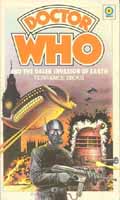 |
| Published | 1977 | |
| ISBN | 0 426 11244 X | |
| First Edition Cover | Chris Achilleos |
| Back cover blurb: The TARDIS lands in a London of future times - a city of fear, devastation and holocaust... a city now ruled by DALEKS. The Doctor and his companions meet a team of underground resistance workers, among the few survivors, but after an unsuccessful attack on the Dalek spaceship, they are all forced to flee the capital. A perilous journey through England finally brings them to the secret centre of Dalek operations... and the mysterious reason for the Dalek invasion of Earth! |
One of the best by Tim Roll-Pickering 4/2/04
Terrance Dicks often cites this as one of his favourite novelisations of all time and reading it it is not hard to see why. Whereas many of his contemporary novelisations of Jon Pertwee and Tom Baker stories are straightforward translations of the camera scripts into a quick novelisation, this book feels like a lot more work was put into it, with many additions and enhancements to it. Although the original cover features images taken from the movie Daleks: Invasion Earth 2150 AD, this is clearly an adaptation of the television story, but not as straightforward as many. Often scenes have been relocated, such as the bomb intended to destroy part of London is now located in the tunnels by the resistance group's headquarters, whilst at other times the order of sequences changes so that the Dalek saucer now sets off on a specific mission to intercept Barbara and Jenny en route after landing in Bedfordshire rather than deviating from its course on its journey there. Often the dialogue feels subtly different from the televised version, such as the Doctor's departing words to Susan, whilst other details change so that Barbara and Jenny now travel in a dustcart not a milk float. Moments that make little sense on television are also improved, most noticeably the shaft which is now described as something more akin to that seen in the film version and so Ian's survival and interception of the bomb come across as far more believable. The dramatic moment where Larry confronts his robotised brother is also altered, so that Larry now kills Phil in an isolated tunnel before being shot dead by another Roboman, leaving Ian alone and in danger.
The book also feels a lot grimmer than many. The opening line is well known:
Through the ruin of a city stalked the ruin of a man.It is one of the best openings in the Target series and sets the trend. This is a book set in a world where humanity has been bombarded by meteorites, subject to plague, invaded, bombed, attacked and enslaved and is living in fear amidst the remains of a once great civilisation. It is not a joyous place but one where brother is literally turned against brother, as shown in with Larry and Phil, and few punches are spared. The dehumanisation of those who haven't been robotised, most obviously Jenny, is all too clear and the reader is left looking for hope. Fortunately this comes in the form of Susan's growing relationship with David, which is carefully built up to seem natural and with the full approval of the Doctor. Wisely in a book of only 144 pages no time is wasted with long speculation about whether Susan is human or not, something which was never answered on television or even suggested back in 1964, and instead we see a young couple slowly coming together throughout the adventure and its aftermath before Susan faces the agonising choice between choosing between her grandfather and David. Surprisingly Susan uses "the Doctor" several times instead of "Grandfather", a sign of how they are starting to drift apart.
The television story is very familiar, especially with its release on DVD this year, but reading the book one gets the impression that Terrance Dicks was not very familiar with it, possibly because back in 1977 the junkings were still going on and a copy may not have been available to him. The 1990 reprint shares its cover with that year's VHS release of the story and so it is harder than usual to read the book without thinking of the televised story and the conclusion reached is that the book was written purely from the scripts, taking the opportunity to tidy things up. As a result this is a novelisation that feels like more than just a text video of the story and instead comes across as a valid alternative interpretation of the story. This is easily one of the best novelisations in the series and is highly recommended. 10/10
But I really wish an English edition had been released with the cover used for the German release as Kampf um die Erde. That is truly one of the best covers used on any novelisation. For those who have yet to see it, take a look at the scan on the On Target website.
Attack the Daleks! Rebellion! Explosion! by Andrew Feryok 16/4/12
"We are the Masters of Earth! We are the Masters of Earth!"
- A Dalek rebutting the Doctor's defiance, chapter 3, page 33
My relationship with this story has been like a rollercoaster: up and down. I was really excited when I first got this story on VHS for Christmas back in my youth, but when I finally watched the story I was severely disappointed. After repeated viewings, I eventually began to appreciate it for the well-written story that it was with a World War II allegory that I just didn't pick up on as a kid since I was so far removed from the events of that generation. But recently my opinion has gone down again as I am now becoming more aware of the impact directors have on the look of a story and realized that Richard Martin's direction is rather awful and tacky. But despite my up and down attitude, the impact of this story cannot be underestimated. It blew the scope of the show wide open with the first extensive location shooting, it saw the departure of Doctor Who's first companion, and also marked the height of Dalekmania in 1964/65. It also was the inspiration for a feature film adaptation! So with all this to capture, does Terrance Dicks' thin novelization stand up?
Dicks mostly succeeds with his novelization, although I wouldn't say its his very best. It's more a solid or average entry for him. Dicks stays strictly to the original TV serial, except at the end of the story when he uses the Dalek control room from the Peter Cushing feature film. Dicks is still sort of in his early years when he was willing to change the story to make it bigger and better, but there is clear evidence that he is starting to slip as some of his changes had me scratching my head. For instance, he hacks down the iconic moment when Barbara, Jenny, and Dortmun have to make their way through the streets of London while avoiding Dalek patrols around famous landmarks. Granted, it would have been difficult to capture what film is able to do so much more easily, but it's not exactly impossible. Dicks opts to simply cut all this and reduce it down to a few general statements and one single scene: he focuses on one sequence where they try to get across Westminster Bridge.
Dicks also understandably tries to update the Daleks by eliminating references to their dependency on static electricity and their beaming energy into them via satellite dishes on their backs. But in doing so, he has to flub a few explanations. First, he has to explain how the Daleks now have the power to move around without static electricity as their first adventure with them made this a major part of the story. Dicks muddles a strange explanation about how they are like hover craft and moves the reader along before they can think too hard about this. He also later has to justify what David and Susan are sabotaging if it isn't the main satellite that beams their power out. Once again, Dicks has to fudge a weird explanation about how they are sabotaging their communications satellite and how being cut off from this causes them to have a back surge of electricity that causes all the Daleks to short circuit for a short period of time.
But not everything Dicks does in the book is bad. In fact, he does many things well. He captures the bleak feel of the desolated Earth very well, as well as portraying the demoralization of the rebels. He also cuts down on the tedious sewer sequences and generally quickens the pace of the story. He adds little subtle moments such as David taking Susan's hand early in the story to emphasize even more the growing romance between David and Susan. At first, it seems to be a subconscious thing on their part, but it soon grows more and more obvious. The TV story had ended with Susan's future being a little bit scary since she wasn't quite sure of her choice and now that it's been made for her, she's basically stuck with the consequences of it. What if her relationship with David doesn't work out? She has no way of asking her grandfather for help! However, Dicks writes the endings so that, when the Doctor makes the choice for Susan, she is much more confident that it was the right choice and much more clear that their relationship isn't going to fall apart.
Best of all is the way in which Dicks makes the Doctor's character much more central to proceedings than he was on TV. Because Hartnell had a contracted holiday in the middle of the story, the Doctor inexplicably cries out and collapses leading to his being sidelined from the story. Even when Hartnell returns, it still takes a while for the story to finally work him into events. But Dicks has characters throughout the book thinking about him and trying to guess what kind of a solution to the current problem the Doctor might come up with. Also, the Doctor's sudden collapse is eliminated and instead he is the one who deactivates the Dalek bomb that nearly goes off in the alley with David and Susan. However, Dicks once again has to fudge an explanation when David and Susan have to explore the sewers on their own to meet Tyler and get menaced by crocodiles (he explains that the Doctor decides to have a rest while they try to find a route out).
On the whole, this is a pretty decent novelization. It's not exactly Dicks' best, but it captures the original story quite well. Perhaps I just wasn't in the mood for this story when I decided to read it? Nevertheless, I like how he gets the Doctor to participate in events more than he does on TV, and how he does a really good job of building up Susan and David's romance. But some of his changes lead to some fudged fixes. On the whole, a solid novelization that will definitely entertain, but probably won't blow you away. 8/10
A Review by Aristide Twain 16/6/19
...so the ironic thing is that it'll probably be a while before I watch the actual, televised version of this story, seeing how I've already watched two other takes on the same plot and am getting pretty sick of it. The first version, of course, was the excellent bit of fun that is the Peter Cushing movie, which, in its sole greatest flaw, bears the syntaxically nightmarish title of Daleks Invasion Earth 2150 A.D.. (All the rights words are there, but it just doesn't.........!)
The second, and subject matter of the present review, is the Terrance Dicks novelization of the same book, from 1977 - well, no, not even that; what I actually got was the 2009 audiobook read by William Russell (Ian Chesterton in the TV series, way, way back) and Nicholas Briggs (the latest and greatest of Dalek voice artists).
I could recite the plot by heart at this point, but for the benefit of those not currently suffering from Dalek Invasion of Earth overdose: after numerous travels through time and space with 1960s' English schoolteachers Ian Chesterton and Barbara Wright, the two runaway Time Lords known as the Doctor and Susan English, respectively, finally manage to land the TARDIS in what appears to be London, where they have been trying to return Ian and Barbara since the second episode. Unfortunately, it soon turns out that this is 22nd century London, and in ruins at that, following many long years of Dalek occupation.
For indeed, the Daleks, last seen being karmically exterminated by their ancestral enemies the Thals at the end of The Dead Planet, are back with a vengeance. After meeting up with the local resistance, the TARDIS travellers are soon separated, and all sorts of things happen as they trudge about the devastated England trying to figure out what the Daleks want on this planet and how to stop them.
Notable secondary figures in this plot are the laughably named Robomen, a first draft of the Cybermen (being robotized, emotionless humans) who serve as the Daleks' henchmen; Tyler, a resistance leader who has lost the use of his legs but not the will to think up a giant bomb with which to rid the planet of the Daleks' filth; and David, a handsome young fighter in the resistance, who develops into Susan's love interest. (In both the televised episode and the audiobook, his last name is Campbell, but I'm told that in the printed version of the novelization, his name was, rather hilariously, David Cameron.)
So how does it fare?
Well, for a start, four hours and ten minutes is way too long for this story, which was perfectly condensed as the hour-and-a-half Cushing feature. But that can't really be helped, and I know there is much, much worse. (Some Doctor Who audiobooks push on 10 hours! Ten blinking hours!)
As an audio product, it's otherwise quite good. William Russell was always a bit too deadpan for my taste as Ian, but he's perfect as a narrator; he doesn't sound much like himself anymore, it must be said, making the times he's reading out Ian's dialogue somewhat eerie; but, on the plus side, he's very good at voicing the First Doctor. He's not limiting himself to an impression of his late co-star, not by far; he couldn't do that if he wanted to, because Terrance Dicks took many liberties with the original teleplay when turning it into a novel.
If nothing else, the Doctor's farewell speech to Susan is very different, and Russell's delivery of it, accordingly, couldn't be further from Hartnell's serene "one day, yes... one day I shall come back"; the corresponding line in the Dicks script (simply "One day, I'll come back!") is angrier here, as if he's scolding Susan for doubting that he would.
Aside from the weirdness inherent in an old man voicing Barbara or Susan, there is one bit that doesn't quite work, though; the Robomen's voices are described by Dicks as "slurred", and Russell took that, I think, a bit too much to heart. They don't sound like zombies, they sound drunk.
Meanwhile, Nicholas Briggs is predictably awesome as the various Daleks, bringing his full range into it, bless him; it's not that the original voices were bad (1960's Dalek voices, whether on the small or big screen, are the best non-Briggs Dalek voices, in my opinion), but Briggs is an outright wizard. At the drop of a hat, he is the Daleks, and that is because he gets them; as he has explained, when he voices the Daleks, he's not voicing emotionless robots, he's voicing three-dimensional people; it's just that those people happen to be inordinately awful, perpetually angry, little people. Hence he is convincingly confused or vainglorious or angry, without ever forgetting the all-encompassing irrational hatefulness lurking beneath their every dark throught.
The sound design is great; the music, where there is some, is fitting, though a bit forgettable; it's certainly no patch on Bill McGuffie's fantastic score to the Peter Cushing film, which contains, among other things, a marvelously energetic theme song and one of my favorite pieces of movie music ever, 'Fugue For Thought'.
What of the script? Well, it does what it can with the meandering plot; certainly, it conveys the apocalyptic scope quite well, and, while no character is particularly deep, they're all believable people. Dicks is inordinately good at setting up moods, better than he is at thinking up people; thus things are creepy when they need to be or majestic or tense or thrilling. The opening line "Through the ruin of a city stalked the ruin of a man" is justifiably famous.
The story itself, for which, of course, we cannot blame Dicks, is as I said needlessly meandering and needlessly reliant on Susan twisting her ankle at convenient times of the plot, but the sheer fun of a premise like "the Daleks have taken over the Earth" usually makes up for it, and the worldbuilding of what life is like under the Daleks for the resistance forces and for the mining slaves is actually quite well thought out.
Dicks is quite good at foreshadowing the Susan/David romance, but not so much the Doctor's decision to leave her to live with him. The way the televised story made a story arc out of the Doctor's slow realization that she wasn't his little girl any more may have been a bit ungraceful at times ("jolly good smacked-bottom" indeed), but it was something; here there is no trace of it; we spend most of the story with no insight into the Doctor's view of Susan, nor any signs that he's getting on in years in a way that would justify her determination that she needs to stay with him to take care of him. Then suddenly, we're told (in quite a hamfisted fashion) by David that "he knew all along". Well, okay, jolly good, why shouldn't he have? What have we discovered exactly?
Oh, and another failing, simultaneously very small and quite major: Dicks made the very questionable decision to refer to the mining-cart in which Ian gets trapped for most of the climax as a "giant bucket". It is much, much harder than anyone in the production expected to take seriously the travails of a man trapped in what an old British actor keeps calling a "giant bucket" with the utmost seriousness.
All in all, I enjoyed Doctor Who and the Dalek Invasion of Earth, but if you're not a dedicated Who fan, there are probably much quicker, much funnier ways to experience the story, starting with the Cushing film. (Unless, of course, you are visually impaired, in which case, I'm not an expert, but this seems like a pretty fun audiobook.)