THE DOCTOR WHO RATINGS GUIDE: BY FANS, FOR FANS
| Episodes |
6 |
 |
| Story No# |
10 |
| Production Code |
K |
| Season |
2 |
| Dates |
Nov. 21, 1964 -
Dec. 26, 1964 |
With William Hartnell, William Russell,
Jacqueline Hill, Carole Ann Ford.
Written
by Terry Nation. Script-edited by David Whitaker.
Directed by Richard Martin.
Associate Producer: Mervyn Pinfield. Produced by Verity Lambert.
|
|
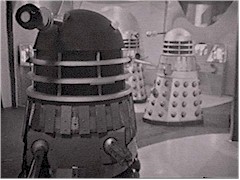
Synopsis: The Daleks return as masters of Earth in the 22nd century, crushing
a small band of resistance fighters and capturing the Doctor.
|
Back to page one (the first twenty
reviews)
Reviews
A Review by Paul Williams
2/3/19
The second story featuring the Daleks is much stronger the first, inspired by the second world war rather than the threat of nuclear conflict. The Bedfordshire camp and the treatment of the humans resembles Auschwitz, and, as the Daleks talk of the final solution, you are encouraged to make the Nazi comparison. Pitted against them is the spirit of the blitz epitomised in Dortmund. This time Terry Nation excels in characterisation, bringing the rebels to life as individuals and giving the regulars plenty of action. Susan's romance with David is nicely plotted, and the Doctor's farewell speech is magnificent.
The problem is the Daleks themselves. Visually, they look more sophisticated and impress when patrolling through occupied London. Such scenes make a mockery of the Doctor's claim that their demise on Skaro is millions of years in the future, until you realise how stupid they are. One rises from the Thames where it had no reason to be. Then they leave a convoluted intelligent test in the saucer cell, to identify the Doctor as someone suitable for robotization and almost immediately proceed to robotize the less intelligent Craddock. They spend ages making a big hole in the earth for an explosive to release the molten core, then fail to protect both the device and the base before being easily defeated. Barbara and Jenny demonstrated how easy it was to control the Robomen, so the Daleks, instead of exterminating them, leave them imprisoned and unsupervised in the same room.
Nation attempts to keep the Daleks in the background, but the Slyther and alligator, whilst adding to the sense of danger, are, like the Robomen, ineffective substitutes. The Daleks missed their opportunity to dominate.
A Dalek Britain by Matthew Kresal
22/12/20
In my review of The Reign of Terror, I noted how Classic Doctor Who rarely engaged in the big end of seasons tales that Modern Who does. If you want proof of that, look no further than the second story of its second season. The Dalek Invasion of Earth is a story that has all the hallmarks not only of those modern finales but of the best tales of the Hartnell era.
That's something down mainly to the sheer scope of the piece. For perhaps the first time in the show's run, there's a genuine sense of an epic feel to proceedings. The Doctor and companions take viewers on a journey across a Dalek-occupied Britain of the 22nd century (even if it looks suspiciously like the 1960s at times). We get to learn of the Dalek onslaught via not only dialogue but get to see it first hand in a series of extensive film sequences shot on location. The best of these are in episodes three and four, with Barbara, along with members of the resistance, trying to escape London as Daleks patrol around various landmarks. Those sequences, and the first-episode cliffhanger, have become iconic and deservedly so in the eyes of this 21st-century viewer.
While the series had pushed to do big scale stories before (particularly with the likes of Marco Polo or The Keys of Marinus), this is the one where it feels like they finally figured out how to do it right. There's the aforementioned location filming, but also how director Richard Martin and designer Spencer Chapman push and often strive against the limits of the multi-camera studio. Even the use of stock footage in places serves the story well when it shifts to the Bedfordshire mine. True, those effect sequences of the Dalek saucer aren't up to much, so much so that it's all too easy to understand why the DVD release has the option to look at some nicely done replacement shots, but that's a small flaw in an otherwise well-made serial.
That it works as well as it does is how grounded it is. Yes, this is a science fiction story with Daleks, Robomen and a weird alien known as a Slyther roaming around as a kind of guard dog. For all of that, the trappings and tropes at play owe less to 1950s sci-fi than to the Second World War. For make no mistake, this is Terry Nation channeling those fears from 25 years before of a Nazi invasion of Britain.
And it's not even done subtley. The way the Daleks insist "WE ARE THE MASTERS OF EARTH", their propaganda broadcasts, the slave labor at the mines, to the use of "the final solution" to describe their ultimate objective in the concluding installment all bear this out. Elsewhere, there are plenty more tropes of Second World War fiction on display, from the resistance members the TARDIS crew encounter, their leader Dortmun's Churchillian speeches, to the black-marketeer Ashton. Even the women in the woods who betray Barbara and Jenny to the Daleks for better treatment, justifying their actions by telling themselves they would have been caught anyway, echoes stories from across Nazi-occupied Europe during the war.
Terry Nation wasn't the first writer to explore the idea of Hitler's Britain, of course. Noel Coward's Peace in Our Time was among the earliest works, written and performed in the immediate aftermath of the war. Also being made around the same time was the pioneering independent film It Happened Here, which likewise features sequences of young men in Nazi uniforms marching around many of the same landmarks we see in episode three. Other works would follow, among the most notable being Len Deighton's thriller SS-GB but The Dalek Invasion of Earth is notable not only for being among the earliest works but also for how it put a particular genre based spin on events.
Lastly, there's a significant first here, one that brings us back around to Modern Who: a companion exit. The last ten minutes or so of the final episode deal with Susan's departure, the Doctor leaving her behind to help rebuild this post-invasion world. It's a beautifully handled sequence, well played by both Hartnell and Carole Ann Ford, the grandfather saying goodbye to his granddaughter. Its effectiveness is helped by the way that the relationship between Susan and a young man named David Campbell is built into the story throughout, setting the stage wonderfully for what would follow. There would be companion exits throughout Classic Who but rarely handled as well as this one was, as evidenced by the likes of Dodo's exit in The War Machines and Leela's departure after The Invasion of Time. Indeed, this sequence would set the stage for the departures we've seen throughout Modern Who from Rose in Doomsday to the many (and finally overwrought) departures of Clara in the Moffat era. All of them, the best and the worst across nearly sixty years, have their basis in what viewers first saw on Boxing Day 1964.
If you only ever watch one Hartnell story, you could do a lot worse than watch The Dalek Invasion of Earth. It is, hands down, one of the best stories of this era. It's also a notable gamechanger for the series, bringing back a monster for the first time, telling its first alien invasion story, and featuring the first companion exit. It deserves it's status based on any one of those reasons but, to the credit of all involved, it's also a cracking story to boot.
And that makes it a rare beast, indeed.
"We are the Masters of Earth. We are the Masters of Earth." by Daniel Shillito
8/7/21
Man, this story does not hold up under repeat viewings, and that's a shame.
The Daleks are back. After the huge response to their first appearance in Doctor Who's second-ever serial, the demand for a rematch with the pepperpots from Skaro was very quickly moved forward in production. Doctor Who's first ever sequel saw the Daleks not on some far-off alien planet, but in the familiar setting of London.
Now, there's a lot to love here, but iconic imagery - the first cliffhanger of the Dalek emerging from the Thames, the Daleks in familiar London locations across the likes of Westminster Bridge and the famous first ever departure of a companion - does not carry this six-parter alone.
However, the pacing of this serial is almost as bad as the first one. I criticise The Chase for being tonally inconsistent, but it at least was fast-paced; this is just extremely dragged out. The direction by Richard Martin is very flat and uninspired in places. Francis Chagrin's musical score is a bit all over the place, and all that stuck in my head were those damn bongo drums. While the cast try and do their best, it's clear there's not a great lot of enthusiasm going around until the very end where William Hartnell delivers one of the finest speeches the programme has ever produced. That speech alone gets 5 stars, but the rest of the story doesn't compare in the slightest. The Dalek voices have had an awful downgrade from their previous adventure, sounding almost as bored as the ones from Day of the Daleks.
Overall, The Dalek Invasion of Earth is an extremely bloated, poorly paced and dull story that seems to be only remembered for the iconic imagery of certain scenes. If you want this story but done far better, you're much better off checking out the Peter Cushing film.
"One day, I shall come back, yes I shall come back..."
5/10
One Day I Shall Come Back... by Jacob Licklider
9/10/22
Doctor Who was a show that was originally estimated to go on for a couple of seasons with the same cast before dying off and most likely being forgotten about. After The Daleks, the estimate was changed to five seasons before the popularity of the Daleks would most likely die down for the show to end. Then something happened at the end of 1964 that led to the show being able to continue beyond that initial idea of five seasons. Carole Ann Ford chose to leave the program, so when her contract ended in The Dalek Invasion of Earth, the production team wrote her out of the show, beginning the trend that characters could come and go as they please with the changing time periods of the show. I will discuss how well the goodbye scene works shortly, but as the title of the story suggests we have Daleks to deal with. The Daleks have invaded Earth and are mining in Bedfordshire to hollow out the Earth and use it as an enormous spaceship, which is just a silly plan as to why they would want to conquer the world, but at least it gives a decent excuse as to why there are remnants of humanity allowed to survive. Their plan makes no scientific sense, but as they appear here they are much more intimidating than in their inaugural appearance. Here they aren't afraid to kill people who disagree with them, as there is a much larger cast that can be killed off.
Terry Nation returns to write for them in his third story for Doctor Who, and while the story is engaging, it does start to show that Nation only has a couple of plots up his sleeve. The story structure feels very much like The Daleks. "World's End" is the mysterious episode ending in the reveal of the Daleks, "The Daleks" and "Day of Reckoning" have the heroes captured then escape by tricking the Daleks into letting them go followed by an ambush on the resistance group. "End of Tomorrow" is the expedition to the Dalek base while "The Waking Ally" and "Flashpoint" are the climax of the story where the Daleks are defeated. What this structure does better is its pacing, as it isn't seven parts long, instead only six episodes to tell the story, which is more ideal as The Dalek Invasion of Earth has more to add to the Dalek mythos than the initial The Daleks. The script is only as good, however, as how well it is realized by the director, and Richard Martin actually doesn't do that poor of a job with the material. He was able to get several days for location filming around London, which were shot beautifully, showing off the sights, and he was able to mix them well into the sets he had built for the story. Those sets, especially the Dalek saucer and Dalek base and mining sets all come across really well, as the team had more production space to work with this time around instead of the small Lime Grove Studio D. Martin isn't perfect, however, as there are several points where he really doesn't use the space properly. This is mainly when rubble falls on the TARDIS when shot in close up and the cliffhanger to "The End of Tomorrow", which has the cameras jolting all around so as not to see what the Slyther looks like.
William Hartnell as the Doctor has his largest change here to his character, as now instead of having stories motivated by a desire to get back to the TARDIS, he now has an active stake in the events wanting to help the people of Earth. It is the Daleks that brings out the Doctor's moral side, as he has the call to action against them. Hartnell also generally gives a good performance in this story, even if he had to be written out of "The End of Tomorrow" after a back injury. He really shines with Susan, as going in Hartnell and Ford were prepared to say goodbye and it shows in both their performances. The actual goodbye is the final change for the Doctor, as he knows that this is time for Susan to settle down and she will be safe here while he keeps on running. The final speech from Hartnell is great, and it overshadows the rest of the story, which wouldn't be remembered nearly as well as it is without it being written in at the last minute to close out the story. It also helps that all the actors got a month off after the filming of this story, as the production block had ended and would continue with The Rescue once they had cast a replacement.
To summarize, The Dalek Invasion of Earth isn't really a story about the Daleks, but a story about the Doctor and Susan, looking back on how far they have come as characters. Its biggest flaws are that the direction and pacing of certain scenes are badly timed in several places for the story to truly be perfect and the plot itself still takes its main structure from The Daleks, which had only finished airing ten months earlier. The acting is on form even if the rest of the cast is lackluster and the location work really is a feast for the eyes. 85/100
Back To The Future by Rem Morrison
21/8/26
Wow --- a lot that bodes ill for the state of the franchise here, isn't there? The ratcheting up body count is disgusting and doesn't represent the show as fans had known it at this point. Several subplots don't drive the main thrust of The Dalek Invasion of Earth at all --- think the cynical collaborators in the mines or the woods, the Sawardian carnage wrought on people who befriend and travel with the cast only to be choked by their own siblings. Worst of all is the nauseating feel-good "power of humanity" denouement --- all it appears to take is the words of the Doctor and his companions to make people rise up against their near-invincible Dalek oppressors and topple them. All it's missing is bloody Murray Gold...
All right, I jest. I've recently been digging back into Classic Who after a long time away from the franchise and a patchy folk memory of how a lot of the significant episodes actually work in execution. The Dalek Invasion of Earth was, I thought, meant to be a dreary dud, with ambitions at once too expansive for a soundstage and a Sunday morning's location filming, and too limited for a six-parter.
Instead, I thought it was tremendous. The self-evident weaknesses seem like an inevitable product of how the show was made at this point, while the strengths portend various ways the show is going to be told for the next 60 years. The uncanny wrongness of Earth being compromised, for example. Or a significant companion's departure. Or people from the future acting and talking like regular folk (sure, this one will wax and wane...) It's a treasure.
Let's start with the setting we're presented with at first --- the initial Roboman we see lowering himself in the river, the bodies sign, the dilapidated settings and the marvellous, creaking organ/harmonium score. More than any early serial bar the blasted forest and spires of the first Dalek story, this really lets us have it and has more in common with horror than the First Doctor's era is given credit for. Really, the effective worldbuilding for the Dalek invasion --- propaganda broadcasts, block-by-block bombings of abandoned industrial areas, a brave underground resistance --- has come from the talents of a cast and crew with living memory of the Second World War (particularly the Blitz). Most of that 'resistance' supporting cast --- Bernard Kay, Ann Davies, and Alan Judd in particular, though no one's a disaster in the ensemble - play things with a real grit and gravitas. Like the future in Bad Wolf/The Parting of the Ways, you get the sense this was a real world where people turned up in ties and got to work before disaster struck, rather than space jumpsuits or "ten solar years ago" and all that. The scene in the woods with the two women is marvellous. We'll see plenty of big cheeses who are deluded with power attempting to go toe-to-toe with the Daleks later on, but this is a chastening reminder that the little people in this situation will do whatever they have to for bread, oranges, sugar and another day.
And as for when the exposition does go on? There's a fantastic sequence in Part Two (whether it was envisaged by Nation, Richard Martin or both) where an account of the invasion itself pivots between the Doctor, Ian and Craddock in a cell and Susan, Barbara and David underground. Then we get what I believe is one of the show's first flashbacks (or perhaps more accurately, an illustrative montage, a little like the vignette of Morgus's venality twenty years later in The Caves of Androzani). Martin, who got lumbered with three-and-a-half of the longest and most technically demanding early serials, has come in for some heat. But the film-shoot material here is pacy and atmospheric, and certain sequences like the raid on the saucer are dramatically lit and clearly staged. Other than boom-mike shadows everywhere in the race to get this in the can, his biggest weakness here is the overenthusiastic use of some pretty inapt stock footage (that tiny smiling alligator in the sewers is the most Ed Wood part, but the random disaster footage at the end isn't great either). If anything, the team needed to have a tighter rein on Nation's more Dan Dare comic strip ideas, which lead to follies the show could have never convincingly done.
The Daleks come in for a bit of criticism here for the ungainly design modifications, but I like the thought that's gone into their return. Someone had confidence in a young audience's ability to remember their rules last time and make the changes make sense. The weirdest (dare I say, 'timey wimey') part is Nation/the Doctor's theory that we're seeing them earlier in their history, a notion that doesn't square with their introduction or subsequent lore. My personal head canon is that Hartnell's Doc, who really staunchly comes into his own here as the scourge of tyrants and is fantastic winding them up, didn't want to admit he hadn't beat them fair and square the first time. Anyway, it's more interesting to think of them as still early in their galactic ascendancy here --- using biological warfare methodically in lieu of a huge invasion force, clumsily harnessing solar power, and hoping to turn a planet into a mobile beachhead. The voices are almost as crap as those in Day of the Daleks, but at least they're not being written as robots.
More than anything, there are hints that they really are sadistic bastards here --- that chilling "The Daleks offer you... life" broadcast, the notion that the Black Dalek keeps something from Skaro as a imperial pet and how incensed they get at any disrespect. Seen through this eyestalk, even the Robomen work. They're not Cybermen, they're a demoralising and horrific form of warfare where people see their friends and families turned into lobotomised slaves.
The four regulars all have a reasonable showing, notwithstanding the 60s tendency to have someone imprisoned, incapacitated, or unconscious/on holiday at least once. Barbara and Ian are both given sub-companions and sort of mini-quests of their own, and Jacqueline Hill and William Russell are obviously hewing to opportunities for the characters as conceived, with Ian up to the elbows in electronics in a plummeting bomb and Barbara crafting a fake history lesson to distract the Daleks. It's a shame that Carole Ann Ford is given a twisted ankle to work with at the start, but she imbues Susan with humour and spirit elsewhere ("I eat"; "I hope I'm never like that, pretending not to care"). The minimal work to show a budding romance works, as far as a 1964 kids' show can. Ford and Hartnell (and Peter Fraser --- who's a bit thin and affable, but works when everyone else is so dour) are genuinely charming in that campfire scene.
Hartnell works really well as a twinkling and stern master of ceremonies, encouraging and corralling all the characters towards a final victory. It's the first "humanity moves mountains inspired by the Doctor" climax, and while we'll eventually see too much of that, I prefer it philosophically to "the Doctor as superhero" for those who can't save themselves as a way to defy possible odds. Remember, at this point in the show, we've mainly seen mankind as subject to the brutal determinism of their time, place and society, so throwing off their shackles and crowdsurfing the Daleks feels cathartic: rewriting history, in so many lines.
In any event, we're still left with a ruined London and the ragged chimes of Big Ben, not a reset. Earth is permanently changed, and so the eventual stakes feel more meaningful than 45 minutes of The Power of Three--style "everyone's buying electric toothbrushes that will take over the planet, but we stopped them".
Count me in as (another) big fan of the departure scene and Hartnell's speech, too. I've always found criticisms informed by all the lore since then a little bit glib, even bad faith --- "the old git never comes back in his later regenerations", "what happens as Susan doesn't age?", etc. In proper context, this is the elderly main character in a telly programme that will only be around another one or two years saying a final goodbye to his only known family. He does so in the knowledge that she'll never leave him and his risky itinerant lifestyle otherwise, potentially denying herself the chance of an ordinary life. It's a bit sudden and mercurial, but it's not uncharacteristic of the First Doc to brood on a significant decision and make it without any announcement.
It can't be as perfect as small scale triumphs like The Aztecs and The Rescue, but part of the show's vivacity and charm from here will be to occasionally go for improbable blockbuster glory with mixed results. It's somehow unrelentingly grim and unrelentingly optimistic and cements the Daleks as both a narrative and pop cultural force. I like it a lot.