THE DOCTOR WHO RATINGS GUIDE: BY FANS, FOR FANS
| Episodes |
7 |
 |
| Story No# |
2 |
| Production Code |
B |
| Season |
1 |
| Dates |
Dec. 21, 1963 -
Feb. 1, 1964 |
William Hartnell, William Russell,
Jacqueline Hill, Carole Ann Ford.
Written by Terry Nation.
Script-edited by David Whitaker.
Directed by Christopher
Barry and Richard Martin.
Associate Producer: Mervyn Pinfield. Produced by Verity Lambert.
|
|
Synopsis: The Doctor, Ian, Barbara, and Susan encounter the malevolent survivors
of a nuclear holocaust, who are destined to become the Doctor's greatest
enemy... now in colour!
|
Reviews
Old Daleks Made New by Matthew Kresal
4/10/25
New versions of Doctor Who serials are nothing new. Omnibus broadcasts in the 1970s that often cut serials down to a 60- or 90-minute BBC time slot, those versions making it onto home video in the 1980s, or special edition versions of everything from The Five Doctors to Silver Nemesis and The Curse of Fenric even before DVD and Blu-Rays arrived. Perhaps the natural successor to that would be to take a 1960s serial and do the unthinkable: make it more palatable to a modern audience. In time for Doctor Who's 60th anniversary in 2023, that is exactly what happened with The Daleks in the form of a 75 minute colorized version. Would the final result be blasphemy or a revelation?
The underlying idea is nothing new, even beyond the aforementioned examples. Colorized clips from the black-and-white eras of William Hartnell and Patrick Troughton have been appearing in DVD extras and in Modern Who for well over a decade now. Nor is taking this approach to a Classic Who serial new, as it's what the DVD special editions of Enlightenment and Planet of Fire attempted to be fifteen years ago. Namely, to take a serial from what we're calling Classic Who these years and give it something a more modern polish and pace. Those serials didn't need it (and in the case of Planet of Fire they went overboard to the point of taking the title literally with their new CGI effects). To do that approach and make it work, you need a serial that actually benefits from that approach rather than one arbitrarily selected by a DVD extras producer because its director was still alive at the time.
The Daleks is such an example. Yes, it's the first Dalek story, a classic and the thing that perhaps singlehandedly guaranteed that Doctor Who would have a future beyond 13 episodes. On the other hand, given the Peter Cushing film managed to cut Terry Nation's scripts down to about 80 minutes, it's clearly a story with more than a fair amount of padding. This new edit from Benjamin Cook proves that by offering a fast-moving version of it that, honestly, doesn't lose much in terms of actual plot. Indeed, condensing things like the cave trek to the city by Ian and Barbara alongside the Thals improves rather than detracts.
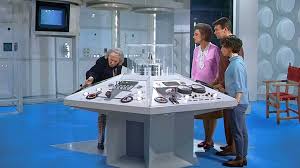
And what of the colorization? On the whole, it looks remarkably good. The color choices are vivid, evoking the Technicolor spectacle of the Cushing film while also making some decisions of its own such as giving Barbara a bright pink blouse. It's something that is immensely effective except in a handful of shots where the original film quality isn't great to begin with. On the audio front, the new sound mix from Mark Ayers adds so much depth, especially considering the "as live" nature of the original recording limited the soundscape beyond what could be played into the studio. Perhaps the prime example of Ayers's new work comes in the scene where Ian and the Doctor pull the creature out of the Dalek shell. An already memorable moment, it has never been more chilling than it is with the added creature sound effects. Tip of the hat, too, on the score from Ayers that wonderfully complements the original Tristram Cary score by and large.
Is it perfect? No, and some of the criticisms made by Classic Who fans seem valid. It does get flashback-heavy in places, yes, a necessity to cover some of the editing choices made by Cook. The escape sequence where Ian is in the Dalek plays out as a nice heist-like scene, but the cutting back and forth is rapid to the point of approaching confusion. It perhaps wouldn't have been a bad thing to take a further cue from the Cushing film and it let run to 80 minutes to give it a bit more chance to breathe. And, like with much of Modern Who, there are times when the sound mix and music does threaten to intrude on dialogue.
Is it a worthwhile venture? For this reviewer, undoubtedly. Can I see why some Classic Who fans feel it to be at best unnecessary or, at worst, an attempt to invalidate a classic? To an extent, yes. It's something that comes from those who have the view of Classic Who and archive TV in general as something sacred and untouchable. Things which, as Russell T Davies says in the making-of included on the Blu-Ray release, aren't meant to be viewed solely as museum pieces. Or, indeed, lest we forget that museums renovate to find new ways of presenting things to visitors.
That is ultimately what The Daleks in Color accomplishes. It's an engaging vision of a classic story, one that ultimately preserves the best of what could have been a moribund museum piece and shows it in a whole new light (or, rather, color). Does it replace the original? Nope, it's even included as an extra on the Blu-ray release. The result is a revelation, but thankfully not the Revelation of the Daleks.