THE DOCTOR WHO RATINGS GUIDE: BY FANS, FOR FANS
| Episodes |
7 |
 |
| Story No# |
2 |
| Production Code |
B |
| Season |
1 |
| Dates |
Dec. 21, 1963 -
Feb. 1, 1964 |
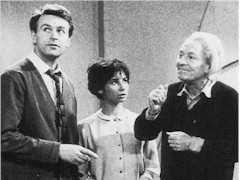
William Hartnell, William Russell,
Jacqueline Hill, Carole Ann Ford.
Written by Terry Nation.
Script-edited by David Whitaker.
Directed by Christopher
Barry and Richard Martin.
Associate Producer: Mervyn Pinfield. Produced by Verity Lambert.
|
|
Synopsis: The Doctor, Ian, Barbara, and Susan encounter the malevolent survivors
of a nuclear holocaust, who are destined to become the Doctor's greatest
enemy...
|
Back to page one (the first twenty
reviews)
Reviews
A Review by Declan McKeown
25/7/08
Most people say The Daleks is one of the best Dalek stories .
Yet I would have to disagree with them for a few reasons.
The first reason is because the whole thing drags after the second
episode mostly because of Ian saying that he can't feel his legs, and also
because of pathetic acting from the people who played the Thals.
Also the Dalek voices are terrible and the dialogue is lousy. I mean,
episode six's cliffhanger is woeful and the way the Daleks themselves are
dispatched is laughable. The statue thing that the Thals are carrying is
portrayed by the most amateurish modelwork and the way the TARDIS crew and
the Thals escape from the Dalek citadel is not even shown.
The visual effects for the time might have looked impressive but now
they end up looking cheap and dated. The lake of mutations is not
necessary, the cliffhanger featuring it is as you'd expect - rubbish - and
half the story is spent running around corridors and the other half is
spent moving around boring and dreary-looking locations. Hartnell also
looks bored rigid.
When I sat down to watch this, I had my doubts but I was expecting
something better than the end result. I was put off watching William
Hartnell stories but I am watching them again because of true classics
like The Aztecs and The Dalek
Invasion of Earth.
It took me a week to watch this dreary rubbish, yet some bits of this
story are good, like a creepy episode one and impressive Daleks. But
ultimately this is nothing more than an exercise in padding.
2/10
A Review by Anthony Smith
29/8/09
Just to prove that everyone is different and opinion is subjective, I'd
like to completely disagree with certain other reviews of the absolute
classic, The Daleks. (And while we're about it, The Dalek Invasion of Earth is pants.) The
Daleks carries on the wonderfully gritty style of 100,000 BC, carrying on with the point of view of Ian
and Barbara, now adrift on a strange alien world. I adore the way they
accept it so readily: no melodrama, just numb acceptance.
The great thing about The Daleks is that every single episode
title describes what happens in the next twenty two minutes (The
Escape, The Ambush, etc) and you then get the most
bottom-clenchingly tense episode; every one of the seven episodes project
the story forward a huge amount. The first four are completely about the
time travellers' ordeal, and what an ordeal! Considering everyone claims
that at first Doctor Who was simply a kids' programme, we here have
the second story ever, in which, by the second episode, every one of our
heroes has radiation poisoning and is surely going to die a horrible slow
death. I can't decide if it was more scary in the sixties where the threat
of nuclear war was ever present, or in the modern day where we have all
been deeply emotionally scarred by Where the Wind Blows.
The Invasion of Time is always cited as how
to do a long story correctly, with it split into two parts. Here is the
blueprint. In one of the earliest classic cliffhangers, the TARDIS crew
are finallly free of the Daleks' city, when it gradually dawns on Ian that
he has left the fluid link in the hands (plungers?) of the Daleks, and
they have to go back. We then have a very uncomfortable few scenes where
the Doctor and Barbara want to casually use the Thals as their own
disposable army to get them back, with Ian getting some great moral
outrage across.
Everything switches for the last couple of episodes, as we switch to
the Thals' point of view. The spotlight is firmly on Ganatus and his
brother, Antodus. Antodus isn't brilliantly acted, but you can really see
his perspective. He doesn't understand why they have to risk their lives
to help the others, but only signed up because his big brother immediately
did. Ganatus covers for him when Antodus tries to cowardly leave Ian and
the others, and when he kills himself - beautifully, you are never sure if
it is to save Ian (doubtful), or if it is just because he would rather die
than show any backbone whatsoever - Ian finally clicks that Ganatus has
just been carrying his kid brother, and shows some understated compassion.
Well, I say understated, but let's face it, William Russell does his
job, but he's no Brando. (Show me a dad who isn't a tearful wreck in any
of Jor Els' scenes in the director's cut of Superman, and I'll show you
someone who, well, isn't me, I guess.) Jaqueline Hill, though, shines
throughout. Considering Who companions are always considered to be
very wet screamers, Barbara is probaby the strongest woman in the history
of the classic series, and Hill never ever puts in a duff performance. I
cheered when she grabbed Ganatus and kissed him at the end. The Daleks
themselves are obviously brilliant, though it's surprising how they talk
together: they say things like "Precisely that" instead of "Yes", although
they really feel like characters instead of your tin plated pepperpots.
Okay, it's a bit rubbish where the Thals run in and just push the
Daleks over at the end, but what else could Nation do? In any real sense,
the Thals would be slaughtered, but, let's face it, it's good, but seven
episodes is enough. Hartnell's great as usual and Carol Ann Ford isn't as
bad as in the first story (seriously, what is with that weird head lolling
running?). Utterly brilliant, overall.
The second best Dalek story by Roland Thompson
22/3/10
In my opinion, this story would rank as the second greatest of all
Dalek stories, close behind Genesis of the Daleks. In
The Dead Planet, one gets a genuine sense of atmosphere from the
outset with haunting mechanical tones set to an aerial view of the
as-yet-unnamed planet Skaro. In the previous story, it was Barbara
reassuring Ian when he became frightened, and now the other way around; an
excellent juxtaposition.
There is a wonderful sense of voyeurism throughout the entire first
episode. We really do get the sense that these characters are being
watched. With only the main characters, we don't have as much dialogue to
get in the way of the visuals (the city) and the music (mechanical and
haunting) to interfere with building the natural tension. Long, drawn out
dramatic pauses allow the tension to build yet there is still some
remarkable dialogue, Hartnell displaying a pomposity and dramatic flare
that most other Doctors couldn't pull off ("Uninvited passengers... I
didn't invite them into the ship!").
This is part of what made Hartnell's portrayal the greatest of all the
Doctors in my humble opinion. His cantankerous nature was tempered with a
moral fiber that was unrivaled by any other Doctor. You loved his inherent
tendency to be a curmudgeon. Why? Well, you also knew that it came from
the same sort of old school, flaming teapot, haughty nature that also made
him angry with injustice and firmly committed to the righteous.
By the end of part one (The Dead Planet), the viewer feels an
eerie sense of desperation. Ian, Susan and the Doctor are all inexplicably
disoriented, the Doctor having no idea what destoryed life on this
planet... for now. Meanwhile, Ian earnestly waits for the return of
Barbara, who has been trapped in a maze of corridors by Daleks who finally
approach her as she screams in terror... Without a doubt the best
Doctor Who cliffhanger bar none.
With that we go to The Survivors. The drama in this episode
focuses on some breathtaking dramatic scenes in a Dalek prison room where
Ian, Susan and most especially Barbara and the Doctor wallow in
radiation-addled illness. Susan must show her teenage spitfire like
bravery, venturing out among mutated Thals to recover their (the Thals)
radiation medicine with Ian crippled by a Dalek gun; Barbara and the
Doctor too weak to move. Perhaps the most grit and raw drama of all the
different situations throughout the story can be found here in the second
episode.
In the third episode, The Escape, we see the best interplay
between the four main characters in the story. As in the previous episode,
we see Ian portrayed as the leader whereas the Doctor is more a cunning
and sometimes even devious ally (lying about the fluid link). The
playacting to throw the Daleks off the scent is an especially nice touch.
The benevolence of the Thal Alydon reinforces the evil nature of the
Daleks ("if they call us mutations... what must they be like?"). There was
so much movement and action in the first story (100,000
BC) that we didn't really have a chance to see the characters relate
to each other as people as we do here in the third episode of The
Daleks. Susan has had a chance to show her bravery and Ian has
successfully played the role of courageous leader. Of course, now it's
Barbara's turn. To stop the Daleks with something so simple (mud) gives us
a sense of whimsy yet this does not detract from the drama and genuine
sense of panic we feel as the four attempt to deactivate a duped Dalek!
The final shot of the creature's arm popping out from beneath Alydon's
cloak must also rank as a hall-of-fame cliffhanger.
In the fourth episode, The Ambush, the dramatic focuses shifts
much more decidedly towards the Thals and their situation. This covers the
much more intellectual nature of the story which begins to manifest at
this point. Issues such as the cosmic fate of worlds (epic fare reserved
usually for traditional thought-provoking science-fiction novels; Poul
Anderson, Issac Asimov, Arthur Clarke, Edgar Burroughs, etc), pacifism and
the consequences of nuclear technology and indeed nuclear war are all
brought to bear here, and these deeper intellectual aspects of the story
come to fruition here. That aside, much of the action was centered around
the escape from the Dalek city. Ian's escape from the Dalek machine, the
scenes with the lift and Ian's attempt to warn the Thals are some of the
most-well-filmed action in the programe's history and holds up even to
today's standards. Though reluctant to leave the Thals to their doomed
fate, the Doctor and company are ready to be on their way after what
they've been through when Ian discovers that the fluid link, which had
been functional all along, was taken from him... in the city.
Another great cliffhanger takes us into the next episode, The
Expedition. In one of the most pivotal scenes from this story, Ian
forces the Thals to defend themselves. This early in Doctor Who and
we already see gritty moralism and realism. The Doctor and Barbara want to
use the Thals to fight for them so they can leave Skaro but Ian realizes
that that Thals must want to fight for themselves and by teaching them to
do that ensures that they will fight willingly and not retreat into their
plateau "There is nothing wrong with being afraid to die but there is a
terrible shame in being afraid to live!"
We have a grim set of circumstances to contend with at the beginning of
the classic harrowing sixth episode, The Ordeal. Ian and Barbara
are part of a two-party force out to attack the Daleks. However, the way
is fraught with many dangers as the classic lake beast claims a victim.
There are remarkable feelings of tension when watching the cave sequences
even in comparison with a modern gritty horror film. The chemistry between
Ganatus and Barbara is shockingly believable and carefully developed for
television at this time, not to mention how natural the flirtation is for
the early 60s. The fatalistic character of Antodus is also nicely
constructed, as is his relationship with the brother, Ganatus. You can't
help feeling sorry for both of them and what ultimately happens between
them creates some great drama in the sixth episode...
After the tragic heroic beginning to episode 7 (The Rescue, not
to be confused with the second season, two-part story The
Rescue), Ian, Barbara, Ganatus and Kristas keep looking for a way into
the Dalek city through the mountains and the caves. They realized they
were only a few feet away from the city when they saw light coming in. The
Doctor, Susan, Alydon, Dyoni and the other Thals tamper with the Daleks'
instruments by reflecting their energy back at them. Again, Doctor
Who's tradition of staying within reality and realistic drama is
reinforced when Ian reminds the despairing Ganatus that his brother died
for something, even if he had been afraid and contemplated treachery. A
strong old chunk of moralism in the very early weeks of the show.
The Daleks know they must destory Skaro to survive, making them all the
more bent on destruction. While Susan and the Doctor are prisoners of the
Daleks, Alydon and a group of Thal men storm the defenseless city (they
were blocking their defenses while Ian, Barbara, Ganatus and Kristas storm
the Dalek control center at the same time). It is the Doctor Who
equivalent of the gunfight at the OK Corral. The Daleks' power is dying
out rendering them immobile. They beg the Doctor to save them who replies
with yet another classic Hartnell line in this story (the others are too
numerous to mention), "Even if I wanted to, I don't know how." An epic
struggle which portends the challenges that the Doctor and those he calls
his companions will face in the TARDIS; "No doubt you will have other wars
to fight".
The Daleks is the second greatest Dalek story of all time, one
of the five greatest Hartnell stories of all time and one of the ten
greatest Doctor Who stories of all time. As we ponder on fighting
to defend what we believe in and those that we love, as we think on the
consequences of our actions in the world and how the things inside our
hearts lead us to good (Thals) and evil (Daleks), we might remember that
while good may not always have as much power, it has much more strength.
We might remember that powerful secrets and powerful knowledge are not
worth their price if we live in an underground shell like the Daleks. We
might remember that it is better to have known and loved someone then to
have not, even if they leave us. We might also remember these words from
the good Doctor himself, voiced by the one and only William Hartnell:
"You wanted advice, you said. I never give it, never. I will
say this. Always search for truth. My truth is in the stars and yours is
here"
10/10
A Review by Francis Salvi
17/4/11
When they first appeared in the chilly Christmas season of 1963/1964,
no one could possibly imagine how successful they would become, how they
would send kids scurrying behind the back of the sofa. But they have
become successful, they have sent kids behind the sofa ever since. Who are
they? The Daleks of course!
Following the relatively dire An Unearthly Child,
the series really gets into gear with The Daleks, a seven-part epic
by one of the series' most prolific writers, Terry Nation. What he has
done is crafted a wonderful seven episodes that have become immensely
popular, even being made into a feature-length film, Dr.
Who and the Daleks.
Personally, I find this an immense improvement over An
Unearthly Child, with the seven episodes neither moving too fast or
too slow, just how I like it. We see a more selfish side to the Doctor
when he sabotages the fluid link. We also see the first signs of the crew
moulding into a sort of family. The city itself is remarkable, even if the
background in some scenes is just a painted backcloth. I find the scene
where the Doctore confesses he sabotaged the fluid link to be a tense and
enjoyable moment. But the scene most people remember of this serial is the
image of the arm of an unknown creature menacing Barbara at the end of the
first episode, which I think is one of the finest cliff-hangers in the
series if not the finest.
The Daleks themselves are well-realised. An obvious image of Hitler and
the Nazis, they must have brought back memories of World War Two. In this
story, they show a cunning not seen anywhere else, deliberately goading
the travellers into trusting them and manipulating the Thals into coming
to the city so they can exterminate them. There is also the first
appearance of an Assault Dalek, which might not be as well-realised as the
one in The Parting of the Ways in the new
series, but it opens up the mind to how many variants of Dalek there might
be.
The other inhabitants of Skaro, the Thals, are not so great. Wearing
shocking hot pants and tops that I'm still convinced to this day were
re-used in 1968's The Dominators (even though the
tops in that story were a lot bigger), they come across as pretty
pathetic, even for pacificts. The other unconvincing element is the lizard
creature glimpsed occasionally in the jungle scenes in the first half of
the story.
The latter half of The Daleks focuses on the Doctor, Susan, Ian,
Barbara and the Thals' efforts to find their way into the Dalek city. The
side story, of Ian, Barbara and one batch of Thals making their way
through the caves, is pretty exciting stuff, with one of the most touching
self-sacrificing scenes in the entire black and white era of Doctor
Who. The other half of the quest, the Doctor, Susan and another batch
of Thals trying to disable The Daleks' sensors, is equally exciting. The
resolution is a bit rushed, and the tipped-up Daleks look a bit pathetic,
but these are only minor quibbles in an otherwise fantastic story.
At the end of the day, The Daleks is a story no Whovian should
miss. And for those looking to introduce their friends to Doctor
Who, they should show them this as their first black and white story.
Verdict: 9/10
A Review by John Laking
9/1/14
The Daleks saw the Doctor and the TARDIS crew make their first
trip together to an alien world and in doing so encountered their first
alien beings, who would prove to be the most iconic in the series'
history. The impact of the Daleks was immediate and saw the show's viewing
figures climb dramatically, establishing it in the public consciousness.
As a creation, they transcend the programme and it is remarkable to think
that they represented just the kind of 'bug-eyed monster' that the series'
creators had initially set out to avoid.
Following on from An Unearthly Child, the initial
exchanges in The Daleks are a slight disappointment. The dialogue
between the show regulars that had sparked with tension in the first story
here falls a little flat. Terry Nation, the writer of the serial and
creator of the Daleks, has a reputation for writing good adventure
stories, but his dialogue is often less impressive. The actors also seem
to be having a tricky time delivering the lines, with their excellent
naturalistic performances from the first serial slightly slipping in
quality in the early stages of the new adventure. William Hartnell fluffs
the odd line, but I should point out at this stage that these mistakes
have never bothered me. There's an argument from some fans that many of
the so-called fluffs were deliberate on the part of Hartnell as part of
his characterisation of the Doctor. Personally, I think the fluffs are
understandable mistakes given the pressure on the actor and the
ridiculously tough recording schedule he and the acting team had to deal
with. There are times when they interrupt the flow, but more often than
not they make little difference and, deliberate or not, can be seen as
part of the charm of the first Doctor.
The Daleks had two different directors over its seven episode
run, Christopher Barry and Richard Martin. Both make some interesting
choices and there are some very nice touches such as when Barbara places
her hand on the camera lens when feeling her way around a wall. Generally
though, the more interesting and experimental elements of the direction
jar with what is a pretty static piece. In particular, the directors
seemed to struggle with exactly how to make the scenes involving just the
Daleks seem interesting given their lack of movement and often long
speeches. That said, Barry does provide us with one of the most iconic
shots in Doctor Who history as episode one ends with Barbara
pressed against the wall in fear as we see a Dalek arm approaching her.
So to our eponymous monsters. They make their first full appearance in
episode two and the first thing that is noticeable about them is how
incredibly verbose they are. The nature of the Dalek speech pattern and
their relatively static nature in this serial does cause a few issues with
the flow and rhythm of the adventure; nonetheless, their initial
appearance makes an immediate impact. It's well worth stating that this is
in no small part down to the brilliant work of Raymond Cusick. The design
of the monsters has barely changed in fifty years and the many subsequent
attempts to recreate their success by later designers demonstrates just
how impressive Cusick's achievements were. It is also notable that at this
early stage the Daleks haven't quite developed their exterminate on sight
policy. They initially simply temporarily paralyse Ian when he attempts to
escape and overall these Daleks are far more scheming and thoughtful than
many of their later incarnations. In episode four, we get our first tiny
glimpse of the insides of a Dalek. I mentioned in my review of An Unearthly Child how particularly in the early stages
of the show much use was made out of the reactions of the actors to events
happening off screen. This is a classic example of how well that can work
to cover up a limited budget and the limits of special effects. When Ian
and the Doctor lift up the lid of the Dalek casing their reaction is
immediately one of horror and disgust. It's a wonderful moment and it
allows the audience to imagine what they may have seen. Shortly after we
get a glimpse under a Thal cloak of the Dalek and, though it is only
fleeting, it can't really live up to the effect of that initial reaction
shot.
By the end of the serial, there are the first signs of the Doctor who
we see as a hero starting to show themselves. However, at the beginning,
he is still very much the untrustworthy and seemingly selfish individual
we left at the end of An Unearthly Child. As the
TARDIS crew land on the unfamiliar planet, they all agree that they should
leave as soon as possible and only the Doctor wants to stay. He therefore
lies to his companions, claiming that he needs mercury for the TARDIS
fluid link in order to leave, ultimately endangering the lives of them all
just to satisfy his scientific curiosity.
His first thought remains his own safety and he is seemingly quite
happy to leave Barbara stranded when it first becomes clear they are in
danger, even snapping at Susan when she challenges him for this reaction.
Despite this, there is evidence of a bond developing between him and
Barbara later in the story. First he praises her ingenuity when they
overpower the Dalek and then later they form an alliance when attempting
to persuade Ian to use the Thals to get into the Dalek city. Ian's
relationship with the Doctor remains frostier, but they enjoy a nice
moment after the Doctor gets Ian's name wrong. The Doctor remains happy to
leave the Thals to deal with the Daleks on their own until he realises
they cannot leave without first returning to the Dalek city. It's
noticeable though that at the end of the adventure the Doctor remains with
the Thals for longer than is absolutely necessary, suggesting that his
meeting with the pure evil of the Daleks, coupled with his introduction to
Ian and Barbara, has already made him re-assess his general policy of
non-intervention and self-preservation.
As the Thals are introduced, the story turns into an attack against
pacifism as Ian and the crew attempt to persuade their alien allies that
fighting the Daleks is essential if they are to survive. Sadly, the Thals
come across as being rather bland. It's ironic, given the clear influence
of the Nazis on the Daleks, that the Thals are positively arian in their
looks. Furthemore, while they look mostly the same, they are also fairly
indistinguishable as characters. The exception is the character of
Antodus, who though mostly whiny and cowardly, does have his own
personality and when eventually dying in a moment of self-sacrifice he
completes an interesting character arc that is sadly lacking with his
fellow Thals. Of course, the TARDIS crew do eventually manage to persuade
the Thals of the need to fight and the Doctor's response of "the mind will
always triumph" to Ian's query of how they were supposed to take on the
Daleks with no weapons can be seen as a defining mantra for the show in
the ensuing years.
The link between the Daleks and the Nazis is often mentioned and it's
clear from very early on in their creation, most blatantly in episode six
when their arms point upwards in a Nazi style salute and they chant about
becoming 'the master race'. Ian had earlier pinpointed the Daleks hatred
of the Thals as simply a 'fear of the unlike' though there is again a
slight irony in the positioning of this statement. It comes in the middle
of a scene in which Barbara and Ian talk regularly of a lack of humanity
and human characteristics in the Daleks, and the tone and manner of their
speech makes it clear that they are including the Thals under the umbrella
of the term 'human' simply because they look like them, when of course
they are really just as alien as the Daleks.
Ultimately, The Daleks isn't the best Dalek serial in Doctor
Who, but as the first it is an early watershed moment in the history
of the show. The Daleks themselves are very successful and they provide a
genuine menace that makes it easy to understand why they caught on to such
an enormous extent. The Doctor and his companions' relationships are
continuing to develop alongside the series itself. A development that
would kick on once more with the next serial, the unique The Edge of Destruction.
"The unwilling adventurers" by Thomas Cookson
20/1/16
One thing is clear when looking back on Hartnell's era. This wasn't an
era where the Doctor was your best friend or staunch reliable protector.
He was anything but. He was the quite frighteningly wilful, unsympathetic
self-serving egocentric and quite down-patting and unappealingly stern
patriarch. He was not one hundred percent on your side even a fraction of
the time.
We weren't with him to embrace or regard affectionately with
inspiration or championing this pioneering crusader. Because he wasn't
one. He was the king of his manor, and frankly he believed that struggling
people elsewhere needed leaving to their own fates. But within his sphere,
his word was law.
This story for me is the quintessential encapsulating of Hartnell's
Doctor. The self-willed unpredictable manchild who's clearly used to
getting his own way and isn't really so unpleasant about this. Seeing him
fool the rest of his unwilling companions here is immensely amusing and
satisfying. The way he gets his way, it's impossible not to cheer him
slightly. Not just at his self-serving nature, but at just how good he is
at cajoling, fibbing through his teeth to thus ensure his way. We even
feel complicit in his breaking of the fourth wall to boast of how the time
of day is set to have everyone agreeing to do what he wanted and holding
up his handiwork proudly with a smirk. And we can't really hate him for
it, even though we should.
But because we have headstrong, proud characters like Ian and Barbara
to fiercely defy him and golden-hearted, innocent Susan to reach and
appeal to his better nature, we don't see whether Hartnell could be so
bullying as to virtually threaten grievous bodily harm if they won't let
him explore the city. That's the whole point of his deception. It was his
only way around these people's dictates. That's what makes him someone to
root for: because he has something worthy and challenging to go against.
We see here the charms that won us all over about him and made him
always a point of unflinching curiosity. Because you daren't take your
eyes off him.
Moffat's TSV interview made no concessions whatsoever, describing
Hartnell's performance as unbroadcastable, and the slow-burner pacing of
The Daleks as 'boring' (particularly worrying given Moffat's
preference for Let's Kill Hitler's horrid frenetic overkill mess). No
taking time to appreciate the finer points. I'd expect better from someone
claiming to be an accomplished writer than to wilfully overlook the
content and sneer at the more patient execution.
So it's a boring story if you don't count the Doctor and companions
nearly dying of radiation, Susan being stalked in the forest, the perilous
trek through mutations and the treacherous cliffs. It's about war of
nerve. A hopeless situation the show's never depicted these people being
in before. The directing is cutting edge, emphasising the unnatural
treacherousness of the nightmarish forest, the Dalek city's exotic
alienness and the walls and floor being live. The heroes dying by
radiation or overexposure to Dalek rays really stings and hurts. The main
cast are the best they've ever been, and if it's an episode too long, then
six out of seven isn't bad.
It's important to note points where the Doctor acknowledges he's
beaten, or desperate. He tells Barbara he is too old to relate to Susan's
adolescent feelings and asks her to speak to her (this is the beauty of
the show's prime family focus), when he realises his game with the fluid
link has gone too far, when he's so desperate to stop the Daleks from
committing genocide he even willingly bargains his ship's technology for
the Thals' lives. Much of this story is actually at its core about the
bitter taste of defeat.
This phase of the show wasn't about the heroic Doctor, but about living
under his terrifyingly selfish arrogant authority, forcibly exposing them
to this universe's worst horrors. Hartnell's Doctor perhaps lacks empathy
or perspective. Force and rigidness of arrogant old habit render him
unknowably wise yet too narrow to understandably care he's being
self-serving. He loves Susan yet rides roughshod over her, treats like she
doesn't know her own mind. She pleads him not to take off, dislocate and
entrap them in places none of them want to be. Yet that's what defines
them all. This is about the least suited to being brave having to be so
anyway, with all the courage and strength and conviction they have.
When they're all dying of radiation, Susan's the least brave, but she
alone is fit and healthy enough to face the horrors outside the Dalek
city's strangely clinically protective shelter to fetch medication for
them all. Fleeing her allegedly mutated monstrosity stalker Alydon.
I love damsels in distress. Vulnerable, preyed on, breathy nervy
females with panicked heaving bosoms, desperate, trembling, mortally
terrified, so alive and excited, needing men's physical comfort,
protection. Susan's pre-sexual and alone. Now scorned in this unwelcoming
desolate nightmare with one relieving protective shelter she cannot stay
in. But she discovers Alydon is beautiful, kind and chivalrous. Fear gives
way to euphoric awe. In this frighteningly uncertain world, Alydon's
almost her sexual awakening. But he takes no advantage. It's her trusting,
curious nature to love his company. As he walks her back to her cell.
That whole sequence of her realising to her horror she must go alone,
the warm sweet relief she feels when finally within the TARDIS shelter.
But then Ian's words come back to haunt her. "Don't stop for anything,
straight there, straight back. An hour could make all the difference"
Reminding her she's not here just to save herself but save those she loves
too.
We're in a period where every written line of script matters. Where
dialogue is a beautiful persuasive thing designed to reach hearts and
minds and justify motivations. We're still in an era where character
sentiments and motivations actually go hand in hand. So Susan trembles
before turning the switch to the TARDIS doors and shivers before making
herself venture out again against the threatening lightning storm. Then,
when she meets Alydon, she is almost awed by him and trusts him and bonds
with him. This moment in particular I see as Susan having her sexual
awakening within the midnight forest. Beautifully acted! With her whole
very face and body as well as her delivery. I was with Susan every step of
the way here.
Anyhow, the Thals perhaps represent the zoned-out Hippie movement but
also echo their literary inspiration, the naive child-like Eloi from The
Time Machine. Basically living in a paradise of innocence, which had made
them forget what it means to have to struggle and fight to survive. I also
detected a sense of the Garden of Eden about them (partly because of their
Aryan good looks as well as their innocence), with the point being made
that actually we need to embrace a bit of sin in order to survive against
it - which is a common theme of mythology and horror fiction. I also
sensed that Ian and Barbara were speaking from the point of view of being
schoolteachers who know that the school bully will keep on picking on the
victim until they fight back and speaking for the good old days when said
bully would actually get a caning as their deserved punishment and
deterrent.
These Daleks aren't hateful. They're routine creatures, caring nothing
for others. It doesn't matter who lives or dies to them. Like Cybermen,
they're even beyond caring to exact revenge for fellow units they place no
value or sympathy on. They can't be bothered being destructive. For the
moment, the fact they're keeping the TARDIS crew alive is no reassurance,
as it is more than clear that they're being regarded rather like lab rats
in a long gruelling experiment. But the more the Daleks learn, the worse
they get. They learn they can fool the Thals and then kill them for sport.
That they as a species are dependent on the very radiation that is fading
and dying away. They learn that the elusive Thals are gathering numbers.
They and their breathing toxic life blood is to be purged utterly. Daleks
share nothing.
The Doctor, usually keen to leave well alone, even when leaving
struggling cultures to their own fatalities, here challenges this enemy of
the universe's life force, with words of reason that are coldly calculated
against and dismissed by his enemies:
"You'll be responsible for more deaths unless you help these
people."
But their minds are made up. His altruism is nothing to them. Conversely,
the Thals, the ones most ill-suited to fight or to do harm or to spoil
community harmony, learn they must fight and destroy that which would
destroy them first and value nothing of what they are.
These Daleks are technologically and physically limited. I think it was
perhaps consistent with Nation's original belief that the Daleks, like the
Nazis that inspired them, or like the end result of nuclear holocaust,
should not be something desired or vaunted as a superior force, but in
certain hands could be potentially and wrongly glorified (and, to be fair,
David Whitaker's comic TV Century 21 strips did turn them perversely into
the strips' heroes). But they will counter and learn, just as the Doctor
and his allies have learned. They'll develop freer reign, through their
environment and space - and even time.
The 50 year war begins today.
A Review by Charles Crowe
2/4/17
Terry Nation is not an amazing writer. He is, frankly, a very inconsistent writer: he has written some good stories, he has written some bad stories, and he never has a streak of pure brilliance or utter bollocks for more than two or three stories. Despite this, Terry Nation is a very important writer for the show. If not for him and this seven-part 'epic' (loose term there, but still) the show may have died within a year or so.
Now, The Daleks is not one of the best Dalek stories. Far from it, in fact. It's good, sometimes great, but it doesn't belong in the league of The Dalek Invasion of Earth, Power of the Daleks, Evil of the Daleks, Genesis of the Daleks or Dalek.
It's still a competent story. More than competent, in fact: it's quite a well-written, if sometimes badly paced, science-fiction adventure.
The Thals are rather poorly realised, but make an effective pacifist (ish) foil to the violent and deranged obviously Nazist Daleks. While the Thals seen in Genesis are a far cry from the pouty pretty boys we're shown here and in Planet of the Daleks, it does effectively (if somewhat retroactively) showcase a transitioning in their race's public consciousness, going the fairly bland 'good guy' way, whereas the Daleks go the 'bad guy' way. Now, this is a very base tale of good versus evil - which isn't necessarily a bad thing after a very grey first story with no defined protagonists or antagonists - but to the modern audience it's a little bit simplistic.
Watching all seven parts in one sitting is not the correct way to view this story, and I wouldn't recommend it at all. It emphasises the negatives of the story without really demonstrating any of the positives. Paced correctly, over seven weeks or (more realistically) seven days, the mounting tension and reasonably epic scope of the plot begins to make itself known, and a newfound appreciation can be found for the story.
Even this early in the series, you can see certain character traits starting to develop with the mains. The Doctor, manipulative and mischievous, making things difficult for everybody else just to satisfy his insatiable curiosity. Susan, the screaming girl, terrified of monsters and pretty much completely useless. Ian, the male action hero, performing daring feats of adventure and saving everybody's arse. Barbara, the oddly promiscuous (she's wearing Ganatus' pants in Episode 7 for god's sake!) female counterpart to Ian, the intelligent and relatable heroine.
The Daleks are the real stars of the story, though. This is a sentiment echoed by many others throughout the years, but it really is a good point. They are responsible for most of Who's popularity in the early 60s, and in this story it is fairly obvious to see why. The Daleks, for the first time, are to some degree genuinely frightening; they won't reach this degree of unsettling again until 1965, and from then only '75 and 2005 will treat them with the right respect again.
But we'll talk about that another time.
The Daleks isn't the best debut story for the show's most-loved villains, in fairness. It's got its problems, and it eludes 'classic' territory in my books, but for a show only just finding its feet, it's a winner.
8/10
A Whole New World by Paul Williams
20/4/18
The Daleks are the reason for Doctor Who's longevity, but their debut story has not aged well. In part, this is due to the length; the story could be told in four or five episodes and was cut to 82 minutes by Milton Subotsky. The other reason is the unconvincing Thals, poorly acted farmers who manufactured a miracle drug to cure radiation sickness but who lack the depth of character to adequately convey the simplistic but powerful themes.
The first episode, like An Unearthly Child, only features the four regulars. Unlike An Unearthly Child, the dialogue meanders but the tension builds, culminating in the scenes where Barbara explores the city. In his willingness to leave her behind, the Doctor shows that he hasn't yet developed any feelings for his two human companions. He is equally unwilling to help the Thals, despite absorbing their knowledge. This leads to one of the finest moral debates you'll ever see, at the start of Episode 5. It is Ian, supported by the Doctor and Barbara, who persuades the Thals to fight. By then, we know exactly how dangerous their opponents are, and this almost compensates for the woodenness of the Thals.
For two episodes, the Daleks skulk around like harmless dodgems, plotting in the city they can never leave. The worst they do is temporarily paralyse Ian until they turn on the peace delegation. This turns them into monsters, more effectively than the mutant pulled from the casing. Because their movements were restricted, this power of destruction is restricted to threats of a second neutron bomb until the final episode when they start exterminating again. Unfortunately, the signposted grand resolution falls flat and is followed by a lengthy goodbye.
A Review by Murdo Macleod
16/11/18
In terms of its impact and legacy, The Daleks comes second only to An Unearthly Child. It's introduction of the Daleks, the arch villains of the series, established Doctor Who as a series that would stand the test of time. However, the story needs to be viewed not for its legacy but just for what it is: a whopping 7-episode story that feels like 10.
The TARDIS crew land on Skaro, a dead planet, destroyed and irradiated by a nuclear holocaust. Underneath an abandoned city live the remnants of the Dalek race. (According to the continuity experts, these are a weaker group of Daleks left behind on the planet after the main group evacuated.) Teaming up with a rather limp bunch of Thals, the Doctor and friends take out the Daleks, more by accident than by design.
The Majesty: There are some excellent aspects to this story. The design overall is very memorable: the forest is alien, the Dalek city is designed for machines and especially the Dalek monster itself is a design that is instantly recognisable. Indeed, there have been only tiny modifications made to the original design in fifty years, in comparison to the Cybermen, for example. It is a brilliant-looking creation, as sinister today as ever. In this, their first outing, they do not just rely on firepower: they are shown as vulnerable and therefore perhaps even more scheming and cruel than normal. The idea that the TARDIS crew are all suffering from a real illness, radiation sickness, adds a needed dimension of realism to the story.
The Misery: The story is very long and slow, involving lots of tunnels and corridors and lift shafts and wandering about. The plot is convoluted and branches off in different directions without much structure. The Thals are certainly better characters than the cavemen from An Unearthly Child. They joke around a little, and there is something approaching a romance with Barbara, but they are still completely 2D. The whole setting up of straw-man pacifism and its subsequent infantile take-down is very annoying. It undermines the moral value of pacifism as defiance, and Ian's jingoistic speeches about soldiers being better than farmers feel both dated and irritating.
Magical Moments:
- The Doctor, desperate to look around the city, sabotages the TARDIS and smugly says that if they want to fix it, they'll have to go to the city after all.
- When Ian discovers the truth, his takedown of the Doctor is highly enjoyable.
- The hunky Thal appears outside the TARDIS to Susan like an angelic vision appearing to the Virgin Mary: Do not be afraid!
- The Dalek tentacle emerging from the cloak at the end of episode three is delightfully sinister... shame we never come back to it!
- There is an extended argument between the TARDIS crew in episode 4. The Doctor and Barbara are all up for using the Thals as cannon fodder while they sneak past the Daleks to steal back the fluid link. Ian and Susan are appalled. It's great TV. The Doctor even ends up saying 'My dear boy, this is no time for morals!' which is quite a statement, especially considering the way the Doctor is portrayed today.
- In episode 5, the Daleks realise they have become so dependent on radiation that they will die without it. For one marvellous moment, we experience a tiny glimpse of something approaching sympathy for them. They were scientists, attacked with a neutron bomb. Now they realise they can never repair their world and get back to the way things used to be. But they are Daleks, and their solution is pragmatic, evil and almost nihilistic: irradiate the planet. If we can't survive in this environment then let us change our environment. It's great to watch.
- The Daleks line up, sucker arms raised in a fascist salute.
- Barbara kisses one of the Thals just before jumping into the TARDIS. Lovely moment!
In Summary: It's a lot better than the preceding cavemen episodes, but it's still long, rambling and slow. The Thals are lame on screen, but the Daleks are lots of fun. Ultimately, this is a story that is better to remember than to actually watch.
Overall: 3.1
A Review by Richard O'Hagan
25/12/18
In October 1962, for 13 terrible days, the world stood on the brink of nuclear Armageddon. The word Armageddon comes from the ancient Jewish town of Megiddo where, according to myth, the end of all things would come. For those who lived through those dreadful October days, as the US and the USSR confronted each other over the Soviet's plans to place nuclear missiles in Cuba, it really did seem as if the end prophesied in the name Megiddo might come. At the last, Soviet leader Nikita Krushchev and President Kennedy both blinked. A compromise was agreed. Armageddon was, for now, averted, and the world moved on.
The world moved on; it did not forget. The writers of songs, books, films and plays were haunted by the prospect of nuclear oblivion for a generation. From popular culture to the youth movements of the second half of the 60s, the influence of the bomb was everywhere. To those of us of a later generation, the fact that The Daleks is set on a planet that has become death, Skaro the scarred planet, is a factual detail of no greater significance than the fact that The Chase is set, in part, on Aridius, the, ummm, arid planet. To those watching in December 1963, what was evoked was the memories of those days in October 1962. The title of the first episode, The Dead Planet, recalls the words of Oppenheimer, the father of the bomb, who years later drew on the words of the Bhagavad Gita to say, "Now I have become death, the destroyer of worlds."
There were other influences, of course. Terry Nation is plainly channelling HG Wells' The Time Machine, both in the way that the TARDIS crew have to figure out how this world works and in the parallels between the Daleks' relationship with the Thals and that between the Morlocks and the Eloi.
The Daleks is famously the moment when Doctor Who, still new and not yet fully formed, first stretched its wings to visit not just another world but a prophecy of our world. The first episode is unique in Doctor Who, 25 minutes of exploring an alien environment. Later, alien worlds would become a matter of routine and the show would be correspondingly blase about them. Here Skaro functions as another character in the story, and for the first episode is compelling in its own right. The compelling quality comes in part from the fact that the episode is an exercise in the uncanny, one eerie image succeeding another as the crew explores the dead forest, discovers the alien city and then begins to explore that also. The strangeness is emphasised at every stage. It is an episode in which narrative is less important than atmosphere.
If this is an exercise in atmosphere, then the music is central. Tristan Carey famously used the musique-concrete style for the score. The result was stunning, an eerie, ethereal sound that evokes strangeness, desolation and loss. Excepting the times when Carey's score would be reused, the series would never sound like this again.
That is not to say that narrative is unimportant. At this stage, Doctor Who is still the story of Ian and Barbara, the teachers transported to another world by a sinister time traveller. In this story, the Doctor is morally ambiguous. By the time this story was remade as a film, the sabotage of the fluid link had become little more than a mischievous prank carried out in collusion with Susan. Here, it is a solitary act of capricious cruelty with catastrophic results. The Doctor has moments of morality; his condemnation of the Daleks' senseless, evil killing is passionate and sincere. Nonetheless, he remains an essentially selfish and immoral man for much of the story. He is content to leave the Thals to their fate in Part 4 and remains only because the loss of the fluid link forces that upon him. Earlier, he would have left the Thals to enter the Dalek ambush unwarned had Ian not insisted otherwise. Susan is still the unearthly child with moments of genuine strangeness. None of this is yet what Doctor Who will become.
Ian and Barbara's relationship is also developing in this story. The idea of them as lovers has become firmly embedded in fan consciousness. Later, the show would itself adopt that view. It is difficult to see the villa scene in The Romans as anything other than post-coital. The heady joy of the last few moments of The Chase is likewise the return of two lovers. In his novelisations of this story, the show's first script editor David Whittaker, would make the relationship very explicitly a romantic one. It is jarring, then, to see Barbara flirting with the Thal Ganatus here, given that later knowledge, like seeing a photograph of a parent with an earlier partner. In context, it is all quite natural.
I have deliberately held off till now from the Daleks. So much has been written about the way they look and sound, I have little to add on that side. As I have said elsewhere, Doctor Who was sometimes lucky to a degree that would be difficult to accept as plausible did we not know it was so. In its first attempt at an alien race, it produced an iconographic design and an astonishing voice. It is little wonder that the Daleks have endured. Less commented on is the way that, even when stationary, these Daleks move constantly, their appendages twitching with alien life, their single iris dilating and contracting.
Narratively, the Daleks are compulsive. In a rare but complete lapse of critical judgment, the critic Elizabeth Sandifer gets it utterly wrong. She suggests that the story is morally queasy because it sides with the Thals against the Daleks, preferring the race that looks human to the one that does not, the essence of anthropomorphic racism. What Sandifer misses is the obvious; the story rejects the Daleks not because they look alien, but because they are the children of the bomb, literally and metaphorically. The Daleks are evil not because they are other but because they are the progeny of death. The story goes out of its way to make it clear, even to the point that we learn the Daleks need radiation to survive.
There is a genuinely strange bit of racial politics in this story, but it lies with the Thals. The Thals are, we are repeatedly told, perfect. Perfect in this case means white, blond and well muscled. In other words, it means Aryan. It is perplexing that, a mere 18 years after the defeat of Nazi Germany, the show should have held up the Nazi ideal of the Aryan as perfection, stranger still that it should have turned the supermen into beleaguered pacifist farmers. It is all very odd. It is difficult to believe that those making the show were endorsing fascism. Verity Lambert and Carole Ann Ford were both Jewish. The use of Nazi iconography is difficult to explain.
Finally, it is interesting to try to reconcile the Daleks we see here with the Daleks of the future. In this story, the Daleks are a terrible but strictly parochial menace. Not only do they have no ambition to conquer worlds beyond Skaro but they have no idea that they even exist. Moreover, it's clear that the Doctor and Susan have never heard of them, something inconceivable in the context of their later profile. How can this be reconciled with the rest of Dalek history? One thought is that, had the Doctor never visited Skaro, the Daleks would have remained a strictly local menace. By visiting Skaro, the Doctor creates a new timeline in which the Daleks have been made aware of the wider universe. When they recover from the events of this story, the Daleks' attention will turn outwards.
1964 is when Everything Changes by Matthew Kresal
20/12/19
Imagine the following: It's the winter months of early 1964. You're a kid coming in as the night falls after an afternoon out playing. You settle in front of the TV at teatime, and the episode of a new science-fiction series comes on. You watch for 23 minutes or so, as a group of travelers meets a strange alien race living inside machines, and at the end, you want to know what happens next. By all accounts, such a scenario occurred all over the UK when the Daleks made their first appearance in Doctor Who, thus securing the show's future and creating the template for decades of stories that followed.
If An Unearthly Child was all about setting up the TARDIS and the lead characters, then The Daleks (or The Dead Planet if you prefer) sets up everything the show will be. There are the Daleks (the archetypal Doctor Who monster), a strange alien world in the form of Skaro with its petrified forest before we ever get to the Dalek city where most of the tale takes place, a set of imprisonments and escapes, and moments of philosophical debate (however dubious they might be). Plus a bit of action here and there as well as those all-important cliffhanger endings, which were there in the opening serial but are all the more important here. It's all there and, more so than anywhere else, it's here that what we would today recognize as Doctor Who truly began.
However, being the early days of the show, things aren't entirely what they will be later. The Daleks aren't their all-powerful conquering selves just yet, trapped as they are inside the walls of their city running on static electricity. Nor do they cry out "Exterminate!" at the drop of a hat (though they use the word a few times throughout the story). Additionally, and like with the previous story, the Doctor isn't quite the figure we'll come to know just yet either, since he willfully manipulates those around him via the business with the fluid link to get into the city, somewhere only he wants to go, and, as a result, lands everyone into trouble. The show is getting there, though, and the origins of what will one day be the hallmarks of the series are all there in these seven episodes.
Even more remarkable is how much of that is by accident rather than design. The atmospheric direction of both Christopher Barry and Richard Martin give the early episodes of the story inside the Dalek city a genuine sense of menace, to name an example which helps establish the trope of the TARDIS crew arriving in an odd place. Take the Daleks themselves, a genuine combination of Terry Nation's scripts, Raymond Cusick's design work, those operating them unseen, and the voice artistry of Peter Hawkins all coming together just right to give them the right impact. It's incredible to think how much of that came down to chance.
The funny thing is, of course, that this story wasn't meant to have been broadcast here at all. This second outing was intended to have been The Masters of Luxor, a six-part serial scripted by An Unearthly Child writer Anthony Coburn. Like Nation's script, it involved a seemingly deserted city set on a deserted world, seemingly robotic creatures, a reluctant ally based outside the city, and the TARDIS not quite working the way it was meant to be. Superfically, at least, they're quite similar tales. Diving into Masters further, both in the form of its Titan scriptbook and the 2012 Big Finish version, it's clear they couldn't be more different tales, as Coburn's script is more talkative and more philosophical. It's what he did with An Unearthly Child in a more overtly genre context and, if it hadn't been for producer Verity Lambert and script editor David Whitaker being unhappy with those scripts as they stood, it could have defined what the series would have become.
Instead, both as a story and as a creation, The Daleks defined Doctor Who. Coburn's scripts for both An Unearthly Child and The Masters of Luxor represented, oddly enough for a just born show, the past: the series as it had been initially conceived in meetings inside BBC Television Center. Nation's Dalek story was its future: action/adventure narratives in a science fiction context. Thus, I submit, Doctor Who was truly born in those winter months of 1963-64.
Fifty-five years on, we can remain grateful for the fact.
You Will Go Ahead of Us and Follow My Directions by Jacob Licklider
16/5/21
An Unearthly Child, while including the pilot episode, works very much as the pilot to the overall series of Doctor Who in that it is mainly testing the waters for the series and it really began to take off with the airing of the second serial, The Daleks. Almost every fan knows the story of how Verity Lambert, Christopher Barry and Terry Nation had to convince Sydney Newman to allow them to go forward with the serial, going against Newman's explicit orders to not include bug-eyed monsters in the television series. The rest of course is history, as the viewing figures of this serial reaching 10 million by episode three and the series was allowed to continue on with the rest of the first season. This makes the very first Dalek story become a bit of a legend among stories due to what it means to the series, and I wish I could say that it is a perfect example of Doctor Who. It is not of course, as it is still in the very early days of forming what would become the show we now know and love.
The plot of course comes straight off the end of An Unearthly Child where the TARDIS crew have landed in a petrified jungle. The first episode of this story, The Dead Planet, sets up the trope of the first-episode exploration where the episode would often would just feature the main cast exploring the area before the story would actually take off which after the characters became established. It would often be the more tedious section of a story, instead of just getting on with the plot. The Dead Planet, however, actually uses its runtime to allow us to explore the first TARDIS team and help establish their relationships a lot better. The Doctor is still horrible to Ian and Barbara in a selfish way, as he sabotages his own TARDIS so they have an excuse to go down to the city and explore. I will speak of how this affects the character of the Doctor overall later on, but without him doing this, he would never be able to grow as a character as he has to take up the responsibility for someone more than just his granddaughter. This is seen mostly through his rocky relationship with Ian, who is really the star of the show here, while the Doctor is the real side character. Ian doesn't trust the Doctor and honestly why should he? The Doctor is responsible for ripping them out of their time and now refuses to get them home.
This is juxtaposed with Barbara, who is more inclined to trust the Doctor, as he is the only one who can actually get them back to their own time. Barbara also gets to be the mediator between the Doctor's old age and Susan's youth, actually connecting them together, especially considering after the first three episodes of the story Susan has nothing to do. The end of The Dead Planet sees the introduction of the Daleks who in their first appearance are far from the conquering force they would become, and the story is really two storylines: "Escape from the Daleks", which takes up The Dead Planet to The Ambush and is about the TARDIS crew escaping the Daleks, and "Revenge of the Daleks", which is The Expedition to The Rescue and concerns getting back the fluid link. Honestly, the plot for the most part is good except for the final two episodes, The Ordeal and The Rescue, which feels like one episode spread over two. The story in The Ordeal comes to a screeching halt, and you really cannot get invested in the Thals exploring the cave, as the Thals as individuals aren't very interesting characters, which becomes an even larger problem.
Outside of that, we have the enormous character development for the Doctor with William Hartnell as the Doctor. Right now, he is not the Doctor that we know and love today, as here he is still an awful person. He puts everyone in danger in this story by forcing them down into the city to see what exactly there is to explore, which in turn causes everyone's lives to be at risk by the Daleks. You don't see this stated on screen, but in the subtle way Hartnell acts, you see that the Doctor is extremely remorseful for what has happened to his companions, and this is where he promises himself that he is going to help those who are in danger of injustice. This is because of the theme of the Daleks' pure sense of survival and hate for the unlike versus the Thal's sense of pacifism. Terry Nation of course says that both are wrong and that you need to fight for your freedom, which opens the Doctor's eyes to the injustice in the universe and that it isn't just about Susan's safety.
The production design of this story is also rather interesting in how on and off it actually is. The sets and props for the most part are designed really well. The Dalek city and the petrified jungle both hold up really well along with the Dalek designs, but there are those moments where they fail. Mainly the petrified lizard in The Dead Planet looks extremely stupid, and there is bad continuity to what the lifts in the city look like. The only set that is lackluster is the cave set, which just kind of look like a black backdrop for no real reason. The other problem with the production is the two different styles of direction between Christopher Barry, who tries to make everything look a lot more dramatic, and Richard Martin, who just makes everything look really flat. There are several points when Martin is behind the camera where shots start almost too early and you are just left waiting for a second for things to resume.
To summarize, The Daleks is a story that began the real development of the Doctor and allowed the show to have its staying power. It isn't perfect, however, as there are several production problems in the story with continuity and some lackluster sets and differences in direction style between two directors. It's still a great watch and well worth the purchase. 77/100