
The Creature From the Pit
Doctor Who and the Creature From the Pit

|
The Creature From the Pit |
Target novelisation Doctor Who and the Creature From the Pit |
|
| Author | David Fisher | 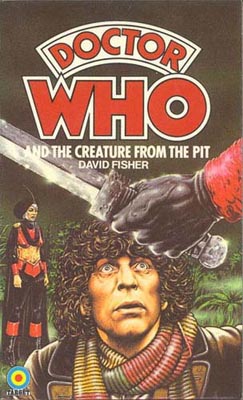 |
| Published | 1981 | |
| ISBN | 0 426 20123 X | |
| First Edition Cover | Steve Kyte |
| Back cover blurb: The planet Chloris is very fertile, but metal is in short supply, and has therefore become extremely valuable. A huge creature, with most unusual physical properties, arrives from an alien planet which can provide Chloris with metal from its own unlimited supplies, in exchange for chlorophyll. However, the ruthless Lady Adrasta has been able to exploit the shortage of metal to her own advantage, and has no wish to see the situation change. The Doctor and Romana land on Chloris just as the creature's alien masters begin to lose patience over their ambassador's long absence. The action the aliens decide to take will have devastating consequences for Chloris, unless something is done to prevent it... |
He forgot the penis by Tim Roll-Pickering 1/6/09
When this book originally came out, novelisations by the original authors were extremely rare so it is a breath of fresh air to see David Fisher adapting his own scripts. On television, The Creature from the Pit is a reasonably simplistic tale of exploitation and monopolistic control of resources, and that translates well to the book. Fisher has taken the opportunity to tighten up a lot of things. Gone are all the scenes after the neutron star has been dealt with, whilst also missing are the gags of the Doctor have to learn Tibetan so he can learn about mountaineering. Also lost are some of the weaker points of the production, including Erato's infamous appendage.
There are many little touchs throughout the book, most notably the footnotes that explain words such as "puka" (a rodent that inhabits hollow trees) or "fondel" (a wild turkey native to Chloris). We even get a correction to Romana's thoughts that tells us the real weight of Erato. In another strong move, Fisher has shifted some of the exposition from dialogue to characters' thought patterns, thus making the work feel more like a novel. The humour is far more subtle here than on television and it helps strengthen the story, whilst the characters are enhanced through descriptions of their background such as a brief summary of how Karela has worked her way through the court and harbours ambitions for power herself. This works wonders for many, particularly Torvin and his thieves who no longer seem so cliched.
Since much of the plot of the story involves unravelling a mystery about the basic existance and resources of Chloris, it's not easy for the book to devote lengthy sections to background exposition before the revelations come. Similarly, restructuring the plot heavily to cut elements, particularly the neutron star epilogue, may not have been an option available under the-then editorial policies. However, Fisher manages to maintain the pace and remembers that he is writing a short novel, not merely translating camera scripts. The result is a book that flows well in the reading and offers a good alternative perspective on a much-maligned adventure. 7/10
A Review by Jason A. Miller 1/1/17
I try to take in a variety of different types of Doctor Who on November 23rd. This year, for me, that involved watching three different single episodes, selected at random from the online episode generator (Terror of the Vervoids 4, Death to the Daleks 3 and The Mind of Evil 1) and reading one novelization, selected from a random generator... which, for the 53rd anniversary, was David Fisher's adaptation of The Creature From the Pit. The book ended up being the most fun part of the anniversary, hands down.
Looking at the physical copy of the book is interesting, for starters. What a horrible back-cover blurb! The blurb on my reprint of the original 1981 Target edition spoils everything about the plot up through Part Four, which means that you've gotten about 80 pages into the (not much longer than 80-page) book before you're left in any suspense. But I love the rust-colored cover: this is when Target was just starting to move away from exclusively white covers, so on my childhood bookshelf, where I had all the books lined up in story order, the rust-colored spine on the Creature novelization ended a long, long run of pure-white spines dating all the way back to Pyramids of Mars.
I find it fascinating to consider how the novelization is different from the TV story. And we now have a pretty good Rosetta Stone as to why they're different. The DVD text commentary for this story was quite fond of the novelization, in a way that most text commentaries are not, for one thing. So we know that Fisher was novelizing his own pre-rehearsal scripts and not the finished product. Thus anything that Douglas Adams added to the scripts or that director Christopher Barry added in post-production (such as the we're-out-of-ideas Part Three cliffhanger, which is nicely produced but otherwise more abstract than tense) is just not here.
Fisher shows a complete disinterest in "square" story structures. Not for him the house-style of Target, where a four-part story got twelve chapters with a cliffhanger at the end of Chapters Three, Six and Nine. Instead, Fisher spends minimal time on adapting the Part One material, but almost half the book on Part Four alone -- minus the arbitrary, added-in-post-production Lady Adrasta-in-jeopardy cliffhanger, for one thing, Erato is also given much, much more to say. If you want to know all about gender fluidity and the reproductive lifestyle of the Tythonian species, boy, is this ever the book for you. I also love the observation that Tythonians are given a name based upon their credit rating.
Fisher uses the prose format to make the supporting characters much more interesting. While Eileen Way (back for the first time since her role as a sinister grandmother in the very first Doctor Who story) made Madam Karela (Adrasta's henchwoman) memorable on screen, Fisher lends her even more dimensions in the book. She's described as a "wizened old woman with evil eyes", and we learn of her personality type that, had she not been born on Chloris, she "would of course have retired long ago to spend her declining years spoiling her grandchildren and infuriating their parents". The three metal bandits -- Torvin, Edu and Ainu -- are also given more depth and individuality; we learn that they're displaced mine workers whose livelihoods were rescinded by Adrasta when she trapped Erato in the pit. This is more satisfying than Chris Barry's brief of just having Torvin play the worst Fagin stereotype that he could muster... Also very nifty is the random castle guard killed off in Part Three; Fisher has his death scene occurring just seconds after he wishes on a star.
The prose is pretty excellent, too. While the TV episode plays out almost as a ghastly parody of a Who story, Fisher clearly has put some thought into making this thing sensible. Adrasta's castle "rose out of the jungle like a great black sea-beast rising from the green depths". This is the one Doctor Who novel, I think, to use the word "integument", and the neutron star that menaces Chloris in Part Four is neatly described as "dead but deadly". And the footnotes, of course, are unique among all other Target novelizations; they give Chloris a unique system of flora and fauna (although one character is familiar enough with medieval Earth literature to describe someone as "quixotic"). On the downside, the bit about Adrasta having an "almost lustful" expression as she summons the Creature to kill yet another of her failed underlings is a bit much. It's also a bit annoying that Fisher supplies scenes from Erato's POV before the Part Two cliffhanger, in which Erato is first revealed in all his glory, but, as we've established above, Fisher is more interested here in storytelling than in adhering to the standard cliffhanger format.
I also like Fisher's supplementing the Fourth Doctor's onscreen habit of shameless but prolific name-dropping; Fred Astair and Tenzing Norgay show up here, as does Thomas Babington Macaulay (of course). He even gets into the Doctor's head very nicely. Not only does Romana observe that "There are moments when I positive loathe that man", but we also get a good look into just how this Doctor ticks:
"It was the story of his own life: overelaboration; never knowing when to stop; always going that bit further even when caution and good sense said you had gone far enough. How much trouble had he got himself in to doing just that? A wise man would know when to call a half. On the other hand, he reflected, a wise man could get bored out of his mind. Whereas he had always enjoyed himself. It had been interesting. Sometimes even fun."Fisher also includes a debate between Organon and the Doctor as to why Erato is actually a giant brain:
"It can't be a brain," he objected, "It's green, not grey. You can't have a green brain." "Why not?" Organon couldn't think of an immediate answer.On a side note, this may also be the first Doctor Who book written from a vegetarian perspective; Tythonians are explicitly stated to be vegetarians, and the Doctor notes that plants can be repurposed to produce beefsteaks.
In the end, I do find the novelization to be just a few pages too short. The final palace scene is not here, indicating that Adams, not Fisher, wrote it. But it's a good scene and a necessary epilogue: it explains what happens to Chloris after Adrasta is no longer in charge, and it gives Organon the last word, where in Fisher's world we last see him unconscious. The loss of this scene means that the book ends rather abruptly and thus winds up being merely fantastic rather than, say, unsurpassably brilliant.