
The Clockwise Man/The Monsters Inside/Winner Takes All
The Clockwise Man

|
The Clockwise Man/The Monsters Inside/Winner Takes All |
BBC Books The Clockwise Man |
|
| Author | Justin Richards | 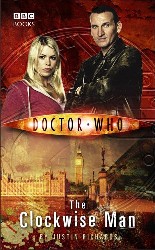 |
| ISBN | 0 563 48628 7 | |
| Published | 2005 |
| Synopsis: In 1920s London the Doctor and Rose find themselves caught up in the hunt for a murderer. But not everyone or everything is what they seem. Secrets lie behind locked doors and inhuman killers roam the streets. Who is the Painted Lady and why is she so interested in the Doctor? How can a cat return from the dead? Can anyone be trusted to tell - or even to know - the truth? With faceless killers closing in, the Doctor and Rose must solve the mystery of the Clockwise Man before London itself is destroyed... |
A Review by Finn Clark 19/6/05
Of the first three 9DAs (The Monsters Inside, Winner Takes All, The Clockwise Man), precisely half are good... specifically Winner Takes All and the second half of The Clockwise Man. I enjoyed those. Unfortunately the latter book has a first half too.
For tradition's sake, I'll begin at the beginning. The Clockwise Man may contain Justin's most boring writing ever. It's efficiently written nothingness... terribly well-mannered people in 1920s clubs having breakfast and discussing the British Empire Exhibition. What the hell? Where's the bug-eyed monsters and alien spaceships? I want someone's head pulled off and I want it NOW. The character overload doesn't help either. Even had these people been interesting (which they're not), I'd have struggled to tell them apart after we're introduced to them in rapid succession at the club.
Oh, and there's an exiled Tsar. No, they're delusional. No, the person who told us that is delusional. What? Am I supposed to be interested? This links into a theme of identity which will be developed later in much greater depth, but you just don't care. Whatever your political convictions, you'll decide that the Bolsheviks had the right idea.
The TARDIS crew are probably the weakest you'll find in these first three 9DAs, which is an impressive statement since even here they're rather good! They don't have Cole's vernacular or Rayner's chemistry, but it's a solid portrayal of Eccleston and Piper that kicks the poor stumbling early 8DAs out of sight. Come to think of it, this sails past the latest 8DAs too. Poor old McGann, eh?
Things improve after the halfway point. Admittedly it's an action-packed second half, so readers who don't like that kind of thing might get left behind. However this isn't merely a page-turner. There's a theme! I've seen this aspect of this book criticised, but I liked it a lot. This is a shorter book than you'd think from the page count, but even in a full-length novel this would have been plenty of meat to chew on. It's about identity. People who aren't who they say they are... the difference between the mask and what lies beneath, how one affects the other.
There are revelations, as we've come to expect from Justin Richards, but that doesn't make them bad! There's one in particular, late on, which hooked me. As we learn more about the stuffy-looking characters from the first half, we find reasons to be interested in them... in some cases even reasons to care.
There are links to the TV series. There's a Bad Wolf reference (of course) and a glimpse of Big Ben. The TV show enjoys returning to the same places in different eras... the same hospital, the same space station - and for some reason they like showing us Big Ben.
With hindsight I think the book's theme was the cause of its structural problems. In a short novel like this, it was always going to be hard to make the characters' false identities as interesting as the real ones underneath. In other words, until the masks are torn away they all seem to be a bunch of stuffed shirts. Whoops. However once you're past that little speed-bump (i.e. the entire first half) then the book just keeps getting stronger. By the end I was racing through and really enjoying myself. There's some great stuff here. But boy, that first half was a slog.
Fantastic! by Joe Ford 30/6/05
When I first heard of the hardback ninth Doctor "novellas" I was horrified. A shorter page length, heftier price and they were being aimed at twelve year olds and above! Whilst I fully understood the BBC exploiting the novel range to appeal to a younger audience I felt it was a complete betrayal of the core novel audience the BBC already had. Notably me, I did not want to read Harry Potter style Doctor Who books which skirted around the issues of sex, violence and swearing and I certainly loathed the idea of being forced to read Target-like books again, since I have progressed a great deal since those early days of reading and expected something rather more complex from my Doctor Who books these days.
What a prat I am.
I have no idea which of the three ninth Doctor books is meant to be read first but I am such a fan of Justin Richards' scribblings I had to pick this one up first. Needless to say this was not at all what I was expecting.
It occurred to me during the early stages of the book that this was hardly different from Justin's usual novels. He usually writes in short, concise sentences anyway. The only difference I could really tell was his language was slightly simpler than usual but still just as evocative. What's more he seems to have discovered his sense of fun again and without the constraints of having to tie up an entire ranges plot threads (Sometime Never...) or push it in a new direction (Time Zero) he has loosened up a lot and focussed on what should be a core factor of every Doctor Who book, pure entertainment. This is what Robert Smith? was talking about when he reviewed Trading Futures, the sense of humour and excitement that Doctor Who exhibited so well on the telly is expressed in The Clockwise Man in abundance.
Kids will love this book because it is challengingly written with red herrings in every chapter and the high action content. Adults will adore it because it recaptures that giddy sense of excitement they had when reading the Target novels and because this is still a Justin Richards novel, packed with details about the historical period chosen, super cool dialogue and set pieces that would amaze on screen. This isn't high art or anything, Rob Matthews would call it another Justin Richards throwaway book, but it holds the attention well, provides some good laughs and twists and finishes on a fabulously staged climax.
Justin plays it safe with his first foray into the ninth Doctor's world and sets his book in the early twentieth century. He obviously has such affection for that period, not only because this is another in his increasing series of historical Doctor Who books (The Banquo Legacy, The Burning, The Sands of Time, Time Zero) but because his evocation of the time is atmospheric. There is some intelligent discussion about the social and medical problems of the time which helps to whisk you back to the 1920's. There are some lavish descriptions of London and in particular a very good use of one of its major landmarks which makes for an immediately recognisable, comfortable setting. I especially enjoyed the trip to the British Exhibition because despite being far less detailed than the trip to Crystal Palace in Camera Obscura it was still just as fascinating and the books are slowly building a picture of early twentieth century life.
Most important in making these books work is the characterisation of the Doctor and Rose which if I was honest I feared would not work in print. There is something immediately recognisable and quirky about their relationship on the telly which is primarily due to the actors' chemistry but also thanks to RTD's hand in the writing of each script. This is uniquely Justin Richards own take on the two characters and despite trips to the set to see the characters first hand (lucky beggar!) can Richards possibly hope to capture their unique relationship? In a nutshell, yes. Somehow this really works, the ninth Doctor and Rose are re-interpreted to the page without any great effort on the reader's part. The dialogue shines between them, openly flirtatious and sparkling and they clearly have a great deal of affection for each other. Eccleston's ninth Doctor is word for word perfect, from his anachronistic northern slang, his sudden shock bursts of anger and delight and his quietly disturbed reactions when people talk about the "War". I feared Rose would read like a real Ace/Sam clone but Justin concentrates on her individuality, her compassion for others and really cuts back on the slang to make her Piper's character through and through. She rushed headlong into danger without much thought of how she might get out of it and her sudden bouts of humanity are used to touching effect, especially in the climax as she is trying to save Freddie's life. What is especially refreshing about this pair is that there is no hidden agenda, no arcs to see the characters through, they are just two friends revelling in their adventures together and it helps to make the book even more enjoyable.
The story itself is typical Justin; plots, double plots, triple plots and then those being subverted so by the end of the book nothing and nobody is quite what they seemed to be at the beginning. I loved all the confusion over Repple and Aske, as each layer of their identity is peeled away I was as lost as the Doctor and Rose were! Justin has written far too many books to get this formula wrong now and he allows for a number of pleasing mysteries to hang in the air before ticking them off one by one. As usual there is a number of surprises and some twists that are so obvious you can see them a mile off. This is a predictably well plotted Richards's book and I expected nothing less.
Where this differs from his more recent work is in dropping the angst and the heavy arc twists and concentrating on thrilling action. This is a good move and thanks to a number of superb set pieces the book hurtles from one plot twist to another. When the knights started coming to life I thought the book couldn't get any cooler but I still had robo-cat, the siege on the Club and the clock tower climax to go! Most brilliant of all was the Doctor's scheme to escape from his underwater dungeon, use your head matey!
One thing I have heard people criticise about Justin's work is his poor characterisation, not allowing the reader to get close to the characters because he is focussed on the plot. This is not an unfair assessment but is somewhat rectified in The Clockwise Man and not because this has unexpectedly deep characterisation going on but because he includes a number of quite touching scenes at the climax which pay off each of the characters rather well. It makes these people worth reading about when they reach a decent climax and Rose's relationship with Freddie certainly pays off well, as does the Doctor's with Wyse. And there is a wonderful moment with two of the Clockwise Men which against all odds was quite moving. Nobody of this crowd stands out as being amazingly profound but you get a strong impression that they all existed outside of this plot and (those that survive) will exist afterwards, which should be obligatory for a novel but is surprisingly absent in some.
A success for the BBC range then who for once manage to triumph over Big Finish and their inexplicably popular short story collections (I loathe them, sorry), thanks to their association with the new series. This is the most exciting thing to happen to the book range in a long while and could see them in business for quite a while. If hugely entertaining novels like The Clockwise Man is any example of how good these books will be sign me up for the long haul!
Beautifully packaged and well written, this another fine offering from Justin Richards.
A Review by John Seavey 9/8/05
Here he is, the Ninth Doctor in print for the first time... and I can honestly say, without fear of contradiction, that this could well be the best debut novel of any Doctor Who range ever. Mind you, its main competition would be Timewyrm: Genesys, The Eight Doctors, Goth Opera, and The Devil Goblins From Neptune, so it'd have a pretty solid lock on second place if it were 250 blank pages. As it is, it's another Justin Richards book. The prose is clear, the dialogue is good, the plot is intelligent, and it reads quickly... but the prose isn't brilliant, the dialogue isn't brilliant, and it doesn't leave any kind of deep impression.
That said, having intelligent plotting, good dialogue, and clear prose isn't as easy as it sounds, and this is a good start for the Ninth Doctor. Richards captures his brusque, clever, sharp tone well, and hits several emotional notes in his character without hectoring you with them. (The whole thing revolves around a hunt for a mysterious mass murderer, and you catch yourself wondering at times if this person is mistaken, as the Doctor keeps insisting, or if his sins of the Time Wars might be catching up to him.) Rose is done well too, and there are some nice riffs on elements present in the TV series. (This includes a nice little jab at the TV Doctor's over-reliance on the sonic screwdriver, and what might be my favorite 'Bad Wolf' reference ever.)
The plot is... it's all right. It's clear and answers all its own questions, but it hits a lot of the standard Justin Richards tropes about deposed rulers, conflicted villains, and megalomaniacs who conceal their evil very well. If you've read Dreams of Empire, you don't really need to read this. If you're going to balk at shelling out twelve bucks for a hardcover, you're going to balk at this. But if you've got the cash, or if you can read a friend's copy, it's a fun read.
An Earthly Child by Jason A. Miller 26/3/06
This was the first novel in the 9th Doctor series. Representing a change for Doctor Who original fiction after 15 years of edgy cheaply-made paperbacks aimed at the narrowest niche of fandom, the new series is made of shorter novels that don't quite capture the intensity of the first season of Doctor Who, Russell T. Davies style. Well, at least the cover illustrations aren't embarrassingly bad.
Justin Richards, who's been writing interesting Who books for a decade, fires the opening gun in the 9th Doctor range -- set, as Doctor Who always did best, in a gaslit early 20th century, in parlors and dark alleys and museums. The novel opens with a knowing tug at the first Doctor Who TV episode, as the TARDIS lands in a London junkyard. One of the story's mysteries revolves around a young boy who is not quite who he appears to be.
The rest of the plot, in essence, is similar to a forgotten Richards' epic called Dreams of Empire. A deposed alien dictator is kept prisoner on Earth. The problem is, he is hidden so well (to the characters, if not to the readers) that neither the Doctor, nor a futuristic female assassin and her two mechanical helpers, can figure out who he is until it's almost too late. Along the way, Richards lays out a series of puzzles that the characters must solve in order to progress to the next chapter. There's a lot of double dealing, hidden identities, decoy villains, word games and chess games.
For all the intrigue, The Clockwise Man never takes any risks or thinks outside the box. When the climax begins in a tower that rises 300 feet above central London, you instantly know how the villain will be dispatched. And although Richards cheats badly by writing a moving death scene for a character who's later revealed to have lived, there are very few surprises in terms of who makes it and who doesn't. Secondary characters check out when you expect them to, in the way that you expected.
The Clockwise Man is an extremely competent novel, but in the end it's a bit bloodless. As a print debut for the 9th Doctor, the story lacks the gleeful schizophrenia of Rose, the TV debut. Not a bad read, but in the end Richards' storytelling is just a shade too narrow and too shallow for the small screen.
The dawn of a new book series by Andrew Feryok 17/7/12
"You in a war?" Wyse wanted to know.In the words of the Brigadier, "Here we go again." With advent of the new Doctor Who series on TV in 2005, the era of the "Wilderness Years" came to an end. These years were largely carried by the book series starting with the Virgin's New Adventures and Missing Adventures series, then followed by BBC Book's Eighth Doctor Adventures, Past Doctor Adventures and Telos publisher's novella series. After hurriedly bringing BBC Books and Telos novellas to an unceremonious end, the BBC was keen to start a new book series focused solely on the new series. The Clockwise Man was one of three books that kicked off this new era in the Doctor Who book series, although if you go by the Gallifreyan letters on the spine, this is actually book one of the series.
"Been in many war. Far too many"
"Thought as much. You can tell. It's there in the eyes. And the attitude too. A sort of enthusiasm for life between the ennui. Like we can't quite believe we're still here, but we must make the most of it while we are." He sighed and nodded at the chess set on the table between them. "Best stick to chess. Far less dangerous."
"Usually," the Doctor agreed with a smile.
- Wyse uncovering the truth about The Doctor, Chapter 7, page 110
Its interesting reading a book featuring Christopher Ecceleston's ninth Doctor since he still remains such an enigma to most fans. While there have been other Doctors with short spans, such as the sixth and eighth, those Doctors at least had extensive coverage in books and audios following their TV stories. But the ninth Doctor is uniquely situated since we now know the tenth and eleventh Doctors so well, but know very little about the ninth. And since the new series in any of its media has not yet seen fit to revisit its old Doctors, it's unlikely we'll be seeing new ninth Doctor adventures for a very long time. In fact, the only story he has appeared in following the end of his era was as part of the tenth Doctor comic The Forgotten and that is it! So really what we got in that one year when he was the Doctor is pretty much all we are going to get for a good long time regarding his incarnation which is going to make one of the least accessible and explored of the incarnations.
I was therefore excited to pick up the first of the Ninth Doctor adventures in the BBC New Series Adventures (or NSAs) because he is such an unknown. It was a little weird at first to reading about the Doctor wearing black jumpers and a leather coat and a slightly less silly incarnation, at least in comparison to his successors (he seems so dark and brooding compared to his wacky successors now). But things got even stranger as I realized that Justin Richards was trying to pass off the new Doctor and Rose in an old-fashioned BBC costume drama. At the time, I could totally understand why they decided to do this. I was one of those fans who was frustrated by the short 45-minute single episode format after years of watching four and six part adventures on DVD. But, over time, I've come to adjust myself to the format and the authors themselves have also gotten used to it and better utilized it than they did in that first Ecceleston season. But during those early days we did complain about how the show was too fast-paced and too shallow compared to the old series. For those who are curious as to what the series might have looked like if it had been done at the slower pace of the classic series, then look no further than The Clockwise Man.
Because I am now accustomed to the fast pace, its painfully obvious how slow Justin Richard's story is. But even if this had used a classic series incarnation, this still would have been a dull story and I think Justin Richards fumbled things with this story. To begin with, the story is called The Clockwise Man and we don't even see a clockwork robot until 3/4 of the way through! While there are some interesting mysteries and characters thrown up early in the story, it never seems to advance anywhere. Richards seems to want to wallow in the time period, but forgets that the readers want to advance the plot every now and then! To make matters worse, it's often difficult to tell exactly what time period it is. The back of the book says its the 1920s, but if it wasn't for mentioning of the assassination of the Czar's family and the presence of cars, you could easily mistake this for being turn-of-the-century, almost Upstairs, Downstairs.
The plot is actually a pretty good one. An alien assassin using clockwork robots is looking for a alien dictator in hiding in order to bring him to justice. Inexplicably, the assassin doesn't know what the target looks like so when the Doctor shows up with alien technology, he immediately gets mistaken and targeted as the culprit. The problem is that it takes forever for the assassin to start targeting the Doctor. Once that happens, the story picks up considerable pace as investigations become more urgent, attempts are made on the Doctor's life, and it all culminates in a spectacular, action-packed conclusion with the Doctor battling clockwork robots inside the biggest clock in London.
The characters are where Justin Richards really shines. One of my favorites characters is Freddie who is the first character we suspect of being the target of the assassin. He's a young boy being hidden away by his parents and has royal connections in Russia. Over the course of the story, he befriends Rose and the Doctor and becomes a sort of companion for this one adventure. It's so rare to see a child character in the Doctor Who books since they are usually aimed at an adult audience, but Freddie is a breath of fresh air in the book, being different and heroic. It's clear he was part of BBC Book's plan to entice younger readers to the book series. When he finally gets in peril, at the end of the book, we really get scared that he might not live to the end of the book and Rose is willing to jeopardize all of the Doctor's plans in order to see to his safety.
Other characters include Repple and Aske. Repple thinks he's a deposed ruler in hiding. Aske claims he is mad and he is his physician, while others say that Aske is mad and Repple is trying to keep up appearances for his sake. The identity of the mad man is one of the best mysteries of the book. We also meet the kindly Wyse who runs a sort of rescue home for deposed European rulers and their families and who becomes an early ally to the Doctor and Rose. Then there is Melissa Heart, also known as the Painted Lady, who has strange fancy-dress masks that change depending on her mood. Her masks are clearly not of this time and the world, and the fact that she steals the Doctor's coat and sonic screwdriver makes here all the more suspicious. I won't give away the truth about these characters, but it if you are planning to read this book, I won't spoil one of the few good things about it.
The Doctor and Rose come across a bit bland in comparison to Richards' original characters. He gets their mannerisms and attitude right, but they just don't seem to fit this story very well. It's also apparent that Richards prefers much more to write for his original characters than the Doctor and Rose. Or maybe he's still used to writing EDAs where the Eighth Doctor's character was so unknown it was preferable to focus on original characters than dwell on the Eighth Doctor's lack of character. But the Ninth Doctor and Rose are such rich characters it seems strange for them to be so subdued and flat. However, I will give Richards points for stripping the Ninth Doctor down to nothing. Early in the story he takes away the Doctor's TARDIS, sonic screwdriver, and even his leather coat, leaving him with nothing but his wits to get by. But because Richards keeps the plot on such a slow burn, the Doctor comes across as being a bit more helpless than usual since he seems incapable of investigating anything until the author allows him to at the right moment. Even then, he seems to blunder around getting everything wrong. It ends up being Rose and other characters who do the real investigating and solving of the problems. But then, this was part of his character throughout Season 1 of the new series anyway. He wasn't yet the walking god who can solve everything that David Tennant's Doctor became.
On the whole, I thought this was a middle-of-the-road story. It had some good characters and mysteries and a wonderfully action-packed ending. But as the debut story for a new book series, this story just fell flat on its face. If you are a trooper, you'll endure the slow beginning and persevere to the end. But what good is an end if the journey to get there isn't that exciting? Given that this book was aimed at kids, I'm sure they probably didn't last long beyond second chapter. It's also strange that, having read Justin Richard's first Tenth Doctor book, The Resurrection Casket, he pretty much cut and pasted his story for that adventure! Just replace clockwork robots with steam-powered robots, add a GENIE from The Stone Rose, put a dash of Treasure Island and you've got a new book! Needless to say, a lackluster beginning to a new series of books. Here is hoping that the other two were better. 6/10