
The Claws of Axos
Doctor Who and the Claws of Axos

|
The Claws of Axos |
Target novelisation Doctor Who and the Claws of Axos |
|
| Author | Terrance Dicks | 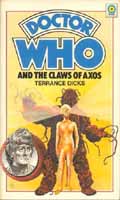 |
| Published | 1977 | |
| ISBN | 0 426 11703 4 | |
| First Edition Cover | Chris Achilleos |
| Back cover blurb: 'Axos calling Earth, Axos calling Earth...' The creatures stood before them, beautiful golden humanoids, offering friendship and their priceless Axonite, in return for - what? Only DOCTOR WHO remains suspicious. What is the real reason for the Axons' sudden arrival on Earth? And why is the evil Master a passenger on their spaceship? He very soon finds out... |
So just what is a Time Loop? by Tim Roll-Pickering 18/2/04
The television story The Claws of Axos is one of the weakest of the Pertwee years and the its failure to appear amongst the earliest Target originated novelisations may have been a hint that the story would not be novelised for a good time yet - especially since another great failure of the Pertwee years, The Time Monster, was also overlooked and was not to be novelised until 1986. However the book eventually appeared in 1977, at a time when Terrance Dicks had just produced one of his best novelisations, Doctor Who and the Dalek Invasion of Earth, and it seems that the effort was not a one off as Doctor Who and the Claws of Axos feels like another book which is more than a mere retread of the camera scripts. The printed page lacks the horror of dodgy rubber tentacles and missing CSO backgrounds, whilst when the book came out in 1977 there were eleven novelisations released that year but this was the only Pertwee-UNIT story amongst them and so the formulaic elements did not stand out as much.
The novelisation is also far more successful than the television story in exploring the relationship between UNIT and the British government. On television this gets buried heavily amidst Chinn's arrogance and determination to control the situation but here we get some passages explaining how relations between UNIT and Whitehall are poor, with a new "super" Ministry of Security trying to bring all the intelligence organisations under a single controlling body but UNIT's UN status complicating matters. Throw in a civil servant that the Minister can't stand and decides to send to UNIT in the hope that at least one problem will be sorted out and the result is an explosive situation! Dicks takes great delight in showing the Brigadier's annoyance with Chinn, wishing he could send the man to a firing squad! The conflict between the two is all too clear, with the Doctor, the Axons and the reader all seeing Chinn's assertions of British control as being incredibly narrow minded and over localised. Unfortunately all Bill Filer brings to the story are some humourous scenes where he humiliates Chinn by refusing to discuss the Master with him, but otherwise his role in the plot is superfluous and in later years his role would clearly have been taken on by Captain Yates, Sergeant Benton or Harry Sullivan. However the character does at least come across as a determined individual rather than the spoof of a spy that appeared on television.
Otherwise Terrance Dicks does a lot to enhance the story, with many subtle additions to scenes - the ending where the Doctor, the Brigadier, Yates and Benton are all arguing over the transportation of the TARDIS whilst Jo notes that nothing has changed is a particular highlight - as well as enhancing characters through comments on their thoughts, even those with minor roles such as Sir George Hardiman who finds to his delight that after years and years of conferences and board meetings he can still carry out practical work when he disconnects the cables even though he gets killed in the back blast. The scenes where the Doctor is seemingly planning to escape Earth also have a new edge to them, with Jo genuinely believing that the Doctor could have decided to save his own skin, something that was never in doubt on screen. There is also an attempt to show that the Axon invasion is not confined just to Britain by reference to what happens to the Axonite samples around the world, something many a more straightforward novelisation would have left out. However there is still no clear explanation as to just what a Time Loop actually is, making the story's resolution feel very much like a "magic wand" solution to the problem. Despite these limitations, Doctor Who and the Claws of Axos remains a competent adaptation of the story that is far preferable to the video. 7/10
"Axos calling Earth" by Andrew Feryok 4/3/11
"All things must die, Doctor. Mankind... this insignificant planet. Axos merely hastens the process a little... Axonite is merely bate for human greed. Because of that greed, Axonite will soon be spread across this entire planet. Then the Nutrition Cycle will begin."The Claws of Axos has been a particular favorite of mine from the Pertwee era. A lot of people don't like it, but there are still enough of us out there who will defend the story as one of the best that Bob Baker and David Martin wrote for the series. Although I have to admit that much of the reason why I liked this story so much was down to the nostalgia factor that this was the first Jon Pertwee story I ever owned on VHS and fourth episode I ever owned on VHS (back when I was trying to get one story from each Doctor and was only going by what was available in the video catalog that got delivered to my house). It was therefore with great surprise that I found Terrance Dicks' novelization so dull and tedious to read. I tried reading it twice, and twice I got to about the halfway mark where approximately episode 2 would have ended, put the book down, and then didn't come back to it for a long stretch of time. It was finally through sheer stubbornness that I persevered and pushed my way through to the end. So why was this book such a chore?
"And what happens then?"
"We shall consume every last particle of energy, every cell of living matter. Earth will be sucked dry."
- The Axon Core reveals its plan to the Doctor, page 89, chapter 7
Terrance Dicks wasn't exactly being lazy with the book. His writing style is quite good and he went to enormous lengths to expand the story way beyond what was possible on the BBC budget and added numerous new or alternate sequences that showed that Dicks did have a liking for this unusual story. One of my favorite additions was the cliffhanger to episode 2 itself. On TV, we got a guy crawling around in an orange trashbag trying to act like an alien blob as Perwee, Manning and Grist try to pretend this is a threat. In the book, the blob grows inside the glass tube and bursts out of it and attacks everyone in the laboratory! You could just see this sequence being realized in CGI and looking really awesome. Another cool add-on was at the very end when the Nutrition Cycle begins. The Axon ship suddenly grows to the side of a mountain and threatens to engulf the power station! During the Doctor's interrogation before the Axon Core, the Doctor surprises Axos by revealing that he is aware that they already have a small amount of time travel capabilities since it was how they avoided the missiles that UNIT fired at them. They dematerialized before the missiles hit and landed on Earth before the missiles were ever launched! And finally, Dicks alters the scene where the Doctor betrays everyone by showing the Doctor reluctant to go through with the plan and hesitates. It takes the Master to instigate a comment with Bill Filer and force the Doctor to use the laser gun or face being arrested by Filer. This is just one of many additions and alterations throughout the book and for someone who is well familiar with the TV story, this is very intriguing.
So is it the characters then that let the story down? Well, no, not really. The characters are quite well written. They aren't Malcolm-Hulke- or Robert-Holmes-level characters, but they are still characters. In particular, Dicks seems to flesh out the characters of Chinn and Hardiman more in the book. Chinn comes across much more an evil bureaucrat. Whereas Peter Bathurst plays the character largely for laughs on screen, Dicks turns him into an utter weasel who is willing to sell out, lock up, or backstab anyone who gets in the way of his personal greed. He is the type of politician who runs and stays low and out of sight when things are going wrong, but then is the first person to step forward and take credit for all the successes. I particularly liked how Dicks made it clear that even the Minister couldn't stand Chinn and put him on this mission with UNIT as part of a political battle between UNIT and the Defense department that wants to bring UNIT under British government control. If Chinn succeeds, then the Minister scores a victory. If Chinn fails, then he has an excuse to get rid of him. Either way, the Minister wins! Hardiman also gets some characterization towards the end as we discover that Hardiman has always been uncomfortable being a bureaucrat and going to meetings. He much more preferrs being a scientist in the laboratory getting 'hands on' with experiments. And when he has to dismantle the accelerator before Axos channels the energy burst back at them, he actually starts to enjoy himself as he is doing what he has always wanted to do.
Is it the main characters? Possibly. This isn't exactly a story showing the best side of anyone, especially the Doctor. In fact, Dicks takes the intriguing move of pitting the Doctor and Jo against each other. Much earlier in the story, Jo begins to suspect that the Doctor is just as greedy as all the other politicians and scientists since he sees Axos as a means of escape from Earth. She becomes even more suspicious when he tacks himself onto the scientific team analyzing the Axonite thinking that he wants to see the accelerator since it could help repair his TARDIS. But whereas on TV Jon Pertwee ran with this side of the Doctor and showed him capable of betraying even Jo in order to gain his freedom and probably would have left Earth if he could after saving them all from the Axons, in the book Dicks decides to reassure the kiddies by dropping hints that the Doctor is really still the good guy and is only interested in stopping the Master and the Axons. Interestingly, the only person who truly trusts the Doctor in this story is the Brigadier who even after the Doctor betrays them is the first to forgive him when he finally comes back. Benton and Mike Yates do get some scenes towards the end of the book, but are largely background characters. The Master is his usual charming and dastardly self. I love the insults Dicks gives for him as he is struggling to get the TARDIS to work. Also, the more chaotic the situation, the more the Master seems to be enjoying himself.
So why, why, why was this book such a struggle? I think it boils down to the story not matching the style of the writer. This is bizarre since Dicks script-edited the story originally. And yet I've found that Terrance Dicks always excels in action/adventure stories with lots of running up and down corridors and people shooting laser guns at each other. This is probably why the end of the book feels so much more exciting as we finally get Axos attacking UNIT and there's lots of tension, running around and gunfights. But the bulk of the story is political intrigue and high-concept science fiction which would be much more suited to an author like Malcolm Hulke. (I drool over the thought of what such a story would look like under his pen.)
There are also times when Dicks goes a little too overboard with the alterations and ruins the story for me. For instance, he cuts/severely alters two of my favorite lines from the story. The cliffhanger to episode 3 originally ended with a marvelous line from the Master: "Either we destroy Axos, or Axos destroys the world. Which will it be Brigadier?" Instead of this simple, intense line, we get this incredibly long-winded paragraph of a speech from the Master which basically says the same thing. Also, when the Doctor is saying his goodbyes to everyone as he escapes with the Master, Dicks cuts the Doctor's sarcastic line to Jo that "I shall miss you."
On the whole, this is not a bad novelization from Terrance Dicks. I've certainly seen worse and its greatly apparent that Dicks put a lot of effort into the novelization and made a valiant attempt to make the story more exciting and fill in the plot holes. But sadly I think this was a case of the story style not matching the author. Dicks is more suited to action/adventure and this was more a story of political intrigue and backstabbing that other authors probably would have done better. Not bad, but not great either. 6/10
A Haiku by Finn Clark 16/9/22
Jolly and fun, but
Quietly important with
Its dodgy Doctor.