THE DOCTOR WHO RATINGS GUIDE: BY FANS, FOR FANS
| Episodes |
4 |
 |
| Story No# |
105 |
| Production Code |
5H |
| Season |
17 |
| Dates |
Sept. 29, 1979 -
Oct. 20, 1979 |
With Tom Baker, Lalla Ward.
Written by David Agnew
(Douglas Adams and Graham Williams,
based on a story by David Fisher).
Script-edited by Douglas Adams. Directed
by Michael Hayes.
Produced by Graham Williams.
|
|
Synopsis: The last member of a dead race fights to prevent his own catastrophe
with the help of a Parisian art collector who plans to steal the Mona Lisa. The Doctor and Romana discover the collector's plans when dangerous
shifts in time lead them to a remarkable discovery....
|
Back to page one (the first twenty
reviews)
Reviews
So Dark The Con Of Man by Jason A. Miller
8/3/06
Is there any chance that the upcoming "Da Vinci Code" movie is going to
be as fabulous as City of Death? Both stories tell us that the
world we know is a lie, that the mythology on which we have built our
lives is based on a carefully fabricated and jealously protected false
premise.
In City of Death, those mysteries are uncovered by private eye
Tom Chadbon, coincidentally dressed as Tintin, and those same mysteries
have been guarded by Julian Glover, who was so cool that he went on to
play a bad guy in films from three quintessential action franchise movies
in the '80s (Bond, Star Wars, Indiana Jones).
But in "The Da Vinci Code", we just get Tom Hanks again.
This is "The Big Lebowski" of Doctor Who scripts: every line is
brilliant; even the bits of dialogue that are supposed to be serious
exposition are drop-dead funny. The all-star cast of Glover and Chadbon,
not to mention the brilliant Doctor/companion team of Tom Baker and Lalla
Ward, takes this hilarious script -- written by Douglas Adams in one
weekend while consuming pots and pots of black coffee -- and play every
scene dead straight, right down the middle. The story produced right
before City was The Creature From The Pit,
which has since been reduced to a cautionary tale about what happens when
you don't play comedy dead straight, right down the middle.
As has been written elsewhere, the story is plotted so tightly you
could sing it like an opera. Scaroth, the last survivor of a vicious
reptilian race, is fractured into 12 identical "splinters" of himself, set
adrift in Earth's history and working to advance the human race to the
point where a nebbishy Russian scientist can build him a small time
machine. Scaroth's prior selves have hoarded the great art treasures of
humanity: Gutenberg bibles, Gainsborough paintings, and seven original
"Mona Lisa"s, all so that his 1979 self can sell them to buy the
technology he needs. Which he will then use to save his people by
preventing the cataclysm that, coincidentally, made life on Earth
possible.
Because Julian Glover's villain is so suave and assured, he gets the
rare Who trifecta of getting the final close-up of every
cliffhanger. All right, in Part One it's not really him -- it's his stunt
double's nose or chin visible through an aperture in the reptile mask --
but Glover's stern visage ends Part Two, and his smiling photo op self
concludes Part Three just as he's killed off the Russian scientist in
gruesome fashion. His line readings are a primer on how to speak the
English language properly.
The DVD restoration team pulled out all the stops for the City of
Death extras. The story itself didn't need a whole lot of work, so
instead they've restored 25 minutes of raw camera footage, which had been
recorded onto a kind of videotape that was obsolete the day it was
recorded and so managed to avoid being wiped by the BBC, or stuffed under
a highway like "The Wicker Man" film cans. The DVD also presents the raw
film of the story's model effects -- a spaceship taking off and exploding,
and five chickens acting the role of a single bird that ages to death
inside an unstabilized time field.
The audio commentary doesn't feature Tom or Lalla, but it does have
Chadbon and Glover (a huge addition to the DVD, huge), and director
Michael Hayes, commenting on the story. Most prior Who
commentaries feature aging actors and directors kvelling over lame 1970s
relics that "really stand the test of time!" even when they didn't
(Exhibit HHH: The Claws of Axos). Chadbon, Hayes and
Glover are more realistic. They actually compare this story to the
production values and shooting schedule 2005 season of Doctor Who!
They also discuss Doctor Who conventions at length. It's great to
hear Glover rediscover a role he's not seen in some time; I loved hearing
his delight when he realiezd that Kerensky's death scene prefigured his
own in "Indiana Jones and the Last Crusade".
My favorite extra is the making-of documentary. This is not just your
standard press-kit where talking heads praise the performance of each and
every cast and crew member. You've gotta raise the bar for City of
Death. So DW book author Jonathan Morris, who wrote the
dead-on Douglas Adams homage Festival of Death, wrote
the script. Two writers from the 2005 DW series comment on what
makes the story work, at the same time that Hayes, Chadbon and Glover tell
us why they loved making it so much. The narration is hilarious, and the
reconstruction of David Fisher's original and abandoned script, via pretty
color illustrations, is nifty.
We learn how Adams took a complicated, wide-ranging script and, over
the course of one weekend, stripped it down into a story that utilized
just a few sets, a minimal cast, 13 filmed minutes of actors jogging
through Paris -- and turned it into one of Doctor Who's shining
moments, that one story where everything just fit together perfectly.
Followed by The Creature From The Pit.
Supplement 25/9/20:
I previously reviewed this episode for the Ratings Guide in 2006. Looking back on it now, a dozen years later, I'm struck by three things. One, I don't remember writing it. Two, I spent too much time reviewing the DVD special features, which are rather lovely, as opposed to the actual story. And, three, I tied my review in to the then-current release of the DaVinci Code movie, which... well, nobody remembers seeing that, a dozen years later. So my old review is in sore need of a better-written coda.
City of Death, for me, remains Doctor Who perfection. I watch it every couple of years, and have never once grown tired of it. There's not a wasted moment in the whole story. Even all the lengthy jogging-through-Paris montages in Parts One and Four come to life, thanks to the scenery and the Dudley Simpson score. I came to my most recent re-watch because I just visited Paris for the first time in the last week of August 2018, and everything I took my family to see and do on the trip was rooted in my love for City of Death. Top of the Eiffel Tower? Check. The Louvre, to goggle over the Mona Lisa? Check. Running through the colonnade and past the shops on the Rue de Rivoli, alongside the Gardens of the Tuilieries, in between the Louvre and Place de la Concorde? Check. A quick stagger up the Champs-Elysees? Check. A bite at Maxim's? ... well, no, we're not that rich and weren't that well dressed. But, if I saw it in City of Death, I wanted to do it in Paris, and that's exactly what we did.
So, I'm going to supplement my old review by talking some more about why this story means so much to me. This is not an easy task, as I proved 12 years ago. Everybody loves City of Death. There's hardly any point in reviewing it, even, because what bad or negative or every slightly critical thing is there to even say? I'd better start by quoting other and far more interesting and noteworthy people.
Of this story, Paul Cornell wrote in The Discontinuity Guide a generation ago: "It's a pity that the rest of Doctor Who exists to make this story part of a bigger continuity, because it deserves to stand alone." What he said.
Of this story, James Goss wrote in the afterword to the hardback edition of his novelization, in 2015: "[A]nd what a script. There are about three people in the world who don't like City of Death, and they're steadily being hunted down."
Interestingly, that afterword was deleted for the abridged paperback edition that BBC Books released in 2018, when they revived the Target imprint. I suspect that the afterword was deleted from the paperback because, by now, all three of those people have been hunted down, and there are no more haters left.
So, yeah, what he said.
What impresses me most about City is how the dialogue and humor never gets old. The Doctor's confrontation with the Count and Countess in Part Two is word for word as funny and sharp as Classic Who ever got. The Doctor's slightly harsher takedown of the Countess in Part Four ("How discreet. How charming.") is equally affecting, even on the umpteenth viewing. Lalla Ward gives a clinic in breezily dismissive putdowns ("I expect so"). Even the bit parts excel; witness Pamela Stirling's delicate in-character flinch when Tom Baker mimics a right cross punch at her face in Part Three.
City of Death is go-to viewing for me. It's a story I've literally never tired of. Even the best Classic Who stories must necessarily go stale with the passage of time, as acting methods change and as old-style special effects become obsolete. But, even in gloriously 1979-o-vision, with wobbly walls (as Duggan shoulders his way through the Count's cellar in Part Two) and over-the-top death acting (Professor Kerensky's arm-waving in Part Three), City of Death has yet to go stale for me, and I doubt it ever will. It was a pleasure to visit Paris and mentally re-enact the story.
... oh, wait. I forgot to breeze into a cafe and ask the Patron for three glasses of water -- make them doubles. I can't believe I forgot ... OK, I'm going back to Paris to check that off. Catch you later.
A Review by Finn Clark
10/5/07
City of Death is lovely, but somehow it's more than that. It's
the traditional "good Graham Williams story of the year", but unlike
Season Sixteen's The Ribos Operation it's become a
symbol of its era. The Ribos Operation is wonderful,
but it's not even trying to resemble its neighbours. It's a Robert Holmes
story and a different genre from anything else in Doctor Who, let
alone in Season Sixteen. It's a caper movie in which the criminals are
the protagonists.
City of Death however gave us the rare sight of the shambolic
Graham Williams era getting everything right. This is what the entire era
wanted so hard to be. It's clever. The wit and playfulness actually
works. It's charming instead of annoying. For starters, almost
everyone's doing their jobs, although we shouldn't be getting excited
about mere competence. Here there's genuine brilliance, which is true
surprisingly often in Doctor Who but in this case there's so much
of it that it seems to permeate the entire production. It's like
champagne. The Paris location filming and John Cleese don't hurt either.
The whole thing sparkles, somehow floating on its self-aware cleverness
instead of being dragged down by it.
And when I say brilliance, I mean it. Let's start with Tom Baker and
Lalla Ward. Tom may have been an uncontrollable drunken nightmare in
rehearsals, but what he brought to the screen is absolutely unique. Lalla
Ward isn't a particularly good actress, as was demonstrated in The Armageddon Factor, but here she's charming as Romana
and she works beautifully with Tom Baker. They have chemistry. ("At it
like rabbits" is the technical term.) In many ways the Williams era is
the sloppiest, most shockingly lazy period of Doctor Who and that's
partly a result of Tom Baker's behaviour, but at the same time his
performance is probably the most iconic ever seen on British television.
So often he had to transcend the rubbish surrounding him on all sides, but
here for once the entire show has risen to his level.
The acting is delicious. Julian Glover is elegant and sinister, one of
my all-time favourite Doctor Who villains. Catherine Schell as the
Countess is stunning, but no less importantly is also a match for Glover
and never less than delightful. I'd also like to praise Tom Chadbon as
Duggan, doing great work in the sort of part that you'd expect a Graham
Williams-era actor to ruin by hamming up. He's a stupid detective who
punches things. Many actors would have turned that into a cartoon, but
Tom Chadbon plays him for real and makes him surprisingly charming.
Alas, there's also David Graham's Professor Kerensky. Seeing him
opposite Julian Glover gave me flashbacks to The
Underwater Menace. The accent's not helping, but no one forced him to
do it. He's overacting and rubbish. Oddly, he'd previously voiced Daleks
and Mechanoids throughout the Hartnell era, not to mention playing Charlie
in The Gunfighters. You'd expect a certain level of
quality from an actor whose only on-screen appearances were in two of the
all-time wittiest Doctor Who stories, but it's funny how these
things work out.
Then there's the script. Douglas Adams is Doctor Who's most
famous writer and this is undoubtedly his finest story (albeit credited to
David Agnew), but the scary thing is that it was rewritten from a David
Fisher script regarded as unusable. In fairness, the writing wasn't the
main problem in Season Seventeen. Nightmare of Eden
has a great script, for instance. However I've never liked David Fisher
and presumably his draft of City of Death was outclassed by (gulp)
Creature From The Pit. Nevertheless, the final
version is lovely. It communicates breathtaking ideas with beautiful
simplicity. (Even the mere timespan covered is gobsmacking, although
those 400 million years have since been trumped more than tenfold in The End of the World.) The nearest I have to a
criticism is to say that it's awfully clever. To be precise, it's
constructed more like a puzzle or an intellectual game than a drama. The
Doctor and Count Scarlioni are playing chess rather than doing anything
visceral. Scaroth has a rock-solid set of motivations, but even so, one's
left with an impression of everyone just being terribly elegant and witty.
On the downside, on first viewing I regarded part one as a waste of
time with the Doctor and Romana wandering around Paris doing bugger all,
waiting for the plot to start. There's a certain amount of that. ("Steal
the bracelet!" "Steal it back!" "Look, we're being menaced by comedy
thugs in ridiculously conspicuous coats and hats!") However this
rewatching showed part one to be less aimless than I'd thought. The
temporal hijinks are being set up and of course we're waiting to see how
Scaroth fits in, the payoff to which is a million times better than most
"look, it's the monster!" cliffhangers because the revelation overturns
our assumptions about Scarlioni's motivations and the stakes for which the
story's playing. Of course part one also wants to gawp at Paris, but for
Doctor Who, Paris is a big deal. It looks nice and it's well
filmed.
Comparisons with The Pirate Planet are
interesting. Scriptwise, they're nearly identical. However, Paris looks
gorgeous, while Zanak was godawful. The acting in City of Death is
a highlight of the series instead of a festering blight on it, with the
comparison between Julian Glover and Bruce Purchase in particular being
akin to that between Dom Perignon and a urine sample. Furthermore,
City of Death had a competent director, while The
Pirate Planet had Pennant Roberts.
It's a cheeky story and I don't just mean John Cleese's cameo. That
image of Scaroth as Jesus is fleeting enough for plausible deniability,
but one can hardly believe that the production team did it accidentally.
It's also solid on a production level, with the Jagaroth spaceship and
primaeval Earth both looking lovely when a Time-Flight at the story's climax could have ruined the
production. Someone put in a lot of work for the sake of only a few
minutes of actual screentime.
There are those who argue that City of Death is overrated, if
only since the only way it could match its rapturous reception in certain
quarters would be for its cast to emerge from the television and provide
you with your choice of sexual favours while you watched. It's a
Doctor Who story, not a religious experience. However, I'd call it
brilliant. One doesn't see that much, especially on British television,
but I think City of Death qualifies. That doesn't make it the
greatest drama in mankind's history, but I'll point out that it's so
charming and effervescent that it almost makes the Graham Williams era
look good. That's no small feat. It's a very specialised kind of
Doctor Who story, but, like a shark, it's almost perfect at what it
does.
A Review by Thomas Marshall
21/11/09
It is so, so rare in any show that the producer, and the director, and
the actors, and the writer, and the script editor, and the designer, and
the location manager all do their job to absolute perfection. The plus
side is that when they do you are rewarded with a rich, sumptuous story,
usually the finest made for the specific show. The only downside is that
this puts all the other surrounding stories in a shabby light.
That is what City of Death does. I am going to rave about this
story as I have done once with The Talons of
Weng-Chiang, and intend to do with The Caves of
Androzani. These three form my favourite Doctor Who stories of
all time. What I love about City is that if you compare it to the
other two "greats", which I just mentioned, it is nowhere near as good.
"Uh," you cry. I will explain. City of Death is not the masterpiece
of television drama that Talons and Caves are: the former exploring complex themes,
beautifully directed, atmospheric, well written, the latter a frantic and
bleak portrayal of a society, a heroic story of sacrifices, with more
morals than a 17th-century Catholic priest. City of Death is
neither moral nor complex nor atmospheric nor heroic. It never tries to be
about the most villainous bad guy ever trying to blow up the universe. It
is simply wonderful, nevertheless.
City of Death is so wonderful because of its imagination,
because of its warmth and wit, because of its direction. We know it is not
the most solid and serious slice of Doctor Who and yet we still put
it up there with the all-time greats, whilst maligning other stories with
a similar sense of humour. But that's where it triumphs: because it is so
much fun.
The slapstick and "humour" of the Graham Williams era often seemed to
fall rather flat on its face for me, so to have a story (written in just
one weekend by Douglas Adams and Graham Williams) which is exactly the
same but works is touching and brilliant. There are so many comic moments
in this story, there is no way I will get them all down. For a start, the
very premise is incredibly funny: an alien wants to steal the Mona Lisa!
Pure genius! Why didn't anyone think of that before?
This little 1979 four-parter gets a lot of bonus points. It was the
first story to be filmed overseas in the history of the show, in this case
in Paris, as the Doctor and Romana struggle to uncover a plot to steal the
Mona Lisa. The Paris location filming is breathtaking, as the Doctor and
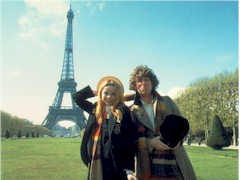
Romana have fun. They run down boulevards and into cafes and to the Eiffel
Tower and they are having so much fun, you just want to eat your DVD of
the story. It's padding, perhaps, but so mundanely beautiful - these two
Time Lords who walk eternity, revelling in the atmosphere of Paris - you
cannot fail to be impressed.
The ideas and the plot are breathtaking. It's one of those stories
which is so fabulously plotted that it starts off about something
(relatively) minor, as the Doctor and Romana experience time lapses and
discover someone wants to steal the Mona Lisa. The alien involvement is
quickly explained, and is followed by the revelation that Scaroth wants to
go back to 4 million years ago and stop all life on earth. It's skilfully
done, yet it doesn't feel as if they spent years deliberating over it
(well, they didn't!) It's simple, instantaneous, fun!
The direction is also outstanding: Michael Hayes does a superb job,
whether it is the beautiful scenes running down roads and round street
corners in Paris or the extremely impressive model work of Scaroth's
spaceship blowing up 4 million years ago. His excellence is consistent.
The production is also wonderful: atmospheric caves, the cafe, the
sumptuous living room of the Scarlioni household.
I cannot commend the eminently watchable time team of the Fourth Doctor
and Romana II, played by Lalla Ward, enough. They have such an incredible
chemistry, it would have been a crime for them not to get married in a
couple of years: watching them run around Paris, them discussing art,
Romana's confrontations with Duggan, their arguments and - oh! They take
your breath away. This is what every story should be like!
It is largely down to Tom Baker that most of his stories are commended
so much. With another Doctor they might not be so popular. Although
City of Death would no doubt hold on its own even if another actor
took Baker's place, much of its popularity must be laid fairly and
squarely on his shoulders. He is by turns devious ("That's the whole point
of art!"), rebellious ("Is no one interested in history?"), charming
("You're a beautiful woman, probably"), and laugh-out-loud hilarious
("What a wonderful butler, he's so violent!"/"A man with one eye and green
skin, ransacking the art treasures of history, and you noticed nothing?
How discreet, how charming!") and my personal favourite, "The centuries
that divide me shall be undone? I don't like the sound of that!")
He is backed by Tom Chadbon as the dependable Duggan, an absolutely
marvellous detective and sidekick who I really wish had become a companion
("That's your philosophy, isn't it: if it moves, hit it"). However, it is
ultimately Duggan who saves the day, by knocking Scaroth out cold. "That
might have been the most important punch in history!" the Doctor claims.
The Countess Scarlioni is imbued with charm and haute couture by Catherine
Schell, and I was very tickled by the humour of David Graham's eccentric
Professor Kerensky; plus this story has a cameo from John Cleese and
Eleanor Bron! What's not to like?
But best of all is Julian Glover. We already know he's an outstanding
actor; he was in Star Wars and Indiana Jones and, a very long time ago, he
was in The Crusade, in which he also impressed. But
this is his triumph, as Glover plays Scaroth/Scarlioni/Tancredi. The idea
of Scaroth, this terrifying alien and last of the Jagaroth race, being
splintered through time is beautiful, and Glover nails the two splinters
we get to see exactly right: they have style, sophistication. Tancredi has
a rather splendid costume, and Scarlioni a keen wit ("It'll be so much the
worse for you, for this young lady, and for thousands of other people I
could mention, if I happened to have the Paris telephone directory on my
person!"). But he does his best as the actual alien Scaroth, a truly
brilliant creation, marvellously made-up (a man with one eye and green
skin! Sublime!), and terrifyingly acted with the urge to survive by
Glover!
What makes this wonderful story even better is that the Graham
Williams' era is so often maligned, so hated, so blamed for the show's
troubles, that for him to have produced the story voted as one of the
greatest ever, renowned for its brilliance, and the story which gained the
highest viewer ratings ever, is wonderful. The story should be hung up in
the Louvre itself. Everyone could do dark and scary back then, but only
Douglas Adams could do plain joyous and fun like this.
This, my friends, is City of Death. The story so marvellous it
consistently comes in the top ten of every DWM poll. The story so
marvellous it is consistently cited as the best story to show to those who
have never seen the series before. The story so marvellous it
simultaneously epitomises the Tom Baker era, the Graham Williams era, and
the 70s era. A true masterpiece.
There's only one thing wrong with it, and that's the title, City of
Death. There are three deaths by the end. Oh well, it's pretty much a
mick-take title at the end of the day, isn't it? Forgivable. It's better
than The Curse of Fatal Death at any rate -
although, having said that, that title is supposed to sound bad...
Classic? Are You Kidding? by Clement Tang
5/3/12
This story is well known for being the highlight of the Graham Williams
era, but I just can't see it. This is the only Douglas Adams script I have
seen, and I'm convinced that his other scripts aren't that great.
Let's start with the acting. Tom Baker is superb as the Doctor as he
always was since the beginning of his Doctor Who tenure, and Lalla
Ward is just brilliant as Romana. Both of these actors had such good
chemistry (and not just because they were in a relationship at the time).
The supporting cast was not so great. That scientist was really annoying,
and the detective Duggan just rubbed off wrongly on me.
Moving on to the plot. Scaroth wants to steal the Mona Lisa. Why, when
you could have asked Da Vinci to paint you one more replica instead of
going to all that trouble? And was there a need for the excess padding
that is the "running through Paris" scenes? In my opinion, if you take
these scenes out, then everything would fit into three parts instead of
being so slow-paced.
Lastly is the dialogue. I never did like the dialogue in the Graham
Williams era. In fact, I never knew how much excess humour was in that
era. Even the JNT era wasn't that bad, and that's saying things since I
hate JNT to the point that I completely disregard his entire era. However,
there were bits here and there that I did like such as the conversation in
the train "philosophically or geographically?" and "That was the most
important punch in the entire history of Earth."
In conclusion, City of Death doesn't deserve classic status. In
fact, it doesn't even deserve to be in my top twenty. It's just a story
that is saved by the lead acting and some good lines.
7.5/10
A Review by Brian May
8/10/13
City of Death is one of the all-time highly regarded Doctor
Who stories, coming from one of its most maligned seasons. There is a
lot to commend in other season 17 stories, of course: Destiny of the Daleks is well directed; The Creature From the Pit has a great jungle set; Nightmare of Eden has one of the programme's most
intelligent scripts; The Horns of Nimon
has...has...um...well, it has Lalla Ward looking superb in a hunting
outfit. They all had their individual faults, but shared one major
problem: an overall jokiness, caused twofold by the influence of script
editor Douglas Adams and the comedic dominance of an increasingly
out-of-control Tom Baker.
City of Death is not immune from this, but it's the one case
where the emphasis on humour works perfectly. It takes two of the most
standard Who plotlines - that of a stranded alien seeking to
survive, escape and revive; and extra-terrestrial interference upon human
evolution - but runs with them in the most unusual of ways. This
particular stranded alien has become a witty, urbane and charming
millionaire who steals valuable artworks! The jokes are smart and the
dialogue is sharp. The idea of "This is a fake" written beneath the
genuine Mona Lisa makes you smile wryly, but I feel we should be
laughing-out-loud instead, as we definitely ought to be with the various
exchanges, insults and ad libs ("You're a beautiful woman, probably"; "You
know what I don't understand?"/"I expect so" are just two examples from a
wide range of choices.) Baker plays it up, but, as opposed to other
instances, this is what much of the story calls for. It should be noted
he's also very serious when required, just as he was in The Pirate Planet and Eden.
There is a wealth of acting talent here, the magnificent Julian Glover
stealing the show. As the Count, he displays all the attributes listed in
the previous paragraph, but he also astutely communicates Scaroth's
seething resentment and agonised patience. Tom Chadbon is wonderful as
Duggan, playing the stupid, boorish but always likable detective with a
deadpan perfection, while John Cleese's cameo is hilarious. The only weak
link is David Graham, who over-exaggerates Kerensky as the eccentric
scientist a little too much. You can tell this is the beginning of the
short-lived love story between Tom Baker and Lalla Ward. Their chemistry
is great, their rapport on screen (and undoubtedly off as well) is
delightful.
Of course, when discussing this story, one has to mention the setting.
This is the first time Doctor Who had been filmed in a foreign
locale, and the images of Paris are gorgeous. They're utterly cliched of
course; we've got the Eiffel Tower, the Champs-Elysees and Arc de
Triomphe, the river Seine and the Metro. It's an unashamed, or perhaps
shameless, showing off. But why the hell not? What better way to prove
they've been there (and justify the travel budget) than to milk the
scenery for all it is worth? Anyway, what could have been a gratuitous
travelogue is given some panache, with the stylish camera angles and
terrific music. Dudley Simpson does great work elsewhere; I especially
adore the Countess's sultry saxophone score and the Egyptian-themed twangs
when she opens the scroll.
In my younger days, I was convinced the interiors were also shot in
Paris. This is not the case; these scenes with all their impressive sets
were all, of course, recorded at good old BBC Television Centre. But
that's part of the illusion, I suppose; it draws you in and carries you
away. If there's anything I would criticise about City of Death,
it's that the third episode is a bit slow, as it's mainly info-dumping and
a lot of sitting around and talking. The title is a bit of a misnomer as
well. But if this is the worst, then it isn't much to complain about. It's
smart, sophisticated and seductive; a very good story indeed. 9/10
"Art for Art's Sake" by Craig Land
19/1/16
Quite simply one of my favourite Doctor Who stories of all time,
if not my absolute favourite. This isn't a controversial opinion; City
of Death regularly turns up on lists of the best stories from the
show's entire run. But browsing online for other people's reviews, nobody
seems to be able to sum up exactly what it is that's so continually
entrancing about this story. The script is gloriously witty and
outstandingly plotted, as you'd expect from Douglas Adams. Tom Baker,
Lalla Ward, Julian Glover and everyone else in it give peerless
performances, easily rising to meet the needs of the script. And the Paris
filming gives the whole thing a classy sheen, which separates it visually
from the stories around it. These are all things that barely need saying.
But, ultimately, it's the story's utter belief in its own hedonism and
fun, and the way that Douglas Adams basically dares you to complain about
its lack of deeper themes, that really raise it up. It's clever,
certainly, but more important are the ways in which it's intelligent.
The story is structured like an incredibly clever and satisfying puzzle
box, in a way that Steven Moffat at his best often aims to achieve. We
start with a number of seemingly unconnected elements - a plot to steal
the Mona Lisa, some time experiments, a man made of green spaghetti in an
exploding spaceship - and then the pleasure of the story comes in the way
that Adams gradually draws these elements together to show us how they
fit. Particularly good is the way that Adams puts Count Scarlioni at the
centre of his web of plotting, with all the other characters being almost
exclusively concerned with individual bits of the plot. Countess Scarlioni
is concerned with the art theft, but has no idea about the time
experiments in the basement. Professor Kerensky is busy conducting the
time experiments with little consideration about the art theft. Captain
Tancredi, in his brief appearance, is focussed mostly on his identity as
Scaroth, with the art theft and the time experiments being more the domain
of Count Scarlioni. Thus, Adams creates a sense of scale by making sure
each part of his plot has characters working to their own agendas, with
Scarlioni sitting at the centre of the web linking everything together.
But while the plot itself is quite complex and engaging, the bulk of
the entertainment here comes from the way that Adams just plays his
characters off each other in amusing ways. By this point, Tom Baker has
long since abandoned subtlety or naturalism in his performance, but he
compensates by being compulsively watchable and funny. I saw someone refer
to him as a 'terrible actor' on tumblr recently, which is correct insofar
as I don't think Tom's doing much acting here but completely misses the
point by suggesting that that's even close to being a problem. And putting
him opposite Julian Glover and Catherine Schell for most of the story
proves to be the best idea imaginable: Romana and Duggan are eccentrics,
whereas the Count and Countess are giving grounded, suave performances
throughout. The comedy emerges by making the villains the straight man to
the Doctor's lunacy, as distinct from the companion (as is more usually
the case when Tom's playing opposite Sarah, Leela or Romana I). The Fourth
Doctor often mocks the villains he faces, but here the story and
characters are aware of it. This is a very Graham Williams-era thing to
do: if the primary point of the Williams era is to show that the greatest
threat to the universe is stuffy bureaucracy and mindless profiteering,
then contrasting a completely insane (but fun) TARDIS crew opposite such
figures is both an entertaining and logical move.
Thus, the Williams era also gets away with Romana as the other primary
identification figure - someone whose perspective is very different to
that of the audience at home. This is fitting for two levels: for one
thing, Tom Baker is such a familiar figure after six seasons on the
program that he can provide a lot of identification for the audience, but,
for another, putting two highly intelligent eccentric Time Lords as the
leads is just a very good idea for a series that is mocking mundane
villainy. This story, more than any other, is the one that establishes
Lalla Ward's Romana as a distinct character from Mary Tamm's version, too;
look at Creature from the Pit or Nightmare of Eden, and she's busy playing the haughty
Time lady who doesn't quite understand the rest of the universe, but here
she's utterly delighted to be going on holiday and is established as the
Doctor's equal, with huge technological capability and her own sonic
screwdriver. If the Tamm Romana was the Doctor's intellectual superior but
his emotional inferior, Ward takes the logical next step and basically
becomes a pseudo-Doctor. She occasionally makes mistakes (such as being
taken in by Scarlioni in Part 4), but then so does the Doctor. In many
ways, the Season 17 TARDIS crew provides a happy medium on Tom Baker's
oft-stated desire to not have a companion, by giving him a companion who
basically reflects his own best traits straight back at him.
And yet, despite all this, this is basically a story that rejects any
attempts to read anything into it beyond 'this is fun'. That's not to say
that the story lacks themes. But this is a story in which the main theme
is that aestheticism and cleverness for its own sake is a worthy goal. A
central plotline is about Count Scarlioni trying to monetize the Mona
Lisa; he steals it to create wealth. It's repeatedly emphasized how
ridiculous this is: Part 2 has that marvellous sequence where Romana is
perplexed by the idea that somebody would buy a stolen Mona Lisa and then
never be able to tell anyone. And, of course, the entire idea about
Leonardo painting seven copies of the Mona Lisa is about commodifying art
- valuing it in financial, rather than aesthetic terms. The Doctor then
defeats Scarlioni's art theft plot by devaluing the paintings - not by
changing the art itself, but simply by playing with notions of
authenticity. If you're the sort of stuffy person likely to buy the Mona
Lisa simply for the prestige of it, you're the sort of person who is going
to be bothered by the fact that it has 'this is a fake' written in felt
tip underneath the paint. The sheer cheekiness of this becomes clear in
that delightful speech at the end:
DUGGAN: But it's a fake! You can't hang a fake Mona Lisa in
the Louvre!
ROMANA: How can it be a fake if Leonardo painted it?
DUGGAN: With the words "This is a Fake" written under the paintwork
in felt tip?!
ROMANA: It doesn't affect what it looks like.
DUGGAN: It doesn't matter what it looks like!
DOCTOR: Doesn't it? Well, some people would say that's the whole
point of painting.
There's more. Scaroth is a villain who has built up the entirety of human
culture to meet his own ends, but his main aim is to essentially ensure
that humanity has never existed, wiping out that culture in the first
place. To Scaroth, culture is a tool - something which is used to score
financial or political points. By defeating him, the Doctor essentially
vindicates that human culture is an end in itself, in whatever form it
takes; if Scaroth has teleologically been pushing humanity towards a
single end point, the Doctor's victory ensures human culture can be
tangential and that art can exist for art's sake. The reason that John
Cleese and Eleanor Bron's sequence is hilarious is because they're trying
to read intense meaning into something that is in the gallery by accident.
It's like that sketch about a bunch of people walking past an apple left
in an art gallery by mistake, each of them reading different things into
it.
This, then, is an incredibly hedonistic story, one in which people
should be able to do things based entirely on how much pleasure they
cause, and where the primary threat to existence is to try and give life
(and art) a purpose. And yet, ultimately, it feels like Douglas Adams
trying to justify a script where the primary pleasure sources from
aesthetic concerns. This is a story that argues for aestheticism, while
simultaneously being a narrative where clever plotting and wit are the
most important elements, rather than deeper thematic concerns. It's a
story about justifying its own featherlight nature. I strongly suspect
Paul Magrs has at some point in his life been influenced by it.
If it were anyone other than Douglas Adams writing this, then, this
could have been the most pretentious and irritating waffle ever made. But
it is Adams writing this, and thus it's glorious. It's much easier to
accept that beautiful art and wit is enough in itself when you're watching
Tom Baker and Lalla Ward run through one of the most beautiful cities on
Earth for 20 minutes while Dudley Simpson delivers his career-best
incidental music (all together now: running through Paris, we're running
through Paris, we're running through Paris, we're running through
France...) The dialogue is consistently magnificent (the first scene of
Tom and Lalla standing at the top of the Eiffel Tower might be one of my
favourite moments in the entire history of the program, being a moment of
charm executed perfectly without showing off), the performances are some
of the best in the entire series (Glover and Schell are perfect, and even
Kerensky, while pretty terrible by any normal standard, manages to fit in
quite well). This is a story held together by Douglas Adams crossing his
fingers and hoping for the best, but the execution is so perfect as to
make it look effortless.
City of Death is ultimately a hymn to its own pointlessness, but in the process it creates possibly Doctor Who's single best story.
A Review by Olly King
10/1/22
For a Doctor Who fan in the 21st century, getting to know the old show (pre-2000) is a kind of rite of passage. There are still loads of older people who are just dying to tell you which episodes you HAVE TO watch because they're so good, and which ones you HAVE TO watch because they're so bad that they're in fact good. In that first category, there are a lot of common threads: watch Pyramids, they say, watch Androzani, watch Weng-Chiang, watch The Robots of Death, watch The Web of Fear. Well, I've done all that (and more besides), and apart from a giant rat and some stupid hats, I haven't been disappointed.
But fans of the old show are determined people, and once they get their teeth into you, they take the greatest of pleasure in someone else discovering the things they have loved since childhood. Fair enough. There's always some new mountain to climb: a novel to read, a comic strip to track down, even radio plays and of course yet another TV "classic" coming over the horizon. The problem is that, if you watch a lot of it, sooner or later you're going to find something that is supposed to be a "classic" but isn't. Maybe I should have kept my opinions to myself, because I had no idea of the offence it would cause by saying that I thought City of Death wasn't very good.
It's supposed to be funny, but I think I only laughed once. It's supposed to be classy, but apart from a few bits filmed in Paris, it's really rather cheap. It's supposed to be one of the show's best scripts by one of the show's best ever writers (and a couple of his friends), but really? ("I had this fool of a detective followed" "Why?" "Reasons" "Oh please don't play games". Giiyyaarrggh!!)
Sitting through the whole thing, I had the feeling that a blokey, private-school-educated production team were throwing counterfeit pearls to a swinish multitude and sneering at them for putting up with it. Worse was that this particular group of people thought that prime-time TV was beneath them, but they would take the money for it anyway. I've watched a dozen or so other Tom Baker stories, and loved every one of them, including a few from when Graham Williams was in charge and a couple co-starring Lalla Ward. I even watched the other finished Douglas Adams story The Pirate Planet and laughed like a drain all the way through: not only funny, but clever and affecting too. But City of Death left me feeling as if I'd been cheated.
All I can say is that I hope that the cast and crew all had a good time at the BBC's expense (who wouldn't want a free holiday dodging traffic in 1970s Paris?) and that their hangovers weren't too bad when they got back to London.
And they say that the rest of the Doctor Who stories made that year were much, much worse?! Ye gods!