
|
BBC Blink |

|
| Story No. | 198 | 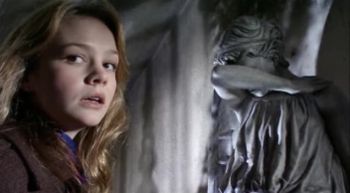
|
| Production Code | Series Three Episode Ten | |
| Dates | June 9 2007 |
|
With David Tennant,
Freema Agyeman Written by Steven Moffatt Directed by Hettie MacDonald Executive Producers: Russell T Davies, Julie Gardner. |
|
|
BBC Blink |
|
| Story No. | 198 |
|
| Production Code | Series Three Episode Ten | |
| Dates | June 9 2007 |
|
With David Tennant,
Freema Agyeman Written by Steven Moffatt Directed by Hettie MacDonald Executive Producers: Russell T Davies, Julie Gardner. |
| Synopsis: Sally Sparrow finds a series of messages from a man trapped in the past who she doesn't even know. But the angels are looking for her. |
A Review by Joe Ford 10/8/07
I don't mean this as a slight to David Renwick or a slight to Doctor Who but Blink reminded me wholeheartedly of an episode of One Foot in the Grave. Not because Victor Meldrew regularly came up against the awesome power of living statues and had relatives popping backwards in time or because in this episode the Doctor has all the TARDIS furniture nicked and ends up in the pub with another Time Lord who mistakes him for the ninth Doctor. No, its on a much more abstract level than that. Blink and Steven Moffat's writing in general has a number of similarities to David Renwick's which makes the pair of them two of the best writers on television ever. Blink mimics a One Foot in the Grave episode in that it is skilfully crafted, lots of weird and apparently unconnected things happen in the first twenty minutes or so and for a while you think the writer has lost the plot but seamlessly, beautifully everything connects together to make brilliant, perfect sense. It's like watching a particularly good jigsaw being assembled before you. Not just that, but One Foot in the Grave was not like any other comedy that tried to fire jokes every five seconds (like any abysmal American sitcom you can imagine), Renwick would use his plotting to gear the episode towards one of two very special, absolutely hilarious moments. The pot plant in the toilet. The hundred gnomes in the garden. Blink does that too but with chills rather than laughs. It's not a Doctor Who episode that is scary all the way through but builds its suspense slowly and carefully, hinting and suggesting horrors behind you before unleashing a truly frightening sequence in the climax. The sequence involving the Weeping Angels attacking Sparrow and Nightingale is so instantly shocking and pulse pounding my boyfriend Simon was actually hiding under a pillow and jumping out of his seat. A Doctor Who episode made him do that.
I think it is worth with this episode to mention how a chap from Eastbourne (that's me) who just five years seemed to be the only Doctor Who fan in the world and jeered at a derided for his interest is now suddenly surrounded by other Doctor Who fans. It is episodes like Blink that made that happen. Janet (Simon's mother) phoned us as soon as Blink finished to rave about how fantastic it was. Beth, a friend from work texted me to let me know she will never be looking at statues in the same way ever again. These people, who often bitterly complain that there is nothing of substance on the telly are for 45 minutes a week thrilled and delighted by Doctor Who.
Is Blink as good as Love and Monsters? Many will probably think so because it doesn't have the silliness and embarrassment of that earlier episode, swapping pure entertainment for an uneasy atmosphere of suggestion. I wouldn't say it was better, just different. Both episodes feature a fresh face in the driving seat, both Elton and Sally would make terrific companions... or even better a great double act. Both episodes made me laugh (Elton being seduced by Jackie, "You've only got 17 DVDs!"). Both episodes shocked me at how far they could push their time slots (Elton's indication to oral sex, the sweat-breaking Weeping Angels). And both episodes proved that you can write a Doctor Who episode without the Doctor being the central character. See Andrew Cartmel, this is how it should be done. The Doctor is pulling the strings here without any kind of Warlock-style perverseness.
What I like is that initially this episode appears scatterbrained and random. Scenes like Kath being transported backwards in time and Billy's inclusion feel as though they are wasting precious seconds but they are all essential to the overall story. Lawrence Miles wrote in his website that the events of this episode are what you expect of a science fiction show on television. Maybe so, but that doesn't mean to say that I have seen such events recently or that they would pull it off with such style. Particularly pleasing is how the Doctor ends up as an Easter Egg on Sally's DVD. What could have been an embarrassing idea without explanation is worked into the plot superbly. I am a sucker for examining plot construction (hey, I'm studying literature) and Blink works its terrifying central idea into a flawless piece of plotting. The only question hangs over the rock being thrown through the window but let's assume Sally wrote about that in her purple wallet for the Doctor to read and write on the wall in the sixties.
Hettie McDonald is not a name I have heard on Doctor Who before but if this episode is anything to go by she will be back to direct again. I love a director who makes subtle but powerful use of the camera. It is the complete opposite of the Graeme Harper approach (which is also brilliant) which throws as much action and drama at you and knocks you for six, slowly and insidiously drawing you into the story until you are hooked and then confronting you with some seriously scary imagery. It's nothing but suggestion. You never actually see the statues move. That is essential in making them work. I thought the combination of a female director and female protagonist and Steven Moffat writing (after The Girl in the Fireplace) this would be the most Bridget Jones Doctor Who episode ever, but nothing could be further from the truth. McDonald moves the camera slowly and eerily throughout the episode, using lighting to create a brilliantly disquieting mood.
Carey Mulligan holds the episode up very well and we can only hope that she will make a return appearance at some point. The episode treats Sally respectfully, allowing her to boggle at its more absurd SF moments and feel as if somebody is playing a cruel joke on her but quickly coming to terms with the fact that this is all horrifically real. Mulligan's scenes with Finlay Robertson are amongst this episodes best scenes, they make a very modern-day and far more ordinary and likable Mulder and Scully. From when they stick the Easter Egg DVD on in the haunted house right up to being surrounded by the Weeping Angels as the TARDIS dematerialises, I was gripped by their plight. There is something truly frightening about two normal people being in jeopardy and the Doctor not being there to save them.
Season Three is turning out very dark indeed. I am not sure if season four should be as serious because the show would lose something if it lost its sense of humour but I cannot deny that it has by far been the most successful year of the show so far and easily the most gripping. Davies, Tennant, Agyeman and the writers should be very happy with the result. Many people were wondering if the show could survive beyond Doomsday's events, let alone prosper and thrive. Doctor Who is in peak territory.
Other points of interest:
Unsettling.
Behind You by Mike Morris 26/12/07
What is it with Steven Moffatt? The man seems to be better at writing for Doctor Who than the rest of his CV comes close to suggesting. Possibly it's the steadying hand of Russell T. Davies (and one of the more annoying habits of the RTD detractors is not to give him credit for the scripts written by other writers, as if - unlike any other script editor in history - he's got nothing to do with any of them), but anyone who saw Coupling or Moffat's turgid, silly reworking of Jekyll and Hyde wouldn't imagine he's capable of producing something as sharp as Blink. This is probably his slickest Doctor Who script, and is also the one with the fewest incredibly annoying moments of glibness.
It's also frightening. Moffat has an instinct, it seems, for scary; so far he's given us the gas-mask men, the clockwork soldiers and now moving statues; not only is it three-for-three, but all of them are genuinely original. With this story, he's clearly gone all out with the scares and thrown in a haunted house for good measure. Given Moffat's natural ability to structure a story well, this is very much his natural stomping ground.
Indeed, Blink is probably the most successful story of Series 3, if not quite the one that I liked the most. It doesn't have the sweeping vision of Gridlock or the beating heart of Human Nature, but it's not really supposed to; and even in the midst of what's essentially a horror story with incongruously good structure, there's a scene of genuine emotion. In fact, when I come to think about it, there's not really a scene in Blink that you could describe as wrong or not well realised. If I had to aim a criticism at anything, it would be Sally Sparrow getting chatted up by some policeman or other, which echoes Steven Moffat's complete inability to write a female character who doesn't go all giggly when in the company of a good-looking bloke (volumes could be written about the heterosexual male wish-fulfilment that has populated Moffat's scripts), and this fantasising becomes more overt when she decides she's really interested in the geek who's horrified she's only got seventeen DVDs... but this time it's achieved with so much charm that I'm undoubtedly reaching.
I'm not sure if I've actually said it in written form, but I have previously accused Moffat of being rubbish at female characters. This is more off the back of the completely useless women who he seemed to think were representative of the wider populace in Coupling, and doesn't - if I'm honest - stand up to scrutiny; this is the bloke who's given us the vivid Madame de Pompadour, the strong and courageous Nancy, and... well if you want, you can trace it back to Linda from Press Gang, who was a beautifully argumentative and severe character long before it was fashionable to write women that way. And yet... there's still something in it. Moffatt is obviously a man (I mean 'obviously' as in 'you can tell from the way he writes' rather than 'well his name's Steven for god's sake'), and the one truly convincing woman - Nancy - that he's created for Doctor Who is someone who isn't supposed to be attractive. Madame de Pompadour, on the other hand, is the classic example of heterosexual wish-fulfilment - glamorous, confident, intelligent, brave, who'll still fall in love with the first dashing bloke who waves a sonic screwdriver at her.
Sally Sparrow, on the other hand, is... well, Linda from Press Gang, albeit played in a less harsh fashion. The one thing about her that doesn't ring true is the fact that she ends up with Laurence, but I can shrug my shoulders and put that down to genre convention. Carey Mulligan isn't just preternaturally attractive, she's a very good actress whose emotions are scrawled over her face in moments of real, naked honesty. She's comfortably the best guest star of the season, whose delivery of "I'm clever, and I'm listening, and don't patronise me because people have died and I'm not happy" is a punch-the-air moment. And yet, the best moment of Blink - or rather, the one that stays with the viewer after repeated listens - is Billy's death scene. Mulligan conveys such grief over a character that she's barely met (and we've barely met, come to think about it) that the scene has real, emotional power. For all that Billy talks about his life and his past, the impression is of a life lived in rehearsal - that, as the Doctor says, the Angels really have stolen all his precious moments and left him with something indefinably hollow. "My hands... old man's hands. How did that happen?" It's a truly wonderful moment.
Moffatt can be glib, pathologically so sometimes. And yet, when he goes for vulnerability, he can do it better than most. There's something unbearably smug about all that dancing = sex stuff in his first two stories, particularly The Girl in the Fireplace, and the character of Laurence does verge on that same smugness (and there's a moment, when Sally almost-but-doesn't tell Laurence about his sister, that could have come across horrendously misjudged in the hands of a less actress). His scripts can sometimes smack of "look-at-me" cleverness, and Blink is no exception. It's incredibly smug in the way it revels in its narrative tricks. And yet... he can pull off genuinely moving moments. The finale of The Doctor Dances, for example, is lovely - and all the more impressive, in retrospect, for how well it compares to the similar scene at the end of New Earth. Blink is maybe the best example of this duality. The montage at the end is real "see, statues, aren't I clever?" stuff, and all the timey-wimey shenanigans sometimes resemble an exercise in televisual Sudoku. Moffatt gets away with it, this time, simply by virtue of the fact that it genuinely is very clever (the way that the Doctor's responses tally with Sally's remarks twice is a beautifully snug bit of storytelling) - and again, manages to have memorably joyous moments. Somehow, the Doctor's first (and, presumably, only) meeting with Sally manages to be a lovely, happy scene, and his "Good to meet you, Sally Sparrow" is terrific. At that moment, the story achieves a freewheeling atmosphere that's comparable with something like City of Death. And I don't say that lightly.
A few people have said "well, you could just wink with alternate eyes", but that's a slightly cheap criticism (besides, I've tried it and it's bloody difficult you know). Kudos should go to Hettie McDonald, who might have a name that suggests an octogenarian granny but her direction is slick, stylish and beautifully lit. It was also a wise decision for us not to see the statues moving - it's essentially a convention that draws the viewer in to the story, as they can't move when we're looking at them either. The one thing that doesn't make much sense is why an Angel (presumably) feels the need to chuck a rock at Sally, although there is the impression that they're slightly playful and sadistic assassins.
There's been a lot of talk that Moffat, rather than RTD, should be the man to take Doctor Who forward. Perhaps this is the best argument for that, since - in contrast to Rusty's increasing self-indulgence - Moffat seems to be curbing his weaknesses as time goes by. And yet I can't help but feel that his gift for structure is beginning to become an obsession with cleverness for its own sake. The other thing that I can't help but feel is that Blink is filler, albeit very good filler, and that it's been rather overrated since it's broadcast. For all that, it's a stylish and clever exercise in frightening kids which does what it sets out to do very well. It's beautifully achieved and has some really touching moments. In other words, it's everything that - say - 42 isn't, and it manages to be the best-realised story of the season. The only thing that stops me rating it higher - as highly as everyone else, anyway - is a rather small-scale feel to the story, but even that's charming in its way. Very impressive stuff.
A Review by Daniel Saunders 6/2/08
Blink was very good indeed, probably the best story of 2007 (it's hard for me to judge Human Nature, having read the novel first and so having its edge blunted a little, but I suspect it might stand up to repeated viewing better than Blink). That's partly a reflection of my low opinion of the rest of this season, but I enjoyed Blink not because it was made according to Daniel's Own Recipe for Doctor Who (although it was, by and large), but because it managed to do successfully what the other stories this year have been trying and largely failing to do.
The first thing that's obvious about this story is the complicated nature of the plot. This is especially obvious compared with the extremely linear nature of most of the other stories this year (this happens, then this happens, then something surprising happens and everyone dies or lives happily ever after). Such linear storytelling isn't necessarily a bad thing; after all, the most basic stories have such narrative formats: myths, legends, fairy tales, folk stories and the like. However, it is partly a function of oral storytelling, where the storyteller has only his memory to help him tell a coherent story. As a result, such stories are simplistic and lacking in surprise; what power they do have comes from saying something profound about the human condition. This is less satisfactory when a writer has the ability to plan, draft and redraft to tell a more complicated story, doubly so when the audience can also return to the story to deepen their understanding, as they can in an era of DVDs and almost instant BBC3 repeats. To have such a complicated story told after so many simple "chase" narratives such as Smith and Jones and The Lazarus Experiment is a long-overdue acknowledgement that while an adrenaline rush can be fun, viewers would like some intellectual stimulation too.
Not only is the audience expected to follow a more complicated story than usual, they are also supposed to follow a more original one. This year's scripts have seen a level of recycling that puts the Green Party to shame, with Daleks in Manhattan in particular being an unwelcome return to the "greatest hits" remixes of the Saward era. Blink opts for a more experimental approach. Doctor Who has never quite done a story like this before. Indeed, there are two innovations here, the "haunted house" genre (Doctor Who has done odd "haunted house" moments within other stories, but only episode four of The Chase is a consistent attempt at the genre) and the out-of-sequence time-travel story.
As well as being crediting the audience with the ability to follow complicated, innovative stories, Moffat assumes they can pick up on nuances of characterization. Throughout, he exhibits a laudable tendency to show rather than tell, again at odds with many of his Doctor Who colleagues. Sally's attraction to Billy is made perfectly clear by her Freudian slip when giving her name and her embarrassed reaction to it. The entire Sally-Billy almost-relationship is set up and played out in the space of about ten minutes, yet with its skilful, subtle, economical writing it is far more believable and poignant than the Doctor-Rose and Doctor-Martha relationships. The absence of the clunky "I like him, but I don't know what he thinks of me" style of dialogue that has dominated storylines of thwarted attraction over the past few years adds to the believability and hence emotional power of the scene. Does it matter if the ten-year-olds miss the detail of this particular strand of the plot?
The strength of characterization extends to the Doctor himself. As with Human Nature, but unlike every other tenth Doctor story, the Doctor seems a powerful force at the heart of the story, not despite, but because of, his almost-total absence. This is a Doctor so powerful he can influence events from almost forty years in the past, and for once he doesn't even need to shout or wave his sonic screwdriver. The Oncoming Storm has finally stopped being The Passing Drizzle. I admit I'm not at all keen on the Doctor-as-lonely-god for a number of reasons, but if we absolutely must go down that route, then this is the way to do it.
There's one final difference between Blink and the rest of this year's output which few people seem to have noticed yet. Fandom has been very critical of the scientific inaccuracies in recent stories, yet the scientific bizarreness here has seemed to pass largely without comment. There's a good reason for this, and it comes down to great writing again. Viewers are not stupid, and they know they need to suspend their disbelief. What they do demand, even if unconsciously, is internal narrative coherence. Blink establishes its rules fairly early on, even though they are not confirmed for quite a long time. Having done this, it sticks rigidly to them. There are no extra plot devices to get the heroes out of trouble. More to the point, the eventual explanation for this fantastic series of events is kept as near to pure fantasy as possible and not grafted onto real science. As a result, the viewers get a coherent series of signals about how to approach the story; very different from spouting a load of nonsense technobabble, confusing solar flares, gamma radiation and lightning and adding a hefty dollop of magic.
I hesitate to call this a truly great story. As a "puzzle" story, I don't know how well it will withstand repeated viewing. Once you know which tabs go in which slots, there is not much left. The story seems at points to want to say something about the brief nature of life (blink and you'll miss it?) and the need to seize the day whatever happens, but that theme is never quite developed. Still, it is impossible not to like a story which ends with a montage sequence of apparently mundane objects, purely to leave millions of children terrified.
A Review by Graham Pilato 24/5/08
Oh, this is damn good.
And it's clever. The clever "wallpaper reveal" pre-titles sequence is, of course, a classic time-travel storytelling device, but utterly perfect and creepy here. When something impossible happens that can only be explained with time travel, we're often looking at ordinary Doctor Who, but this is still quite an extraordinary episode. And it's not just because of how clever Steven Moffat is, even so. But that is what I'm blown away by.
It's all about this being a perfectly measured episode in terms of building up the horror gradually, with all the little creepy twists and turns along the way. It starts with intriguing, charming wallpaper, moves along to a disappearing friend, and then gets so much more creepy with the build up of impossible coincidences and bizarre events that lead, finally, to a gimmick-laden, but perfectly frightful climax. Moffat shows us yet again how adept he is at figuring the perfect combination of horror and charm.
So much is so clever and so good about this whole episode as to make one want to just weep at the level of quality in the writing achieved here that we just haven't seen so much in this series in stories not written by Steven Moffat or Paul Cornell. In fact, I see such genius as a commonplace element of this blessed show, but often used to its maximum in the presence of some other, corrosive, distractingly silly, cheesy, poorly conceived ideas... ahem, Russell... Sometimes the CGI fails this show, sometimes it's the so-sappiness of the lingering on the crying, whining people, and sometimes it's the acting - but not that so much as the writing. And the brilliance here is overwhelming.
And Steven Moffat's stories absolutely never veer too far off into the maudlin traps of so many Russell T. Davies scripts, though he comes close with the death of Madame de Pompadour. Sure, I love The End of the World, Tooth and Claw, Gridlock and even his wacky Love & Monsters to pieces, but his Rose, The Last of the Time Lords, New Earth, Doomsday and The Runaway Bride are just endlessly frustrating for all of their dwelling on magic, crazy ideas - sometimes just too silly to behold - but also for being just too damn baldly emotive. I said sappy already, but I mean it: it's a pain to have someone cry in front of you when instead you could cry for them if the storyteller pushed your buttons instead of the characters' so much. Moffat's writing, full of wild emotions and deeply moving moments every time, is never like that. And his cleverness is truly shown in that simple lack of sap, in the measured build over many different kinds of comedy, horror and exhilaration, all to some great catharsis every time. He builds his chills with laughs and originality, all to a brilliant climax, and then brings you close to tears from overwhelming joy. And it always works so far. He's that damn clever.
I shan't give away a thing about the plot here in my review, other than to say that one should see this episode unawares and with an eye to the corners of every shot. The monsters are lurking everywhere. Enjoy. It's not just about the writing. The acting and photography are lovely too.
The fact that this is also an adaptation from an earlier work didn't reach me until I listened to the audio commentary on the DVD. Yes, this was a short story called "What I Did Over Christmas" or something like that, that also featured a Sally Sparrow and her encounter with the Doctor and some similar monsters. Steven Moffat wrote it for us, the fans, in an annual, a sort of official fanzine, a few years back. So, yes, the adaptations keep coming. And I love it. I don't see it as a sign of weakness for this show, that it relies on good ideas from previous stories. It's only wisdom to keep the best of a lot of marvelous pulp fiction only exposed to a very few devoted fans. Though, this is some of the best stuff of the new series, too.
Oh, also...
This is the one where the Doctor is as Doctor-ish as can be, and present throughout, but not featured as much as a short term character and her friend. Accept it. If anyone is complaining about the lacking of a Doctor in this story or in Love & Monsters, all I have to say is: skip the show -- it's a picture of David Tennant on your bedroom wall that you really want. Go get a nice lifesize poster and have as much fun as you can. The Doctor is all over these stories, and they're both marvelous at what they're doing. This one's a horror show with a magnificent hook; Love & Monsters was comedy with a love letter to fandom of all kinds written throughout and it's in many ways the most adult episode of the series (seeing as anyone younger than 18 or so is likely to take this far too seriously and miss all the irony and all the messages to fandom).
But hey, is this my favorite story of the season? Nope, that was Gridlock. But, the universal acclaim falls here, for good reason. Like most all the favorite Doctor Who stories of ages past, what this one does best is a two-sided effect: scaring children and charming adults. Keep it up, Mr. Moffat.
10/10
A Review by Finn Clark 21/12/08
Tomoko and I watched Blink the other day. We hadn't watched Doctor Who in quite a while, largely since she can't understand Tennant when he gabbles, which is most of the time. However this is Blink. He's hardly in it and, when he is, he's usually a DVD extra. He's a motormouth again on meeting Billy back in 1969, but that's only one scene. In addition it's one of surprisingly few genuine standalones in New Who. Most stories will have a scene or two that ties into the companion's character development or something, but this hardly even stars the Doctor in the first place and isn't set at a single point in his timeline anyway, so no problem there.
Damn, it's good. I know just about everyone went loopy for it back in 2007, but it deserves it. Winning Steven Moffat his third successive Hugo, it had an even stronger effect on me on this umpteenth viewing as it did when I first saw it. This isn't one of Steven's overt tragedies like The Girl in the Fireplace or The Shadows in the Library, but I still found the emotional bits getting to me.
Of all things in the world, Tomoko went apeshit for the camerawork. I could tell it looked good, but she knows these matters better than me. She's a professional editor. She'd previously reacted similarly to Midnight and I briefly thought both stories had the same director, confusing myself with the fact that they're both women. A little digging revealed that in fact the common factor in both stories was their Director of Photography, the unpronouncable Ernie Vincze. It would seem that New Who gets split between him and Rory Taylor. Admittedly, this means he'd done plenty of other episodes which hadn't caused this kind of reaction, but what Midnight and Blink have in common is that they're less frenetic and action-packed than usual. They have a little more breathing space.
The extraordinary thing of course is that "breathing space" should be the last phrase you'd apply to this story. Intricate even by Moffat's standards, here we have enough time-twisting for a full movie. The pre-credits sequence in particular is either (a) some kind of super-paradox or (b) a cool scene shovelled in early and then conveniently forgotten, making no sense at all. The problem isn't that it's been shoehorned in from the Doctor Who Annual 2006 story it's adapted from, What I Did On My Christmas Holidays By Sally Sparrow. There it works. No, the problem is the addition of "duck". Getting a grip on how this works requires venturing into fan theories, such as hypothesising that it's the Doctor himself who threw the rock. How about this? Yet another Doctor returns to the house and sees Sally in danger from the Weeping Angels. He can't warn her directly because that would mean her seeing him, so he throws a rock and then makes a note to go back and retroactively warn her with the wallpaper. He can't have thrown it before getting snatched by the angels, since his TARDIS has been sitting abandoned for weeks at the police station. A later Doctor doubling back on himself would even explain his knowledge of when Billy's going to die.
It works for me, but you can see how a production team might choose not to include it. It's only a pre-credits sequence, after all. I'm sure any missing exposition was a problem for about 0.0001% of the audience. It took me several viewings to notice that it's the one gap in Moffat's intricate explanations.
In fact, there's something satisfying about how the episode comes full circle. It's bugging Sally Sparrow and so us too. It's interesting that I haven't seen anyone criticising the episode for potential paradox and effects without causes, since that might superficially seem to be its obvious problem. If I give a copy of Hamlet to William Shakespeare as a boy, then where did it originally come from? Sally Sparrow's conversation with her TV screen is a similar situation, since the Doctor in 1969 is just reading a script. He didn't even write it. This would seem to make a mockery of "that sentence got away from me a bit," so either he's hamming it up for the camera or we're getting into realms of counter-intuitive temporal physics that even Time Lords would find hard to explain. Maybe if you push it hard enough, the universe just goes silly, as in A Brief History of Time.
On reflection, perhaps Moffat's silly exposition scenes for the Doctor were a brilliant trick of misdirection. It helps that they're funny. "My timey-wimey detector. It goes ding when there's stuff."
The Weeping Angels are of course a fantastic idea. Mind you, they puzzled me, since you'd think sending someone back in time would eat up energy rather than generate it. If it can be described as temporal potential energy, then surely it would be rolling a boulder up a hill? However everything fell into place afterwards when I was explaining it to Tomoko. "They take you out of time and eat the hole that's left." Simple. Unlike many people, I have no appetite for speculation about mirrored sunglasses and tinfoil suits, since Sally and Larry never get the chance for such preparations. The Doctor's final victory is ingenious too.
As a piece of TV, it's pretty much perfect. The acting, the writing and the production values... everything's solid. Carey Mulligan is even cuter as Sally Sparrow than Martin Geraghty's original illustrations. The best part is that they succeed in making the Weeping Angels scary. Yes, I said scary. I know some people call them merely "creepy", but for me Blink is very nearly the only scary Doctor Who story. Furthermore, the credit for this must go largely to the production team. Yes, Moffat more than played his part, but if you're unaware of how badly a production team can massacre a perfectly good script then you can't have seen much Doctor Who. That's doubly so with horror, even on Saturday evenings on BBC1.
Looking at Moffat's four stories under Russell T. Davies, I prefer the one-parters. The Boy in the Gas Mask and The Shadows in the Library were excellent, but they don't astonish me as do Blink and The Girl in the Fireplace. It'll be interesting to see what Moffat does with his season finales once he becomes showrunner, which is the main kind of New Who he hasn't been unleashed on yet.
In other words, Blink is stunningly good. It's pretty much up there with the best television currently being produced anywhere on the planet, in fact. Joint best of the season with Gridlock.
A Review by Harry O'Driscoll 2/8/10
During the followup to the 2007 season, I heard that Blink would serve as the season's Doctor-lite episode and I cringed, thinking that we were up for something similar to Love & Monsters. Thankfully I was proven wrong, as it was Steven Moffat writing it and I remember it as one of the best Doctor Who stories ever.
The Weeping Angels are the best thing about the story. For the first time in ages I was genuinely scared. Once again, Steven creates a great monster based upon childhood fears, namely what we cannot see; we all instinctively fear the idea of someone lurking behind our back. Here we have a monster that we never actually see in the traditional sense; technically all we see is a statue, seeing that they have moved when we are not looking, seeing them lunging at the characters now that is scary. Only thing I will criticise is the method they kill with, zapping someone into the past isn't exactly scary. As the Doctor says, the only species in the universe to kill you nicely.
The whole narrative of the story is brilliant. The idea of time travel I actually think is sometimes underused in Doctor Who; the idea of the Doctor leaving a message for someone on a DVD is brilliant once you consider it is only half a conversation that gives the illusion that the Doctor is right there talking to Sally. When we hear just the Doctor's half of the conversation, there is an element of spookiness there and curiosity that keeps the viewer interested. When the Doctor's response fits two different conversations with Sally, that was brilliant.
So the story has the fear factor, time paradoxes and a mystery. Everything you could want in an episode of Doctor Who, except perhaps for the Doctor.
A Review by Greta Maggs 29/1/11
Blink, in my opinion, is the best Doctor Who episode I have ever seen. And that's coming from someone who has seen all of the Christopher Eccleston, David Tennant and Matt Smith episodes and is only 12 years old, so that is quite a statement. In saying that, it does have some low points but as I love Doctor Who and hate to criticize it, we will start with the higher points. As I was only 9 when I saw this episode, it took me 3 times of watching it on my crappy video recording to get my head around. And, as I said, being only 9, I was too busy being scared most of the time. To start with, I love the way there are always things in the background to notice that are not made obvious. Like the way in about the third scene when Sally is taking the key, you see behind her the angel change and then change again. It was something that when I noticed it, it sent shivers running up my spine. And that's what I love about Doctor Who: it can be scary without being too scary.
And now for the flaws. As I said, I hate to criticize Doctor Who so I'll keep this short and sweet. In the final scene, I didn't like the way that it says one year later and then I don't see one bit of ageing on either Sally or Larry's face (such an effect could have been achieved easily with some makeup). And also in the final scene they seem awkward when they are standing at the desk and I'm assuming that's deliberate so if Sparrow and Nightingale have been running the shop for a while then I'm assuming that the awkwardness has worn off by now. I was disappointed by the fact that the creepiness was not consistent throughout the whole episode.
However, I will continue to say that Blink is the best Doctor Who episode I have ever seen.
It goes ding when there's stuff by Evan Weston 20/6/15
Challenge to the readers: see if you can avoid blinking through this entire review. Actually, don't, that'd probably hurt and you'll miss half of it.
Blink is, at least in the television community, almost universally regarded as the best episode of Doctor Who ever made. It's often placed not on just Doctor Who best of lists, but on lists of the best episodes of television ever. It has a transcendent feel to it when you watch it: you just sort of know that it's better than everything else. I've actually got this episode ranked second overall; despite some niggling issues with monster mechanics (the Angels seem to move as quickly as the script needs them to at any point), Blink is practically flawless and remains the paragon of Doctor Who at its best. The story's primary accomplishments are twofold: its unbelievably intricate plotting and its terrifying and now-iconic villains.
Blink sees Sally Sparrow, played by a then-unknown Carey Mulligan, lose her best friend and a fresh flirt within hours of each other to the menacing Weeping Angels, which only move when you aren't looking and zap you back into the past if they catch you. The way Sally discovers this information is the episode's greatest moment, and it's absolutely ingenious - the Doctor is stashed away in an Easter egg on every DVD in Sally's collection, so that she can find his recording... of a conversation they have 38 years apart. That scene is, for my money, the best in the history of Doctor Who, with Laurence reacting hilariously to Sally's conversation with the Doctor. It's unbelievably well-scripted, mostly because every line is important. That's what makes Blink so great. Everything that happens is important to the plot and to the development of Sally's character. Kathy's death puts Sally in an emotional spiral and helps make the Angels scary. Billy's introduction accomplishes too many things to list. It's utterly phenomenal work by Steven Moffat, whom I convinced won the showrunner job thanks to this episode (though I believe The Girl in the Fireplace to be superior).
Blink's progression is also startlingly good. The episode seems innocent enough until Kathy dies, and the emergence of her grandson with the letter is a real shocker. Then, once you're tricked into thinking that Sally is going to take 25 minutes to figure out what's going on - and remember, the DVDs have already been established at this point - we get the Billy Shipton sequence, which is unreal in its size and scope. In the span of three minutes, we go from Sally meeting a new character to the two engaging in a touching goodbye sequence, and it feels completely earned. Billy's time on screen also advances the DVD plot point and adds to Sally's motivation to solve the mystery. It's a perfect example of how to write a story. Every element pushes the plot forward without feeling forced, while organically helping to work in characters.
Back to that conversation scene. Sally and Laurence are somehow conversing with the Doctor on a DVD between 1969 and 2007, the exposition is laid out, the wibbly-wobbly timey-wimey catchphrase is unleashed, and then the scene ends with the greatest shock moment in the show's history. Sally and Laurence look up to see an Angel, teeth bared for the first time, screaming down at them. The Weeping Angels are Steven Moffat's greatest triumph as a writer. They are the scariest monsters I've ever seen on a television show, and they were written for teatime. Moffat plays on our primal fear of the unknown, in this case what our eyes can't tell us. The Angels could be behind or above or below you at any moment, ready to rip you from the roots of your existence. They're marvelously evil. Or, as the Doctor says, "the only psychopaths in the universe who kill you nicely". Then there's the Angels' appearance. I'll be frank: statues are creepy. The Weeping Angel statues are creepier. They are so simple, and yet so elegantly designed. The first time we see the teeth is genuinely frightening, and then that moment is nearly topped a minute later when it bears down on Laurence. The first time I watched Blink was at night by myself, and I had to spend an hour pacing around my dark apartment to make sure the Angels weren't lurking behind the refrigerator.
Of course, none of this would matter if we didn't care about the characters. I've mentioned Sally's development briefly, but it always astonishes me how I can care about this character so much while knowing virtually nothing about her life. We know that she's into some weird stuff, most likely, and that she doesn't have too much going on. Or so we think. Maybe? She's almost a perfect companion, the eyes through which we see the events unfolding, yet she's the main character. Sally's success is thanks to both the script and Carey Mulligan. We may not know too much about her situation, but we know a lot about Sally's personality. She's caring, curious, brave, a bit flirty and having a really bad day. We just want her to be able to move on with her life and stop the tragedy, and that's what makes her climactic scene with the Weeping Angels so compelling. Mulligan gives Moffat a huge assist with the best guest performance of Series 3 to date, drawing the viewer in with her wide eyes and passionate voice. Mulligan puts all she has into making Sally sympathetic but strong, and it's no surprise that she became a star shortly after this episode aired.
We also get a pretty great performance out of Finlay Roberston as Laurence. He nails the lovable geek aspect of the character right from the get-go, but his best moment comes when he's forced to stare the Angel right in the eye during the climax. His fear is a perfect reflection of what the audience is feeling - OH GOD PLEASE DON'T BLINK LAURENCE - and he's shown enough of the character that we aren't quite sure whether or not he'll do it. We also get most of the episode's humor - there isn't much - from David Tennant's Doctor, who is on screen in person for about a minute and a half if you include the ending. His lines are utterly hilarious - my title quote, "it's not pretty when they blow," "four things and a lizard," "don't go swimming for half an hour." It's another example of Moffat writing the Eleventh Doctor into his Davies scripts, but here it actually keeps the proceedings from getting too serious. It's also interesting to note that this is a Doctor-lite episode done right, after Series 2's disastrous Love & Monsters. Series 4's version is Turn Left, and it ends up somewhere between the two.
All in all, basically, Steven Moffat is pretty damn good at his job. What his era offers over Russell T Davies' is far more thoughtful plotting (Series 6 excluded), and Blink is probably the best example of that on Moffat's resume. It's a complicated web of narrative elements weaved together almost seamlessly into a coherent whole, filled with characters we've never met before but feel like we've known forever. The Doctor is barely involved, which to me heightens the accomplishment. Blink is about as close to perfect as you'll get on Doctor Who, and I don't mind its level of consideration among TV critics one bit. In fact, I daresay I agree with it.
GRADE: A+
"I Have Until the Rain Stops" by Jason A. Miller 29/11/22
I first watched Blink in a dark metal tube at 50,000 feet. The only thing scarier than watching Blink for the first time in 2007, was watching Blink via digital download on a cross-country flight, at night, with the cabin lights off. This is back when I was living in Los Angeles but still flying back to New York every six weeks or so. I collected my digital download before boarding the flight, watched it in mid-air, in the dark, and, boy, was that just viscerally frightening. I probably didn't sleep the rest of the flight, spooked to close my eyes, lest something be gaining on me in Economy Class.
I didn't watch Blink for more than another decade after that. I didn't want to see it a second time, terrified that it wouldn't hold up. Plus, as time went by, I saw Blink's TV sequels, which descended into tortured plot illogic and silly contrivances (stand up and wave to everybody, The Angels Take Manhattan). It wasn't until my own kid, aged 8, showed a glimmer of interest in Doctor Who (after a trip to the Who Shop while on vacation in London in the summer of 2018) that I put Blink on again, this time to show her. Doctor Who may be very much on the wane in America, but she still knew about the Weeping Angels, primarily from her school friends' older siblings who were still Who fans. We'd even played Weeping Angels before I showed her the episode. And, yeah, the episode did still work, and she was more than a little freaked out.
In fact, and this just goes to show how I'm dumb and my kid is smart, and I question how her intellect came out of my DNA, but she picked up something in Blink that I'd missed. How, when Kathy goes back in time, she has a daughter named Sally... and when Billy Shipton goes back in time, he marries a woman named Sally. A white woman named Sally. The same Sally.
What's lovely about Blink, even more than the scares, is that this is a perfect Moffat script. While it invents the phrase "Timey-Wimey", which later became shorthand for "Moffat doesn't have a way out of this, so he'll just have his characters say Timey-Wimey to get out of a jam", Blink is actually intelligent about the term's use. Everything ties together in the end, with Sally Sparrow's revelation that "It was me all along, you got it all from me." There is no wasted moment (OK, we don't know who threw the rock in the cold open, but at least Moff explains that on the DVD commentary).
What else is lovely? While the Doctor is only properly in two scenes, excepting video clips, Cary Mulligan is the perfect one-episode female lead... and, in Sally and Larry, can't you just see clear echoes of the first two companions that Moffat would later create as show-runner, Amy and Rory? So, the script makes perfect sense, the human emotions are real, the dialogue is ideal. But that's not even all.
The hospital scene between Sally and Old Billy brought tears to my eyes on this, my third and most recent viewing. "It's the same rain." "Look at my hands." These characters had not appeared in Who before and never would again, but this one scene between two guest characters is heartbreaking. And the acting is so good, you don't even question your emotional investment in these two strangers.
And what a great role for Louis Mahoney, as Old Billy. Back in the '70s, when Doctor Who refused to cast any black roles for years and years and years, the only two proper-speaking black characters seen on screen at all, between 1973 and 1978 (an eternity, in the life of a TV show) were both played by Mahoney -- but even those were basically bit parts, extraneous to the plot. How wonderful that Mahoney could come back 30 years later, this time for a meaningful scene (Moffat on the DVD commentary even points out the Planet of Evil connection), which Mulligan and Mahoney just play perfectly. And, unlike Billy, who died when the rain stopped, Louis Mahoney lived until June 2020.
Look, most of us have our issues with Moffat as showrunner. His later scripts were spectacles of disconnected moments, emotional beats that got ignored moments later, grand plot reveals that didn't make any sense. Moffat spent a year trying to build up Something between Clara and Danny Pink, only to give up with an audible sigh halfway through a season finale, with Danny never to be mentioned again. But Sally Sparrow's one sequence with Young Billy (the hopeful flirting) and her grabbing Larry's hand at the end, moments after rebuffing him (the recognition of true love) are perfect relationship drama, effective writing. If only all Moff's scripts as showrunner had been as perfect as Blink... they weren't, but Blink is just about the height of TV scriptwriting, and a remarkable testament to the Doctor Who format, that a story like this can exist and work and hold up so many years later.