
Black Orchid
Doctor Who - Black Orchid

|
Black Orchid |
Target novelisation Doctor Who - Black Orchid |
|
| Author | Terence Dudley | 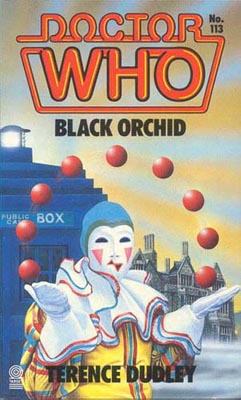 |
| Published | 1982 | |
| ISBN | 0 426 20254 6 | |
| First Edition Cover | Tony Masero |
| Back cover blurb: On a lazy June afternoon in 1925 the TARDIS materialises at the tiny railway station of Cranleigh Halt. Warmly welcomed by the local gentry, the time-travellers look forward to a well-deserved rest from their adventures. After a stunning performance at a friendly cricket match, the Doctor, together with Tegan, Adric and Nyssa, is invited to a splendid masked ball by Lady Cranleigh and her son, Charles. But a dark menace haunts the secret corridors of Cranleigh Hall. And before the ball is over, the quiet summer will be shattered by the shocking discovery of a brutal murder... |
Red herrings by Antony Tomlinson 14/3/05
I haven't seen the TV story, Black Orchid, but I know that it is only two episodes long. I thus expected some depth from a book that spread this fifty-minute historical over 143 pages. Did this book then, with its original setting (upper-class, 1920s England), and its gorgeous front cover, live up to my expectations?
In its first few chapters it did. The book is written in a leisurely, witty style, taking in elements of its two most obvious influences - P.G. Wodehouse and Arthur Conan Doyle. We get lovely little reflections on the strict system of manners at the time (Terence Dudley has obviously done his research). We also get some wry philosophical musings in the mind of the Doctor; slight drunkenness in the mind of Tegan as she gulps champagne and cocktails, and mildly amusing confusion at English sport and etiquette in the minds of the alien companions. Incredibly, Adric is also made a very likable character at the start of this tale, as he overcomes his shyness to take to a dance floor.
In a world of cricket and parties, all this is fine. The problems arise, however, when the plot kicks in. Dudley's relaxed writing style means that moments of fast-paced action end up dragging. The Doctor seems to spend forever wandering and pondering through secret passages, and the kidnap of Ann is slow. Dudley also seems happy that entire lines of conversation and scenes be repeated over and over again.
However, there is another more fundamental problem with this book. Dudley's writing does indeed do an excellent job of bringing this TARDIS crew to life. Unfortunately, this is one book in which the TARDIS crew are almost totally irrelevant to the plot. They are merely the red herrings caught up in a crime drama - the people the police arrest by mistake.
The real drama concerns Lady Cranleigh, her two sons and the character of Ann Talbot. However, these central characters are not explored in anywhere like the detail that Doctor and his companions are - they are treated almost like extras. So when the Cranleighs' various revelations come to light we really don't care. It therefore all ends rather disappointingly - the scandal behind the whole story is highlighted in a couple of sentences, there is then a small fight on a roof and finally the reader is left shrugging apathetically.
This book was therefore a pleasant enough read, but ultimately rather unsatisfying. It could easily have been improved, however, in one of two ways. Firstly, if the story had been told from the perspective of a character actually emotionally caught up in the drama (say family friend and chief constable, Sir Robert) then the Doctor and his companions could have been the slight oddities that they actually represent in this tale. The focus of our attentions could then have remained on the real plot - the Cranleighs. Alternatively, Dudley could have just cut out all the deformed maniac stuff altogether, and stuck to a summery tale of cricket and cocktails on the manor lawn.
One last historical by Andrew Feryok 9/3/13
The Doctor reflected, yet again, that curiosity was not without its dangers. It even killed cats, and cats had nine lives. And the Doctor's life was about to become more complicated than any projection of his wildest dreams.Black Orchid is a bit of an oddity within 1980s Doctor Who. It is best known for being the last historical although it really doesn't follow the typical historical formula. If the story had just been about the Doctor being accused of murder and trying to disentangle himself from it in order to get back to the TARDIS and dropped the whole deformed murderer, this probably would have felt more like a typical Hartnell story. Instead, this feels like a compromise. Nevertheless, this is easily Terence Dudley's best script for the Doctor Who series (compared to his Four to Doomsday, The King's Demons and K9 and Company). The plot is better and the characters are better. Dudley opted to novelize his own stories for Target and he would succeed in doing so except with Four to Doomsday. I have to admit that, going into the novelization, I wasn't expecting very much since Dudley doesn't really have a great reputation among fans. Granted, his reputation isn't as bad as Pip and Jane Baker, but fans don't exactly flock to wax lyrical about his stories for 80s Doctor Who. So how did his novelization stand up?
- The Doctor musing about when his cover will be blown, Black Orchid, Chapter 2, Page 39
The novelization blew all of my expectations clear out of the water. Dudley proves to be a fantastic writer of prose and character, and delivers a cracking novelization. He doesn't just transcribe what we saw on screen, but vastly expands the story to give us more background. We learn more about Ann's childhood visiting Cranleigh Hall and befriending George Cranleigh, we learn more of the expeditions George took the Amazon and exactly why the story is called Black Orchid. We also see the sheer depths to which Lady Cranleigh will go to conceal her son and "keep up appearances". But there are even further details such as an explanation as to why the Cranleighs have such a large secret wing of the house: at one time they not only hid priests, but all the royal family during the Roundhead period. The secret passages are more ingenious and we even get some background on Dittar, the Indian who takes care of George.
One of my favorite aspects of this story is the regulars, who really get to let their hair down in this story and enjoy time traveling rather than just jumping from peril to peril. I think over time the series lost this sense of time traveling as something other than a vehicle for getting into peril. After all, why would the time travelers travel with the Doctor? Why would the Doctor travel? I find it hard to believe that there is a situation like the Sarah Jane Adventures special Death of the Doctor where Sarah Jane and Jo are practically having an orgasm with each other saying the names and remembering the monsters they encountered during their travels. Weren't they screaming in terror at the time they met these things? But here we get to see everyone relaxing and enjoying themselves enormously.
I love Dudley's portrayal of the regulars. Tegan doesn't shout once in the story and instead we discover that she is an avid cricket fan and falls head over heels for the Doctor when she discovers how good he is at playing it. She also becomes the cultural liaison for Adric and Nyssa, who know nothing about the ways of Earth. Thus, for Adric and Nyssa, we get a marvelous "fish out of water" subplot in which they are constantly puzzled by everyday things such as how cricket works, what a "cocktail" is, or what the Walrus and the Carpenter is (Lord Cranleigh tries to explain it to Nyssa only to discover she doesn't know what oysters are). The Doctor gets two whole chapters to show off his cricketing prowess and then relaxes for a bath in what has to be one of his few relaxing moments during his tumultuous adventures (the other being his trip to the Eye of Orion in The Five Doctors). Dudley really brings out the "old man in a young man's body" aspect to the Doctor especially when he stands accused of murder and tries to argue his way out of it.
Lady Cranleigh makes for an unusual and ruthless villain. In fact, her role of as villain is played up more in the book. She's shown to be more cold and callous at setting the Doctor up for his wrongful arrest. You just don't see villains like this on Doctor Who very much. She isn't a cackling madwoman with dreams of world domination. She's a mother protecting her child and a decent woman who lets her selfishness about her own image and status lead her down the dark road she takes. You get the sense that Lady Cranleigh isn't a bad woman, but that she has had to construct a web of lies in order to hide her son George from the world and when that web of lies threatens to come undone, she has to create more and more lies just to keep things going. She essentially backs herself into a corner that she cannot escape from. Mix this with a bit of "mother bear" protection and you have an enemy who will do anything to see the Doctor take the fall for her son's murders.
But Black Orchid isn't perfect. For one thing, Terence Dudley makes two bad continuity errors. First he has the Doctor suspect that he may have been sent by the Time Lords on a mission to solve the mystery of Cranleigh Hall when he stands accused of murder. By this point, the Doctor had long stopped running missions for the Time Lords and the idea that they would send him to intervene in something so trivial to the time/space continuum as a simple murder mystery and Lady Cranleigh's treatment of her son is absurd. Second, to back this up, he then has the Doctor wonder if the Time Lords sent him on purpose to stop the Master preventing the signing of the Magna Carter in the middle ages during the story The King's Demons. Terence Dudley probably thought he was being clever linking in another story he had written to this one, but it's flat-out wrong, continuity-wise. The King's Demons concluded Season 20 and happened long after Black Orchid. And he was traveling with Tegan and Turlough in that adventure, not Tegan, Nyssa, and Adric!
Terence Dudley also gets the pacing of this story horribly wrong. I realize that authors hated doing two-part stories because it was felt that there wasn't enough story to cover a novelization, but this is ridiculous. Black Orchid was badly paced to begin with, as the murder mystery doesn't kick in until part 2 and is resolved almost as fast as it is introduced. The book is even worse. With 9 chapters to the book, the Doctor isn't even accused of murder until chapter 7! The rest of the book consists of the Doctor wondering around secret rooms and the companions enjoying the party. Dudley dedicates two entire chapters to describing in immense detail the cricket match! I wonder if many kids were turned off by this book, since it is clearly a book not paced for kids' tastes.
But don't let those negatives deter you. On the whole, this is one of the very best novelizations for the Fifth Doctor and a lost gem in the same vein as William Emms' Galaxy Four. Don't let the TV episode's reputation or the author's name deter you. This book has very well-written prose, great characters and a marvelous attention to period details. Plus, you get some amazing characterizations from all the regular characters including Adric. This book is a not to be missed "special edition" novelization. 10/10
Last But Not Least by Jason A. Miller 3/11/19
The three Peter Davison two-part stories present an interesting dilemma for the novelizations line. Target by the mid 1980s typically allotted 128 pages per book (a good 20-page improvement over the late '70s), but that assumed most books were adapted from four-part TV stories. The two-parters would be lucky beneficiaries of this standard page count; Target was not going to publish a 64-page book for a two-part story, so the adapter would have literally twice as much space to work with. Target tended to handle this conundrum in a different ways. For The Awakening, the first of the two-parters to see print, Eric Pringle released a faithful scene-by-scene and line-by-line retelling of the TV script, but with added descriptions and character insights to fill out the extra 64 pages. For The King's Demons, Terence Dudley turned in a rather different story to his original scripts, with many added scenes, and with a near-completely different ending.
Black Orchid, also by Dudley, was not only the last of the Davison two-parters to see print but was also the last Peter Davison novelization, full stop. Even though it was the first of the two-parters on TV. Dudley himself appears confused by this reversal of fortune: he has the Doctor remember the events of The King's Demons, which is going to confuse any Target reader who approaches the novelizations in story order rather than in publication order.
At first, Dudley appears to be doing what Pringle did, rather than what he himself did in the King's Demons book. In the opening chapters, there are several added or prolonged scenes, but the dialogue is typically quite faithful to what ended up on television, with the omission of continuity dialogue added by script editor Eric Saward referencing back to previous televised story, The Visitation.
While the extra material is interesting, the book starts off with a somewhat inconsequential feel. The original cover is gorgeous, with the faithfully-depicted clown juggling an extraordinary amount of balls (that's what she said). But then you have the prose. Dudley falls into the unfortunate habit of adding at least one adjective for every single noun in every single sentence in every single paragraph. This does help fill the story out to the book's length, but would have been, I imagine, the dreadful chore for the audiobook narrator (Michael Cochrane, who played Lord Cranleigh on TV).
Surprisingly, Tegan fares quite well in print. I was wary going in, due to the unfair and stereotyped way that Dudley wrote for her previously in King's Demons. But here, all the added cricket descriptions and rules and lore are filtered through her POV, which gives her a chance to show off her love for the game. There is also, among all the comedy of manners, a moment where Tegan reflects that the serving girls of 1925 are not dissimilar to her own occupation of airline hostess in 1981. And it's Tegan in the book who insists that the Doctor's companions be arrested as accessories alongside him in the Part Two material -- an agency denied her on TV.
Dudley also plays well with his period setting; as in his other book, with the medieval castle, here the mansion of Cranleigh Hall (and we learn that the family's proper name is Beauchamp, a detail presumably snipped out by Saward on TV) is a proper character in the book. There's lots more hide-and-seek with George Cranleigh and a creepy added moment at the end of Chapter 2 as he stalks Ann Talbot through a room full of armor. The Doctor's exploration of the attic and hidden apartment late in Part One is given added space, with some extra terror and extra hide-and-seek. This is either material cut from the draft script by Saward for timing or invented for the book, but it keeps the pages turning and does not serve as mere padding.
As the story is an Agatha Christie lift, there is unfortunately a racist stereotype walking around, but Dudley does portray Latoni a little more fairly in the book, with Lady Cranleigh treating him as a visiting dignitary (he's said to be chief of his tribe) rather than as just another servant who dies of stupidity (as on TV).
Once you get past the profuse proliferation of additive adjectives, the prose has its moments. Dudley writes with a vocabulary befitting the period setting, and belying the fact that this is nominally a children's book:
"He'd had no right to penetrate the secret passages of Cranleigh Hall but his protean curiosity demanded satisfaction about the nature of any fugitives seeking sanctuary here."(Again, too many adjectives, but the vocabulary is great for the 12-year-old reader.)
Of course, at other times, he overdoes it, and carries alliteration a bit too far:
"... a danger, a deadliness in the deliberate descent..."And who could forget:
"The Doctor looked back penitently at the perspiring policeman."The added words and dialogue allows us to see the characters in slightly different lights. The Doctor shows more curiosity as to the identity of the dead man in the cupboard, Lady Cranleigh gives a more detailed history of her home, and Nyssa needs constant explanations of 1920s idioms, such as the costumes at the ball and the abundance of bird metaphors. And Dudley shows a keen understanding of the landed aristocracy, 30 years before Downton Abbey:
"Sir Robert frowned. He was deeply worried that such an exemplary cricketer appeared not to have an exemplary character to match. It denied a whole code of ethics, contradicted a whole way of life."
Dudley has a good handle on the Doctor's thought processes, too: "The Doctor had gambled on the maxim that fortune favors the brave and hoped that it extended to the foolhardy". That's a great mission statement for our favorite Time Lord.
At the end, though, Dudley again pulls a King's Demons, and changes up the ending -- not quite as drastically, but he does change it. The Part Two material is slightly restructured, with the Doctor now being the one to discover the second body (James the footman) and presenting a more vigorous defense of his innocence. There's even a "Doctor... Who?" joke and namechecks to George Washington and Winston Churchill. As he did in The King's Demons, Dudley saves a character who died on TV, and, in fact, the character who survives is rescued by the very person who, on TV, had killed him.
If you can get past the excess verbiage and the occasional run-on sentence, Black Orchid pretty much sings in print. Dudley uses the extra space well, to get into his characters' heads, to explain the period setting and give more backstory to Cranleigh Hall, and to tell a slightly different story from the familiar TV one. Black Orchid has, I feel, an unfair reputation on TV, but the book is a lively Christie pastiche and, in the end, a successful one.