
The Masters of Luxor scriptbook
The Masters of Luxor

|
The Masters of Luxor scriptbook |
Big Finish Productions The Masters of Luxor |
|
| Written by | Anthony Coburn, adapted by Nigel Robinson | 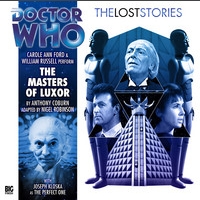 |
| Format | Compact Disc | |
| Released | 2012 |
| Starring William Russell and Carole Ann Ford |
| Synopsis: The TARDIS is drawn to a mysterious signal emanating from a seemingly dead world. Trapped within a crystalline structure, the Doctor and his friends inadvertently wake a vast army of robots that have lain dormant for many, many years. Waiting... for the Masters of Luxor. |
Of Gods And Robots by Matthew Kresal 16/4/13
It almost seems surprising that has taken this long for Big Finish to get around to doing The Masters of Luxor as part of their Doctor Who - The Lost Stories range. It is the oldest "lost story" after all, having been originally commissioned to be the second-ever story for the series as well as having had its script published in book form in the early 1990s. So, after forty-nine years, we can finally hear the story with two of the original actors, William Russell and Carole Ann Ford, who would have been in it. So has it been worth the wait?
Unlike the usual full-cast audio dramas that Big Finish normally releases for Doctor Who, this production of The Masters of Luxor was done instead as an "enhanced talking book". To explain the format, Robinson took the Coburn script and turned it into what is effectively prose. This prose is read by actors William Russell and Carole Ann Ford (who reprise their respective roles as Ian and Susan from the television series, as well as narrating the story and also taking the parts of the First Doctor and Barbara). Joining them is actor Joseph Kloska who reads in the various robots as well as The Perfect One and Tabon. The result gives this version of the story the most unique feel of its three versions: a cross between a novelization of the scripts and one of Big Finish's Companion Chronicles releases.
The adaptation by writer Nigel Robinson (who adapted the scripts for the First Doctor Box-set) of the original Anthony Coburn scripts is largely faithful. Robinson keeps the six episode structure of the story and also retains the originally written cliffhangers. But instead of keeping the story in its originally intended placement, the story is shifted to after the previous First Doctor stories in the Lost Stories range. It also keeps the originally written cliffhangers despite some of them being rather odd (the first episode cliffhanger is a good example) which nevertheless helps make it faithful to the original scripts in that regard anyways.
Robinson, though, makes some changes of his own. Due to the lack of descriptions given in the script, Robinson was largely given free rein to create descriptions for the characters and sets. The Mark One robot descriptions seem to come out of 1950s B-movies while the Derivitrons were based, by Robinson's own notes for the CD booklet, on the Miranda robot from the classic silent film Metropolis. For The Perfect One and Tabon, Robinson took note that the name seemed to come from the discovery of the so-called 'Tabon Man', a fossilized early humanoid discovered in the Philippines the year before Coburn wrote his scripts. As a result, the characters were given a description somewhat Asian in appearance with skin "the color of pale honey". The devices used for The Perfect One's experiments are also taken from the aforementioned Metropolis as well.
Some of Robinson's characterization, where he was allowed to fill in gaps in the script, can be a bit odd as well. A perfect example being a moment early on where Susan daydreams about being kidnapped "half naked" by one of the robots. While this is perhaps befitting any number of B-movies from the 1950s and 1960s, it feels odd coming from this character even if Carole Ann Ford is reading it.
The production also reduces the religious subtext found in the script significantly. The main result of this is that a pivitol scene in episode six has been cut out completely as well as the hymn sung by Susan and Barbara being changed from Onward, Christian Soldiers to the somewhat less religious hymn Jerusalem. Given that the point of the Lost Stories range is to present stories from the era, this change in emphasis (while having its reasons) seems odd as surely the point is to present the story, even with some possibly anachronistic themes, intact.
As mentioned earlier, this has two of the series original cast members both reprising their roles and narrating the story. William Russell and Carole Ann Ford, having done similar jobs on The First Doctor Box-set as well as their work on the Companion Chronicles, are well versed in this style of production and are the definite highlight of this production. Their performances also bring out the best parts of the original Coburn script such as Ian's "the projectionist has gone home" line in the first episode. Joseph Kloska's performances as the various other characters is the icing on the cake, giving Russell and Ford both a fine actor to bounce off in their scenes together. The sums of their performances give this version an air of authenticity it might otherwise lack.
So has The Masters of Luxor been worth the wait? For me, the answer is yes and no. "Yes" because of the excellent performances and readings from the actors. I say "No" because of the sometimes-excessive changes made by Robinson in his adaptation. Perhaps someone who hasn't read the original scripts might feel differently but, to my mind, this version of The Masters of Luxor is good but definitely flawed.
The Perfect One - A Mockery of A Man by Jacob Licklider 19/8/25
The second story for Doctor Who as we all know is The Daleks, but that wasn't always the case. Up until the production of An Unearthly Child, the second story would have been another script by Anthony Coburn, The Masters of Luxor or "The Robots", which would have dealt with a deserted planet where there is a pyramid inhabited by the Perfect One. The Perfect One is a robot created from an idea of the masters of Luxor who wants to be perfect. Its idea of perfection is sucking the life out of people as a way to become a human being. The original script was meant to be overtly religious in nature and a story about the fear of atomic weapons. Big Finish of course took the edited version of the scripts from the official script book and had Nigel Robinson edit it further to allow it to work with series continuity. The Christian undertones are still there under heavy suppression, but the fear of atomic weapons and a nuclear fallout stayed through the adaptation. The weird thing is that without that overt Christian undertones there really isn't anything in the story that we haven't seen before, as the atomic fear is just what was done in The Daleks.
That said, Coburn's writing style for the social commentary has this hypnotic quality for the audio that evokes the very first episode where we feel something odd is going to happen. It's a weird feeling for the story, as it brings back the mystery. This is seen in the story even if while in the story it is Barbara bringing the mystery to the story in the early scenes, Carole Ann Ford is voicing Barbara. The obvious difference in the two characters that always seems to come through in Ford isn't a problem. I put it down to Lisa Bowerman's excellent direction for the story, but the way Ford performs in this one just captures the late great Jacqueline Hill in a way that seems to work. You really feel that sense of foreboding as the TARDIS is drained of energy and there is this dead world, but something calling out to the crew to come closer. It really feels like something that could have been broadcast on Doctor Who in 1963. That really is something special, and it's a feeling that is difficult to reproduce, as hearing a story in black and white is nearly impossible, but this one really nails it when it comes to turning off the color of the television and hearing in monochromatic wonder.
William Russell really shows his theater chops, as he only has to play Ian and the Doctor. His First Doctor is of course impeccable, especially in this one, giving even Peter Purves a run for his money when it comes to impersonating William Hartnell. This is down to the small cast size in this one, so Russell has to keep his Hartnell on point or the listener will notice. Russell is a good actor, so he pulls it off wonderfully. He even has to switch between voices in the same scene, as there is a portion of the story where it's just Ian and the Doctor while Barbara and Susan are both captured by the Perfect One. The plotline with the Doctor and Ian is this piece about them finding Tabor, the man responsible for creating the Derivitrans and killing the fourteen other masters of Luxor. While the diversion goes on for a bit too long before bringing the focus back to the idea of the Perfect One, what is done with it is still very interesting to hear, as Tabor is the embodiment of hubris in creation and science gone too far. It is something that of course goes back to the Christian undertones and the problems with taking them out of the story makes it lose this sort of depth. Joseph Kloska is the one playing every other character, and I hope this guy gets into television or even film as he plays five separate characters all based on the same person. His performance is very similar to Patrick Troughton in The Enemy of the World and is the highlight of the story as the different robots are all variations on Tabor. His portrayal of the Perfect One is of course perfect, as it is the true mockery of a man.
To summarize, The Masters of Luxor is a true gem of a Lost Story that comes right out of the 1960s. Looking at it is interesting, as the idea of it replacing the Daleks as villains wouldn't have kept the show going, but it should have been made in place of say The Keys of Marinus as it really goes for a lot of ideas that aren't explored. It shares pacing problems and the adaptation does lose a bit of its luster with the removal of what would be controversial undertones in the story. 80/100