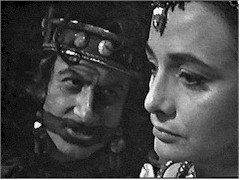
. Except of course that writer John Lucarotti
does make it worse. He puts the wrong characters on the wrong
sides of the argument — and then promptly has them
“forget” their own arguments. In short, The Aztecs is
an incoherent swampland of mischaracterization, hoping that the audience
won’t notice the flaws with the script amidst the generally strong
acting and production design.
Once a writer makes the implications of time travel the central theme
of a Doctor Who story, he’s on very shaky ground —
especially if he chooses to make the Doctor the advocate for
non-intervention. Lucarotti makes his job even harder by choosing to set
this argument against the backdrop of known Earth history. Do what you
want to the history of Skaro, or even the events of the present day upon
the future of the Earth, but stories about Earth’s actual history
require much greater care than Lucarotti was apparently able to give.
There is, after all, very little established at the beginning of
episode one that isn’t contradicted by the end of it. The other
three episodes are just there to let Lucarotti get himself into deeper
trouble. When the TARDIS crew first arrives, the Doctor doesn’t care
at all about tampering with the timeline. Instead, he gleefully helps set
up Barbara as a god and all but encourages Ian to contest for the
leadership of the military. While Barbara is screwing with the timeline
to the benefit of the TARDIS crew, the Doctor chuckles a lot and finds it
all, to use his word, “charming”. Within a few short minutes,
though, this Doctor regenerates into a Time Lord more akin to Borusa than
himself. When Barbara tries to intervene with the local customs and stop
a ritual killing, the Doctor goes Gallifreyan on her, giving her a
standard “non-interventionist” line. Then, he ignores what
he’s just said, nipping off to the Garden of Peace for a little bit
of local strumpet. Meanwhile, Susan and Ian both make similar incursions
into local customs and the Doctor, apparently spent from his argument with
Barbara, shows no concern over their polluting the time stream.
Problematically, the only member of the TARDIS crew to whom the
non-interventionist theme of the story applies to is Barbara -- and, of
course, only after she’s set up as a god.
And there’s really no damn good reason for the inconsistencies.
What did the Doctor expect was going to happen when he encouraged his crew
to assume positions of high power in fifteenth-century Mexico? Surely he
had to anticipate that his crew might use their newfound positions of
power to affect change. If he did, then the Doctor’s just a selfish
bastard, more concerned with getting back to the TARDIS than the potential
damage to the timestream. If he didn’t, he’s just a damned
fool. For the love of God, Lucarotti: Ian and Barbara are high school
teachers from the 60s. Idealists like this are exactly the wrong humans
to install as leaders of Aztec Mexico if you’re trying to avoid
intervention. Regardless of his companions’ “fitness to
command”, the Doctor got Barbara into this mess. He’s got no
business yelling at her for, well, being herself.
Worse, Lucarotti takes the Doctor’s hypocrisy inexplicably
further. What, after all, does the Doctor do almost immediately after his
blow-out with Barbara? He goes to sample the local cuisine, falling in
love with Cameca. Now, had this been used as part of the motivation
behind the Doctor’s generally romance-less TARDIS, it would’ve
been cool. Very cool. The Doctor falls in love with a human from the
fifteenth century, realizes the error of his ways, then takes a memento of
her with him, foreswearing love with humans forever more. Instead,
it’s just a rather stock “ships that pass in the night”
kinda thing that exposes the Doctor’s anger in episode one as a lie.
Taken with the other logical inconsistencies, the story’s theme is
reduced to a legalistic punch line: “You can’t change
history, Barbara. Not one line. Unless helping set you up as a God will
get us back to the TARDIS. Or if I get a little action in the Garden of
Peace. Or if my granddaughter is forced to marry someone she
doesn’t want to. Or if Ian’s sense of macho isn’t
offended. Or if you only affect the destiny of one or two locals (and you
can assure me that those one or two locals don’t go on to lead a
revolutionary movement). Oh, the hell with it, woman. You fly in my
TARDIS. Just obey me and bring me tea when I ask for it.”
Still, having said all this, Lucarotti could’ve gotten away with
it all. He could have, indeed, written one of the very best stories
Doctor Who had ever televised. If he had merely taken his
situation, and his thesis, and written the parts appropriate to character.
The thought that struck me on my very first viewing of this story was that
Barbara and the Doctor were playing the wrong parts. Strictly from a
character standpoint, the Doctor should have been Yetaxa. Then he would
have been the one to make the timestream-altering decisions—a far
more palatable position for the Doctor to be in. Imagine The
Aztecs if the Doctor were himself, crusading against injustice, while
Barbara, the history teacher, works out the implications to her time line
if the Doctor carries on. The tension in the story thus becomes the alien
of Unearthly Child doing what he thinks is best
versus the human who cares about saving her own timeline. The tension
would have been infinitely more effective if the history teacher had been
using one of her character traits to fight for something that directly
affected her, rather than the more esoteric position she finds herself
defending. And imagine the fun of her upbraiding the Doctor for falling in
love with the local! Instead of a quickly-mumbled line giving playful
assent to the Doctor’s romance with Cameca (one that, incidentally,
never has Barbara even vaguely taking the Doctor to task for being such an
obvious hypocrite) we could have had a wonderful subplot with Barbara
upbraiding the Doctor for messing not only with Earth’s timestream
but the affections of a woman he knew full well there could be no future
with. Were Barbara herself and the Doctor actually a renegade Time Lord,
the line that might have been extracted for the back cover wouldn’t
have been the mundane, “You can’t change history,” but
the infinitely more intriguing, “You can’t fall in love,
Doctor. Ian and I might never be born!”
As televised, though, its many scripted flaws make The Aztecs
more an “important” work than a good one. Should you watch
it? Of course. But then, you’re a Doctor Who fan trying to
understand the history of the series. Most casual viewers today, to the
extent that they would watch a black-and-white program at all, would
probably switch it off after episode one. And that’s really the
source of most of the enjoyment this serial offers. The Aztecs is
important for the Doctor Who fan to watch because it shows
perfectly why this type of Doctor Who faded. Careful observers
might even see, by virtue of the story’s negative example, how the
form might be revived to better effect in future. I suppose, too, The
Aztecs provides a useful jumping-off point for broader discussions
about the Doctor’s use of time travel throughout his several
regenerations and format changes. It’s just a shame that the one
thing The Aztecs fails to do is provide a consistent approach to
the subject within its own four episodes. Had it at least done this
— regardless of what other producers did with the subject later on
— it might be entirely a classic today.
A Review by Finn Clark
5/6/07
I had trouble working out how to sum up The Aztecs. I'll
probably get lynched for this, but the name that kept coming to mind
wasn't Shakespeare, but P.G. Wodehouse. No, give me a moment.
Theoretically this is one of the bleakest Doctor Who stories, up
there with Genesis of the Daleks. The TARDIS crew
arrive in an advanced civilisation that's due to be annihilated by Cortez
and the Spanish, but there's nothing they can do to prevent this. The one
good and gentle man who trusts Barbara ends up abandoning everything to
wander forever in the desert. In the end, the High Priest of Sacrifice
has re-established his power and is merrily cutting out hearts again.
But is it depressing? Is it, my arse. It's practically an Oscar Wilde
drawing-room comedy. Lucarotti isn't going for laughs like Donald Cotton
or Dennis Spooner, but it's hard to imagine a less horrifying treatment of
this material. Like Gallifreyan Bertie Woosters, the greatest shocks
facing specifically the Doctor and Susan are threats of marriage.
Barbara's playing with fire by impersonating a goddess, but her
confrontations with Tlotoxl are bristling with intelligent dialogue and
impeccable manners. Meanwhile Ian finds himself in a struggle to the
death with a mortal enemy... but this foe happens to be a good-natured,
likeable fellow who isn't even a match for Ian in a fair fight.
Even the plotting is Wodehousian, in places reminiscent of a sitcom.
The Doctor helps Ixta because he thinks he'll thus learn about the tomb,
not realising that Ixta's opponent is Ian. (He's even mistaken in this,
incidentally.) The only person with complete knowledge about what's going
on is Tlotoxl, with everyone else stumbling through misunderstandings and
misapprehensions. Barbara overestimates her own power and doesn't realise
that she's approved the scourging of Susan. Autloc's usefulness to our
heroes is dependent on him believing a lie. You'd hardly need to change a
thing to turn this into outright farce.
Barbara is, of course, the heart of the story. All four regulars get
their own plot thread, although Susan's is hardly anything to write home
about, but there's only one Yetaxa. She's in complete control and almost
terrifying in her role as a living goddess. Damn, she's quick! Look at
all those sharp comebacks when being questioned by the high priests. Here
for once we have a companion being allowed to have intelligence, knowledge
and a point of view that's not merely shadowing the Doctor's. Her
confrontation with him in episode one is a highlight of the entire
Hartnell era, not just of this story.
However almost as enjoyable are the Barbara-Tlotoxl scenes. John
Ringham's Tlotoxl is a wonderful villain and never better than when
locking horns with his arch-nemesis. They have a sinister kind of
rapport, actually. It's interesting to note that the Barbara-Autloc
relationship is warm, full of admiration and based on a lie, while that
between Barbara and Tlotoxl is openly hostile and yet, after a certain
point, completely honest. Even when scheming to bring about Barbara's
death or downfall, he never lies. He merely avoids mentioning that his
peace draught is poisonous or that Susan is the one who'll be scourged.
Ian gets a good role too, but it would take a lot to pull fandom's
attention away from the Doctor and Cameca. Just look at the dreadful old
reprobate. Note that the straightforward thing to do after his little
misunderstanding would be to own up and say you goofed. Come clean! But
not Hartnell. Oh no. He's genuinely fond of Cameca and they seem to
reach some kind of understanding between episodes three and four, but he's
still exploiting her with no intention of either staying in Mexico or
taking her with him in the TARDIS. Well, that's the First Doctor for you.
Despite the talkiness, it's a fast-moving story. Historicals often
start slowly but this one's off with a bang, Barbara hell-bent on her
suicidal plan almost as soon as she dons the headdress. Only being a
four-parter helps of course. It's theatrical, but I don't see that as a
bad thing. Note the painted backdrops. The Hartnell years had so much
ambition partly because they could realise their ideas so simply. I love
black and white.
Of course it's disturbing if you think about it. What did Barbara do
to Autloc? Was he wrong to trust her? He's gone into the wilderness and
he'll no longer be High Priest of Knowledge, but he'll no longer have
anything to do with the sacrifices. However, is this a good thing? It
obviously doesn't help Autloc materially, while the Aztec society is
hardly improved by losing its humanitarian high priest. The Doctor claims
that Barbara helped one man, but did she really? And of course episode
four is darker than the rest of the story because it has killing.
There's a decent fight at the end between Ian and Ixta, although
episode one has a fight scene that's pretty lame. Nevertheless The
Aztecs is a whole-hearted story that takes itself seriously and
doesn't make its characters or world the butt of jokes. There's also
lovely sub-Shakespearian dialogue, which is as good a method as any I can
imagine of representing an alien language and culture. It's a landmark
twice over in Doctor Who history: (a) the Doctor's relationship
with Cameca, and (b) Barbara's attempt to change the future, bringing her
into conflict with the Doctor in that rightly famous scene in part one.
It's never cheap or silly, instead being a solid BBC historical drama and
full of quality. It's admirable.
A Review by John Greenhead
25/9/07
Having already excelled in writing Marco Polo,
John Lucarotti surpassed himself with The Aztecs. Not only do his
scripts provide an interesting, well-researched glimpse into Aztec
culture, but they also contain some fine dialogue and gripping conflicts
between the characters, marking this out as one of the finest historical
adventures.
At the centre of it all stands Barbara, mistaken for the reincarnation
of an Aztec priest and determined to use her new divine status to end the
practice of human sacrifice. This story is undoubtedly Jackie Hill's
finest hour in Doctor Who, and one of the main reasons why I regard
Barbara as one of the best companions the show has ever had. Hill conveys
Barbara's determination to change the course of history, and her ultimate
disillusionment, extremely well and her confrontations with Tlotoxl are
electrifying. John Ringham is also outstanding as Tlotoxl. His Richard
III impression initially seems to portend a hammy performance, but in fact
he delivers a subtle, nuanced portrayal which blends charisma with evil
cunning and makes Tlotoxl quite hard to really dislike. One of the story's
main themes is the contrast between the "good" and the "bad" elements of
Aztec culture (at least as seen from a modern Western perspective), and
Tlotoxl vividly represents the bad. Keith Pyott's Autloc stands at the
opposite end of the spectrum and Pyott convincingly shows Autloc's gradual
loss of faith in traditional Aztec beliefs, under Barbara's influence.
This emphasis on the good and the bad gives the story much of its
power, not least because it is evil that triumphs in the end. The Doctor
warns Barbara that she can't change history, and sure enough her attempts
to "save" Aztec culture by ending human sacrifice come to nothing. Tlotoxl
is triumphant and Autloc, her one convert, goes off into the wilderness.
It is an uncompromising ending which fits with the overall maturity of the
story, and once again illustrates how adult early Doctor Who could
be: the Aztecs are still doomed to destruction at the hands of the
Conquistadores and that sense of ultimate doom hangs over the story.
Given that it is only four episodes in length, The Aztecs also
successfully provides the other regulars with involving subplots. The
Doctor gets a touching and amusing little romance with the Aztec lady
Cameca, which is very well played by both William Hartnell and Margot van
der Burgh. Hartnell is at his best throughout this story, showing the
first Doctor at both his most tender, in his conversations with Cameca,
and also at his fiercest, when he argues with Barbara over her attempts to
reform Aztec culture ("you can't rewrite history, not one line!"). His
farewell to Cameca is quite emotional, showing he feels guilty about
breaking their engagement and indicating that, although he is alien and
had been using Cameca all along to help himself and his companions to
escape, he does feel some genuine fondness for her. It shows the soft
heart that beats beneath the gruff exterior of this Doctor and works far
better than many of the attempts in the new series to inject emotion into
the Doctor's relationships. Ian and Susan are also well served by the
scripts, Ian getting to play the hero again as he is forced into a rivalry
with the arrogant, petulant warrior Ixta, who is convincingly played by
Ian Cullen. Susan's appearances are limited by Carole Ann Ford's holiday
in the middle two episodes, but she shows more character and spirit than
she often does in asserting her right to marry whom she chooses, when
faced with the prospect of an arranged union with the "Perfect Victim".
Another major factor in the story's success is Barry Newbery's superb
set design, which really helps the viewer to believe that the TARDIS crew
are in Aztec Mexico. The costumes are also excellent, and John Crockett
provides some fine direction, apart perhaps from Tlotoxl's slightly cheesy
aside to the camera at the end of the first episode. This, however, is the
only criticism I would make of probably the best story of the first season
(just edging out The Daleks), and one of the
highlights of the Hartnell era.
A Review by Declan McKeown
25/11/08
The Aztecs defeats the argument that many of the Doctor
Who historical stories were inferior to the space-age episodes.
I'll start by saying that the plot is of one of the best for historical
Doctor Who, mainly because it was written by John Lucarotti, who
knew his history and could adapt it to feature the TARDIS crew.
The Temple of Evil really has some impressive sets. Yetaxa's
tomb is clearly the best of them but sadly it is not in the rest of the
episode. However, Barbara's quick change of costume, similar to that in The Keys of Marinus, never fails to astonish me. The
standard of design for the characters clothes is first rate. John
Ringham's hammy Richard 111 impersonation is well disguised by some
generally excellent music and great dialogue.
The Doctor telling Barbara off in episode two is probably the most
famous scene in The Aztecs and rightly so, with excellent acting
from both William Hartnell and Jacqueline Hill. It would be interesting to
learn how Ian learnt the Vulcan grip, exhibited to great effect against
Ixta early in Episode One. Ixta tricking the Doctor to give him a poison
thorn to help him to try to kill Ian is perfectly sly, and the episodes'
cliffhanger is edge-of-the-sofa stuff.
Most Aztec laws are really weird, like having no choice in marriage and
Ixta being Ian's friend even after attempting to murder him in Episode
Two. It's also great to see Barbara with a knife because she really suits
one. Nearly everyone in The Aztecs is an untrustworthy character,
especially Tlotoxl, who slyly asks Barbara to drink with him when the
drink is actually filled with poison. The Doctor's engagement to Cameca is
hilarious, mostly due to of the Doctor's expression when he turns towards
the camera. Again, the cliffhanger to this episode is gripping, like all
cliffhangers should be.
The Day of Darkness is definitely the saddest part of The
Aztecs because of the scenes of Autloc and Cameca leaving. The way Ian
disposes of Ixta by throwing him from the roof of the Aztec temple is
shocking, as we never see a companion directly killing another human, and
what a brilliant way to end a story by someone getting sacrificed.
Overall I was sad to see The Aztecs end, as it is my favourite
William Hartnell story, probably because I love history. I thought the
production team did a fantastically realistic Aztec temple. This story is
definitely in my top ten, and it also proves how good historical stories
really were.
10/10
A Review by Brian May
12/10/10
"You can't rewrite history, not one line!" - The Doctor, The Temple of
Evil
"You can't fight a whole way of life" - Ian, The Bride of
Sacrifice
The Aztecs is one of the best historicals, one of the best Hartnell
adventures and one of the best Doctor Who stories of all time. It's
masterfully written, meticulously researched and a complex human drama,
very tragic and well paced. When it comes to serving the historicals'
intent to both educate and entertain, it passes with flying colours.
Barbara's professional knowledge of the Aztec civilisation makes an
excellent plot device, enabling her to impersonate Yetaxa and maintain her
facade as long as she does without any sense of contrivance.
The dialogue is beautifully lyrical, the double-crossing, lies and
manipulation worthy of a Shakespearean, Jacobean or similar-type drama.
The cliffhangers are some of my favourites: episode one's is a dramatic
pause, while episode two gives us a confrontation and dilemma. The third
is the most typically Who-ish, a regular in peril, but it's one of
the most understated and unforced. The design is wonderful, the sets and
costumes magnificent, and, thanks to the photo gallery on the DVD release,
we see how a lot of these looked in colour.
Not only is the script sublime, but so too the acting. The four
principal Aztecs - Keith Pyott, John Ringham, Margot van der Burgh and Ian
Cullen - are all spot on with their respective characters (Ringham's
Richard-III-styled turn is never over the top, suiting Tlotxol perfectly).
Jacqueline Hill is absolutely superb as Barbara, who gets her moment in
the spotlight. William Hartnell and William Russell are similarly
excellent, both in their respective sub-plots and their great interactions
with Barbara, which include the two quotes prefacing this review. I'll
return to these in a moment, but before moving on I'm not going to forget
Carole Anne Ford. She's been described by many (including myself) as the
weakest link of the original regulars, but she's very good here. Although
Susan's particular sub-plot is the most marginal, pushing the character
further into the background, John Lucarotti nevertheless manages to weave
her situation into the dramatic core during the final episode.
The two aforementioned quotes form the crux of The Aztecs.
Barbara bravely but naively believes she can change the horrific aspects
of their culture, but the inevitability of history is against her. Ian is
right when he tells her Autloc is the exception rather than the rule,
making the priest's fate all the more heartfelt. His loss of faith and
self-imposed exile are described as salvation and redemption, but this is
open to question, especially after he has begged Barbara not to deceive
him and she repays him by doing just that. The gentle, romantic scenes
between the Doctor and Cameca have rightly been remarked upon as unique in
showing a new side to the series' lead character. The Doctor's accidental
proposal allows for some humour to lift the sombre mood (his casually
delivered "I made some cocoa and got engaged" is hilarious), but despite
the affection he feels for the Aztec woman, in the end he is simply using
her to engineer the travellers' escape, and it doesn't take her long to
cotton on. But she still helps him and her parting request, a simple
"Think of me", is a very sad moment. The two decent people we meet are
both manipulated and abandoned by story's end, while Tlotoxl is victorious
which, as Barbara admits, he has to be.
This is a much better adventure than Marco Polo.
Lucarotti's first historical is highly lauded, and deservedly so, but at
seven episodes it did meander a bit; at four, The Aztecs is much
tighter. Indeed, for a Hartnell story the pace is very quick, the tension
often edge-of-seat. In short, it's an amazing story, and I'm so thankful
all four episodes exist so we can continue to appreciate it in full.
9.5/10
A Review by Paul Williams
10/10/18
The Aztecs is high quality drama. There are similarities with John Lucaroti's previous story, Marco Polo. Both historicals see the TARDIS crew separated from the ship and disrupting an alliance of two men, one who is evil and one who is basically good but not necessarily their friend. Both have strong characters, with plausible motivations and complex interpersonal relationships. Both feature a reluctant bride in an arranged marriage, but this time Susan is the victim.
That's all she contributes, due to the difficulties of sustaining four separate storylines for the regulars. Three is an achievement, with the Doctor, Ian and Barbara all shining. Lucaroti adds conflict between them, as Barbara ignores both men to pursue her vision. Her adversary Tlotoxl is equally misguided. Ian and Ixta engage in an ongoing battle of stealth and wits, whilst the Doctor enjoys a romance that is comical and emotional. Underpinning it all is a contrast between the barbarity and wisdom of the civilisation.
A Prime Historical by Matthew Kresal
29/5/20
The so-called pure historical, where the TARDIS travels back in time and gets the TARDIS crew involved without aliens or other sci-fi elements, is one of the things that sets the Hartnell era apart from the rest of Doctor Who. While Marco Polo gets the credit for starting this Whovian subgenre, it's not until a couple of stories down the line that it hits its stride. With The Aztecs, broadcast across May and June 1964, it most certainly did that.
That's in part due to a smart set of scripts by John Lucarotti. Having written the aforementioned Marco Polo, which as I noted in my review was more travelogue and didn't feature the main cast perhaps as strong as it should have, The Aztecs feels like him learning lessons from that experience. Here, for example, the plot is far more contained. Instead of wandering for weeks on end, everything takes place around a single Aztec city and temple. The time scale is smaller, across the space of a few days at most. Tying in with that, the story also has four episodes instead of seven, meaning that it's far tighter than Marco Polo was.
All of which serves the story well. For just six stories into Who's run, it's already tackling one of the biggest questions a time-travel series can face: Can you change history? Should you try to? Set against a backdrop of a civilization that's at once immensely cultured yet superstitious and obsessed with human sacrifice, it explores those themes by putting the history teacher Barbara (and Jacqueline Hill for that matter) at the center of events. Her push to change history, to save the Aztec people from their own worst excesses pushes the story forward, creating conflict on all fronts. The result is an engaging drama of hope and fear, and the conflict between past and future with Hill's performance lying at the heart of the serial.
There's also an intriguing subtext that runs through the story as well. In some ways, it's hard not to see a commentary on colonialism. Barbara is, after all, a European stepping into a native culture and working to change it to her own ends. As benevolent as her intentions are, the results of her attempted intervention is clearly on display throughout, as it leads to deceit, suspicion and bloodshed. It's fascinating to think that Lucarotti was writing this at a time when Britain's colonies were gaining independence still, effectively critiquing an era that was just ending.
If that makes the story sound stagey or talky, there's more to it than that. There's an adventure-story element to this as well, something that allows the story to be a showcase for the other Earthly companion Ian. With Ian facing down the warrior Ixta multiple times across the four episodes, the story sees him getting involved in numerous scrapes, from hand-to-hand combat to getting trapped inside a temple corridor. It's a chance for the series' first man of action to shine in some well-staged fight scenes for the era (even if William Russell is being doubled for a good portion of the climactic fight).
The set design and costumes are equally strong, working to the series' strengths at the time. While the science-fiction stories would see them trying to break both the budget and the walls of the set, the historicals are just as much a showcase for their ingenuity. After all, recreating an Aztec city is no mean feat, especially on the sort of budget we're talking about at this point in the series' history. True, it may look primitive by the standards of Who's 21st-century regeneration, but it remains engaging and immensely watchable.
Because, being part historical drama and part adventure story, The Aztecs has something to offer for everyone. True, it lacks aliens or the more overt genre trappings, but it offers something else in spades. That would be a compelling human story of hope for change played out against the fate of a civilization. The result? One of the standout stories of the series, from this era or any other.