THE DOCTOR WHO RATINGS GUIDE: BY FANS, FOR FANS

Kraals
|
BBC
The Android Invasion
|

|
| Episodes |
4 |
 |
| Story No# |
83 |
| Production Code |
4J |
| Season |
13 |
| Dates |
Nov. 22, 1975 -
Dec. 13, 1975 |
With Tom Baker, Elisabeth Sladen, John Levene, Ian Marter.
Written by Terry Nation. Script-edited by Robert Holmes.
Directed by Barry Letts. Produced by Philip Hinchcliffe.
|
|
Synopsis: The Doctor and Sarah land on Earth to find dead men returning to life and inhabitants of a small village guarded by faceless androids. Even UNIT is seems to be controlled by an alien force aided by a missing astronaut.
|
Reviews
A Review by James Mansson
9/4/98
The Android Invasion is not a Doctor Who adventure that
tends to attract much comment, and I was not really sure what to expect
when I first watched it. I must say that I enjoyed it a great deal. One
reason is that it is not at all like the other invasion stories of the
UNIT era. Most of these had pretty simple plots and were not especially
fast paced. In addition, there was no great mystery as to what was going
on. In contrast, the plot of The Android Invasion contains plenty
of twists and turns, and there is a greater sense of urgency as the
Doctor and Sarah are pursued around the countryside. Also, the situation
is a more mysterious and intriguing as events do not proceed quite in the
pattern we have come to expect. Even the title, which might seem to give
the game away, only helps to distract the viewer from what?s really going
on.
Although the story doesn?t contain any especially original elements,
there are a number of nice details. There is some nice banter between the
Doctor and Sarah, which is helped considerably by the great rapport there
was between Tom Baker and Liz Sladen. The clues the Doctor is able to
pick up on to deduce what is happening are clever, and both he and Sarah
are called upon to demonstrate considerable ingenuity to overcome their
enemies.
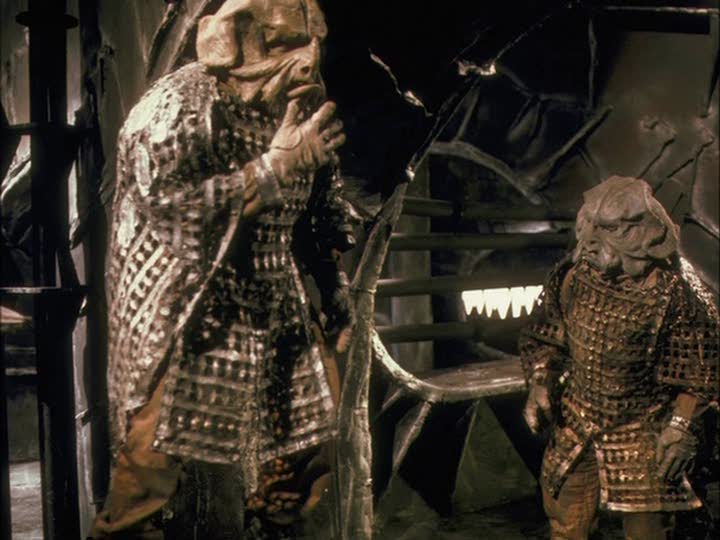
The production team did a good job in realising the alien Kraals,
which look rather good with their rhinoceros-like heads, stocky bodies
and shambling gait. Their grumbling, ill-tempered personalities seem
well-matched to their appearance. Their invasion plan is quite an
interesting one, and their human agent, the astronaut Crayford, is a
plausible and well-thought out character, even if the performance of the
actor playing the part is a little overwrought.
Ultimately, The Android Invasion is not an especially profound
story or innovative piece of science fiction. Then again, it was never
intended to be. What we have is another enjoyable adventure from the Tom
Baker-era, and one which I have no hesitation in recommending.
Insulting the Intelligence by Eddie Robson
18/5/98
Every time fans are asked to name their least favourite story, one
usually hears them cite a Colin Baker story, or something from Season 24.
However, I'd like to make my case for Phillip Hinchcliffe not
being the infallible producer of legend. The Android Invasion is
easily my least favourite Who story.
Let's face it, if you're a Doctor Who fan you'll be quite used
to tacky sets, poor effects and the odd bit of bad acting. For this
reason, I prize nothing so highly in a Doctor Who story as a good
script, since I believe that this one aspect has the potential to save
everything else. Unfortunately, it also has the power to drag the entire
production into the mire with it. Terry Nation's script in this
particular story demonstrates a total lack of respect for the audience,
as though he doesn't expect them to be paying any attention.
The gaping holes in the plot are too numerous to mention, but I'll
mention some anyway. Why do the Kraals bother building a fake village?
How can they and the Doctor and Sarah survive on the surface with all
that deadly radiation around? What happens to the invasion fleet? If they
can take Earth by force, why do they mess about with the androids and the
virus? It's just a hotchpotch of set-pieces, barely connected by a plot.
Of course, one has to consider how Doctor Who was intended to
be viewed in those days. It was pretty much a case of making enough of an
impact on the audience for twenty-five minutes that they would tune in
again next week. The Android Invasion does this, creating a decent
atmosphere and producing some successful scenes (including the
cliff-hanger to Part Two which everyone always goes on about, even though
in my opinion it looks a little silly). Stories which rely on this
piecemeal consumption often suffer when re-viewed as a whole; just look
at Earthshock.
However, there is one scene in Part Four which will always condemn
this story, to my mind. It's the scene at the Space Centre, when the
Doctor is confronted with two of the staff whom he suspects to be
androids. He pulls a small box from his pocket, with a button and a red
light on it, and declares that it's a "robot detector". I challenge
anyone to find an example in Doctor Who of lazier scriptwritng,
harking back to the incredibly convenient devices seen in the sixties TV
Comic strips. And they were rubbish.
I haven't mentioned the acting or directing in this review; that's
because they would have to be of an exceptional standard if they were to
save The Android Invasion, and I don't think they are. All the
best children's TV appeals to adults by not talking down to the kids.
This is an unwelcome exception in the Doctor Who canon, and gives
me an overwhelming impression that I'm being insulted.
A Review by Keith Bennett
4/6/98
The Android Invasion is a story which is quite enjoyable if
one doesn't bother thinking about it too much. The opening episode is
quite intruiging with all sorts of strange things going on to offer the
viewer genuine interest. But as the story unfolds, logic tends to take a
back seat and familiarity becomes painfully obvious.
Several factors are blatantly copied from Terror of the Zygons, including the look of the Kraals'
ship and the controls, their use of duplicates and even their hidden
scanner in the dartboard, which echoes the bug the Zygons used in the
stag's head. And the sliding doors at the research centre make the same
sound as the Zygons' doors did, while the finger-shooting guards are
rather reminiscent of the Autons. The Kraals themselves are... well, not
bad enough to be dreadful, not interesting enough to be terribly
memorable, although their masks don't seem to fit on the actors very
well. Basically, The Kraals remain one of the most forgettable aliens
Doctor Who has even had (even the Doctor doesn't seem terribly
scared of them. The way he says "Hello" to Styggron when they first meet
sounds like he's just found a lost puppy) which is quite ironic,
considering the creator of them also created the Daleks... No, I mean
Terry Nation, not Davros!
However, the setting at the fake village looks good and, as I said,
taken on face value, the story remains entertaining and certainly never
dull. 6/10
Terror of the Zygons II by Michael Hickerson
18/7/98
Every time I watch The Android Invasion, I'm impressed by how
great the cloning process is. Unfortunately, I'm not talking about the
process the Kraals use to produce an entire village of androids. No, I'm
referring to the fact that virtually the entire story of Android
Invasion is the same as the earlier season thirteen entry, Terror of the Zygons.
The Zygon's plan to invade Earth by replacing key figures. Same
thing goes for the Kraals. Another similarity comes in that the Zygons
and Kraals look a lot alike when in their natural form. About the only
part of the Zygon plan the Kraals haven't taken is that aren't a monster
like the Skaarasan to wreak havoc.
It's a shame they didn't as it might brighten up the overall story a
bit.
The main problem with the story is the incredible leaps of logic (or
illogic if you prefer) the Kraal plan has. One has to wonder just why
they bothered to build the village for the clones to hang out in? Why go
to such painstaking efforts only to destroy it in episode three?
Another question I ask is just how Crayford knew that Benton had been
promoted? Presumably he left Earth during the Pertwee era when Benton
was a sergeant, long before his promotion in Robot. So, why is he RMS Benton here?
I am a person who can usually overlook major plot holes as long as
they don't interfere with my overall enjoyment of the story. But in
The Android Invasion, the plot holes are just too glaring to be
overlooked or ignored. They simply add up to a less than enjoyable
overall experience.
Which is a shame because in spots, Android Invasion is fun to
watch. While I don't agree that the cliffhanger for episode two is one of
the best of all time, I will agree that it's an effective one. I also
like the little attention to detail used here with Sarah's scarf clueing
in both the Doctor and the audience that something is amiss with her.
Also, Tom Baker turns in a good performance, even though at times his
voice sounds hoarse.
However, when you add it all up, The Android Invasion is the
weakest entry in season thirteen. There are pieces of a good story
struggling to get out here, but they just don't quite make it.
A Review by Stuart Gutteridge
4/10/98
The Android Invasion is a story overshadowed by the stories
surrounding it-- a pity, as it has a lot going for it. Terry Nation`s
idea of a race living on a radiation soaked planet was first used in The Daleks, and the use of androids even
resulted in an android companion, Kamelion.
The characters come across well here: Guy Crayford gets the sympathy
vote here, and Elisabeth Sladen makes for a great villain as the android
Sarah. The Kraals are also impressive, but there are only two--hardly
enough for an invasion.
Other memorable moments include the unmasking of the android Sarah and
the apparant death of the U.N.I.T soldier. Unfortunately, however, there
is hardly a sufficient U.N.I.T team. Whilst it was nice to see Benton and
Harry, Colonel Faraday is hardly a substitute Brigadier. Another gaping
hole is why would the Kraals use androids when they have a virus to wipe
out humanity.
Despite these shortcomings, The Android Invasion benefits from
the location work, and Tom Baker`s intermitent short throat doesn`t affect
his performance as the Doctor, making this highly enjoyable.
Is that finger loaded? by Ken Wrable
26/2/00
The Android Invasion is most famous for being the weakest story
in the celebrated thirteenth season of Dr Who. This is certainly
true. There's nothing here that can stand comparison with the
well-realised and chilling concepts of the other stories of this period,
and Styggron, the villain of the piece, would come woefully low on a list
of the series' most effective baddies. The Kraals are terribly pedestrian
and hackneyed aliens (although, unlike some other commentators, I actually
quite like their "rhino" masks) who spend most of their on-air time
ranting, bellowing and stomping about. Worst of all, their invasion plan
is hopelessly convoluted and riddled with flaws. The plot just doesn't
stand up at all, and it's doubly unfortunate to have a story which
revolves around aliens duplicating humans coming so soon after Terror of the Zygons, which uses much the same idea.
But this story does have some redeeming factors which in my opinion
save it from the Dr Who hall of infamy (hello Timelash, Monster of Peladon and
Warriors of the Deep). Firstly, the situation in
which the Doctor and Sarah inadvertently find themselves is truly
intriguing: a seemingly normal English village in the countryside that's
initially deserted and then suddenly filled with suspiciously
preprogrammed locals. The atmosphere established in the first two episodes
is impressively eerie and credit is due to the production team for the
excellent location shooting. It's an achievement to make such an
unremarkable piece of countryside seem so sinister. The scenario is
somewhat reminiscent of Patrick Mcgoohan's brilliant The Prisoner,
another instance of things definitely not being what they seem.
Then you've got the performances of the two regulars, both of which are
well up to par. In fact, I'd single out Elisabeth Sladen as making the
better contribution to this story, in particular the scenes where she's
acting Sarah's android double. She's really convincing as a
not-quite-human, somehow. These scenes lead up to the cliffhanger of
episode two and one of the classic images of Dr Who: Sarah's face
being seemingly dislodged to reveal electronic circuitry. It's as great as
the shop window dummies coming alive in Spearhead From
Space.
After this highlight the story takes something of a downward turn as we
get into the scenes where the Kraals' ridiculous invasion plans are
gradually made clear. Oh, and there's the bit with the bomb - did they
really need to blow up their painstakingly contrived replica village?
Happily, the climax to the story at the space centre on Earth is much
better, with the fight between the Doctor and his android double being
particularly well executed. Trick photography is largely avoided (a wise
decision) and Terry Walsh makes a professional job of being the Doctor's
stunt double. It's nice to see Harry Sullivan and Benton again, as well.
Despite all its flaws, I would recommend you to watch this one if you
get the chance. It's a long way from being a classic but it's far above
Dr Who's worst stories.
Gunfight with an okay Kraal by Andrew Wixon
22/1/02
This is a really frustrating story to watch. There are many
not-very-good DW stories, but some of them were doomed from the
moment they were commissioned - Seeds of Death, Planet of the Daleks, all those stories with
intrinsically flawed/boring concepts. What's frustrating about Android
Invasion is that it's a poor story based on absolutely rock-solid
concepts - the 'training ground' copy of Earth on an alien world, and the
Body Snatchers pastiche with evil doppelgangers on the loose. What lets it
down is sloppy writing, pure and simple.
The first episode is brilliant, an Avengersesque trip around a slightly
out-of-kilter English countryside. For once Terry Nation's gift for the
blatant title works in the story's favour - I'm prepared to bet many
viewers would fall into the trap of believing this is post-invasion Earth
rather than pre-invasion Oseiden. But the seeds of the story's downfall
are sown even here and come rapidly to fruition in episode two.
Crayford is a hugely implausible astronaut. He looks like a wimp
(sorry, Milton) and is far too nervy. The Kraal masks are good but Chedaki
is obviously the same bloke who plays Zippy off Rainbow. The list of
stupid ideas and plot contrivances rapidly grows: the 'perfect replica' of
Devesham has hedges with useful lengths of binding creeper in them and a
pub landlord who acts like a zombie. The 'android detector' is
ridiculously sloppy writing. The whole thing with the eyepatch is just
insulting to your intelligence.
Production-wise it's the same sad decline. The direction early on is
fine but by episode three we're into dodgy stock footage and photographic
backdrop territory. Some of the CSO is very poor indeed. Unworthy of you,
I'm afraid, Barry.
And it could all have been so much better; a tight, paranoid thriller,
maybe even over six episodes. A worthy swansong for Harry and particularly
Benton, who deserved at least one last chance to shine. Not to be,
unfortunately. a story for the 'nice in theory...' file.
Tired and rehashed by Tim Roll-Pickering
28/8/02
At first it seems as though the TARDIS has arrived once more in
contemporary Britain but it soon becomes clear that not everything is at
it seems. Like the earlier Invasion of the
Dinosaurs, The Android Invasion sees the Doctor and Sarah
trying to come to terms with a world that is very different from the one
that they left. And therein lies the first problem with the story - it's
recycling elements from before.
In addition to the Earth not quite as normal environment, we are also
treated to doubles of most of the characters (used endlessly throughout
science fiction), a robotic Doctor (previously used in Terry Nation's own
The Chase), an alien invasion of Earth that is likely
to be resisted by one small defence installation in one tiny part of the
world (probably the most implausible invasion scenario yet seen in the
series), a rural British setting (seen how many times by now?) and UNIT.
Although it is something of a novelty to see a story by Terry Nation that
does not feature Daleks (this is only his second, the other being The Keys of Marinus), there are far too many reworked
elements in this story to generate much enthusiasm. The Kraals are an
attempt to produce a new race, but they are just another bunch of aliens
whose own world has become uninhabitable and so are seeking to take over
Earth to create a new home. This has been done many times before, most
obviously and recently in Terror of the Zygons. The
result is a story that's short on originality and suffers from weak
characterisation as well.
The doubles should allow for a degree of uncertainty about who is real
and who isn't, but for much of the story it's either unclear that there
are fakes at all or the fakes are obvious. The revelation that 'Sarah' is
in reality a robot at the end of Part Two is supposed to be a shocking
cliffhanger, but it has never been anything but clear that she is a fake
and it does not say much for the sturdiness of the androids that a mere
fall can cause their faces to fall off. It is only at the story's climax
when the Doctor reprograms his double and it is gunned down by Styggron
that there is ever any real uncertainty about who is who.
The other elements of the story are poorly handled as well. It is
exceptionally hard to accept that Crayford has not realised that his eye
is perfectly intact beneath his eye patch. Nor is there much reason for
him to have been deceived about this. The Kraals are not particularly
memorable, with Chedaki coming across as comical. Styggron is a classic
hunchback scientist and suffers for it. The performances of both Milton
Johns (Crayford) and Martin Friend (Styggron) are entirely forgettable.
This story also sees Ian Marter and John Levene making their final
appearances as Harry and Benton respectively. Whilst it may not have been
intended that this would be their final tale, it is a poor exit for both
characters given that they make only small appearances as themselves. The
absence of the Brigadier is felt, with Patrick Newall's Colonel Faraday
never coming across as being anything more than a one-shot fill in
character. Even Baker and Sladen seem tired by the story, with their
performances as the android doubles giving away their identities, whilst
as the real Doctor and Sarah they betray a tiredness with the tale.
Production wise The Android Invasion is difficult to fault. It
shows the same dedication and co-ordination that is present in many other
stories from this period and Barry Letts' final directing contribution to
the series is an especially memorable one. But this isn't enough to raise
the story to much since it is hampered by both a weak script and a
disillusioned cast. 3/10
"Is that finger loaded?" by Joe Ford
10/4/04
I have decided there should be a law against 'evil double stories'
from now on. It is one of the most frequent cliches in science fiction
and manages to crop up for a million and one contrived reasons
(alternative universes, android copies, twins...). I can fully understand
why writers adopt the storytelling technique; it gives you a chance to
have some fun playing tricks with the audience, duping them into thinking
they are the genuine article when they are in fact the super-evil copy.
Also it gives actors who play a regular character in said series a chance
to stretch their wings and play at being evil for a change. When this is
done especially well the audience can marvel in the ability of the actor
convincing in this brand new persona (Troughton as Salamander in Enemy of the World, Nick Courtney as the Brigade
Leader in Inferno) but more often than not the
actors have a habit of overdoing their new roles (Sophie Aldred's
embarrassing android Ace in The Genocide Machine)
or staring glassy eyed and not trying at all (Mary Tamm's android
Romana). Tom Baker and Elisabeth Sladen are so unconvincing as their
robot doubles in this story you have to question why they chose to play
their roles in such an obvious and embarrassing manner. "Come we have
much to do" he says with all the conviction of Matthew Waterhouse playing
Hamlet. Even worse are John Levene and Ian Marter who play their evil
doubles with no subtlety at all just so we KNOW they are evil rather than
their regular lovable selves. Bizarre because when they are playing their
normal roles they are fine. Thus my law, stamping out cardboard acting
and cliched plots.
There is something very special about season thirteen of Doctor
Who, a time of confidence for the show. Rarely was there such a good
vibe from all corners, the press in the shows favour, the audience
figures extremely high and the production team happy with their work and
the actors producing some of their best ever work in their careers. The
quality beams from the screen of all five stories. Five stories? I
thought there was six... unfortunately one story fails to reach the
heights of the others this year and that is The Android Invasion.
Why? Well a variety of reasons actually. This is one of two scripts
that Terry Nation wrote without the Daleks and it qualifies the statement
that without his creations his work lacks that sparkle that they bring.
There are some gaping holes in the plot of this story and huge leaps of
logic that remain unexplained and they ruin what might have been an
intriguing idea. The thought of aliens creating a fake Earth as a testing
ground for their invasion is quite clever and one I would suggest
regularly conquering aliens like the Daleks should try to see where they
are going wrong. Had the story remained on this fake Earth and taken a
rather less predictable path of android rebellion (thanks to the Doctor)
I think it would have worked better, it would have been cool if the
Doctor defeated the Kraals and wiped left the androids free on this
second version of the Earth.
But no instead the action moves back to our Earth and predictably the
scientifically-minded Kraals who have planned their invasion to the
letter are utterly defeated in the most contrived of ways. The budget has
already been spent so this last episode (which truly deserves the
majority of the budget) becomes an embarrassing comic strip of CSO.
The most annoying aspect of the story is the lost potential. It could
have been great, I am certain of that but first Robert Holmes would have
to rewrite the scripts, Barry Letts would need to be replaced by a more
assured director and the set designer would have to be shot.
What I really enjoy about this story is the first episode which
despite some flaws (Dudley Simpson having a heart attack with the music)
manages to create a fine atmosphere of mystery and suspense. I love
deserted town stories (Roswell the series managed the best version I have
seen yet, much better than the much lauded 28 Days Later), all the eerie
streets and feeling that something terrible has happened. It helps this
is a different sort of location to what Doctor Who is used, this
charming little village is creepily deserted with the exception of some
spooky looking space suited people. There is a magical moment when a
truck unloads a party of villagers who take their seats in the local pub
and sit there staring into space for ages until a clock strikes and
suddenly they are acting and socialising like normal people. At this
point the show is wonderfully spooky, throwing up lots of possibilities.
Are the villages under an influence? Are they the villagers? When the
UNIT soldgier who had recently thrown himself off a cliff shows up
drinking a pint, the Doctor and Sarah are truly disturbed.
I just wish the story had continued more in this vein. Weird
occurrences like the Doctor being hounded by UNIT soldiers, chased across
the building of the Space Centre and forced into hiding. Just what the
fuck is going on? How big is this latest disaster?
It is when the answers start to spill out that the story takes a
downward spiral. The Kraals were probably the least effective aliens
during the Hinchcliffe era because they look so damn fake. And worse, for
a conquering species they lack any kind of genuine threat. Chedaki (the
warrior) and Styggron (the scientist) are the only two Kraals that we get
close to and they spend much of the first three episodes bickering like
old men, it's almost Last of the Summer Wine with rubber aliens. Fleeing
from a destructive home planet is such an old idea now and it occurs to
me that every alien race that has this problem chooses Earth (much like
the Zygons two stories earlier) which ultimately turns out to be their
downfall. If they chose say Planet X which the Doctor couldn't really
give a toss about they would get on much better. Perhaps I should
bulletin that in the next rocket to outer space. It is nice to see an
alien race that is a little worse for the wear (they all seem to walk
with a funny hump and limp) but their foamy faces and wiggly eyes never
convince and they sound like old men too, not the most chilling of alien
voices (compared to say Sutekh just one story ago). Plus their plan is so
hackneyed, why use androids if you are going to poison the Earth? Just
send back Crayford with the infection and then pop along when it has done
its work.
It cannot be often that a set designer is asked to create a corner
shop, a pub, a space centre and an alien base. The pub and the shop look
authentic enough but these things are easy to imagine but what of that
sparsely furnished space centre and cardboard cut out spaceship? Plus the
walls genuinely wobble in this story, a favourite comment of the non-fans
but I saw the Kraal cell have a wiggle and a super brainy computer in the
space centre take a knock too! Cheapness and Doctor Who go
together like salt and pepper but usually the designers manage to hide
their limitations with some rich and interesting designs (look at that
veiny, pulsing Zygon spaceship!) but The Android Invasion looks
cheap and nasty. Especially the Kraal base.
The story also has a touch of amateur when it comes to the direction
including some extremely dodgy special FX (that rocket ship on top of the
space centre) and uninspiring camerawork. The show is workmanlike and
solid certainly, nothing offensively bad (there is some decent location
work for a start and the opening scene which leads to the UNIT soldier
diving over the cliff in slow motion is worthy of praise) but when you
start using words like that it proves you are desperate to say something
positive. Barry let some awful material slip through the net, Sarah's
flattened G-force face, the android strangling her panto-style, some
hideous shots of the android faces with sticky out eyes...
I think we should all be grateful to The Android Invasion
because usually in a Doctor Who season there are lots of stories
which are above average but have lots of flaws. It is as if Hinchcliffe
decided to toss all the flaws into one story in season thirteen and
polished all the others. The Android Invasion is the second
weakest Hinchcliffe production (nothing could approach Revenge of the Cybermen) of them all and the only blip
in the otherwise pristine season.
A Review by Brian May
23/11/04
Oh dear, The Android Invasion is incredibly silly, isn't
it? It's definitely the poorest offering from the wonderful season 13. On
a fundamental level it's not out of place - the season is filled with
tributes to particular sci-fi and/or horror films (this story tipping its
hat to Invasion of the Bodysnatchers), but it has none of the class, mood
or atmosphere of the surrounding tales, all of which contain elements of
horror and suspense that do justice to their roots - and prove how great
Doctor Who was under the guidance of Robert Holmes and Philip
Hinchcliffe. But this is just so blas?
This is not to say it doesn't have its moments. The first episode is
excellent (but then the same can be said for The Space
Museum...) There's the usual mystery and series of unexplained
occurrences that get most Doctor Who tales off the ground in an
enjoyable way. The soldier leaping off a cliff only to turn up drinking in
the pub; the strange behaviour of the villagers; the weird guards with
pistols for fingers; Sarah spotting one's android face under its raised
visor; the TARDIS taking off in front of her eyes. This is all great fun!
The location photography around the village and surrounding countryside is
magnificent; as a matter of fact it's some of the best in the entire
programme. It sets up what could be a great story - but unfortunately this
is not to be. Apart from one more memorable scene in episode two - the
cliffhanger in which the face of the android Sarah drops off, there's not
much else to rave about. Episode three is tedious all the way through -
and we get the privilege of watching more painfully obvious NASA
stock footage.
The script is daft. It's one of Terry Nation's worst. From the minute
Chedaki mentions the Kraal invasion of Earth in part two, it's goodbye
suspense. The plot vacuums have been elaborated many times before - why
are just the village and space defence centre replicated and why are they
destroyed if the Kraal planet is to be abandoned? Are the dogs androids?
Chedaki's fleet is still waiting in space after Styggron is destroyed. How
did the Doctor reprogram his android double if it's been neutralised by
the radar jamming unit? And it's insulting to the intelligence to think
that Crayford would never have looked under his eye-patch!
There are aspects of the story so horribly contrived they're
embarrassing. This is the only ever occasion the Doctor exits the TARDIS
drinking ginger beer - just so he can offer some to Sarah, just
so she can say she hates it, just so he can offer some to the
android Sarah who can give herself away by saying it's delicious! The same
goes for her scarf - which the Doctor takes before she's captured, just
so the android can turn up wearing a copied one, for another obvious
giveaway. (And the real Sarah had no scarf while being replicated, so the
android shouldn't really be wearing one!) And why does Sarah climb down
from the tree she's hiding in? Just so she can get herself
captured! The separation of Doctor and companion in part one is woefully
done - and very unwise on the Doctor's part... but then we need
Sarah to witness the TARDIS dematerialising and then forget to tell him
about it. And if the Doctor's carrying a robot detector around in part
four, why didn't he put it to use earlier? It would have saved so much
hassle! (It could be suggested he nipped into the TARDIS after
landing on Earth and produced it...nah, I don't buy that, either.)
The acting is uninspiring at best - Tom Baker and Elisabeth Sladen
especially so. They seem to be resigned to the fact they're in the middle
of a stinker. Milton Johns is terribly miscast; his blend of camp and
creepiness suits his other roles (sadistic henchman in The Enemy of the World, schemer in The Invasion of Time), not a misguided victim,
deceived into betraying his planet but honourably and tragically redeeming
himself. Martin Friend is passable as Styggron, but the character is so
boring and formulaic, making for a totally unmemorable villain, especially
when surrounded by the likes of Sutekh, Solon and Harrison Chase. John
Levene and Ian Marter are served the ultimate injustice for their final
Doctor Who appearances. Both the android and real versions of Harry
and Benton are dreadfully written. It's sad to see them bow out this way.
Avengers fans forgive me, but you've got to admit Patrick Newell is below
average here. The rest of the cast are all rather insipid. Barry Letts's
work is great in the first episode but, like the story, descends into a
boring direction by numbers. There are some bizarre touches that simply
don't succeed - the extreme close-ups of faces in the pub for example.
Dudley Simpson's music follows the same trend - memorable in part one,
forgettable afterwards.
However, on the positive side, the Kraal masks are simply but
effectively
designed. They could have been a great adversary had the story been not so
atrocious. The dialogue is nothing special - there are only two lines
worth
mentioning, but they're wonderful. Tom Baker gets the honours for both:
"Is that finger loaded?"
and
"Don't worry Sarah. Who'd notice me?
The Android Invasion is the runt of season 13. After a great first
episode, everything goes downhill. There are a few saving graces, but not
enough to lift it out of the pit of mediocrity.
And what a boring title! Why not call it The Oseidon Adventure?
3.5/10
A Review by Harry O'Driscoll
19/4/08
The Android Invasion has a bit of a murky past and is thought to
be the worst Of the Holmes-Hinchcliffe era. But I feel that, despite some
significant plot holes, it is a very interesting story.
Ok, let's address some of its shortcomings first. The title instantly
gives away what would otherwise be a gothic and tense opening two
episodes. There are some major plot holes, such as what happens to the
Kraals after stygyron is killed. The purpose of the mock village on
oseiden is a mystery, but this can probably be explained by giving the
androids ideas of the village and space centre and/or letting the androids
practise acting like humans so as to blend in back on Earth.
Otherwise, I quite enjoy The Android Invasion. The Kraals and
their ship look realistic (although the door with the spiky bottom was a
daft idea). The opening episode delivers the gothic atmosphere of the
Holmes-Hincliffe era. It is not the typical invasion story like Spearhead From Space or Terror of the
Zygons, as it is showing the Kraals prepare for the invasion. The
scenes at the space centre in episode four have an interesting
doppelganger theme. Trying to tell who's an android and who's not adds a
bit of comedy towards the end. The effects used for when the Doctor fights
his android replica are also impressive.
At the end of the day, The Android Invasion makes a nice change
from another dull invasion story, but with its gaping plot holes I'm
forced to give it a 3/5. An all right episode, but not great.
Doomsday in Devesham by Joe Briggs-Ritchie
1/9/08
This is by far the most unpopular story of Season Thirteen and it's not
that difficult to see why. I mean, for a start it's imbued with a
staggering paucity of logic. Favourite examples include Crayford's eye
patch. Terry Nation expects us to believe that Crayford would never have
noticed that he really has got an eye after all? Then there's the little
matter of the Kraal invasion fleet. Styggron does an athletic backflip
into a puddle of chicken korma and that's it? They just turn around and go
home? It's also remarkably similar to Terror of the
Zygons, a story so good that it definitely did not need remaking. So
similar in fact that one can almost hear the words "rip-off" floating on
the breeze. The real strength of The Android Invasion is that none
of the above shortcomings spoil what is actually a rather enjoyable story.
This is one that definitely needs to be watched with the more critical
areas of your brained turned off. I have to confess, I've always had
something of a soft spot for it. The fact that something so unoriginal can
be so utterly entertaining is testiment to the strength of Season
Thirteen.
The location filming is absolutely gorgeous. The English countryside in
the summertime is simply wonderful and this story really captures that. If
it had been set somewhere else then I really don't think it would have
worked so well. I mean, the idea of a British Space Defence Centre is
quaint enough in itself, but the fact that it's located in a sleepy
English village is the icing on the cake. It's that very same quality that
makes stories like The Daemons, Image of the Fendahl and The Stones of
Blood work so well. This story certainly has one of the most unusual
openings; Max Faulkner acting funny and twitching. Before throwing himself
off a cliff. Nice. Seriously, it is quite a good stunt. Tom Baker and
Elisabeth Sladen have got a lot to do with why this story succeeds when by
all accounts it shouldn't. They can make more or less anything watchable
and their chemistry puts them head and shoulders above any other
Doctor/Companion team. But then, you already knew that. I have to say
though that I don't care very much for Sarah's cliff routine. Pathetic and
completely unnecessary. Ditto for that equally pathetic ankle business.
Tom does sound rather hoarse thought doesn't he? Can that much ginger beer
really be healthy? Who can say? The guest cast are serviceable but
unremarkable, apart from Milton Johns who is endlessly watchable. He'll
eventually move to Gallifrey and get promoted to Castellan, you mark my
words.
The Kraals are serviceable villains but they don't really leave much of
an impression. They are quite well designed but the masks are somewhat
immobile. Continuing the Terror of the Zygons theme,
they appear to have some kind of organic-based technology. It's a nice
touch and I do like it but Terror of the Zygons does
it infinitely better. Much more effective are the android mechanics.
Faceless monsters are somehow more scary and the mechanics evoke a strong
sense of creepiness. Their finger guns are a nice touch, reminiscent of
the Autons and prompting a classic Tom Baker line "Is that finger loaded?"
However, I'm afraid that they can't shoot straight. Do they actually
manage to hit anyone? Four episodes and they can't even notch up a body
count.
I was left with a lingering question: why Devesham? Of all the places
the Kraals could choose as the starting point for their invasion, why
Devesham? Even if it does have the Space Defence Centre. Surely somewhere
a little less backwater would have been strategically more sensible. Oh
well, this is a Terry Nation script, you can't expect miracles.
Perfectly enjoyable. It doesn't compare to the rest of Season Thirteen
in terms of quality but it is just as entertaining.
A Review by Stephen Maslin
14/4/10
Ah, Season Thirteen.
No robot dogs, no Mary Whitehouse's Revenge, no Star Wars on the
horizon, bliss. Just think...
- The Scottish one, with the wonderful whispering aliens.
- The claustrophobic one with Frederick Jaeger.
- That really good Egyptian one filmed in Mick Jagger's house.
- Philip Madoc and the thing made from bits of different aliens.
- And the really scary one with the killer vegetables.
Sigh.
Hang on. That's only five stories. There should be six. Wait a
minute. Zygons, Evil, Pyramids... Oh yes. The Android Invasion. The
runt of the Season Thirteen litter. The single shrug in a season of
enthusiastic waving. What makes it the ghost at the wedding? One answer
and one answer only: the title.
Fair enough, as a story it makes no sense but (notoriously) the plot of
Pyramids of Mars doesn't either, which didn't stop it
being top ten material. Okay, the principal enemy sound like (indeed are)
the cast of "Rainbow" but the most scary thing about Terror of the Zygons turns out to be a glove puppet.
Yes, Faraday is no worthy replacement for Lethbridge-Stewart but nor is
Beresford in The Seeds of Doom. Fine, there was
the absence of any really challenging alien presence but the same could be
said of Planet of Evil (which, even by Who
standards, is a piss-poor title for anything). And, what's more, the
Sisterhood of Karn are far more tedious than anything the supporting cast
of The Android Invasion can boast.
So it's not that bad then? No, I don't think it is. Its entire
problem is just that you know what's going on before anything even
happens. There it is in big letters:
The Android Invasion
By Terry Nation.
So it is that wonderfully bizarre events are rendered predictable from
the very start. All that new-Doctor, old-style, all that Tom Baker wit,
all that strange England, wasted. Without the title, it is my contention
that Android Invasion's episode one would now be considered a
classic opener, dragging the rest of the story with it to glory.
You don't believe me? Watch it again and make a list of all the
things you can't explain if you hadn't already been told it's all
about androids and an invasion. I've tried it. The list is huge. Odd,
twisty UNIT soldier; "Stop man, stop!"; identical coinage; something
seems to have annoyed them again; the silent pub...
"Who sent you?"
"Detention? Not detention..."
"...and you're not the real Sarah."
"We have much to do."
If you hadn't been aware of the "A" word, The Android Invasion
would have stayed in the mind as a baffling,
wetting-the-pants-in-expectation moment, somewhere in that misty changing
from Autumn to Winter, 1975.
And it is in good company: calling "The Storm Mine Murders" The Robots of Death is a similar faux pas. Of all the
things I would do to revise the programme's entire past if I had the
power, I would change the name of The Android Invasion to
"Devesham", the utterance of which is the story's first point of
recognition, even though it is a false one. A great and an unusual title.
(So much better than "Terror of Evil Doom" don't you think?)
Okay, perhaps there is one other thing that The Android Invasion
needs to redeem itself: no, not CGI (though that might help) but a
gigantic pair of scissors. There are so many lazy little fillers that
have no dramatic function whatsoever: the too-early introduction of the
Kraals in part one or the demonstration of the special android to attack
Kraals to name but two. Get rid of 'em. Sod reverence; the whole thing
trimmed down to three parts (or even two) by expert hands would do the
world of good.
It's not too late. Future generations looking back on this awesome era
in the show's time on Earth, need the thrill that this programme could
have given. No one but us would know. Or care. All together now.
"Is that finger loaded?"
P.S. Does anyone else think that the only things that make the Kraals in
any way shocking are their decadence and profligacy? Make a world in
order to analyse another world which one wants to invade, then destroy
previously made world? Kraalf-indulgent or what?
"Perhaps by error, perhaps by design" by Paul Williams
17/9/26
The Android Invasion is an unconvincing story. The plot resembles Terror of the Zygons with aliens seeking to invade Earth by using replica humanoids. The aliens, the Kraals, have the ingenious idea of building a testing ground on their home-world, a perfect replica of an English village and space centre. They even stocked the pub with ginger beer and found a pack of hunting dogs to locate travellers that might accidentally visit their soon-to-be uninhabitable planet. Such detailed plans are unnecessary, as they intend to destroy humans with a virus.
The setting changes three times: the Kraal planet, the ship journeying to Earth and then the real Earth. It also changes mood from suspense to a standard sci-fi run around. The opening episode is genuinely creepy, as the Doctor and Sarah investigate a suicide survival, people activated by remote control and coins minted with the same date. Astute viewers will have made deductions from the title. By the end of the second episode, everyone knows what's going on, ruining what might have been the finest cliffhanger of all time as the android Sarah is exposed. In Episode Three, Styggron tries to kill the Doctor, imprisons him, then tries to kill him again. The final part gives minimal time to returning old friends, Harry and Benton, and Styggron only reappears for the last few minutes to be killed by his own poison. The eerie success of the opening is not repeated.
The Kraals are not the Zygons, less terrifying and not organised. Aliens quarrelling with each other can raise tension. Instead, Styggron and Chedaki argue like a couple of grumpy old men. It is unclear whether science or the military have overall control. Styggron is not the tactical genius that the script, Crayford and the Kraals need him to be. We learn nothing about Kraal society and their accomplishments. The Zygons had a history and a forceful leader.
Until the last episode Crayford is the only human character. He is sometimes presented as a victim and sometimes as a villain, probably being unsure himself. The deception with the eyepatch is ridiculous. What saves the story is the chemistry between the Doctor and Sarah. Some of their dialogue is delightful. They are a joy to watch, and the scenery on the fake Earth is effective.
With more focus and structure, perhaps by introducing the Earth characters earlier or sending Sarah to Earth with the Doctor left behind, The Android Invasion might have worked. Instead, it is a mismatch of conflicting ideas glued together with a flimsy plot.