
The 2007 Storybook

|
|
Panini Publishing The 2007 Storybook |
|
| Published | 2007 | 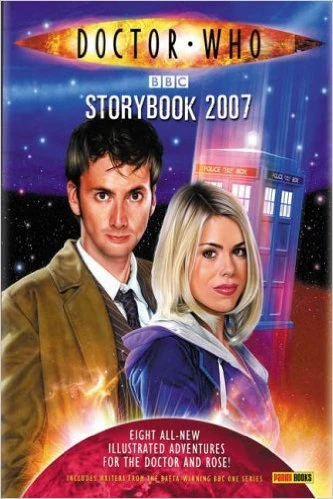 |
| Featuring The tenth Doctor and Rose |
Thrilling Adventures in Time and Space! by Niall Jones 16/4/26
When fans think about Doctor Who in prose, two things probably come to mind: novelisations and novels. There is, however, a third strand of Whovian literature that is often overlooked: the annuals. First published in 1965, they were aimed primarily at children and included a mix of stories, articles and features. Given the success of the revived series, it was inevitable that the annuals would also make a return. It's ironic then that the first official Doctor Who annual in a decade proved to be the last of its kind. Published by Panini, the 2006 Annual featured a mix of games, features and stories, including one by Steven Moffat that would go on to inspire Blink (What I Did on My Christmas Holidays by Sally Sparrow). The following year, however, BBC Worldwide revoked Panini's right to release a Doctor Who annual. The annuals would, henceforth, be published by BBC Books and aimed at a younger audience. This wasn't the end for Panini, however. In lieu of publishing an annual, they were allowed to release an 'annual-like' publication. The result? The Doctor Who Storybooks.
There were, in total, four editions, spanning the full length of the Tenth Doctor era. The first of these, The Doctor Who Storybook 2007, consists of seven short stories and one comic strip, all written by authors who had either contributed scripts to the first two series of the revived show or who had produced Doctor Who-related works during the Wilderness Years. The result of this is a volume that feels like a complete series of Doctor Who. References to actual TV stories are kept to a minimum, and there are no returning monsters, but the Tenth Doctor's personality transfers successfully to the page, as does his relationship with Rose.
What makes the storybooks different from the novelisations and novels, other than length, is their extensive use of illustration. While illustrations are not unheard of in Doctor Who fiction, the ones that feature in the storybook stand out due to their lavishness and use of colour. They are also unusual in that they form an integral part of the book, rather than being added extras. They don't supplement the text, they enhance it. They also make flipping through the book an inherently exciting activity. A boy with creepy glowing eyes stands in the twilight gloom of an abandoned house, holding what looks like a rotting pumpkin; Rose Tyler hangs perilously from a bare cliff, a crashed space probe above her firing energy beams into the sky; the Doctor looks on in horror as three skeletons rise from their graves, seemingly triumphant. Seeing these pictures out of context, not knowing what they mean (or in some cases, even what they depict), piques your curiosity and makes you want to go back and read the story properly. The illustrations are also done by a range of artists, giving each story a distinct visual identity.
The first of these eight stories is Cuckoo-Spit by Mark Gatiss. At first glance, it appears typical of Gatiss's oeuvre: a period setting, laced with horror. Read more closely, however, it becomes a deeply unsettling and disturbing tale that, for all its merits, sits oddly in a publication intended for children.
Narrated in the form of a diary, covering a two-week period in 1975, it tells the story of a boy called Jason whose friend goes missing and who becomes involved with the Doctor and Rose's investigations. Both the text and illustrations are dense with contemporary references --- Barry Sheen, Mike Yarwood, Z Cars --- that will probably go over the heads of most young readers but which help to build up a portrait of an era that is, if nothing else, culturally distinct. Jarringly, there's even a reference to Jimmy Savile, which would almost certainly not appear in a children's story written now.
While the story is scary --- consider the description of 'a sort of wet puppy with no eyes and no mouth' --- it is the relationship between Jason and the Doctor and Rose that proves most unsettling. Judging by the illustrations, Jason is probably aged between 12 and 14, and his diary entries certainly have an early adolescent feel. Alternately defensive and naive, they gesture at aspects of life that he himself barely understands. His language is often casually homophobic --- he writes of his friend, 'I really like Graham but I AM NOT A PUFF OR ANYTHING' --- while his initial description of Rose hints at a burgeoning sexual awareness: she was 'very pretty', with 'a big chest like that swimming teacher that came for just one term'. Throughout the story, Jason sees things, but he doesn't understand them. The Doctor and Rose remain shadowy figures, the TARDIS a 'blue shed'. He draws strength from them --- 'I didn't feel frightened cos Rose and the doctor policeman were outside too' --- but they also use him. They encourage him to deceive his parents, deliberately place him in danger and instruct him not to tell anyone what has happened. From an adult perspective, this reads alarmingly like grooming. Cuckoo-Spit is fascinating and thorny, but it's an odd choice to open a children's short story collection.
The second story, Gareth Roberts's The Cat Came Back, is more reassuring, with a simple but arresting hook: a cat used to test a new form of space travel becomes superintelligent and seeks revenge on humanity. There are elements of whimsy in the story --- Rose struggles to take seriously a villain called Mitzi --- but the plot is broadly serious, putting a clever twist on the tragic tale of Laika the dog.
Tom MacRae's story Once Upon a Time takes place in a fairytale-like world, but, this being Doctor Who, not everything is quite what it seems. It's also a Doctor-lite story, with the Time Lord not appearing until the second half and Rose remaining entirely absent. The story itself is fine, but not super-memorable. Instead, it is Adrian Salmon's striking illustrations that stand out. Their stark simplicity, all sharp lines and block colours, contrast with the more detailed illustrations found elsewhere in the book and complement the story's fairytale tone.
The book's sole comic strip is Jonathan Morris's Opera of Doom. In a move that prefigures The Devil's Chord by 18 years, it sees the Doctor and Rose travel to the Italianate world of Vanezia to meet 'musical genius' Frederico Gobbo, only to find that his talent has mysteriously deserted him. The plot unfolds at a frenetic pace, feeling like a 45-minute episode of Doctor Who that has been squashed down to fit into a mere seven pages. It is, nevertheless, an enjoyable read, with expressive and imaginative illustrations by Martin Geraghty.
Justin Richards's Gravestone House brings the book back to Earth and combines elements of sci-fi with Gothic horror. The Doctor and Rose trace a terraforming device back to contemporary England, while a group of children disturb a 'witch' in a creepy old house. These genre elements ultimately combine in a way that is both amusing and that makes perfect sense. My one complaint is that a plot twist at the very end of the story isn't particularly well set-up and seems to come out of nowhere.
Untitled by Robert Shearman, the most visually stunning of the book's stories, takes place in an abandoned art gallery on the Moon, prefiguring 2008's Silence in the Library. Art is a key theme in the story, with the Doctor and Rose coming under attack from the gallery's exhibits, so the beauty of Brian Williamson's illustrations is apt. The image of the Doctor and Rose arriving in the gallery is incredibly lifelike and expressive, capturing their joy and excitement at travelling in the TARDIS. Even more stunning is the illustration on page 57, which shows a screaming Doctor being pulled into a painting. His past faces drip from one hand, while the other fans out, leaving behind a rainbow of Rose's face. It's just fantastic, and my description fails to do it justice. In fact, it's almost worth seeking the book out for this picture alone. It's also worth noting that not everything depicted in the illustration is explicitly described in the text, showing the extent to which the relationship between word and image is symbiotic. Together, Shearman's writing and Williamson's illustration create a story that is perfectly suited to Doctor Who --- conceptually bold, but with a light, often humorous, touch.
The book's penultimate story, No One Died by Nicholas Briggs, sees the Doctor and Rose investigate the disappearance of a small English village. Intriguingly, while the book contains no recurring adversaries, No One Died introduces one: the bulkily helmeted Viyrans, who would go on to appear in a number of Big Finish audio dramas. While the story itself is enjoyable, it is unfortunately let down by its illustrations, with Ben Willsher's depictions of Rose bordering on caricature.
The final story, Steven Moffat's Corner of the Eye, brings the book full circle, with another dark tale told in an unconventional way. In this case, the story consists of a series of online messenger conversations between the characters Kathy and Tom, with the Doctor's appearance recounted via Tom's messages. It also involves a creature that you can only see out of the corner of your eye, a concept which would later recur in Moffat's 2014 episode Listen. Corner of the Eye isn't difficult to read, but it is structurally clever and, like much of Moffat's best work, uses that cleverness to powerful emotional effect.
For adult fans, there can be a temptation to dismiss books like this as 'for kids', but so is Doctor Who. That doesn't mean it can't also be enjoyed by everyone else. The stories in this collection are sophisticated, clever and occasionally dark. They might be 'for kids' (except for Gatiss's Cuckoo-Spit, which, with its unsettling undertones, feels more like a story for adults about childhood), but they are never childish.
Writing this review has given me the chance to re-read a book I last encountered as a child. That can sometimes be a disappointing experience, but not here. Here it acts as a reminder that, while a love for Doctor Who may often have its roots in childhood, that love doesn't die just because you have a job and a mortgage.