
1963: The Space Race

|
|
Big Finish Productions 1963: The Space Race |
|
| Written by | Jonathan Morris | 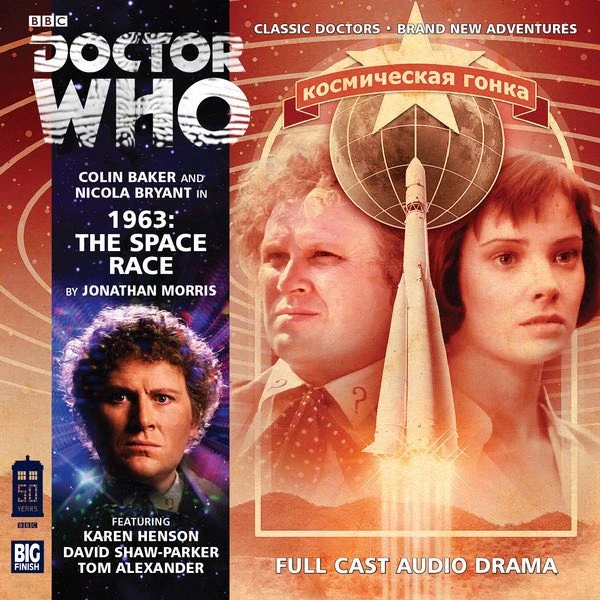 |
| Format | Compact Disc | |
| Released | 2013 |
| Starring Colin Baker, Nicola Bryant |
| Synopsis: November 1963, and the Soviet space programme reigns supreme. Having sent the first animals, then the first men beyond Earth's atmosphere, now they're sending a manned capsule into orbit around the Moon. Just as Vostok Seven passes over into the dark side, however, its life support system fails. Only the intervention of the Sixth Doctor and Peri, adopting the identities of scientists from Moscow University, means that contact with the capsule is regained. But something has happened to the cosmonaut on board. She appears to have lost her memory, and developed extreme claustrophobia. Maybe she's not quite as human as she used to be... |
The Dogs of Space by Matthew Kresal 31/10/26
It's hard to believe that Doctor Who's 50th anniversary was a dozen years ago now. The hype building up to the 23rd of November remains vivid in this reviewer's mind, leading as it did to The Day of the Doctor simulcast. There was a wider celebration of that anniversary across various media, from comics to reprinted novels (the first time a number of Wilderness Era titles had seen print in nearly a decade) and in audio dramas from Big Finish. While the latter's The Light at the End got much of the attention with a big multi-Doctor story, they also celebrated the anniversary with a trilogy in their monthly range from September to November with a trilogy of stories set in and around 1963 that took listeners (and the Doctor) across the anniversary month. With Eddie Robson's Fanfare for the Common Men having kicked off the trilogy with Peter Davison's Doctor, Jonathan Morris and Colin Baker's incarnation had the October release slot with The Space Race.
Featuring Baker and Nicola Bryant's Peri, The Space Race trades London and the pop music scene for Soviet Kazakhstan and the decade's race for the Moon. Having arrived owing to a TARDIS malfunction, they soon find themselves taking the place of two scientists from Moscow sent to aid in what should be the latest Soviet space triumph as Vostok 7 and cosmonaut Marinka Talanov head into lunar orbit. Except, of course, something quickly goes wrong as Vostok 7 returns to Earth with not Talanov but the much earlier (and presumed dead) Soviet dog Laika onboard.
And that's only the first episode.
As a lifelong space geek who grew up in the proverbial shadow of NASA's Marshall Space Flight Center, it's hard not to appreciate what Morris brought to his script. There's a clear sense of the period when the eyes of the world were focused on the superpower's game of one upmanship from launching first satellites and animals to human beings in orbit and eventually landing on the Moon. That Morris condenses all of that into a couple of weeks in the middle of November 1963 not only justifies this story's place in the trilogy, but also offered him a rich creative sandbox. True, there are things that are nowhere near historically accurate (especially with the middle episodes that throws in a rather wild plot point), but Doctor Who has often existed in a larger than life version of our reality. Nor is the space race the only event of 1963 that Morris ties into, adding a nice twist to what is fundamentally an anniversary story.
Like Fanfare for the Common Men, The Space Race also plays into the era's conspiracy theories and lingering questions. Cold War secrecy still casts a shadow over the Soviet space program with rumors about who the first person launched into space really was and "phantom cosmonauts" whose missions might have failed and been erased from official history. Like so many myths and conspiracy theories, there are kernels of truth behind the otherwise outrageous, but it's something that makes perfect fodder for something like Doctor Who. Add in the intrigues of Cold War espionage and sabotage with state secrets, double agents and mistaken identities, and it makes for a heady brew that would have been enough for any story as it was.
So, of course, Laika returns to Earth surgically altered and far more intelligent than when she left.
Given that there are times when Big Finish has been influenced by successive eras of Modern Who since 2005, The Space Race shares a fault with the otherwise excellent Moffat era episode Vincent and the Doctor. Namely that it shoehorns in a science-fiction element into what could have been an otherwise "pure historical" or something akin to it. Given its placement in the 1963 trilogy, The Space Race would have been an interesting place for such a historical, with the Doctor and Peri involved in a secret Soviet moon shot. Other plot points could have remained in place, and you'd have had a Doctor Who take on something like Apollo 13 inside of a Cold War thriller.
Instead, you get a space dog out for revenge. True, if there's a franchise that could pull off such a thing, it would be Doctor Who, where the R101 airship can encounter a flying saucer or the Master can be involved with the JFK assassination. It's also a classic first episode cliffhanger that could only work in a non-visual medium, given the temptation to visually cut between Baikonur control and the capsule earlier on (see The Amabassadors of Death, for example). Audio is also the cheaper way of doing it given the effort to try and create an anthropomorphic dog (and other animals) capable of not only speech but eventually other actions. The visual effects look better in your mind's eye, as it were.
Which doesn't mean it's either a great idea or well realized. True, it creates a nice sense of mystery in the second episode that sets up where the Doctor goes next (literally) and the interactions between Peri and Laika are solid enough. But it becomes one note after a while, clearly meant to be offering commentary on animal experimentation and a bit of body horror, but it does so without any depth. It's also apparent during re-listens over the last dozen years that it's filler in a story that already builds in a three-day time jump into its opening and closing episodes. It might let Big Finish get the most of the cast (especially Samantha Beart as Talanov/Laika), but it's the least successful element in an already rather traditional Doctor Who adventure.
Is The Space Race the weakest story of the 1963 trilogy, then? Certainly. Is that a bad thing? Given the strength of what it's sandwiched between, being the least of the three was going to be inevitable. Nor is it anywhere near Minuet in Hell or Scaredy Cat levels of appalling. It merely aims for the moon and doesn't quite make it.